PVS1
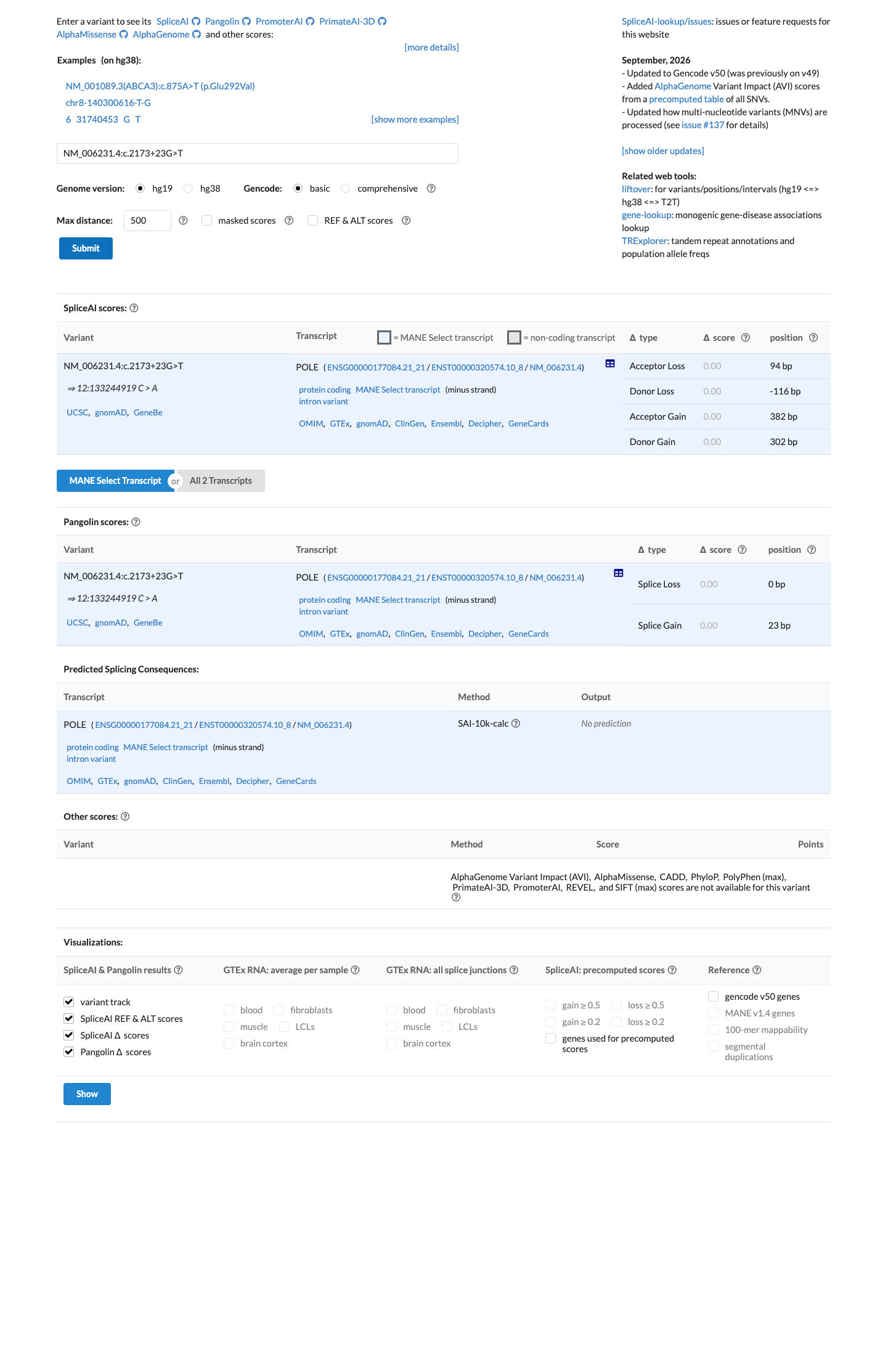
Not met: this deep-intronic substitution (23 bp into intron 19) has SpliceAI max delta 0.003, so no null consequence is predicted and PVS1 cannot be triggered.
PS2
Not assessed: no proband or parental genotype data exist in this case to establish de novo occurrence.
PS3
Not assessed: no functional or RNA assay of POLE c.2173+23G>T exists; the only splice datum is computational (SpliceAI max delta 0.003).
PS4
Not met: variant recurrence count 0 in the COSMIC/TCGA EC table vs the PS4_Supporting requirement of combined count >=10.
PM1
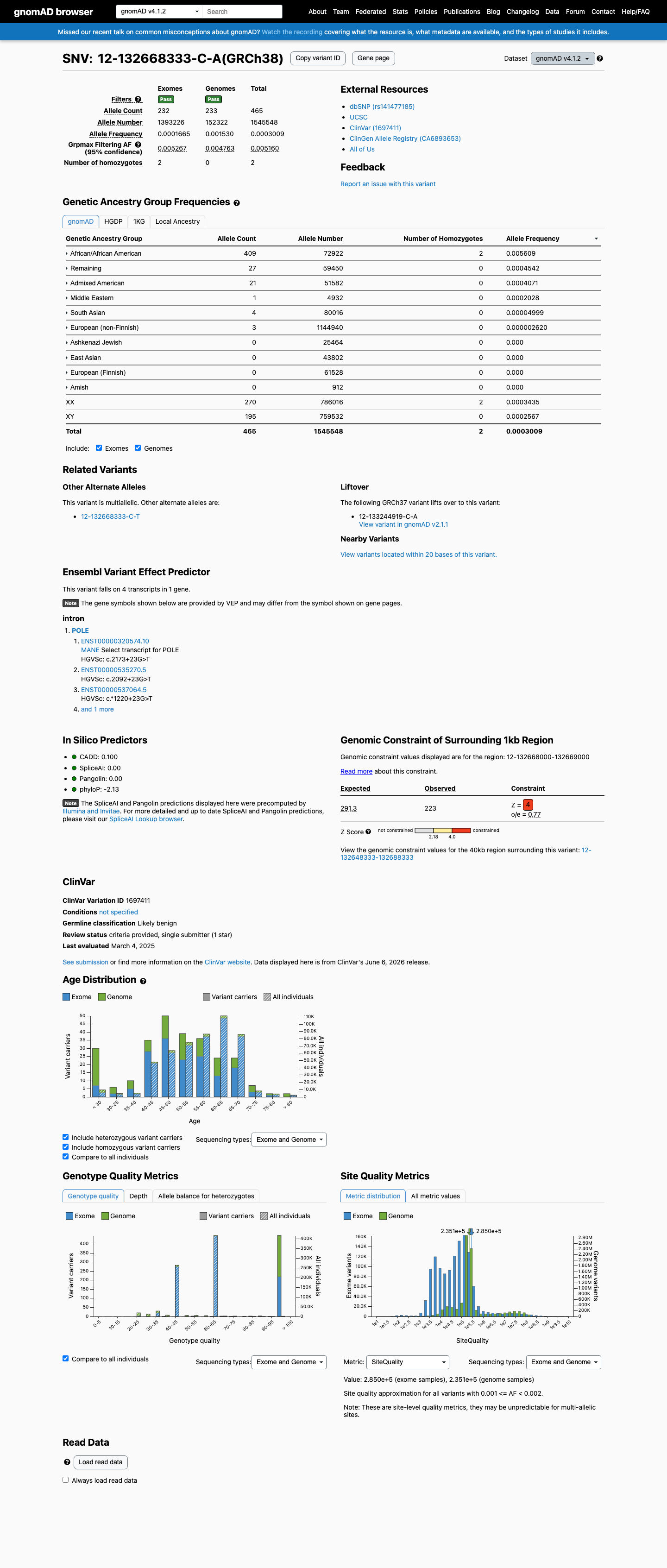
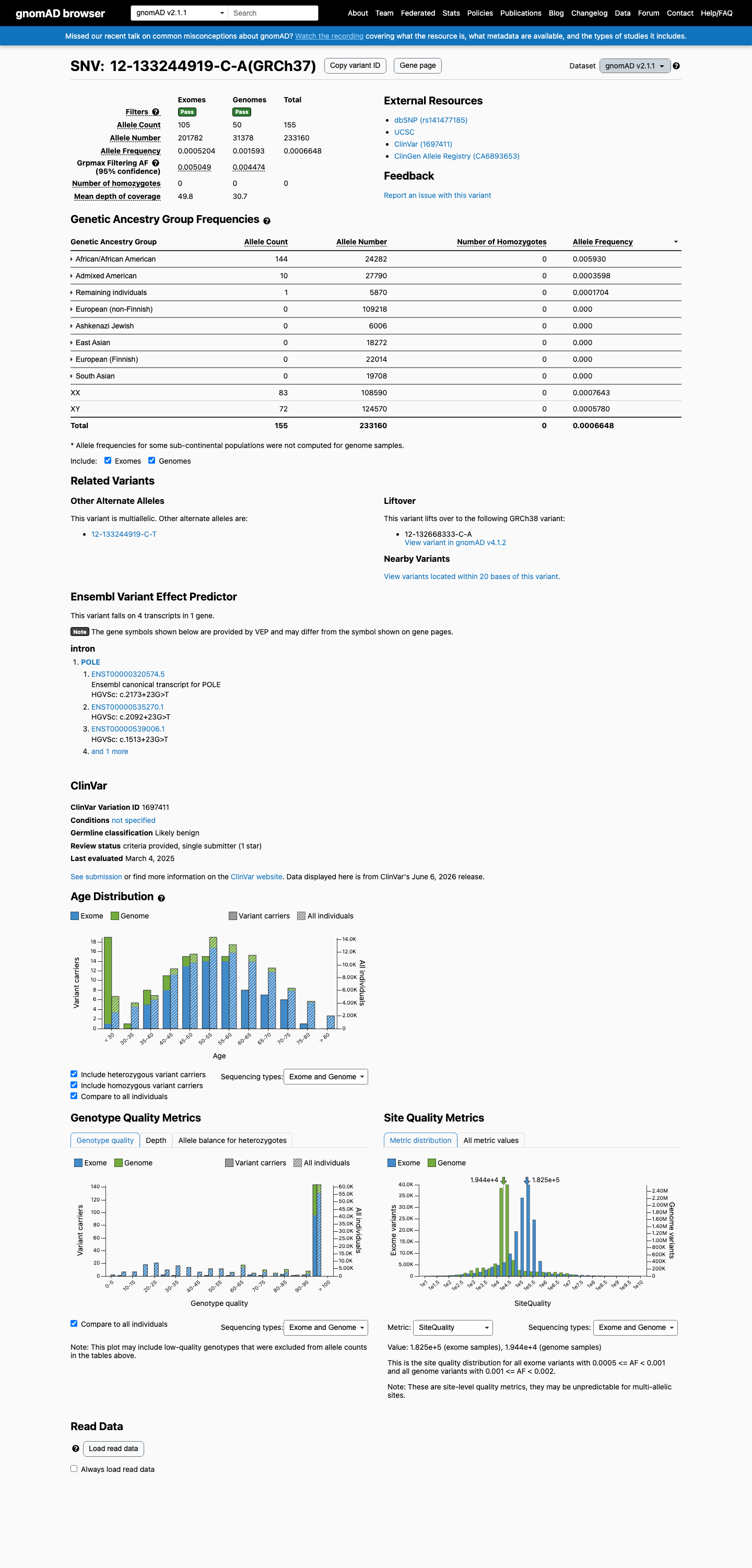
Not met: intronic c.2173+23G>T (intron 19, p.?) lies outside the POLE exonuclease domain and all framework hotspots, and is present in gnomAD at 0.066% overall.
PM2
Not met: total allele frequency 0.000665 (gnomAD v2.1, 155/233,160 alleles) exceeds the 0.0001 PM2 rarity threshold in every dataset assessed.
PM3
Not assessed: no phase, pedigree, or second-variant data exist to determine whether a pathogenic POLE allele is in trans.
PM6
Not assessed: no proband or parental testing data are available to support an assumed de novo occurrence.
PP1
Not assessed: no pedigree or relative genotype data are available to assess co-segregation.
PP3
Not met: SpliceAI max delta 0.003 for this intronic variant, far below the >=0.2 supporting PP3 threshold.
PP4
Not assessed: no proband phenotype, HPO terms, or family history anywhere in the case, so PP4's patient-specific specificity requirement cannot be evaluated.
PP5
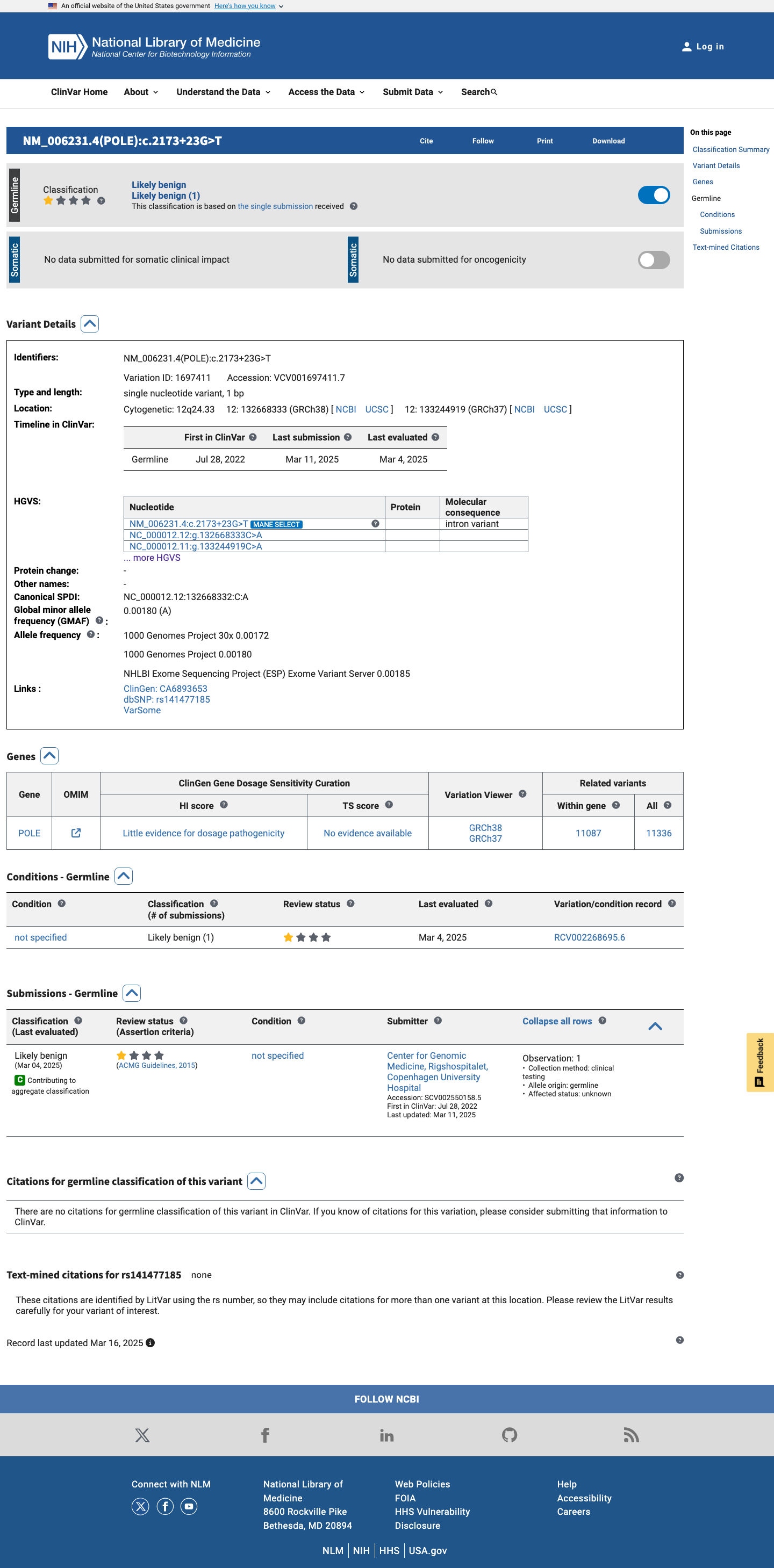
Not met: no ClinVar expert-panel assertion exists (0 expert-panel submissions); the sole record is Likely benign, single submitter.