Analysis in progress
Initialising…
0%
complete
This report is still being assembled — sections appear as each stage finishes. It isn't final yet.
POLE
Final classification
VUS
POLE c.286-8C>G · p.?
POLE

PM2 (Supporting): absent from gnomAD v2.1 and v4.1 (AF=0), consistent with a rare disease-associated allele.

Gene
POLE
Transcript
NM_006231.4
HGVS · transcript:coding
NM_006231.4:c.286-8C>G
Consequence
N/A
GRCh38
chr12:132680230 G>C
GRCh37
chr12:133256816 G>C
Basis VUS: one pathogenic-supporting criterion (PM2, absent from gnomAD) and one benign-supporting (BP4, SpliceAI 0.08) meet no qualifying ACMG combination rule.
VUS: one pathogenic-supporting criterion (PM2, absent from gnomAD) and one benign-supporting (BP4, SpliceAI 0.08) meet no qualifying ACMG combination rule.
Classification rationale
PM2 BP4 VUS
POLE c.286-8C>G

PM2 (Supporting): absent from gnomAD v2.1 and v4.1 (AF=0), consistent with a rare disease-associated allele. BP4 (Supporting): SpliceAI max delta 0.08, below the 0.1 threshold, predicts no significant splice impact. Final classification: VUS — one pathogenic-supporting and one benign-supporting criterion satisfy no qualifying ACMG combination rule.

PM2 + BP4 VUS
Gene diagram · NM_006231.4 · variants mapped to exon structure
POLE NM_006231.4
Fetching transcript structure from UCSC…
Applied criteria · 2 applied · 18 assessed
Applied · 2
Strength Supporting Moderate Strong Very strong
PM2 supporting Pathogenic
Met (supporting): absent from gnomAD v2.1 and v4.1 (AF=0), below the <0.1% ultra-rare threshold.
Absent (AF=0) in gnomAD v2.1 (GRCh37) and gnomAD v4.1 (GRCh38); AF=0 < project non-VCEP PM2 threshold of 0.1% (user profile convention).Base rule: ACMG/AMP 2015 PM2 (PMID 25741868) - absent in controls or extremely low frequency.PM2 supporting-strength calibration: Whiffin N et al., 'Using high-resolution variant frequencies to empower clinical genome interpretation', Genet Med 2017 (PMID 28518168), recommending PM2 at supporting strength for absence/ultra-rareness in population databases.
BP4 supporting Benign
Met (supporting): SpliceAI max delta 0.08, below the 0.1 threshold; no significant splice impact predicted.
SpliceAI Lookup (spliceai): max delta 0.08 (DS_AG 0.0, DS_AL 0.08, DS_DG 0.0, DS_DL 0.04) - SpliceAI predicts no significant splice impact; below the BP4 threshold.Generic in-silico operating thresholds (generic_acmg_combination_rules, source PMID 25741868): for intronic/synonymous/non-canonical-splice-position variants evaluate SpliceAI only; SpliceAI max delta <0.1 -> BP4 supporting, per SVI-recommended thresholds (Walker et al. 2023, ClinGen SVI Splicing Subgroup report, PMID 37442131). Max delta 0.08 is <0.1, so BP4 supporting is met.Custom POLE BP4 rule (final_classification_framework; vcep_path_250_323_s003 / vcep_path_250_323_s004): applies only to exact missense variants listed in Supplementary Tables S2/S3; c.286-8C>G is intronic and absent, so the framework falls back to the generic in-silico workflow.
Assessed · not applied
Pathogenic
PVS1 Not met: no null-allele effect predicted — SpliceAI max delta 0.08, below the 0.1 threshold.
PS2 Not assessed: no proband-parent trio data with confirmed parentage was available to evaluate a de novo occurrence.
PS3 Not assessed: no functional assay evidence, such as RNA or minigene studies, was available for this variant.
PS4 Not assessed: no case-control, cohort, or somatic-recurrence data existed for this variant in any source.
PM3 Not assessed: no second POLE variant or phase data was available to establish a trans configuration.
PM6 Not assessed: no de novo observation of the variant was reported in ClinVar or the literature.
PP1 Not assessed: no affected family members were tested, so no segregation data existed.
PP3 Not met: SpliceAI max delta 0.08, below the >0.2 PP3 threshold for predicted splice impact.
PP4 Not assessed: no proband phenotype or family-history information was available to judge phenotype specificity.
PP5 Not met: no expert-panel ClinVar classification exists; the only submission is a single-lab Likely benign record.
Benign
BA1 Not met: absent from gnomAD (AF=0), far below the >1% BA1 population-frequency threshold.
BS1 Not met: allele frequency 0, below the >0.3% threshold; no excess carrier frequency observed.
BS2 Not met: no carriers observed in healthy individuals (AF=0); BS2 requires positive observation of the variant.
BS3 Not assessed: no well-established functional assay, such as an RNA splicing study, demonstrating normal function.
BS4 Not assessed: no family-testing data existed to observe a non-segregation event.
BP2 Not assessed: no second POLE variant was observed, so no cis/trans configuration could be evaluated.
BP5 Not assessed: no proband data on an alternate molecular basis for disease was available.
BP6 Not met: no expert-panel ClinVar classification exists; the single-lab Likely benign label does not qualify.
N/A · 8 PS1 · PM1 · PM4 · PM5 · PP2 · BP1 · BP3 · BP7
Research & evidence
Population frequency
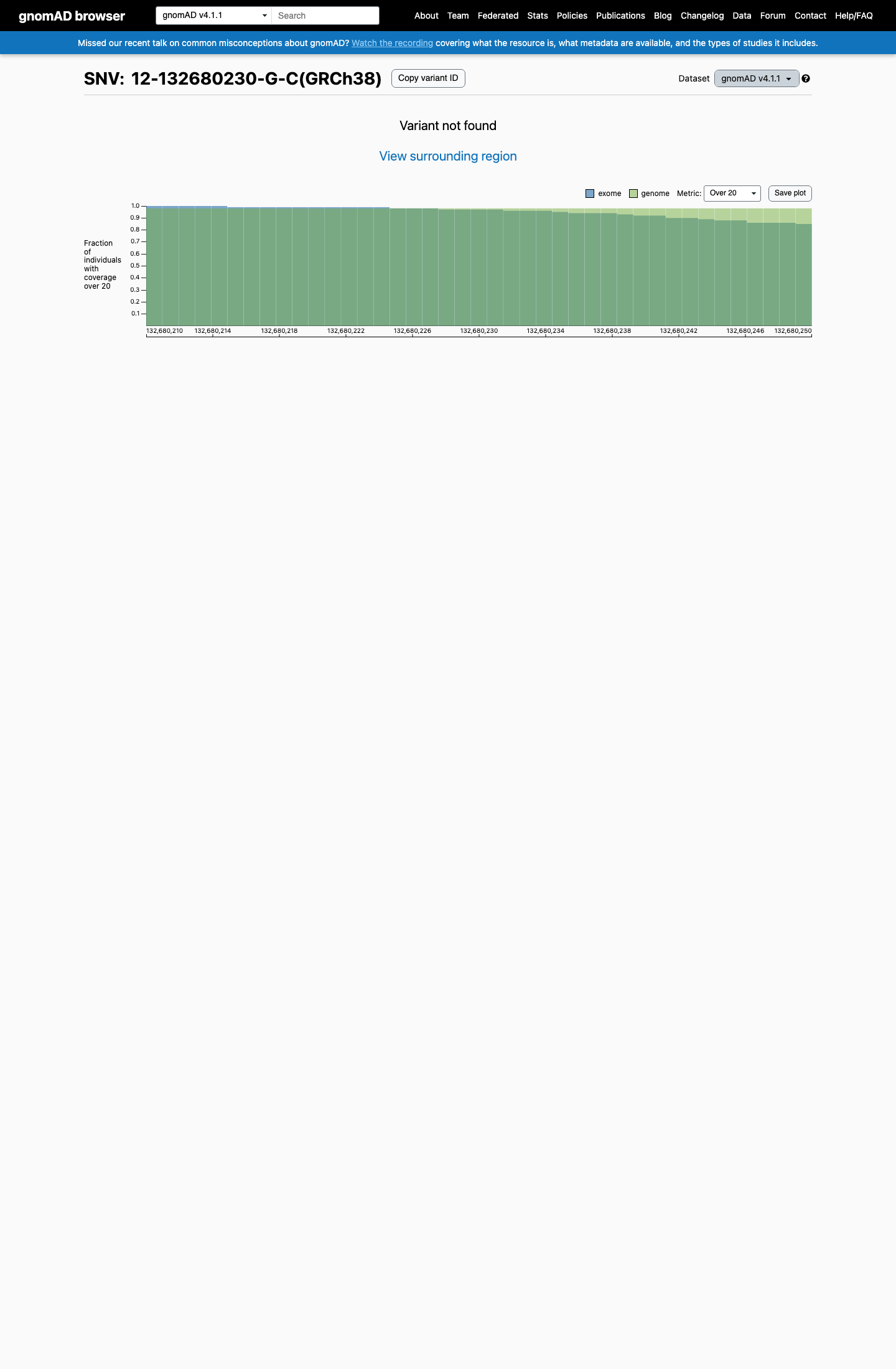
gnomAD v4.1 screenshot
gnomAD v4.1
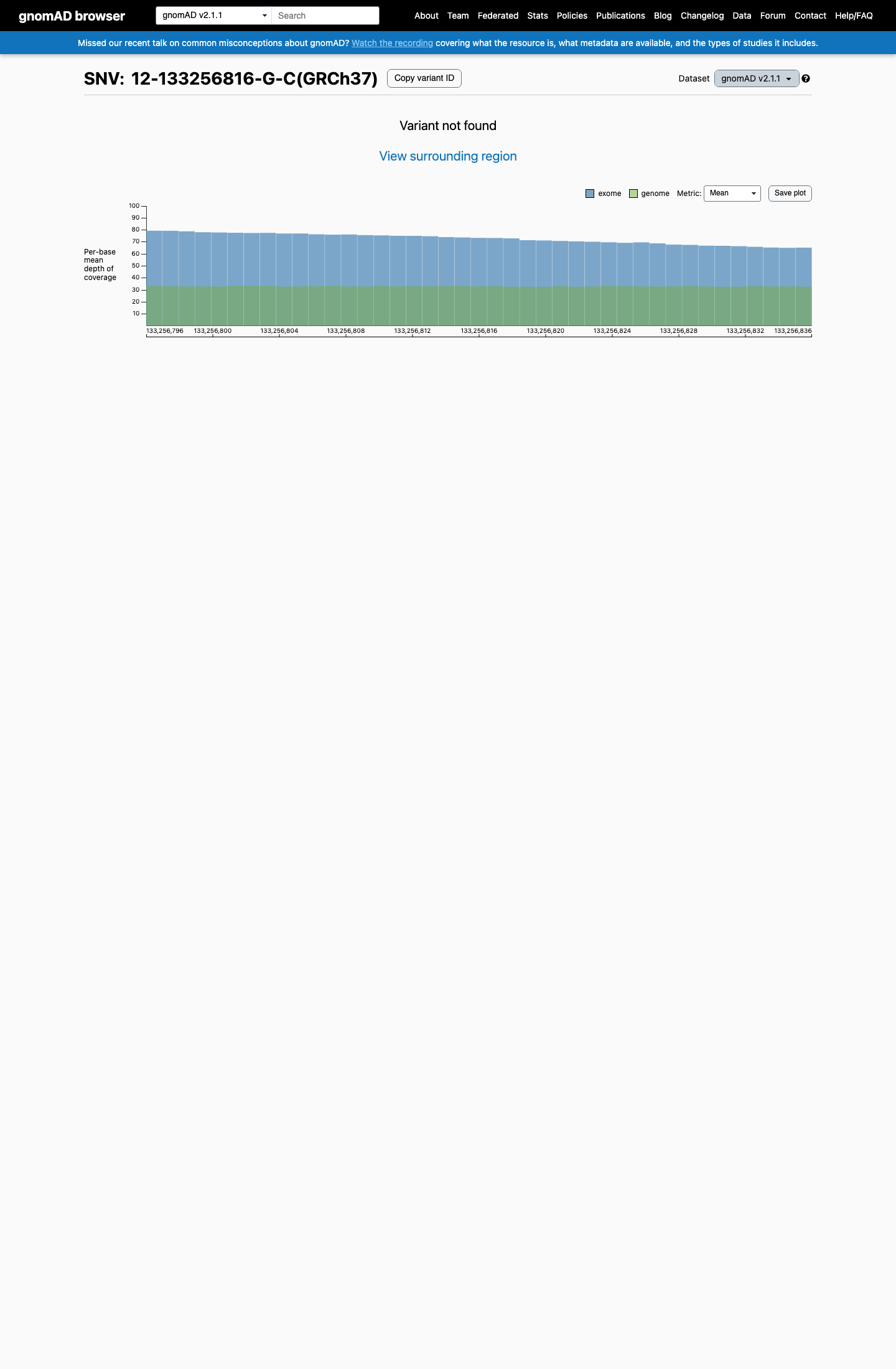
gnomAD v2.1 screenshot
gnomAD v2.1
v4.1
Absent from gnomAD v4.1.
v2.1
Absent from gnomAD v2.1.
🇨🇦 CA
Not available in gnomAD-Canada v1.0.
Allele frequency by ancestry
three datasets · side by side
gnomAD v4.1
Absent · 0 / ?
0 hom
Not observed in any ancestry group.
gnomAD v2.1
Absent · 0 / ?
0 hom
Not observed in any ancestry group.
gnomAD Canada 🇨🇦
Absent · 0 / ?
0 hom
Not observed in any ancestry group.
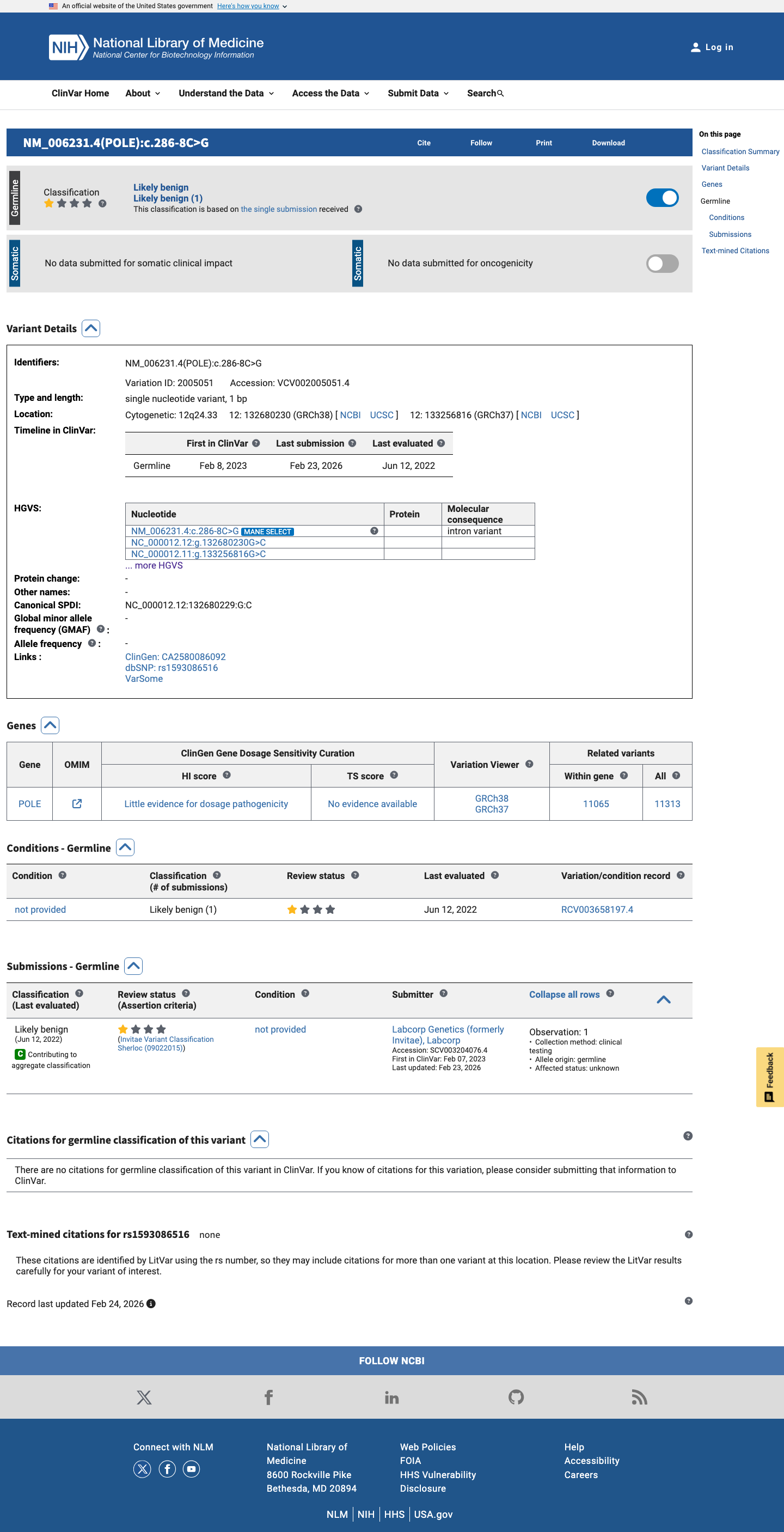
ClinVar screenshot
ClinVar
This variant has been reported in ClinVar as Likely benign (1 clinical laboratory). (ClinVarID = 2005051)
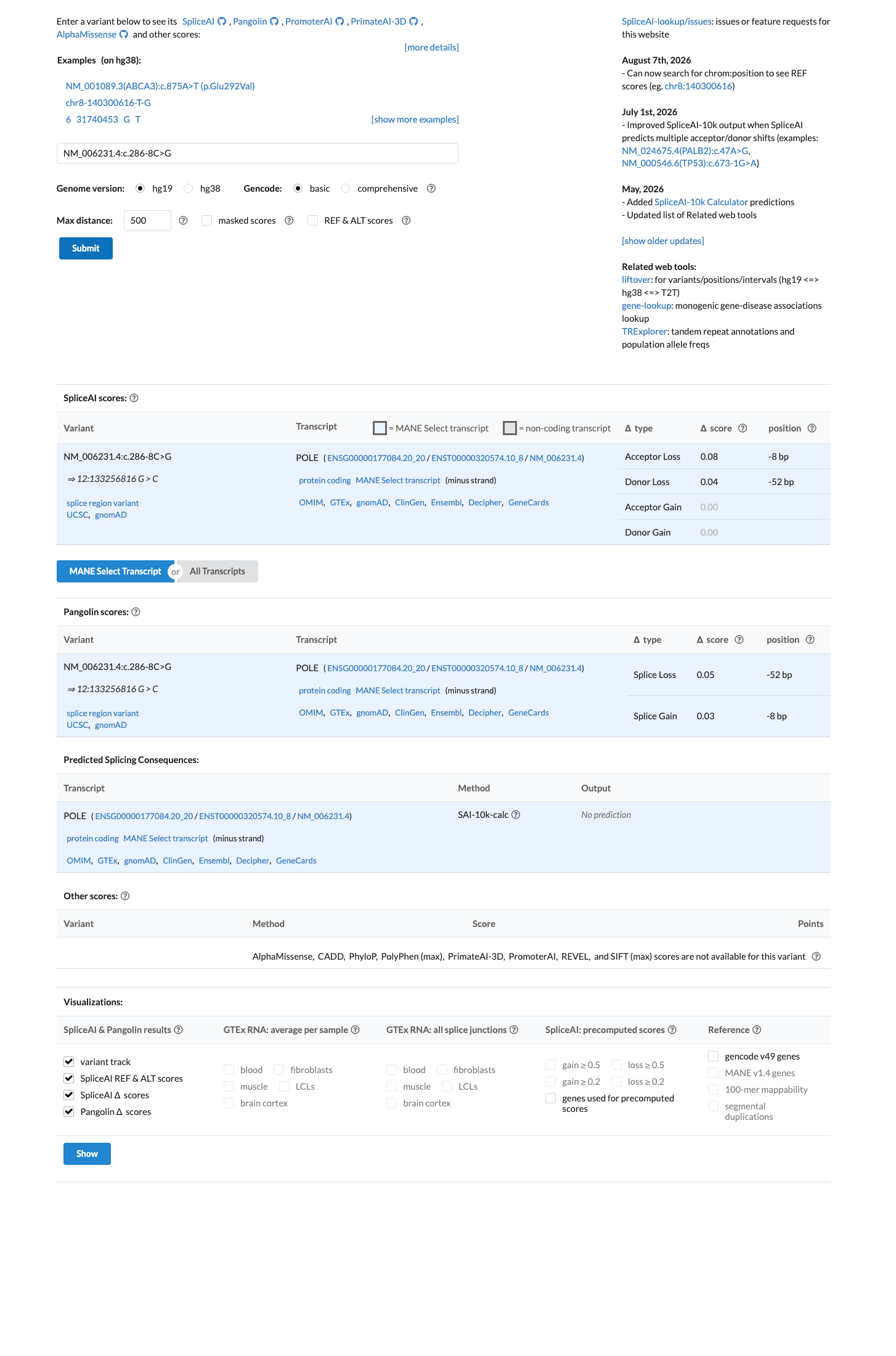
SpliceAI screenshot
In silico
SpliceAI predicts no significant splice impact for this variant (max delta score = 0.08).
Functional No data
No calibrated functional assay or RNA evidence was identified for this variant.
OncoKB ↗
COSMIC screenshot
COSMIC
Somatic evidence
COSMIC
This variant has not previously been reported in somatic cancers (COSMIC).
Hotspots
This variant does not lie in a statistically significant cancer hotspot.
COSMIC ↗
Literature · how each cited paper was used
1papers cited
Each card is an audit: what was searched, what was found, whether it names the variant, which criteria it fed, and why.
Rule & framework references · cited for criterion definitions, not variant evidence
28492532 ↗ Sherloc: a comprehensive refinement of the ACMG-AMP variant classification criteria.
Sources & reference links
7Sources
ClinVar
gnomAD v2.1
gnomAD v4.1
gnomAD-Canada
SpliceAI
OncoKB
COSMIC