León-Castillo et al. 2020 custom POLE framework · vleon-castillo-2020-custom-framework-v1
0%
complete
Re-run interpretation
Re-run this variant?
This variant was interpreted by pipeline
7.1.0.
The current version is
8.0.0.
Re-running queues a fresh interpretation; the result replaces this page when complete.
Re-runs are not free. Blank = draws on today's public interpretation allowance.
With a code = uses 1 of that code's uses.
POLE encodes the catalytic subunit of DNA polymerase epsilon, the enzyme that replicates the leading strand of DNA during cell division and participates in DNA repair. It contains a proofreading domain that corrects replication errors, keeping the accumulation of mutations in check. Germline mutations in POLE cause polyposis and predispose to colorectal cancer, and are also linked to a rare syndrome of facial dysmorphism, immunodeficiency, livedo, and short stature. Somatic mutations, particularly in the proofreading domain, occur in colorectal and endometrial cancers, where they drive an ultra-mutated tumor phenotype and are associated with better responses to immune checkpoint inhibitors.
This variant
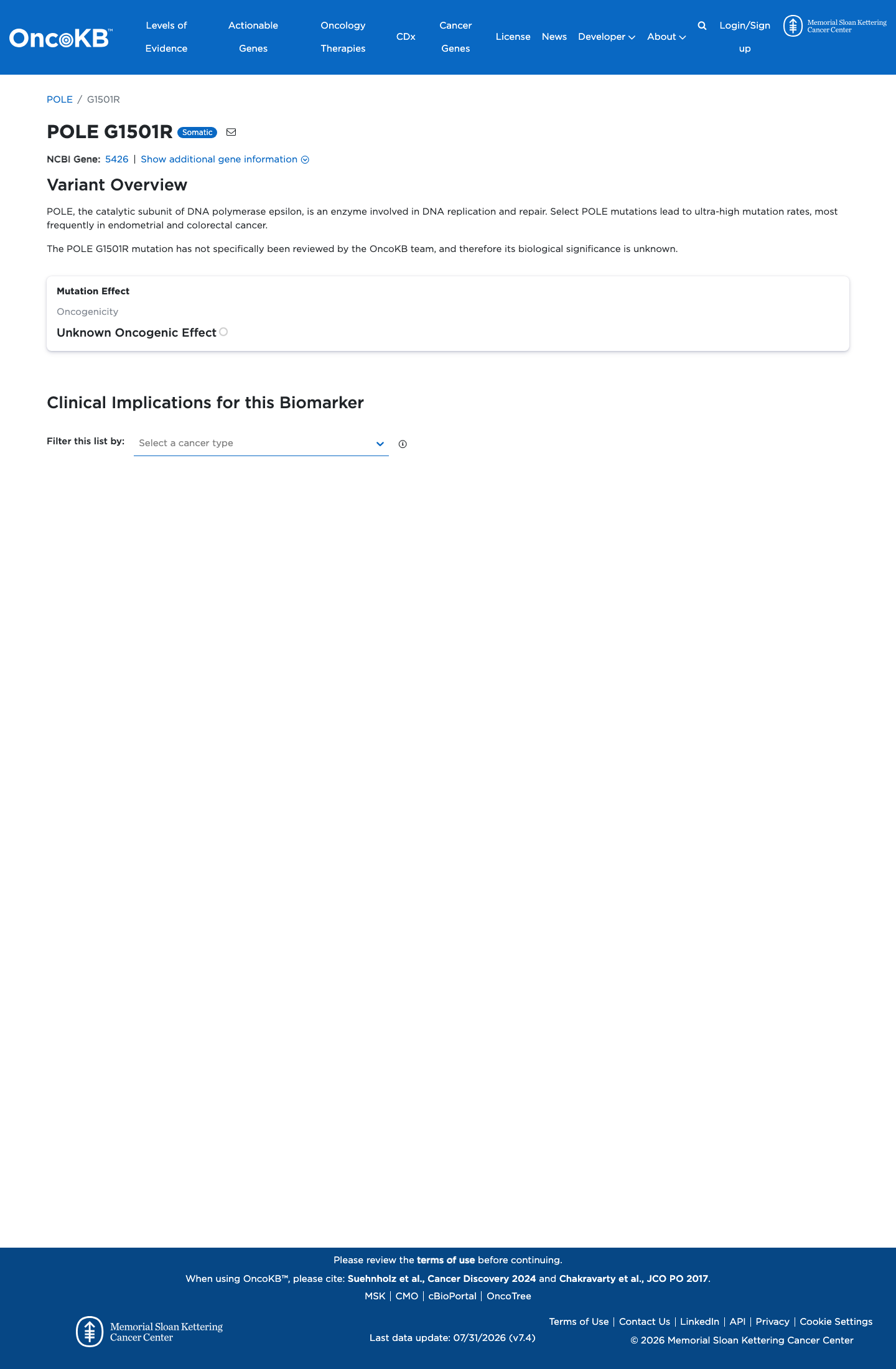
POLE disease relevance centers on pathogenic missense mutations in its exonuclease (proofreading) domain, which drive an ultra-mutated tumor phenotype; p.Gly1501Arg lies in the C-terminal polymerase region, outside that domain. With only ultra-rare population frequency supporting it and no pathogenic or benign evidence, this variant remains an Uncertain Significance (VUS): current evidence cannot establish whether it alters POLE function or cancer risk.
Transcript
NM_006231.4
HGVS · transcript:coding
NM_006231.4:c.4501G>A
GRCh38
chr12:132643274 C>T
GRCh37
chr12:133219860 C>T
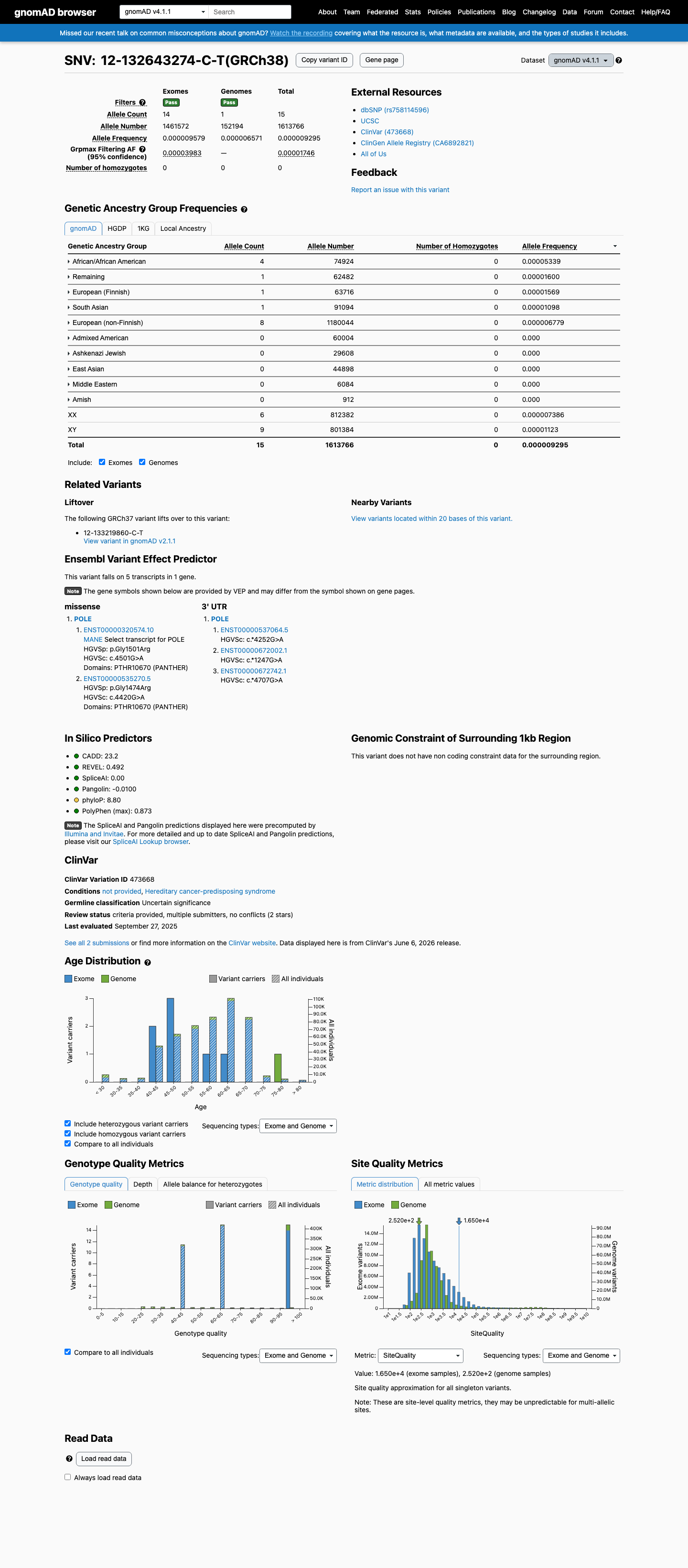
VUS: the only met criterion is PM2_Supporting (gnomAD v4.1 total AF 9.3e-06, 0 homozygotes), which alone satisfies no ACMG/AMP 2015 combination rule.
Classification rationale
PM2VUS
POLE c.4501G>Amissense
PM2 (Supporting): ultra-rare population frequency — gnomAD v4.1 total AF 9.3e-06 with 0 homozygotes, far below the 0.1% cap. Final classification: Uncertain Significance (VUS) — the single PM2_Supporting criterion satisfies no pathogenic or benign combination rule under ACMG/AMP 2015.
PM2→VUS
LYFE Sciences is an AI system, and it can make mistakes. Criteria
may be applied incorrectly, sources may be misread, and a confident-looking
classification can still be wrong. Double-check every criterion and
its underlying evidence before relying on any call.
Gene diagram
· NM_006231.4 · variants mapped to exon structure
POLENM_006231.4
Fetching transcript structure from UCSC…
Exons
—
Transcript span
—
Strand
—
Variants mapped
—
Source
UCSC ncbiRefSeqCurated
All variants in POLE—click a row to locate it on the plot · use the link column to open its page
Protein
Location
Classification
Link
Applied criteria · 1 applied · 23 assessed
MetEvidence satisfies this criterion.
Not metEvaluated against available evidence; threshold not reached.
Not assessedApplies in principle, but no evidence was found to evaluate it.
N/ADoesn't apply to this variant type.
Applied · 1
Strength Supporting Moderate Strong Very strong
✓
PM2supportingPathogenic
Met (Supporting): gnomAD v4.1 total allele frequency 9.3e-06, far below the 0.1% PM2 cap, with zero homozygotes.
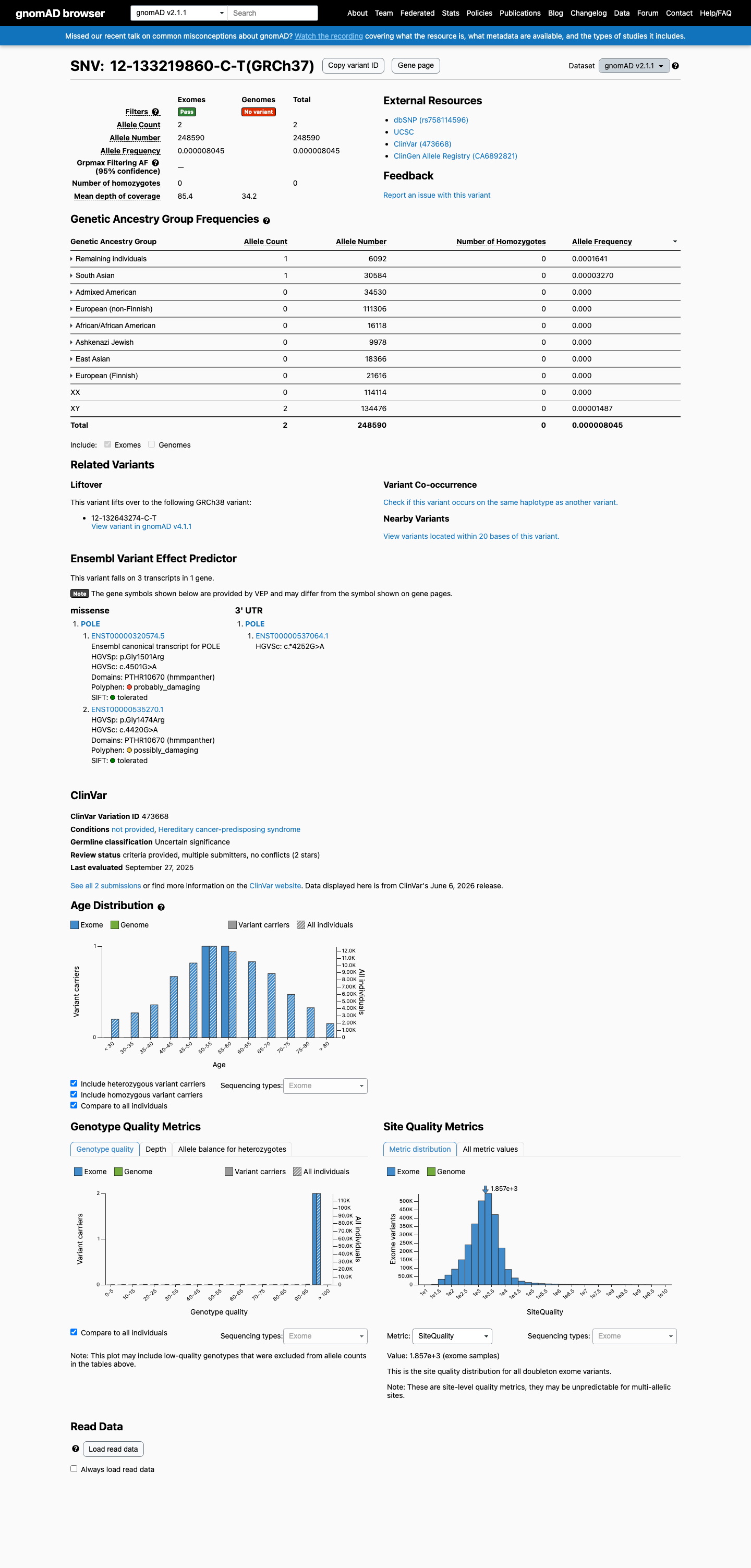
gnomAD v4.1 (gnomad_v4): total AF 9.295e-06 (0.00093%), 15/1,613,766 alleles, 0 homozygotes; AFR subpopulation AF 5.339e-05 (0.00534%); joint grpmax FAF 1.746e-05 - all far below 0.1% PM2 capgnomAD v2.1 (gnomad_v2): total AF 8.045e-06 (0.00080%), 2/248,590 alleles, 0 homozygotesgnomAD-Canada v1.0 (gnomad_canada): variant absent
Assessed · not applied
· 11 not met · 12 not assessed
Pathogenic
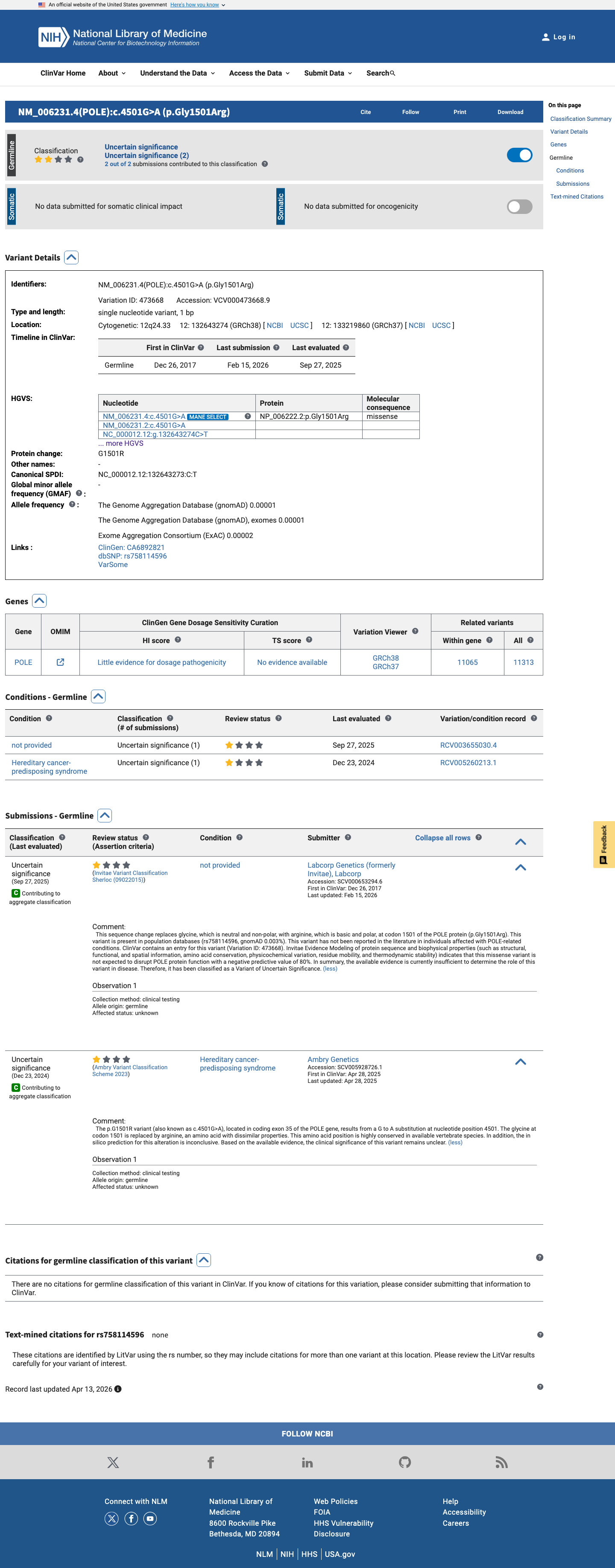
PS1Not met: no pathogenic record of p.Gly1501Arg via a different nucleotide change exists; ClinVar classifies this variant as Uncertain significance.
PS2Not assessed: no de novo occurrence of this variant in a tested proband is documented in any source.
PS3Not assessed: no variant-specific functional study of p.Gly1501Arg exists; OncoKB reports no functional evidence.
PS4Not met: the variant is absent from the Leon-Castillo recurrent-variant table and COSMIC, failing the somatic-recurrence rule.
PM1Not met: residue 1501 lies outside the exonuclease proofreading domain (residues 286-459) containing all established hotspots.
PM3Not assessed: no proband genotyping or phase data exist to test for a variant in trans with a pathogenic allele.
PM5Not assessed: no pathogenic comparator at residue 1501 was found, though its absence is not comprehensively confirmed.
PM6Not assessed: no de novo occurrence is documented with or without parentage confirmation.
PP1Not assessed: no segregation or family-testing data document any informative meiosis.
PP2Not assessed: no gene-level missense constraint data (e.g., gnomAD Z-score) are available to evaluate this rule.
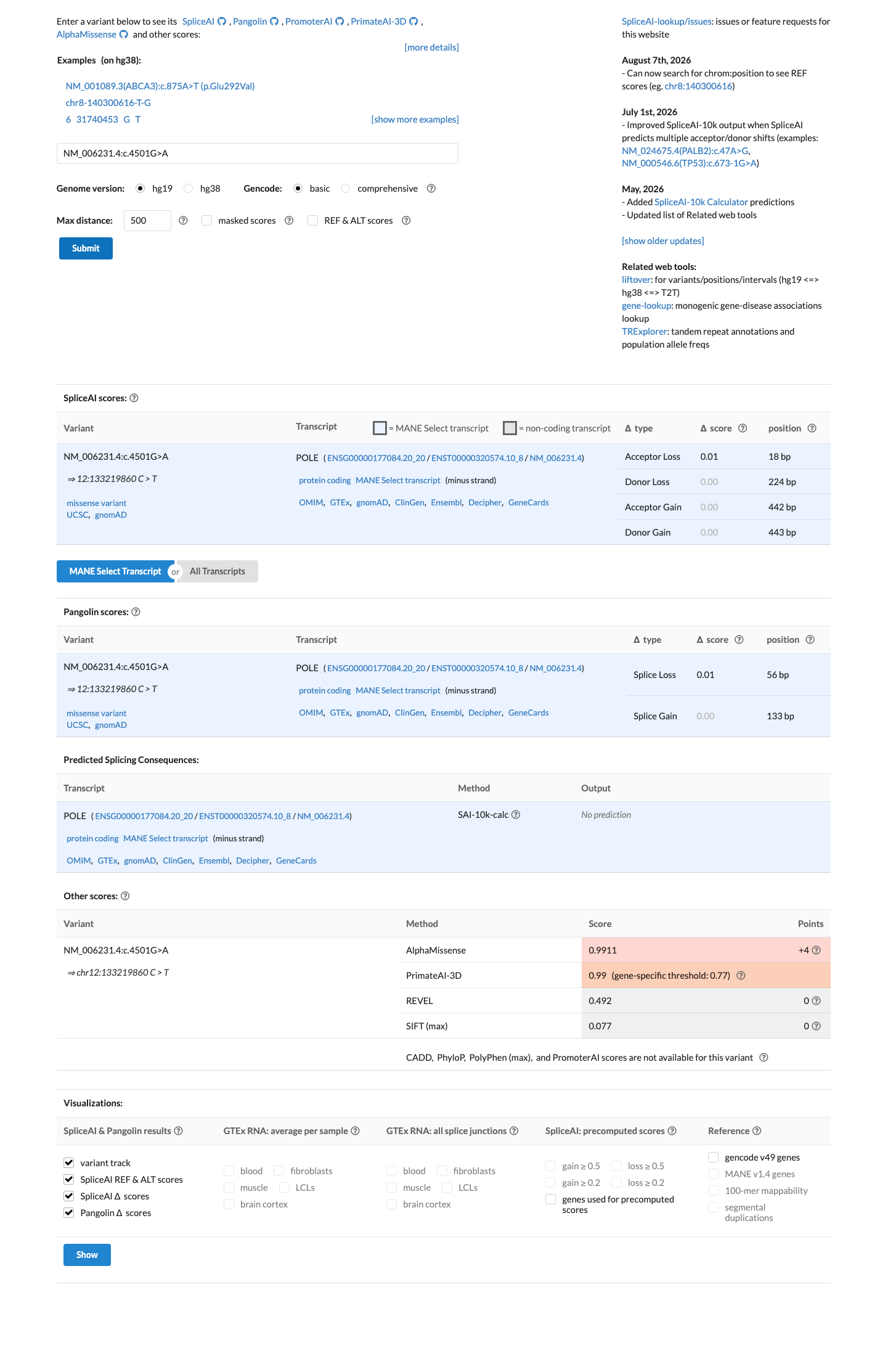
PP3Not met: REVEL 0.492 falls below the supporting threshold of 0.644, and SpliceAI max delta 0.01 shows no splice impact.
PP4Not assessed: no phenotype or family-history data for any carrier are available.
PP5Not met: ClinVar classifies this variant as Uncertain significance with no expert-panel submission.
Benign
BA1Not met: highest observed allele frequency 0.00534% is roughly 300-fold below the 5% BA1 threshold.
BS1Not met: gnomAD v4.1 frequency 0.00093% is about 1,000-fold below the 1% threshold and 60-100x below the 0.3% convention.
BS2Not met: zero homozygotes in gnomAD v2.1 and v4.1, and reference cohorts are not cancer-screened.
BS3Not assessed: no well-established functional study shows a lack of damaging effect for p.Gly1501Arg.
BS4Not assessed: no affected relative has been tested and shown not to carry the variant.
BP1Not met: missense in the POLE exonuclease domain is an established disease mechanism, not primarily truncating variants.
BP2Not assessed: no second POLE variant or phase data exist to establish cis/trans configuration.
BP4Not met: REVEL 0.492 is far above the benign supporting threshold of 0.016.
BP5Not assessed: no case-level information documents an alternate molecular basis in a carrier.
BP6Not met: ClinVar classifies this variant as Uncertain significance with no expert-panel benign classification.
N/A · 4PVS1 · PM4 · BP3 · BP7
Research & evidence
Population frequency
gnomAD v4.1
gnomAD v2.1
v4.1
This variant is present in gnomAD v4.1 (AF= 9.29503e-06; MAF= 0.00093%, 15/1613766 alleles, homozygotes = 0) and has highest observed frequency in the African/African American population (AF= 5.33874e-05; MAF= 0.00534%, 4/74924 alleles, homozygotes = 0); grpmax FAF= 1.746e-05.
v2.1
This variant is present in gnomAD v2.1 (AF= 8.04538e-06; MAF= 0.00080%, 2/248590 alleles, homozygotes = 0) and has highest observed frequency in the Remaining individuals population (AF= 0.00016415; MAF= 0.01641%, 1/6092 alleles, homozygotes = 0).
🇨🇦 CA
Absent from gnomAD-Canada v1.0.
Allele frequency by ancestry
three datasets · side by side
gnomAD v4.1
0.00093%
· 15 / 1,613,766
0 hom · FAF 0.0017%
African/African American
4 / 74,924
0.0053%
Remaining individuals
1 / 62,482
0.0016%
European (Finnish)
1 / 63,716
0.0016%
South Asian
1 / 91,094
0.0011%
European (non-Finnish)
8 / 1,180,044
0.00068%
+ 5 not observed (Admixed American, Amish, East Asian, Middle Eastern, Ashkenazi Jewish)
gnomAD v2.1
0.0008%
· 2 / 248,590
0 hom
Remaining individuals
1 / 6,092
0.016%
South Asian
1 / 30,584
0.0033%
+ 6 not observed (African/African American, Admixed American, Ashkenazi Jewish, East Asian, European (Finnish), European (non-Finnish))
OncoKB did not identify variant-specific reviewed functional evidence for this variant; gene-level curated context is available for reviewer follow-up. POLE, the catalytic subunit of DNA polymerase epsilon, is an enzyme involved in DNA replication and repair. Select POLE mutations lead to ultra-high m
Triaged references · 1 PMID not cited in assessment
25394175 ↗A practice guideline from the American College of Medical Genetics and Genomics and the National Society of Genetic Counselors: referral indications for cancer predisposition assessment.CLINVAR