Analysis in progress
Initialising…
0%
complete
This report is still being assembled — sections appear as each stage finishes. It isn't final yet.
POLE
Final classification
VUS
PM2BP4
POLE
c.5066C>T
p.Thr1689Ile
missense · exon 38

POLE encodes the catalytic subunit of DNA polymerase epsilon, the enzyme that replicates the leading strand of DNA during cell division and participates in DNA repair. It contains a proofreading domain that corrects replication errors, keeping the accumulation of mutations in check. Germline mutations in POLE cause polyposis and predispose to colorectal cancer, and are also linked to a rare syndrome of facial dysmorphism, immunodeficiency, livedo, and short stature. Somatic mutations, particularly in the proofreading domain, occur in colorectal and endometrial cancers, where they drive an ultra-mutated tumor phenotype and are associated with better responses to immune checkpoint inhibitors.

This variant

Germline POLE variants predispose to polyposis and colorectal cancer, but p.Thr1689Ile lies outside the exonuclease-domain hotspot residues that drive disease and is absent from population databases. With only PM2_Supporting and BP4_Supporting met, it remains a variant of uncertain significance, not evidence of POLE-related cancer risk.

Transcript
NM_006231.4
HGVS · transcript:coding
NM_006231.4:c.5066C>T
GRCh38
chr12:132642284 G>A
GRCh37
chr12:133218870 G>A
Basis VUS: under the primary local POLE framework (Leon-Castillo et al. 2020), only PM2_Supporting (pathogenic) and BP4_Supporting (benign) are met; this mixed combination satisfies no pathogenic or benign rule.
VUS: under the primary local POLE framework (Leon-Castillo et al. 2020), only PM2_Supporting (pathogenic) and BP4_Supporting (benign) are met; this mixed combination satisfies no pathogenic or benign rule.
Classification rationale
PM2 BP4 VUS
POLE c.5066C>T missense · exon 38

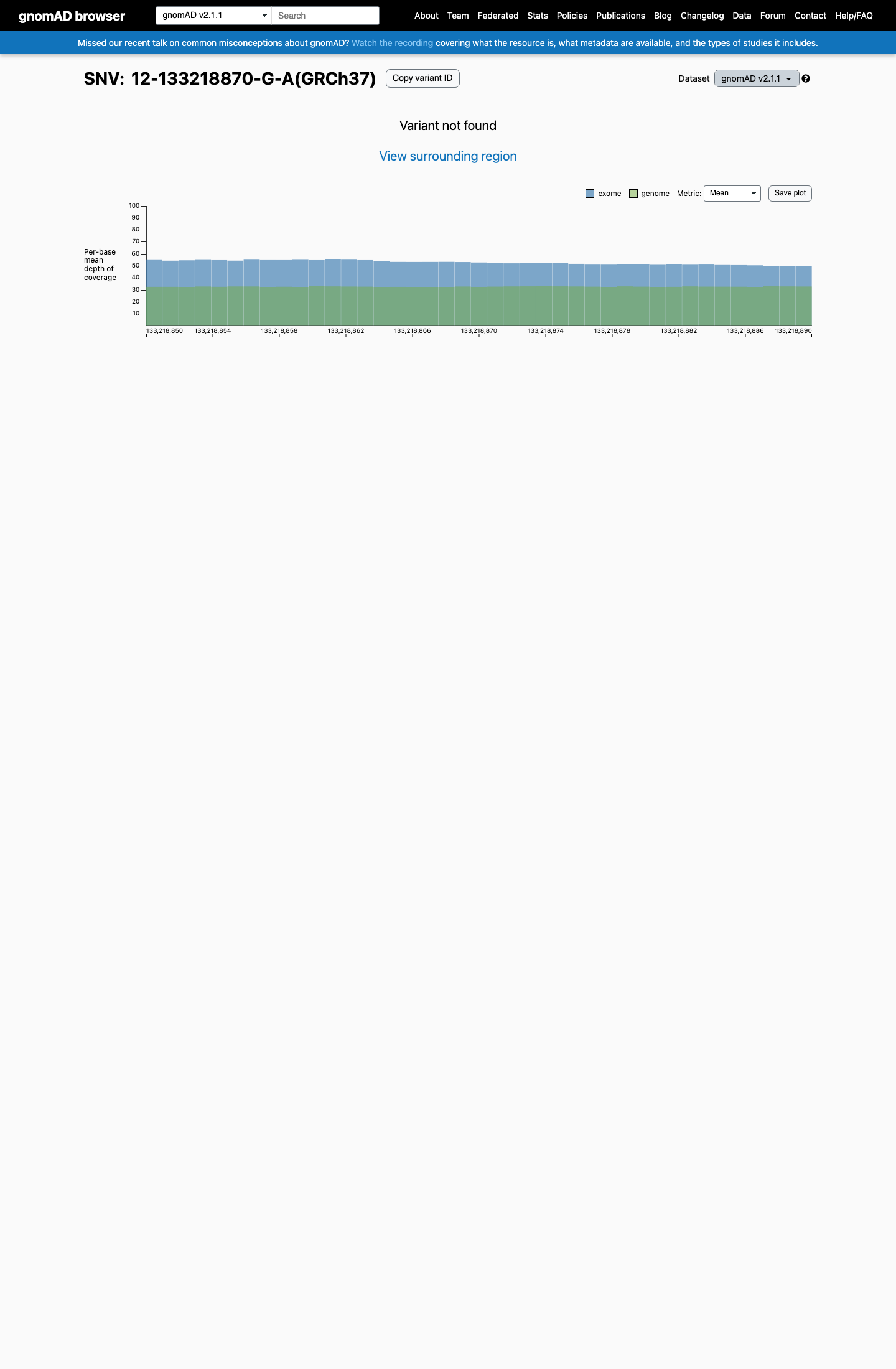
PM2 (Supporting): absent from gnomAD v2.1, v4.1 (0 of 1,608,632 alleles), and gnomAD-Canada v1.0. BP4 (Supporting): REVEL score 0.178 is below the 0.250 benign threshold. VUS: PM2_Supporting plus BP4_Supporting meets no pathogenic or benign combination rule under the local POLE framework.

PM2 + BP4 VUS
Gene diagram · NM_006231.4 · variants mapped to exon structure
POLE NM_006231.4
Fetching transcript structure from UCSC…
Applied criteria · 2 applied · 25 assessed
MetEvidence satisfies this criterion.
Not metEvaluated against available evidence; threshold not reached.
Not assessedApplies in principle, but no evidence was found to evaluate it.
N/ADoesn't apply to this variant type.
Applied · 2
Strength Supporting Moderate Strong Very strong
PM2 supporting Pathogenic
Met (Supporting): absent from gnomAD v2.1 and v4.1 (allele count 0 of 1,608,632, AF 0.0) and from gnomAD-Canada v1.0.
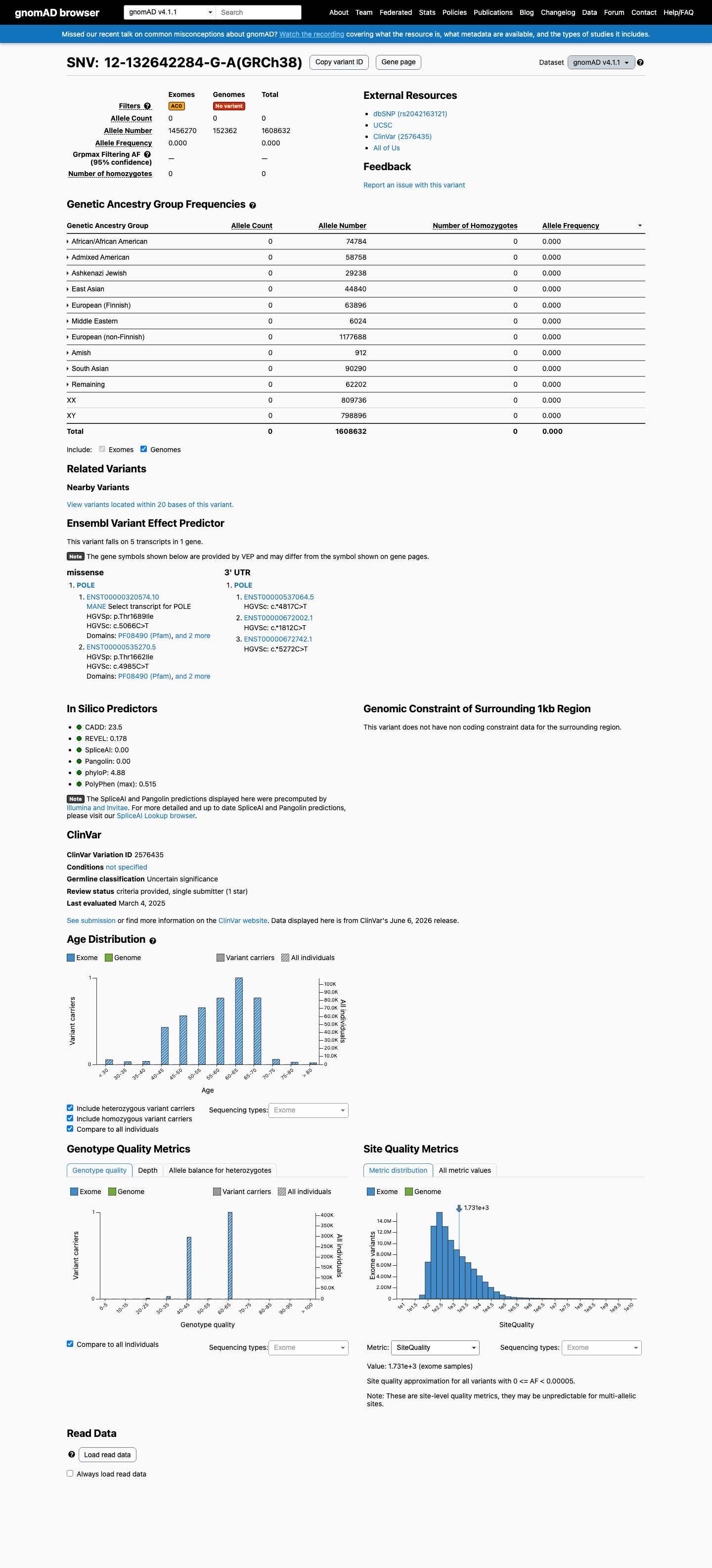
gnomAD v4.1: exact variant 12-132642284-G-A; total AC 0, total AN 1,608,632, AF 0.0, homozygotes 0; the highest-observed listed subpopulation is AFR with AC 0/AN 74,784 and AF 0.0.gnomAD v2.1 reports the exact variant as absent.gnomAD-Canada v1.0 reports the exact variant as absent.
BP4 supporting Benign
Met (Supporting): REVEL score 0.178 is below the 0.250 BP4 threshold.
The POLE local BP4 rule requires an exact Supplementary Table S2 or S3 entry classified as 'Likely benign' or 'Likely-benign' with at least four benign in silico results; p.Thr1689Ile is not listed in either table, so the framework directs generic fallback.The generic missense fallback assigns BP4_Supporting for REVEL <0.250; the observed REVEL score is 0.178. The use of calibrated REVEL computational thresholds is supported by Pejaver et al. (PMID:36413997).BayesDel score -0.338929 was not used because no verified published BayesDel threshold is available for this pipeline.
Assessed · not applied · 11 not met · 14 not assessed
Pathogenic
PVS1 Not met: this is a missense substitution, p.(Thr1689Ile), not a predicted null (nonsense, frameshift, or splice-site) variant.
PS1 Not assessed: no verified pathogenic variant producing the same p.Thr1689Ile change was available; ClinVar's sole submission is uncertain significance.
PS2 Not assessed: no de novo assertion, parental genotypes, or maternity/paternity confirmation was documented.
PS3 Not assessed: no variant-specific validated functional assay result for p.Thr1689Ile was available.
PS4 Not met: p.Thr1689Ile is not among the four exonuclease-domain variants the POLE framework qualifies for PS4, and no COSMIC record exists.
PM1 Not met: p.Thr1689Ile is not a listed exonuclease-domain hotspot, and no statistically significant hotspot at Thr1689 was reported.
PM3 Not assessed: no confirmed in-trans pathogenic comparator, phase information, or biallelic disease evidence was available.
PM4 Not met: a single amino-acid substitution with no in-frame insertion/deletion or protein-length alteration.
PM5 Not assessed: no verified same-residue comparator variant at Thr1689 was identified.
PM6 Not assessed: no de novo observation with confirmed maternity and paternity was documented.
PP1 Not assessed: no segregation data, informative meioses, or relative genotype information was available.
PP2 Not assessed: no POLE-specific data showing pathogenic missense predominates with a low benign missense rate.
PP3 Not met: REVEL score 0.178 is below the PP3 threshold and instead meets BP4.
PP4 Not assessed: no proband or tumor phenotype indicating a POLE-related disorder was supplied.
PP5 Not met: ClinVar has only one uncertain-significance submission and no expert-panel pathogenic assertion for this exact variant.
Benign
BA1 Not met: gnomAD v4.1 allele frequency is 0.00000% versus the >5% stand-alone benign threshold.
BS1 Not met: absent from all gnomAD datasets, with no allele frequency above the maximum credible population frequency.
BS2 Not met: no healthy adult carriers documented; gnomAD reports 0 homozygotes.
BS3 Not assessed: no validated benign functional assay evidence for p.Thr1689Ile was available.
BS4 Not assessed: no unaffected relatives tested or informative non-segregation analysis documented.
BP1 Not assessed: no POLE-specific rule establishing that missense variants are generally tolerated.
BP2 Not assessed: no in-trans observation with a pathogenic variant or phase information was available.
BP3 Not met: missense substitution produces no in-frame protein-length change.
BP5 Not assessed: no individual phenotype or alternate molecular diagnosis was supplied.
BP6 Not met: no ClinVar expert-panel benign assertion exists; the sole submission is uncertain significance.
N/A · 1 BP7
Research & evidence
Population frequency
gnomAD v4.1 screenshot
gnomAD v4.1
gnomAD v2.1 screenshot
gnomAD v2.1
v4.1
This variant is present in gnomAD v4.1 (AF= 0; MAF= 0.00000%, 0/1608632 alleles, homozygotes = 0) and has highest observed frequency in the African/African American population (AF= 0; MAF= 0.00000%, 0/74784 alleles, homozygotes = 0).
v2.1
Absent from gnomAD v2.1.
🇨🇦 CA
Absent from gnomAD-Canada v1.0.
Allele frequency by ancestry
three datasets · side by side
gnomAD v4.1
Absent · 0 / 1,608,632
0 hom
Not observed in any ancestry group.
+ 10 not observed (Remaining individuals, Admixed American, European (Finnish), Amish, East Asian, Middle Eastern, South Asian, Ashkenazi Jewish, African/African American, European (non-Finnish))
gnomAD v2.1
Absent · 0 / ?
0 hom
Not observed in any ancestry group.
gnomAD Canada 🇨🇦
Absent · 0 / ?
0 hom
Not observed in any ancestry group.
ClinVar screenshot
ClinVar
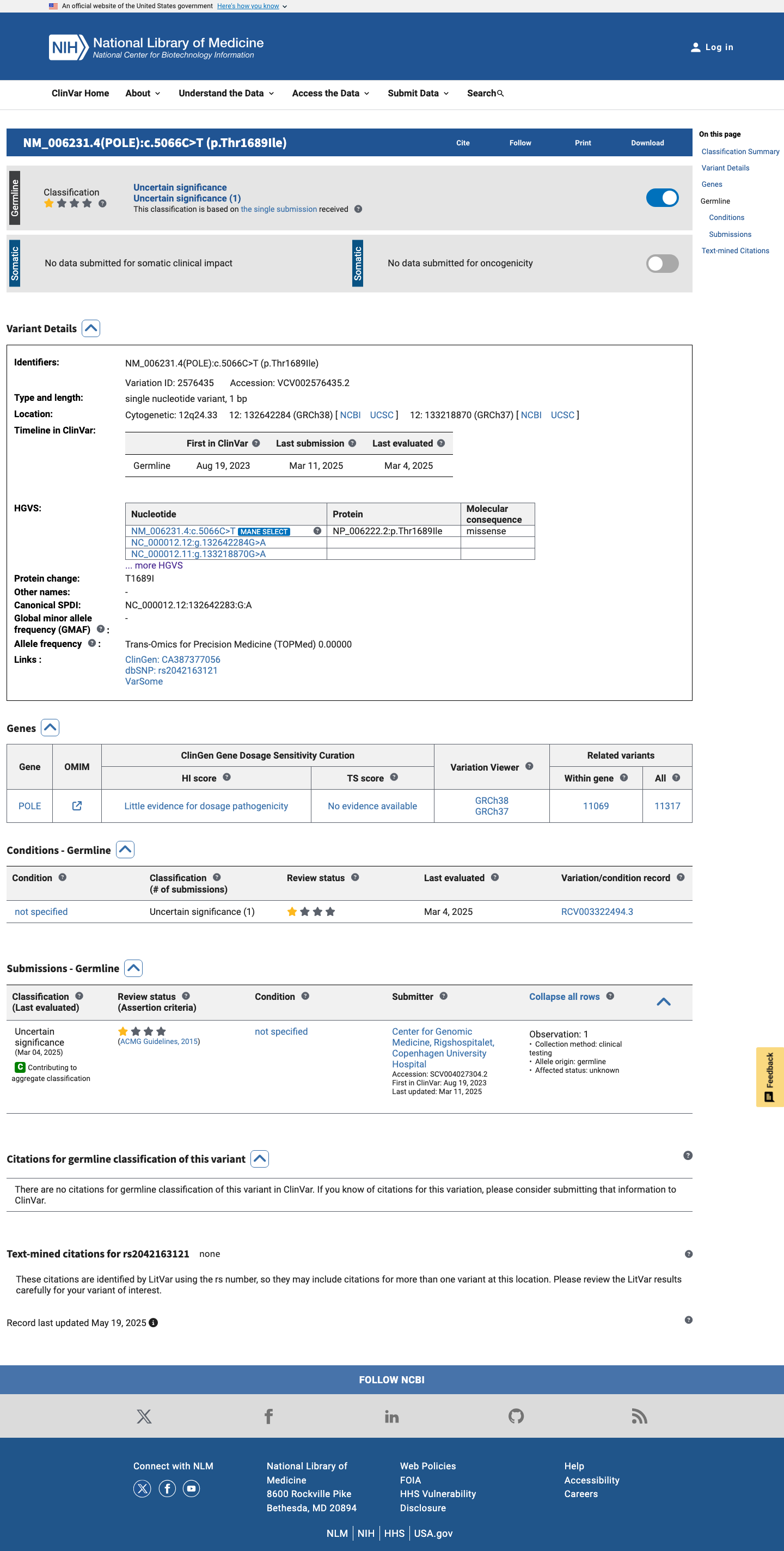
This variant has been reported in ClinVar as Uncertain significance (1 clinical laboratory). (ClinVarID = 2576435)
SpliceAI screenshot
In silico
SpliceAI predicts no significant splice impact for this variant (max delta score = 0.16). REVEL score = 0.178. BayesDel score = -0.338929.
Functional / OncoKB screenshot
Functional Unknown Oncogenic Effect
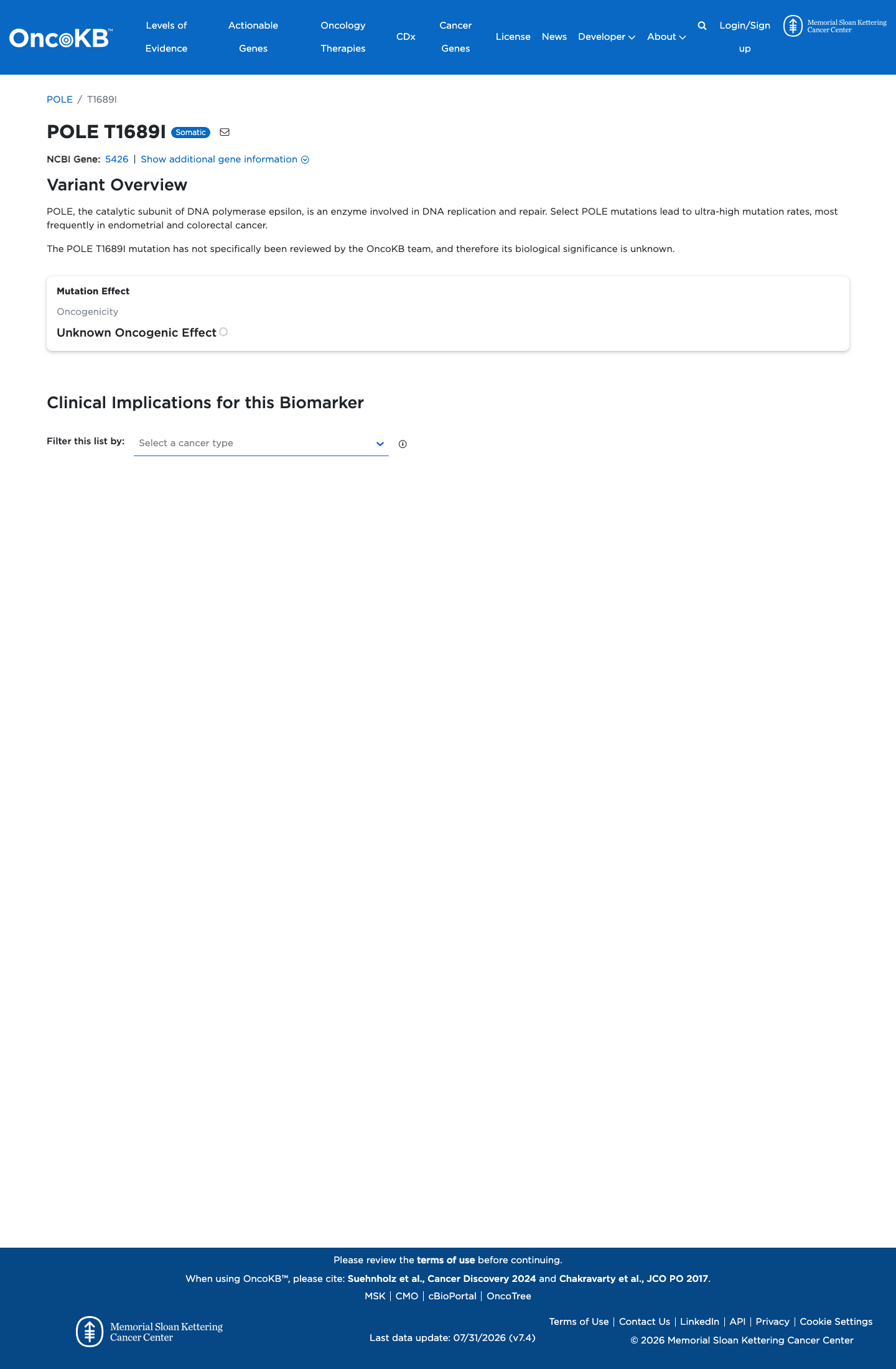
OncoKB did not identify variant-specific reviewed functional evidence for this variant; gene-level curated context is available for reviewer follow-up. POLE, the catalytic subunit of DNA polymerase epsilon, is an enzyme involved in DNA replication and repair. Select POLE mutations lead to ultra-high m
OncoKB ↗
COSMIC screenshot
COSMIC
Cancer hotspots screenshot
Cancer hotspots
Somatic evidence Not in COSMIC / hotspots
COSMIC
This variant does not lie in a statistically significant hotspot. This variant has not previously been reported in somatic cancers (COSMIC).
Hotspots
This variant does not lie in a statistically significant hotspot.
Literature · how each cited paper was used
1papers cited
Each card is an audit: what was searched, what was found, whether it names the variant, which criteria it fed, and why.
Rule & framework references · cited for criterion definitions, not variant evidence
25741868 ↗ Standards and guidelines for the interpretation of sequence variants: a joint consensus recommendation of the American College of Medical Genetics and Genomics and the Association for Molecular Pathology.
Sources & reference links
8Sources
ClinVar
gnomAD v2.1
gnomAD v4.1
gnomAD-Canada
SpliceAI
OncoKB
COSMIC
Cancer hotspots