Analysis in progress
Initialising…
0%
complete
This report is still being assembled — sections appear as each stage finishes. It isn't final yet.
POLE
Final classification
VUS
PM2BP4
POLE
c.590G>T
p.Arg197Met
missense · exon 7

POLE encodes the catalytic subunit of DNA polymerase epsilon, the enzyme that replicates the leading strand of DNA during cell division and participates in DNA repair. It contains a proofreading domain that corrects replication errors, keeping the accumulation of mutations in check. Germline mutations in POLE cause polyposis and predispose to colorectal cancer, and are also linked to a rare syndrome of facial dysmorphism, immunodeficiency, livedo, and short stature. Somatic mutations, particularly in the proofreading domain, occur in colorectal and endometrial cancers, where they drive an ultra-mutated tumor phenotype and are associated with better responses to immune checkpoint inhibitors.

This variant

POLE variants cause polyposis and colorectal cancer predisposition, and somatic proofreading-domain mutations drive ultra-mutated colorectal and endometrial tumors. p.Arg197Met is classified as a VUS, meaning current evidence neither establishes nor excludes a disease-causing role for this variant.

Transcript
NM_006231.4
HGVS · transcript:coding
NM_006231.4:c.590G>T
GRCh38
chr12:132677708 C>A
GRCh37
chr12:133254294 C>A
Basis Under the local POLE framework (León-Castillo et al. 2020), PM2_Supporting (pathogenic) and BP4_Supporting (benign) are both met; neither side satisfies a classification combination, so the result is VUS.
Under the local POLE framework (León-Castillo et al. 2020), PM2_Supporting (pathogenic) and BP4_Supporting (benign) are both met; neither side satisfies a classification combination, so the result is VUS.
Classification rationale
PM2 BP4 VUS
POLE c.590G>T missense · exon 7

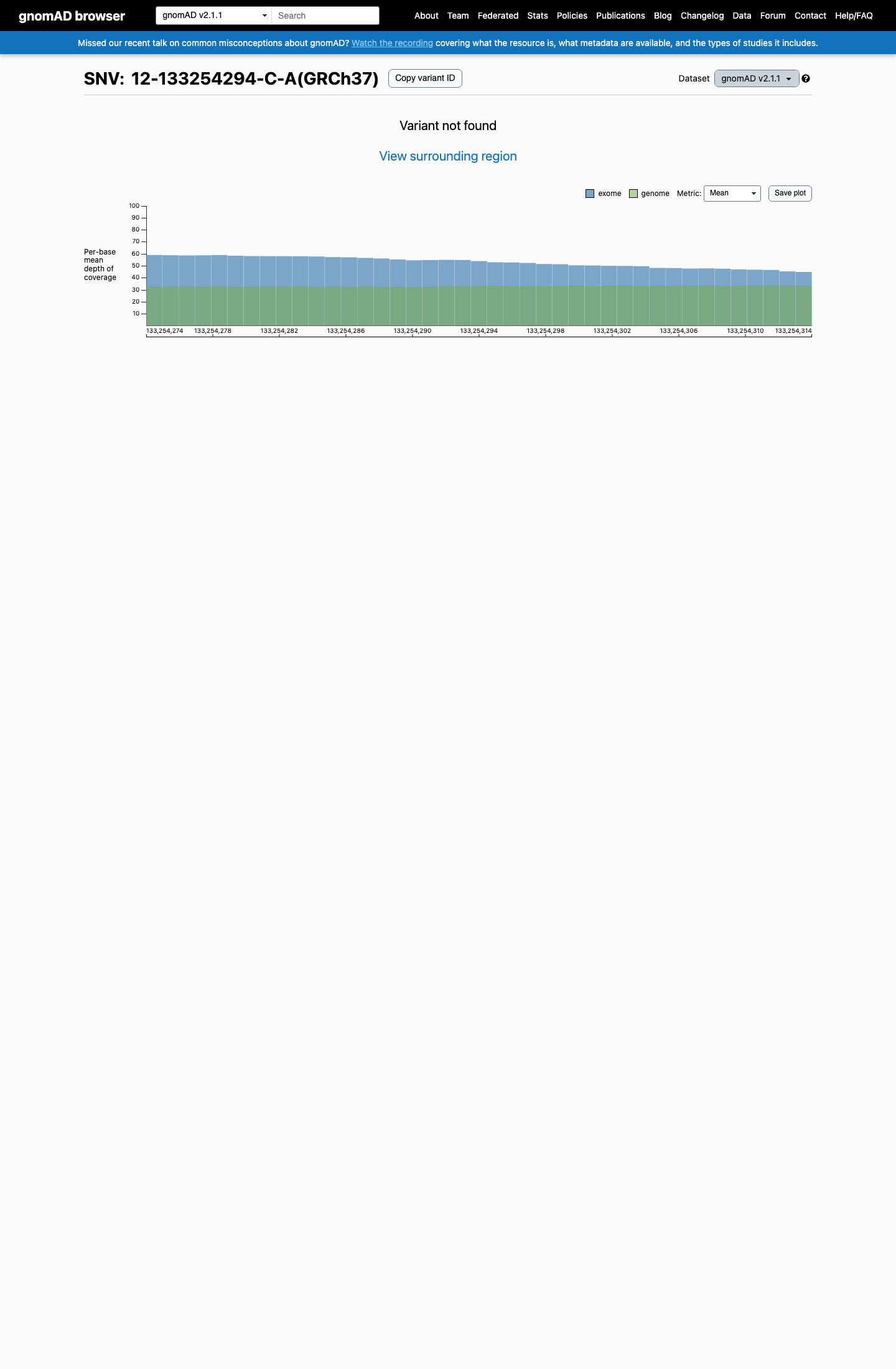
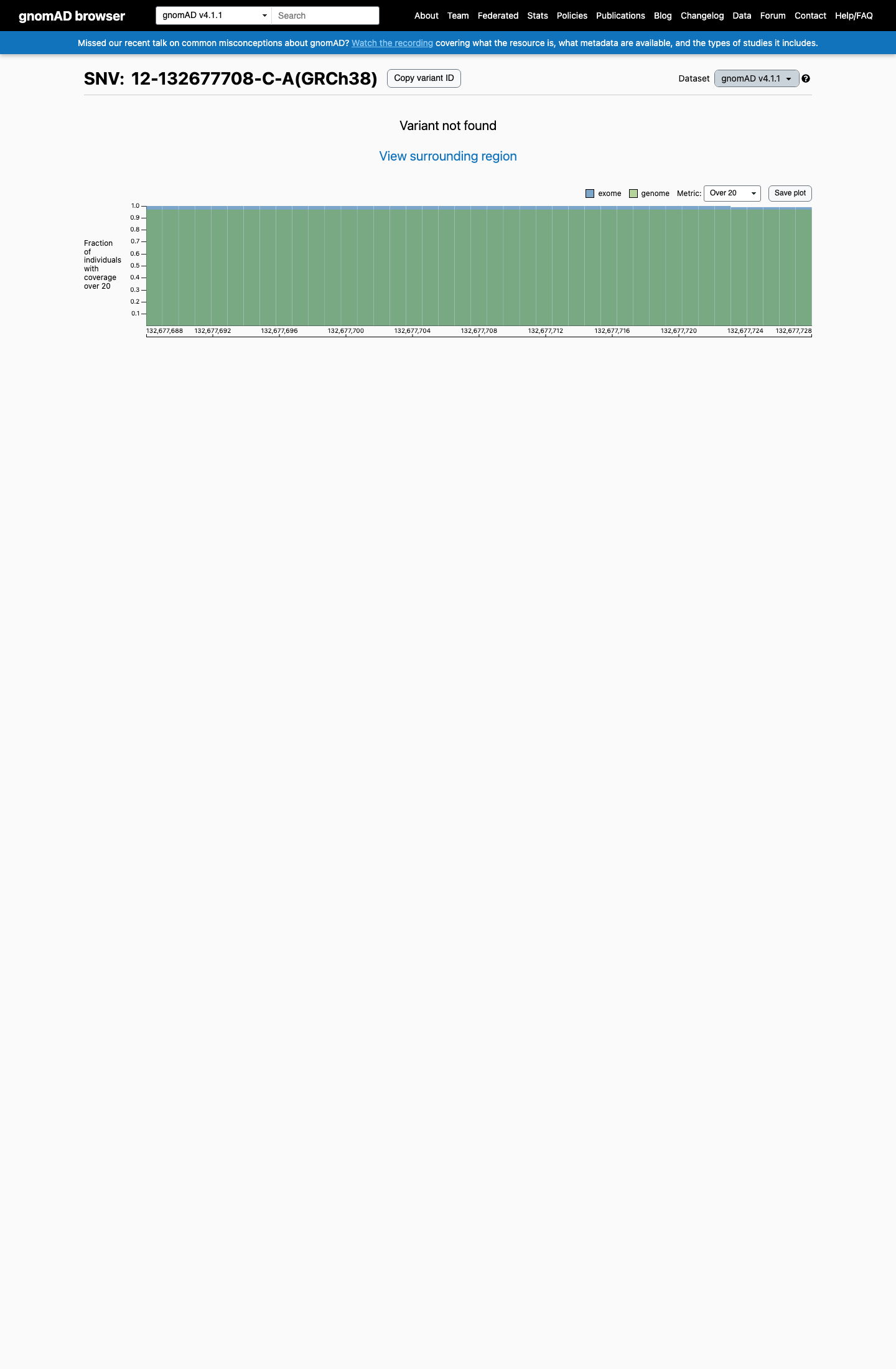
PM2 (Supporting): the exact variant is absent from gnomAD v2.1, gnomAD v4.1, and gnomAD-Canada v1.0. BP4 (Supporting): REVEL score 0.224 is below the 0.290 benign supporting threshold. With one supporting pathogenic and one supporting benign criterion, no ACMG/AMP 2015 combination is satisfied, yielding a final classification of VUS.

PM2 + BP4 VUS
Gene diagram · NM_006231.4 · variants mapped to exon structure
POLE NM_006231.4
Fetching transcript structure from UCSC…
Applied criteria · 2 applied · 25 assessed
MetEvidence satisfies this criterion.
Not metEvaluated against available evidence; threshold not reached.
Not assessedApplies in principle, but no evidence was found to evaluate it.
N/ADoesn't apply to this variant type.
Applied · 2
Strength Supporting Moderate Strong Very strong
PM2 supporting review Pathogenic
Met (Supporting): the exact variant is absent from gnomAD v2.1, gnomAD v4.1, and gnomAD-Canada v1.0.
The case bundle reports the exact variant as absent from gnomAD v2.1.The case bundle reports the exact variant as absent from gnomAD v4.1.The case bundle reports the exact variant as absent from gnomAD-Canada v1.0.
BP4 supporting Benign
Met (Supporting): REVEL score 0.224 is below the 0.290 BP4 supporting threshold.
No ClinGen CSPEC was retrieved for POLE. The applicable local POLE BP4 rule requires the exact missense variant to appear in Supplementary Table S2 or S3 with REVEL class 'Likely benign'/'Likely-benign' and at least four benign in-silico results; direct review found p.Arg197Met/c.590G>T absent from both tables, requiring generic fallback.The case REVEL lookup reports 0.224 for NM_006231.4:c.590G>T (p.Arg197Met).ClinGen SVI's calibrated REVEL thresholds (PMID:36413997) use REVEL <=0.290 for BP4 supporting evidence; 0.224 meets this threshold.
Assessed · not applied · 10 not met · 15 not assessed
Pathogenic
PVS1 Not met: c.590G>T is a missense substitution (p.Arg197Met), not a null variant such as nonsense, frameshift, or canonical splice.
PS1 Not assessed: no confirmed pathogenic variant producing the same p.Arg197Met change was available for comparison.
PS2 Not assessed: no de novo occurrence with confirmed parental testing was documented.
PS3 Not assessed: no validated disease-relevant functional assay data for p.Arg197Met were available.
PS4 Not met: p.Arg197Met is not recurrent in COSMIC or TCGA endometrial cohorts, and no case-control enrichment data were available.
PM1 Not met: p.Arg197Met is not one of the established exonuclease-domain hotspot or recurrent variants under the local POLE framework.
PM3 Not assessed: no observation of the variant in trans with a pathogenic allele in an affected individual was documented.
PM4 Not met: single-nucleotide missense with no protein-length change; not an in-frame insertion/deletion or stop-loss variant.
PM5 Not assessed: no independently established pathogenic missense variant at residue Arg197 was identified.
PM6 Not assessed: no unconfirmed de novo occurrence was documented.
PP1 Not assessed: no pedigree or variant-status data from affected relatives were available for segregation analysis.
PP2 Not assessed: no gene-level evidence that pathogenic POLE missense variation is common while benign missense variation is uncommon.
PP3 Not met: REVEL score 0.224 is below the pathogenic supporting calibration threshold.
PP4 Not assessed: no proband phenotype or family history was provided to assess phenotype specificity.
PP5 Not met: the exact variant is absent from ClinVar, so no expert-panel pathogenic classification exists to support it.
Benign
BA1 Not met: absent from gnomAD v2.1, v4.1, and gnomAD-Canada v1.0, with no allele frequency approaching a stand-alone benign threshold.
BS1 Not met: absent from all three population resources, so no allele frequency exceeds the disease-expected maximum credible frequency.
BS2 Not assessed: no unaffected adult carriers or homozygotes were documented.
BS3 Not assessed: no validated functional assay demonstrating a normal effect of p.Arg197Met was available.
BS4 Not assessed: no informative affected or unaffected relatives with documented genotype and phenotype.
BP1 Not assessed: no evidence that POLE disease is predominantly caused by truncating variants while missense is not an established mechanism.
BP2 Not assessed: no observation of the variant in trans or cis with a pathogenic allele was available.
BP3 Not met: p.Arg197Met is a missense substitution, not an in-frame insertion/deletion.
BP5 Not assessed: no proband phenotype or independent molecular diagnosis was provided to assess an alternate cause.
BP6 Not met: the exact variant is absent from ClinVar, so no expert-panel benign classification exists to support it.
N/A · 1 BP7
Research & evidence
Population frequency
gnomAD v4.1 screenshot
gnomAD v4.1
gnomAD v2.1 screenshot
gnomAD v2.1
v4.1
Absent from gnomAD v4.1.
v2.1
Absent from gnomAD v2.1.
🇨🇦 CA
Absent from gnomAD-Canada v1.0.
Allele frequency by ancestry
three datasets · side by side
gnomAD v4.1
Absent · 0 / ?
0 hom
Not observed in any ancestry group.
gnomAD v2.1
Absent · 0 / ?
0 hom
Not observed in any ancestry group.
gnomAD Canada 🇨🇦
Absent · 0 / ?
0 hom
Not observed in any ancestry group.
ClinVar screenshot
ClinVar
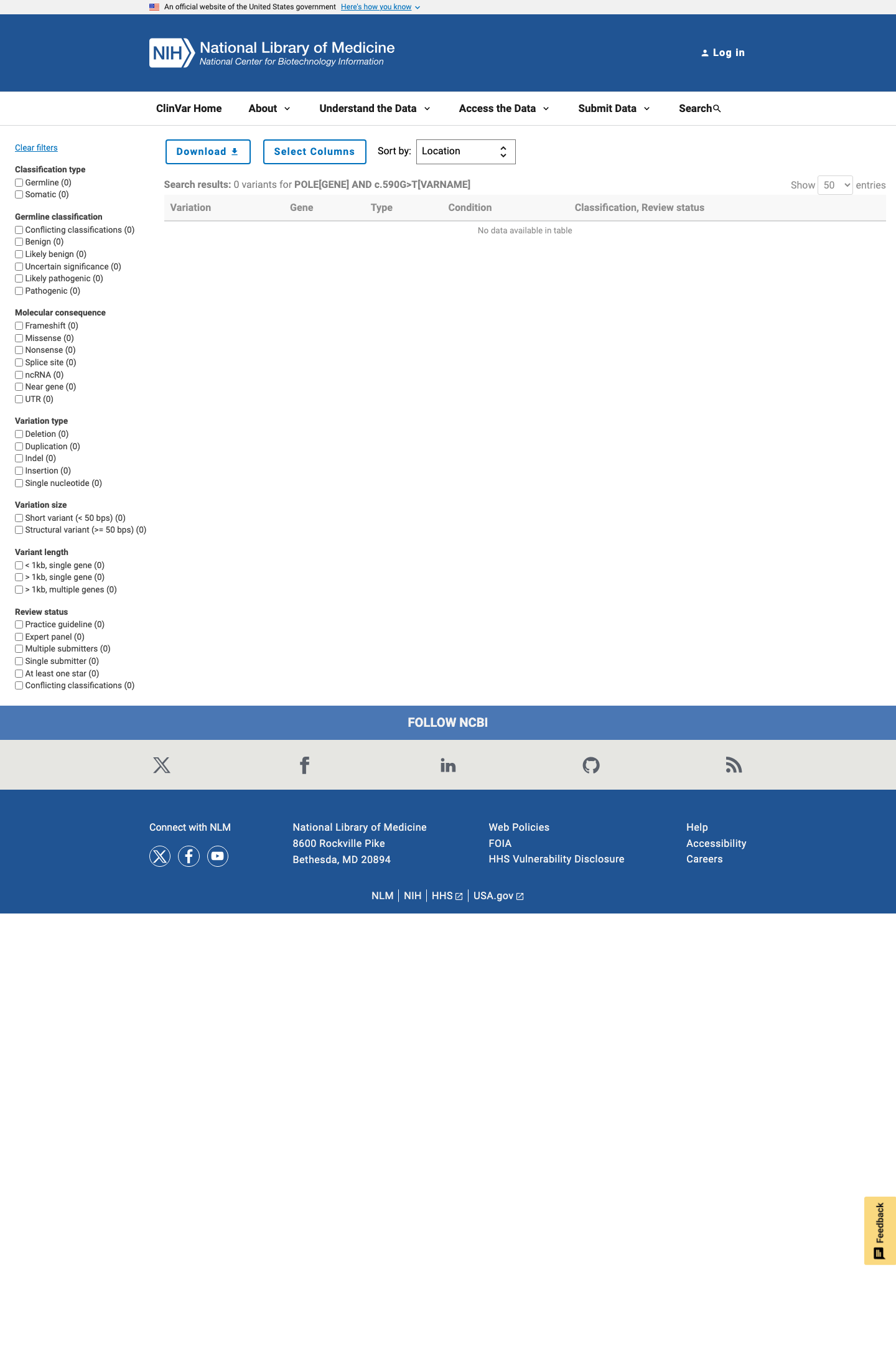
This variant is absent from ClinVar.
SpliceAI screenshot
In silico
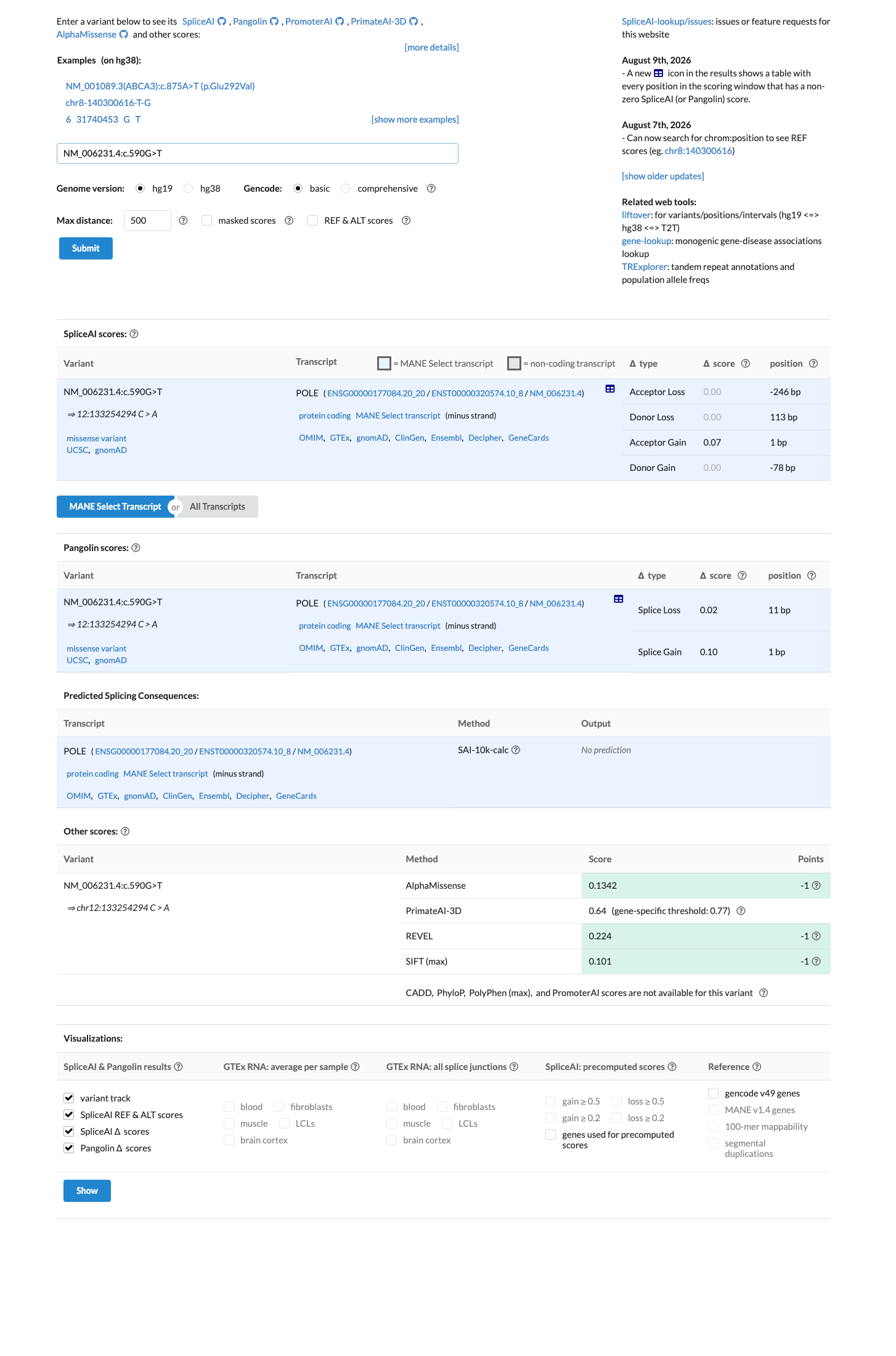
SpliceAI predicts no significant splice impact for this variant (max delta score = 0.07). REVEL score = 0.224. BayesDel score = -0.460088.
Functional / OncoKB screenshot
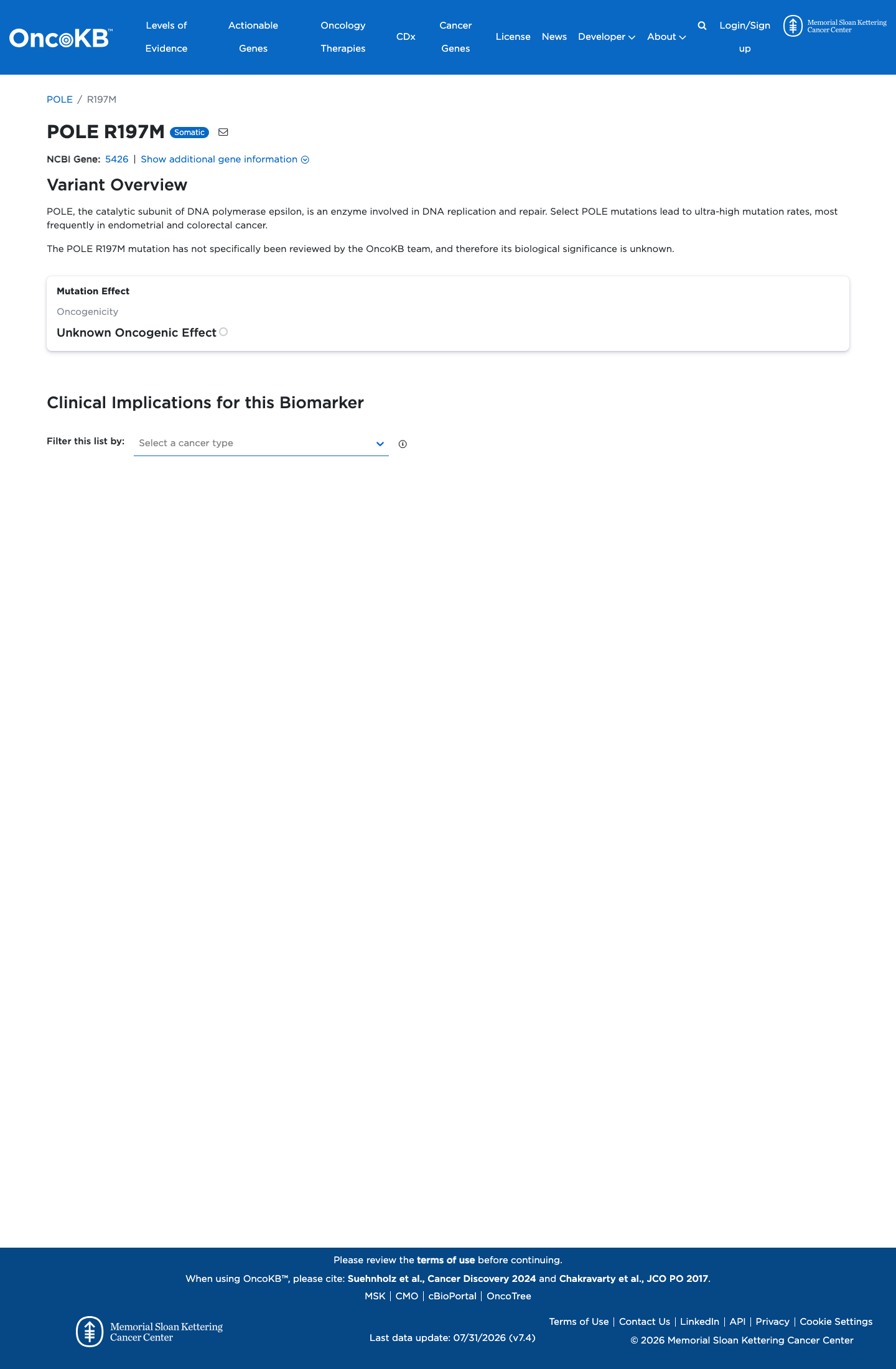
Functional Unknown Oncogenic Effect
OncoKB did not identify variant-specific reviewed functional evidence for this variant; gene-level curated context is available for reviewer follow-up. POLE, the catalytic subunit of DNA polymerase epsilon, is an enzyme involved in DNA replication and repair. Select POLE mutations lead to ultra-high m
OncoKB ↗
COSMIC screenshot
COSMIC
Cancer hotspots screenshot
Cancer hotspots
Somatic evidence Not in COSMIC / hotspots
COSMIC
This variant does not lie in a statistically significant hotspot. This variant has not previously been reported in somatic cancers (COSMIC).
Hotspots
This variant does not lie in a statistically significant hotspot.
Sources & reference links
8Sources
ClinVar
gnomAD v2.1
gnomAD v4.1
gnomAD-Canada
SpliceAI
OncoKB
COSMIC
Cancer hotspots