Back
NM_006231.4:c.6331-24C>T
p.? · POLE
León-Castillo et al. 2020 custom POLE framework · vleon-castillo-2020-custom-framework-v1
0%
complete
Final classification
VUS
BP4
POLE
c.6331-24C>T
p.?
unknown · exon 45i

POLE encodes the catalytic subunit of DNA polymerase epsilon, the enzyme that replicates the leading strand of DNA during cell division and participates in DNA repair. It contains a proofreading domain that corrects replication errors, keeping the accumulation of mutations in check. Germline mutations in POLE cause polyposis and predispose to colorectal cancer, and are also linked to a rare syndrome of facial dysmorphism, immunodeficiency, livedo, and short stature. Somatic mutations, particularly in the proofreading domain, occur in colorectal and endometrial cancers, where they drive an ultra-mutated tumor phenotype and are associated with better responses to immune checkpoint inhibitors.

This variant

This deep intronic POLE variant lies outside the exonuclease proofreading domain whose germline missense hotspots (p.P286R, p.V411L, p.S297F, p.A456P, p.S459F) underlie POLE-associated polyposis and colorectal cancer predisposition.

Transcript
NM_006231.4
HGVS · transcript:coding
NM_006231.4:c.6331-24C>T
GRCh38
chr12:132626341 G>A
GRCh37
chr12:133202927 G>A
VUS: BP4 (supporting), from SpliceAI max delta 0.076, is the only met criterion and satisfies no ACMG/AMP combination rule.
Classification rationale
BP4 VUS
POLE c.6331-24C>T unknown · exon 45i

BP4 supporting: SpliceAI max delta 0.076 is below the <=0.1 threshold, so no splice-altering effect is predicted for this intronic variant. VUS: the single supporting benign criterion (BP4) does not satisfy the Likely Benign rule requiring a strong plus supporting benign criterion or two supporting benign criteria.

BP4 VUS
LYFE Sciences is an AI system, and it can make mistakes. Criteria may be applied incorrectly, sources may be misread, and a confident-looking classification can still be wrong. Double-check every criterion and its underlying evidence before relying on any call.
Gene diagram · NM_006231.4 · variants mapped to exon structure
POLE NM_006231.4
Fetching transcript structure from UCSC…
Applied criteria · 1 applied · 19 assessed
MetEvidence satisfies this criterion.
Not metEvaluated against available evidence; threshold not reached.
Not assessedApplies in principle, but no evidence was found to evaluate it.
N/ADoesn't apply to this variant type.
Applied · 1
Strength Supporting Moderate Strong Very strong
BP4 supporting Benign
Met at supporting: SpliceAI max delta 0.076, at or below the <=0.1 BP4 threshold.
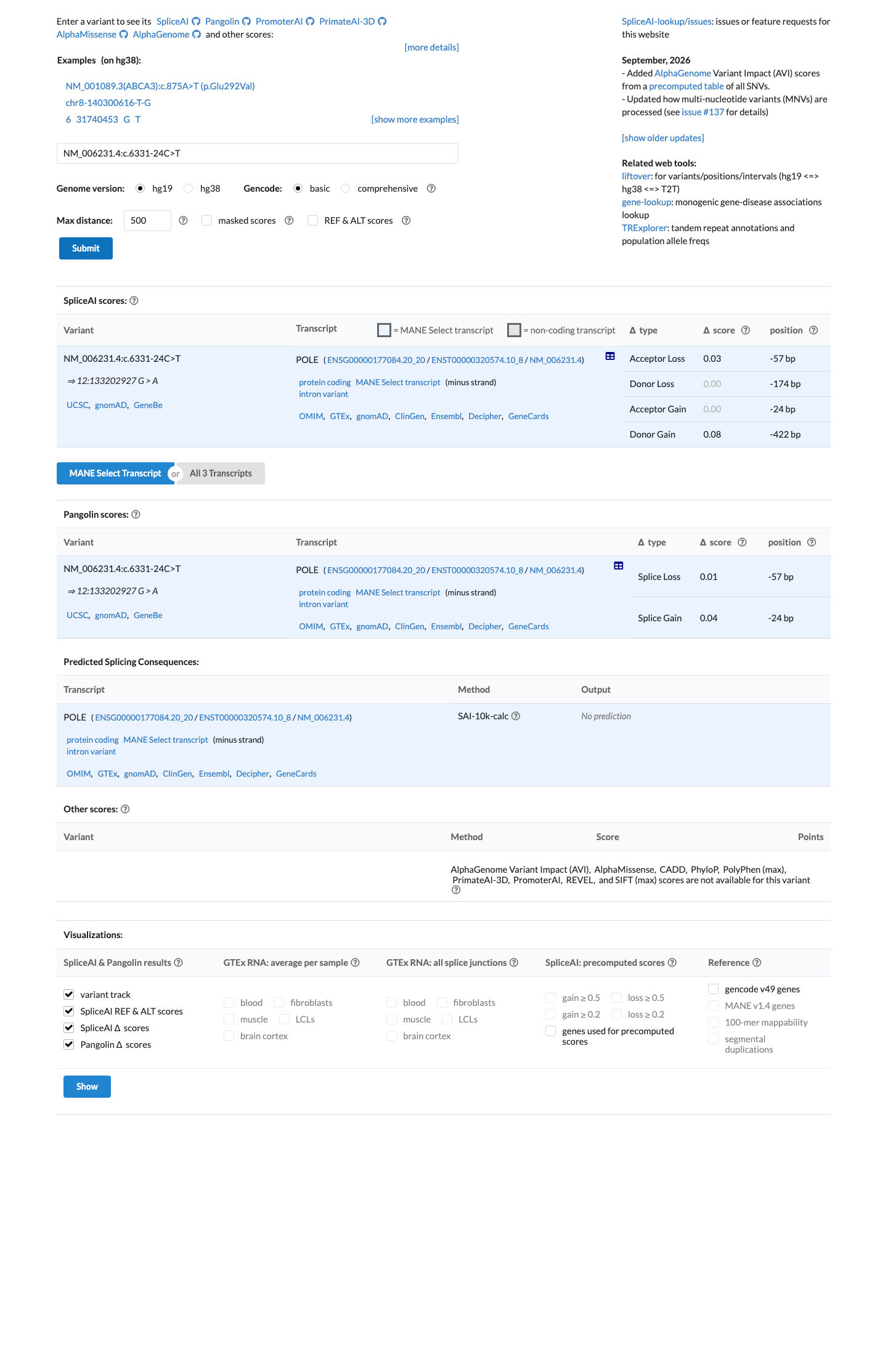
Variant consequence type settled first: c.6331-24C>T is intronic and non-canonical (outside ±1,2 splice consensus positions), so BP4 was evaluated only through the SpliceAI path and no missense predictor (REVEL) was used; the prefetch confirms REVEL 'found: false' and BayesDel 'found: false' for this variant.SpliceAI Lookup (hg37, distance 500, basic annotation, masked, source_data.spliceai_available true) returned DS_AG 0.004, DS_AL 0.028, DS_DG 0.076, DS_DL 0.001, max_delta_score 0.076, compared against the Jaganathan et al. 2019 Cell cutoff supplied for this task (BP4 supporting <= 0.1; PMID:30661751).Pangolin scores from the same lookup (SG 0.044, SL -0.014) independently show no predicted splice gain or loss.
Assessed · not applied · 9 not met · 10 not assessed
Pathogenic
PVS1 Not met: the intronic c.6331-24C>T (24 bp from the exon 46 acceptor) has SpliceAI max delta 0.076, below the 0.2 supporting cutoff, so no null effect is predicted.
PS2 Not assessed: no proband or parental genotypes are available to establish a confirmed de novo occurrence.
PS3 Not assessed: no functional or RNA assay of POLE c.6331-24C>T exists; SpliceAI 0.076 and the absent REVEL score are in-silico only.
PS4 Not met: intronic c.6331-24C>T is absent from the POLE recurrent-variant table (Supplementary Table S1) and no case-control enrichment statistic exists.
PM1 Not met: c.6331-24C>T is intronic (intron 45, p.?) and outside every POLE exonuclease-domain hotspot (P286R, V411L, S297F, A456P, S459F).
PM2 Not met: total allele frequency 0.000237 (gnomAD v2.1, 66/278,448 alleles) exceeds the 0.0001 PM2 rarity threshold in all four datasets.
PM3 Not assessed: no second POLE variant, zygosity or phase is documented and gnomAD reports zero homozygotes in v2.1 (66/278,448) and v4.1 (209/1,611,370) alleles, leaving an in-trans configuration untested.
PM6 Not assessed: no proband carrying the variant is documented, so no assumed de novo occurrence can be recorded.
PP1 Not assessed: no pedigree or affected-relative genotypes provide any co-segregation data for this variant.
PP3 Not met: SpliceAI max delta 0.076 vs the >=0.2 supporting threshold for PP3.
PP4 Not assessed: no phenotype or family-history data for the proband were available, so disease specificity could not be evaluated.
PP5 Not met: the only ClinVar record for this exact variant is a single-submitter, 1-star laboratory assertion, not an expert-panel pathogenic classification.
Benign
BA1 Not met: highest population frequency 0.00053 (gnomAD v2.1 non-cancer exomes, non-Finnish European) versus the BA1 stand-alone threshold of 0.05.
BS1 Not met: highest observed frequency 0.00053 versus the generic BS1 threshold of 0.01, about 19-fold below and 8/8 dataset values under 0.001.
BS3 Not assessed: no functional assay demonstrates preserved POLE splicing or proofreading; SpliceAI 0.076 and the absent REVEL score are in-silico only.
BS4 Not assessed: no affected family members were genotyped, so lack of segregation cannot be demonstrated for this variant.
BP2 Not assessed: no documented co-occurring pathogenic POLE allele and no phase data, with zero homozygotes reported in gnomAD v2.1 (66/278,448) and v4.1 (209/1,611,370) alleles, so no cis or trans configuration can be evaluated.
BP5 Not assessed: no case-level data were available to determine whether the variant co-occurs with an alternate molecular basis for disease.
BP6 Not met: the exact-variant ClinVar Likely benign label comes from one non-expert laboratory (1 star, zero expert-panel submissions), which cannot trigger BP6.
N/A · 8 PS1 · PM4 · PM5 · PP2 · BS2 · BP1 · BP3 · BP7
Research & evidence
Population frequency
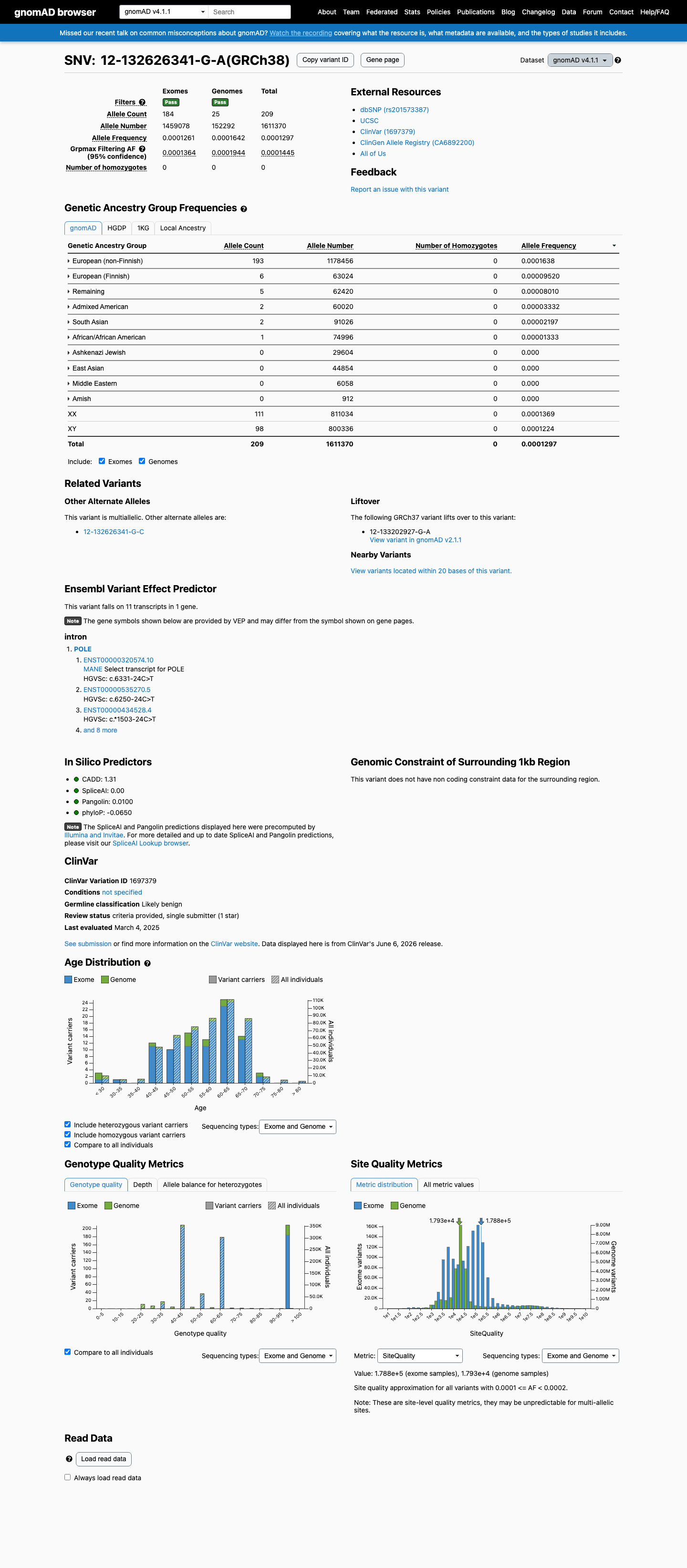
gnomAD v4.1 screenshot
gnomAD v4.1
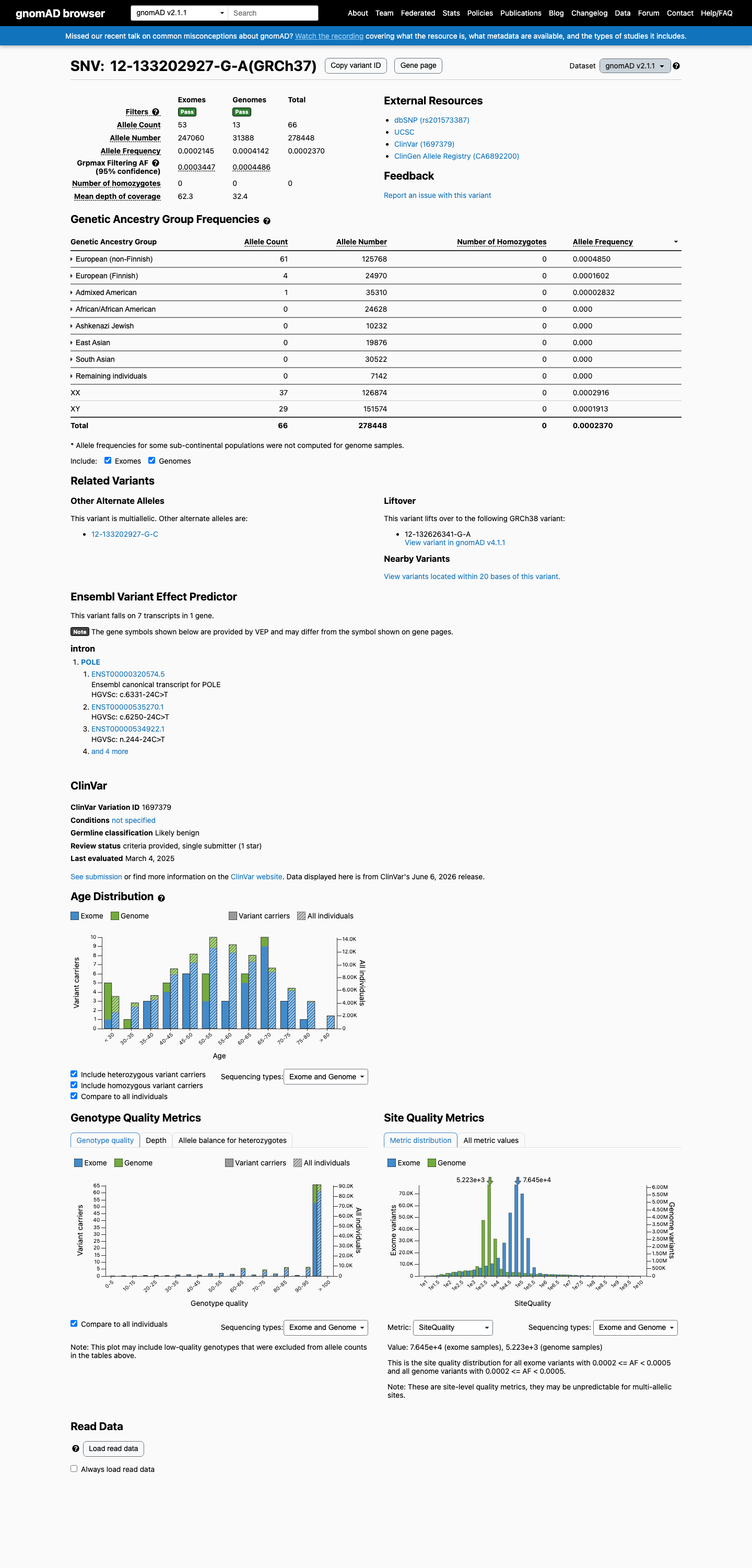
gnomAD v2.1 screenshot
gnomAD v2.1
v4.1
This variant is present in gnomAD v4.1 (AF= 0.000129703; MAF= 0.01297%, 209/1611370 alleles, homozygotes = 0) and has highest observed frequency in the European (non-Finnish) population (AF= 0.000163774; MAF= 0.01638%, 193/1178456 alleles, homozygotes = 0); grpmax FAF= 0.00014455.
v2.1
This variant is present in gnomAD v2.1 (AF= 0.000237028; MAF= 0.02370%, 66/278448 alleles, homozygotes = 0) and has highest observed frequency in the European (non-Finnish) population (AF= 0.00048502; MAF= 0.04850%, 61/125768 alleles, homozygotes = 0); grpmax FAF= 0.00044857.
🇨🇦 CA
Not available in gnomAD-Canada v1.0.
Allele frequency by ancestry
three datasets · side by side
gnomAD v4.1
0.013% · 209 / 1,611,370
0 hom · FAF 0.014%
European (non-Finnish)
193 / 1,178,456
0.016%
European (Finnish)
6 / 63,024
0.0095%
Remaining individuals
5 / 62,420
0.008%
Admixed American
2 / 60,020
0.0033%
South Asian
2 / 91,026
0.0022%
African/African American
1 / 74,996
0.0013%
+ 4 not observed (Amish, East Asian, Middle Eastern, Ashkenazi Jewish)
gnomAD v2.1
0.024% · 66 / 278,448
0 hom · FAF 0.045%
European (non-Finnish)
61 / 125,768
0.049%
European (Finnish)
4 / 24,970
0.016%
Admixed American
1 / 35,310
0.0028%
+ 5 not observed (African/African American, Ashkenazi Jewish, East Asian, Remaining individuals, South Asian)
gnomAD Canada 🇨🇦
Absent · 0 / ?
0 hom
Not observed in any ancestry group.
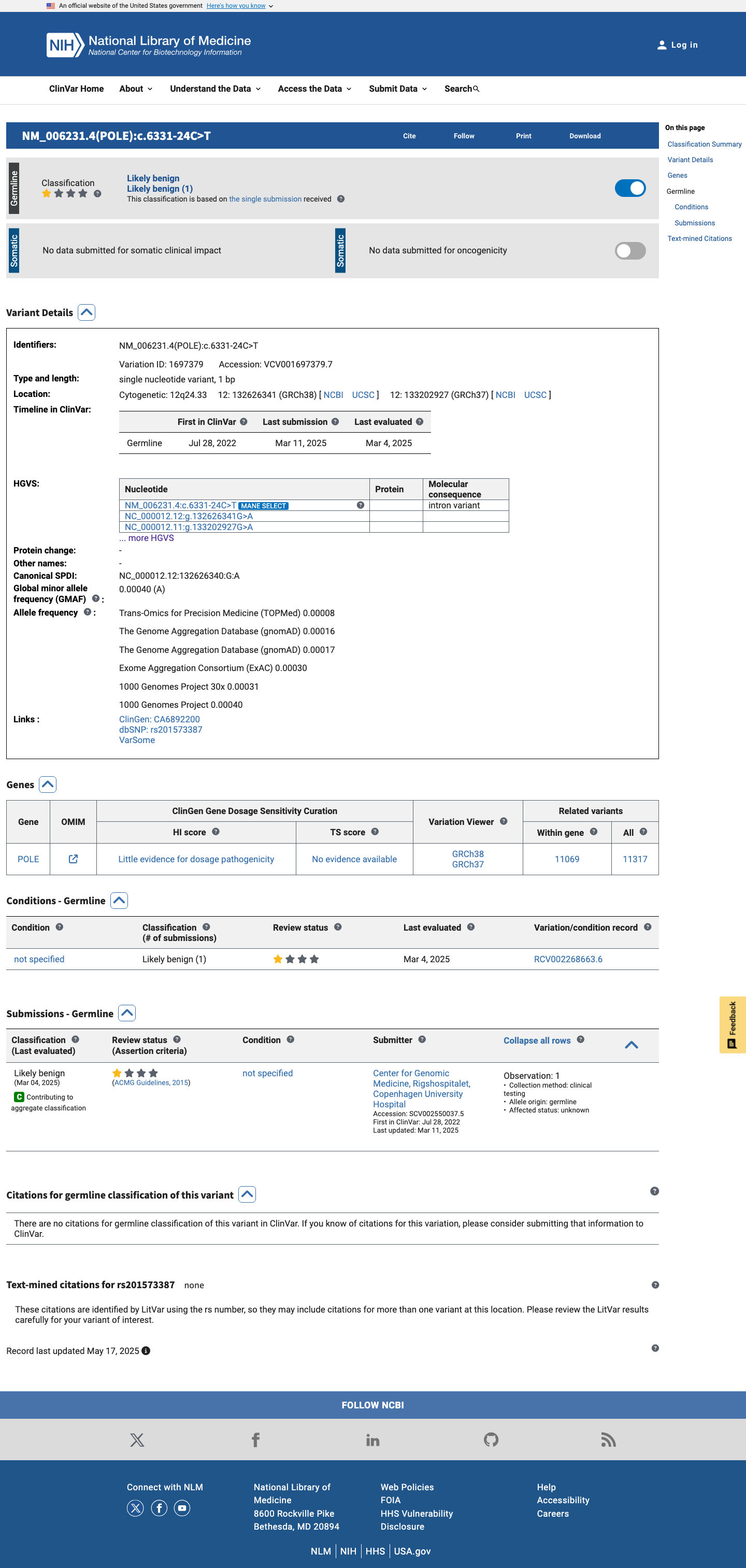
ClinVar screenshot
ClinVar
This variant has been reported in ClinVar as Likely benign (1 clinical laboratory). (ClinVarID = 1697379)
SpliceAI screenshot
In silico
SpliceAI predicts no significant splice impact for this variant (max delta score = 0.08).
Functional No data
No calibrated functional assay or RNA evidence was identified for this variant.
OncoKB ↗
COSMIC screenshot
COSMIC
Somatic evidence
COSMIC
This variant has not previously been reported in somatic cancers (COSMIC).
Hotspots
This variant does not lie in a statistically significant cancer hotspot.
COSMIC ↗
Literature · how each cited paper was used
1papers cited
Each card is an audit: what was searched, what was found, whether it names the variant, which criteria it fed, and why.
Rule & framework references · cited for criterion definitions, not variant evidence
25741868 ↗ Standards and guidelines for the interpretation of sequence variants: a joint consensus recommendation of the American College of Medical Genetics and Genomics and the Association for Molecular Pathology.
Sources & reference links
7Sources
ClinVar
gnomAD v2.1
gnomAD v4.1
gnomAD-Canada
SpliceAI
OncoKB
COSMIC