Analysis in progress
Initialising…
0%
complete
This report is still being assembled — sections appear as each stage finishes. It isn't final yet.
RAD21
Final classification
Likely Benign
PM2BP4BP7
RAD21
c.165A>G
p.Thr55=
synonymous · exon 3

RAD21 encodes a subunit of the cohesin complex, which holds sister chromatids together during cell division, participates in DNA double-strand break repair, and organizes DNA into three-dimensional loops that help regulate gene expression. Germline mutations in RAD21 cause cohesinopathies, a group of disorders with a spectrum of developmental defects. Somatic RAD21 mutations have been identified in acute myeloid leukemia and myelodysplastic syndromes, where they are thought to impair normal cohesin function and contribute to disease.

This variant

RAD21 encodes a cohesin complex subunit; germline mutations cause cohesinopathies and somatic mutations are seen in acute myeloid leukemia and myelodysplastic syndromes. This synonymous variant (p.(Thr55=)) is classified Likely Benign, meaning it does not alter the protein sequence or predicted splicing and is therefore unlikely to impair cohesin function or contribute to RAD21-associated disease.

Transcript
NM_006265.2
HGVS · transcript:coding
NM_006265.2:c.165A>G
GRCh38
chr8:116863239 T>C
GRCh37
chr8:117875478 T>C
Basis No RAD21 ClinGen VCEP framework was available, so generic ACMG/AMP 2015 rules applied: PM2 (supporting) plus BP4 and BP7 (supporting); two supporting benign criteria satisfy the '2 BP -> Likely Benign' rule.
No RAD21 ClinGen VCEP framework was available, so generic ACMG/AMP 2015 rules applied: PM2 (supporting) plus BP4 and BP7 (supporting); two supporting benign criteria satisfy the '2 BP -> Likely Benign' rule.
Classification rationale
PM2 BP4BP7 Likely Benign
RAD21 c.165A>G synonymous · exon 3

PM2 (Supporting): extremely rare in population databases - gnomAD v4.1 allele frequency 0.000016 (26/1,611,624 alleles), no homozygotes. BP4 (Supporting): SpliceAI max delta 0.003, well below the ~0.2 splice-impact threshold. BP7 (Supporting): synonymous change (p.(Thr55=)) with no predicted splice impact - all SpliceAI scores below 0.01. Overall Likely Benign: two supporting benign criteria (BP4 + BP7) satisfy the '2 BP -> Likely Benign' rule.

PM2 + BP4 + BP7 Likely Benign
Gene diagram · NM_006265.2 · variants mapped to exon structure
RAD21 NM_006265.2
Fetching transcript structure from UCSC…
Applied criteria · 3 applied · 17 assessed
MetEvidence satisfies this criterion.
Not metEvaluated against available evidence; threshold not reached.
Not assessedApplies in principle, but no evidence was found to evaluate it.
N/ADoesn't apply to this variant type.
Applied · 3
Strength Supporting Moderate Strong Very strong
PM2 supporting Pathogenic
Met (supporting): extremely rare in population databases - gnomAD v4.1 allele frequency 0.000016 (26/1,611,624 alleles), with no homozygotes.
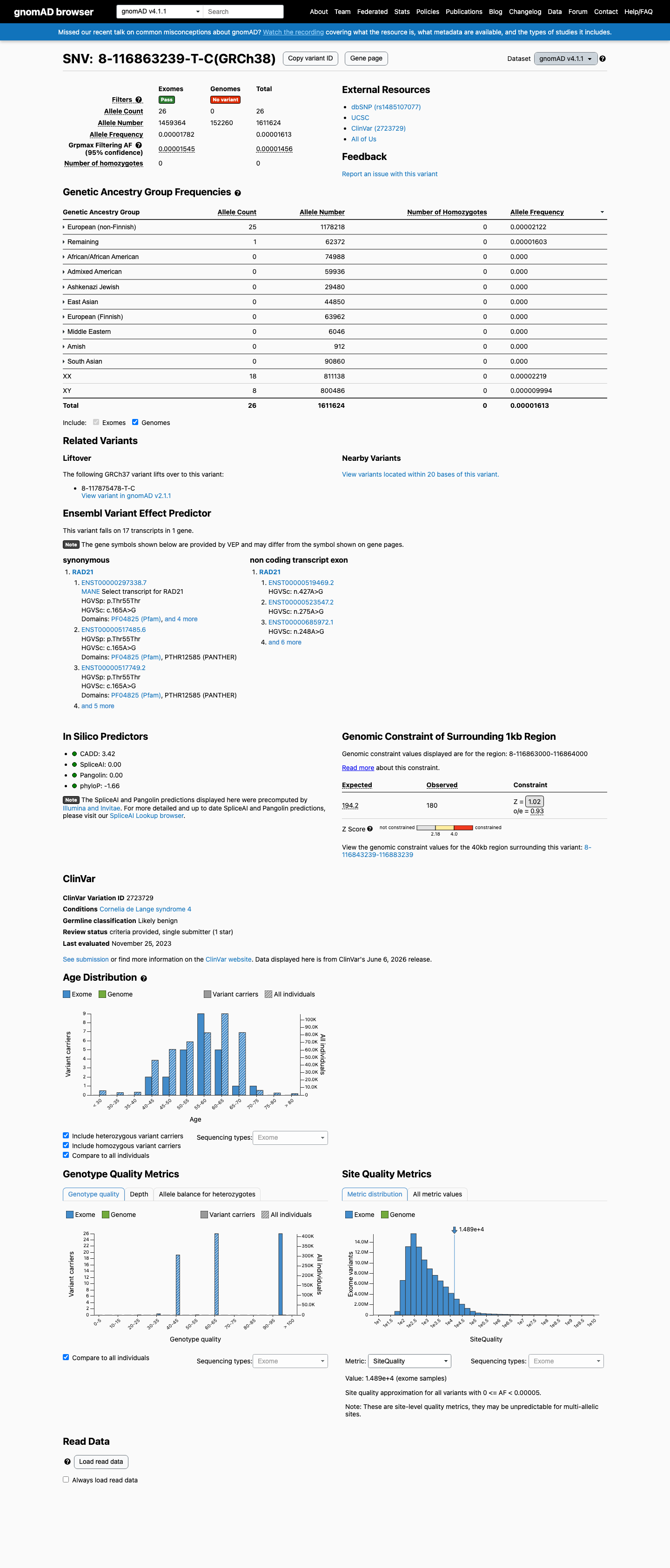
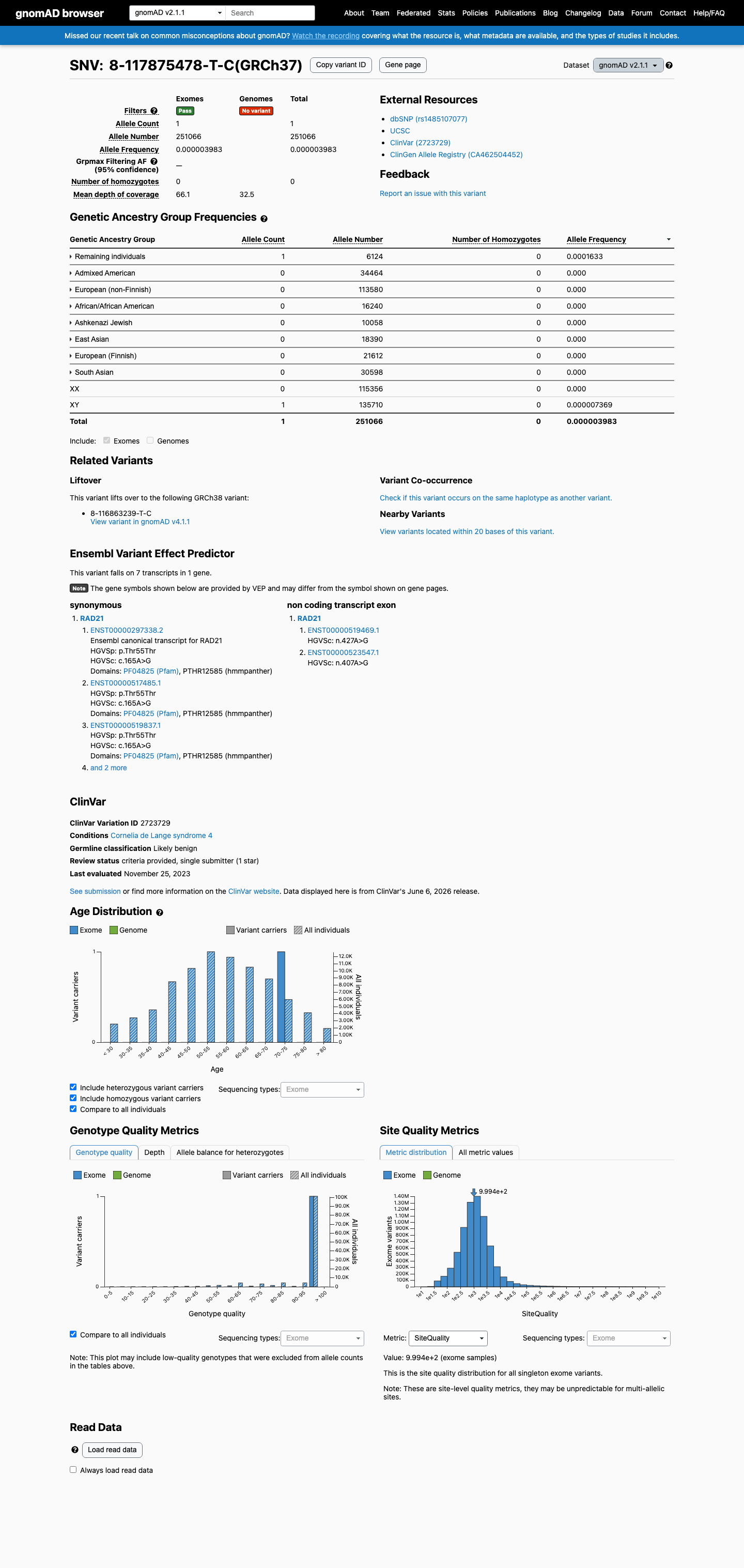
gnomAD v4.1: 26/1,611,624 alleles, AF 1.61328e-05, group-max FAF 1.456e-05, 0 homozygotes.gnomAD v2.1: 1/251,066 alleles, AF 3.98302e-06, 0 homozygotes.gnomAD-Canada v1.0: absent.
BP4 supporting Benign
Met (supporting): SpliceAI max delta score 0.003, well below the ~0.2 threshold for a predicted splice effect.
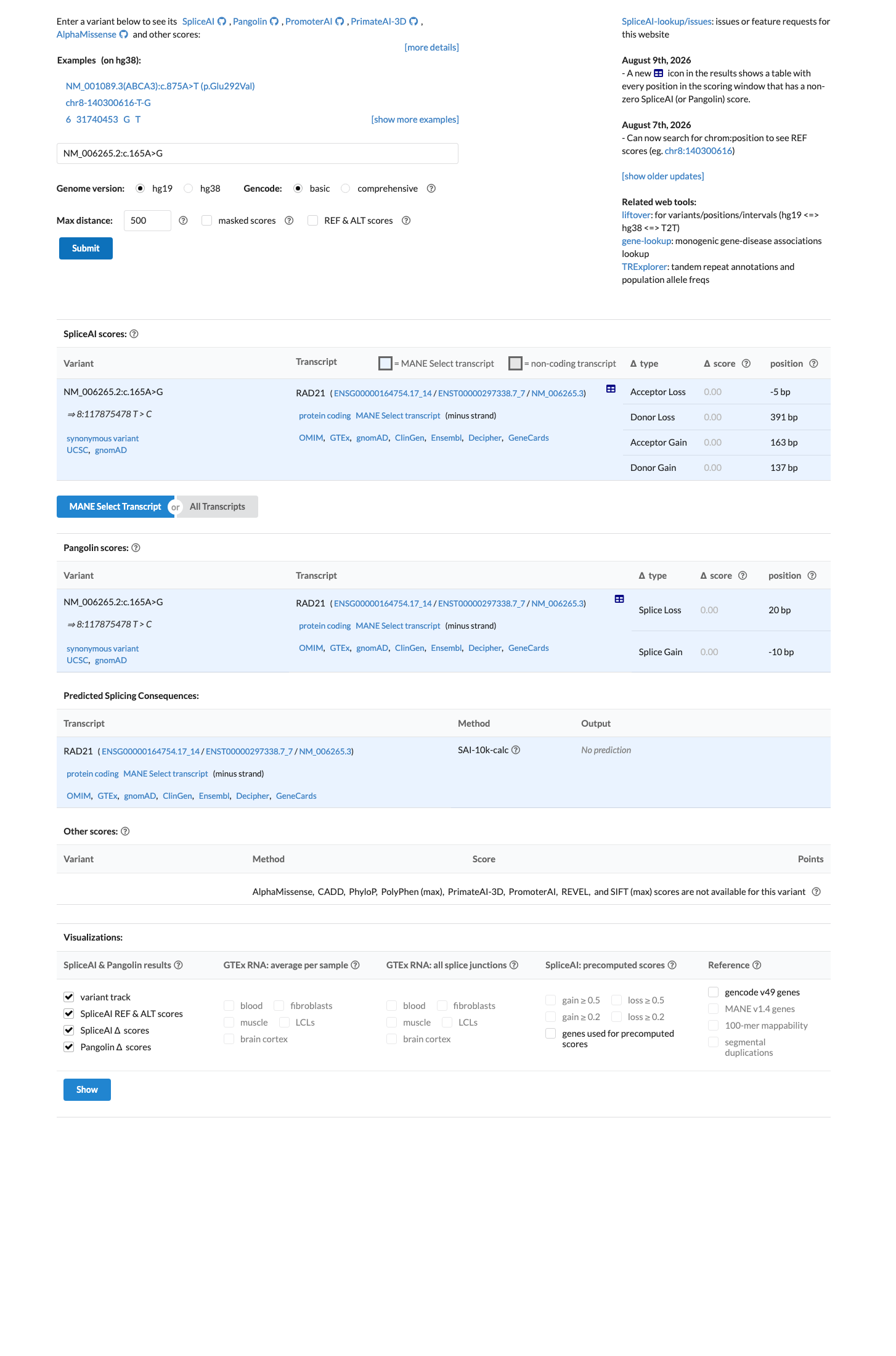
SpliceAI max delta score = 0.003 across all four splice-altering categories (acceptor gain/loss, donor gain/loss), indicating no predicted splicing disruption.
BP7 supporting Benign
Met (supporting): synonymous variant with no predicted splice impact - SpliceAI max delta 0.003, all four scores below 0.01.
Variant is synonymous, NP_006256.1:p.(Thr55=), per normalization data in case_summary.json.SpliceAI predicts no significant splice impact for this variant (max delta score = 0.003).
Assessed · not applied · 2 not met · 15 not assessed
Pathogenic
PS2 Not assessed: no de novo occurrence with confirmed maternity and paternity was documented.
PS3 Not assessed: no functional or splicing assay results for this variant were available.
PS4 Not assessed: no case-control enrichment or affected-case data for this exact variant were available.
PM3 Not assessed: no second pathogenic allele or phase evidence showing the variant in trans was available.
PM6 Not assessed: no parental testing or clinical documentation supporting a presumed de novo occurrence.
PP1 Not assessed: no co-segregation or pedigree data in relatives were documented.
PP3 Not met: SpliceAI max delta score 0.003, far below the ~0.2 threshold for a predicted splice effect.
PP4 Not assessed: no patient-level phenotype was available to establish a highly specific phenotype-genotype match.
PP5 Not assessed: no ClinVar expert-panel Pathogenic or Likely pathogenic classification exists for this exact variant.
Benign
BA1 Not met: gnomAD v4.1 allele frequency 0.000016, far below the >1% stand-alone benign population threshold.
BS1 Not assessed: no RAD21-specific expected allele-frequency threshold was available to test against.
BS2 Not assessed: no healthy adults homozygous for or carrying the expected disease genotype were documented.
BS3 Not assessed: no functional assay evidence demonstrating a lack of damaging effect was available.
BS4 Not assessed: no unaffected carriers or non-segregation family data were reported.
BP2 Not assessed: no evidence of this variant occurring with a pathogenic variant in cis or trans.
BP5 Not assessed: no alternate molecular basis for the reported phenotype was documented.
BP6 Not assessed: no ClinVar expert-panel Benign or Likely benign classification exists for this exact variant.
N/A · 8 PVS1 · PS1 · PM1 · PM4 · PM5 · PP2 · BP1 · BP3
Research & evidence
Population frequency · supports benign
gnomAD v4.1 screenshot
gnomAD v4.1
gnomAD v2.1 screenshot
gnomAD v2.1
v4.1
This variant is present in gnomAD v4.1 (AF= 1.61328e-05; MAF= 0.00161%, 26/1611624 alleles, homozygotes = 0) and has highest observed frequency in the European (non-Finnish) population (AF= 2.12185e-05; MAF= 0.00212%, 25/1178218 alleles, homozygotes = 0); grpmax FAF= 1.456e-05.
v2.1
This variant is present in gnomAD v2.1 (AF= 3.98302e-06; MAF= 0.00040%, 1/251066 alleles, homozygotes = 0) and has highest observed frequency in the Remaining individuals population (AF= 0.000163292; MAF= 0.01633%, 1/6124 alleles, homozygotes = 0).
🇨🇦 CA
Absent from gnomAD-Canada v1.0.
Allele frequency by ancestry
three datasets · side by side
gnomAD v4.1
0.0016% · 26 / 1,611,624
0 hom · FAF 0.0015%
European (non-Finnish)
25 / 1,178,218
0.0021%
Remaining individuals
1 / 62,372
0.0016%
+ 8 not observed (Admixed American, European (Finnish), Amish, East Asian, Middle Eastern, South Asian, Ashkenazi Jewish, African/African American)
gnomAD v2.1
0.0004% · 1 / 251,066
0 hom
Remaining individuals
1 / 6,124
0.016%
+ 7 not observed (African/African American, Admixed American, Ashkenazi Jewish, East Asian, European (Finnish), European (non-Finnish), South Asian)
gnomAD Canada 🇨🇦
Absent · 0 / ?
0 hom
Not observed in any ancestry group.
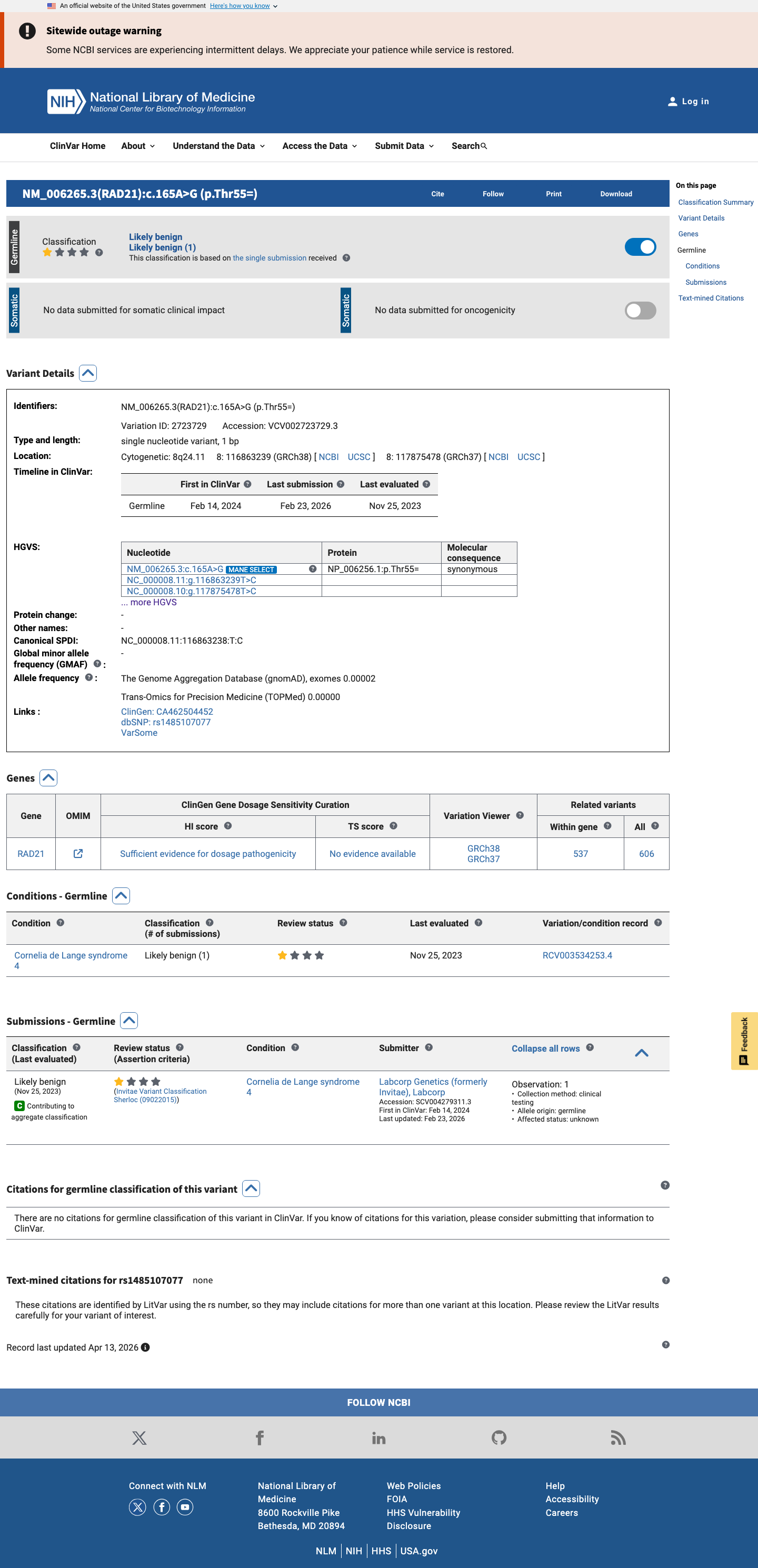
ClinVar screenshot
ClinVar
This variant has been reported in ClinVar as Likely benign (1 clinical laboratory). (ClinVarID = 2723729)
SpliceAI screenshot
In silico
SpliceAI predicts no significant splice impact for this variant (max delta score = 0.00).
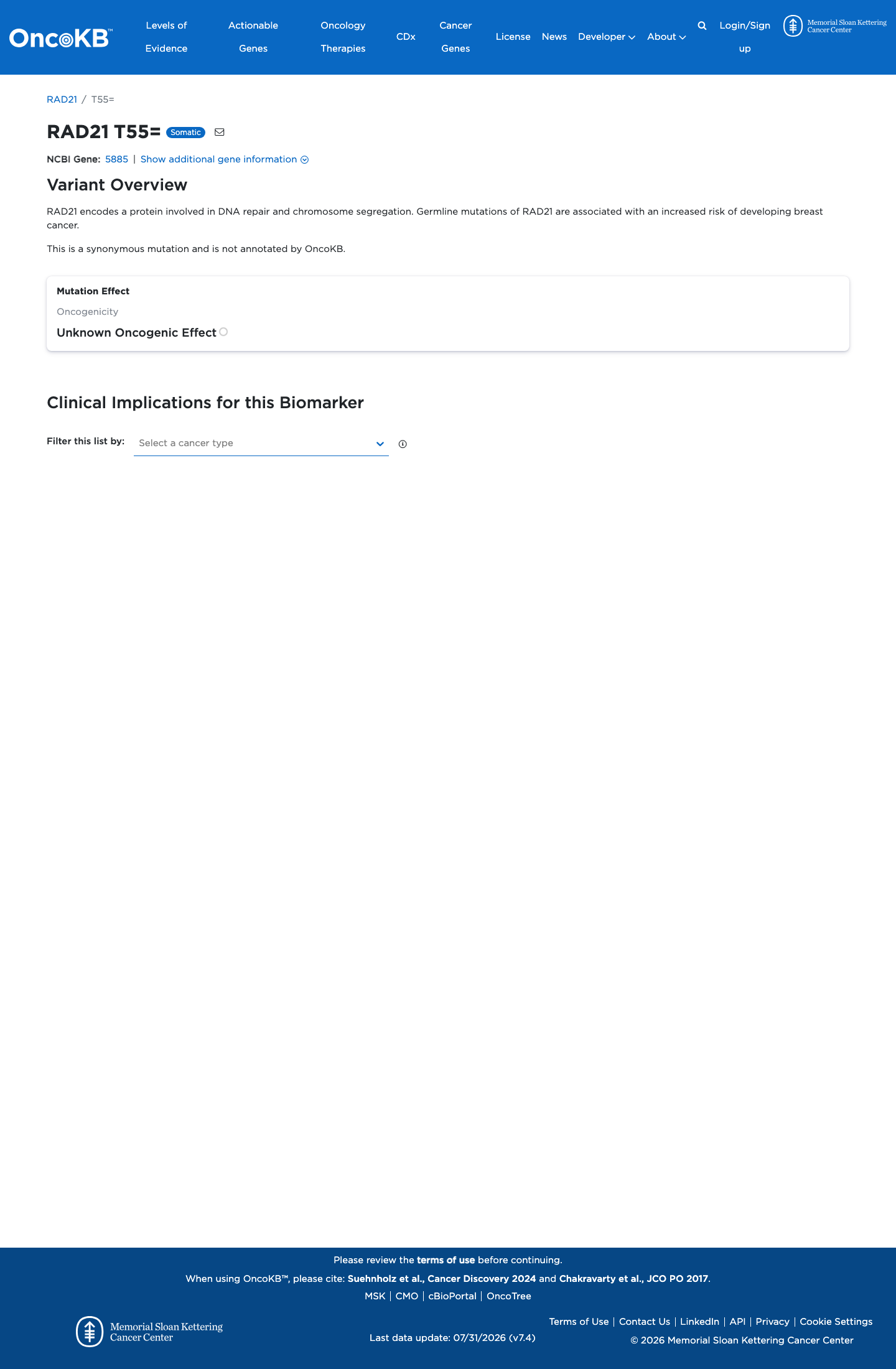
Functional / OncoKB screenshot
Functional Unknown Oncogenic Effect
OncoKB identified curated literature and non-variant-specific oncogenicity context for review; listed oncogenicity label: Unknown Oncogenic Effect.
OncoKB ↗
COSMIC screenshot
COSMIC
Cancer hotspots screenshot
Cancer hotspots
Somatic evidence Not in COSMIC / hotspots
COSMIC
This variant does not lie in a statistically significant hotspot. This variant has not previously been reported in somatic cancers (COSMIC).
Hotspots
This variant does not lie in a statistically significant hotspot.
Sources & reference links
8Sources
ClinVar
gnomAD v2.1
gnomAD v4.1
gnomAD-Canada
SpliceAI
OncoKB
COSMIC
Cancer hotspots
Triaged references · 2 PMIDs not cited in assessment
20301283 ↗ Cornelia de Lange Syndrome. CLINVAR
28492532 ↗ Sherloc: a comprehensive refinement of the ACMG-AMP variant classification criteria. CLINVAR