Analysis in progress
Initialising…
0%
complete
This report is still being assembled — sections appear as each stage finishes. It isn't final yet.
PRPF8
Final classification
VUS
PRPF8 c.2013A>G · p.Thr671=
PRPF8 ·synonymous

BP4 (Supporting): synonymous variant (p.Thr671=) with SpliceAI max delta 0.004, far below the 0.1 threshold, indicating no predicted splice impact.

Gene
PRPF8
Transcript
NM_006445.3
HGVS · transcript:coding
NM_006445.3:c.2013A>G
Consequence
synonymous
exon 15
GRCh38
chr17:1677144 T>C
GRCh37
chr17:1580438 T>C
Basis Variant of Uncertain Significance: the only met criterion is BP4 (supporting, benign direction; SpliceAI max delta 0.004), which alone matches no Benign or Likely Benign combination rule. Flagged for human review: borderline South Asian frequency (BS1) and homozygous gnomAD observations (BS2).
Variant of Uncertain Significance: the only met criterion is BP4 (supporting, benign direction; SpliceAI max delta 0.004), which alone matches no Benign or Likely Benign combination rule. Flagged for human review: borderline South Asian frequency (BS1) and homozygous gnomAD observations (BS2).
Classification rationale
BP4 VUS
PRPF8 c.2013A>G synonymous · exon 15

BP4 (Supporting): synonymous variant (p.Thr671=) with SpliceAI max delta 0.004, far below the 0.1 threshold, indicating no predicted splice impact. Overall: Variant of Uncertain Significance - a single supporting benign criterion matches no Pathogenic, Likely Pathogenic, Benign, or Likely Benign combination rule.

BP4 VUS
Gene diagram · NM_006445.3 · variants mapped to exon structure
PRPF8 NM_006445.3
Fetching transcript structure from UCSC…
Applied criteria · 1 applied · 18 assessed
Applied · 1
Strength Supporting Moderate Strong Very strong
BP4 supporting Benign
Met (Supporting): SpliceAI max delta 0.004 is far below the <0.1 BP4 threshold, indicating no predicted splice impact.
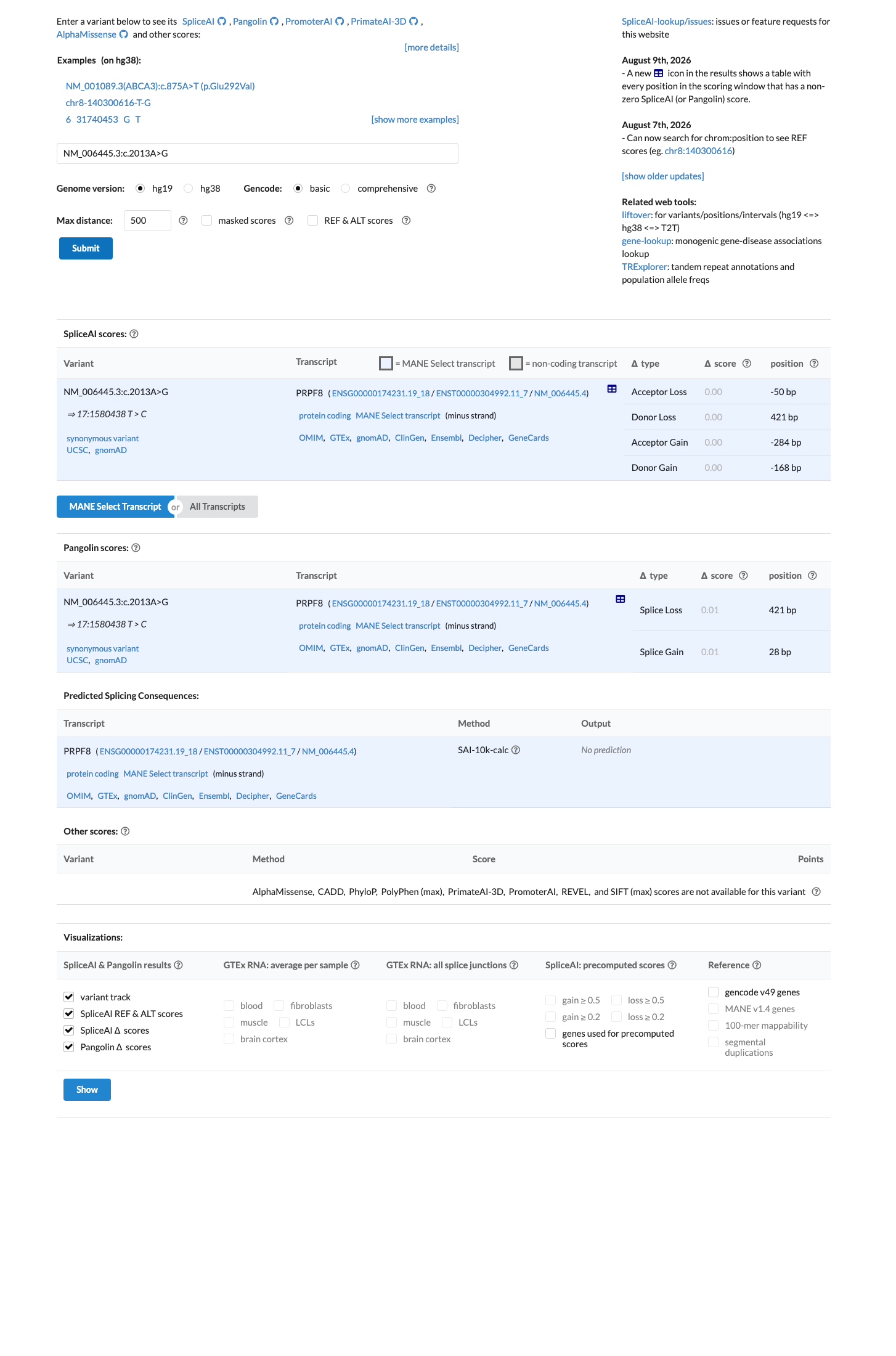
SpliceAI lookup (spliceai; tool publication Jaganathan et al. 2019, PMID 30661751, Cell 176:535-548) reports max_delta_score 0.004 for NM_006445.3:c.2013A>G.Governing PP3/BP4 calibration (output/generic_acmg_classification_rules.md, source basis Richards et al. 2015 PMID 25741868; SpliceAI thresholds as per SVI recommendations reflected in VCEP CSPECs, e.g. ATM, per Walker et al. 2023): for synonymous/non-missense variants SpliceAI max delta < 0.1 -> BP4 (supporting). Observed 0.004 < 0.1, so BP4 is met (supporting).Per the governing framework, exactly one mechanism is evaluated per variant and a synonymous variant is scored with SpliceAI only; the missense path (REVEL) is not applicable, and no REVEL/BayesDel/aGVGD scores are available for this variant (REVEL and BayesDel lookups found=false).
Assessed · not applied
Pathogenic
PS2 Not assessed: no de novo observation with parental testing exists for this variant in any clinical source.
PS3 Not assessed: no functional assay data exist; SpliceAI (max delta 0.004) is in-silico and cannot substitute.
PS4 Not assessed: no case-control or affected-cohort frequency exists; gnomAD documents only general-population frequency.
PM2 Not met: highest subpopulation frequency (South Asian 0.284-0.320%) far exceeds the 0.1% threshold, so the variant is not rare.
PM6 Not assessed: no assumed de novo event or parental testing data exist for this variant.
PP1 Not assessed: no segregation analysis or affected-family genotype data exist for this variant.
PP3 Not met: SpliceAI max delta 0.004 is far below the >0.2 PP3 threshold; no other computational evidence supports pathogenicity.
PP4 Not assessed: no clinical case or phenotype data exist to evaluate phenotype specificity for this variant.
PP5 Not met: no expert-panel ClinVar pathogenic classification exists; the sole submission is a single-laboratory Benign label.
Benign
BA1 Not met: maximum allele frequency (South Asian 0.32%) is far below the >1% BA1 threshold.
BS1 Not met: population-maximum allele frequencies (grpmax FAF 0.256-0.269%) stay below the 0.3% threshold.
BS2 Not met: gnomAD homozygotes (4 in v4.1) do not satisfy the healthy-adult phenotype requirement.
BS3 Not assessed: no well-established functional studies exist; SpliceAI max delta 0.004 is in-silico, not a validated assay.
BS4 Not assessed: no affected-family non-segregation data exist for this variant.
BP2 Not assessed: no phase information (trans or cis with a pathogenic variant) is documented for this variant.
BP5 Not assessed: no case-level data exist to evaluate an alternate molecular basis for disease.
BP6 Not met: the Benign ClinVar label comes from a single laboratory, not an expert panel, so it cannot trigger BP6.
BP7 Not met: crediting BP7 would double-count the SpliceAI prediction already used for BP4, and conservation data are absent.
N/A · 9 PVS1 · PS1 · PM1 · PM3 · PM4 · PM5 · PP2 · BP1 · BP3
Research & evidence
Population frequency
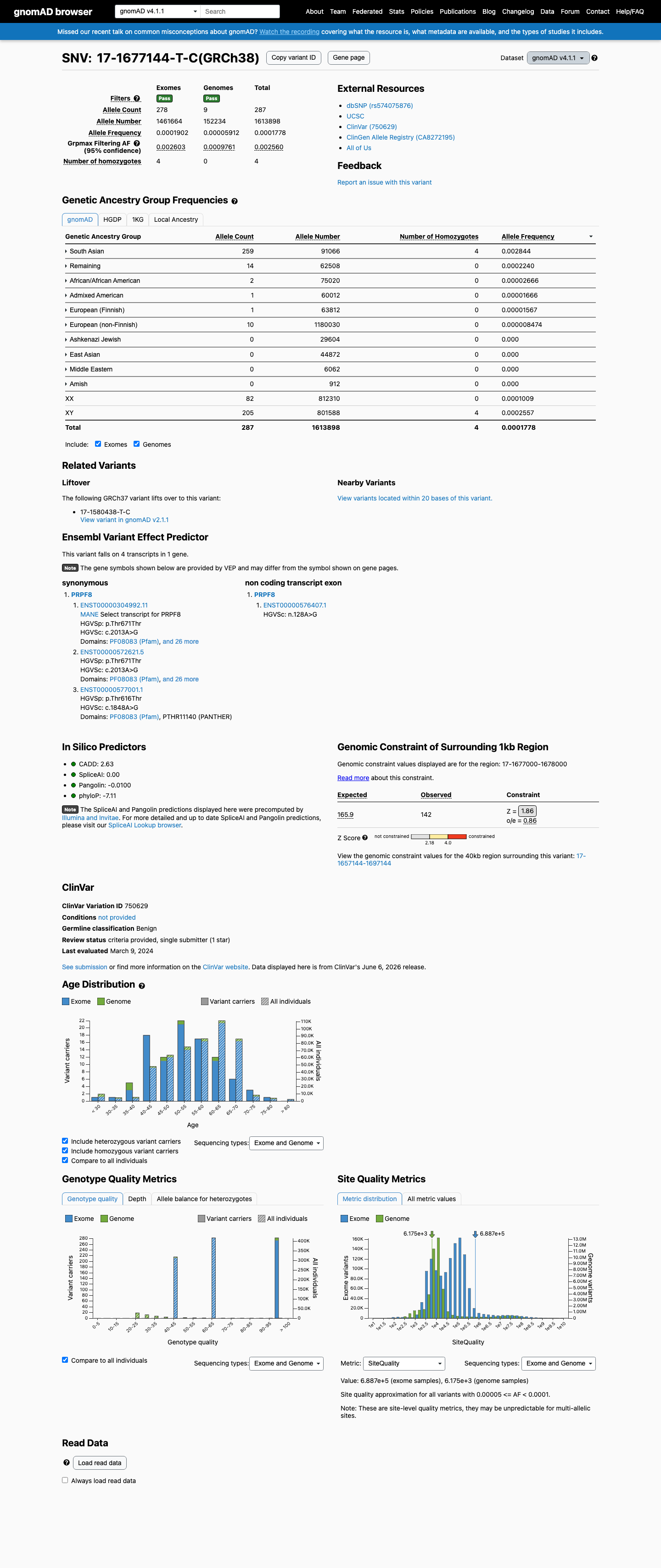
gnomAD v4.1 screenshot
gnomAD v4.1
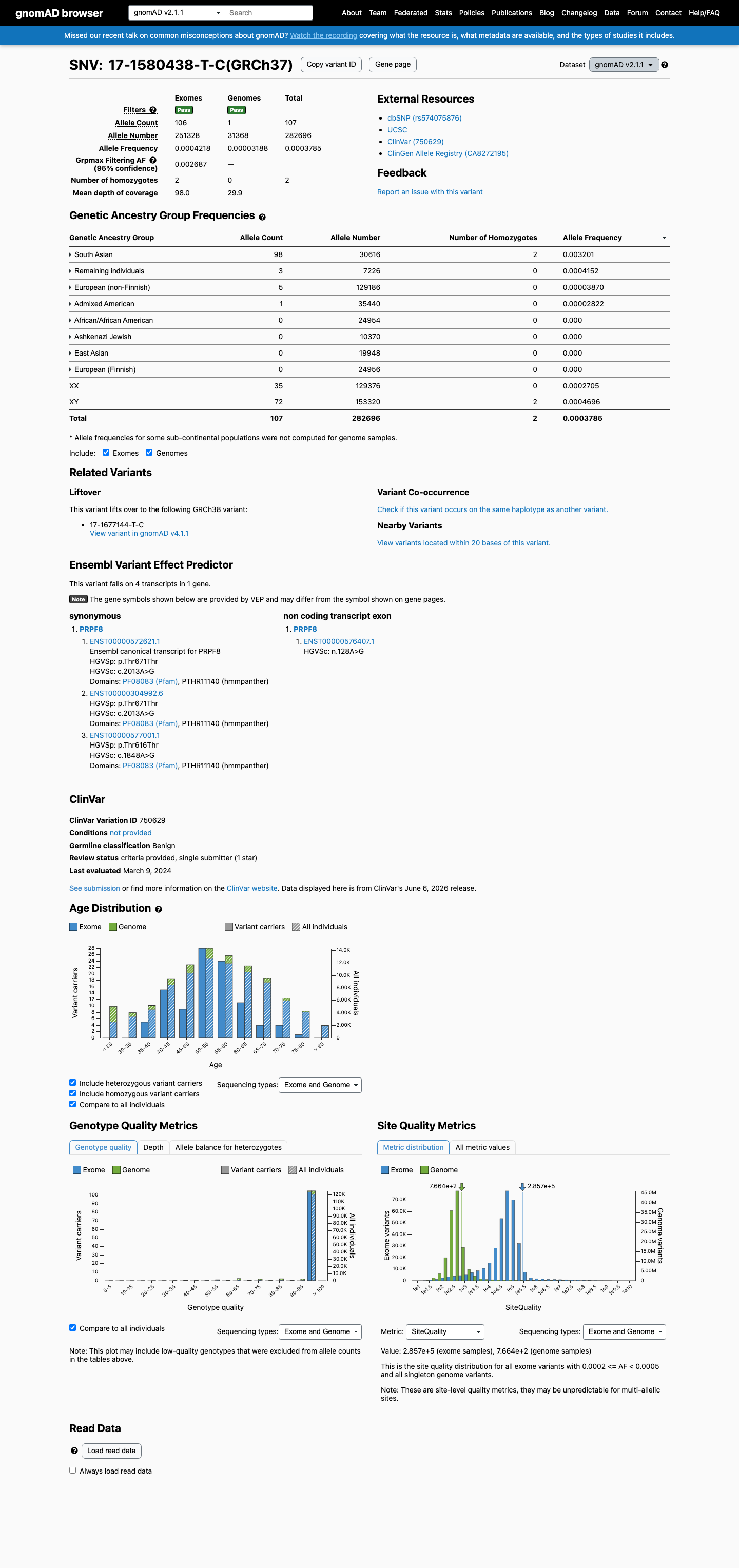
gnomAD v2.1 screenshot
gnomAD v2.1
v4.1
This variant is present in gnomAD v4.1 (AF= 0.00017783; MAF= 0.01778%, 287/1613898 alleles, homozygotes = 4) and has highest observed frequency in the South Asian population (AF= 0.00284409; MAF= 0.28441%, 259/91066 alleles, homozygotes = 4); grpmax FAF= 0.00255955.
v2.1
This variant is present in gnomAD v2.1 (AF= 0.000378498; MAF= 0.03785%, 107/282696 alleles, homozygotes = 2) and has highest observed frequency in the South Asian population (AF= 0.00320094; MAF= 0.32009%, 98/30616 alleles, homozygotes = 2); grpmax FAF= 0.00268731.
🇨🇦 CA
This variant is present in gnomAD-Canada v1.0 (AF= 0.0001085894233901618, 2/18418 alleles, homozygotes = 0).
Allele frequency by ancestry
three datasets · side by side
gnomAD v4.1
0.018% · 287 / 1,613,898
4 hom · FAF 0.26%
South Asian
259 / 91,066
0.28%
4 hom
Remaining individuals
14 / 62,508
0.022%
African/African American
2 / 75,020
0.0027%
Admixed American
1 / 60,012
0.0017%
European (Finnish)
1 / 63,812
0.0016%
European (non-Finnish)
10 / 1,180,030
0.00085%
+ 4 not observed (Amish, East Asian, Middle Eastern, Ashkenazi Jewish)
gnomAD v2.1
0.038% · 107 / 282,696
2 hom · FAF 0.27%
South Asian
98 / 30,616
0.32%
2 hom
Remaining individuals
3 / 7,226
0.042%
European (non-Finnish)
5 / 129,186
0.0039%
Admixed American
1 / 35,440
0.0028%
+ 4 not observed (African/African American, Ashkenazi Jewish, East Asian, European (Finnish))
gnomAD Canada 🇨🇦
0.011% · 2 / 18,418
0 hom · FAF 0.026%
South Asian
2 / 1,362
0.15%
+ 8 not observed (African/African American, Latino/Admixed American, Ashkenazi Jewish, East Asian, European (Finnish), Middle Eastern, European (non-Finnish), Remaining individuals)
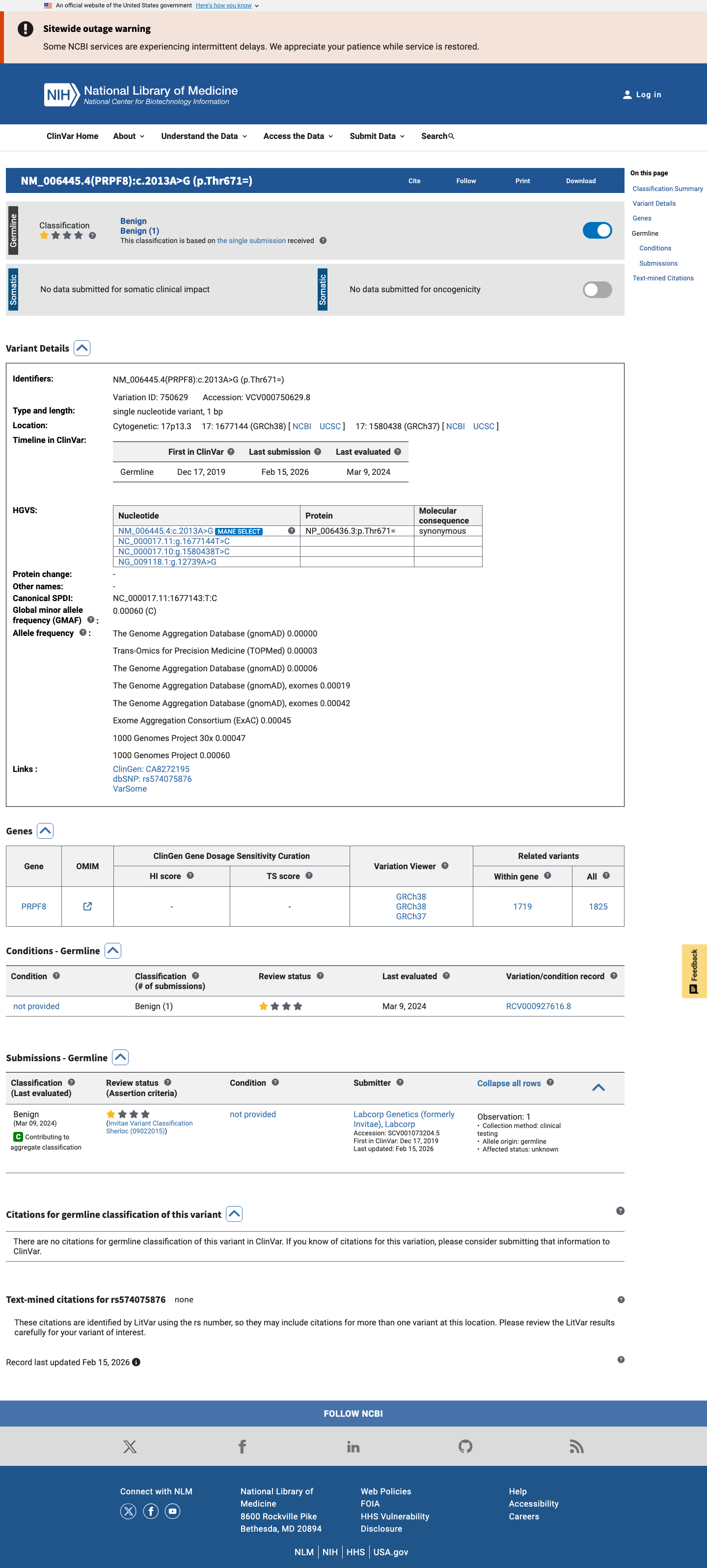
ClinVar screenshot
ClinVar
This variant has been reported in ClinVar as Benign (1 clinical laboratory). (ClinVarID = 750629)
SpliceAI screenshot
In silico
SpliceAI predicts no significant splice impact for this variant (max delta score = 0.00).
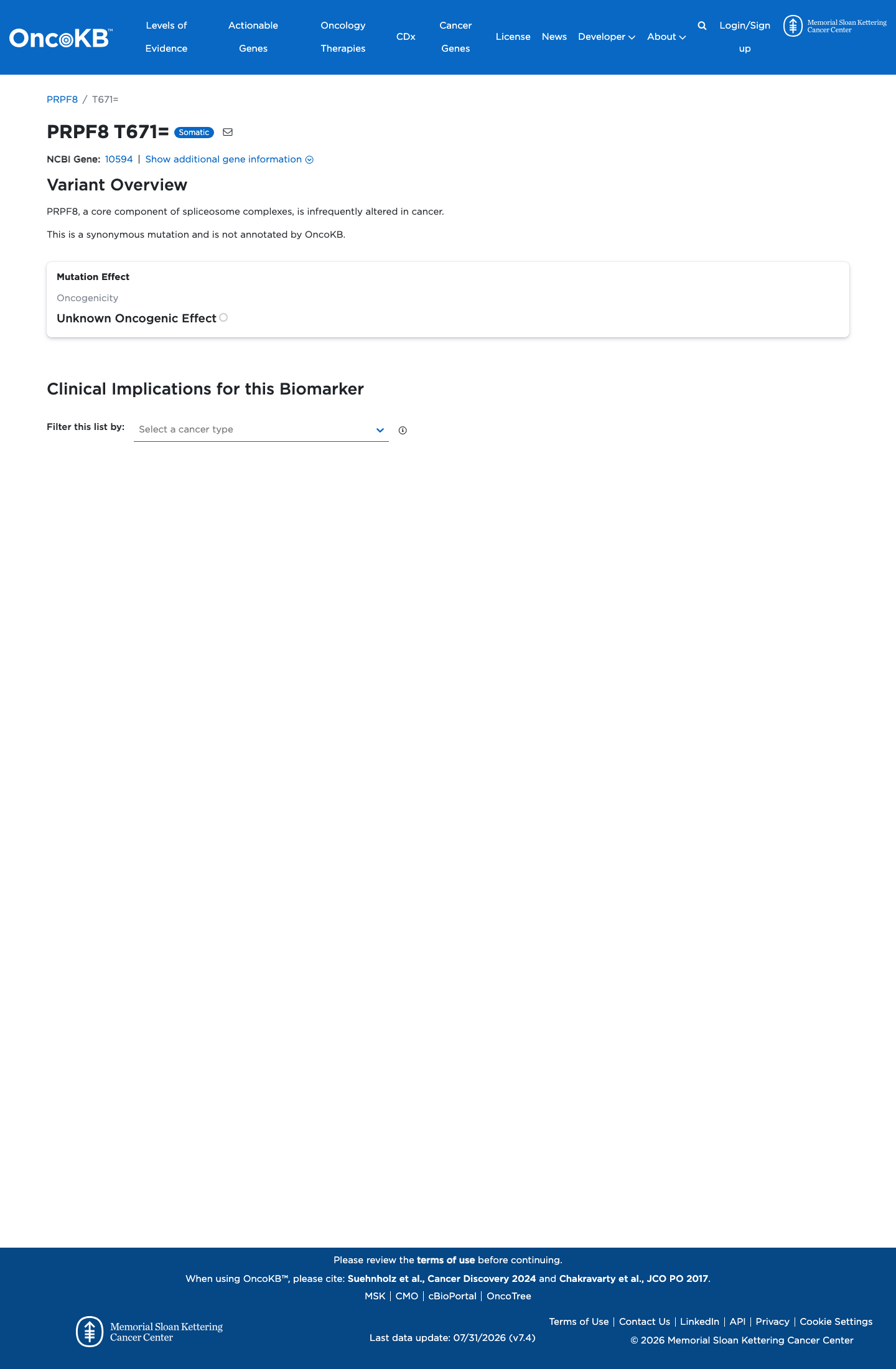
Functional / OncoKB screenshot
Functional Unknown Oncogenic Effect
OncoKB identified curated literature and non-variant-specific oncogenicity context for review; listed oncogenicity label: Unknown Oncogenic Effect.
OncoKB ↗
COSMIC screenshot
COSMIC
Cancer hotspots screenshot
Cancer hotspots
Somatic evidence Not in COSMIC / hotspots
COSMIC
This variant does not lie in a statistically significant hotspot. This variant has not previously been reported in somatic cancers (COSMIC).
Hotspots
This variant does not lie in a statistically significant hotspot.
Sources & reference links
8Sources
ClinVar
gnomAD v2.1
gnomAD v4.1
gnomAD-Canada
SpliceAI
OncoKB
COSMIC
Cancer hotspots
Triaged references · 1 PMID not cited in assessment
28492532 ↗ Sherloc: a comprehensive refinement of the ACMG-AMP variant classification criteria. CLINVAR