Analysis in progress
Initialising…
0%
complete
This report is still being assembled — sections appear as each stage finishes. It isn't final yet.
PRPF8
Final classification
Benign
BA1
PRPF8
c.4639-17T>G
p.?
unknown · exon 29i

PRPF8 encodes a core component of the spliceosome, the cellular machinery that removes introns from pre-mRNA during gene expression; it is essential for the catalytic second step of pre-mRNA splicing and helps assemble splicing complexes through its WD repeat domains. Mutations in PRPF8 are a known cause of autosomal dominant retinitis pigmentosa, an inherited form of progressive vision loss. In cancer, altered PRPF8 splicing disrupts the proofreading function of the spliceosome and is often found alongside TP53 loss-of-function mutations, implicating it in tumor development as a tumor suppressor.

This variant

PRPF8 mutations cause autosomal dominant retinitis pigmentosa and are implicated in cancer, yet this deep intronic variant is common in the general population — 14.95% allele frequency with hundreds of homozygotes — indicating it is normal population variation rather than a disease-causing change. The benign classification reflects that the variant shows no evidence of disrupting PRPF8 splicing or function.

Transcript
NM_006445.3
HGVS · transcript:coding
NM_006445.3:c.4639-17T>G
GRCh38
chr17:1660595 A>C
GRCh37
chr17:1563889 A>C
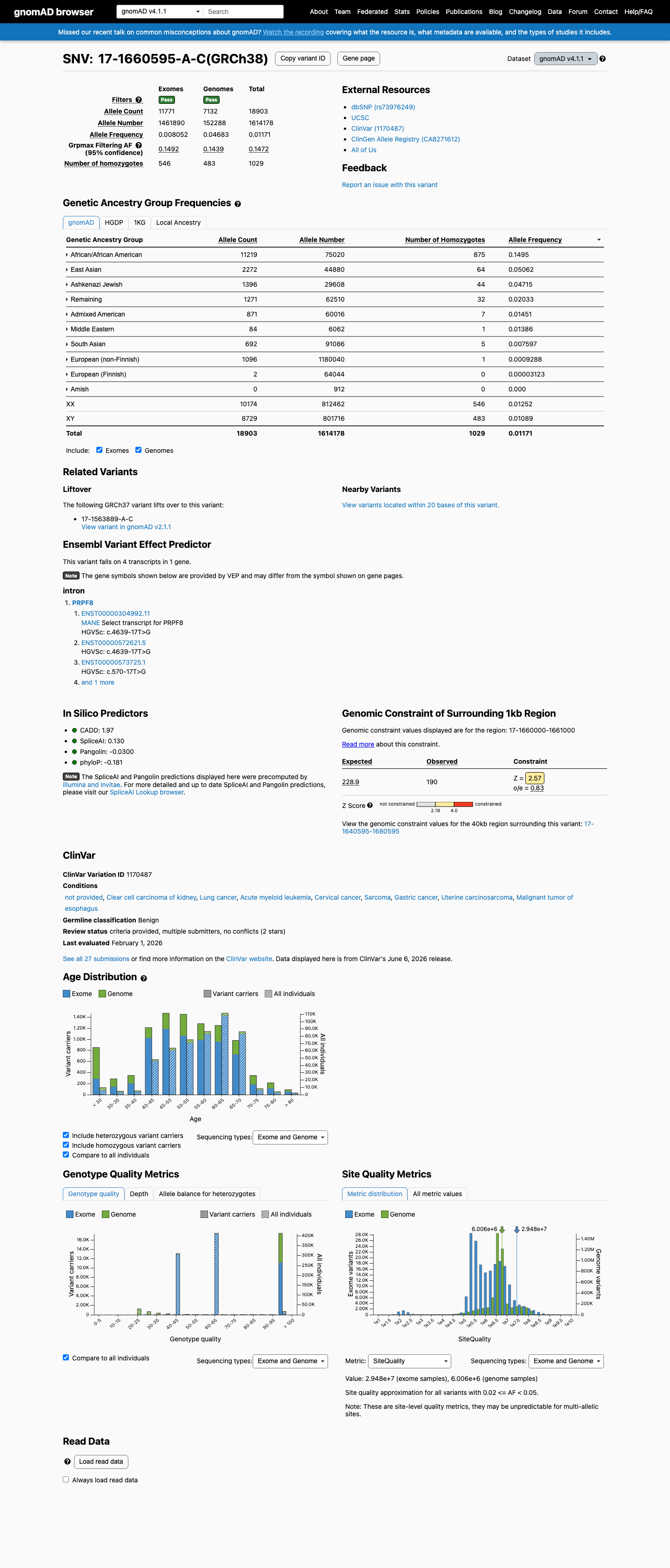
Basis Benign: BA1 met at stand-alone strength — gnomAD v4.1 African/African American allele frequency 14.95% vs the >5% threshold; no pathogenic criteria met.
Benign: BA1 met at stand-alone strength — gnomAD v4.1 African/African American allele frequency 14.95% vs the >5% threshold; no pathogenic criteria met.
Classification rationale
BA1 Benign
PRPF8 c.4639-17T>G unknown · exon 29i

BA1 (Stand-alone Benign): gnomAD v4.1 African/African American allele frequency 14.95% (11,219/75,020 alleles, 875 homozygotes) far exceeds the >5% stand-alone benign threshold. Overall classification: Benign, produced by the BA1 stand-alone rule under generic ACMG/AMP combination criteria.

BA1 Benign
Gene diagram · NM_006445.3 · variants mapped to exon structure
PRPF8 NM_006445.3
Fetching transcript structure from UCSC…
Applied criteria · 1 applied · 17 assessed
MetEvidence satisfies this criterion.
Not metEvaluated against available evidence; threshold not reached.
Not assessedApplies in principle, but no evidence was found to evaluate it.
N/ADoesn't apply to this variant type.
Applied · 1
Strength Supporting Moderate Strong Very strong
BA1 stand-alone Benign
Met (stand-alone benign): gnomAD v4.1 African/African American allele frequency 14.95% (875 homozygotes) far exceeds the >5% threshold.
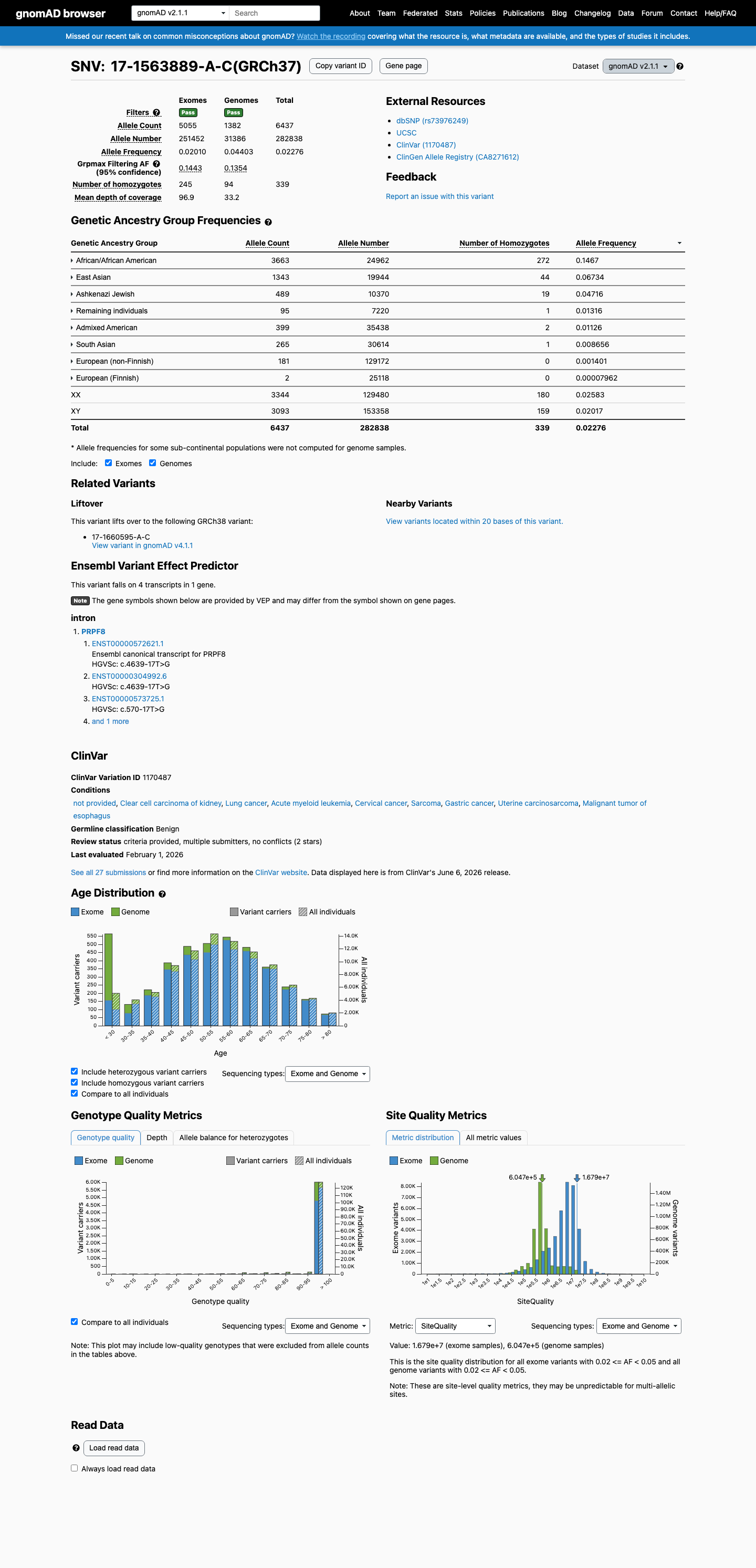
gnomAD v4.1: total AF 1.17106% (18,903/1,614,178 alleles), African/African American AF 14.9547% (11,219/75,020), 875 homozygotes, and grpmax FAF 14.7231%.gnomAD v2.1 independently reports African/African American AF 14.6743% (3,663/24,962), 272 homozygotes, and grpmax FAF 14.4349%.gnomAD-Canada reports African AF 15.7171% (160/1,018), 11 homozygotes, and FAF95 13.7306%.
Assessed · not applied · 5 not met · 12 not assessed
Pathogenic
PS2 Not assessed: no parental or proband data were available to confirm a de novo occurrence.
PS3 Not assessed: no functional assay data (e.g., splicing assay) for this variant were available.
PS4 Not assessed: no case-control or case-series evidence of enrichment in PRPF8-related disease was available.
PM2 Not met: variant is common (gnomAD v4.1 African/African American AF 14.95%), the opposite of the rarity PM2 requires.
PM3 Not assessed: no affected individual with this variant in trans with a pathogenic PRPF8 variant.
PM6 Not assessed: no reported de novo occurrence, with or without confirmed parental identity.
PP1 Not assessed: no pedigree, segregation, or informative meiosis data were available.
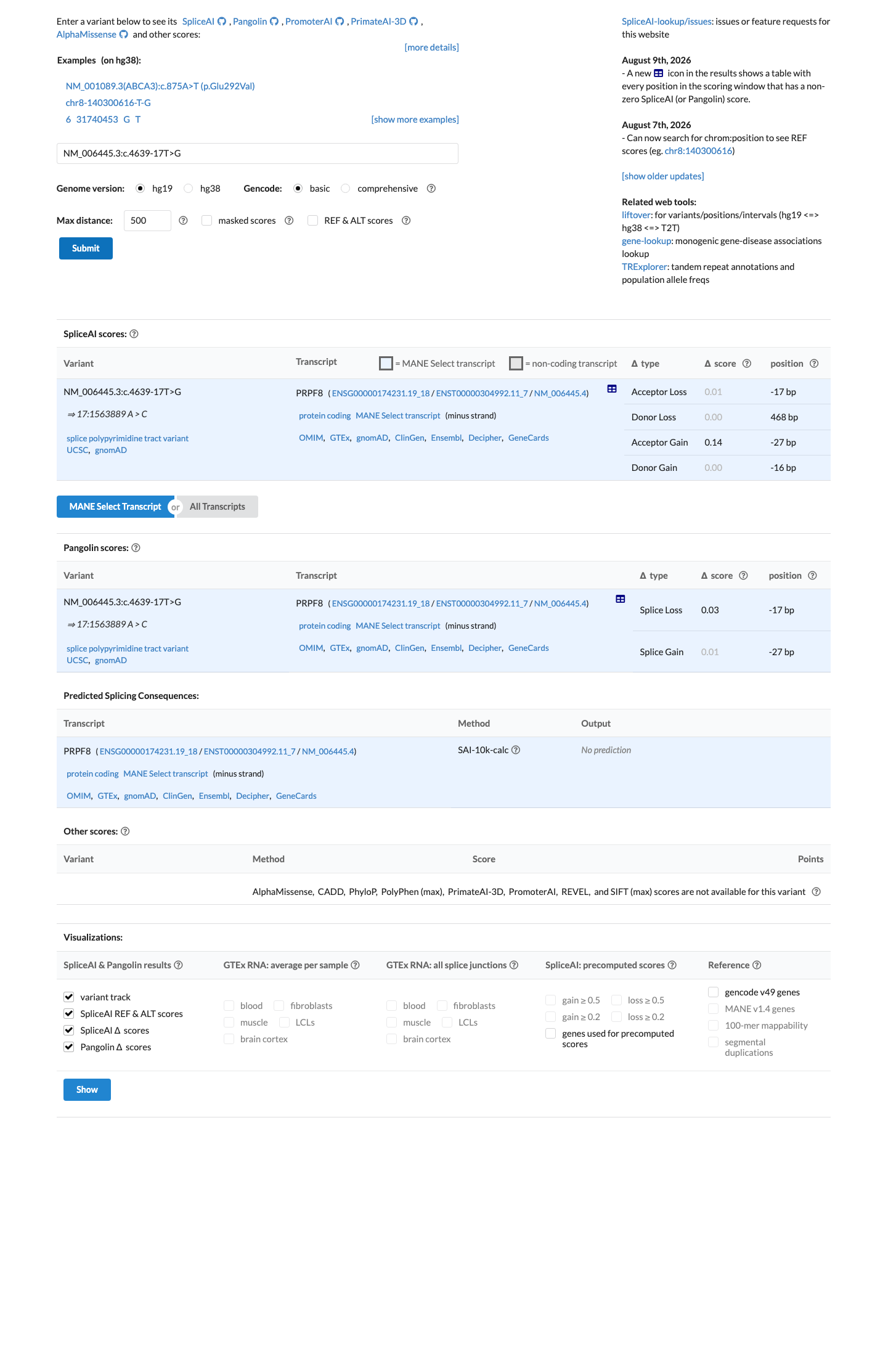
PP3 Not met: SpliceAI max delta 0.135 falls in the inconclusive 0.1-0.2 band, below the >=0.2 splice-altering threshold.
PP4 Not assessed: no phenotype data link this variant to a PRPF8-related disorder.
PP5 Not met: no pathogenic or likely pathogenic expert-panel ClinVar assertion exists for this exact variant.
Benign
BS2 Not assessed: population records lack the phenotype and age data needed to confirm observation in healthy adults.
BS3 Not assessed: no functional assay demonstrating normal splicing or protein function was available.
BS4 Not assessed: no family data showing the variant does not segregate with disease.
BP2 Not assessed: no data establish this variant in cis or in trans with a pathogenic PRPF8 variant.
BP4 Not met: SpliceAI max delta 0.135 exceeds the <0.1 threshold needed to predict no splice effect.
BP5 Not assessed: no individual with this variant and a phenotype explained by an alternative diagnosis.
BP6 Not met: no benign or likely benign expert-panel ClinVar assertion exists for this exact variant.
N/A · 10 PVS1 · PS1 · PM1 · PM4 · PM5 · PP2 · BS1 · BP1 · BP3 · BP7
Research & evidence
Population frequency · supports benign
gnomAD v4.1 screenshot
gnomAD v4.1
gnomAD v2.1 screenshot
gnomAD v2.1
v4.1
This variant is present in gnomAD v4.1 (AF= 0.0117106; MAF= 1.17106%, 18903/1614178 alleles, homozygotes = 1029) and has highest observed frequency in the African/African American population (AF= 0.149547; MAF= 14.95468%, 11219/75020 alleles, homozygotes = 875); grpmax FAF= 0.147231.
v2.1
This variant is present in gnomAD v2.1 (AF= 0.0227586; MAF= 2.27586%, 6437/282838 alleles, homozygotes = 339) and has highest observed frequency in the African/African American population (AF= 0.146743; MAF= 14.67430%, 3663/24962 alleles, homozygotes = 272); grpmax FAF= 0.144349.
🇨🇦 CA
This variant is present in gnomAD-Canada v1.0 (AF= 0.020738327904451685, 382/18420 alleles, homozygotes = 17).
Allele frequency by ancestry
three datasets · side by side
gnomAD v4.1
1.2% · 18903 / 1,614,178
1029 hom · FAF 15%
African/African American
11219 / 75,020
15%
875 hom
East Asian
2272 / 44,880
5.1%
64 hom
Ashkenazi Jewish
1396 / 29,608
4.7%
44 hom
Remaining individuals
1271 / 62,510
2%
32 hom
Admixed American
871 / 60,016
1.5%
7 hom
Middle Eastern
84 / 6,062
1.4%
1 hom
South Asian
692 / 91,086
0.76%
5 hom
European (non-Finnish)
1096 / 1,180,040
0.093%
1 hom
European (Finnish)
2 / 64,044
0.0031%
+ 1 not observed (Amish)
gnomAD v2.1
2.3% · 6437 / 282,838
339 hom · FAF 14%
African/African American
3663 / 24,962
15%
272 hom
East Asian
1343 / 19,944
6.7%
44 hom
Ashkenazi Jewish
489 / 10,370
4.7%
19 hom
Remaining individuals
95 / 7,220
1.3%
1 hom
Admixed American
399 / 35,438
1.1%
2 hom
South Asian
265 / 30,614
0.87%
1 hom
European (non-Finnish)
181 / 129,172
0.14%
European (Finnish)
2 / 25,118
0.008%
gnomAD Canada 🇨🇦
2.1% · 382 / 18,420
17 hom · FAF 14%
African/African American
160 / 1,018
16%
11 hom
East Asian
109 / 1,338
8.1%
3 hom
Ashkenazi Jewish
37 / 832
4.4%
1 hom
Middle Eastern
4 / 144
2.8%
1 hom
Remaining individuals
24 / 1,138
2.1%
Latino/Admixed American
14 / 838
1.7%
South Asian
14 / 1,362
1%
1 hom
European (non-Finnish)
20 / 11,742
0.17%
+ 1 not observed (European (Finnish))
ClinVar screenshot
ClinVar
This variant is present in ClinVar (Variation ID: 1170487); submission details unavailable.
SpliceAI screenshot
In silico
SpliceAI predicts no significant splice impact for this variant (max delta score = 0.14).
Functional No data
No calibrated functional assay or RNA evidence was identified for this variant.
OncoKB ↗
COSMIC screenshot
COSMIC
Somatic evidence
COSMIC
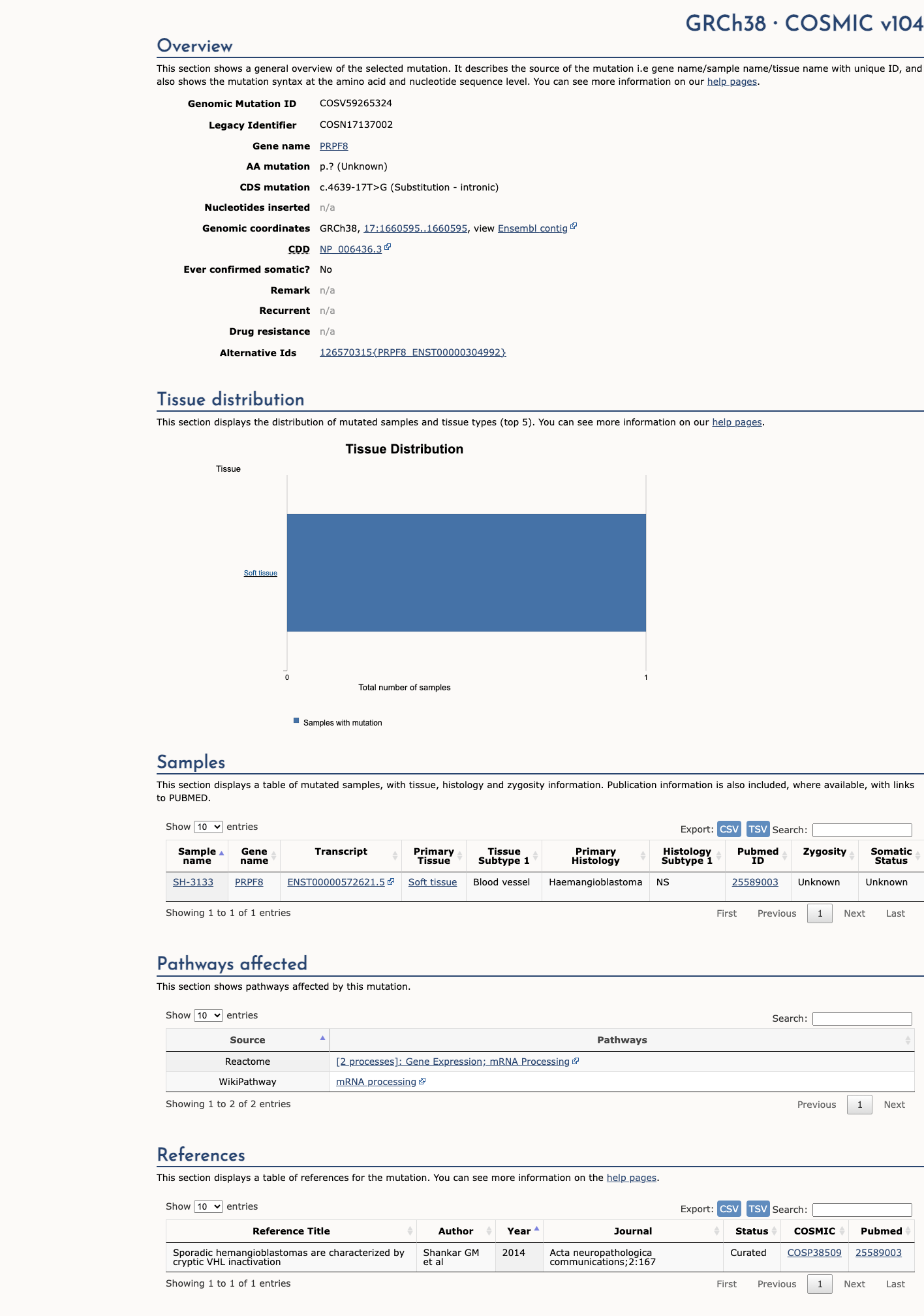
This variant has previously been reported in somatic cancers (COSMIC; COSV59265324, n = 1 times).
Hotspots
This variant does not lie in a statistically significant cancer hotspot.
COSMIC ↗
Sources & reference links
7Sources
ClinVar
gnomAD v2.1
gnomAD v4.1
gnomAD-Canada
SpliceAI
OncoKB
COSMIC
Triaged references · 3 PMIDs not cited in assessment
25741868 ↗ Standards and guidelines for the interpretation of sequence variants: a joint consensus recommendation of the American College of Medical Genetics and Genomics and the Association for Molecular Pathology. CLINVAR
31275557 ↗ Pan-cancer repository of validated natural and cryptic mRNA splicing mutations. CLINVAR
28492532 ↗ Sherloc: a comprehensive refinement of the ACMG-AMP variant classification criteria. CLINVAR