The variant is a synonymous change (p.Leu2083=) with no predicted splice impact (SpliceAI max delta 0.01), so no loss-of-function or missense mechanism is supported.1 It is present in gnomAD at 0.469% (v2.1) and 0.267% (v4.1) allele frequency with 32 and 89 homozygotes respectively, exceeding the 0.3% BS1 threshold for a disorder-causing variant in a rare dominant retinopathy gene (BS1, strong benign).2 ClinVar reports the variant as Benign from three clinical laboratories, a reputable-source benign assertion applied at supporting strength (BP6).3 As a synonymous variant with no splice impact and no evidence of high conservation, BP7 is applied at supporting strength.4 No pathogenic criterion is met: PVS1, PS1, PM1, PM5, PP2, BP1, BP3, PM3, and PM4 are structurally inapplicable to a synonymous substitution, and no de novo, segregation, functional, case-prevalence, or phenotype evidence exists.5 Per the generic ACMG/AMP 2015 combination rules, one strong benign criterion plus supporting benign criteria (BS1 + BP6 + BP7) supports Likely Benign.6
Final classification
Likely Benign
BS1BP6BP7
PRPF8
c.6247C>T
p.Leu2083=
missense
This variant
The variant is a synonymous change (p.Leu2083=) with no predicted splice impact (SpliceAI max delta 0.01), so no loss-of-function or missense mechanism is supported.
gene-specific framework lacked a usable explicit final combination framework, so generic ACMG/AMP 2015 final-combination rules were applied as fallback; applied criteria: BS1 strong benign, BP6 supporting benign, BP7 supporting benign; combination = 1 strong benign + 2 supporting benign, which maps to Likely Benign.
Classification rationale
BS1BP6BP7
Likely Benign
PRPF8 c.6247C>T
missense
BS1 + BP6 + BP7
→
Likely Benign
5
pvs1_variant_assessmentpm5_candidates
6
generic_acmg_combination_rulesPMID:25741868 ↗
LYFE Sciences is an AI system, and it can make mistakes. Criteria
may be applied incorrectly, sources may be misread, and a confident-looking
classification can still be wrong. Double-check every criterion and
its underlying evidence before relying on any call.
Gene diagram
· NM_006445.3 · variants mapped to exon structure
PRPF8
NM_006445.3
Fetching transcript structure from UCSC…
Applied criteria · 3 applied · 16 assessed
MetEvidence satisfies this criterion.
Not metEvaluated against available evidence; threshold not reached.
Not assessedApplies in principle, but no evidence was found to evaluate it.
N/ADoesn't apply to this variant type.
Applied · 3
Strength
Supporting
Moderate
Strong
Very strong
BS1
strong
Benign
Allele frequency exceeds the 0.3% BS1 threshold for a disorder-causing variant: 0.469% in gnomAD v2.1 (1327/282876 alleles, 32 homozygotes) and 0.267% in gnomAD v4.1 (89 homozygotes), with ~4.8% frequency in the African/African American subpopulation, indicating the variant is too common to cause a rare dominant retinopathy.
gnomAD v2.1 AF=0.469% >0.3% threshold32 homozygotesgnomAD v4.1 AF=0.267%
BP6
supporting
review
Benign
ClinVar, a reputable source, reports this variant as Benign from three clinical laboratories (ClinVarID 321876); the underlying laboratory evidence is not available for independent evaluation, consistent with BP6.
ClinVar classification Benign3 clinical laboratory submissions (IlluminaARUP
BP7
supporting
review
Benign
The variant is synonymous (p.Leu2083=) and SpliceAI predicts no impact on splicing (max delta 0.01); no evidence indicates the nucleotide is highly conserved or that the change disrupts function.
Synonymous consequence p.Leu2083=SpliceAI max delta 0.01 (no acceptor/donor gain or loss)
Assessed · not applied
· 16 not met · 0 not assessed
Pathogenic
PS2
No de novo occurrence of this variant has been reported in any source reviewed.
PS3
No variant-specific or systematic functional characterization of this variant exists in the reviewed literature; functional criteria cannot be applied.
PS4
No case-control or prevalence data indicate an enrichment of this variant in affected individuals.
PM2
Allele frequency far exceeds the PM2 threshold: 0.469% in gnomAD v2.1 and 0.267% in gnomAD v4.1, with 32 and 89 homozygotes respectively, so absence from population databases is not supported.
PM6
No de novo report (confirmed or assumed) for this variant was identified in any reviewed source.
PP1
No co-segregation data in affected family members is available for this variant.
PP3
Computational evidence does not support a deleterious effect: SpliceAI predicts no splice impact (max delta 0.01) and no missense predictors apply to a synonymous variant.
PP4
No phenotype or family history data specific to this variant was provided; the criterion cannot be applied.
PP5
Reputable sources report the variant as Benign rather than pathogenic, and no expert-panel pathogenic assertion exists; PP5 is not supported.
Benign
BA1
Overall allele frequency (0.469% in gnomAD v2.1) is below the 1% stand-alone benign threshold; the AFR subpopulation frequency (~4.8%) is high but does not meet BA1 at the population level.
BS2
Population database observations (including homozygotes) are not verified healthy-adult observations with full penetrance expected at an early age for PRPF8-associated dominant disease; BS2 is not strictly met, though BS1 already captures the frequency evidence.
BS3
No well-established functional studies demonstrating absence of damaging effect on protein function or splicing are available for this variant.
BS4
No segregation data showing lack of segregation in affected family members is available.
BP2
No observation of the variant in trans with a pathogenic variant (or in cis with a pathogenic variant) is documented.
BP4
Only a single computational line (SpliceAI max delta 0.01) is available; multiple independent lines of computational evidence of no impact are not met, and missense predictors do not apply to a synonymous variant (BP7 covers this variant type).
BP5
No documented alternate molecular basis of disease in a case carrying this variant is available.
N/A · 9
PVS1 · PS1 · PM1 · PM3 · PM4 · PM5 · PP2 · BP1 · BP3
Research & evidence
Population frequency · supports benign
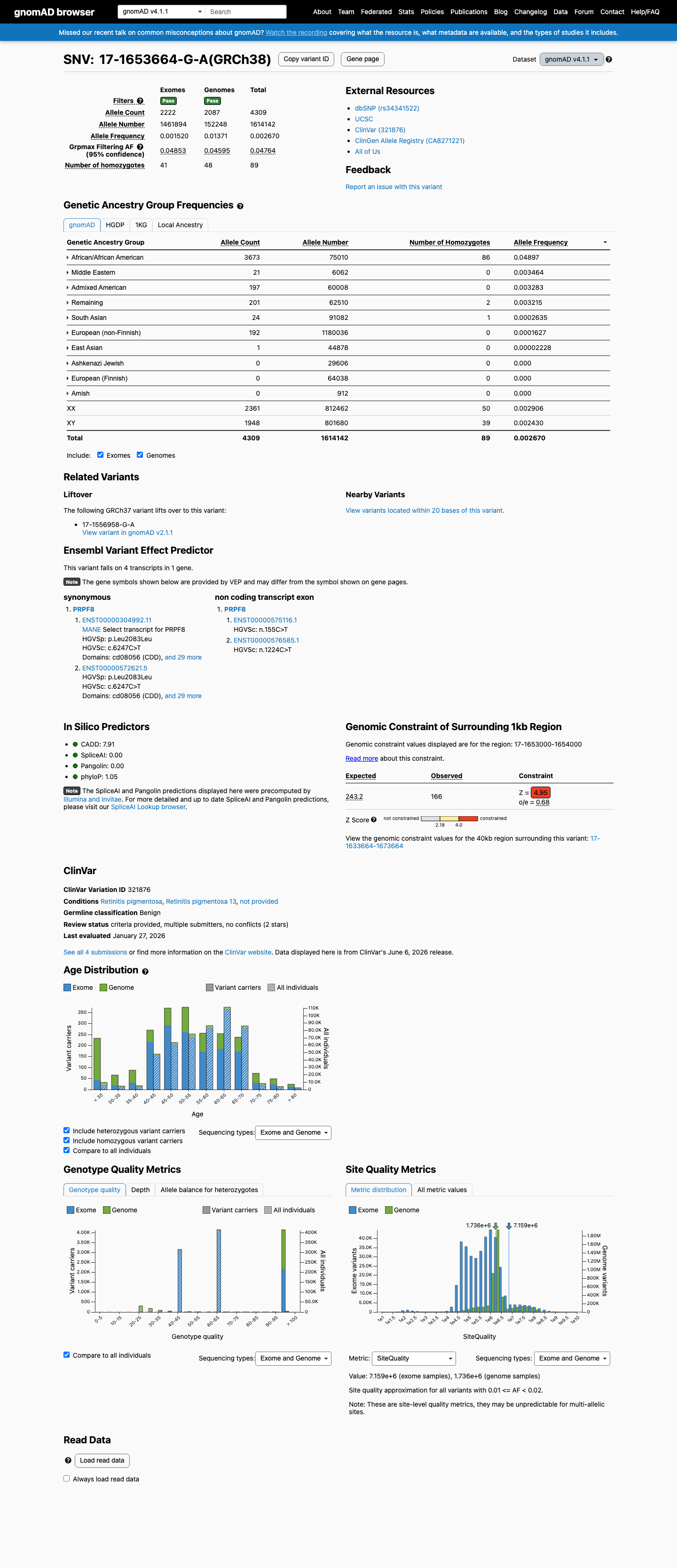
gnomAD v4.1
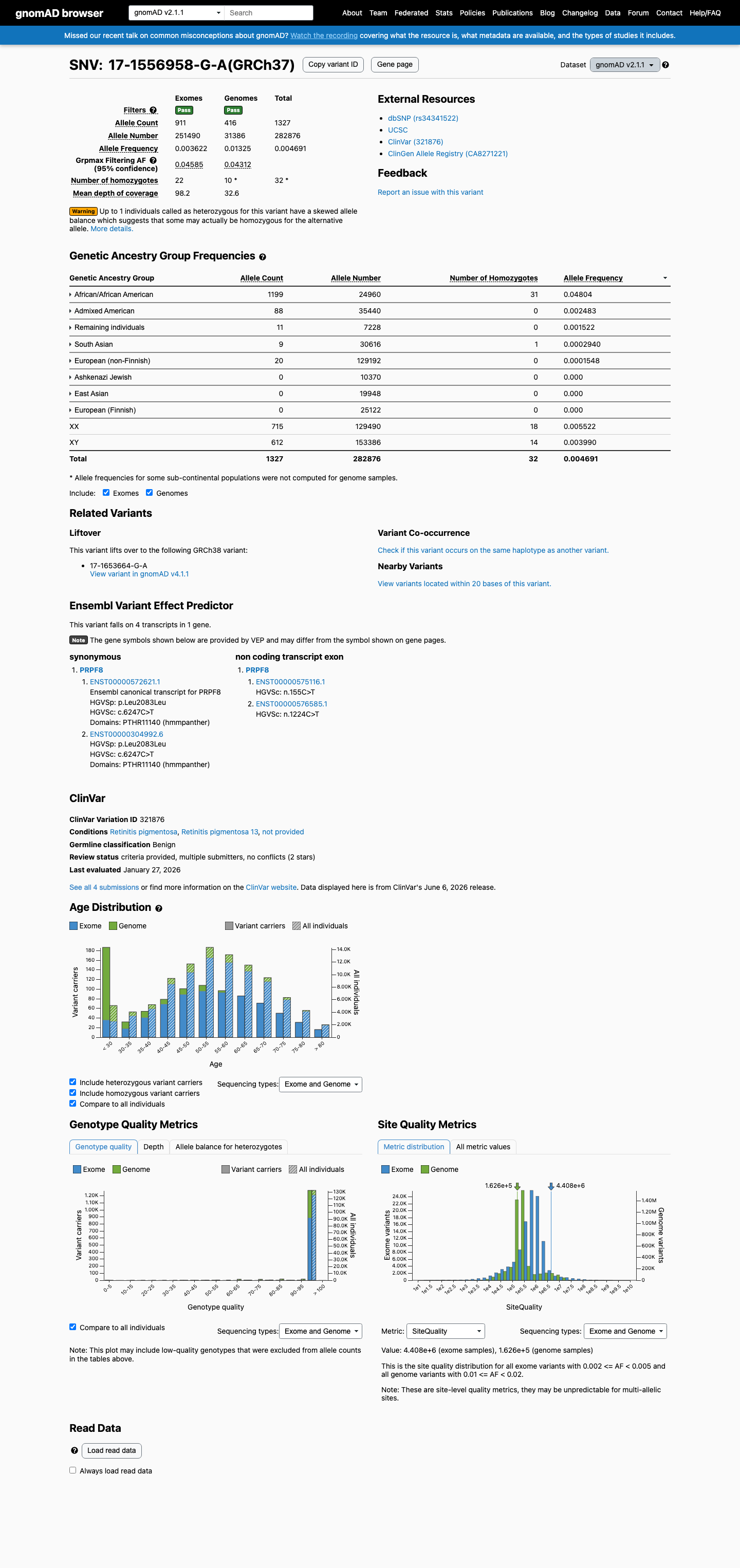
gnomAD v2.1
v4.1
This variant is present in gnomAD v4.1 (AF= 0.00266953; MAF= 0.26695%, 4309/1614142 alleles, homozygotes = 89) and has highest observed frequency in the African/African American population (AF= 0.0489668; MAF= 4.89668%, 3673/75010 alleles, homozygotes = 86); grpmax FAF= 0.0476449.
v2.1
This variant is present in gnomAD v2.1 (AF= 0.0046911; MAF= 0.46911%, 1327/282876 alleles, homozygotes = 32) and has highest observed frequency in the African/African American population (AF= 0.0480369; MAF= 4.80369%, 1199/24960 alleles, homozygotes = 31); grpmax FAF= 0.0458484.
🇨🇦 CA
This variant is present in gnomAD-Canada v1.0 (AF= 0.0029862091432294497, 55/18418 alleles, homozygotes = 0).
Allele frequency by ancestry
three datasets · side by side
gnomAD v4.1
0.27%
· 4309 / 1,614,142
89 hom · FAF 4.8%
89 hom · FAF 4.8%
African/African American 3673 / 75,010 |
4.9% 86 hom |
Middle Eastern 21 / 6,062 |
0.35% |
Admixed American 197 / 60,008 |
0.33% |
Remaining individuals 201 / 62,510 |
0.32% 2 hom |
South Asian 24 / 91,082 |
0.026% 1 hom |
European (non-Finnish) 192 / 1,180,036 |
0.016% |
East Asian 1 / 44,878 |
0.0022% |
+ 3 not observed (European (Finnish), Amish, Ashkenazi Jewish)
gnomAD v2.1
0.47%
· 1327 / 282,876
32 hom · FAF 4.6%
32 hom · FAF 4.6%
African/African American 1199 / 24,960 |
4.8% 31 hom |
Admixed American 88 / 35,440 |
0.25% |
Remaining individuals 11 / 7,228 |
0.15% |
South Asian 9 / 30,616 |
0.029% 1 hom |
European (non-Finnish) 20 / 129,192 |
0.015% |
+ 3 not observed (Ashkenazi Jewish, East Asian, European (Finnish))
gnomAD Canada 🇨🇦
0.3%
· 55 / 18,418
0 hom · FAF 3%
0 hom · FAF 3%
African/African American 41 / 1,020 |
4% |
Middle Eastern 1 / 144 |
0.69% |
Latino/Admixed American 4 / 838 |
0.48% |
Remaining individuals 3 / 1,138 |
0.26% |
European (non-Finnish) 6 / 11,738 |
0.051% |
+ 4 not observed (Ashkenazi Jewish, East Asian, European (Finnish), South Asian)
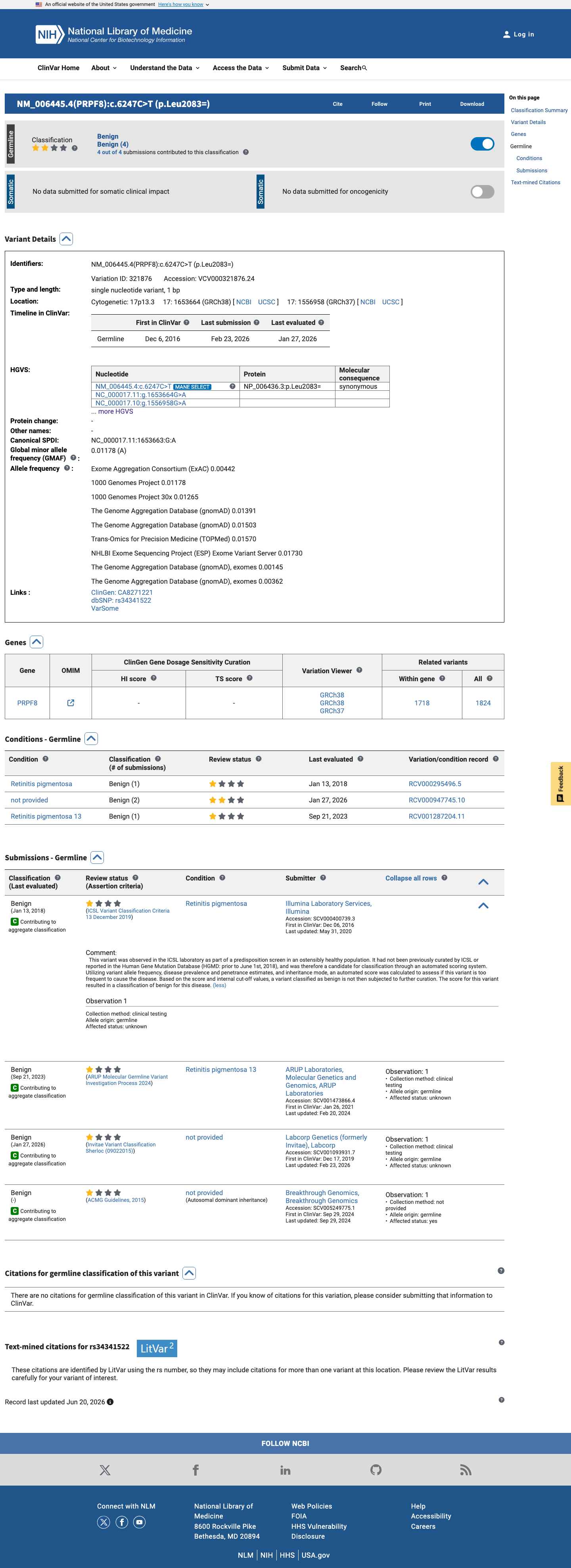
ClinVar
This variant has been reported in ClinVar as Benign (3 clinical laboratories). (ClinVarID = 321876)
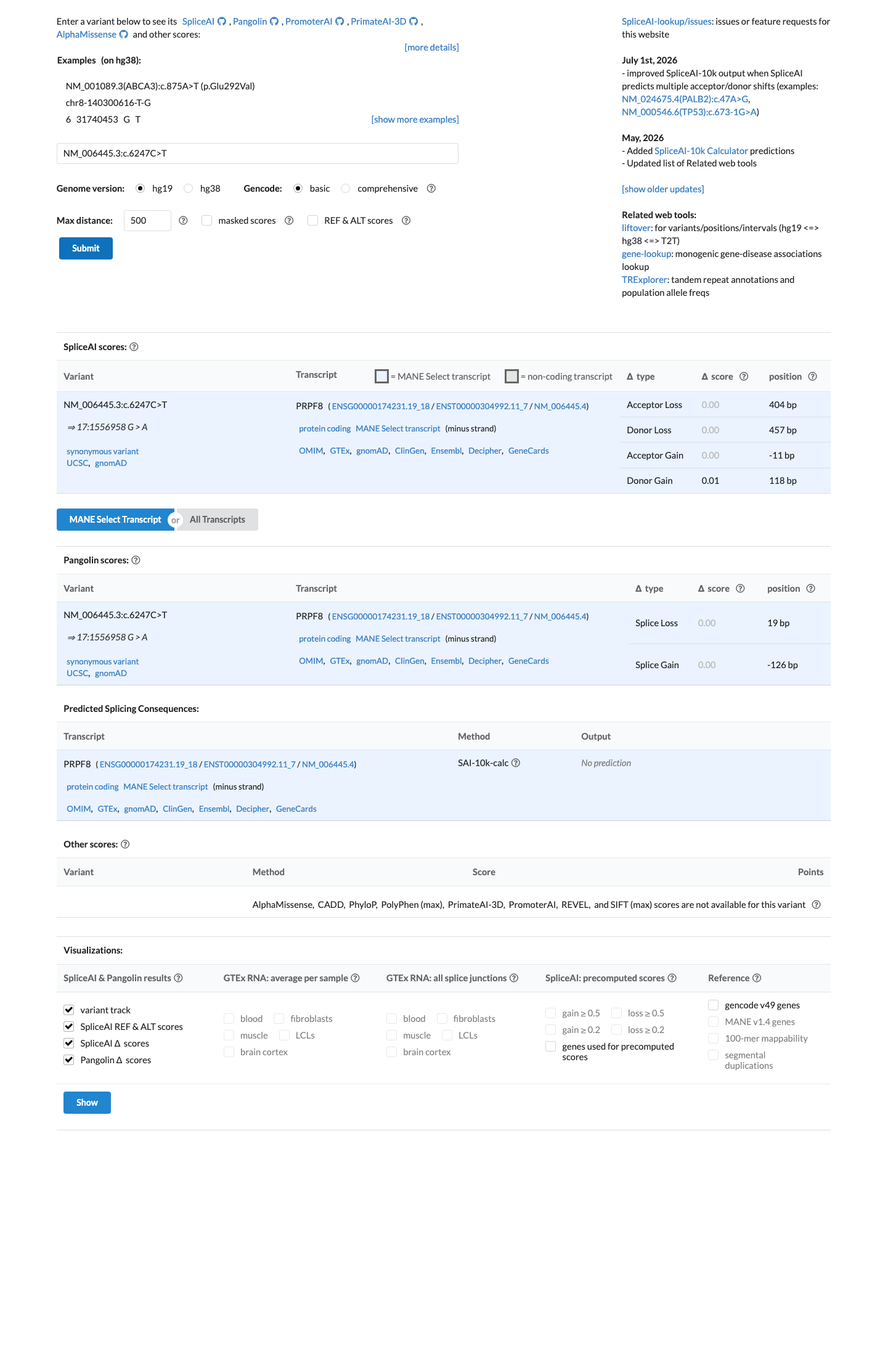
In silico
SpliceAI predicts no significant splice impact for this variant (max delta score = 0.01).
Functional
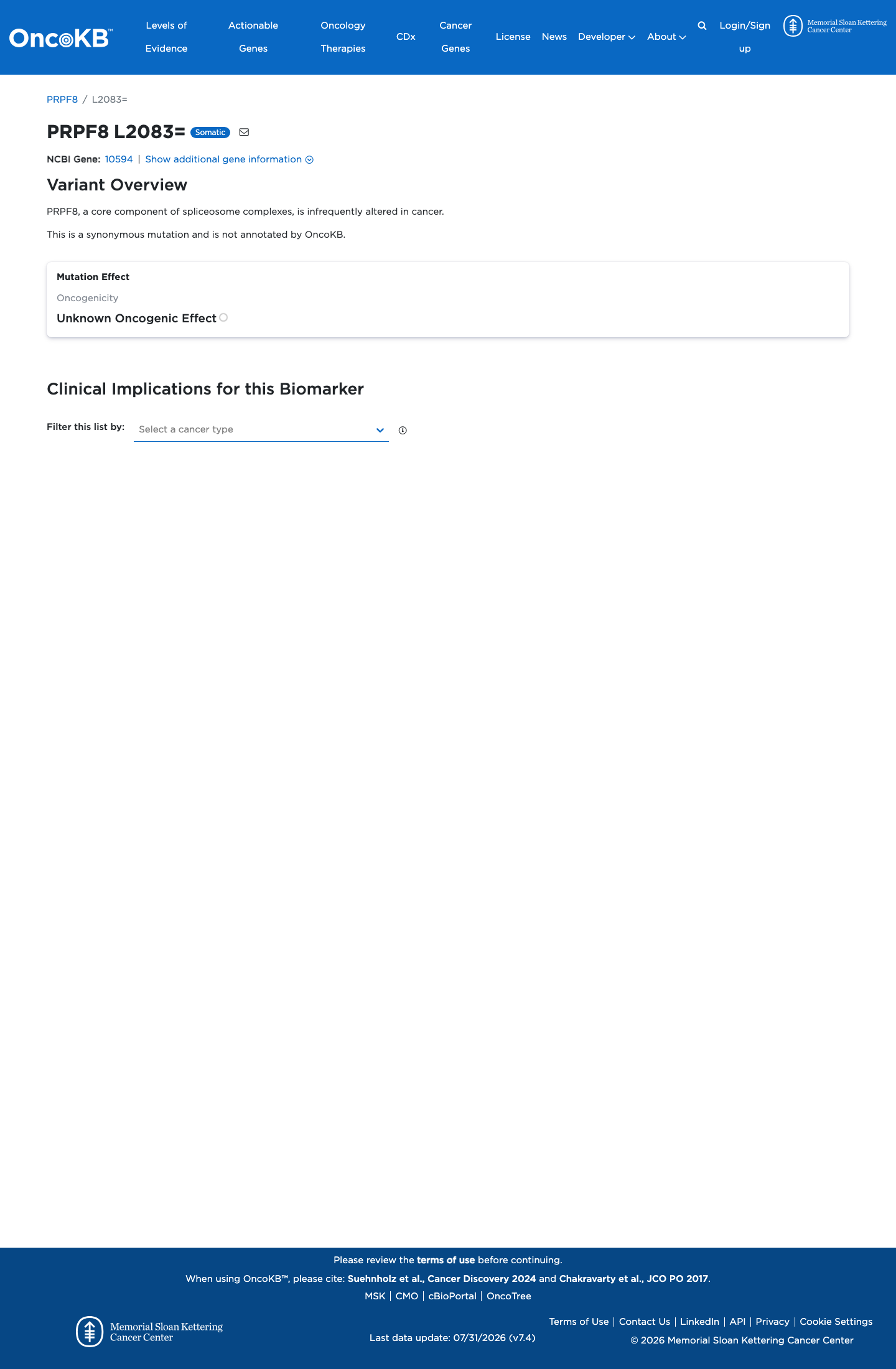
Unknown Oncogenic Effect
OncoKB identified curated literature and non-variant-specific oncogenicity context for review; listed oncogenicity label: Unknown Oncogenic Effect.

COSMIC

Cancer hotspots
Somatic evidence
Not in COSMIC / hotspots
COSMIC
This variant does not lie in a statistically significant hotspot. This variant has not previously been reported in somatic cancers (COSMIC).
Hotspots
This variant does not lie in a statistically significant hotspot.
Sources & reference links
Triaged references · 5 PMIDs not cited in assessment
25741868 ↗
Standards and guidelines for the interpretation of sequence variants: a joint consensus recommendation of the American College of Medical Genetics and Genomics and the Association for Molecular Pathology.
CLINVAR
26666451 ↗
In Vivo CRISPR/Cas9 Gene Editing Corrects Retinal Dystrophy in the S334ter-3 Rat Model of Autosomal Dominant Retinitis Pigmentosa.
CLINVAR
28492532 ↗
Sherloc: a comprehensive refinement of the ACMG-AMP variant classification criteria.
CLINVAR