This variant is located in the kinase domain of CHEK2, a critical functional domain where pathogenic missense variants are known to cluster.1 The variant was directly studied in at least one publication (Baloch et al.) examining CHEK2 missense mutations and breast cancer risk, but functional assay results are conflicting across studies — some report reduced kinase activity while others show wild-type-like function.2 The variant is present in gnomAD v4.1 at an allele frequency of 0.038% (606 alleles, including 3 homozygotes), which exceeds the PM2 threshold of <0.1% and is notable but below BS1 threshold of >0.3%.3 In silico tools do not support a pathogenic role: REVEL score 0.337, BayesDel score -0.013, and SpliceAI max delta 0.05 all indicate a likely benign or indeterminate effect.4 ClinVar classification is conflicted between Uncertain significance (19 clinical laboratories) and Likely benign (13 clinical laboratories), with overall review status of criteria provided, single submitter (1-star).5 One ClinVar submitter reports non-segregation of this variant with disease in a family and observation in unaffected controls, but the primary literature could not be verified.6 Overall, pathogenic evidence (PM1_moderate, PS3_supporting) is balanced by benign evidence (BP4_supporting), resulting in a classification of Uncertain Significance.
Final classification
VUS
PS3PM1BP4
CHEK2
c.1312G>T
p.Asp438Tyr
missense
This variant
This variant is located in the kinase domain of CHEK2, a critical functional domain where pathogenic missense variants are known to cluster.
ClinGen Hereditary Breast, Ovarian and Pancreatic Cancer Expert Panel Specifications to the ACMG/AMP Variant Interpretation Guidelines for CHEK2 Version 1.0 v1.0 lacked a usable explicit final combination framework, so generic ACMG/AMP 2015 final-combination rules were applied as fallback; applied criteria: PS3 supporting, PM1 moderate, BP4 supporting; combination = 1 moderate + 1 supporting + 1 supporting benign, which maps to VUS.
Classification rationale
PS3PM1
BP4
VUS
CHEK2 c.1312G>T
missense
PS3 + PM1 + BP4
→
VUS
4
revelbayesdelspliceai ↗
LYFE Sciences is an AI system, and it can make mistakes. Criteria
may be applied incorrectly, sources may be misread, and a confident-looking
classification can still be wrong. Double-check every criterion and
its underlying evidence before relying on any call.
Gene diagram
· NM_007194.4 · variants mapped to exon structure
CHEK2
NM_007194.4
Fetching transcript structure from UCSC…
Applied criteria · 3 applied · 15 assessed
MetEvidence satisfies this criterion.
Not metEvaluated against available evidence; threshold not reached.
Not assessedApplies in principle, but no evidence was found to evaluate it.
N/ADoesn't apply to this variant type.
Applied · 3
Strength
Supporting
Moderate
Strong
Very strong
PS3
supporting
review
Pathogenic
The variant p.Asp438Tyr was directly studied in PMID:24390236 (title: 'Missense mutations (p.H371Y, p.D438Y) in gene CHEK2 are associated with breast cancer risk in women of Balochistan origin'). Multiple ClinVar submitters reference functional kinase activity assays for this variant (referenced as Baloch 2014 and Bell 2007), reporting intermediate to reduced kinase activity in some studies but conflicting results across laboratories. Full text of PMID:24390236 and PMID:18571837 were not available in the case folder for independent verification of functional assay details. Supporting strength assigned because the variant was directly studied but functional data are conflicting and no systematic range characterization (tiling/saturation mutagenesis) is documented.
PMID:24390236 title confirms direct study of p.D438Y in CHEK2ClinVar submitters cite kinase activity assays showing variable results (reduced to WT-like activity).PMID:18571837 (Bell 2007) cited by ClinVar submitters as secondary functional data source
PM1
moderate
Pathogenic
Variant p.Asp438Tyr is located in the serine/threonine kinase domain of CHEK2 (residues ~220-486), a well-established critical functional domain where pathogenic missense variants cluster. The kinase domain is required for CHEK2 checkpoint function, and missense alterations in this domain are a recognized mechanism of CHEK2-related cancer predisposition.
Residue 438 is within the CHEK2 kinase catalytic domain.CHEK2 kinase domain is a recognized functional domain where missense mutations are associated with loss of function and cancer predisposition.
BP4
supporting
Benign
Multiple in silico tools predict a benign effect for this variant. REVEL score is 0.337 (below the pathogenic threshold of 0.5), BayesDel score is -0.013 (predicts benign), and SpliceAI max delta is 0.05 (no predicted splicing impact). These quantitative, variant-specific scores support a benign interpretation.
REVEL score: 0.337 (below 0.5 pathogenic threshold).BayesDel score: -0.013 (predicts benign).SpliceAI max delta: 0.05 (no splicing impact).
Assessed · not applied
· 7 not met · 8 not assessed
Pathogenic
PS2
No de novo data available for this variant.
PS4
Multiple cohort studies are referenced in ClinVar submissions (PMIDs: 25186627, 27443514, 29484706, 29987844, 36260514, 37656691) but variant-specific case-control or enrichment data could not be independently verified from available abstracts.
PM2
This variant is present in gnomAD v4.1 at an allele frequency of 0.03756% (606/1,613,498 alleles, including 3 homozygotes) with grpmax FAF of 0.23% in the Amish population.
PM6
No de novo data available for this variant.
PP1
Segregation data referenced in ClinVar submissions: the LabCorp submission (SCV000698770) reports that this variant did not segregate with disease in at least one family and was also observed in unaffected controls.
PP3
In silico tools do not consistently predict a damaging effect.
PP4
Variant reported in individuals with personal or family history of breast, prostate, or colorectal cancer per ClinVar submissions, but also reported in unaffected controls.
PP5
ClinVar review status is 'criteria provided, single submitter' (1-star).
Benign
BA1
gnomAD v4.1 allele frequency 0.03756% is well below the BA1 threshold of >1%.
BS1
gnomAD v4.1 allele frequency 0.03756% and gnomAD v2.1 AF 0.03859% are both below the BS1 threshold of >0.3%.
BS2
Observed in 3 homozygous individuals in gnomAD v4.1.
BS3
Functional studies referenced by ClinVar submitters are conflicting: some studies report reduced kinase activity (~70% decrease per one submitter), while others, including a human cell-based assay, show activity comparable to wild-type.
BS4
One ClinVar submitter (LabCorp, SCV000698770, classified Likely benign) reports that this variant did not segregate with disease in at least one family and was also observed in unaffected controls.
BP5
No observation of this variant in an individual with an alternate molecular basis for disease.
BP6
ClinVar review status is 'criteria provided, single submitter' (1-star).
N/A · 7
PVS1 · PS1 · PM5 · PP2 · BP1 · BP2 · BP7
Research & evidence
Population frequency
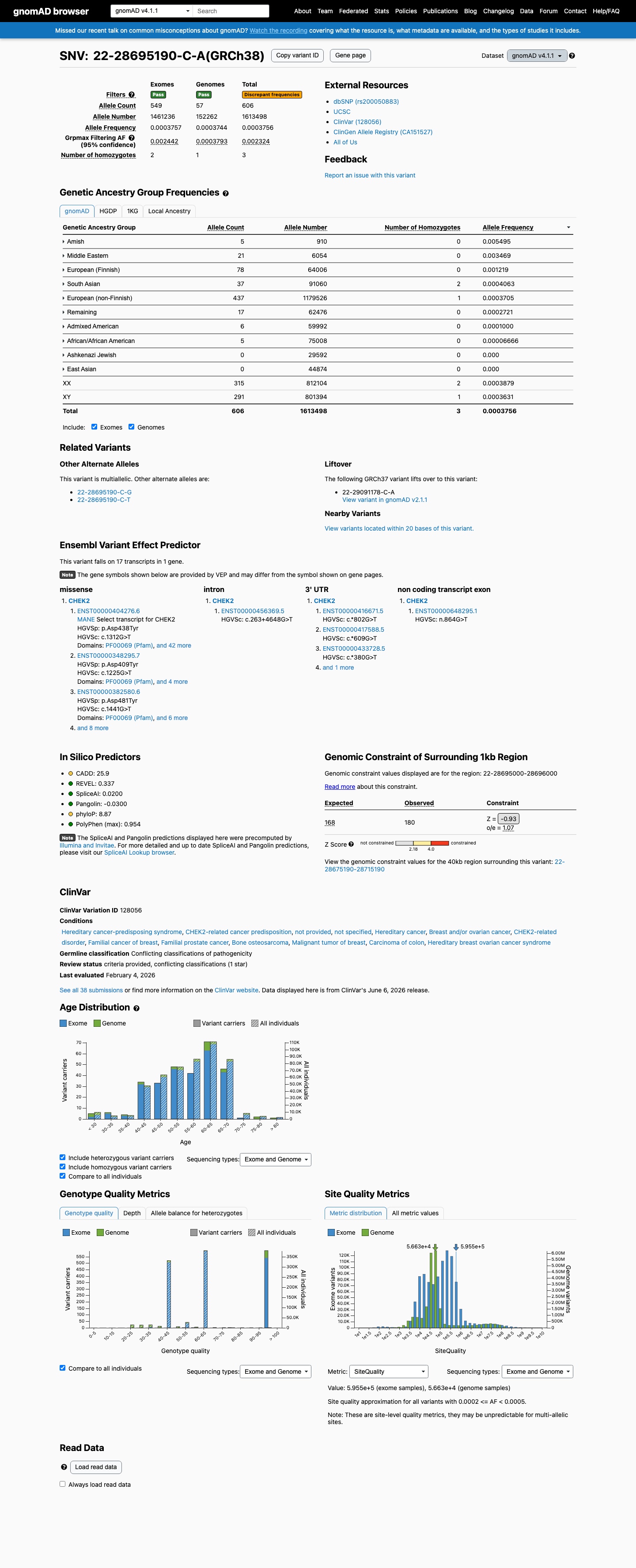
gnomAD v4.1
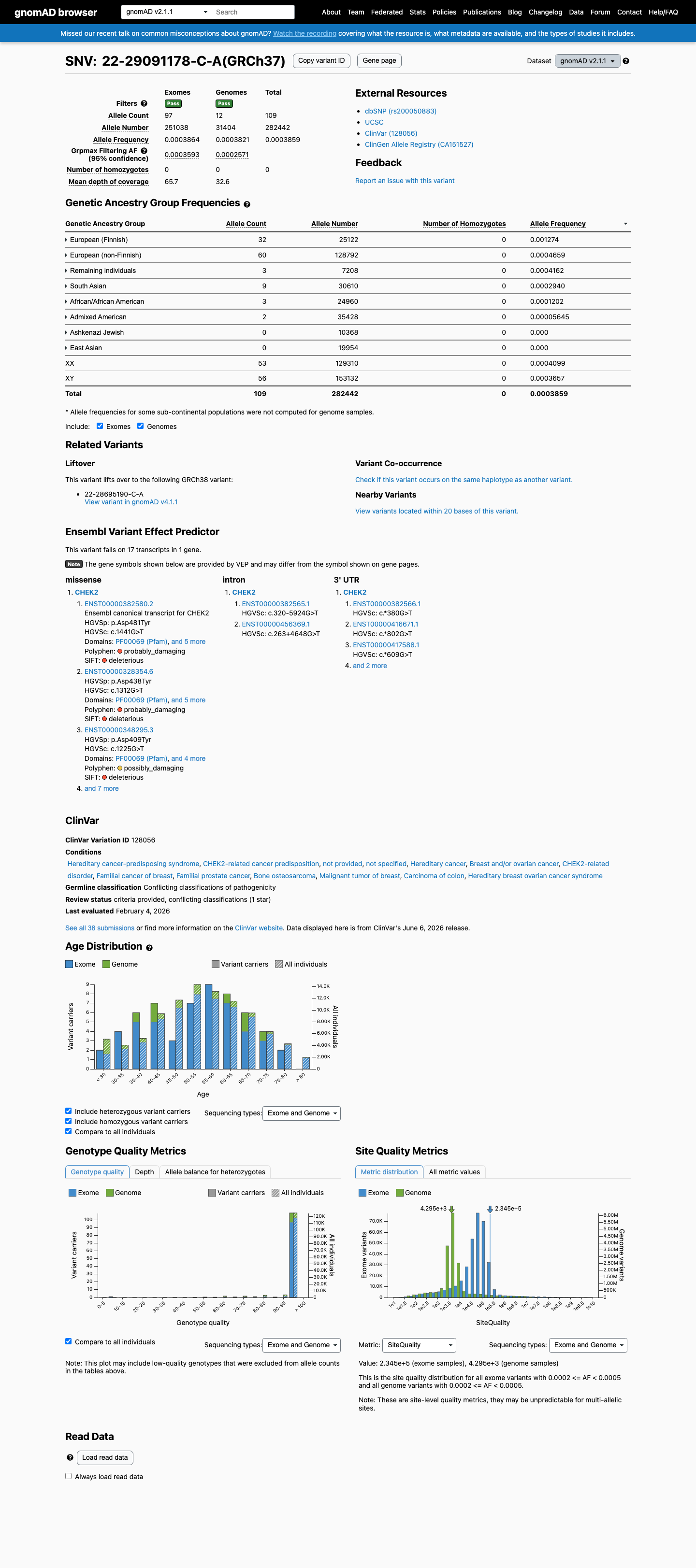
gnomAD v2.1
v4.1
This variant is present in gnomAD v4.1 (AF= 0.000375582; MAF= 0.03756%, 606/1613498 alleles, homozygotes = 3) and has highest observed frequency in the Amish population (AF= 0.00549451; MAF= 0.54945%, 5/910 alleles, homozygotes = 0); grpmax FAF= 0.00232412.
v2.1
This variant is present in gnomAD v2.1 (AF= 0.00038592; MAF= 0.03859%, 109/282442 alleles, homozygotes = 0) and has highest observed frequency in the European (Finnish) population (AF= 0.00127378; MAF= 0.12738%, 32/25122 alleles, homozygotes = 0); grpmax FAF= 0.00035934.
🇨🇦 CA
This variant is present in gnomAD-Canada v1.0 (AF= 0.0005971121485180762, 11/18422 alleles, homozygotes = 0).
Allele frequency by ancestry
three datasets · side by side
gnomAD v4.1
0.038%
· 606 / 1,613,498
3 hom · FAF 0.23%
3 hom · FAF 0.23%
Amish 5 / 910 |
0.55% |
Middle Eastern 21 / 6,054 |
0.35% |
European (Finnish) 78 / 64,006 |
0.12% |
South Asian 37 / 91,060 |
0.041% 2 hom |
European (non-Finnish) 437 / 1,179,526 |
0.037% 1 hom |
Remaining individuals 17 / 62,476 |
0.027% |
Admixed American 6 / 59,992 |
0.01% |
African/African American 5 / 75,008 |
0.0067% |
+ 2 not observed (East Asian, Ashkenazi Jewish)
gnomAD v2.1
0.039%
· 109 / 282,442
0 hom · FAF 0.036%
0 hom · FAF 0.036%
European (Finnish) 32 / 25,122 |
0.13% |
European (non-Finnish) 60 / 128,792 |
0.047% |
Remaining individuals 3 / 7,208 |
0.042% |
South Asian 9 / 30,610 |
0.029% |
African/African American 3 / 24,960 |
0.012% |
Admixed American 2 / 35,428 |
0.0056% |
+ 2 not observed (Ashkenazi Jewish, East Asian)
gnomAD Canada 🇨🇦
0.06%
· 11 / 18,422
0 hom · FAF 0.034%
0 hom · FAF 0.034%
Middle Eastern 1 / 144 |
0.69% |
Remaining individuals 2 / 1,138 |
0.18% |
European (non-Finnish) 8 / 11,742 |
0.068% |
+ 6 not observed (African/African American, Latino/Admixed American, Ashkenazi Jewish, East Asian, European (Finnish), South Asian)

ClinVar
This variant has been reported in ClinVar as Uncertain significance (19 clinical laboratories) and as Likely benign (12 clinical laboratories) and as likely benign (1 clinical laboratory). (ClinVarID = 128056)
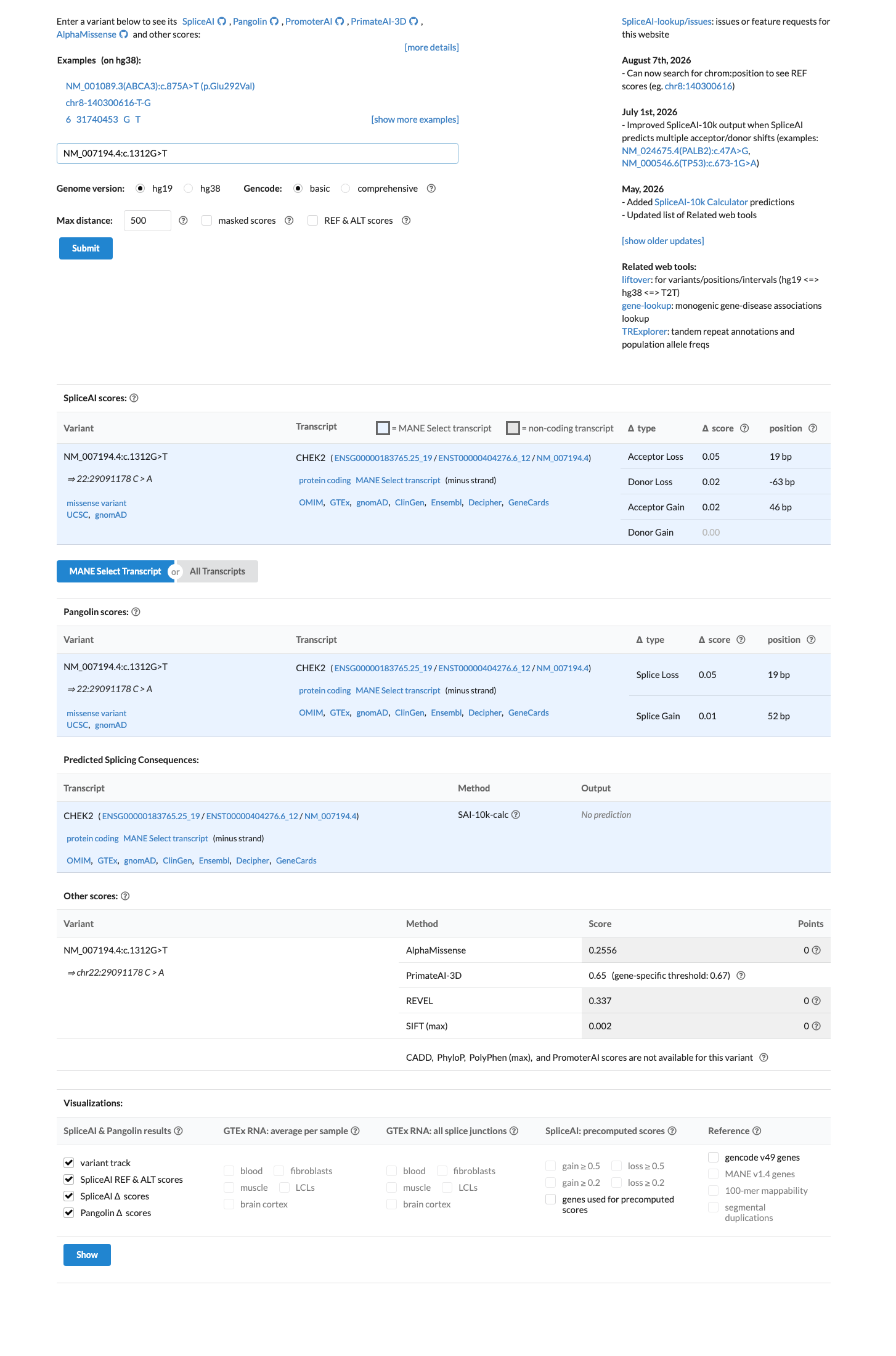
In silico
SpliceAI predicts no significant splice impact for this variant (max delta score = 0.05). REVEL score = 0.337. BayesDel score = -0.0136704.
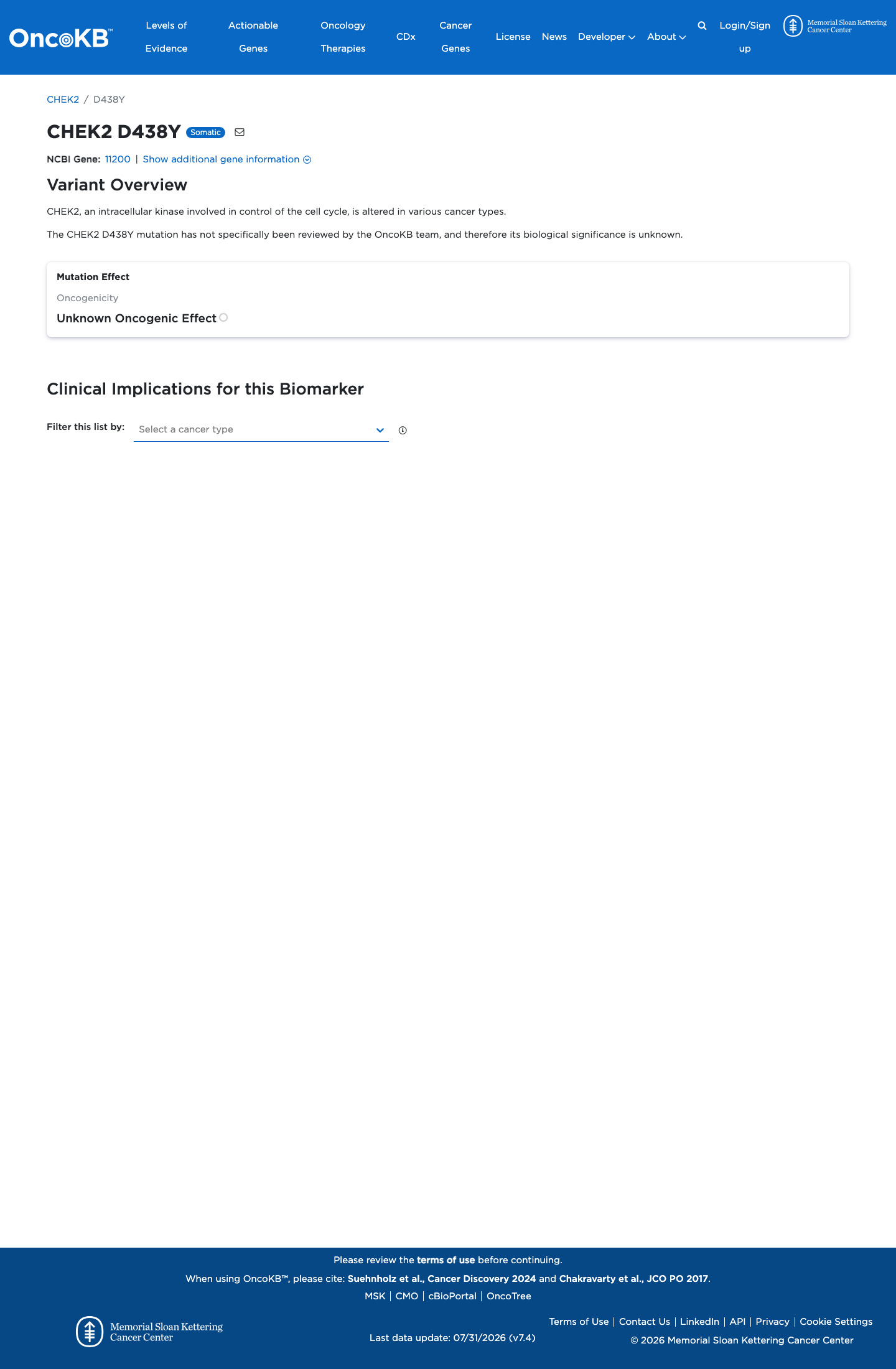
Functional
Unknown Oncogenic Effect
OncoKB did not identify variant-specific reviewed functional evidence for this variant; gene-level curated context is available for reviewer follow-up. CHEK2, an intracellular kinase involved in control of the cell cycle, is altered in various cancer types.

COSMIC

Cancer hotspots
Somatic evidence
Not in COSMIC / hotspots
COSMIC
This variant does not lie in a statistically significant hotspot. This variant has not previously been reported in somatic cancers (COSMIC).
Hotspots
This variant does not lie in a statistically significant hotspot.
Literature · how each cited paper was used
2papers cited
Each card is an audit: what was searched, what was found, whether it names the variant, which criteria it fed, and why. 6 further PMIDs triaged but not cited — see Sources & references.
Missense mutations (p.H371Y, p.D438Y) in gene CHEK2 are associated with breast cancer risk in women of Balochistan origin.
Searched
c.1312G>Tp.D438Yp.Asp438TyrD438Y
Found
Directly studied CHEK2 p.D438Y (NM_007194.4:c.1312G>T) missense variant in women of Balochistan origin and reported association with breast cancer risk. ClinVar submitters cite this study as containing functional kinase activity data for this variant, with reported variable results across assays.
Variant
✓ Names this variant
Applied to
→PS3
met
→PM1
met
Why
Variant-specific study confirmed; title confirms direct investigation of D438Y. Functional details not independently verifiable without full text. Referenced in PS3 and PM1 assessments.
Missense mutations (p.H371Y, p.D438Y) in gene CHEK2 are associated with breast cancer risk in women of Balochistan origin.
Location Title and abstract; full text not available in case folder
Rule & framework references · cited for criterion definitions, not variant evidence
18571837 ↗
Identification and characterization of novel SNPs in CHEK2 in Ashkenazi Jewish men with prostate cancer.
Sources & reference links
9Sources
Triaged references · 6 PMIDs not cited in assessment
25741868 ↗
Standards and guidelines for the interpretation of sequence variants: a joint consensus recommendation of the American College of Medical Genetics and Genomics and the Association for Molecular Pathology.
CLINVAR
26467025 ↗
A Standardized DNA Variant Scoring System for Pathogenicity Assessments in Mendelian Disorders.
CLINVAR
28779002 ↗
Rare, protein-truncating variants in ATM, CHEK2 and PALB2, but not XRCC2, are associated with increased breast cancer risks.
CLINVAR
15087378 ↗
A novel founder CHEK2 mutation is associated with increased prostate cancer risk.
CLINVAR