Back
NM_007294.4:c.2342A>C
p.Glu781Ala · BRCA1
0%
complete
Final classification
Likely Benign
PP4BP1
BRCA1
c.2342A>C
p.Glu781Ala
missense · exon 10

BRCA1 encodes a large nuclear protein that helps maintain genomic stability by coordinating the repair of DNA double-strand breaks through homologous recombination, and it also regulates transcription and the cell cycle. It acts as a tumor suppressor, working with proteins such as RAD51, BRCA2, BARD1, and PALB2 to preserve genome integrity. Inherited alterations in BRCA1 cause hereditary breast and ovarian cancer syndrome, with elevated risks of breast, ovarian, prostate, and pancreatic cancers, and biallelic loss underlies a rare form of Fanconi anemia. Because BRCA1-driven tumors rely on impaired DNA repair, they are treatable with PARP inhibitors.

This variant

BRCA1 encodes a tumor-suppressor protein central to homologous-recombination repair, and inherited BRCA1 alterations contribute to hereditary breast and ovarian cancer susceptibility.

Transcript
NM_007294.4
HGVS · transcript:coding
NM_007294.4:c.2342A>C
GRCh38
chr17:43093189 T>G
GRCh37
chr17:41245206 T>G
Likely Benign: BP1 (strong) contributes -4 points and PP4 (supporting) contributes +1 under the ENIGMA conflicting-evidence point system, yielding -3.
Classification rationale
PP4 BP1 Likely Benign
BRCA1 c.2342A>C missense · exon 10

Likely Benign: BP1 strong because p.Glu781Ala is outside the clinically important domains and SpliceAI 0.018 indicates no predicted splicing impact. Likely Benign: PP4 supporting because the exact-variant clinical-history likelihood ratio is 3.1586, above the 2.08 threshold.

PP4 + BP1 → Likely Benign
LYFE Sciences is an AI system, and it can make mistakes. Criteria may be applied incorrectly, sources may be misread, and a confident-looking classification can still be wrong. Double-check every criterion and its underlying evidence before relying on any call.
Gene diagram · NM_007294.4 · variants mapped to exon structure
BRCA1 NM_007294.4
Fetching transcript structure from UCSC…
Applied criteria · 2 applied · 14 assessed
MetEvidence satisfies this criterion.
Not metEvaluated against available evidence; threshold not reached.
Not assessedApplies in principle, but no evidence was found to evaluate it.
N/ADoesn't apply to this variant type.
Applied · 2
Strength Supporting Moderate Strong Very strong
PP4 supporting Pathogenic
Met at Supporting: the exact-variant clinical-history likelihood ratio is 3.1586, satisfying the ENIGMA PP4 threshold 3.1586 >= 2.08.
The exact BRCA1 c.2342A>C row reports LOG(LR)=1.150122046470642, N_Probands=1, and LR=3.158578379510139.The governing ENIGMA PP4 operator is >=; explicit inequality: 3.158578379510139 >= 2.08? yes.ENIGMA PP4 thresholds are Supporting >=2.08, Moderate >=4.3, Strong >=18.7, and Very Strong >=350; 3.158578379510139 reaches Supporting only.
BP1 strong Benign
Met, strong: p.Glu781Ala is outside all ENIGMA domains and SpliceAI maximum delta 0.018 is below the <=0.1 threshold.
ENIGMA BP1_Strong applies to missense variants outside a potentially clinically important domain with no predicted splicing impact, defined as SpliceAI <=0.1.Residue 781 is outside the ENIGMA BRCA1 domains RING aa 2-101, coiled-coil aa 1391-1424, and BRCT aa 1650-1857.SpliceAI maximum delta is 0.018, satisfying the governing <=0.1 no-splicing threshold.
Assessed · not applied · 6 not met · 8 not assessed
Pathogenic
PS1 Not met: no governing-VCEP pathogenic comparator for p.Glu781Ala/p.E781A was found, despite SpliceAI maximum delta 0.018 being below 0.1.
PS3 Not assessed: no exact variant-specific functional assay entry or calibrated damaging result was found for c.2342A>C/p.Glu781Ala.
PS4 Not assessed: no variant-specific case-control p-value, odds ratio, or confidence interval is available to apply the ENIGMA PS4 requirements.
PM2 Not assessed: the variant is absent from governing gnomAD non-cancer datasets, but the required regional average read depth of at least 25 is undocumented.
PM3 Not assessed: no Fanconi Anemia phenotype, co-occurrent pathogenic BRCA1 variant, or phase evidence is documented for this variant, so the VCEP PM3 point thresholds cannot be reached.
PP1 Not assessed: no quantitative family co-segregation LR is available, and the separate clinical-history LR 3.158578379510139 is not segregation evidence.
PP3 Not met: missense REVEL score 0.423 is below the >=0.644 supporting PP3 threshold.
Benign
BA1 Not met: the variant is absent from governing gnomAD v2.1/v3.1 non-cancer datasets, so no filter allele frequency exceeds the ENIGMA BA1 threshold of 0.001.
BS1 Not met: the variant is absent from governing gnomAD v2.1/v3.1 non-cancer datasets, and the available gnomAD v4.1 grpmax FAF is 5.42e-06 below 0.00002.
BS2 Not assessed: gnomAD reports zero homozygotes, but ENIGMA BS2 requires phenotyped clinical-cohort observations with phase and age or follow-up information.
BS3 Not assessed: no exact variant-specific functional assay entry or calibrated benign result was found for c.2342A>C/p.Glu781Ala.
BS4 Not assessed: no affected-family non-segregation LR is available, while the reported clinical-history LR 3.158578379510139 is not BS4 evidence.
BP4 Not met: missense REVEL score 0.423 exceeds the <=0.29 supporting BP4 threshold and is therefore gray-zone.
BP5 Not met: the exact-variant clinical-history LR is 3.1586, failing the ENIGMA BP5 comparison 3.1586 <= 0.48.
N/A · 12 PVS1 · PS2 · PM1 · PM4 · PM5 · PM6 · PP2 · PP5 · BP2 · BP3 · BP6 · BP7
Research & evidence
Population frequency · supports benign
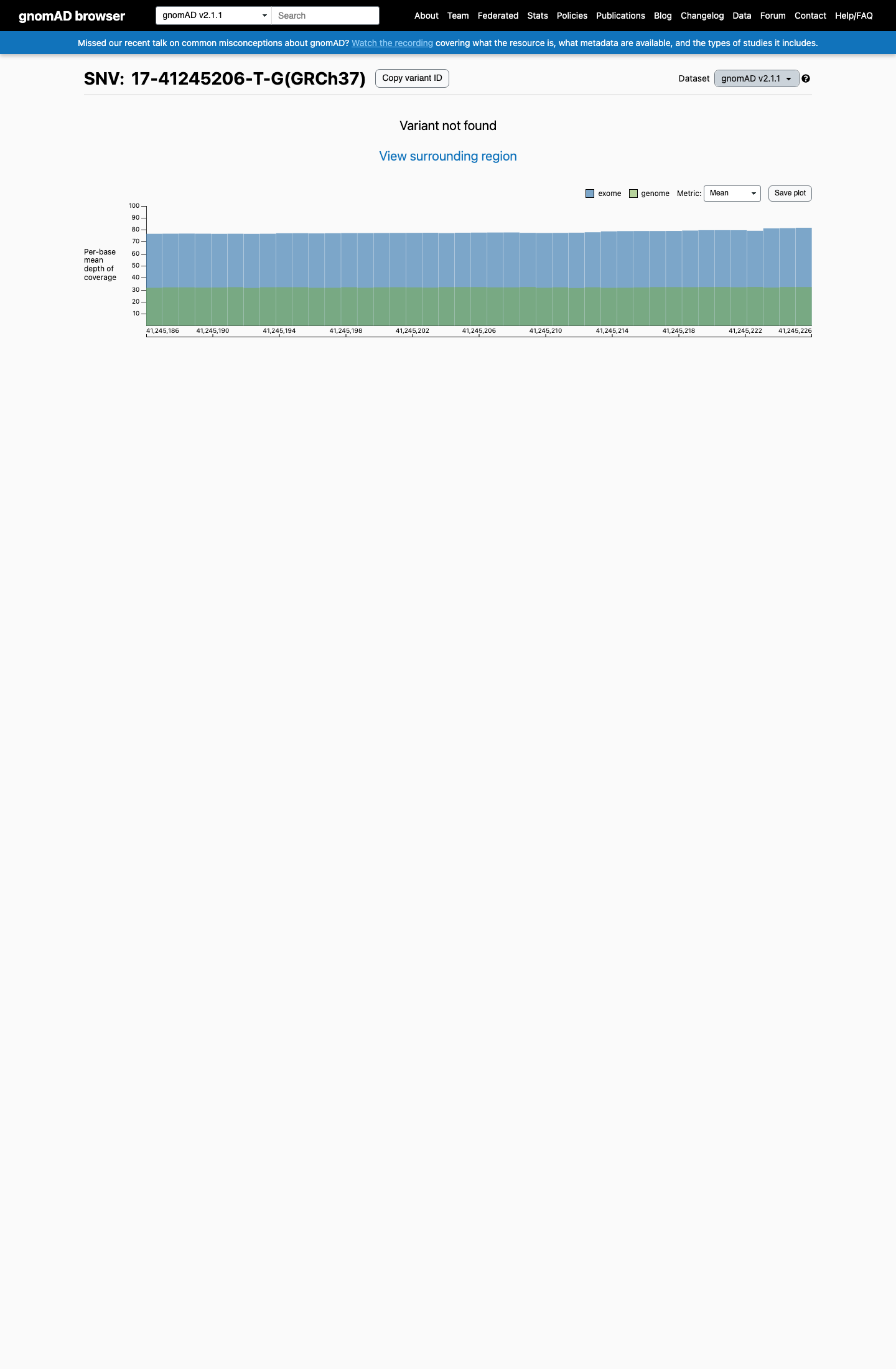
gnomAD v4.1 screenshot
gnomAD v4.1
gnomAD v2.1 screenshot
gnomAD v2.1
v4.1
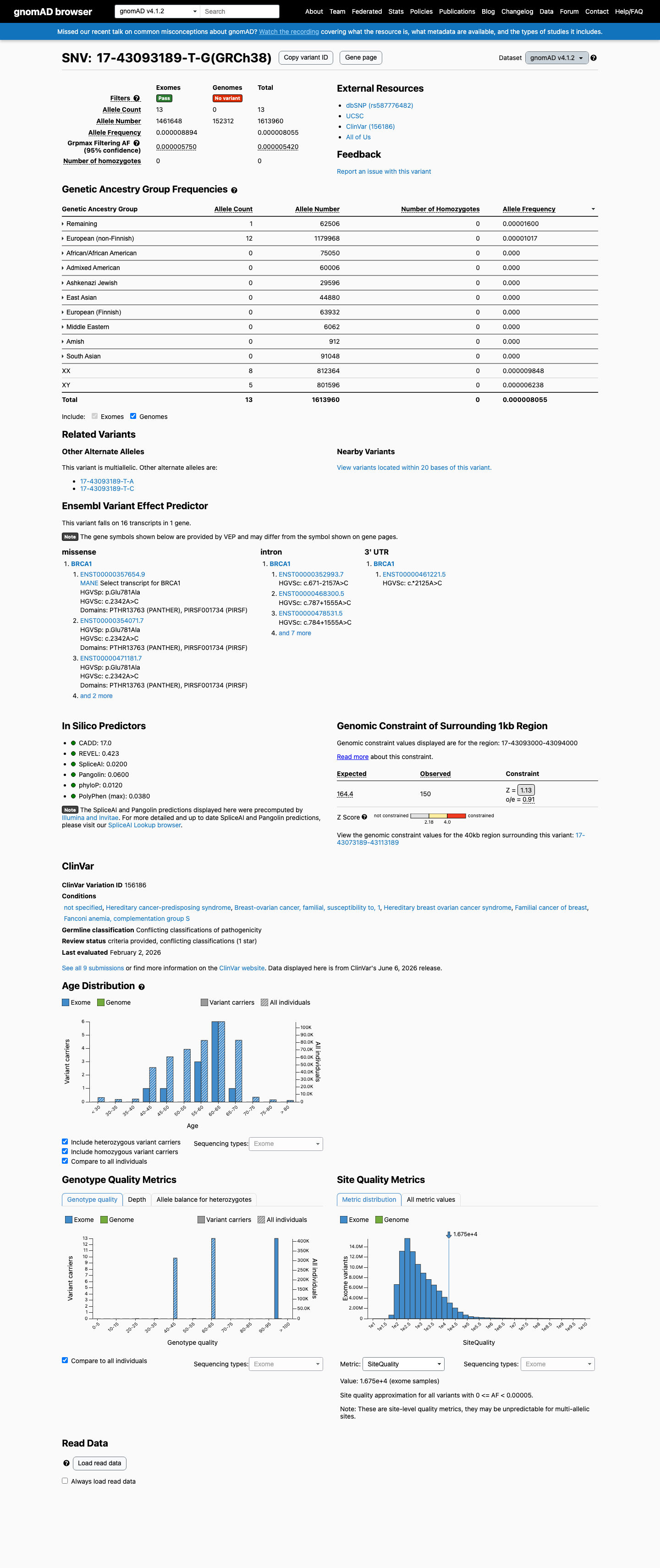
This variant is present in gnomAD v4.1 (AF= 8.05472e-06; MAF= 0.00081%, 13/1613960 alleles, homozygotes = 0) and has highest observed frequency in the Remaining individuals population (AF= 1.59985e-05; MAF= 0.00160%, 1/62506 alleles, homozygotes = 0); grpmax FAF= 5.42e-06.
v2.1
Absent from gnomAD v2.1.
🇨🇦 CA
Absent from gnomAD-Canada v1.0.
Allele frequency by ancestry
three datasets · side by side
gnomAD v4.1
0.00081% · 13 / 1,613,960
0 hom · FAF 0.00054%
Remaining individuals
1 / 62,506
0.0016%
European (non-Finnish)
12 / 1,179,968
0.001%
+ 8 not observed (Admixed American, European (Finnish), Amish, East Asian, Middle Eastern, South Asian, Ashkenazi Jewish, African/African American)
gnomAD v2.1
Absent · 0 / ?
0 hom
Not observed in any ancestry group.
gnomAD Canada 🇨🇦
Absent · 0 / ?
0 hom
Not observed in any ancestry group.
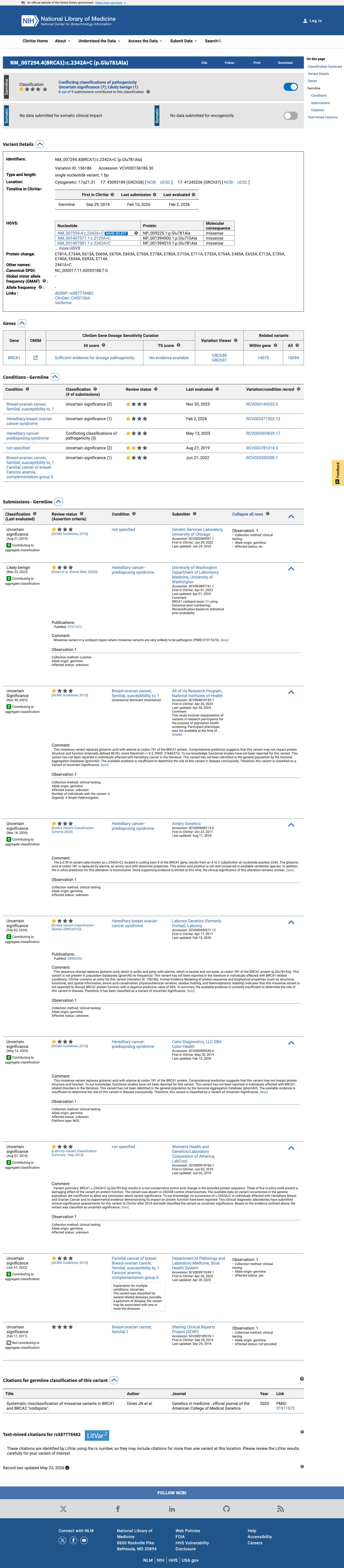
ClinVar screenshot
ClinVar
This variant has been reported in ClinVar as Uncertain significance (7 clinical laboratories) and as Uncertain Significance (1 clinical laboratory). (ClinVarID = 156186)
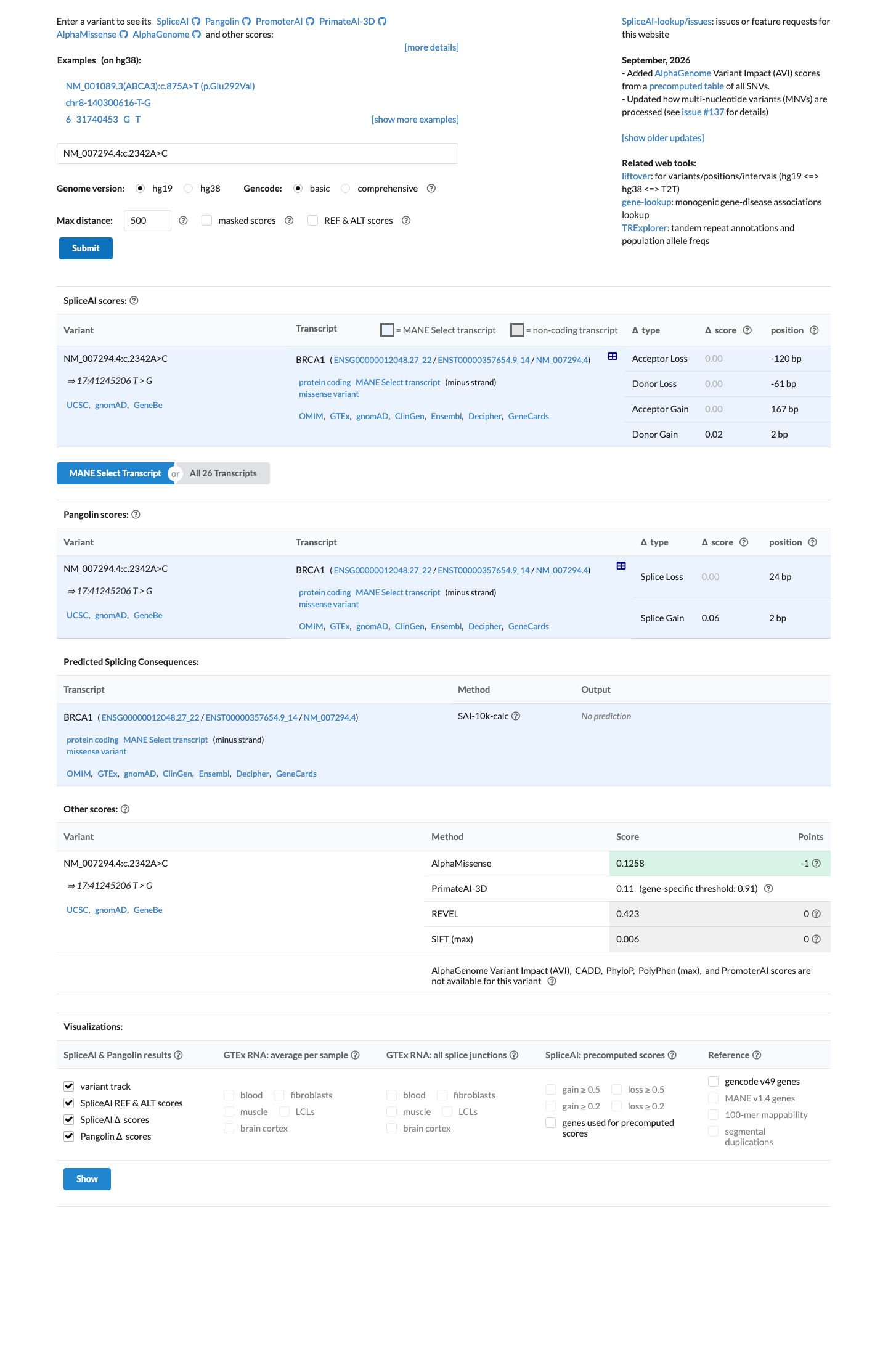
SpliceAI screenshot
In silico
SpliceAI predicts no significant splice impact for this variant (max delta score = 0.02). REVEL score = 0.423. BayesDel score = -0.116509.
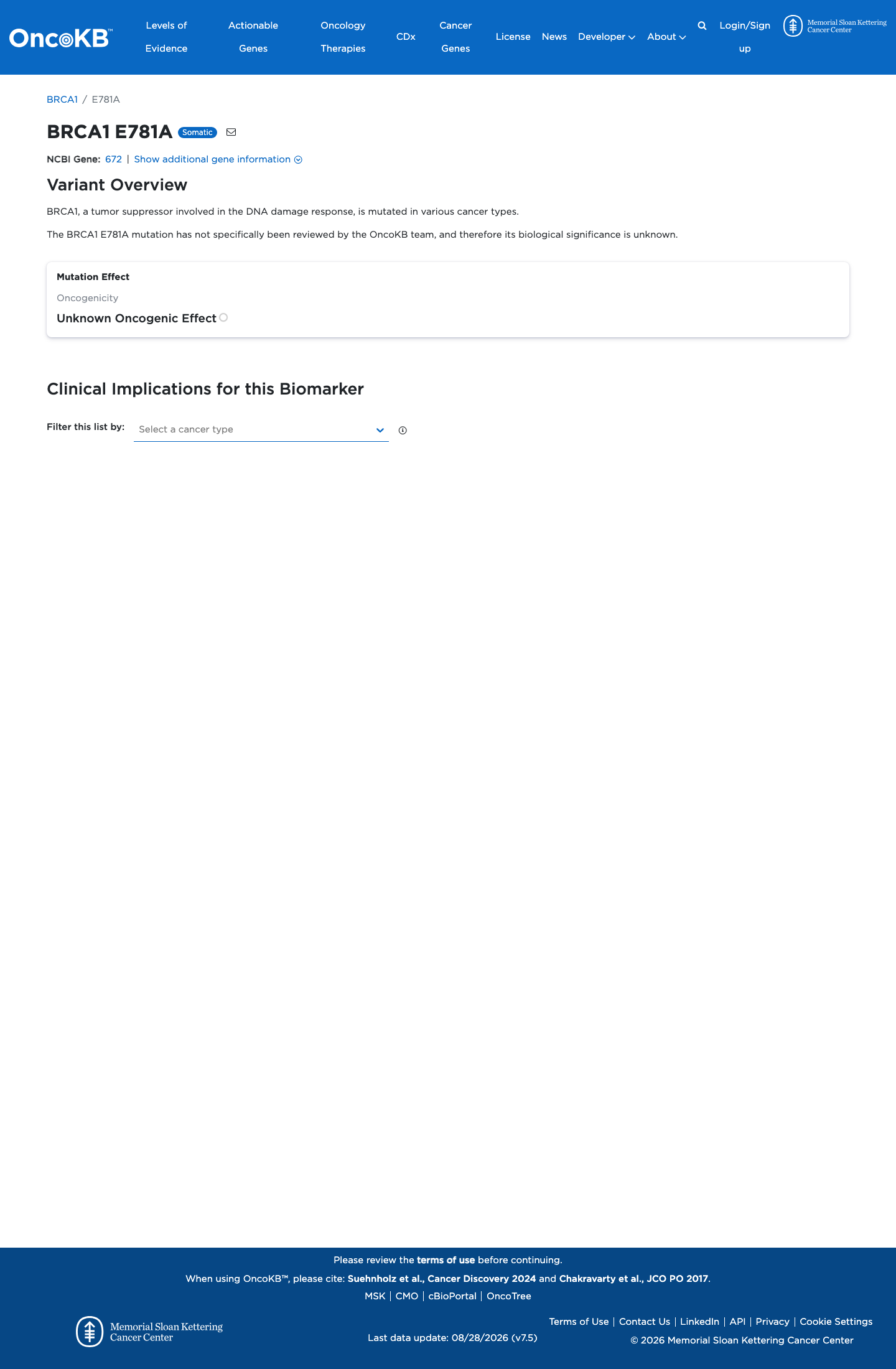
Functional / OncoKB screenshot
Functional Unknown Oncogenic Effect
OncoKB did not identify variant-specific reviewed functional evidence for this variant; gene-level curated context is available for reviewer follow-up. BRCA1, a tumor suppressor involved in the DNA damage response, is mutated in various cancer types.
OncoKB ↗
COSMIC screenshot
COSMIC
Cancer hotspots screenshot
Cancer hotspots
Somatic evidence Not in COSMIC / hotspots
COSMIC
This variant does not lie in a statistically significant hotspot. This variant has not previously been reported in somatic cancers (COSMIC).
Hotspots
This variant does not lie in a statistically significant hotspot.
Literature · how each cited paper was used
2papers cited
Each card is an audit: what was searched, what was found, whether it names the variant, which criteria it fed, and why. 7 further PMIDs triaged but not cited — see Sources & references.
Li et al. 2020 BRCA1/2 clinical-history likelihood-ratio model
Searched
c.2342A>Cp.Glu781Alap.E781A
Found
Li et al. developed a BRCA1/2 personal- and family-history logistic-regression model from multigene-panel testing and calculated a per-variant clinical-history likelihood ratio by multiplying the individual likelihood ratios for probands carrying that variant; the exact gene-specific table row for BRCA1 c.2342A>C reports LR=3.158578379510139 from one proband.
Variant
✓ Names this variant — characterised directly
Applied to
→PP4 supporting
Provides the clinical-history likelihood-ratio methodology and the exact-variant LR table used for PP4 strength.
For each variant, LRs were multiplied for each individual carrying that variant (potentially in different race/ethnicity groups) to arrive at a per-variant LR.
Location Methods, BRCA prediction models, page 2  ·  Context Retrospective logistic-regression analysis of 138,342 eligible multigene-panel-tested individuals, stratified by gene and four racial/ethnic groups; the exact variant-level LR was taken from the gene-specific supplementary clinical-history table.  ·  full text
Rule & framework references · cited for criterion definitions, not variant evidence
17924331 ↗ Easton et al. 2007 BRCA1/2 multifactorial likelihood assessment
Sources & reference links
9Sources
CSpec VCEP
ClinVar
gnomAD v2.1
gnomAD v4.1
gnomAD-Canada
SpliceAI
OncoKB
COSMIC
Cancer hotspots
Triaged references · 7 PMIDs not cited in assessment
23918944 ↗ Tamoxifen and risk of contralateral breast cancer for BRCA1 and BRCA2 mutation carriers. CLINVAR
25741868 ↗ Standards and guidelines for the interpretation of sequence variants: a joint consensus recommendation of the American College of Medical Genetics and Genomics and the Association for Molecular Pathology. CLINVAR
31911673 ↗ Systematic misclassification of missense variants in BRCA1 and BRCA2 "coldspots". CLINVAR
34242744 ↗ Customizing local and systemic therapies for women with early breast cancer: the St. Gallen International Consensus Guidelines for treatment of early breast cancer 2021. CLINVAR
20301575 ↗ Fanconi Anemia. CLINVAR
25356965 ↗ ACMG policy statement: updated recommendations regarding analysis and reporting of secondary findings in clinical genome-scale sequencing. CLINVAR
34012068 ↗ ACMG SF v3.0 list for reporting of secondary findings in clinical exome and genome sequencing: a policy statement of the American College of Medical Genetics and Genomics (ACMG). CLINVAR