NM_007294.4:c.2657_2676del is a 20bp frameshift deletion in BRCA1 exon 10(11) that creates a premature termination codon at p.Ser886Ter. BRCA1 loss of function is an established mechanism for hereditary breast and ovarian cancer.1 Per ENIGMA BRCA1 VCEP Specifications Table 4, PTC variants in exon E10(11) are assigned PVS1 (Very Strong) as null variants in a gene where loss of function is a known disease mechanism, and PM5_Strong (PTC) because other proven pathogenic PTC variants have been reported in this exon.2 The variant is absent from gnomAD v2.1 and v4.1 population databases (allele count = 0), meeting PM2 at Supporting strength per ENIGMA population frequency rules.3 Applying the ENIGMA Table 3 point system: PVS1 Very Strong = 8 points, PM5 Strong = 4 points, PM2 Supporting = 1 point. Total = 13 points, which falls in the Pathogenic range (>=10).4
Final classification
Pathogenic
PVS1PM2PM5
BRCA1
c.2657_2676del
p.Ser886Ter
This variant
NM_007294.4:c.2657_2676del is a 20bp frameshift deletion in BRCA1 exon 10(11) that creates a premature termination codon at p.Ser886Ter. BRCA1 loss of function is an established mechanism for hereditary breast and ovarian cancer.
ENIGMA BRCA1 VCEP Specification v1.2.0 Table 3. No conflicting evidence: no benign criteria are met. Pathogenic criteria: PVS1 (Very Strong, 8 pts) + PM5 (Strong, 4 pts) + PM2 (Supporting, 1 pt). Table 3 pathogenic all_of rule satisfied: 1 Very Strong + >=1 Strong -> Pathogenic. ENIGMA point system confirms: 8+4+1 = 13, in Pathogenic range (>=10).
Classification rationale
PVS1PM2PM5
Pathogenic
BRCA1 c.2657_2676del
PVS1 + PM2 + PM5
→
Pathogenic
LYFE Sciences is an AI system, and it can make mistakes. Criteria
may be applied incorrectly, sources may be misread, and a confident-looking
classification can still be wrong. Double-check every criterion and
its underlying evidence before relying on any call.
Gene diagram
· NM_007294.4 · variants mapped to exon structure
BRCA1
NM_007294.4
Fetching transcript structure from UCSC…
Applied criteria · 3 applied · 8 assessed
MetEvidence satisfies this criterion.
Not metEvaluated against available evidence; threshold not reached.
Not assessedApplies in principle, but no evidence was found to evaluate it.
N/ADoesn't apply to this variant type.
Applied · 3
Strength
Supporting
Moderate
Strong
Very strong
PVS1
very strong
Pathogenic
NM_007294.4:c.2657_2676del is a 20bp deletion in BRCA1 exon 10(11) (legacy exon 11) that creates a premature termination codon at p.Ser886Ter. BRCA1 loss of function is an established disease mechanism for hereditary breast and ovarian cancer. Per ENIGMA BRCA1 VCEP Specifications Table 4, PTC variants in exon E10(11) are assigned PVS1 (standard weight, Very Strong). The variant is a canonical null variant expected to trigger nonsense-mediated decay, with the PTC located well upstream of the 3'-most 50 nucleotides of the penultimate exon boundary.
ENIGMA Table 4 assigns PVS1 to PTC variants in BRCA1 exon E10(11)Variant creates p.Ser886Tera premature termination codon in exon 10(11) of 23 exons
PM2
supporting
Pathogenic
NM_007294.4:c.2657_2676del is absent from gnomAD v2.1 (non-cancer, exome subset) and gnomAD v4.1 (non-cancer). Per ENIGMA BRCA1 VCEP rules, PM2 is applied at Supporting strength when a variant is absent from controls in an outbred population across both gnomAD versions.
Absent from gnomAD v2.1 (allele count = 0)Absent from gnomAD v4.1 (allele count = 0)ENIGMA PM2 rule: Supporting strength for absence from population controls
PM5
strong
Pathogenic
NM_007294.4:c.2657_2676del creates a premature termination codon (p.Ser886Ter) in BRCA1 exon E10(11). Per ENIGMA BRCA1 VCEP Specifications Table 4, PTC variants in exon E10(11) are assigned PM5_Strong (PTC), as other proven pathogenic PTC variants have been reported in this exon. PM5_PTC is applicable because E10(11) is not in the PM5_N/A exclusion list (which includes only E21(22), E6(7), E7(8) for BRCA1).
ENIGMA Table 4 assigns PM5_Strong (PTC) to PTC variants in BRCA1 exon E10(11)E10(11) is in the PM5_PTC applicable exon listnot excluded
Assessed · not applied
· 2 not met · 6 not assessed
Pathogenic
PS4
PS4 requires case-control data with p-value <=0.05 and OR >=4 (lower CI excludes 2.0) per ENIGMA specifications.
PP1
PP1 requires co-segregation data quantified through a likelihood ratio analysis (LR thresholds: Supporting >=2.08, Moderate >=4.3, Strong >=18.7).
PP4
PP4 in the ENIGMA BRCA1 framework is assessed using the clinical-history likelihood ratio from Li et al.
Benign
BA1
BA1 requires filter allele frequency (FAF) above 0.1% (FAF > 0.001) in gnomAD v2.1 (non-cancer, exome only) and/or gnomAD v3.1 (non-cancer), non-founder populations.
BS1
BS1 requires filter allele frequency (FAF) above 0.01% (FAF > 0.0001, Strong) or above 0.002% (FAF > 0.00002, Supporting) in gnomAD.
BS2
BS2 is applied in the absence of features of recessive disease (Fanconi Anemia phenotype) and requires points-based assessment per ENIGMA Specifications Table 8.
BS4
BS4 requires quantitative co-segregation analysis showing lack of segregation in affected family members (LR thresholds: Supporting <=0.48, Moderate <=0.23, Strong <=0.05).
BP5
BP5 in the ENIGMA BRCA1 framework is assessed using the clinical-history likelihood ratio from Li et al.
N/A · 16
PS1 · PS2 · PS3 · PM1 · PM4 · PM6 · PP2 · PP3 · PP5 · BS3 · BP1 · BP2 · BP3 · BP4 · BP6 · BP7
Research & evidence
Population frequency · supports pathogenic
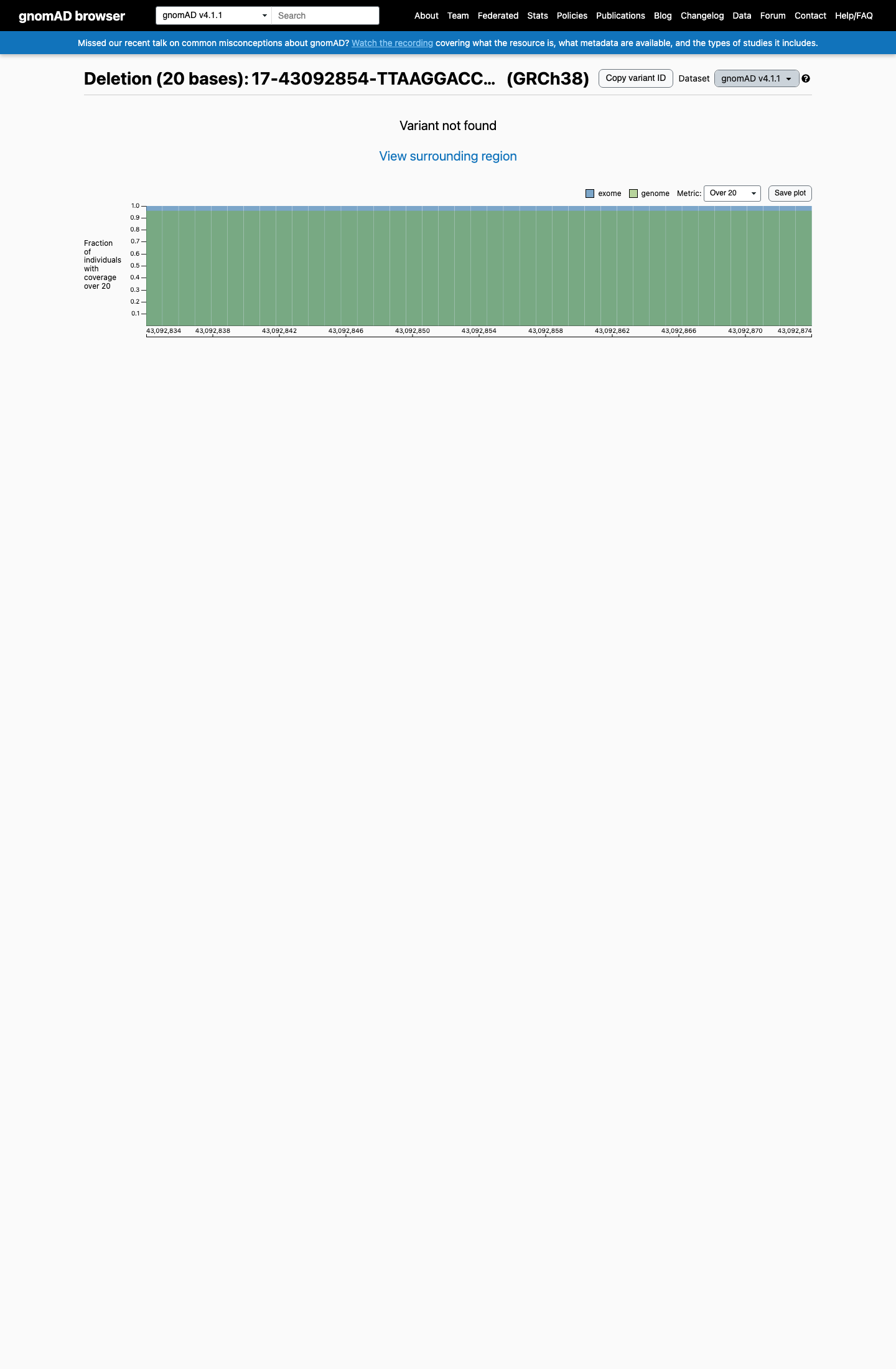
gnomAD v4.1
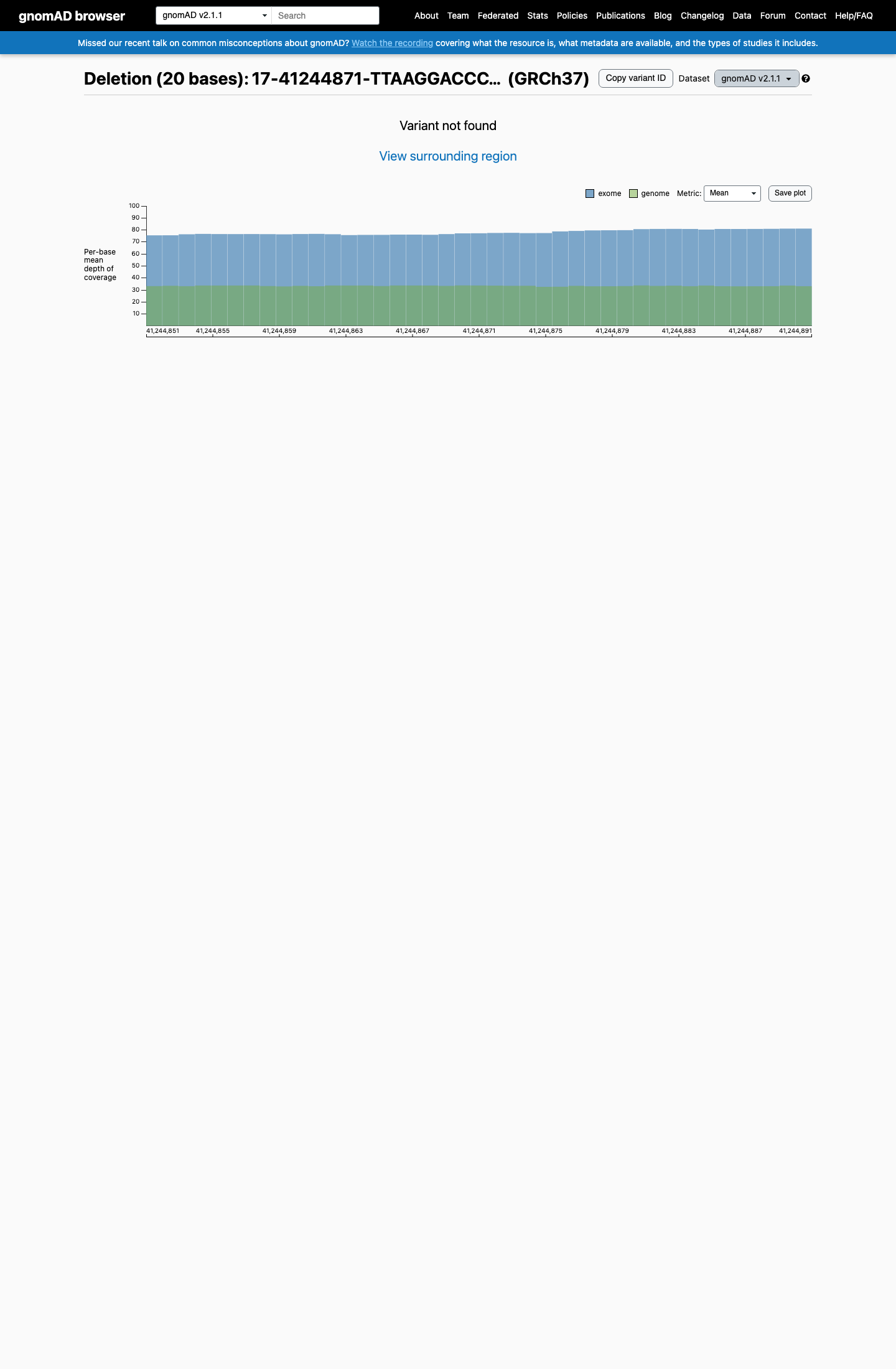
gnomAD v2.1
v4.1
Absent from gnomAD v4.1.
v2.1
Absent from gnomAD v2.1.
🇨🇦 CA
This variant is absent from gnomAD-Canada.
Allele frequency by ancestry
three datasets · side by side
gnomAD v4.1
Absent
· 0 / ?
0 hom
0 hom
Not observed in any ancestry group.
gnomAD v2.1
Absent
· 0 / ?
0 hom
0 hom
Not observed in any ancestry group.
gnomAD Canada 🇨🇦
Absent
· 0 / ?
0 hom
0 hom
Not observed in any ancestry group.
In silico
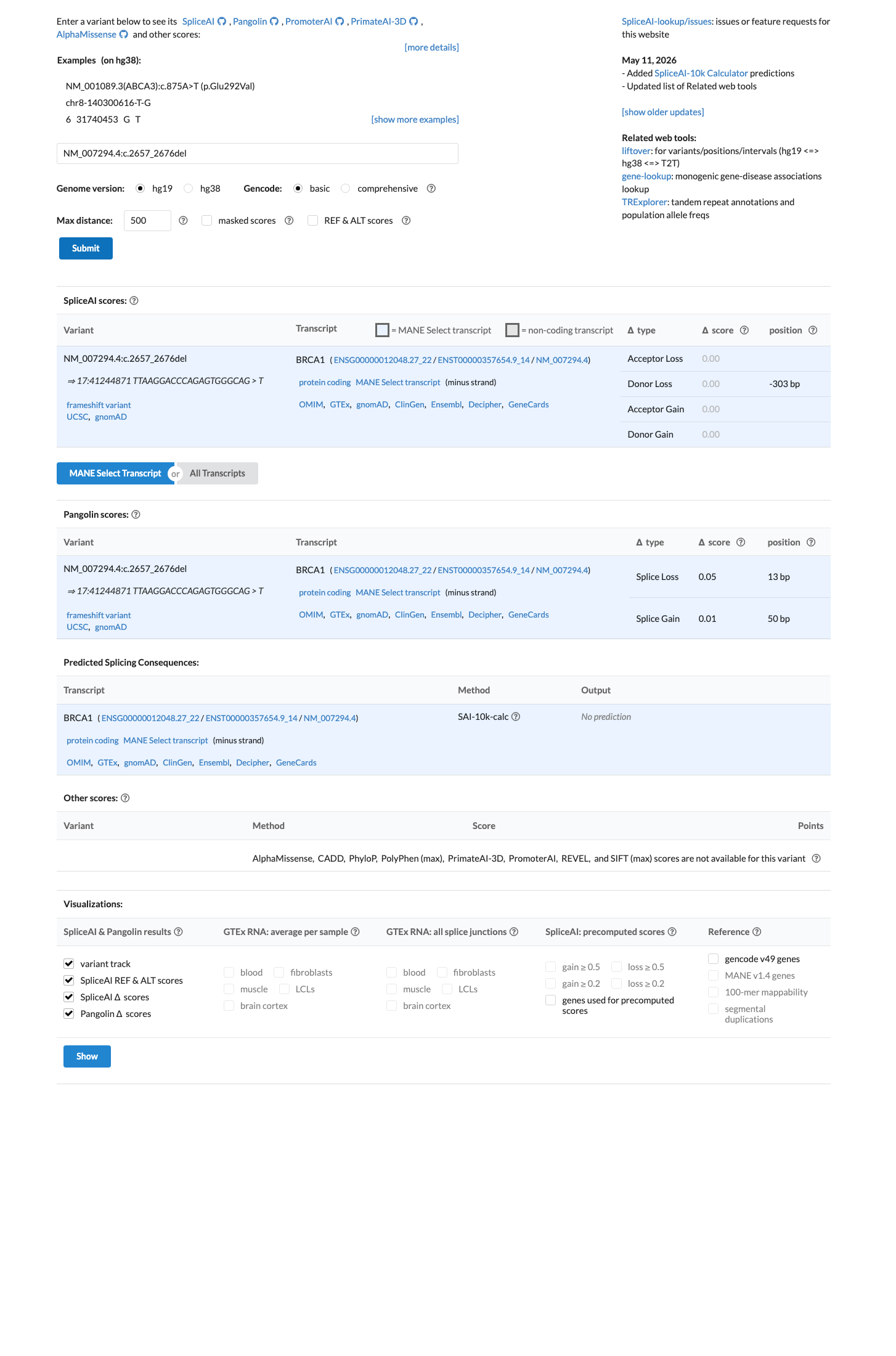
SpliceAI predicts no significant splice impact for this variant (max delta score = 0.00).
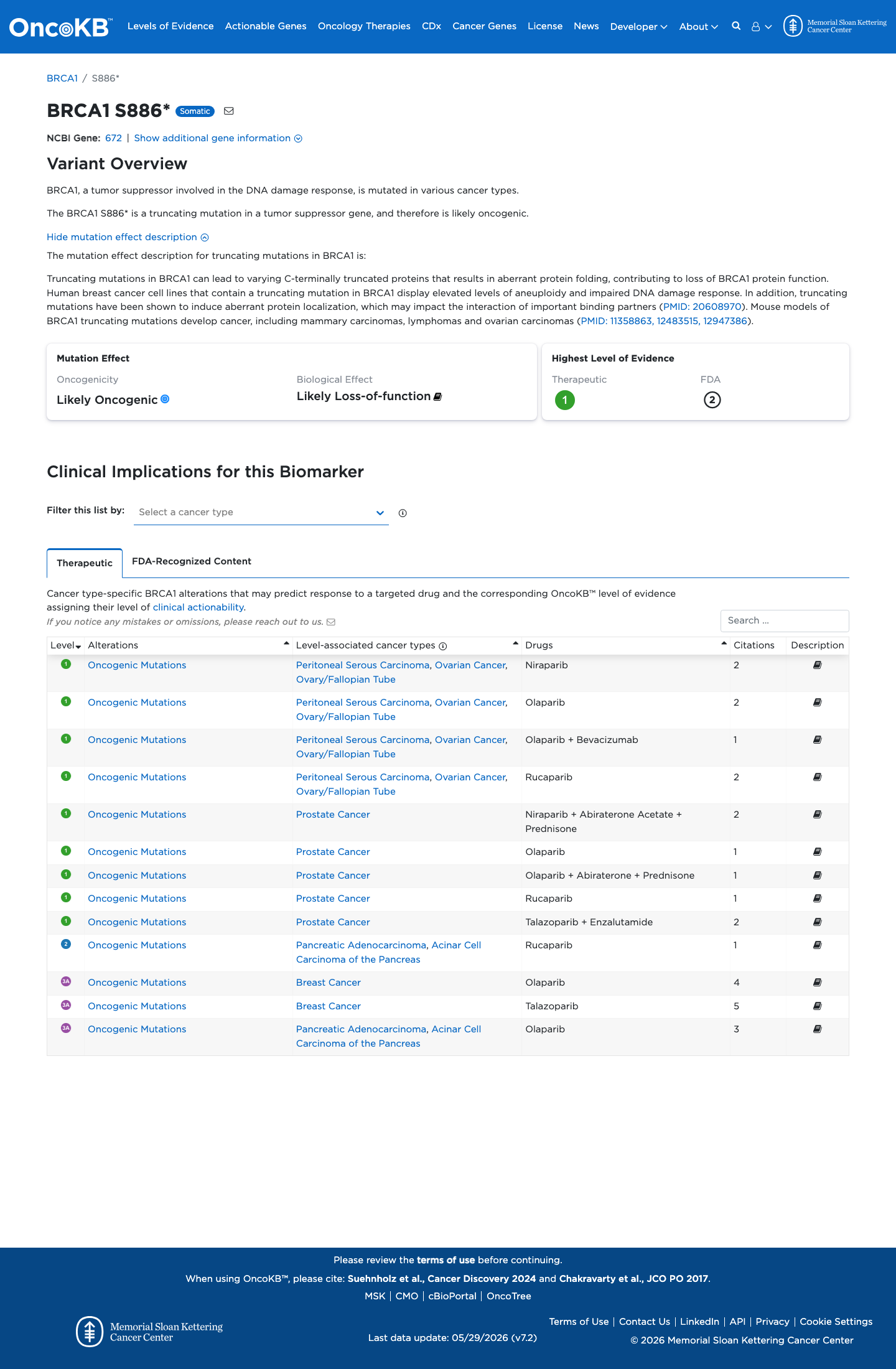
Functional
Likely Oncogenic
OncoKB identified variant-specific curated literature and context relevant to functional review; biological-effect context: Likely Loss-of-function; curated oncogenicity label: Likely Oncogenic.

COSMIC

Cancer hotspots
Somatic evidence
Not in COSMIC / hotspots
COSMIC
This variant does not lie in a statistically significant hotspot. This variant has not previously been reported in somatic cancers (COSMIC).
Hotspots
This variant does not lie in a statistically significant hotspot.
Sources & reference links
Triaged references · 4 PMIDs not cited in assessment
12947386 ↗
Roles of BRCA1 and BRCA2 in homologous recombination, DNA replication fidelity and the cellular response to ionizing radiation.
ONCOKB
20608970 ↗
BRCA1 16 years later: risk-associated BRCA1 mutations and their functional implications.
ONCOKB