Back
NM_007294.4:c.4481A>G
p.Glu1494Gly · BRCA1
0%
complete
Final classification
VUS
BRCA1
c.4481A>G
p.Glu1494Gly
missense · exon 13

BRCA1 encodes a large nuclear protein that helps maintain genomic stability by coordinating the repair of DNA double-strand breaks through homologous recombination, and it also regulates transcription and the cell cycle. It acts as a tumor suppressor, working with proteins such as RAD51, BRCA2, BARD1, and PALB2 to preserve genome integrity. Inherited alterations in BRCA1 cause hereditary breast and ovarian cancer syndrome, with elevated risks of breast, ovarian, prostate, and pancreatic cancers, and biallelic loss underlies a rare form of Fanconi anemia. Because BRCA1-driven tumors rely on impaired DNA repair, they are treatable with PARP inhibitors.

This variant

BRCA1 encodes a tumor-suppressor protein that maintains genomic stability through homologous-recombination DNA repair, and inherited BRCA1 alterations cause hereditary breast and ovarian cancer syndrome.

Transcript
NM_007294.4
HGVS · transcript:coding
NM_007294.4:c.4481A>G
GRCh38
chr17:43076491 T>C
GRCh37
chr17:41228508 T>C
VUS: no pathogenic or benign criterion is met or assigned a usable strength under the ENIGMA BRCA1/2 VCEP Version 1.2 Table 3.
Classification rationale
VUS
BRCA1 c.4481A>G missense · exon 13

All three requested consequence/LOF criteria are not applicable: the variant is a BRCA1 missense substitution, and ENIGMA v1.2 excludes PVS1, PM4, and BP3 for this consequence class. The governing ENIGMA BRCA1/2 V1.2 framework controls all five requested criteria. No requested criterion is met: PS1 lacks a pathogenic same-amino-acid comparator, while PM1, PM5, PP2, and BP1 are not applicable under explicit VCEP rules. The only same-residue alternate found in the governing functional tables, p.Glu1494Lys, is classified as no functional impact/Not Pathogenic. PS2 and PM6 are not applicable under the governing ENIGMA BRCA1/2 VCEP specification. PP1 and BS4 remain not assessed because no variant-specific segregation or non-segregation evidence was available; the clinical-history LR row was not used as a segregation result. Neither PS3 nor BS3 is assessed because the governing ENIGMA variant-specific functional-assay resources contain no entry for NM_007294.4:c.4481A>G (p.Glu1494Gly/p.E1494G), and no separate variant-specific protein-function assay evidence was available in the case bundle. For this missense variant, the governing ENIGMA specification was used first. PS4 lacks required case-control statistics; PP4 and BP5 use the exact Li clinical-history LR of 1.098592032317503, which is below pathogenic-supporting and above benign-supporting thresholds; PP5 and BP6 are excluded by ENIGMA and lack eligible ClinVar expert-panel classifications. The variant is missense, so PP3 and BP4 were assessed through the REVEL protein-impact path only; BP7 is not applicable. REVEL 0.492 is below the supporting PP3 threshold of 0.644 and above the supporting BP4 threshold of 0.29, so neither computational code is met.

LYFE Sciences is an AI system, and it can make mistakes. Criteria may be applied incorrectly, sources may be misread, and a confident-looking classification can still be wrong. Double-check every criterion and its underlying evidence before relying on any call.
Gene diagram · NM_007294.4 · variants mapped to exon structure
BRCA1 NM_007294.4
Fetching transcript structure from UCSC…
Applied criteria · 0 applied · 15 assessed
MetEvidence satisfies this criterion.
Not metEvaluated against available evidence; threshold not reached.
Not assessedApplies in principle, but no evidence was found to evaluate it.
N/ADoesn't apply to this variant type.
Applied · 0

No criteria were applied for this variant.
Assessed · not applied · 5 not met · 10 not assessed
Pathogenic
PS1 Not met: the only same-residue comparator, p.Glu1494Lys, is ENIGMA-classified Not Pathogenic rather than pathogenic or likely pathogenic.
PS3 Not assessed: ENIGMA Table 9 and ST4 contain no c.4481A>G/p.Glu1494Gly/p.E1494G entry assigning damaging functional evidence.
PS4 Not assessed: no variant-specific case-control odds ratio, p-value, or confidence interval is available for the PS4 requirements.
PM2 Not assessed: both required non-cancer datasets failed, and all-comers data show 1 and 5 alleles rather than absence.
PM3 Not assessed: no documented Fanconi Anemia phenotype or phased co-occurring pathogenic/likely pathogenic BRCA1 variant is available for the 2-point PM3 threshold.
PP1 Not assessed: no variant-specific segregation LR or affected-family-member genotype data was available to compare with the PP1 threshold of LR >=2.08.
PP3 Not met: REVEL 0.492 is below the 0.644 supporting PP3 threshold for missense variants.
PP4 Not met: clinical-history LR 1.098592032317503 >= 2.08? no, so it does not reach the ENIGMA PP4 Supporting threshold.
Benign
BA1 Not assessed: required non-cancer gnomAD frequencies failed, while available all-comers AFs (3.98e-06 and 3.10e-06) cannot establish BA1.
BS1 Not assessed: required non-cancer frequencies failed, and available all-comers AFs (3.98e-06 and 3.10e-06) are not governing BS1 evidence.
BS2 Not assessed: no qualifying phenotyped adult or phase evidence is provided, and VCEP excludes gnomAD frequency-only homozygotes from BS2.
BS3 Not assessed: ENIGMA Table 9 and ST4 contain no c.4481A>G/p.Glu1494Gly/p.E1494G entry assigning benign functional evidence.
BS4 Not assessed: no variant-specific non-segregation LR or affected-family-member genotype data was available to compare with the BS4 threshold of LR <=0.48.
BP4 Not met: REVEL 0.492 exceeds the 0.29 supporting BP4 threshold for missense variants and is gray-zone.
BP5 Not met: clinical-history LR 1.098592032317503 <= 0.48? no, so it does not reach the ENIGMA BP5 Supporting threshold.
N/A · 13 PVS1 · PS2 · PM1 · PM4 · PM5 · PM6 · PP2 · PP5 · BP1 · BP2 · BP3 · BP6 · BP7
Research & evidence
Population frequency
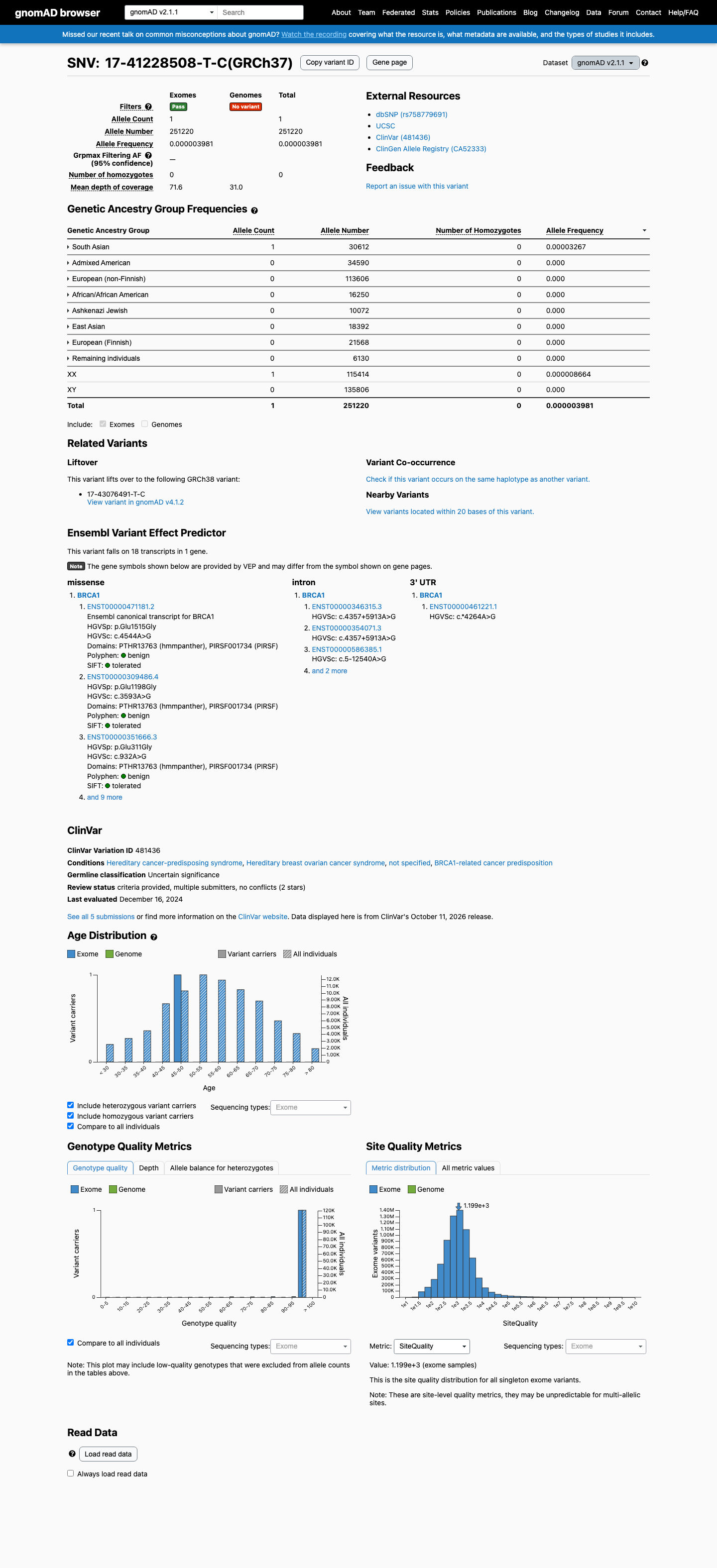
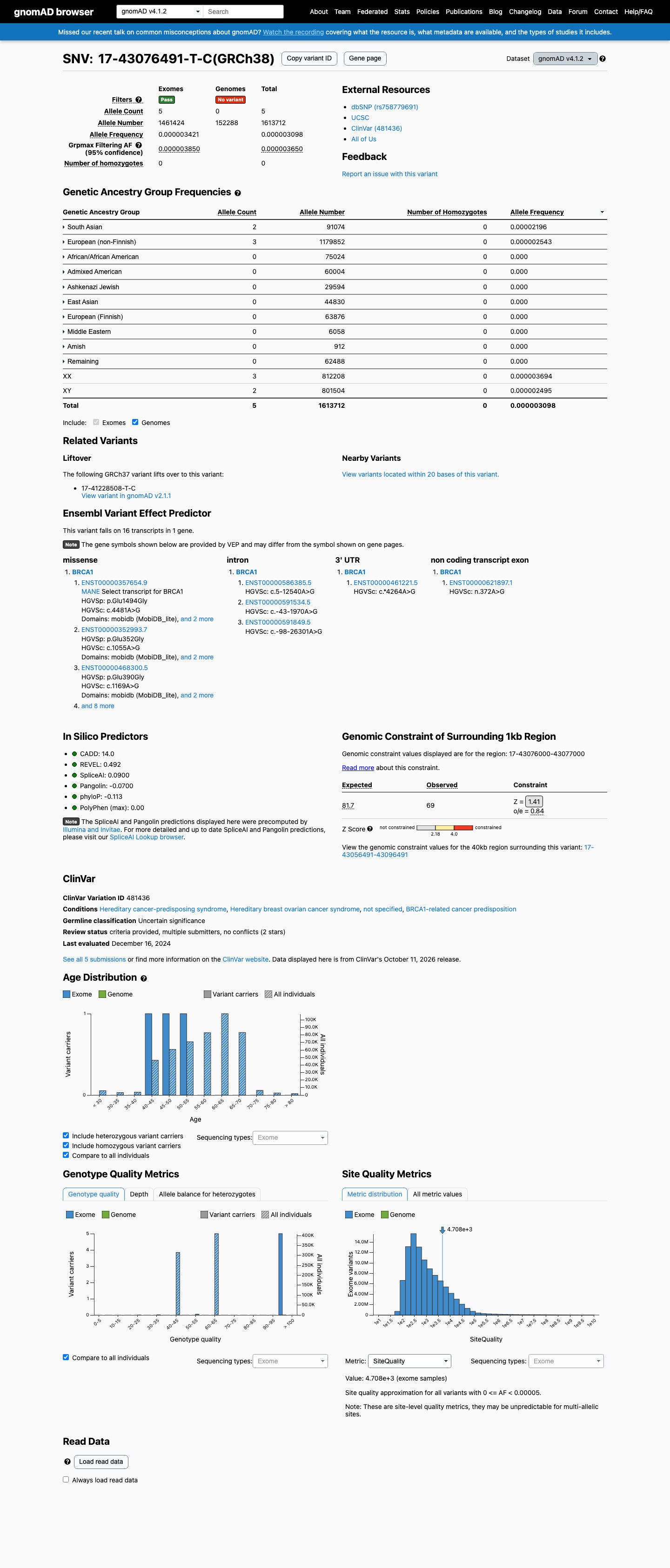
gnomAD v4.1 screenshot
gnomAD v4.1
gnomAD v2.1 screenshot
gnomAD v2.1
v4.1
This variant is present in gnomAD v4.1 (AF= 3.09845e-06; MAF= 0.00031%, 5/1613712 alleles, homozygotes = 0) and has highest observed frequency in the South Asian population (AF= 2.19602e-05; MAF= 0.00220%, 2/91074 alleles, homozygotes = 0); grpmax FAF= 3.65e-06.
v2.1
This variant is present in gnomAD v2.1 (AF= 3.98057e-06; MAF= 0.00040%, 1/251220 alleles, homozygotes = 0) and has highest observed frequency in the South Asian population (AF= 3.26669e-05; MAF= 0.00327%, 1/30612 alleles, homozygotes = 0).
🇨🇦 CA
Absent from gnomAD-Canada v1.0.
Allele frequency by ancestry
three datasets · side by side
gnomAD v4.1
0.00031% · 5 / 1,613,712
0 hom · FAF 0.00037%
South Asian
2 / 91,074
0.0022%
European (non-Finnish)
3 / 1,179,852
0.00025%
+ 8 not observed (Remaining individuals, Admixed American, European (Finnish), Amish, East Asian, Middle Eastern, Ashkenazi Jewish, African/African American)
gnomAD v2.1
0.0004% · 1 / 251,220
0 hom
South Asian
1 / 30,612
0.0033%
+ 7 not observed (African/African American, Admixed American, Ashkenazi Jewish, East Asian, European (Finnish), European (non-Finnish), Remaining individuals)
gnomAD Canada 🇨🇦
Absent · 0 / ?
0 hom
Not observed in any ancestry group.
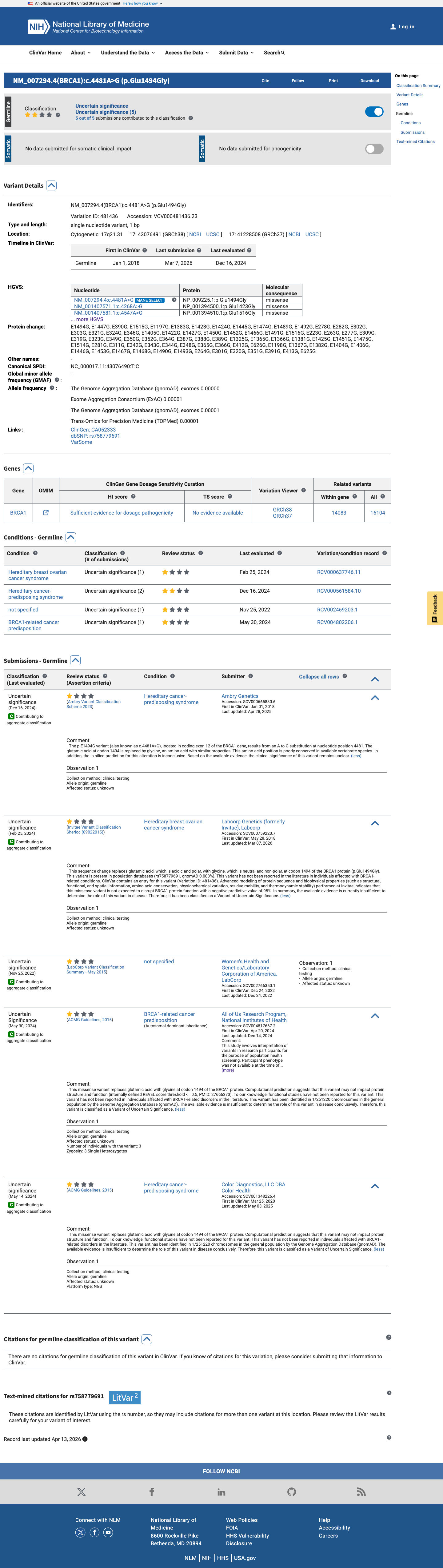
ClinVar screenshot
ClinVar
This variant has been reported in ClinVar as Uncertain significance (4 clinical laboratories) and as Uncertain Significance (1 clinical laboratory). (ClinVarID = 481436)
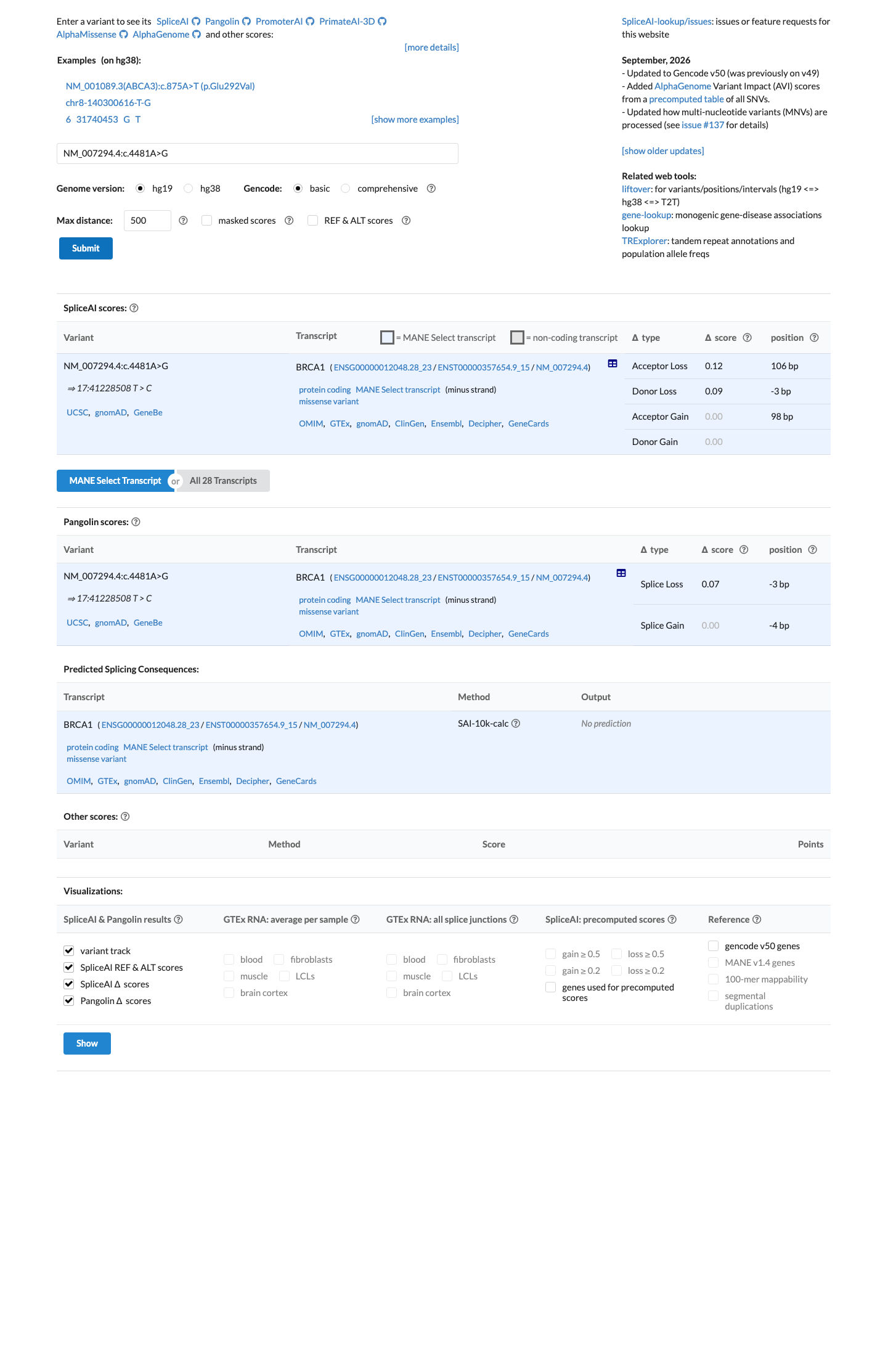
SpliceAI screenshot
In silico
SpliceAI predicts no significant splice impact for this variant (max delta score = 0.12). REVEL score = 0.492. BayesDel score = -0.107518.
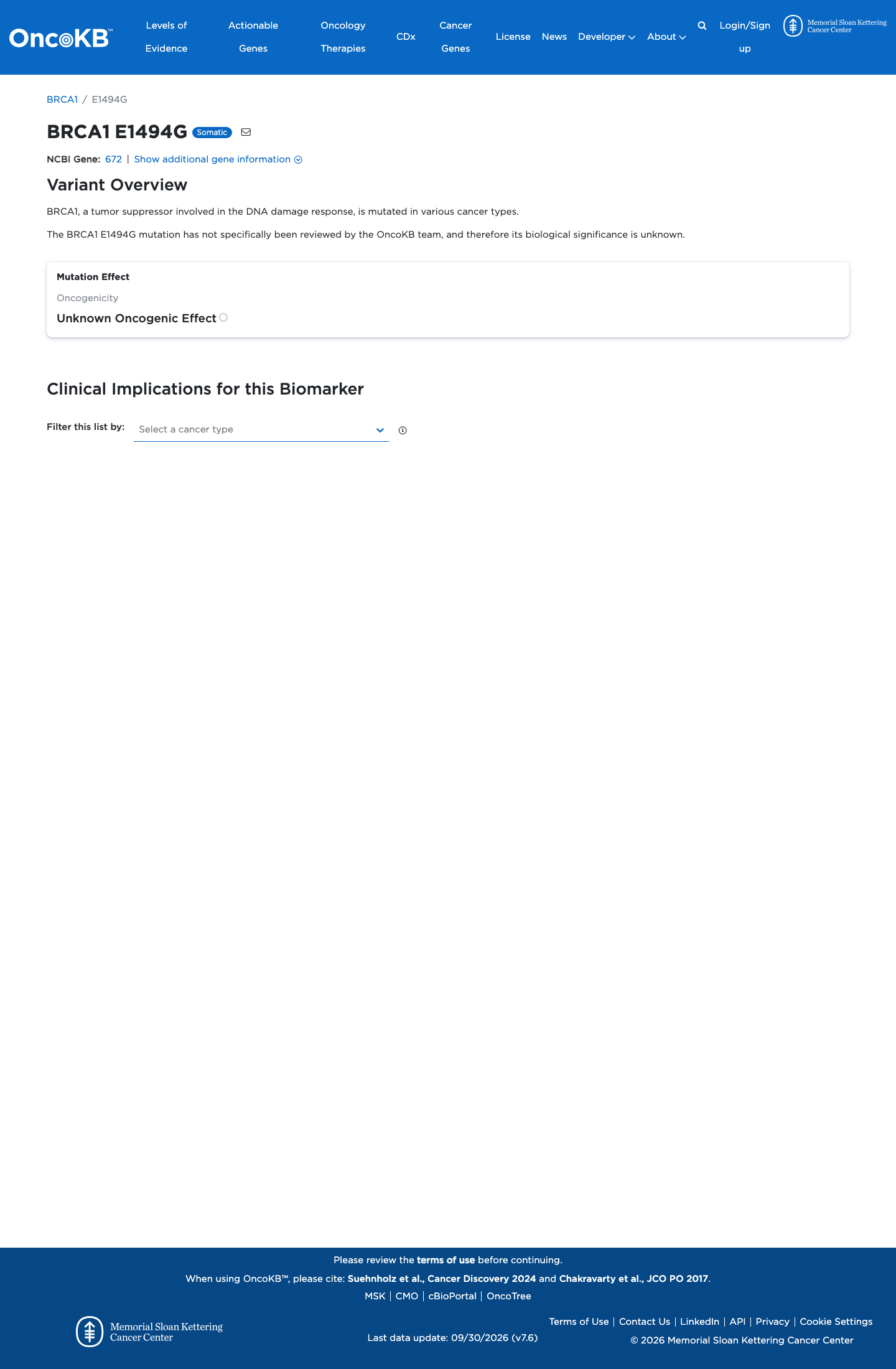
Functional / OncoKB screenshot
Functional Unknown Oncogenic Effect
OncoKB did not identify variant-specific reviewed functional evidence for this variant; gene-level curated context is available for reviewer follow-up. BRCA1, a tumor suppressor involved in the DNA damage response, is mutated in various cancer types.
OncoKB ↗
COSMIC screenshot
COSMIC
Cancer hotspots screenshot
Cancer hotspots
Somatic evidence Not in COSMIC / hotspots
COSMIC
This variant does not lie in a statistically significant hotspot. This variant has not previously been reported in somatic cancers (COSMIC).
Hotspots
This variant does not lie in a statistically significant hotspot.
Sources & reference links
9Sources
CSpec VCEP
ClinVar
gnomAD v2.1
gnomAD v4.1
gnomAD-Canada
SpliceAI
OncoKB
COSMIC
Cancer hotspots
Triaged references · 6 PMIDs not cited in assessment
23918944 ↗ Tamoxifen and risk of contralateral breast cancer for BRCA1 and BRCA2 mutation carriers. CLINVAR
25741868 ↗ Standards and guidelines for the interpretation of sequence variants: a joint consensus recommendation of the American College of Medical Genetics and Genomics and the Association for Molecular Pathology. CLINVAR
15604628 ↗ Genetic cancer risk assessment and counseling: recommendations of the national society of genetic counselors. CLINVAR
17508274 ↗ Risk assessment and genetic counseling for hereditary breast and ovarian cancer: recommendations of the National Society of Genetic Counselors. CLINVAR
24366376 ↗ Risk assessment, genetic counseling, and genetic testing for BRCA-related cancer in women: U.S. Preventive Services Task Force recommendation statement. CLINVAR
24493721 ↗ American Society of Clinical Oncology Expert Statement: collection and use of a cancer family history for oncology providers. CLINVAR