Analysis in progress
Initialising…
0%
complete
This report is still being assembled — sections appear as each stage finishes. It isn't final yet.
TARDBP
Final classification
VUS
PS3PM1PM2PP1PP2BP4
TARDBP
c.881G>T
p.Gly294Val
missense · exon 6
Gene context NCBI Gene ↗

TARDBP encodes TAR DNA-binding protein 43 (TDP-43), an RNA/DNA-binding protein that helps regulate gene transcription, RNA splicing, and the transport and stability of messenger RNA. Mutations in this gene are a cause of amyotrophic lateral sclerosis (ALS) and frontotemporal dementia (FTD), and abnormal clumping of TDP-43 protein is a hallmark of several neurodegenerative disorders. TARDBP has no established role in cancer.

This variant

TARDBP mutations cause ALS and frontotemporal dementia, and TDP-43 has no established role in cancer. This p.(Gly294Val) change — located in the mutation-rich C-terminal domain, essentially absent from population databases, and cosegregating with ALS in one family — is classified as a variant of uncertain significance: the evidence leans toward pathogenicity but does not yet meet diagnostic thresholds.

Transcript
NM_007375.4
HGVS · transcript:coding
NM_007375.4:c.881G>T
GRCh38
chr1:11022290 G>T
GRCh37
chr1:11082347 G>T
Basis Generic ACMG/AMP 2015 fallback: five supporting pathogenic criteria (PS3, PM1, PM2, PP1, PP2) versus one supporting benign criterion (BP4); no combination threshold is met, so the classification is VUS.
Generic ACMG/AMP 2015 fallback: five supporting pathogenic criteria (PS3, PM1, PM2, PP1, PP2) versus one supporting benign criterion (BP4); no combination threshold is met, so the classification is VUS.
Classification rationale
PS3PM1PM2PP1PP2 BP4 VUS
TARDBP c.881G>T missense · exon 6

PS3 (Supporting): two independent functional studies demonstrate abnormal variant biology. PM1 (Supporting): variant disrupts the C-terminal glycine-rich domain where TARDBP disease variants cluster. PM2 (Supporting): essentially absent from population databases (gnomAD v4.1 AF 3.1e-06, zero homozygotes). PP1 (Supporting): cosegregation with ALS in an affected proband and sibling. PP2 (Supporting): missense is the established TARDBP disease mechanism, with low benign tolerance in this domain. BP4 (Supporting): SpliceAI predicts no splice impact (max delta 0.00). Overall: VUS — five supporting pathogenic criteria against one supporting benign criterion meet no combination threshold under generic ACMG/AMP 2015.

PS3 + PM1 + PM2 + PP1 + PP2 + BP4 VUS
Gene diagram · NM_007375.4 · variants mapped to exon structure
TARDBP NM_007375.4
Fetching transcript structure from UCSC…
Applied criteria · 6 applied · 16 assessed
MetEvidence satisfies this criterion.
Not metEvaluated against available evidence; threshold not reached.
Not assessedApplies in principle, but no evidence was found to evaluate it.
N/ADoesn't apply to this variant type.
Applied · 6
Strength Supporting Moderate Strong Very strong
PS3 supporting review Pathogenic
Met (Supporting): two independent functional studies show abnormal variant biology — accelerated amyloid formation with ~25% reduced cell viability, and neurodegeneration in patient-derived motor neurons.
PMID:25090004: synthetic TDP-43 C-terminal peptide (residues 287-322) bearing G294V showed twisted fibrils (8-10 nm width), a beta-sheet conformational shift, increased ThT fluorescence with <10% monomer remaining after 7 days, moderate liposome leakage, and ~25% reduced N2a cell viability at 72h versus wild-type-derived peptide.PMID:25090004 direct quote: 'In this study, we try to characterize the structure, amyloid properties, membrane permeabilization ability, and biological properties of clinically-related TDP-43 mutants including G294V (familial mutation) and G295S (sporadic mutation).'PMID:29630989: patient-derived iPSC spinal motor neuron cultures carrying G294V (and S393L) showed age-dependent neurodegeneration, neurofilament/cytoskeletal abnormalities, and mitochondrial/lysosomal transport deficits versus wild-type cultures, occurring without detectable TDP43 mislocalization or aggregation; D-sorbitol treatment rescued organelle morphology/motility.
PM1 supporting Pathogenic
Met (Supporting): residue 294 lies in the C-terminal glycine-rich domain where essentially all disease-causing TARDBP missense variants cluster, and the change disrupts this domain.
PMID:19864664 direct quote: 'Functional domain analysis from both SMART and ProteinPredict programs predict that this mutation causes the disruption of a low complexity, 41 amino acid glycine rich domain in the C terminus of TDP-43. The G294V mutation is predicted to split the domain into two separate glycine rich regions of 18 and 17 amino acids, separated by a six amino acid gap.'PMID:19236453 describes the variant as located 'in exon 6 within a highly conserved, glycine-rich region of TDP-43'.PMID:19224587 reports the substituted residue is evolutionarily conserved across all or most of seven examined vertebrate species and predicted deleterious by multiple in-silico tools.
PM2 supporting Pathogenic
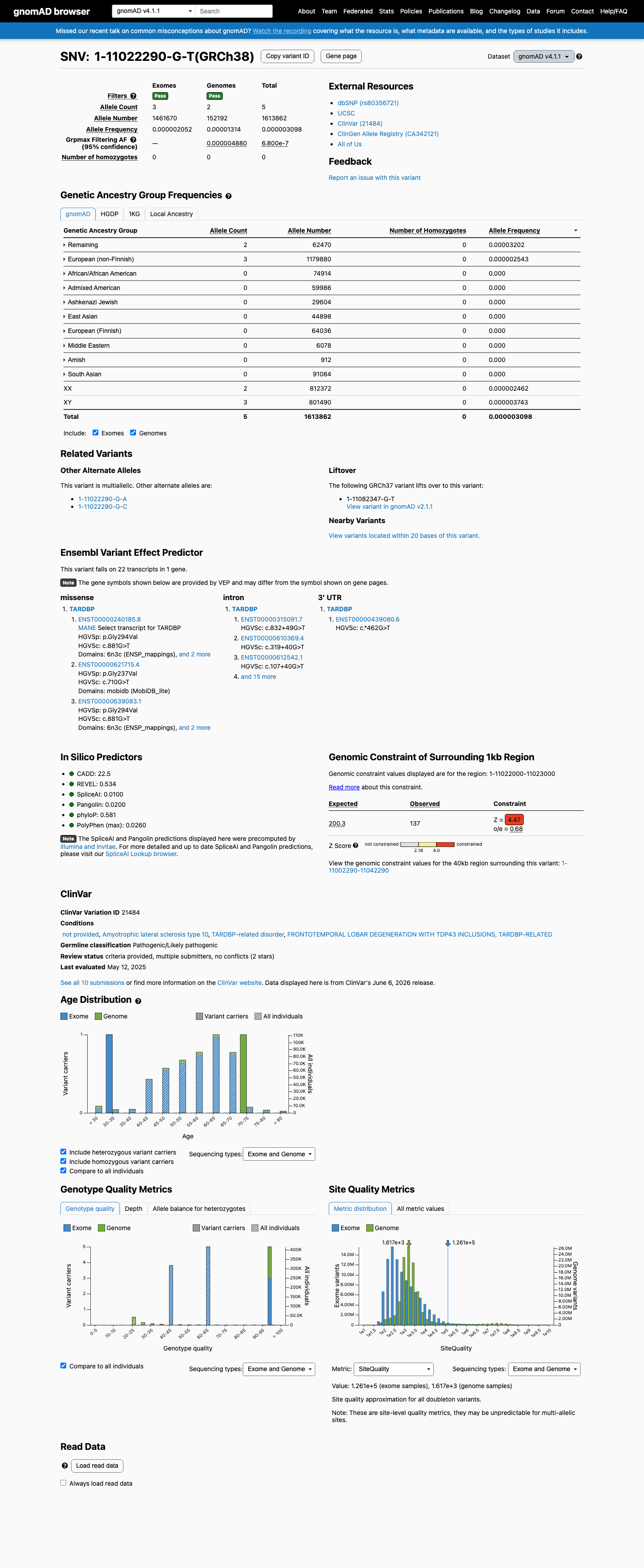
Met (Supporting): essentially absent from population databases — gnomAD v4.1 allele frequency 3.1e-06 with zero homozygotes.
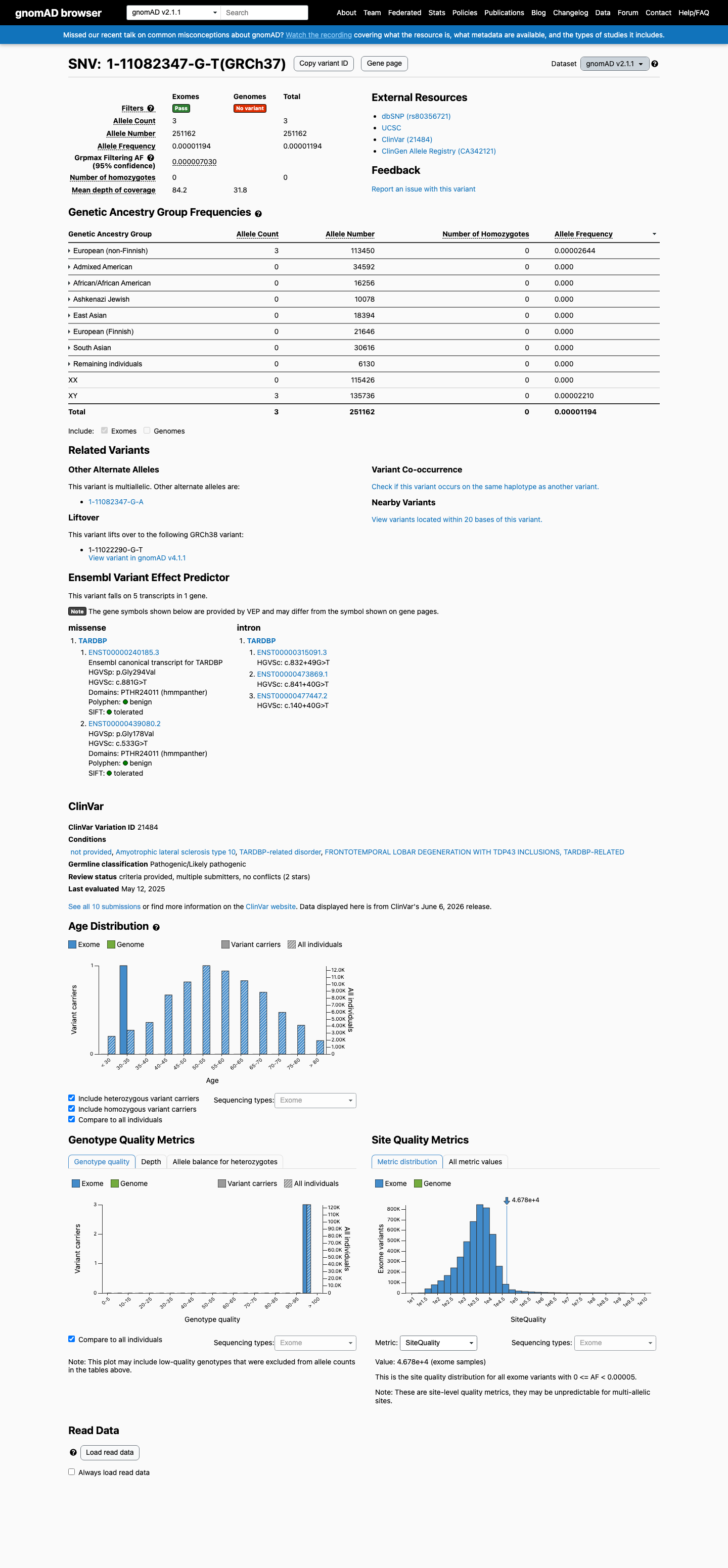
The case evidence reports gnomAD v4.1: 5/1,613,862 alleles, AF 3.09816e-06, 0 homozygotes; the highest listed subpopulation AF is 3.20154e-05.The case evidence reports gnomAD v2.1: 3/251,162 alleles, AF 1.19445e-05, 0 homozygotes; the highest listed subpopulation AF is 2.64434e-05.The variant is reported as absent from gnomAD-Canada v1.0.
PP1 supporting Pathogenic
Met (Supporting): the variant cosegregated with ALS in an affected proband and an affected sibling in a familial case.
PMID:19224587 explicitly reports heterozygous p.G294V in ALS patient CB768 and the same mutation in his sister, who also developed ALS; this is direct variant-level cosegregation evidence.PMID:19224587 states that both parents were neurologically unaffected but were elderly/deceased and that the proband had a positive family history of motor neuron disease; no additional quantitative segregation analysis is available in the extraction.
PP2 supporting Pathogenic
Met (Supporting): TARDBP ALS/FTD is a missense-predominant disease gene, and the affected domain is absent from hundreds of control chromosomes.
PMID:19864664: G294V absent from 354 matched controls (708 control chromosomes).PMID:19236453: G294V absent from 362 control chromosomes.PMID:19224587: p.G294V absent from 771 neurologically healthy Italian controls.
BP4 supporting Benign
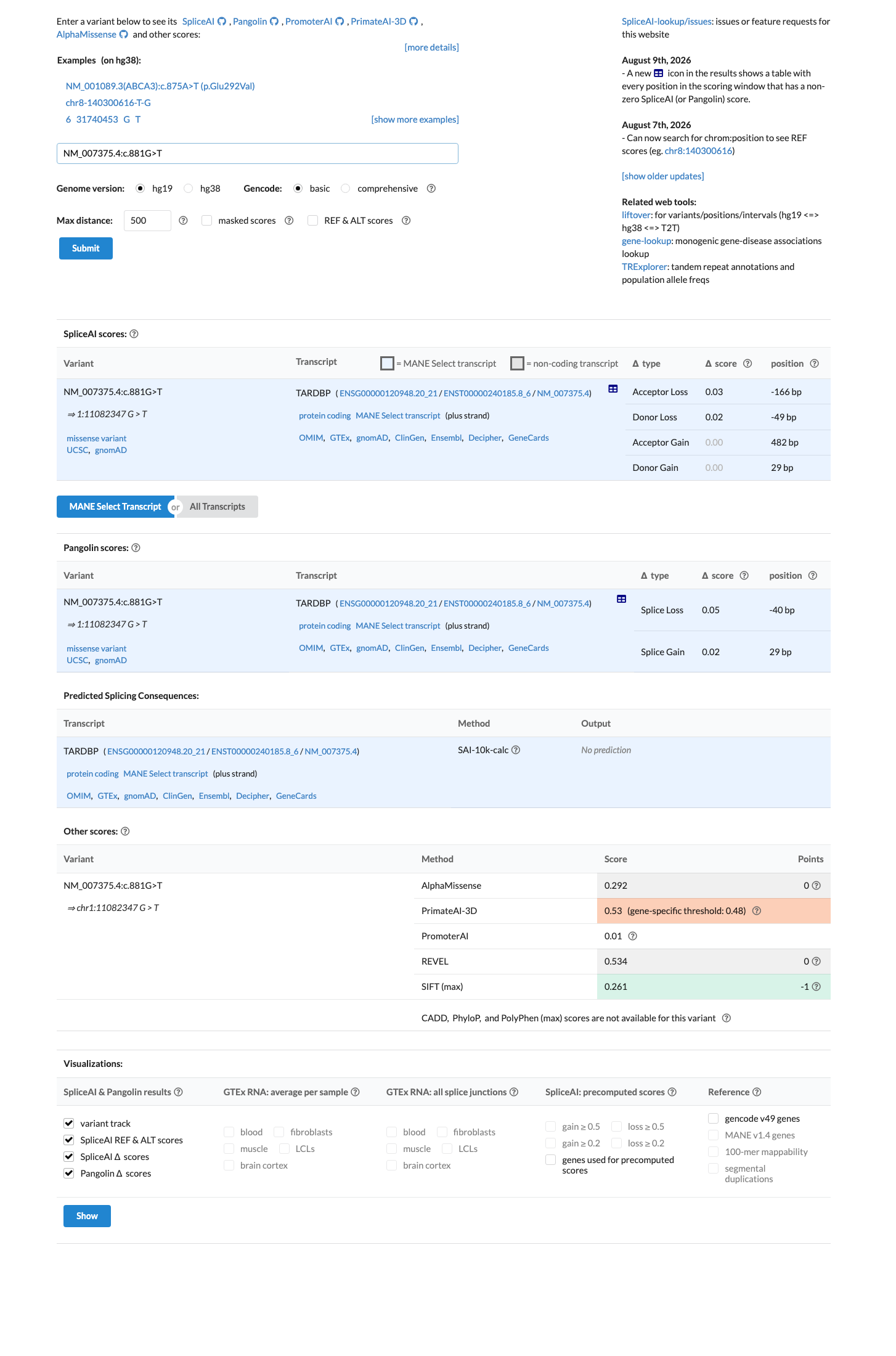
Met (Supporting): SpliceAI predicts no splice impact (max delta 0.00), far below any splice-altering threshold.
SpliceAI max delta score = 0.00 (source_registry 'spliceai'; evidence_sentence: 'SpliceAI predicts no significant splice impact for this variant (max delta score = 0.00)'), well below any threshold indicating a splice-altering effect, supporting BP4 at supporting strength via the splicing arm.REVEL score = 0.534 (source_registry 'revel') is above the ClinGen SVI BP4_Supporting threshold of REVEL <=0.290 (Pejaver et al. 2022, PMID 36413997), so it does not add independent support for BP4 via the missense path; only the SpliceAI-based splicing evidence is used to meet BP4, avoiding double counting.BayesDel score = 0.324549 (source_registry 'bayesdel') has no verified published PP3/BP4 calibration threshold available to this pipeline and was not used to support BP4.
Assessed · not applied · 7 not met · 9 not assessed
Pathogenic
PS2 Not assessed: no confirmed de novo occurrence with both biological parents tested was documented.
PS4 Not assessed: reported ALS cases may overlap and lack matched controls, so population enrichment could not be established.
PM5 Not assessed: no alternate amino-acid substitution at codon 294 with established pathogenicity was identified.
PM6 Not assessed: parental genotyping was not documented, so a de novo occurrence could not be presumed.
PP3 Not met: REVEL score 0.534 falls below the 0.644 supporting threshold, and SpliceAI predicts no splice impact.
PP4 Not assessed: the evaluated individual's phenotype was not available for assessment.
PP5 Not met: no expert-panel ClinVar assertion of pathogenicity exists for this exact variant.
Benign
BA1 Not met: population frequency 3.1e-06 is far below the >1% benign threshold.
BS1 Not met: the highest population frequency (~3.2e-05) is far below the >0.3% benign threshold.
BS2 Not assessed: population data lack the phenotype, age, and penetrance information needed to establish benign homozygosity.
BS3 Not met: the only functional studies show abnormal, not wild-type-like, behavior of the variant.
BS4 Not assessed: relatives' genotypes and ages were not documented, so non-segregation could not be shown.
BP1 Not met: TARDBP disease is driven by missense rather than truncating variants, the opposite of this rule's premise.
BP2 Not assessed: no second pathogenic allele in trans or in cis with the variant was documented.
BP5 Not assessed: no alternate molecular diagnosis fully explaining the phenotype was documented.
BP6 Not met: no expert-panel ClinVar assertion of benign effect exists for this exact variant.
N/A · 6 PVS1 · PS1 · PM3 · PM4 · BP3 · BP7
Research & evidence
Population frequency
gnomAD v4.1 screenshot
gnomAD v4.1
gnomAD v2.1 screenshot
gnomAD v2.1
v4.1
This variant is present in gnomAD v4.1 (AF= 3.09816e-06; MAF= 0.00031%, 5/1613862 alleles, homozygotes = 0) and has highest observed frequency in the Remaining individuals population (AF= 3.20154e-05; MAF= 0.00320%, 2/62470 alleles, homozygotes = 0); grpmax FAF= 6.8e-07.
v2.1
This variant is present in gnomAD v2.1 (AF= 1.19445e-05; MAF= 0.00119%, 3/251162 alleles, homozygotes = 0) and has highest observed frequency in the European (non-Finnish) population (AF= 2.64434e-05; MAF= 0.00264%, 3/113450 alleles, homozygotes = 0); grpmax FAF= 7.03e-06.
🇨🇦 CA
Absent from gnomAD-Canada v1.0.
Allele frequency by ancestry
three datasets · side by side
gnomAD v4.1
0.00031% · 5 / 1,613,862
0 hom · FAF 6.8e-05%
Remaining individuals
2 / 62,470
0.0032%
European (non-Finnish)
3 / 1,179,880
0.00025%
+ 8 not observed (Admixed American, European (Finnish), Amish, East Asian, Middle Eastern, South Asian, Ashkenazi Jewish, African/African American)
gnomAD v2.1
0.0012% · 3 / 251,162
0 hom · FAF 0.0007%
European (non-Finnish)
3 / 113,450
0.0026%
+ 7 not observed (African/African American, Admixed American, Ashkenazi Jewish, East Asian, European (Finnish), Remaining individuals, South Asian)
gnomAD Canada 🇨🇦
Absent · 0 / ?
0 hom
Not observed in any ancestry group.
ClinVar screenshot
ClinVar
This variant has been reported in ClinVar as Pathogenic (8 clinical laboratories) and as Likely pathogenic (1 clinical laboratory). (ClinVarID = 21484)
SpliceAI screenshot
In silico
SpliceAI predicts no significant splice impact for this variant (max delta score = 0.00). REVEL score = 0.534. BayesDel score = 0.324549.
Functional No data
No calibrated functional assay or RNA evidence was identified for this variant.
OncoKB ↗
COSMIC screenshot
COSMIC
Cancer hotspots screenshot
Cancer hotspots
Somatic evidence Not in COSMIC / hotspots
COSMIC
This variant does not lie in a statistically significant hotspot. This variant has not previously been reported in somatic cancers (COSMIC).
Hotspots
This variant does not lie in a statistically significant hotspot.
Literature · how each cited paper was used
6papers cited
Each card is an audit: what was searched, what was found, whether it names the variant, which criteria it fed, and why. 2 further PMIDs triaged but not cited — see Sources & references.
High frequency of TARDBP gene mutations in Italian patients with amyotrophic lateral sclerosis.
Searched
c.881G>Tc.881G4Tp.G294VNP_031401.1:p.(G294V)
Found
The paper reports the heterozygous TARDBP c.881G>T (p.G294V) variant in an Italian ALS patient (CB768) with a positive family history (affected sister with the same variant), absent from 771 neurologically healthy Italian controls, at an evolutionarily conserved residue predicted deleterious by at least two of three in-silico tools.
Variant
✓ Names this variant — characterised directly
Applied to
PM1 supporting
Confirms strong evolutionary conservation of the residue across vertebrates, supporting critical/functional domain status for PM1.
PM2 supporting
Reports the exact variant absent from a neurologically healthy Italian control cohort.
PP1 supporting
The affected proband's sister also had ALS and carried the same p.G294V variant, providing direct cosegregation evidence.
PP2 supporting
Absence in 771 controls and conservation across species support the low benign-missense-tolerance premise of PP2.
The newly identified missense variations affect evolutionary conserved amino acid residues in all or in most of the seven examined vertebrate species... Three of them (p.G294V, p.G335D, and p.S393L) were predicted to have a deleterious effect on TDP-43 protein structure or function by at least 2 out of the 3 considered prediction programs PolyPhen, SNAP, and PMUT.
Location Results, Mutational Analysis; Table 1; Results, clinical characteristics paragraph  ·  Context Exon 6 sequencing in 385 additional Italian ALS patients within a total cohort of 666 ALS patients; comparison with 771 neurologically healthy Italian controls; family testing and in-silico prediction.  ·  full text
TARDBP (TDP-43) sequence analysis in patients with familial and sporadic ALS: identification of two novel mutations.
Searched
c.881G>TNP_031401.1:p.(G294V)p.G294V
Found
The paper reports p.G294V as a novel heterozygous missense mutation in TARDBP in an Italian woman with sporadic ALS, located in exon 6 within a highly conserved, glycine-rich region of TDP-43, and absent from 362 control chromosomes.
Variant
✓ Names this variant — characterised directly
Applied to
PM1 supporting
Independently describes the residue as located within a highly conserved, glycine-rich region of TDP-43, corroborating the functional-domain basis for PM1.
PM2 supporting
Reports the exact variant absent from 362 healthy control chromosomes.
PP2 supporting
Absence in 362 control chromosomes supports low benign-missense tolerance at this locus, consistent with PP2.
The p.G294V amino acid change was identified in an Italian woman who developed progressive lower limb weakness at the age of 73 (Table 2, patient D)... No positive family history for neurological, cardiological and autoimmune diseases has been reported.
Location Results, paragraph describing patient D; Table 2; Discussion, paragraph describing the two novel mutations  ·  Context TARDBP coding-region sequencing in 314 ALS probands (308 Italian) with comparison to 181 Italian healthy volunteers (362 control chromosomes).  ·  full text
A novel TARDBP mutation in an Australian amyotrophic lateral sclerosis kindred.
Searched
c.881G>TNP_031401.1:p.(G294V)c.881G.TG294V
Found
The paper identified the TARDBP missense variant c.881G>T (G294V) in exon 6 in a familial ALS patient of Italian descent, absent from 354 matched controls (708 control chromosomes). Computational analyses predicted the substitution as non-neutral/possibly damaging and, critically, functional domain analysis (SMART, ProteinPredict) predicted disruption of the 41-amino-acid low-complexity glycine-rich C-terminal domain of TDP-43, splitting it into two smaller glycine-rich segments of 18 and 17 residues separated by a 6-residue gap.
Variant
✓ Names this variant — characterised directly
Applied to
PM1 supporting
Directly documents that G294V disrupts the C-terminal glycine-rich low-complexity functional domain of TDP-43, supporting the domain-disruption premise for PM1.
PM2 supporting
Reports the exact variant absent from 708 matched control chromosomes.
PP1 supporting
The source was reviewed as a familial case but explicitly states that segregation could not be confirmed.
PP2 supporting
Absence in 708 control chromosomes and missense-specific domain disruption support the missense-predominant, low-benign-tolerance mechanism underlying PP2.
Functional domain analysis from both SMART and ProteinPredict programs predict that this mutation causes the disruption of a low complexity, 41 amino acid glycine rich domain in the C terminus of TDP-43. The G294V mutation is predicted to split the domain into two separate glycine rich regions of 18 and 17 amino acids, separated by a six amino acid gap.
Location Results, mutation-screening and functional-domain-analysis paragraphs; Discussion, first paragraph  ·  Context TARDBP sequencing of all six exons and flanking intronic sequences in 30 familial ALS families and 74 sporadic ALS cases; qPCR copy-number assessment; computational analyses using cross-species alignment, SNAP, PolyPhen, SMART, and ProteinPredict; 354 matched controls (708 control chromosomes) sequenced.  ·  full text
The influence of pathological mutations and proline substitutions in TDP-43 glycine-rich peptides on its amyloid properties and cellular toxicity.
Searched
c.881G>TNP_031401.1:p.(G294V)
Found
The paper explicitly studies G294V as a familial TDP-43 mutation using a synthetic C-terminal peptide (residues 287-322), alongside the sporadic mutation G295S, finding that the G294V peptide formed twisted amyloid fibrils, underwent beta-sheet conformational transition, showed accelerated aggregation, caused liposome leakage, and reduced N2a cell viability.
Variant
✓ Names this variant — characterised directly
Applied to
PS3 supporting
Variant-specific in vitro biophysical/cytotoxicity assay showing abnormal amyloidogenic and cytotoxic behavior versus wild-type peptide.
PP2 supporting
Demonstrates that another missense substitution (G295S) at an adjacent residue in the same C-terminal domain is also independently studied as disease-relevant, reinforcing that missense variation in this domain is the established TARDBP disease mechanism supporting PP2.
In this study, we try to characterize the structure, amyloid properties, membrane permeabilization ability, and biological properties of clinically-related TDP-43 mutants including G294V (familial mutation) and G295S (sporadic mutation).
Location Introduction; Results, Figures 2, 4, 5, and 6  ·  Context In-vitro biophysical and cell-based assays using a synthetic TDP-43 C-terminal peptide spanning residues 287-322: TEM, CD spectroscopy, FT-Raman, ThT fluorescence, sedimentation/HPLC, liposome leakage, and AlamarBlue viability testing in N2a cells.  ·  full text
Age-dependent neurodegeneration and organelle transport deficiencies in mutant TDP43 patient-derived neurons are independent of TDP43 aggregation.
Searched
c.881G>TNP_031401.1:p.(G294V)
Found
The paper studies TARDBP G294V using patient-derived iPSC-differentiated spinal motor neurons, alongside the S393L mutant, finding age-dependent neurodegeneration, organelle transport deficiency, and cytoskeletal abnormalities without detectable TDP-43 mislocalization or aggregation.
Variant
✓ Names this variant — characterised directly
Applied to
PS3 supporting
Patient-derived motor neuron functional model showing age-dependent neurodegeneration and organelle-transport deficits attributable to G294V, though without the canonical TDP43 aggregation/mislocalization phenotype.
PP2 supporting
Illustrates another independently studied missense substitution (S393L) in the same C-terminal low-complexity domain with disease-relevant cellular phenotypes, corroborating missense as the established TARDBP disease mechanism for PP2.
Human wildtype and TDP43 S393L and G294V mutant spinal motor neuron cultures were differentiated from patient-derived iPSCs... During aging we detected a dramatic neurodegeneration including neuron loss and pathological neurofilament abnormalities only in TDP43 mutant cultures.
Location Abstract; Materials and Methods, Patient characteristics; Results  ·  Context Patient-derived iPSC lines carrying TARDBP G294V or S393L compared with wild-type controls after differentiation into spinal motor neurons.  ·  full text
The first case of the TARDBP p.G294V mutation in a homozygous state: is a single pathogenic allele sufficient to cause ALS?
Searched
c.881G>TNP_031401.1:p.(G294V)
Found
The paper reports the first identified ALS patient with TARDBP c.881G>T (p.G294V) in the homozygous state. The 44-year-old Moroccan male developed progressive ALS; his older brother had ALS, while his parents and eight other siblings were reported as neurologically healthy. The available extraction does not document genotypes for the unaffected relatives or confirm parental absence of the variant.
Variant
✓ Names this variant — characterised directly
Applied to
PM2 supporting
Reports the exact variant at a very low frequency in Italian controls and no homozygotes in cited reference datasets.
Here, we described the first amyotrophic lateral sclerosis patient presenting the c.881 G > T p.G294V TARDBP mutation in homozygous status. The patient belongs to a large pedigree from Morocco. Except for one older affected brother his parents and remaining 8 sibs are referred to be healthy and do not show any neurological sign or symptom.
Location Abstract; Results, Clinical description and Genetic analysis; Discussion  ·  Context Single Moroccan ALS case with TARDBP sequencing, MLPA, array-CGH/SNP analysis, and microsatellite haplotype analysis; comparison with 15 additional heterozygous ALS cases and 3,980 Italian controls.  ·  full text
Sources & reference links
8Sources
ClinVar
gnomAD v2.1
gnomAD v4.1
gnomAD-Canada
SpliceAI
OncoKB
COSMIC
Cancer hotspots
Triaged references · 2 PMIDs not cited in assessment
21651514 ↗ Clinical heterogeneity in Italian patients with amyotrophic lateral sclerosis. CLINVAR
25741868 ↗ Standards and guidelines for the interpretation of sequence variants: a joint consensus recommendation of the American College of Medical Genetics and Genomics and the Association for Molecular Pathology. CLINVAR