Analysis in progress
Initialising…
0%
complete
This report is still being assembled — sections appear as each stage finishes. It isn't final yet.
TARDBP
Final classification
VUS
PM1PM2PP2
TARDBP
c.883G>A
p.Gly295Ser
missense · exon 6
Gene context NCBI Gene ↗

TARDBP encodes TAR DNA-binding protein 43 (TDP-43), an RNA/DNA-binding protein that helps regulate gene transcription, RNA splicing, and the transport and stability of messenger RNA. Mutations in this gene are a cause of amyotrophic lateral sclerosis (ALS) and frontotemporal dementia (FTD), and abnormal clumping of TDP-43 protein is a hallmark of several neurodegenerative disorders. TARDBP has no established role in cancer.

This variant

TARDBP mutations cause amyotrophic lateral sclerosis and frontotemporal dementia, and p.Gly295Ser lies within the gene's established exon-6 mutational hotspot. The evidence is nonetheless insufficient to classify it as pathogenic, leaving it a variant of uncertain significance; TARDBP has no established role in cancer, so no cancer-specific implication applies.

Transcript
NM_007375.4
HGVS · transcript:coding
NM_007375.4:c.883G>A
GRCh38
chr1:11022292 G>A
GRCh37
chr1:11082349 G>A
Basis VUS: PM1 and PM2 (moderate) plus PP2 (supporting) satisfy no ACMG/AMP pathogenic or benign combining rule.
VUS: PM1 and PM2 (moderate) plus PP2 (supporting) satisfy no ACMG/AMP pathogenic or benign combining rule.
Classification rationale
PM1PM2PP2 VUS
TARDBP c.883G>A missense · exon 6

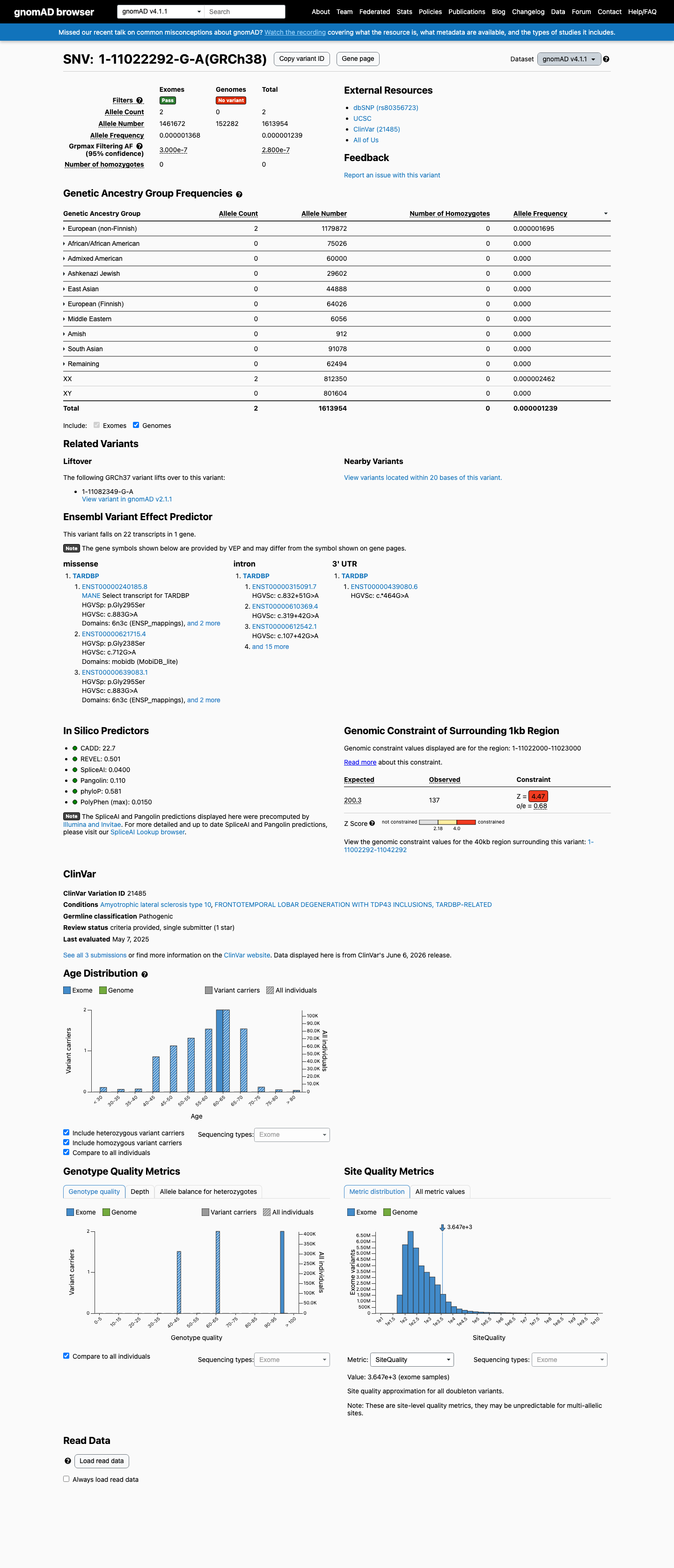
PM1 (Moderate): Gly295 lies in the exon-6 glycine-rich C-terminal domain, an established mutational hotspot for TARDBP-related ALS/FTLD. PM2 (Moderate): the variant is extremely rare - 2 of 1,613,954 gnomAD v4.1 alleles (AF 1.24e-06), below the 0.1% population threshold. PP2 (Supporting): missense variants in the exon-6 glycine-rich domain are the established dominant disease mechanism for TARDBP. Overall classification: VUS - PM1 and PM2 (moderate) plus PP2 (supporting) satisfy no ACMG/AMP pathogenic or benign combining rule.

PM1 + PM2 + PP2 VUS
Gene diagram · NM_007375.4 · variants mapped to exon structure
TARDBP NM_007375.4
Fetching transcript structure from UCSC…
Applied criteria · 3 applied · 20 assessed
MetEvidence satisfies this criterion.
Not metEvaluated against available evidence; threshold not reached.
Not assessedApplies in principle, but no evidence was found to evaluate it.
N/ADoesn't apply to this variant type.
Applied · 3
Strength Supporting Moderate Strong Very strong
PM1 moderate Pathogenic
Met (Moderate): Gly295 lies in the exon-6 glycine-rich C-terminal domain, an established mutational hotspot for TARDBP-related ALS/FTLD.
PMID:19236453 (Del Bo et al.) reports p.G295S and p.G294V together as novel mutations 'located within exon 6 in a highly conserved region of TDP-43' absent from 362 control chromosomes.PMID:21651514 (Piaceri et al.) confirms p.Gly295Ser is located in a highly conserved region affecting a glycine residue conserved across species, in exon 6.PMID:20031275 (Ticozzi et al.) found 10 distinct heterozygous missense mutations in exon 6 across 14 ALS patients, indicating dense clustering of pathogenic missense changes in this coding region; G295R (same codon, different amino acid) is among the reported cluster.
PM2 moderate Pathogenic
Met (Moderate): extremely rare in gnomAD v4.1 at 2 of 1,613,954 alleles (AF 1.24e-06), below the 0.1% threshold.
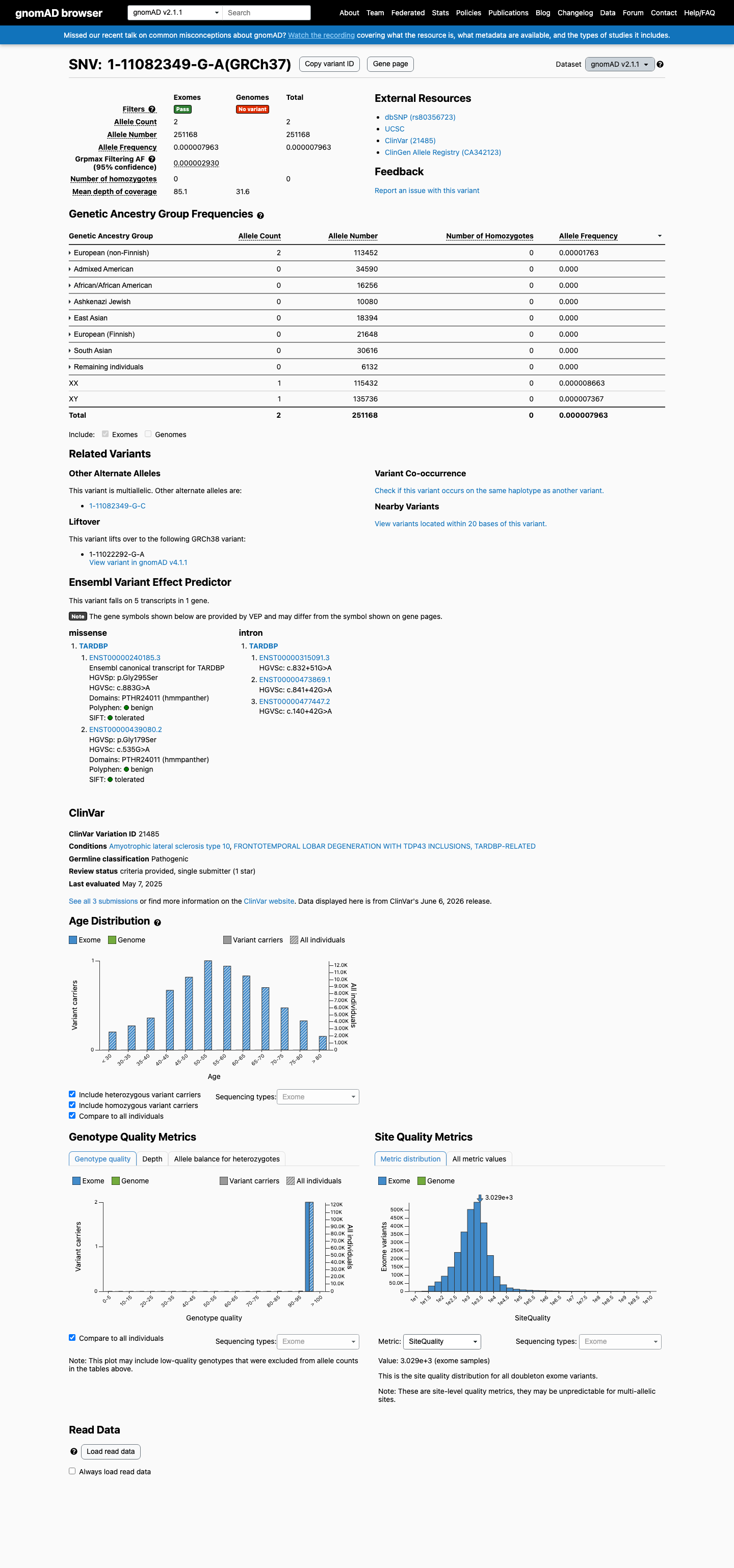
gnomAD v4.1 reports 2 alternate alleles among 1,613,954 alleles (AF 1.23919e-06), 0 homozygotes, and highest listed population AF 1.69510e-06 in European non-Finnish individuals.gnomAD v2.1 reports 2 alternate alleles among 251,168 alleles (AF 7.9628e-06), 0 homozygotes, and highest listed population AF 1.76286e-05 in European non-Finnish individuals.The variant is reported as absent from gnomAD-Canada v1.0.
PP2 supporting Pathogenic
Met (Supporting): missense variants in the exon-6 glycine-rich domain are the established dominant disease mechanism for TARDBP.
PMID:20031275 (Ticozzi et al.) documents that TARDBP-related ALS/FTLD is driven almost exclusively by heterozygous missense mutations in exon 6 (10 distinct missense mutations found across 14 of 397 ALS patients), consistent with missense being the predominant disease mechanism for this gene.PMID:19236453 (Del Bo et al.) similarly reports novel missense mutations (p.G294V, p.G295S) as the disease-causing mechanism identified via TARDBP coding sequencing in a large ALS cohort, with no truncating variants highlighted as causal.
Assessed · not applied · 8 not met · 12 not assessed
Pathogenic
PS1 Not assessed: no alternate nucleotide change producing the identical p.Gly295Ser amino acid substitution has been reported.
PS2 Not assessed: no parental testing confirms a de novo origin of p.Gly295Ser.
PS3 Not assessed: two functional studies suggest abnormal effects, but neither used a validated assay with pathogenic/benign controls.
PS4 Not assessed: two sporadic ALS observations lack the case-control comparison needed for a statistically significant enrichment analysis.
PM5 Not assessed: p.Gly295Arg, reported at the same residue, is not established as Pathogenic/Likely Pathogenic.
PM6 Not assessed: no evidence establishes that p.Gly295Ser arose de novo.
PP1 Not assessed: no affected relatives carrying the variant were reported, so cosegregation cannot be evaluated.
PP3 Not met: REVEL score 0.501 falls below the >=0.644 pathogenic-supporting threshold.
PP4 Not assessed: ALS is genetically heterogeneous and not highly specific to TARDBP-related disease.
PP5 Not met: no ClinVar expert-panel Pathogenic/Likely Pathogenic assertion exists for this variant.
Benign
BA1 Not met: highest allele frequency is 1.7e-06, far below the >1% BA1 threshold.
BS1 Not met: highest allele frequency is 1.7e-06, far below the >0.3% BS1 threshold.
BS2 Not assessed: the two gnomAD carriers lack documented adult phenotype and disease status.
BS3 Not met: available functional studies show abnormal, not normal, TDP-43 function.
BS4 Not assessed: no unaffected carriers or informative non-segregation analysis were reported.
BP1 Not met: TARDBP disease is driven by missense, not truncating, variants.
BP2 Not assessed: no phase or parental data are available to evaluate a trans configuration.
BP4 Not met: REVEL score 0.501 falls above the <=0.290 benign-supporting threshold.
BP5 Not assessed: no molecularly established alternative cause of disease was reported.
BP6 Not met: no ClinVar expert-panel Benign/Likely Benign assertion exists for this variant.
N/A · 5 PVS1 · PM3 · PM4 · BP3 · BP7
Research & evidence
Population frequency
gnomAD v4.1 screenshot
gnomAD v4.1
gnomAD v2.1 screenshot
gnomAD v2.1
v4.1
This variant is present in gnomAD v4.1 (AF= 1.23919e-06; MAF= 0.00012%, 2/1613954 alleles, homozygotes = 0) and has highest observed frequency in the European (non-Finnish) population (AF= 1.6951e-06; MAF= 0.00017%, 2/1179872 alleles, homozygotes = 0); grpmax FAF= 2.8e-07.
v2.1
This variant is present in gnomAD v2.1 (AF= 7.9628e-06; MAF= 0.00080%, 2/251168 alleles, homozygotes = 0) and has highest observed frequency in the European (non-Finnish) population (AF= 1.76286e-05; MAF= 0.00176%, 2/113452 alleles, homozygotes = 0); grpmax FAF= 2.93e-06.
🇨🇦 CA
Absent from gnomAD-Canada v1.0.
Allele frequency by ancestry
three datasets · side by side
gnomAD v4.1
0.00012% · 2 / 1,613,954
0 hom · FAF 2.8e-05%
European (non-Finnish)
2 / 1,179,872
0.00017%
+ 9 not observed (Remaining individuals, Admixed American, European (Finnish), Amish, East Asian, Middle Eastern, South Asian, Ashkenazi Jewish, African/African American)
gnomAD v2.1
0.0008% · 2 / 251,168
0 hom · FAF 0.00029%
European (non-Finnish)
2 / 113,452
0.0018%
+ 7 not observed (African/African American, Admixed American, Ashkenazi Jewish, East Asian, European (Finnish), Remaining individuals, South Asian)
gnomAD Canada 🇨🇦
Absent · 0 / ?
0 hom
Not observed in any ancestry group.
ClinVar screenshot
ClinVar
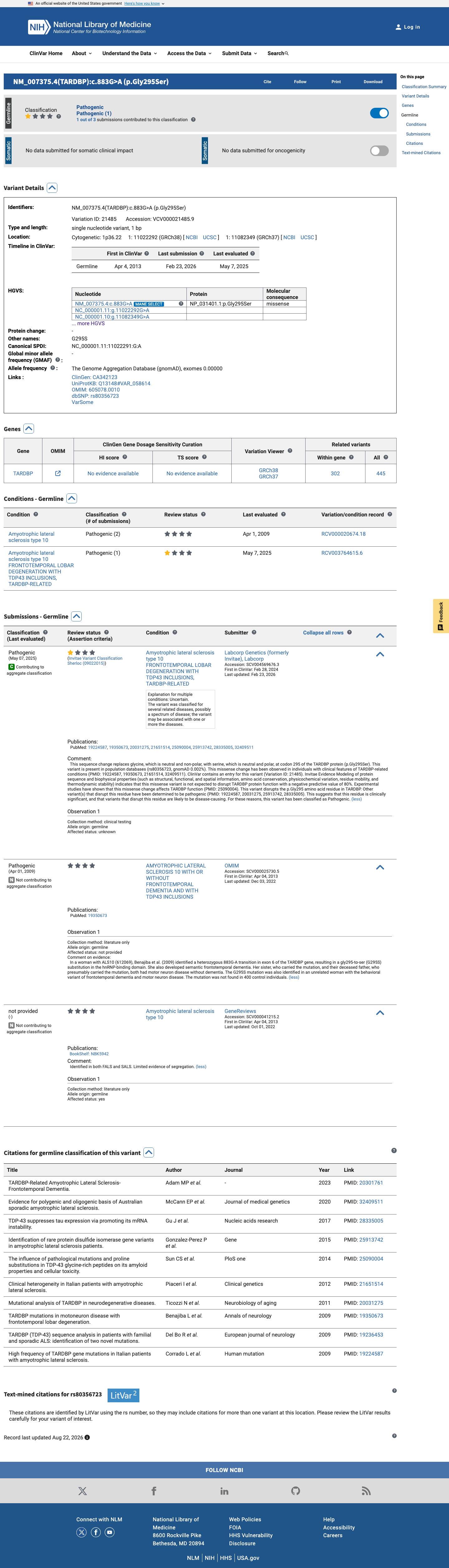
This variant has been reported in ClinVar as Pathogenic (1 clinical laboratory). (ClinVarID = 21485)
SpliceAI screenshot
In silico
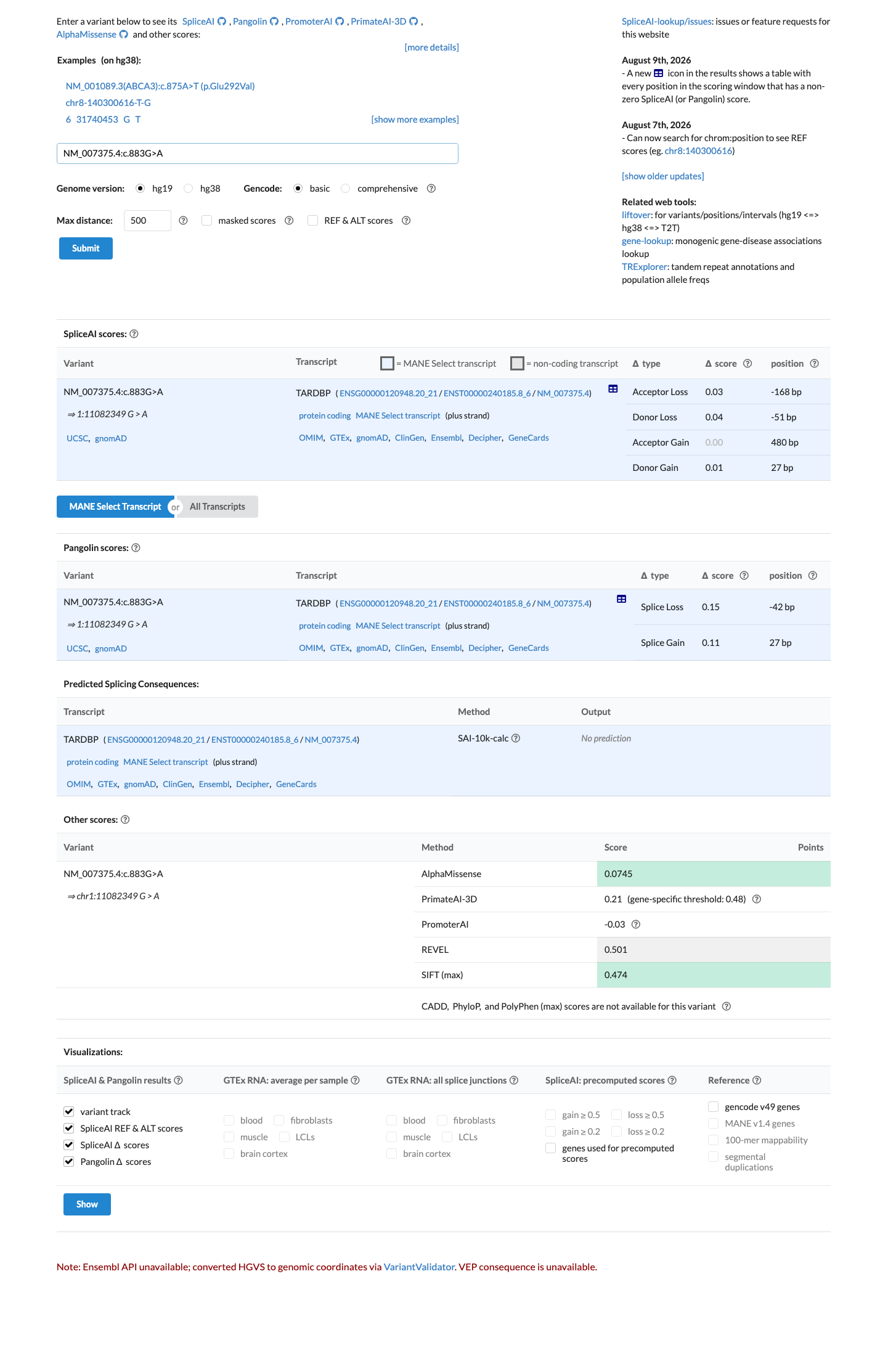
SpliceAI predicts no significant splice impact for this variant (max delta score = 0.00). REVEL score = 0.501. BayesDel score = 0.285256.
Functional No data
No calibrated functional assay or RNA evidence was identified for this variant.
OncoKB ↗
COSMIC screenshot
COSMIC
Cancer hotspots screenshot
Cancer hotspots
Somatic evidence Not in COSMIC / hotspots
COSMIC
This variant does not lie in a statistically significant hotspot. This variant has not previously been reported in somatic cancers (COSMIC).
Hotspots
This variant does not lie in a statistically significant hotspot.
Literature · how each cited paper was used
4papers cited
Each card is an audit: what was searched, what was found, whether it names the variant, which criteria it fed, and why. 5 further PMIDs triaged but not cited — see Sources & references.
TARDBP (TDP-43) sequence analysis in patients with familial and sporadic ALS: identification of two novel mutations.
Searched
c.883G>Ap.(G295S)NP_031401.1:p.(G295S)p.G295S
Found
The paper explicitly reports p.G295S as one of two novel heterozygous missense mutations identified in two sporadic ALS cases, located within exon 6 in a highly conserved region of TDP-43, absent from 362 control chromosomes.
Variant
✓ Names this variant — characterised directly
Applied to
PM1 moderate
Confirms G295S/G294V location within the conserved exon-6 glycine-rich mutational cluster region.
PM2 moderate
The exact p.G295S variant was reported absent from 362 control chromosomes, supporting rarity in population controls.
PP2 supporting
Reports missense mutation as the identified disease mechanism in this cohort.
We also identified two novel mutations (namely, p.G294V and p.G295S) in two sporadic ALS cases. The mutations are located within exon 6 in a highly conserved region of TDP-43 and were absent in 362 chromosomes from control individuals (Fig. 2).
Location Results, sequence-analysis paragraph; Table 2, patient E; Discussion, paragraph describing the two novel mutations  ·  Context TARDBP coding-region sequencing in 314 ALS probands (308 Italian) compared to 181 healthy Italian volunteers (362 control chromosomes); exons 2-5 and first 528 nt of exon 6 amplified and directly sequenced.  ·  full text
Clinical heterogeneity in Italian patients with amyotrophic lateral sclerosis.
Searched
c.883G>Ap.(G295S)p.G295Sp.Gly295Ser
Found
The paper explicitly reports the TARDBP c.883G>A (p.Gly295Ser) variant in one Italian ALS patient (patient 4), noting the variant is located in a highly conserved region affecting a glycine residue conserved across species.
Variant
✓ Names this variant — characterised directly
Applied to
PM1 moderate
Independently confirms the variant's location in the conserved glycine-rich domain of TDP-43.
The p.Gly295Ser mutation was identified in an Italian patient (4; Table 1) who presented, at the age of 62, gait difficulties and, some months later, fell due to weakness and numbness in the left leg extremity.
Location Results, paragraph describing patient 4; Table 1  ·  Context Screening of all coding exons and intron/exon boundaries of TARDBP in 61 Italian ALS patients using high-resolution melting analysis followed by sequencing.  ·  full text
The influence of pathological mutations and proline substitutions in TDP-43 glycine-rich peptides on its amyloid properties and cellular toxicity.
Searched
c.883G>ANP_031401.1:p.(G295S)G295S
Found
The paper structurally and functionally characterizes the TDP-43 C-terminal glycine-rich peptide (residues 287-322, encompassing residue 295) and shows the G295S substitution enhances amyloidogenic, prion-like aggregation properties compared to wild type.
Variant
✓ Names this variant — characterised directly
Applied to
PM1 moderate
Provides structural/biophysical characterization of the glycine-rich domain as an amyloidogenic mutational hotspot region encompassing residue 295.
Our study is the first to report the two TDP-43 C-terminus mutant peptides (G294V and G295S) displayed enhanced amyloidogenic and prion-like characteristics, which may contribute a toxic gain-of-function in TDP-43 proteinopathy.
Location Results, multiple subsections; Discussion  ·  Context Synthetic TDP-43 C-terminal peptides (residues 287-322) evaluated by TEM, CD spectroscopy, ThT fluorescence, sedimentation/HPLC, liposome leakage assays, and N2a cell viability assays.  ·  full text
Rule & framework references · cited for criterion definitions, not variant evidence
20031275 ↗ Mutational analysis of TARDBP in neurodegenerative diseases.
Sources & reference links
8Sources
ClinVar
gnomAD v2.1
gnomAD v4.1
gnomAD-Canada
SpliceAI
OncoKB
COSMIC
Cancer hotspots
Triaged references · 5 PMIDs not cited in assessment
19224587 ↗ High frequency of TARDBP gene mutations in Italian patients with amyotrophic lateral sclerosis. CLINVAR
19350673 ↗ TARDBP mutations in motoneuron disease with frontotemporal lobar degeneration. CLINVAR
25913742 ↗ Identification of rare protein disulfide isomerase gene variants in amyotrophic lateral sclerosis patients. CLINVAR
28335005 ↗ TDP-43 suppresses tau expression via promoting its mRNA instability. CLINVAR
28492532 ↗ Sherloc: a comprehensive refinement of the ACMG-AMP variant classification criteria. CLINVAR