Analysis in progress
Initialising…
0%
complete
This report is still being assembled — sections appear as each stage finishes. It isn't final yet.
KEAP1
Final classification
VUS
PM2BP4
KEAP1
c.1639G>A
p.Val547Ile
missense · exon 5

KEAP1 encodes a cytoplasmic protein that serves as a key regulator of the cellular response to oxidative and electrophilic stress. It controls NRF2, a transcription factor that activates antioxidant and cytoprotective genes: under normal conditions KEAP1 promotes NRF2 degradation, while during stress it releases NRF2 so cells can defend against oxidative damage and toxic insults. KEAP1 functions as a tumor suppressor, and disruption of its regulation of NRF2 is thought to abnormally activate NRF2-driven stress-response and detoxification pathways, which can give cancer cells a survival and fitness advantage.

This variant

KEAP1's tumor-suppressor function depends on tightly regulated NRF2 degradation, and its disruption can hyperactivate NRF2-driven stress-response pathways that favor cancer cell survival. Because this missense variant is classified as a VUS, there is currently no evidence that it alters KEAP1 function or NRF2 regulation, so no impact on this cancer-relevant pathway can be inferred.

Transcript
NM_012289.4
HGVS · transcript:coding
NM_012289.4:c.1639G>A
GRCh38
chr19:10489261 C>T
GRCh37
chr19:10599937 C>T
Basis Variant of Uncertain Significance: only PM2 and BP4 are met, each at supporting strength, and one supporting pathogenic plus one supporting benign criterion satisfies no classification threshold.
Variant of Uncertain Significance: only PM2 and BP4 are met, each at supporting strength, and one supporting pathogenic plus one supporting benign criterion satisfies no classification threshold.
Classification rationale
PM2 BP4 VUS
KEAP1 c.1639G>A missense · exon 5

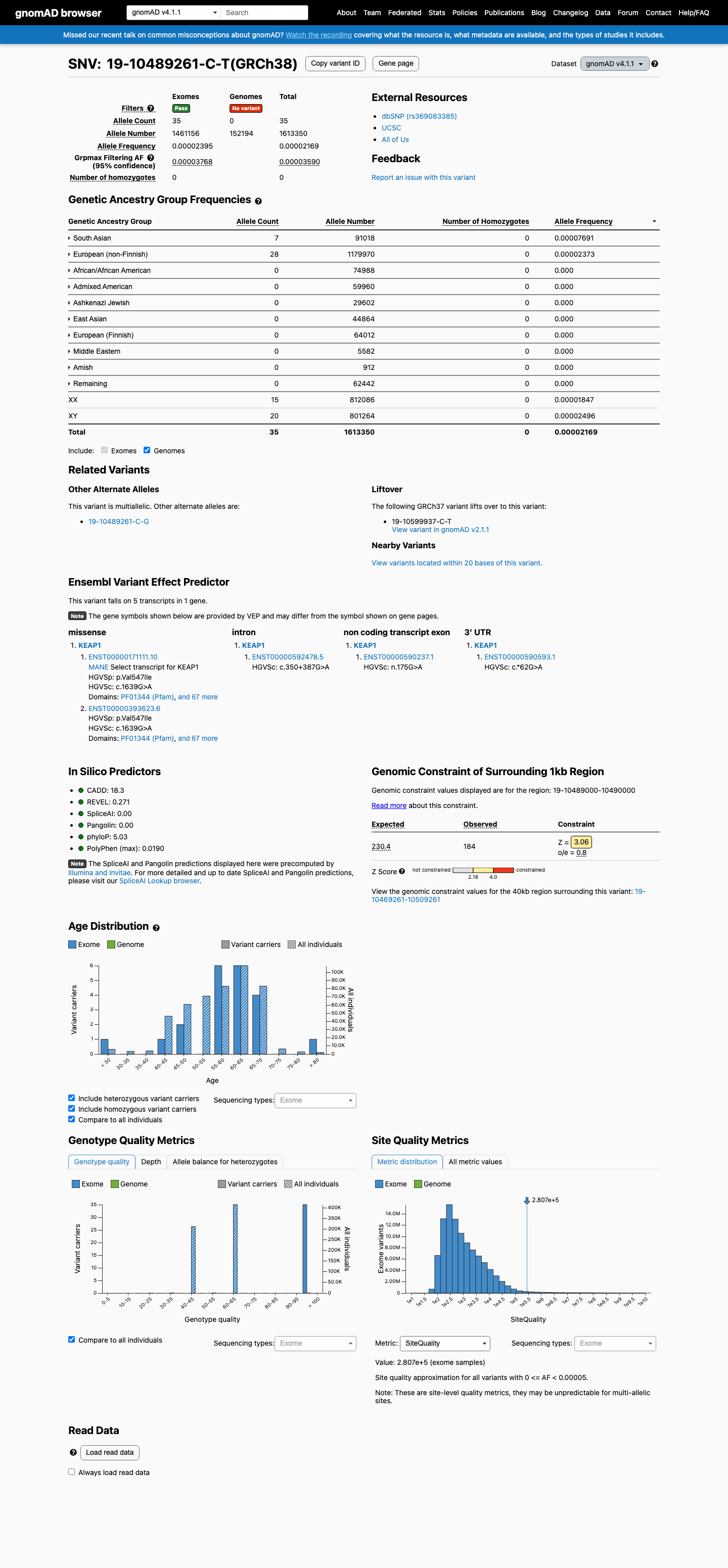
PM2 (Supporting): gnomAD v4.1 allele frequency 2.17e-05, below the 0.1% population rarity threshold. BP4 (Supporting): concordant benign-leaning predictions, REVEL 0.271 (<=0.290 threshold) and SpliceAI max delta 0.003 (below 0.2). Synthesis: with only one supporting pathogenic and one supporting benign criterion, no Pathogenic, Likely Pathogenic, Benign, or Likely Benign combination threshold is reached; overall classification is Variant of Uncertain Significance.

PM2 + BP4 VUS
Gene diagram · NM_012289.4 · variants mapped to exon structure
KEAP1 NM_012289.4
Fetching transcript structure from UCSC…
Applied criteria · 2 applied · 22 assessed
MetEvidence satisfies this criterion.
Not metEvaluated against available evidence; threshold not reached.
Not assessedApplies in principle, but no evidence was found to evaluate it.
N/ADoesn't apply to this variant type.
Applied · 2
Strength Supporting Moderate Strong Very strong
PM2 supporting Pathogenic
Met (supporting): gnomAD v4.1 allele frequency 2.17e-05, below the 0.1% rarity threshold.
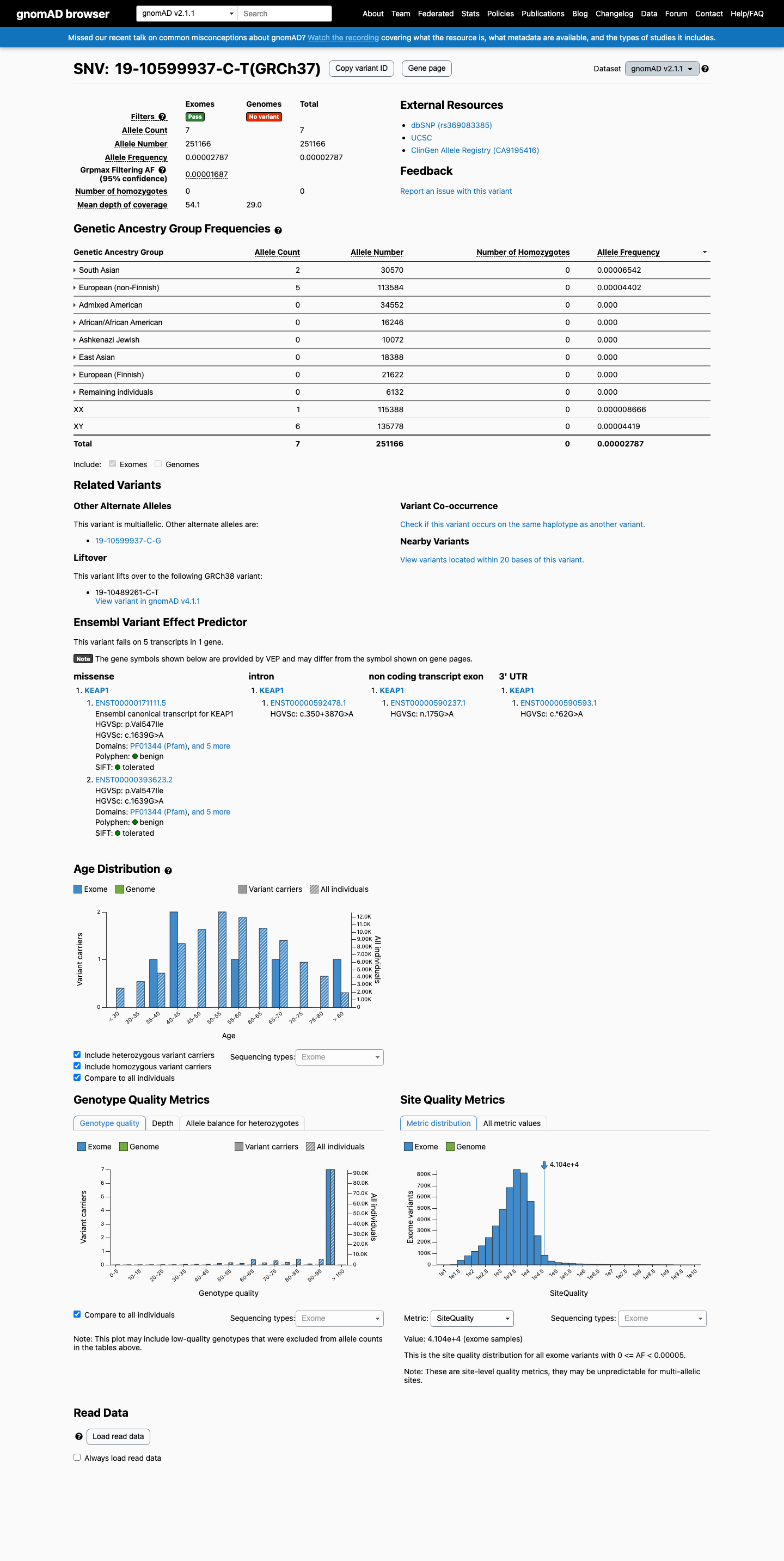
Generic non-VCEP PM2 threshold applied: AF <0.1% supports PM2.gnomAD v2.1: AF 2.787e-05, 7/251166 alleles, 0 homozygotes; highest South Asian AF 6.54236e-05.gnomAD v4.1: AF 2.1694e-05, 35/1613350 alleles, 0 homozygotes; highest South Asian AF 7.69079e-05.
BP4 supporting Benign
Met (supporting): REVEL score 0.271 is below the <=0.290 benign-supporting threshold, and SpliceAI max delta 0.003 is below 0.2.
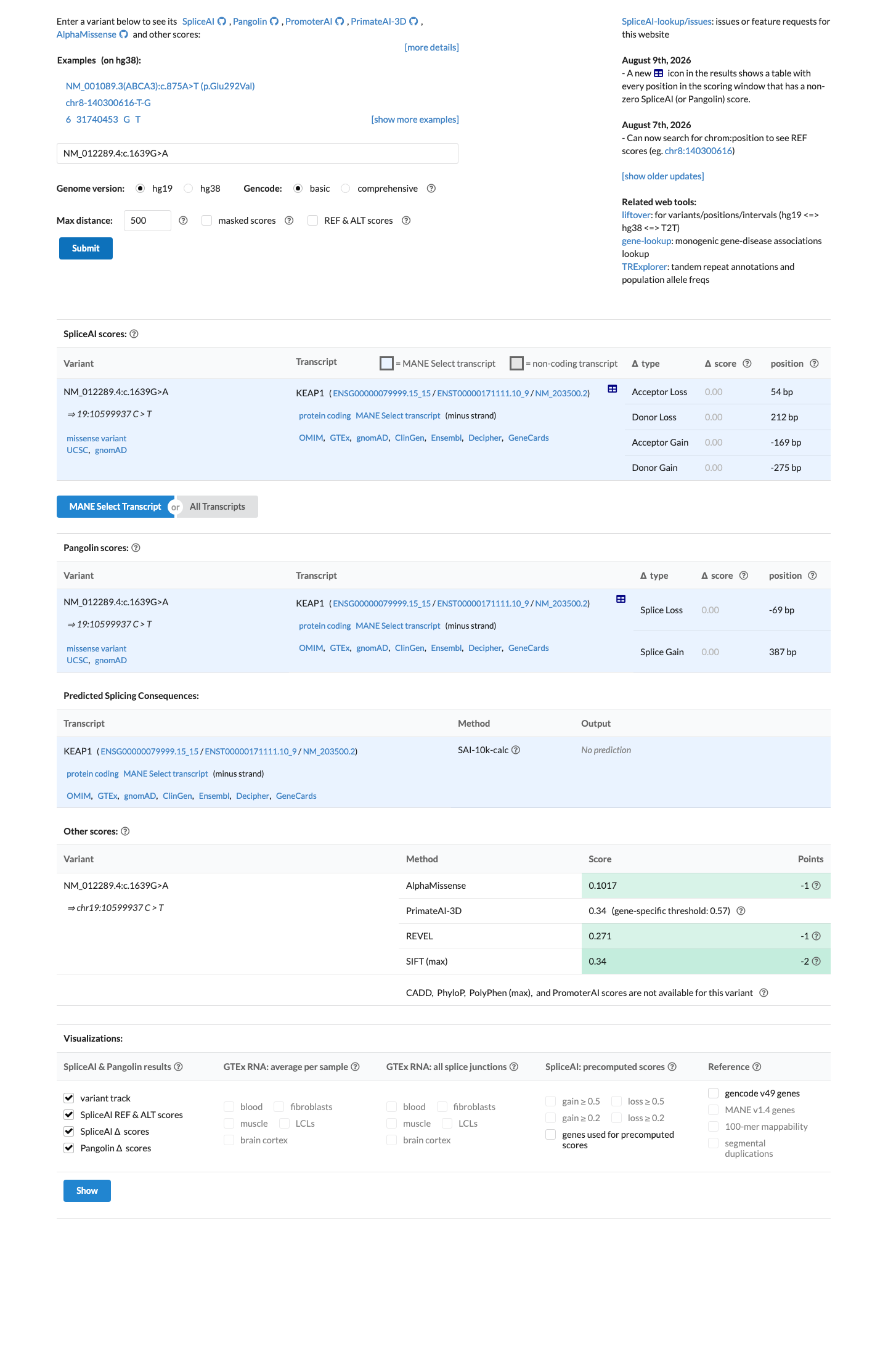
SpliceAI (spliceailookup.broadinstitute.org) for NM_012289.4:c.1639G>A: max_delta_score=0.003, well below the >=0.2 threshold (Jaganathan et al., Cell 2019, PMID 30661751) for a predicted splice-altering effect -- supports no splicing impact.REVEL local predictor lookup: score = 0.271 for 19-10489261-C-T (GRCh38) -- below the ClinGen SVI-calibrated REVEL BP4_Supporting threshold of <=0.290 (Pejaver et al., PMID 36413997) -- supports a benign computational prediction for the missense change.
Assessed · not applied · 6 not met · 16 not assessed
Pathogenic
PS1 Not assessed: no other pathogenic variant producing the same p.Val547Ile change exists, as this variant is absent from ClinVar.
PS2 Not assessed: no de novo occurrence was documented, with no parental testing showing the variant absent in both biological parents.
PS3 Not assessed: no functional assay data for p.Val547Ile (e.g., NRF2/ARE reporter activity) were available.
PS4 Not assessed: no case series, case-control comparison, or disease-enrichment data for this variant were available.
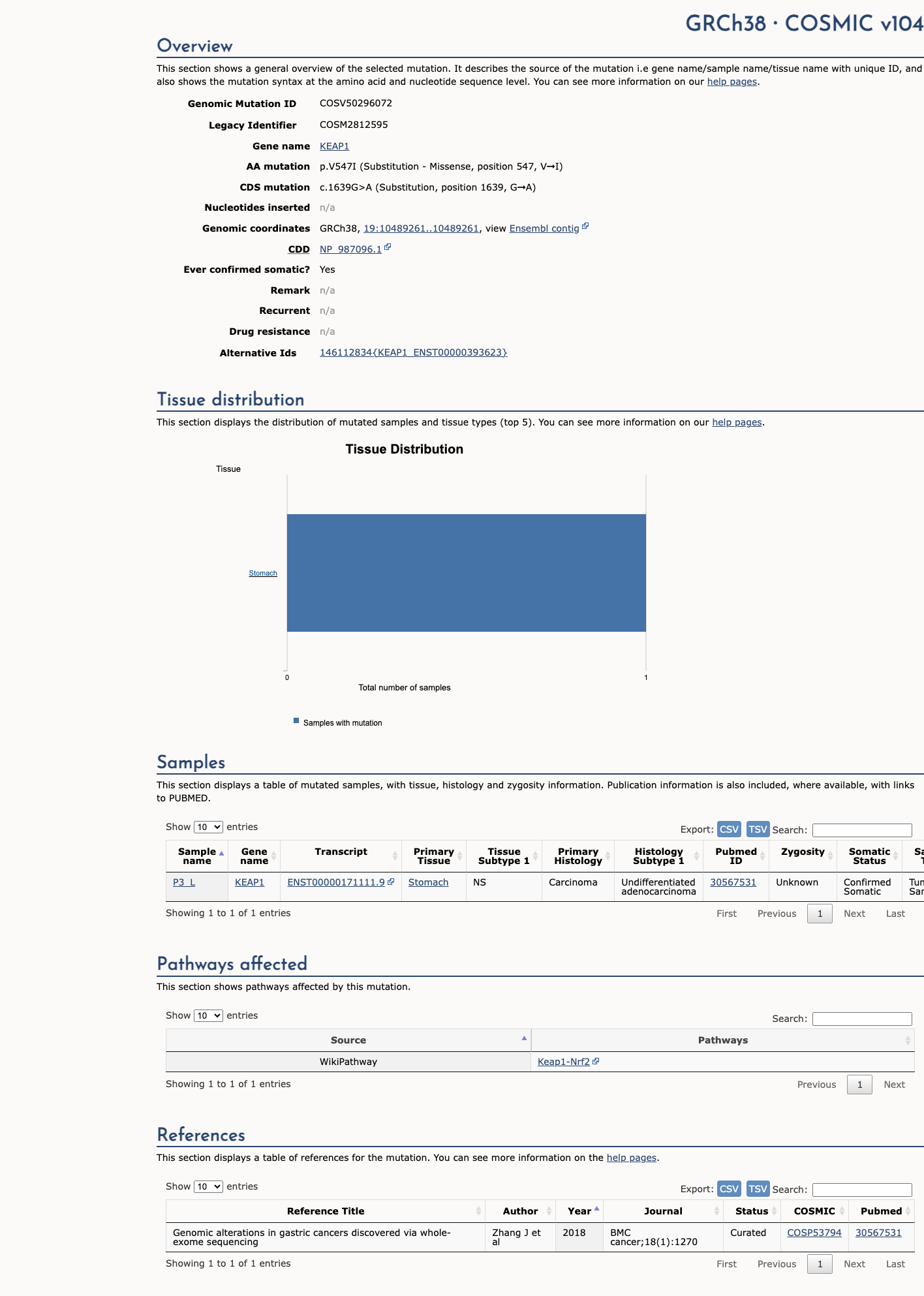
PM1 Not met: cancerhotspots.org reports no significant hotspot at residue 547, and COSMIC shows only a single somatic occurrence.
PM3 Not assessed: no observation of the variant in trans with a pathogenic variant in an affected individual was available.
PM5 Not assessed: no different missense change at residue 547 previously established as pathogenic was available for comparison.
PM6 Not assessed: no suspected de novo occurrence, with or without parental confirmation, was documented.
PP1 Not assessed: no family segregation data were available to evaluate cosegregation with disease.
PP2 Not assessed: no gene-level missense constraint metric (e.g., gnomAD missense Z-score) was available to establish PP2 eligibility.
PP3 Not met: REVEL score 0.271 is below the >=0.644 supporting-pathogenic threshold, and SpliceAI max delta 0.003 is below 0.2.
PP4 Not assessed: no patient phenotype or clinical presentation was provided.
PP5 Not met: the variant is absent from ClinVar, so no expert-panel pathogenic assertion exists to trigger PP5.
Benign
BA1 Not met: gnomAD v4.1 allele frequency 2.17e-05 is far below the >1% stand-alone benign threshold.
BS1 Not met: highest gnomAD allele frequency 7.69e-05 (South Asian) is below the >0.3% benign threshold.
BS2 Not assessed: no healthy-carrier phenotype or disease-model evidence was available; gnomAD reports zero homozygotes.
BS3 Not assessed: no functional assay data demonstrating normal function of p.Val547Ile were available.
BS4 Not assessed: no unaffected relatives or non-segregation analysis were documented.
BP1 Not assessed: no data confirming or excluding missense as a disease mechanism for KEAP1 were available.
BP2 Not assessed: no phase-resolved genotypes or paired pathogenic variant were available to evaluate trans/cis configuration.
BP5 Not assessed: no phenotype or molecular finding indicating an alternative genetic cause was provided.
BP6 Not met: the variant is absent from ClinVar, so no expert-panel benign assertion exists to trigger BP6.
N/A · 4 PVS1 · PM4 · BP3 · BP7
Research & evidence
Population frequency
gnomAD v4.1 screenshot
gnomAD v4.1
gnomAD v2.1 screenshot
gnomAD v2.1
v4.1
This variant is present in gnomAD v4.1 (AF= 2.1694e-05; MAF= 0.00217%, 35/1613350 alleles, homozygotes = 0) and has highest observed frequency in the South Asian population (AF= 7.69079e-05; MAF= 0.00769%, 7/91018 alleles, homozygotes = 0); grpmax FAF= 3.59e-05.
v2.1
This variant is present in gnomAD v2.1 (AF= 2.787e-05; MAF= 0.00279%, 7/251166 alleles, homozygotes = 0) and has highest observed frequency in the South Asian population (AF= 6.54236e-05; MAF= 0.00654%, 2/30570 alleles, homozygotes = 0); grpmax FAF= 1.687e-05.
🇨🇦 CA
Not available in gnomAD-Canada v1.0.
Allele frequency by ancestry
three datasets · side by side
gnomAD v4.1
0.0022% · 35 / 1,613,350
0 hom · FAF 0.0036%
South Asian
7 / 91,018
0.0077%
European (non-Finnish)
28 / 1,179,970
0.0024%
+ 8 not observed (Remaining individuals, Admixed American, European (Finnish), Amish, East Asian, Middle Eastern, Ashkenazi Jewish, African/African American)
gnomAD v2.1
0.0028% · 7 / 251,166
0 hom · FAF 0.0017%
South Asian
2 / 30,570
0.0065%
European (non-Finnish)
5 / 113,584
0.0044%
+ 6 not observed (African/African American, Admixed American, Ashkenazi Jewish, East Asian, European (Finnish), Remaining individuals)
gnomAD Canada 🇨🇦
Absent · 0 / ?
0 hom
Not observed in any ancestry group.
ClinVar screenshot
ClinVar
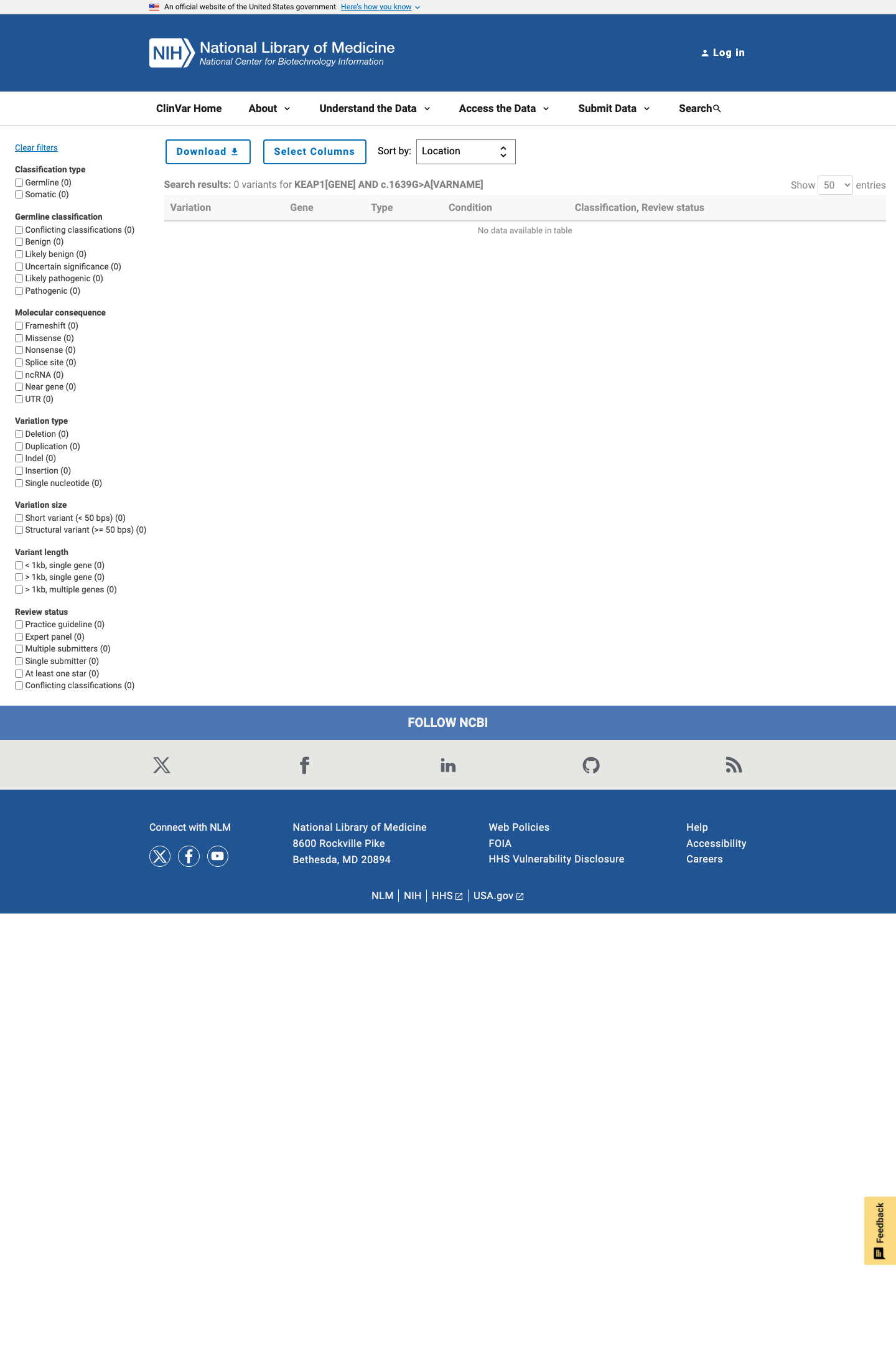
This variant is absent from ClinVar.
SpliceAI screenshot
In silico
SpliceAI predicts no significant splice impact for this variant (max delta score = 0.00). REVEL score = 0.271. BayesDel score = -0.342965.
Functional / OncoKB screenshot
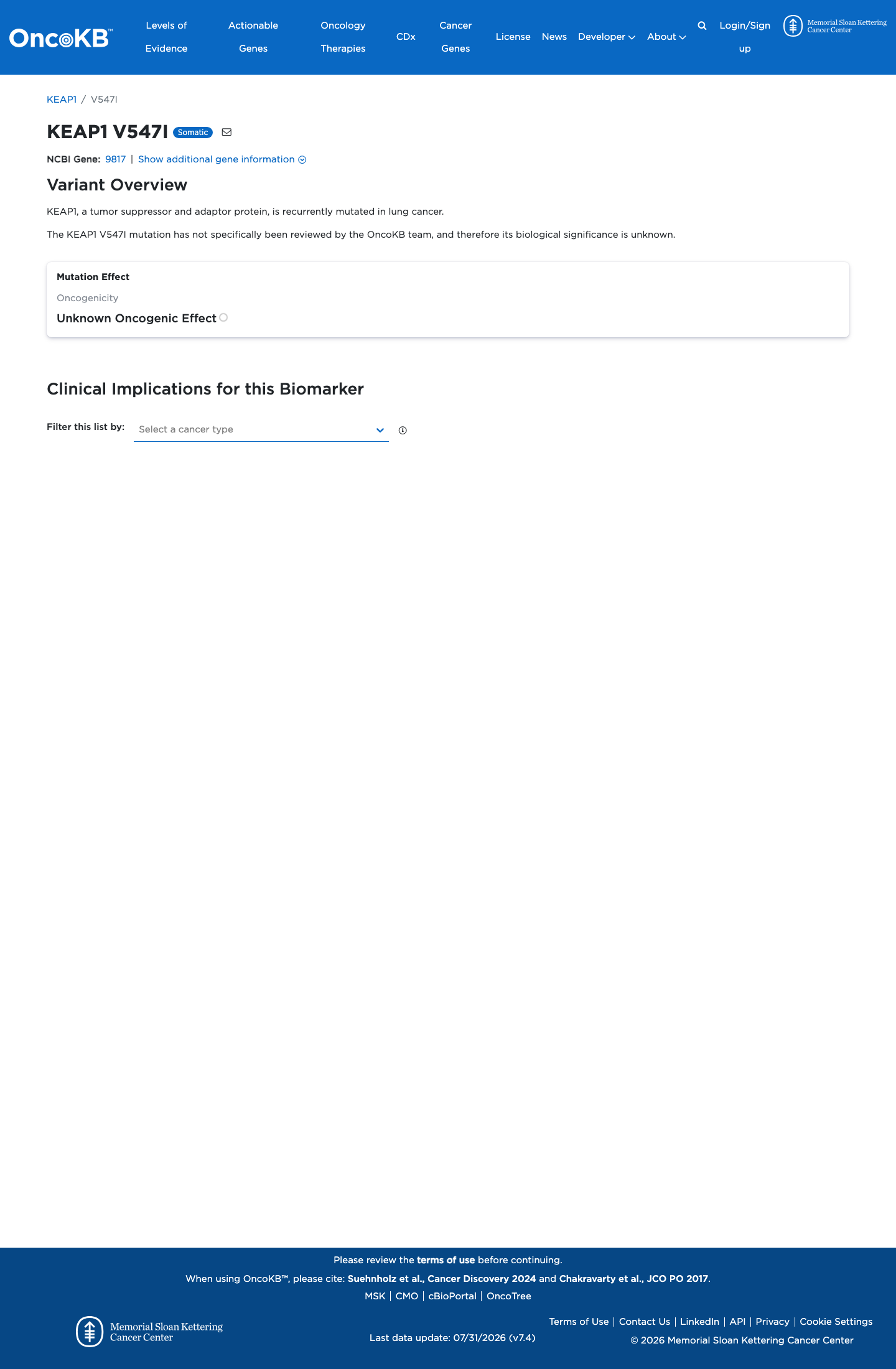
Functional Unknown Oncogenic Effect
OncoKB did not identify variant-specific reviewed functional evidence for this variant; gene-level curated context is available for reviewer follow-up. KEAP1, a tumor suppressor and adaptor protein, is recurrently mutated in lung cancer.
OncoKB ↗
COSMIC screenshot
COSMIC
Cancer hotspots screenshot
Cancer hotspots
Somatic evidence Not in COSMIC / hotspots
COSMIC
This variant does not lie in a statistically significant hotspot. This variant has previously been reported in somatic cancers (COSMIC; COSV50296072, n = 1 times).
Hotspots
This variant does not lie in a statistically significant hotspot.
Sources & reference links
8Sources
ClinVar
gnomAD v2.1
gnomAD v4.1
gnomAD-Canada
SpliceAI
OncoKB
COSMIC
Cancer hotspots