NM_014225.5:c.536C>G (p.Pro179Arg) in PPP2R1A is classified as Likely Pathogenic per ACMG/AMP 2015 generic framework.1 PS3 (Strong): Direct functional characterization of P179R via X-ray crystallography, co-immunoprecipitation, phosphatase assays, and patient-derived tumor models demonstrates unequivocal disruption of PP2A holoenzyme assembly, loss of catalytic subunit binding, and tumorigenic potential.2 PM1 (Moderate): Residue P179 is a statistically significant mutational hotspot (cancerhotspots.org) within HEAT domain 5, a critical functional domain of the PP2A Aα scaffolding subunit.3 PM2 (Moderate): Variant is absent from gnomAD v2.1, v4.1, and gnomAD-Canada population databases (allele frequency <0.1%).4 Combined evidence (1 Strong + 2 Moderate) meets the ACMG/AMP 2015 threshold for Likely Pathogenic classification.5 This variant has been observed somatically in 92 cancer specimens (COSMIC COSV59042232) and is the most recurrent PPP2R1A mutation in high-grade endometrial carcinoma, though germline clinical classification is based on the functional and population evidence cited above.
Final classification
Likely Pathogenic
PS3PM1PM2
PPP2R1A
c.536C>G
p.Pro179Arg
This variant
NM_014225.5:c.536C>G (p.Pro179Arg) in PPP2R1A is classified as Likely Pathogenic per ACMG/AMP 2015 generic framework.
gene-specific framework lacked a usable explicit final combination framework, so generic ACMG/AMP 2015 final-combination rules were applied as fallback; applied criteria: PS3 strong, PM1 moderate, PM2 moderate; combination = 1 strong + 2 moderate, which maps to Likely Pathogenic.
Classification rationale
PS3PM1PM2
Likely Pathogenic
PPP2R1A c.536C>G
PS3 + PM1 + PM2
→
Likely Pathogenic
1
generic_acmg_combination_rules
5
generic_acmg_combination_rules
LYFE Sciences is an AI system, and it can make mistakes. Criteria
may be applied incorrectly, sources may be misread, and a confident-looking
classification can still be wrong. Double-check every criterion and
its underlying evidence before relying on any call.
Gene diagram
· NM_014225.5 · variants mapped to exon structure
PPP2R1A
NM_014225.5
Fetching transcript structure from UCSC…
Applied criteria · 3 applied · 21 assessed
MetEvidence satisfies this criterion.
Not metEvaluated against available evidence; threshold not reached.
Not assessedApplies in principle, but no evidence was found to evaluate it.
N/ADoesn't apply to this variant type.
Applied · 3
Strength
Supporting
Moderate
Strong
Very strong
PS3
strong
Pathogenic
P179R was directly tested in PMID:31142515 via X-ray crystallography (PDB 6EF4, 3.4Å resolution), co-immunoprecipitation, phosphatase activity assays, molecular dynamics simulations, and patient-derived endometrial carcinoma models (UT89, UT42). P179R disrupts PP2A holoenzyme assembly by altering Aα-subunit conformation, near-completely abolishes catalytic C-subunit binding, promotes proteasome-mediated C-subunit degradation, and reduces PP2A phosphatase activity. Restoration of wild-type Aα in P179R-mutant patient-derived cells suppresses tumorigenic features in xenograft assays. The functional effect is unequivocal and directly demonstrated for the exact variant.
Crystal structure of P179R-Aα at 3.4Å resolution (PDB 6EF4) shows altered conformation vs wild-type.Co-IP demonstrates near-complete loss of catalytic C-subunit binding and significant loss of B-subunit binding.Molecular dynamics simulations confirm conformational shift favoring 'closed' donut shape that excludes C-subunit.
PM1
moderate
Pathogenic
Residue P179 is a statistically significant mutational hotspot (cancerhotspots.org) and lies within HEAT domain 5 of the PP2A Aα scaffolding subunit, a critical functional domain for PP2A holoenzyme assembly. PMID:31142515 identifies P179 as the most recurrent PPP2R1A mutation site in high-grade endometrial carcinoma (48 of 51 reported P179 mutations are P179R). No benign variation has been reported at this residue in population databases.
P179 is a statistically significant hotspot residue (cancerhotspots.org).PMID:31142515: P179 is in HEAT domain 5 of PP2A Aα48 of 51 P179 mutations are P179R
PM2
moderate
Pathogenic
NM_014225.5:c.536C>G is absent from gnomAD v2.1 (exomes), gnomAD v4.1 (exomes), and gnomAD-Canada v1.0 (genomes), meeting the PM2 threshold of <0.1% allele frequency in large population databases.
Absent from gnomAD v2.1 (AF=null).Absent from gnomAD v4.1 (AF=null).Absent from gnomAD-Canada v1.0 (AF=0.0).
Assessed · not applied
· 21 not met · 0 not assessed
Pathogenic
PVS1
NM_014225.5:c.536C>G is a missense variant (p.Pro179Arg) and does not fall into null-variant categories (nonsense, frameshift, or canonical ±1,2 splice consensus) required for generic PVS1 application per ClinGen SVI PVS1 recommendations (PMC6185798).
PS1
No evidence of an alternate nucleotide change at codon 179 producing the same p.Pro179Arg substitution that has been classified as pathogenic.
PS2
No de novo observation with confirmed maternity and paternity has been reported for NM_014225.5:c.536C>G (p.Pro179Arg).
PS4
No case-control prevalence data comparing affected individuals to controls is available for this variant.
PM5
No same-residue (P179) comparator variant with a pathogenic classification in ClinVar was identified; automated PM5 candidate harvesting yielded no candidates.
PM6
No de novo observation (without confirmed maternity/paternity) has been reported for NM_014225.5:c.536C>G.
PP1
No co-segregation data with disease in multiple affected family members is available for this variant.
PP2
No gene-level missense constraint metric (e.g., gnomAD missense Z-score or HCI prior probability) is available to establish that PPP2R1A has a low rate of benign missense variation.
PP3
Computational predictors do not support a deleterious effect.
PP4
No patient phenotype data or family history specific to a disease with single genetic etiology is available for this variant.
PP5
NM_014225.5:c.536C>G is absent from ClinVar with no classification from any submitter.
Benign
BA1
Variant is absent from gnomAD v2.1, v4.1, and gnomAD-Canada.
BS1
Variant is absent from gnomAD v2.1, v4.1, and gnomAD-Canada.
BS2
No observation of this variant in a homozygous or hemizygous state in healthy adults has been reported.
BS3
Functional evidence from PMID:31142515 demonstrates a clear damaging loss-of-function effect: P179R disrupts PP2A holoenzyme assembly, reduces phosphatase activity, and promotes tumorigenesis.
BS4
No segregation data in affected families is available to assess lack of segregation with disease.
BP1
PPP2R1A-related neurodevelopmental disorder (Houge-Janssens syndrome type 2, HJS2) is primarily caused by missense variants (PMID:37945024, PMID:40781915).
BP2
No phase data (in trans or in cis with a pathogenic variant) is available for this variant.
BP4
Computational evidence is not consistently benign across tools.
BP5
No observation of this variant in a case with an alternate molecular basis for disease has been reported.
BP6
NM_014225.5:c.536C>G is absent from ClinVar with no classification from any submitter.
N/A · 2
BP3 · BP7
Research & evidence
Population frequency · supports pathogenic

gnomAD v4.1

gnomAD v2.1
v4.1
Absent from gnomAD v4.1.
v2.1
Absent from gnomAD v2.1.
🇨🇦 CA
Absent from gnomAD-Canada v1.0.
Allele frequency by ancestry
three datasets · side by side
gnomAD v4.1
Absent
· 0 / ?
0 hom
0 hom
Not observed in any ancestry group.
gnomAD v2.1
Absent
· 0 / ?
0 hom
0 hom
Not observed in any ancestry group.
gnomAD Canada 🇨🇦
Absent
· 0 / ?
0 hom
0 hom
Not observed in any ancestry group.

In silico
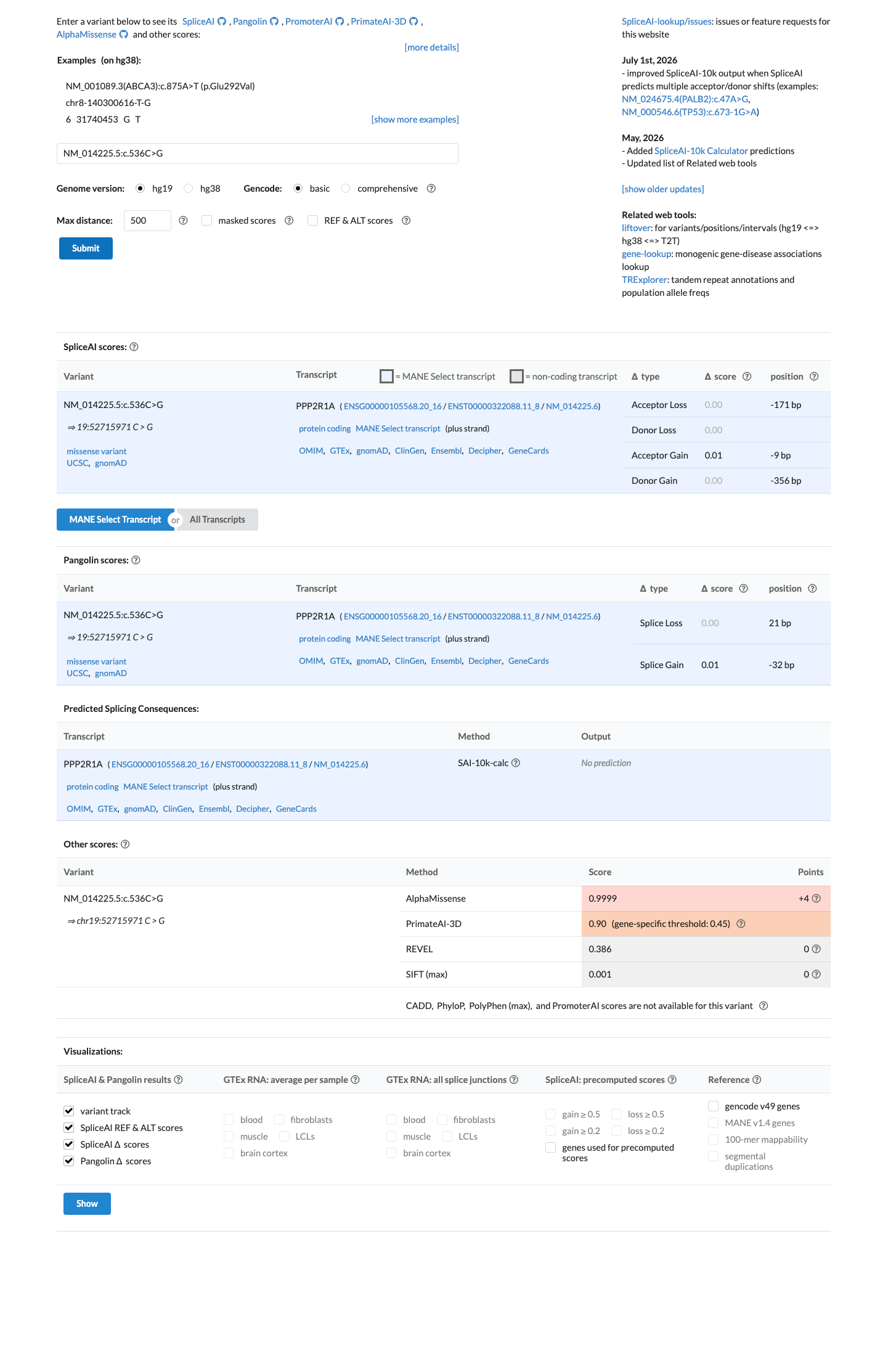
SpliceAI predicts no significant splice impact for this variant (max delta score = 0.01). REVEL score = 0.386. BayesDel score = 0.122929.
Functional
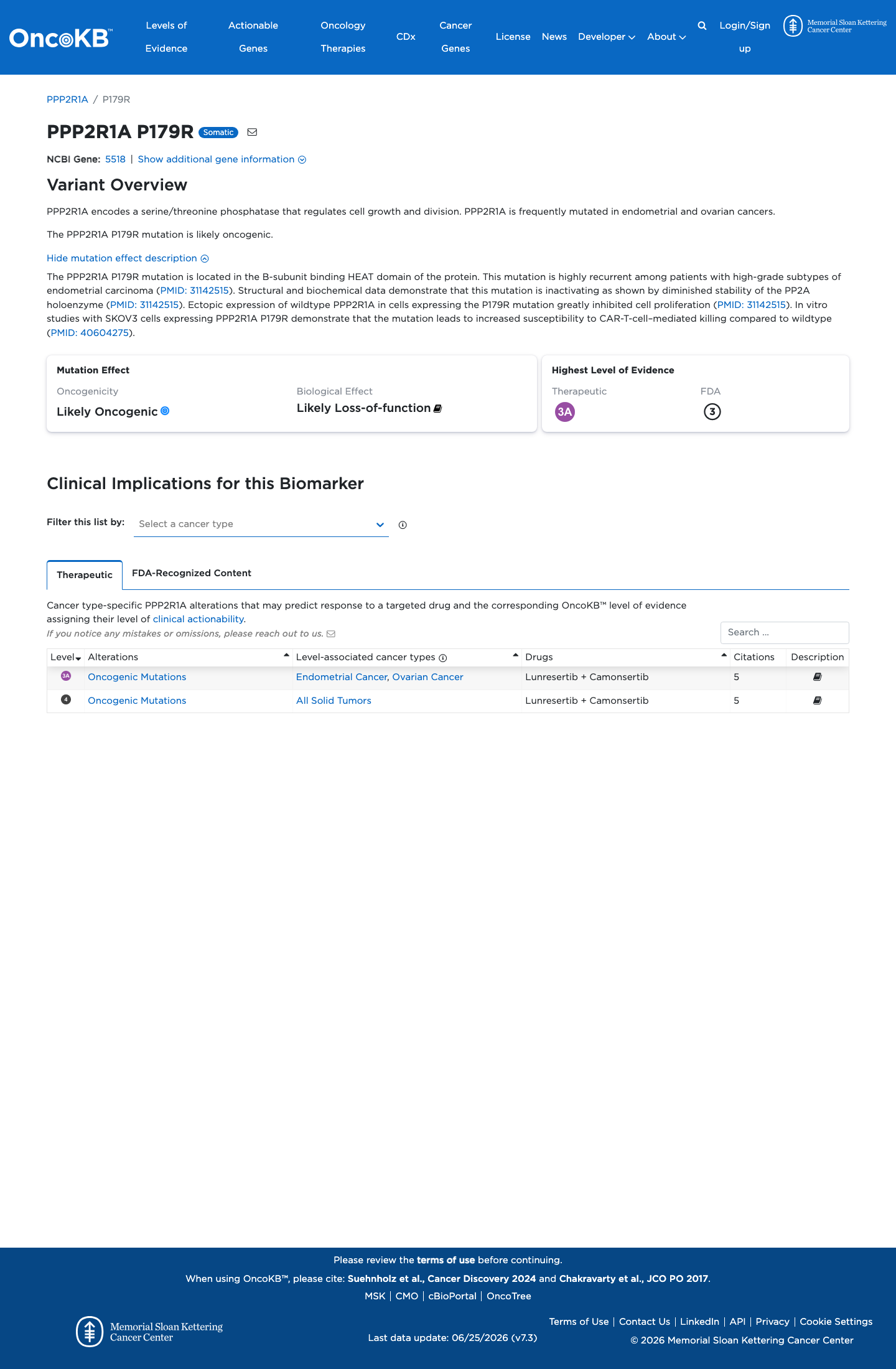
Likely Oncogenic
OncoKB identified variant-specific curated literature and context relevant to functional review; biological-effect context: Likely Loss-of-function; curated oncogenicity label: Likely Oncogenic.
COSMIC

Cancer hotspots
Somatic evidence
Hotspot
COSMIC
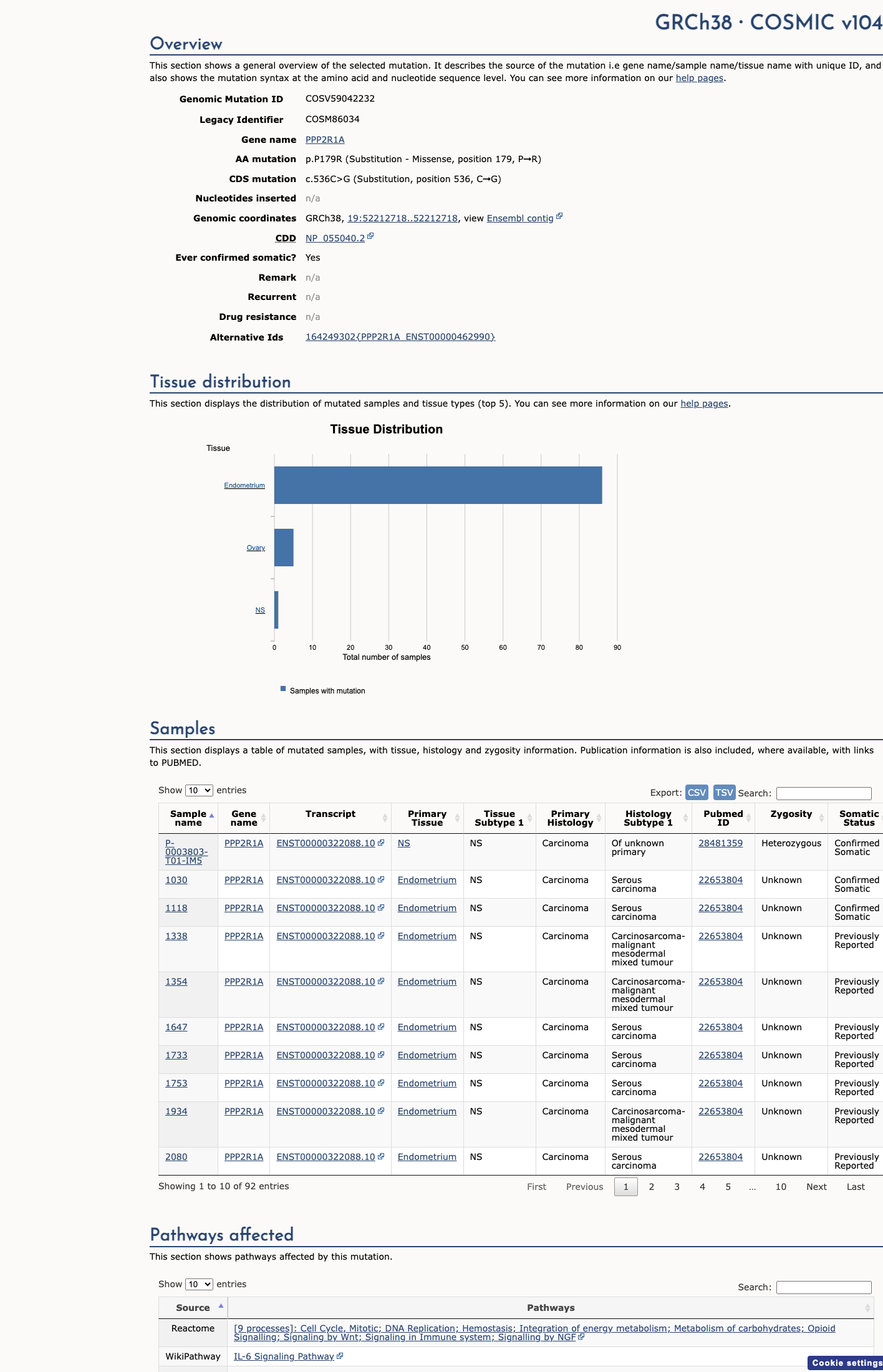
This variant lies in a statistically significant hotspot. This variant has previously been reported in somatic cancers (COSMIC; COSV59042232, n = 92 times).
Hotspots
This variant lies in a statistically significant hotspot.
Literature · how each cited paper was used
1papers cited
Each card is an audit: what was searched, what was found, whether it names the variant, which criteria it fed, and why. 1 further PMID triaged but not cited — see Sources & references.
The Highly Recurrent PP2A Aα-Subunit Mutation P179R Alters Protein Structure and Impairs PP2A Enzyme Function to Promote Endometrial Tumorigenesis.
Searched
P179Rc.536C>GPro179Argp.Pro179Arg
Found
P179R disrupts PP2A holoenzyme assembly by altering Aα-subunit conformation, leading to near-complete loss of catalytic C-subunit binding and proteasome-mediated C-subunit degradation. Restoration of wild-type Aα in P179R-mutant patient-derived endometrial carcinoma cells (UT42) suppresses tumorigenic features in xenograft models. Crystal structure of P179R-Aα determined at 3.4Å resolution (PDB 6EF4) reveals a closed conformation that excludes the catalytic subunit.
Variant
✓ Names this variant — characterised directly
Applied to
→PS3
met
→PM1
met
Why
Direct structural and functional characterization of P179R confirms loss-of-function mechanism; supports PS3 at strong and PM1 at moderate.
the P179R mutation induced significant disruption of PP2A holoenzyme formation, presenting with a significant reduction in binding to members of each B-subunit family except the Striatins
Location Abstract; Results (Figures 1-5); Discussion; Methods (crystallography, co-IP, phosphatase assays, molecular dynamics); Supplementary Figures · Context Co-immunoprecipitation (UT89 serous endometrial carcinoma cells), X-ray crystallography (mouse PP2A Aα P179R, PDB 6EF4), molecular dynamics simulations, in vitro phosphatase activity assays, patient-derived cell lines (UT89, UT42), xenograft tumorigenesis assays · full text
Sources & reference links
Triaged references · 1 PMID not cited in assessment