Analysis in progress
Initialising…
0%
complete
This report is still being assembled — sections appear as each stage finishes. It isn't final yet.
DDX41
Final classification
Likely Benign
DDX41 c.1479C>T · p.Ser493=
DDX41 ·synonymous

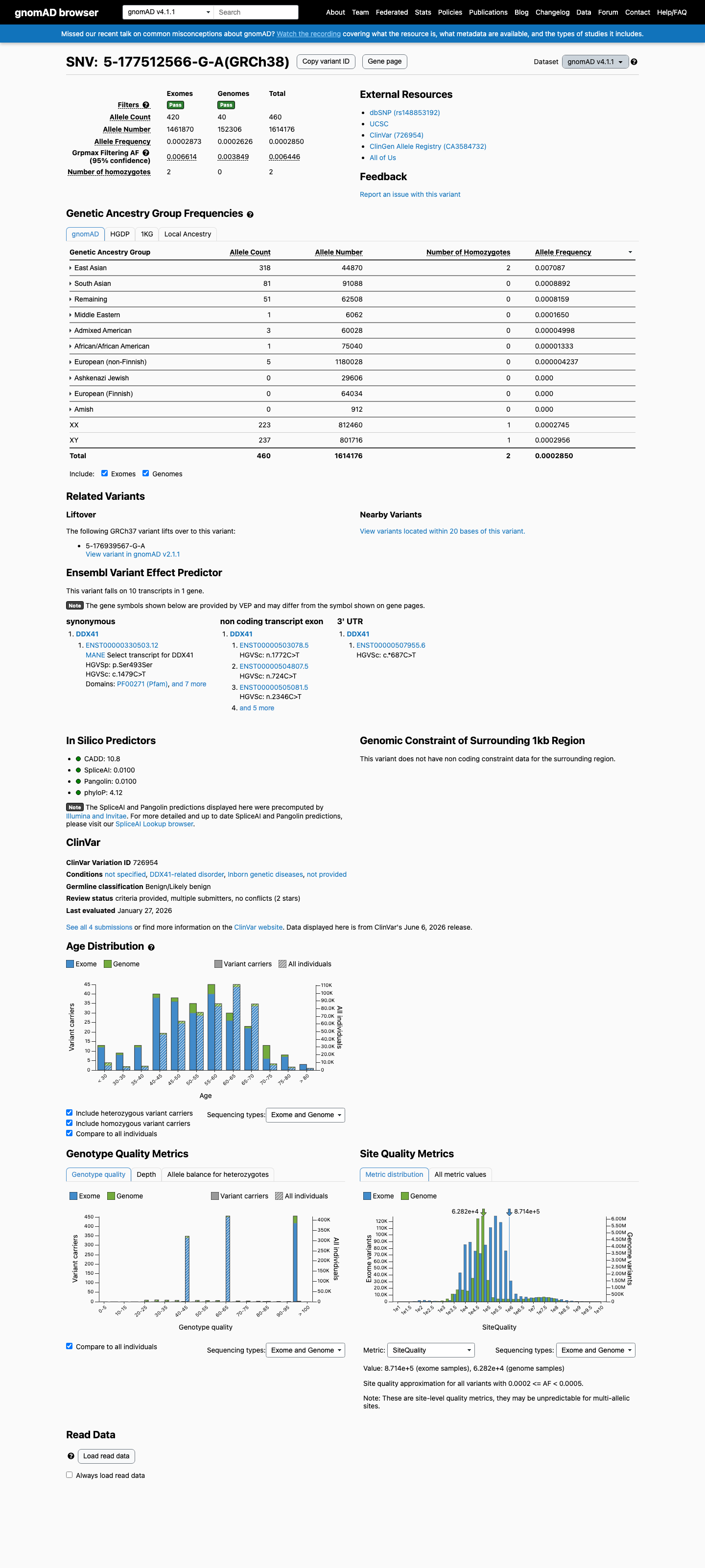
BS1 (Strong): East Asian allele frequency 0.709% (gnomAD v4.1, 318/44,870 alleles, grpmax FAF 0.645%) far exceeds the >0.3% threshold expected for this rare, adult-onset disorder.

Gene
DDX41
Transcript
NM_016222.2
HGVS · transcript:coding
NM_016222.2:c.1479C>T
Consequence
synonymous
exon 14
GRCh38
chr5:177512566 G>A
GRCh37
chr5:176939567 G>A
Basis Likely Benign under the generic ACMG/AMP 2015 combination rules: BS1 (strong, gnomAD v4.1 EAS AF 0.709% vs >0.3% threshold) plus BP7 (supporting, SpliceAI max delta 0.015).
Likely Benign under the generic ACMG/AMP 2015 combination rules: BS1 (strong, gnomAD v4.1 EAS AF 0.709% vs >0.3% threshold) plus BP7 (supporting, SpliceAI max delta 0.015).
Classification rationale
BS1BP7 Likely Benign
DDX41 c.1479C>T synonymous · exon 14

BS1 (Strong): East Asian allele frequency 0.709% (gnomAD v4.1, 318/44,870 alleles, grpmax FAF 0.645%) far exceeds the >0.3% threshold expected for this rare, adult-onset disorder. BP7 (Supporting): synonymous p.Ser493= with SpliceAI max delta 0.015 (below the 0.2 cutoff) at a non-conserved nucleotide that is a common East Asian polymorphism. Overall: Likely Benign — one strong benign (BS1) plus one supporting benign (BP7) under the generic ACMG/AMP 2015 combination rules.

BS1 + BP7 Likely Benign
Gene diagram · NM_016222.2 · variants mapped to exon structure
DDX41 NM_016222.2
Fetching transcript structure from UCSC…
Applied criteria · 2 applied · 15 assessed
Applied · 2
Strength Supporting Moderate Strong Very strong
BS1 strong review Benign
Met (strong): gnomAD v4.1 East Asian allele frequency 0.709% exceeds the >0.3% BS1 threshold for this rare, adult-onset disorder.
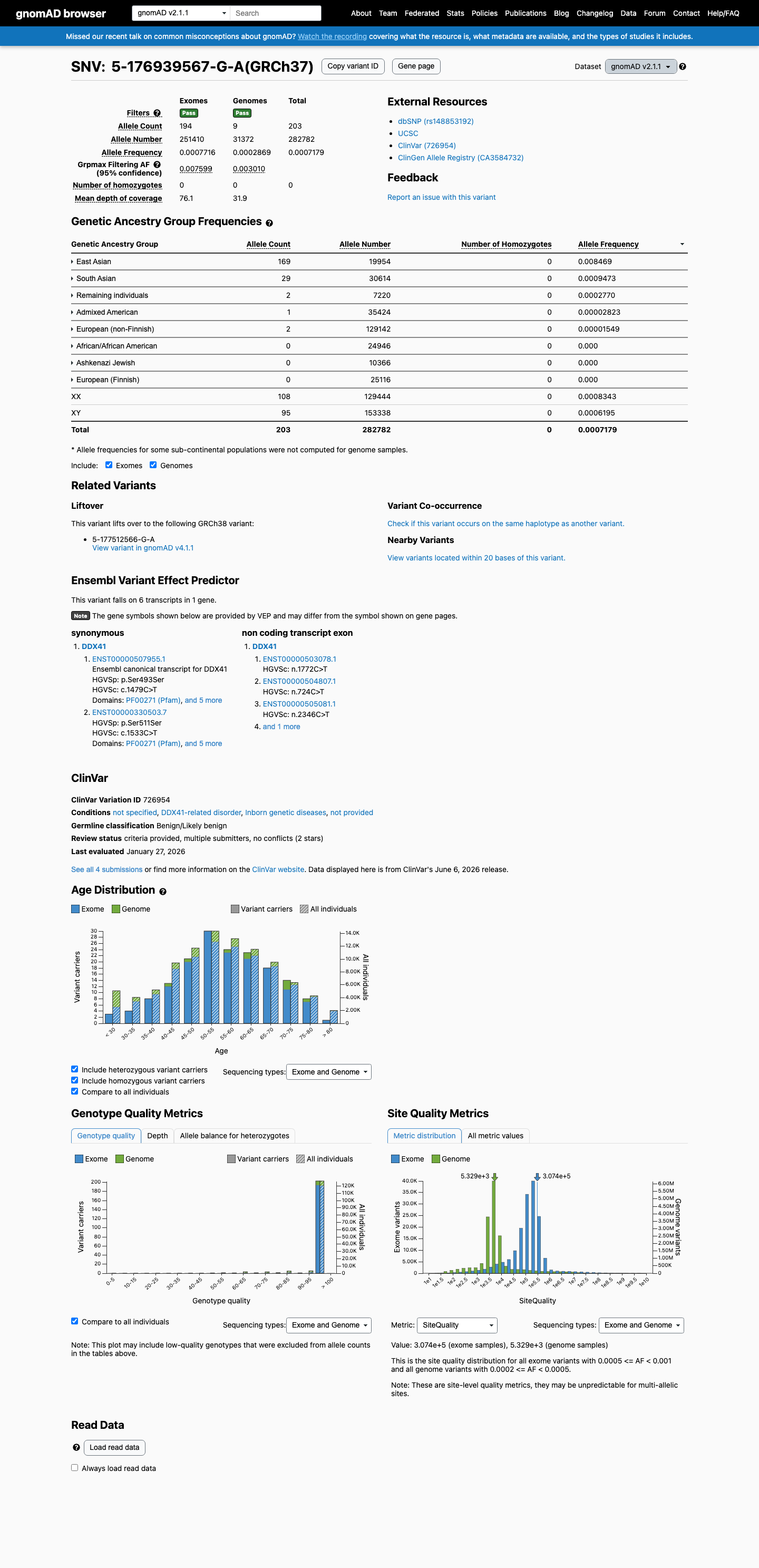
gnomAD v4.1: EAS AF 0.00708714 (318/44,870 alleles, 2 homozygotes); grpmax FAF 0.00644595; total AF 0.000284975 (460/1,614,176)gnomAD v2.1: EAS AF 0.00846948 (169/19,954 alleles, 0 homozygotes); grpmax FAF 0.00759882; total AF 0.000717867 (203/282,782)gnomAD-Canada v1.0: EAS AF 0.0149477 (20/1,338 alleles, 1 homozygote); total AF 0.0014658 (27/18,420)
BP7 supporting Benign
Met (supporting): synonymous p.Ser493= with SpliceAI max delta 0.015 (below the 0.2 cutoff) and a common, non-conserved East Asian polymorphism (AF 0.709%).
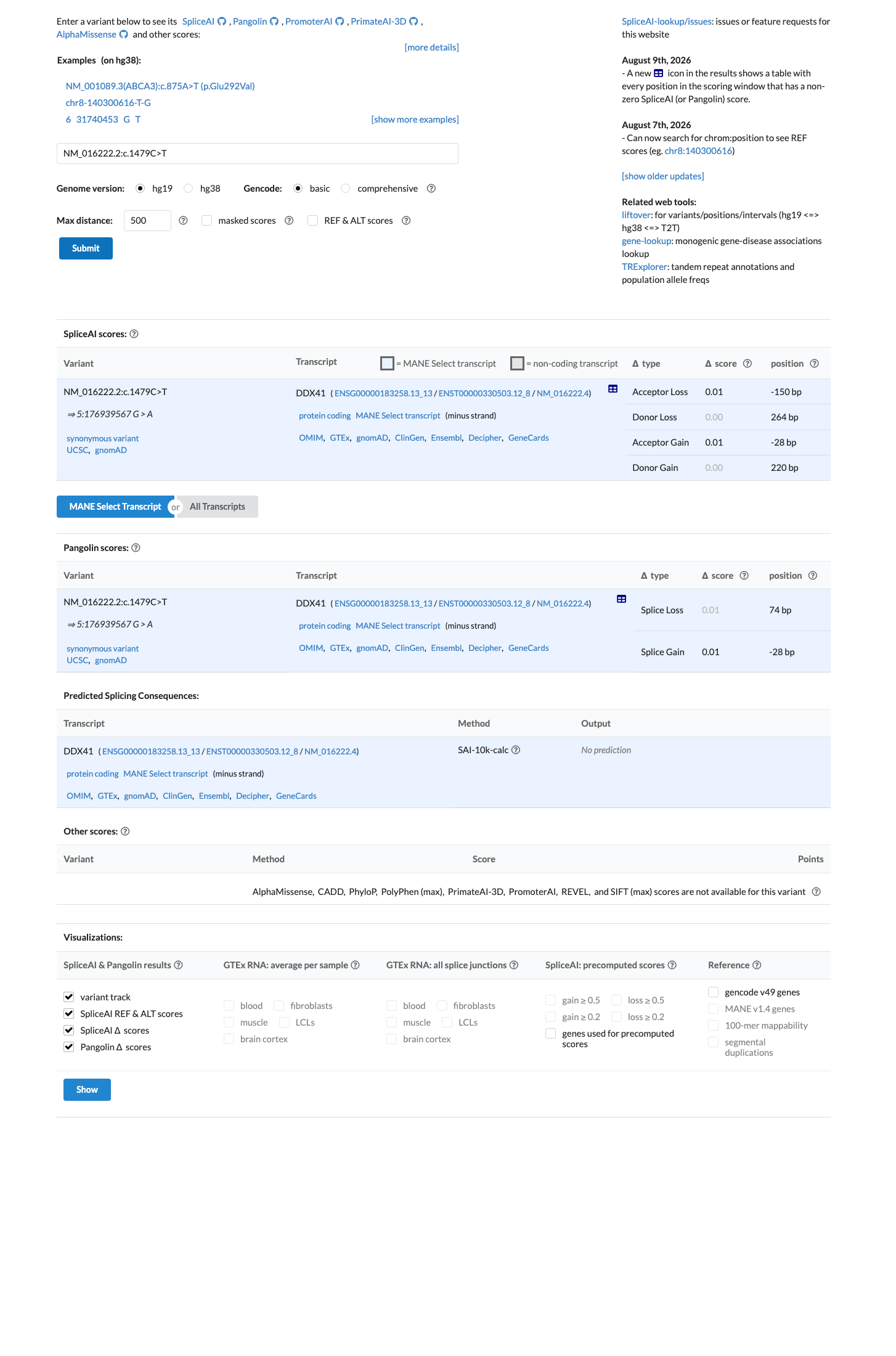
SpliceAI Lookup (source key: spliceai): max delta score 0.015 (DS_AG 0.015, DS_AL 0.014, DS_DG 0.003, DS_DL 0.002) for NM_016222.2:c.1479C>T, below the recommended 0.2 clinical threshold for predicting splice alteration (Jaganathan et al. 2019, Nature Genetics, PMID 30661751); nearest splice-site distances (DP_AG -28, DP_AL -150, DP_DG 220, DP_DL 264) place the variant outside the splice consensus, and no new acceptor/donor gain is predicted.The variant is synonymous: NM_016222.2:c.1479C>T, NP_057306.2:p.(Ser493=), exon 14 of DDX41; gnomAD-Canada VEP annotation is 'synonymous_variant' (source key: gnomad_canada).Nucleotide not highly conserved: gnomAD v4.1 (source key: gnomad_v4) total AF 0.000285 with East Asian AF 0.00709 (318/44870 alleles, 2 homozygotes); gnomAD v2.1 (source key: gnomad_v2) East Asian AF 0.00847 (169/19954 alleles, 0 homozygotes). A common East Asian polymorphism with observed homozygotes indicates the position tolerates variation, satisfying the BP7 non-conservation component.
Assessed · not applied
Pathogenic
PS2 Not assessed: no proband, parental, or de novo genotyping data were available to evaluate this criterion.
PS3 Not assessed: no variant-specific functional assay evidence (RNA, minigene, or cellular) was available.
PS4 Not met: no case-control enrichment data exist, and the variant is common in East Asians (gnomAD v4.1 EAS AF 0.709%).
PM2 Not met: gnomAD v4.1 East Asian allele frequency 0.709% far exceeds the <0.1% PM2 threshold on the max-population-AF basis.
PM6 Not assessed: no parental testing or proband data were available to support an assumed de novo origin.
PP1 Not assessed: no affected relatives were tested, so no co-segregation evidence was available.
PP3 Not met: SpliceAI max delta 0.015 is far below the 0.2 splice-alteration cutoff, and missense predictors do not apply.
PP4 Not assessed: no proband phenotype or family-history data were available.
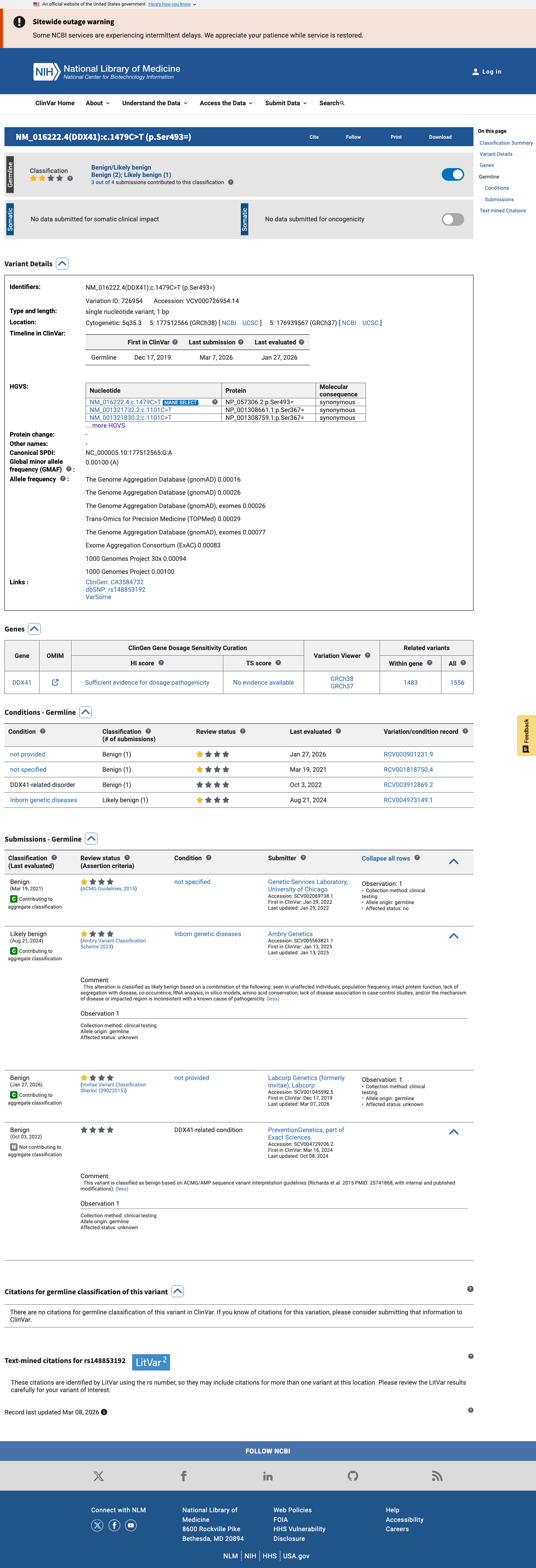
PP5 Not met: ClinVar VCV000726954 contains no expert-panel pathogenic classification (0 of 4 submissions).
Benign
BA1 Not met: highest subpopulation allele frequency 0.709% (gnomAD v4.1 EAS) falls below the >1% BA1 threshold.
BS3 Not assessed: no well-established functional study of this synonymous variant was available.
BS4 Not assessed: no family testing data existed to document absence of segregation.
BP2 Not assessed: no proband or family phase data (cis/trans with a pathogenic variant) were available.
BP5 Not assessed: no proband data were available to identify an alternate molecular basis of disease.
BP6 Not met: all 4 ClinVar submissions are ordinary clinical laboratories, with no expert-panel benign classification.
N/A · 11 PVS1 · PS1 · PM1 · PM3 · PM4 · PM5 · PP2 · BS2 · BP1 · BP3 · BP4
Research & evidence
Population frequency · supports benign
gnomAD v4.1 screenshot
gnomAD v4.1
gnomAD v2.1 screenshot
gnomAD v2.1
v4.1
This variant is present in gnomAD v4.1 (AF= 0.000284975; MAF= 0.02850%, 460/1614176 alleles, homozygotes = 2) and has highest observed frequency in the East Asian population (AF= 0.00708714; MAF= 0.70871%, 318/44870 alleles, homozygotes = 2); grpmax FAF= 0.00644595.
v2.1
This variant is present in gnomAD v2.1 (AF= 0.000717867; MAF= 0.07179%, 203/282782 alleles, homozygotes = 0) and has highest observed frequency in the East Asian population (AF= 0.00846948; MAF= 0.84695%, 169/19954 alleles, homozygotes = 0); grpmax FAF= 0.00759882.
🇨🇦 CA
This variant is present in gnomAD-Canada v1.0 (AF= 0.0014657980456026058, 27/18420 alleles, homozygotes = 1).
Allele frequency by ancestry
three datasets · side by side
gnomAD v4.1
0.028% · 460 / 1,614,176
2 hom · FAF 0.64%
East Asian
318 / 44,870
0.71%
2 hom
South Asian
81 / 91,088
0.089%
Remaining individuals
51 / 62,508
0.082%
Middle Eastern
1 / 6,062
0.016%
Admixed American
3 / 60,028
0.005%
African/African American
1 / 75,040
0.0013%
European (non-Finnish)
5 / 1,180,028
0.00042%
+ 3 not observed (European (Finnish), Amish, Ashkenazi Jewish)
gnomAD v2.1
0.072% · 203 / 282,782
0 hom · FAF 0.76%
East Asian
169 / 19,954
0.85%
South Asian
29 / 30,614
0.095%
Remaining individuals
2 / 7,220
0.028%
Admixed American
1 / 35,424
0.0028%
European (non-Finnish)
2 / 129,142
0.0015%
+ 3 not observed (African/African American, Ashkenazi Jewish, European (Finnish))
gnomAD Canada 🇨🇦
0.15% · 27 / 18,420
1 hom · FAF 0.99%
East Asian
20 / 1,338
1.5%
1 hom
Remaining individuals
6 / 1,138
0.53%
South Asian
1 / 1,362
0.073%
+ 6 not observed (African/African American, Latino/Admixed American, Ashkenazi Jewish, European (Finnish), Middle Eastern, European (non-Finnish))
ClinVar screenshot
ClinVar
This variant has been reported in ClinVar as Benign (3 clinical laboratories) and as Likely benign (1 clinical laboratory). (ClinVarID = 726954)
SpliceAI screenshot
In silico
SpliceAI predicts no significant splice impact for this variant (max delta score = 0.01).
Functional / OncoKB screenshot
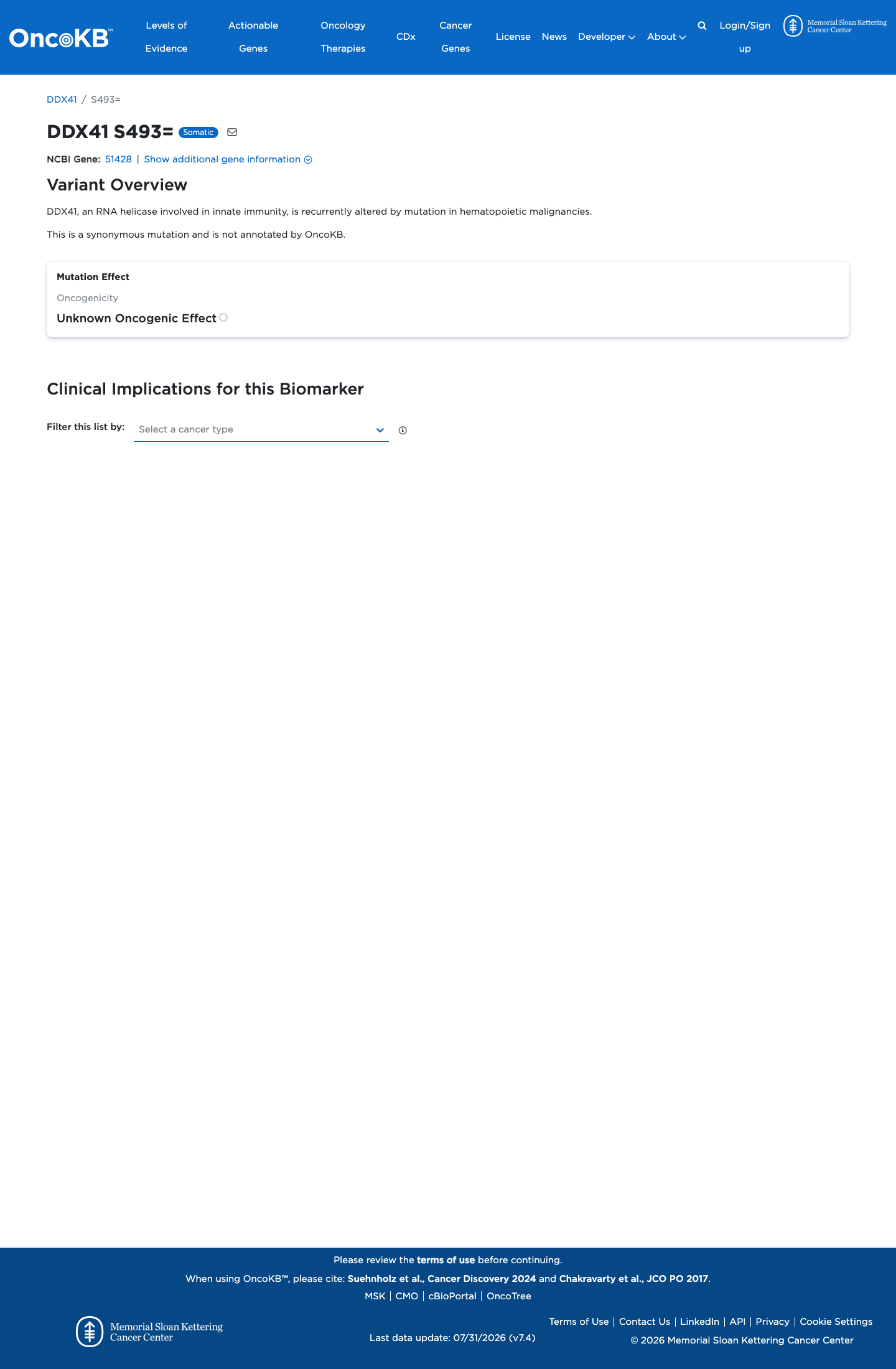
Functional Unknown Oncogenic Effect
OncoKB identified curated literature and non-variant-specific oncogenicity context for review; listed oncogenicity label: Unknown Oncogenic Effect.
OncoKB ↗
COSMIC screenshot
COSMIC
Cancer hotspots screenshot
Cancer hotspots
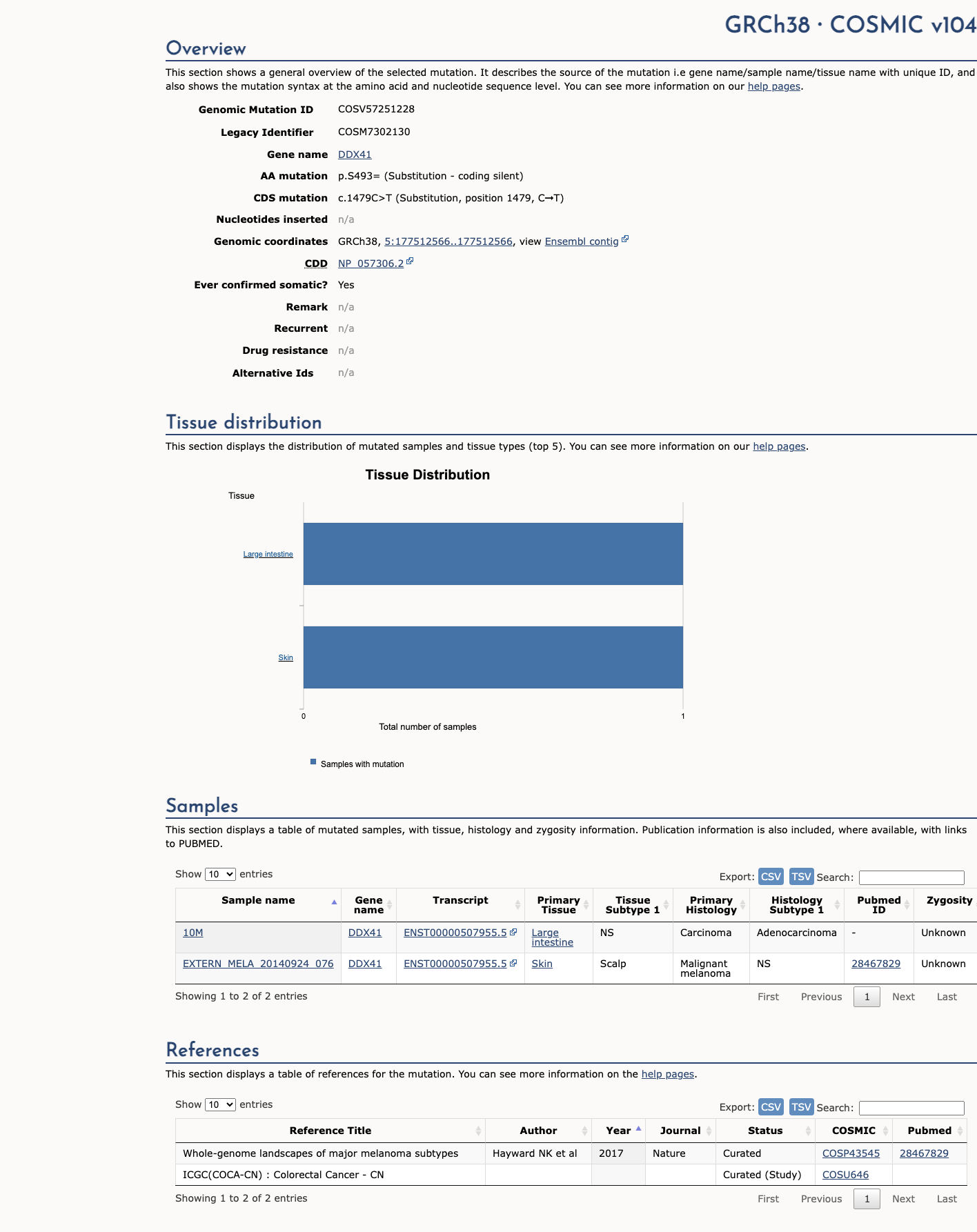
Somatic evidence Not in COSMIC / hotspots
COSMIC
This variant does not lie in a statistically significant hotspot. This variant has previously been reported in somatic cancers (COSMIC; COSV57251228, n = 2 times).
Hotspots
This variant does not lie in a statistically significant hotspot.
Literature · how each cited paper was used
1papers cited
Each card is an audit: what was searched, what was found, whether it names the variant, which criteria it fed, and why. 6 further PMIDs triaged but not cited — see Sources & References.
Rule & framework references · cited for criterion definitions, not variant evidence
25741868 ↗ Standards and guidelines for the interpretation of sequence variants: a joint consensus recommendation of the American College of Medical Genetics and Genomics and the Association for Molecular Pathology.
Sources & reference links
9Sources
CSpec VCEP
ClinVar
gnomAD v2.1
gnomAD v4.1
gnomAD-Canada
SpliceAI
OncoKB
COSMIC
Cancer hotspots
Triaged references · 6 PMIDs not cited in assessment
25730230 ↗ Expanded carrier screening in reproductive medicine-points to consider: a joint statement of the American College of Medical Genetics and Genomics, American College of Obstetricians and Gynecologists, National Society of Genetic Counselors, Perinatal Quality Foundation, and Society for Maternal-Fetal Medicine. CLINVAR
22947299 ↗ Specific guidelines for assessing and improving the methodological quality of economic evaluations of newborn screening. CLINVAR
23037933 ↗ Including the initial newborn screening bloodspot collection device serial number on birth certificates: basis and recommendations from the Secretary of Health and Human Services' Advisory Committee on Heritable Disorders in Newborns and Children. CLINVAR
23881473 ↗ Newborn screening: education, consent, and the residual blood spot. The position of the national society of genetic counselors. CLINVAR
28492532 ↗ Sherloc: a comprehensive refinement of the ACMG-AMP variant classification criteria. CLINVAR
31022120 ↗ ACOG Committee Opinion No. 778 Summary: Newborn Screening and the Role of the Obstetrician-Gynecologist. CLINVAR