Back
NM_020975.6:c.2944C>T
p.Arg982Cys · RET
ACMG/AMP
0%
complete
Final classification
Likely Benign
BS1BS2BS3BP2BP4BP5
RET
c.2944C>T
p.Arg982Cys
missense · exon 18

RET encodes a receptor tyrosine kinase that, when activated by GDNF-family ligands, triggers signaling pathways involved in cell growth, differentiation, migration, and survival, and is essential for development of the nervous system and neural crest-derived tissues. Germline changes in RET cause Hirschsprung disease, congenital central hypoventilation syndrome, and the inherited cancer syndromes multiple endocrine neoplasia type 2A and 2B and familial medullary thyroid carcinoma. In cancer, RET is a proto-oncogene that can be turned on by point mutations or gene rearrangements, driving malignancies such as medullary and papillary thyroid carcinoma, lung adenocarcinoma, and chronic myelomonocytic leukemia, and abnormal RET activity has also been linked to invasion and metastasis in pancreatic cancer and to endocrine therapy resistance in breast cancer.

This variant

This RET p.Arg982Cys variant occurs in a receptor tyrosine kinase gene whose germline variation contributes to Hirschsprung disease and inherited endocrine cancer syndromes.

Transcript
NM_020975.6
HGVS · transcript:coding
NM_020975.6:c.2944C>T
GRCh38
chr10:43124887 C>T
GRCh37
chr10:43620335 C>T
Likely Benign: BS1 (strong) plus BS2, BS3, BP2, BP4, and BP5 (supporting) satisfy the generic ACMG/AMP benign combination rule.
Classification rationale
BS1BS2BS3BP2BP4BP5 Likely Benign
RET c.2944C>T missense · exon 18

Likely Benign: BS1 (strong) because allele frequencies exceed 0.01. Likely Benign: BS2 (supporting) because gnomAD reports 372 homozygotes. Likely Benign: BS3 (supporting) because R982C alone did not alter GDNF-dependent MAPK activity. Likely Benign: BP2 (supporting) because R982C was observed in trans with pathogenic p.C634Y. Likely Benign: BP4 (supporting) because REVEL is 0.282, below the calibrated benign threshold. Likely Benign: BP5 (supporting) because affected individuals carried R982C with alternate RET variants.

BS1 + BS2 + BS3 + BP2 + BP4 + BP5 → Likely Benign
LYFE Sciences is an AI system, and it can make mistakes. Criteria may be applied incorrectly, sources may be misread, and a confident-looking classification can still be wrong. Double-check every criterion and its underlying evidence before relying on any call.
Gene diagram · NM_020975.6 · variants mapped to exon structure
RET NM_020975.6
Fetching transcript structure from UCSC…
Applied criteria · 6 applied · 17 assessed
MetEvidence satisfies this criterion.
Not metEvaluated against available evidence; threshold not reached.
Not assessedApplies in principle, but no evidence was found to evaluate it.
N/ADoesn't apply to this variant type.
Applied · 6
Strength Supporting Moderate Strong Very strong
BS1 strong Benign
Met, strong: gnomAD total allele frequencies of 0.0185349 and 0.0163633 exceed the generic BS1 threshold of 0.01.
gnomAD v2.1 reports total AF 0.0185349 and non-cancer exome AF 0.0194274; its highest subgroup AF is 0.0431147.gnomAD v4.1 reports total AF 0.0163633; gnomAD v3.1 non-cancer genomes report AF 0.0164404; the gnomAD v4.1 highest subgroup AF is 0.0423366.The generic SVI BS1 threshold is allele frequency >=0.01; per-gene derivation is preferred (Whiffin et al., PMID:28518168).
BS2 supporting review Benign
Met, supporting: gnomAD reports 372 homozygotes, including 342 exome homozygotes, challenging a fully penetrant dominant RET disorder.
gnomAD v2.1 reports 82 total homozygotes, including 78 exome homozygotes; its non-cancer exome subset also reports 78 homozygotes.gnomAD v4.1 reports 372 total homozygotes, including 342 exome homozygotes and 30 genome homozygotes.gnomAD v3.1 non-cancer genomes report 30 homozygotes.
BS3 supporting Benign
Met at supporting strength: RET R982C alone showed no alteration of GDNF-dependent MAPK activity in the HEK293 assay, unlike the paired G691S/R982C construct.
PMID:22729463 reports that RET R982C alone did not alter GDNF-dependent MAPK activity in transfected HEK293 cells; the assay used site-directed mutagenesis and GDNF-stimulated MAPK phosphorylation.PMID:21655256 states that prior in vitro expression experiments found normal biological and biochemical behavior for p.R982C, although those experiments were not performed in the reported study.
BP2 supporting Benign
Met, supporting: p.R982C was on the paternal haplotype and pathogenic p.C634Y was maternal, demonstrating the variants in trans in the reported daughter.
In the reported Chinese MEN2A/FMTC family, haplotype analysis confirmed p.C634Y was maternal and p.V292M/p.R67H/p.R982C were paternal and on a common allele.The daughter inherited the paternal p.R982C-containing haplotype and the maternal p.C634Y allele, directly establishing p.R982C in trans with pathogenic p.C634Y.This phase observation satisfies generic BP2 for a dominant RET disease context at supporting strength.
BP4 supporting Benign
Met at supporting strength: REVEL 0.282 is below the <=0.29 BP4 supporting threshold from the ClinGen SVI calibration.
The variant is classified as missense, NP_066124.1:p.(Arg982Cys), so the missense REVEL path governs PP3/BP4.REVEL score is 0.282, meeting the BP4 supporting threshold of <=0.29 specified by the ClinGen SVI REVEL calibration (Pejaver et al. 2022, PMID:36413997).SpliceAI was not used for BP4 because a missense variant must be evaluated through REVEL rather than the splice-impact path.
BP5 supporting review Benign
Met, supporting: affected individuals carried R982C with alternate RET variants, including established p.C634Y or G691S, providing an alternate molecular basis for disease.
PMID:21655256 reports a daughter with the pathogenic p.C634Y variant plus paternal p.V292M/p.R67H/R982C, supporting an alternate molecular basis for the MEN2A phenotype; the study describes R982C as a possible modifier rather than an independently established cause.PMID:22729463 reports a CAKUT patient with RET-G691S and R982C; R982C alone did not alter GDNF-dependent MAPK activity, whereas the double construct showed near-complete loss of signaling, supporting the presence of another molecular basis while leaving possible interaction effects.
Assessed · not applied · 16 not met · 1 not assessed
Pathogenic
PS1 Not met: no distinct nucleotide change producing the same p.Arg982Cys substitution is established as pathogenic; the queried R982C itself is reported as benign or uncertain.
PS2 Not met: reported familial observations document maternal or paternal inheritance, with no confirmed de novo RET c.2944C>T event.
PS3 Not met: R982C alone did not alter GDNF-dependent MAPK activity, while near-complete loss occurred only with the paired G691S/R982C construct.
PS4 Not met: R982C occurred in 3/84 Hirschsprung cases versus 0/96 controls, but confounding variants and population frequency prevent convincing disease-specific enrichment.
PM1 Not met: despite kinase-domain location, R982C has gnomAD v4.1 AF 0.0163633 and grpmax FAF 0.04122125, with no statistically significant hotspot evidence.
PM2 Not met: gnomAD v4.1 total allele frequency is 0.0163633, far above the PM2 threshold of 0.0001.
PM5 Not met: zero same-residue comparator candidates were identified, and no alternate missense change at Arg982 is established as pathogenic.
PM6 Not met: available reports show maternal or paternal transmission rather than an assumed de novo occurrence without parental testing.
PP1 Not met: transmission is reported, but informative affected-relative cosegregation with the disease phenotype is not established.
PP2 Not met: benign missense variation is common in RET, with R982C at gnomAD v4.1 AF 0.0163633 and grpmax FAF 0.04122125.
PP3 Not met: REVEL 0.282 is below the >=0.644 PP3 supporting threshold from the ClinGen SVI calibration.
PP4 Not met: reported phenotypes are heterogeneous and often involve additional RET variants, with no distinctive phenotype uniquely attributable to R982C.
PP5 Not met: ClinVar has zero expert-panel submissions for exact R982C, so laboratory and aggregate classifications cannot trigger PP5.
Benign
BA1 Not met: the highest observed allele frequency is 0.0431147, below the generic BA1 threshold of 0.05.
BS4 Not assessed: no adequately phenotyped unaffected familial carriers are documented to demonstrate non-segregation of RET c.2944C>T.
BP1 Not met: RET disease mechanisms include established missense effects, so disease is not predominantly caused by truncating variants.
BP6 Not met: ClinVar has zero expert-panel submissions for exact R982C, so ordinary benign laboratory assertions cannot trigger BP6.
N/A · 5 PVS1 · PM3 · PM4 · BP3 · BP7
Research & evidence
Population frequency · supports benign
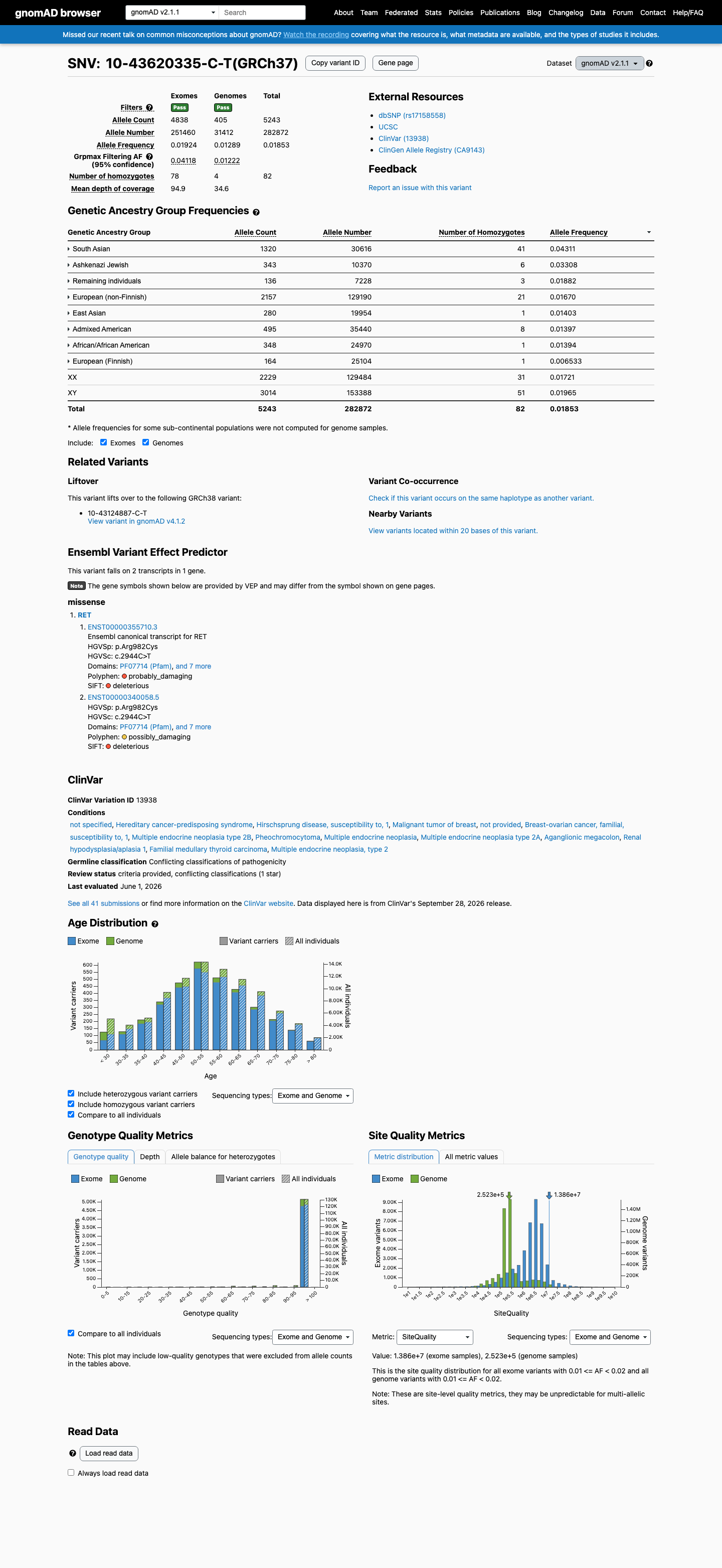
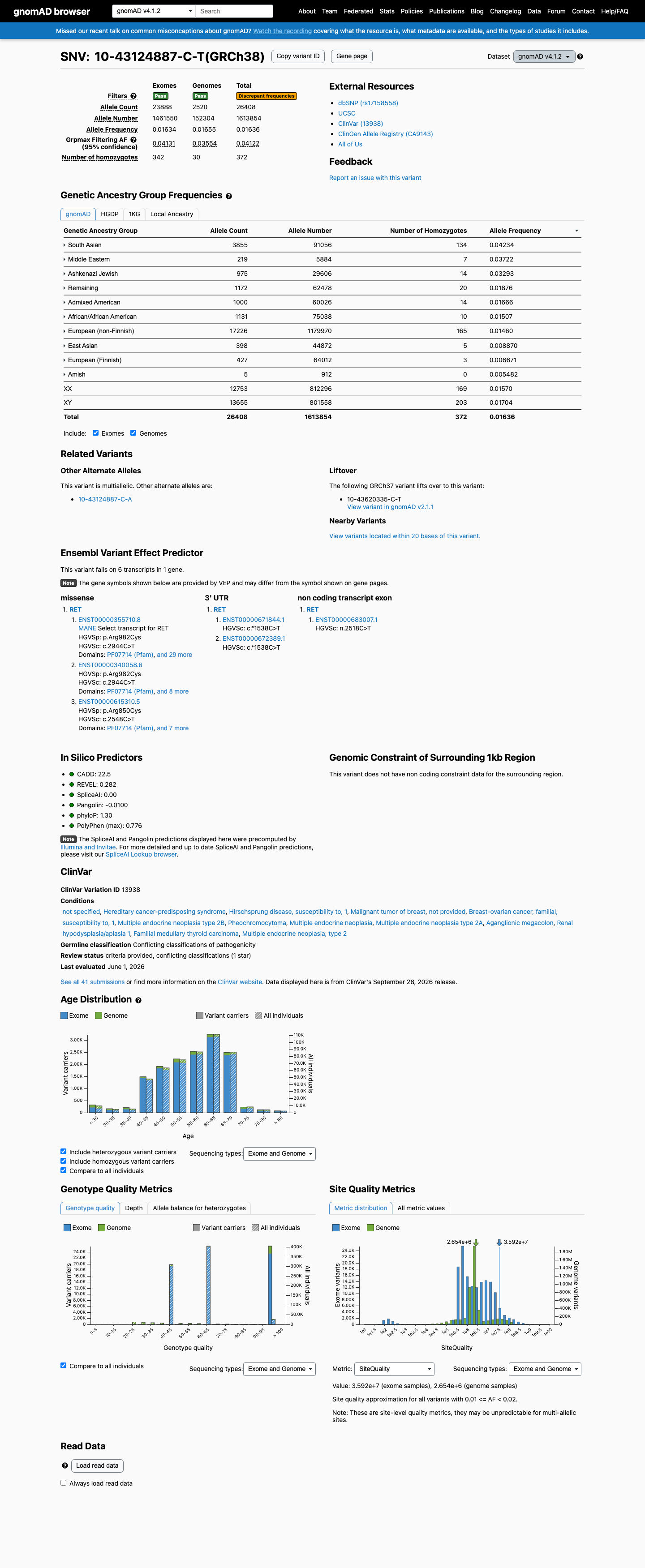
gnomAD v4.1 screenshot
gnomAD v4.1
gnomAD v2.1 screenshot
gnomAD v2.1
v4.1
This variant is present in gnomAD v4.1 (AF= 0.0163633; MAF= 1.63633%, 26408/1613854 alleles, homozygotes = 372) and has highest observed frequency in the South Asian population (AF= 0.0423366; MAF= 4.23366%, 3855/91056 alleles, homozygotes = 134); grpmax FAF= 0.0412213.
v2.1
This variant is present in gnomAD v2.1 (AF= 0.0185349; MAF= 1.85349%, 5243/282872 alleles, homozygotes = 82) and has highest observed frequency in the South Asian population (AF= 0.0431147; MAF= 4.31147%, 1320/30616 alleles, homozygotes = 41); grpmax FAF= 0.0411806.
🇨🇦 CA
Not available in gnomAD-Canada v1.0.
Allele frequency by ancestry
three datasets · side by side
gnomAD v4.1
1.6% · 26408 / 1,613,854
372 hom · FAF 4.1%
South Asian
3855 / 91,056
4.2%
134 hom
Middle Eastern
219 / 5,884
3.7%
7 hom
Ashkenazi Jewish
975 / 29,606
3.3%
14 hom
Remaining individuals
1172 / 62,478
1.9%
20 hom
Admixed American
1000 / 60,026
1.7%
14 hom
African/African American
1131 / 75,038
1.5%
10 hom
European (non-Finnish)
17226 / 1,179,970
1.5%
165 hom
East Asian
398 / 44,872
0.89%
5 hom
European (Finnish)
427 / 64,012
0.67%
3 hom
Amish
5 / 912
0.55%
gnomAD v2.1
1.9% · 5243 / 282,872
82 hom · FAF 4.1%
South Asian
1320 / 30,616
4.3%
41 hom
Ashkenazi Jewish
343 / 10,370
3.3%
6 hom
Remaining individuals
136 / 7,228
1.9%
3 hom
European (non-Finnish)
2157 / 129,190
1.7%
21 hom
East Asian
280 / 19,954
1.4%
1 hom
Admixed American
495 / 35,440
1.4%
8 hom
African/African American
348 / 24,970
1.4%
1 hom
European (Finnish)
164 / 25,104
0.65%
1 hom
gnomAD Canada 🇨🇦
Absent · 0 / ?
0 hom
Not observed in any ancestry group.
ClinVar screenshot
ClinVar
This variant has been reported in ClinVar as Benign (27 clinical laboratories) and as Likely benign (7 clinical laboratories) and as Uncertain significance (1 clinical laboratory) and as benign (1 clinical laboratory). (ClinVarID = 13938)
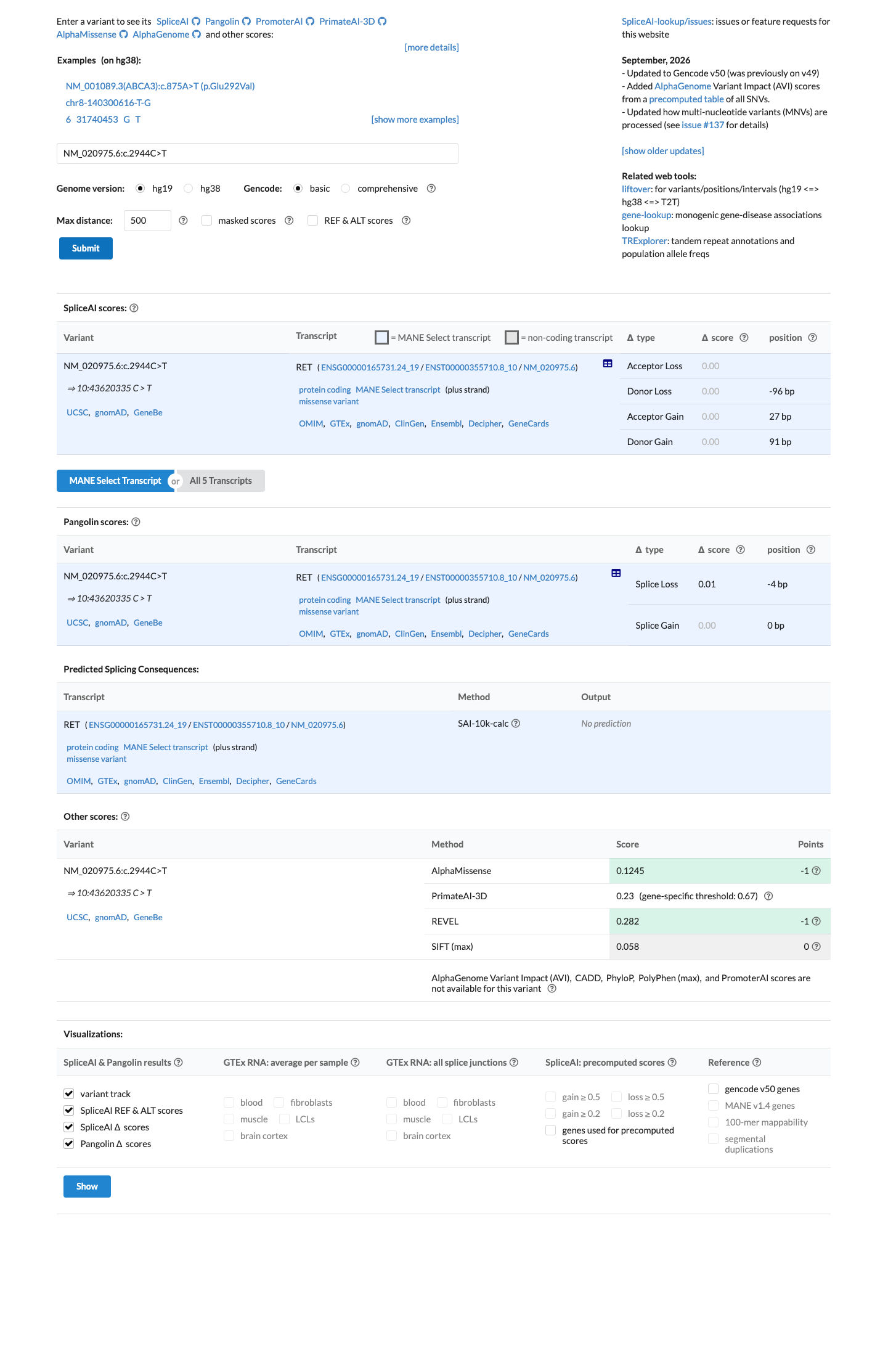
SpliceAI screenshot
In silico
SpliceAI predicts no significant splice impact for this variant (max delta score = 0.00). REVEL score = 0.282. BayesDel score = -0.271781.
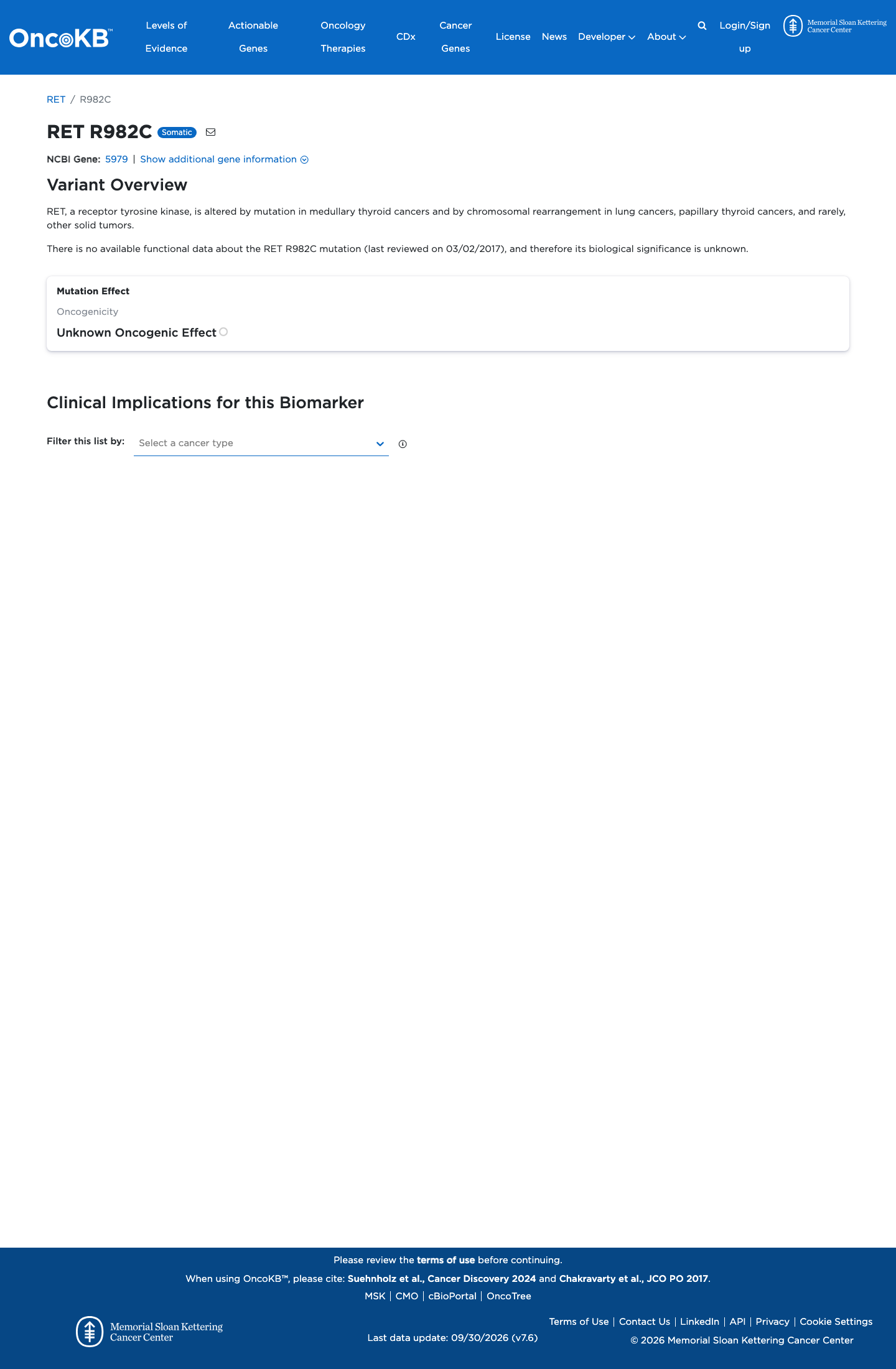
Functional / OncoKB screenshot
Functional Unknown Oncogenic Effect
OncoKB did not identify variant-specific reviewed functional evidence for this variant; gene-level curated context is available for reviewer follow-up. RET, a receptor tyrosine kinase, is altered by mutation in medullary thyroid cancers and by chromosomal rearrangement in lung cancers, papillary thyro
OncoKB ↗
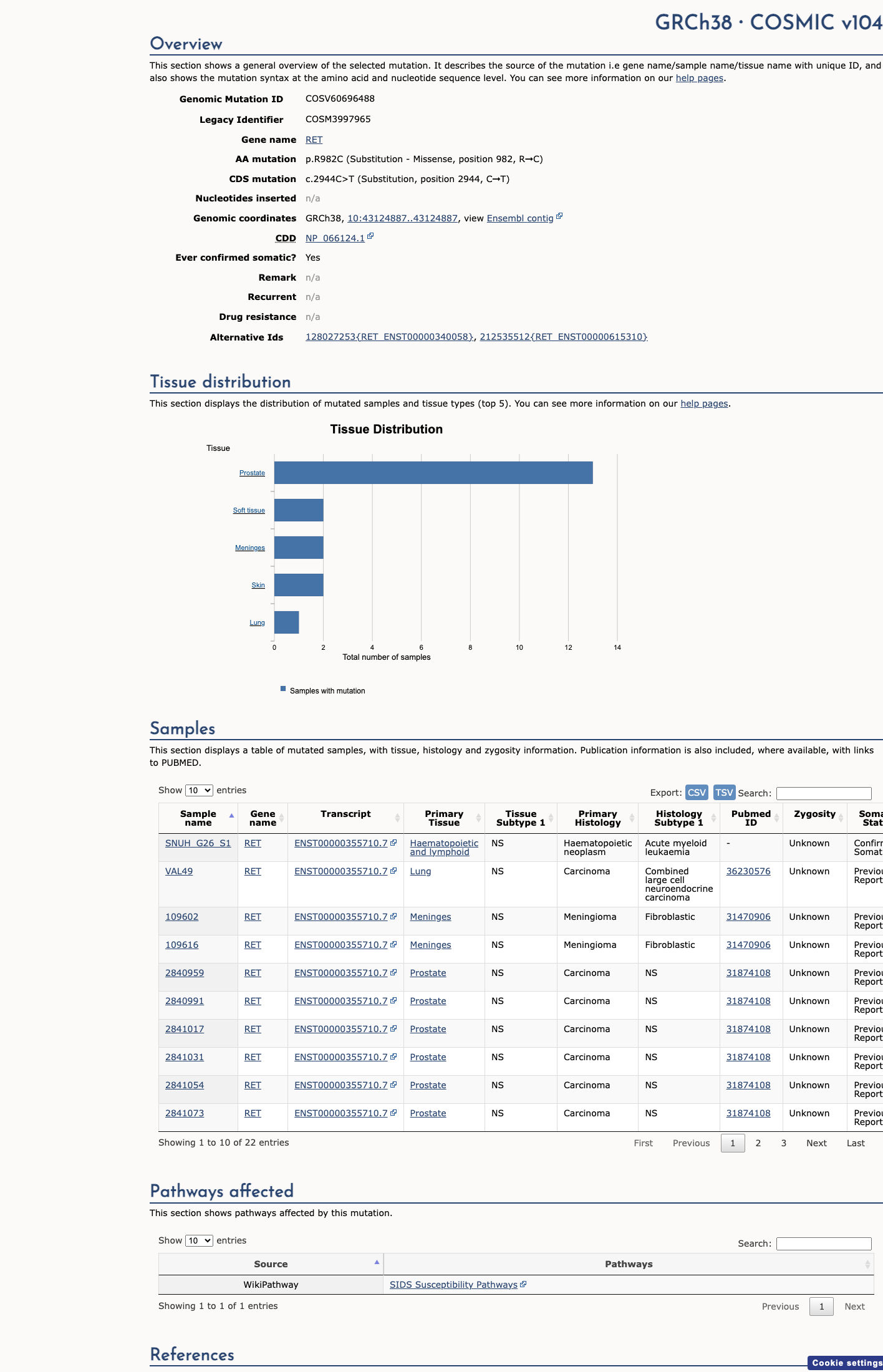
COSMIC screenshot
COSMIC
Cancer hotspots screenshot
Cancer hotspots
Somatic evidence Not in COSMIC / hotspots
COSMIC
This variant does not lie in a statistically significant hotspot. This variant has previously been reported in somatic cancers (COSMIC; COSV60696488, n = 22 times).
Hotspots
This variant does not lie in a statistically significant hotspot.
Literature · how each cited paper was used
4papers cited
Each card is an audit: what was searched, what was found, whether it names the variant, which criteria it fed, and why. 4 further PMIDs triaged but not cited — see Sources & references.
Highly recurrent RET mutations and novel mutations in genes of the receptor tyrosine kinase and endothelin receptor B pathways in Chinese patients with sporadic Hirschsprung disease.
Searched
c.2944C>Tp.(R982C)R982C
Found
The paper explicitly reports RET R982C in three patients and not in 96 ethnically matched controls, while noting that R982C had previously been observed in control chromosomes and remained debated; one carrier also had two de novo silent changes that could have contributed to disease.
Variant
✓ Names this variant — characterised directly
Applied to
→BS1 strong
Directly consulted for the variant's reported control and case frequency context, although the population dataset is more decisive.
→BS3 supporting
We observed the R982C change in three patients (patients 9, 55, and 92) but not in the 96 controls. R982C has been debated widely; it was initially described as a mutation but later was observed in control chromosomes.
Location Results and Discussion, sequence alterations in RET and GDNF; patient details in Table 2  ·  Context RET exon and splice-boundary sequencing in 84 Chinese patients with sporadic Hirschsprung disease and 96 ethnically matched controls, with parental testing when available.  ·  full text
Germline homozygous mutations at codon 804 in the RET protooncogene in medullary thyroid carcinoma/multiple endocrine neoplasia type 2A patients.
Searched
c.2944C>Tp.(R982C)R982CCGC>TGC
Found
The paper reports R982C as a second germline RET mutation in one patient with a codon 804 mutation, did not find it in 100 healthy control chromosomes, and states that the significance and functional consequences of R982C were uncertain.
Variant
✓ Names this variant — characterised directly
Applied to
→BS1 strong
Directly consulted as historical population-frequency evidence; its small sample size is superseded by larger gnomAD datasets.
→BS3 supporting
The significance of the R982C change is not certain. ... the functional consequences of the amino acid change are unknown.
Location Results and Discussion, paragraph beginning To test the model further, p. 3456  ·  Context Five UK patients with codon 804 RET mutations were sequenced; population frequency was assessed using 100 healthy control chromosomes; no R982C functional assay was reported.  ·  full text
RET germline mutations identified by exome sequencing in a Chinese multiple endocrine neoplasia type 2A/familial medullary thyroid carcinoma family.
Searched
c.2944C>Tp.R982CNP_066124.1:p.(R982C)
Found
The paper reports p.R982C as a rare RET polymorphism, documents its inheritance in cis with p.V292M and p.R67H, and states that prior in-vitro expression experiments found normal biological and biochemical behavior; this study did not independently establish a functional effect for R982C.
Variant
✓ Names this variant — characterised directly
Applied to
→BS1 strong
The paper reports an approximately 2% population-frequency estimate for p.R982C, relevant to excess-frequency benign evidence.
→BS3 supporting
Reports prior normal in vitro biological and biochemical behavior for p.R982C, while clearly distinguishing that from the study’s own experiments.
→BP2 supporting
The source directly establishes that p.R982C was on the paternal haplotype and pathogenic p.C634Y was maternal, placing the variants in trans in the daughter.
→BP5 supporting
Shows R982C in affected-family context with the established p.C634Y molecular finding and additional RET variants.
The four alterations were absent in 100 healthy controls. ... p.R982C polymorphism ... [prior studies showed] normal biological and biochemical behavior.
Location Results, Validation of the RET Germline Mutation; Discussion, modifier-variant paragraph  ·  Context Four-generation Chinese family study using exome and Sanger sequencing, restriction analysis, RT-PCR, haplotyping, and comparison with 100 unrelated healthy controls.  ·  full text
Traditional and targeted exome sequencing reveals common, rare and novel functional deleterious variants in RET-signaling complex in a cohort of living US patients with urinary tract malformations.
Searched
c.2944C>TR982CRET-R982Crs17158558
Found
The paper reports RET-R982C in a CAKUT patient with RET-G691S; R982C alone did not alter GDNF-dependent MAPK activity, whereas the combined G691S/R982C construct showed near-complete loss of phosphorylation.
Variant
✓ Names this variant — characterised directly
Applied to
→BS3 supporting
R982C alone showed no alteration of GDNF-dependent MAPK activity in a relevant cellular assay.
→BP5 supporting
Shows R982C in an affected patient with another RET variant and no demonstrated independent functional effect for R982C alone.
One patient with the double RET-G691S, R982C mutations had complex renal malformations and extra renal defects.
Location Results, RET sequencing and RET mutation functional assays; Figure 1 and Figure 2  ·  Context Sequencing of 122 CAKUT patients and 363 controls, parental segregation, and GDNF-stimulated MAPK phosphorylation assays in transfected HEK293 cells.  ·  full text
Sources & reference links
8Sources
ClinVar
gnomAD v2.1
gnomAD v4.1
gnomAD-Canada
SpliceAI
OncoKB
COSMIC
Cancer hotspots
Triaged references · 4 PMIDs not cited in assessment
16441254 ↗ Haplotypes of the human RET proto-oncogene associated with Hirschsprung disease in the Italian population derive from a single ancestral combination of alleles. CLINVAR
22837065 ↗ Multiple functional effects of RET kinase domain sequence variants in Hirschsprung disease. CLINVAR
24033266 ↗ A systematic approach to assessing the clinical significance of genetic variants. CLINVAR
7647787 ↗ Loss of function effect of RET mutations causing Hirschsprung disease. CLINVAR