Back
NM_022552.4:c.2106T>A
p.Asp702Glu · DNMT3A
ACMG/AMP
0%
complete
Final classification
Likely Pathogenic
PM1PM2PP3
DNMT3A
c.2106T>A
p.Asp702Glu
missense · exon 18

DNMT3A encodes an enzyme that adds new DNA methylation marks, helping control which genes are active during development and maintain normal genomic regulation. Germline changes in DNMT3A can cause Tatton-Brown-Rahman overgrowth syndrome, which includes intellectual disability. DNMT3A is also frequently altered in blood cancers, especially acute myeloid leukemia, and acts as a tumor suppressor in cancer.

This variant

DNMT3A encodes a DNA-methylation enzyme essential for genomic regulation, and germline disruption can cause Tatton-Brown-Rahman overgrowth syndrome with intellectual disability.

Transcript
NM_022552.4
HGVS · transcript:coding
NM_022552.4:c.2106T>A
GRCh38
chr2:25240707 A>T
GRCh37
chr2:25463576 A>T
Likely Pathogenic: PM1 (supporting), PM2 (supporting), and PP3 (strong) satisfy the generic ACMG/AMP fallback combination used by the deterministic derivation.
Classification rationale
PM1PM2PP3 Likely Pathogenic
DNMT3A c.2106T>A missense · exon 18

PM1 supporting: Asp702 lies in DNMT3A's methyltransferase domain, where 81% of tested variants showed little or no activity. PM2 supporting: gnomAD v4.1 shows one allele, zero homozygotes, and an allele frequency of 6.20e-7. PP3 strong: REVEL 0.936 exceeds the calibrated strong threshold of 0.932.

PM1 + PM2 + PP3 → Likely Pathogenic
LYFE Sciences is an AI system, and it can make mistakes. Criteria may be applied incorrectly, sources may be misread, and a confident-looking classification can still be wrong. Double-check every criterion and its underlying evidence before relying on any call.
Gene diagram · NM_022552.4 · variants mapped to exon structure
DNMT3A NM_022552.4
Fetching transcript structure from UCSC…
Applied criteria · 3 applied · 21 assessed
MetEvidence satisfies this criterion.
Not metEvaluated against available evidence; threshold not reached.
Not assessedApplies in principle, but no evidence was found to evaluate it.
N/ADoesn't apply to this variant type.
Applied · 3
Strength Supporting Moderate Strong Very strong
PM1 supporting review Pathogenic
Met, supporting: Asp702 lies in DNMT3A's MTase domain, where 81% of 140 tested variants showed little or no methyltransferase activity.
Residue 702 is located in the C-terminal DNMT3A methyltransferase domain.PMID:34429321 reports: Across the protein, 74% (187 of 253) of variants were severe loss of function; 81% (114 of 140) of MTase-domain variants exhibited little or no activity.
PM2 supporting Pathogenic
Met at supporting strength: gnomAD v4.1 total AF is 6.20e-7, below the generic PM2 threshold of 0.0001, with one allele and zero homozygotes.
gnomAD v2.1 reports the variant as absent.gnomAD v4.1 reports one alternate allele among 1,614,170 total alleles, total AF 6.195134341488195e-07, highest subpopulation AF 8.474389547348956e-07, and zero homozygotes.The supplied generic ClinGen SVI PM2 calibration defines PM2 at supporting strength as allele frequency <=0.0001; the observed gnomAD v4.1 frequency is below this threshold.
PP3 strong Pathogenic
Met, strong: REVEL 0.936 meets the calibrated strong PP3 threshold of >=0.932 for this missense variant.
Variant consequence is missense: NM_022552.4:c.2106T>A, NP_072046.2:p.(Asp702Glu).REVEL score is 0.936; the supplied ClinGen SVI calibration assigns strong PP3 at >=0.932 (Pejaver et al. 2022, PMID:36413997).Only the REVEL path was used because PP3 for a missense variant must not use splice predictions; BayesDel lacks a generic ACMG strength calibration.
Assessed · not applied · 7 not met · 14 not assessed
Pathogenic
PS1 Not met: no established pathogenic same-amino-acid change at DNMT3A Asp702 was identified, and the available functional paper does not mention Asp702Glu.
PS2 Not assessed: no documented de novo proband result or confirmed parental testing is available for this variant.
PS3 Not assessed: the assay study tested 253 DNMT3A variants but did not mention c.2106T>A (p.Asp702Glu).
PS4 Not assessed: no exact-variant case-control counts or validated enrichment statistic were available for PS4.
PM3 Not assessed: no affected-proband observation, pathogenic second allele, phase, or inheritance data are available to establish PM3.
PM5 Not assessed: no validated pathogenic or likely pathogenic alternate substitution at DNMT3A residue 702 was available for comparison.
PM6 Not assessed: no presumed de novo report or parental testing is documented for this variant.
PP1 Not assessed: no informative affected-relative segregation, meioses, or genotype-phenotype family data are documented.
PP2 Not assessed: available data show pathogenic missense biology but do not establish the required gene-level pattern of common disease-causing and rare benign missense variation.
PP4 Not assessed: no patient phenotype or disease-specific family history was documented to establish a highly specific DNMT3A match.
PP5 Not met: the exact variant has no ClinVar record or expert-panel Pathogenic/Likely pathogenic classification.
Benign
BA1 Not met: gnomAD v4.1 maximum population AF is 8.47e-7, far below the generic BA1 threshold of 0.05.
BS1 Not met: gnomAD v4.1 maximum population AF is 8.47e-7, far below the generic BS1 threshold of 0.01.
BS2 Not met: gnomAD v4.1 shows 1 allele but 0 homozygotes and provides no phenotype-confirmed healthy-adult observation.
BS3 Not assessed: no variant-specific benign functional result for c.2106T>A (p.Asp702Glu) was reported in the available assay study.
BS4 Not assessed: no informative affected relatives without the variant or demonstrated familial non-segregation is documented.
BP1 Not assessed: available DNMT3A data do not establish a predominantly truncating disease mechanism that would make missense variants generally benign.
BP2 Not assessed: no pathogenic partner allele, phase, affected-proband observation, or inheritance data are available to establish BP2.
BP4 Not met: REVEL 0.936 exceeds the strongest benign BP4 cutoff of <=0.016 for this missense variant.
BP5 Not assessed: no alternative molecular diagnosis or BP5-specific likelihood-ratio evidence was documented.
BP6 Not met: the exact variant has no ClinVar record or expert-panel Benign/Likely benign classification.
N/A · 4 PVS1 · PM4 · BP3 · BP7
Research & evidence
Population frequency · supports pathogenic
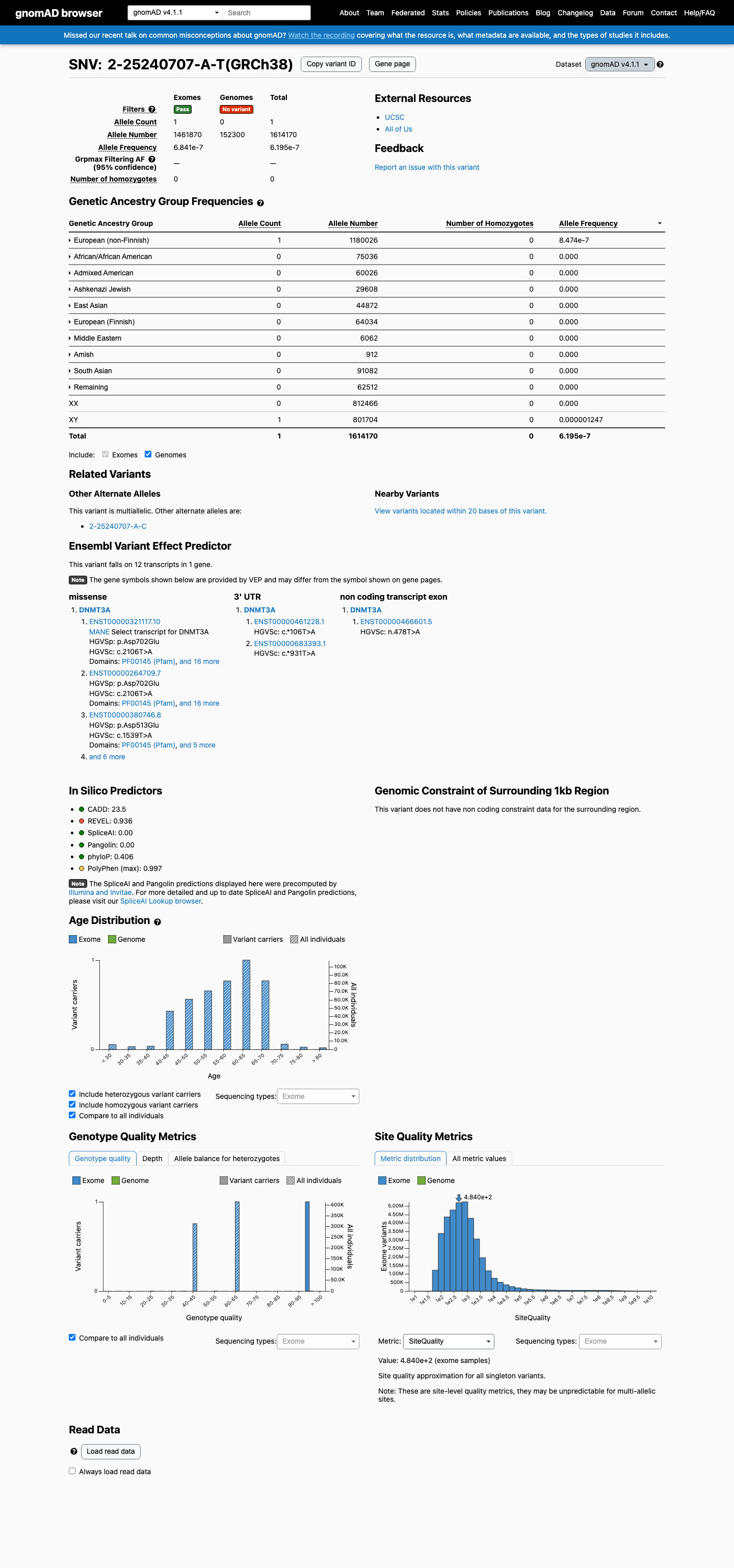
gnomAD v4.1 screenshot
gnomAD v4.1
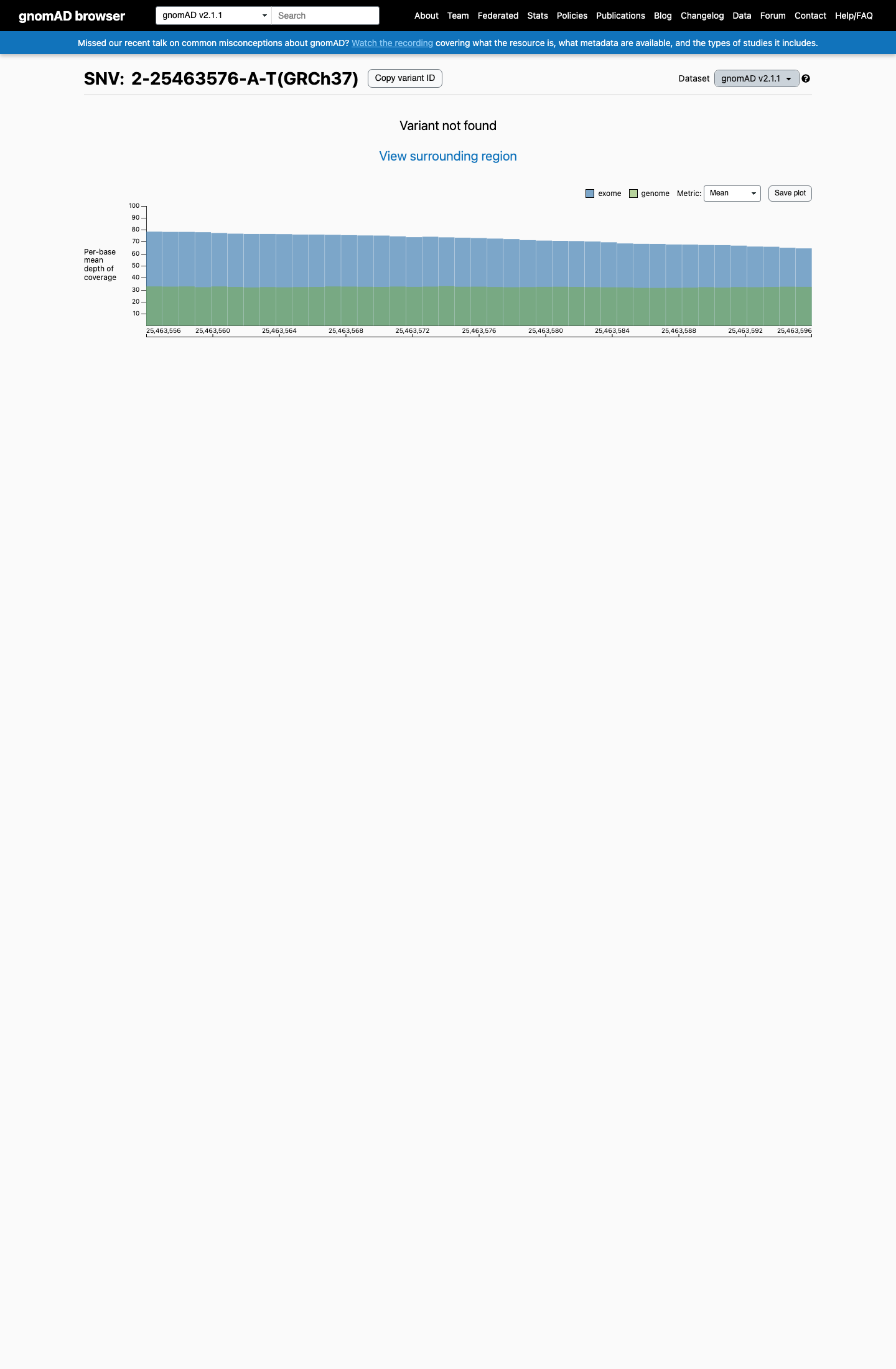
gnomAD v2.1 screenshot
gnomAD v2.1
v4.1
This variant is present in gnomAD v4.1 (AF= 6.19513e-07; MAF= 0.00006%, 1/1614170 alleles, homozygotes = 0) and has highest observed frequency in the European (non-Finnish) population (AF= 8.47439e-07; MAF= 0.00008%, 1/1180026 alleles, homozygotes = 0).
v2.1
Absent from gnomAD v2.1.
🇨🇦 CA
Absent from gnomAD-Canada v1.0.
Allele frequency by ancestry
three datasets · side by side
gnomAD v4.1
6.2e-05% · 1 / 1,614,170
0 hom
European (non-Finnish)
1 / 1,180,026
8.5e-05%
+ 9 not observed (Remaining individuals, Admixed American, European (Finnish), Amish, East Asian, Middle Eastern, South Asian, Ashkenazi Jewish, African/African American)
gnomAD v2.1
Absent · 0 / ?
0 hom
Not observed in any ancestry group.
gnomAD Canada 🇨🇦
Absent · 0 / ?
0 hom
Not observed in any ancestry group.
ClinVar screenshot
ClinVar
This variant is absent from ClinVar.
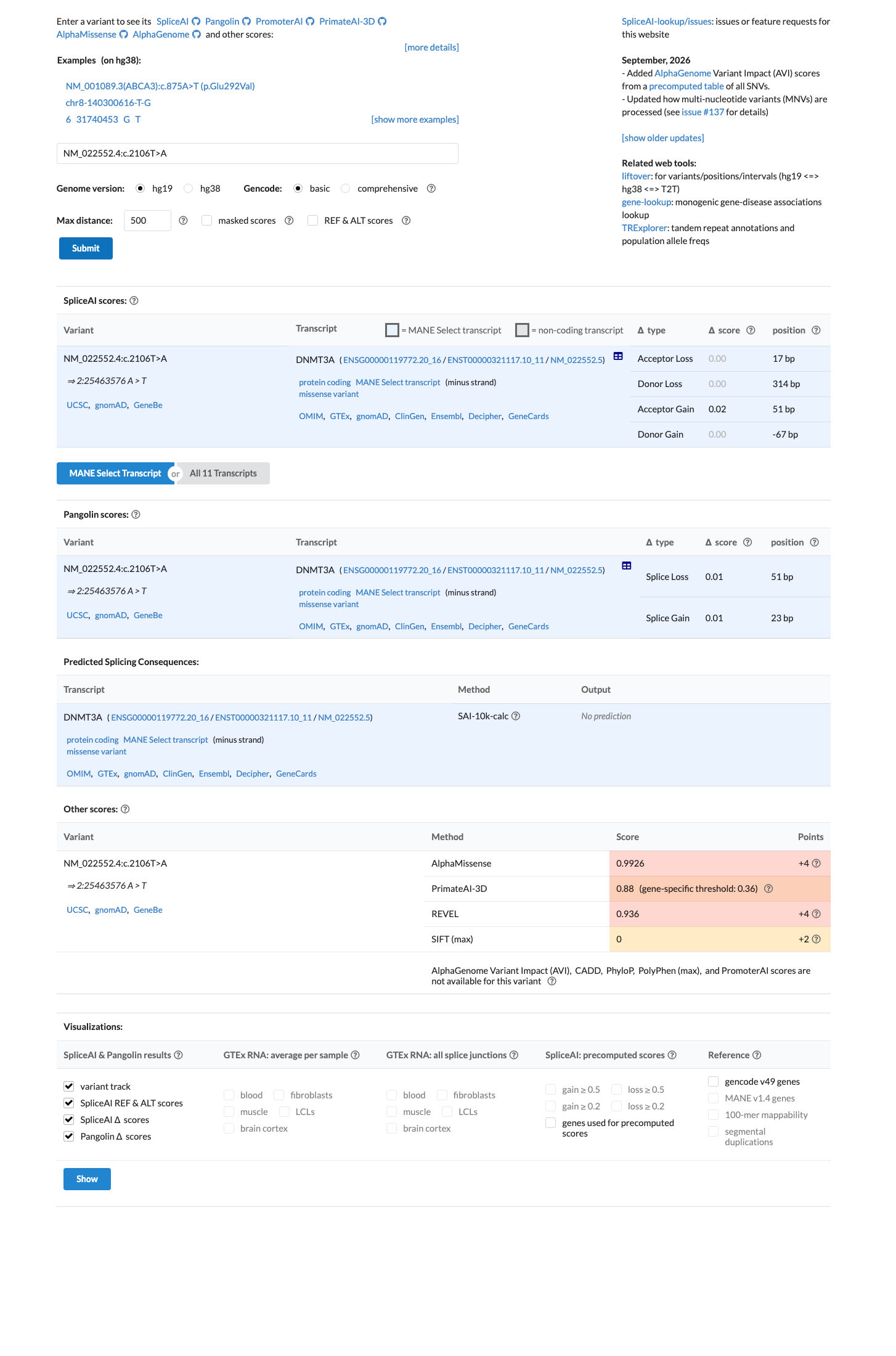
SpliceAI screenshot
In silico
SpliceAI predicts no significant splice impact for this variant (max delta score = 0.02). REVEL score = 0.936. BayesDel score = 0.415589.
Functional / OncoKB screenshot
Functional Likely Oncogenic
OncoKB did not identify variant-specific reviewed functional evidence for this variant; gene-level curated context is available for reviewer follow-up. DNMT3A, a tumor suppressor and DNA methyltransferase, is recurrently mutated in acute myeloid leukemia and other hematologic malignancies.
OncoKB ↗
COSMIC screenshot
COSMIC
Cancer hotspots screenshot
Cancer hotspots
Somatic evidence Not in COSMIC / hotspots
COSMIC
This variant does not lie in a statistically significant hotspot. This variant has not previously been reported in somatic cancers (COSMIC).
Hotspots
This variant does not lie in a statistically significant hotspot.
Literature · how each cited paper was used
1papers cited
Each card is an audit: what was searched, what was found, whether it names the variant, which criteria it fed, and why.
Rule & framework references · cited for criterion definitions, not variant evidence
34429321 ↗ Systematic Profiling of DNMT3A Variants Reveals Protein Instability Mediated by the DCAF8 E3 Ubiquitin Ligase Adaptor.
Sources & reference links
8Sources
ClinVar
gnomAD v2.1
gnomAD v4.1
gnomAD-Canada
SpliceAI
OncoKB
COSMIC
Cancer hotspots