This variant was interpreted by pipeline
7.1.0.
The current version is
8.0.0.
Re-running queues a fresh interpretation; the result replaces this page when complete.
Re-runs are not free. Blank = draws on today's public interpretation allowance.
With a code = uses 1 of that code's uses.
FOXL2 encodes a forkhead transcription factor that binds DNA to regulate gene expression, playing an essential role in ovarian development and granulosa cell differentiation. Mutations in this gene cause blepharophimosis syndrome and premature ovarian failure 3. In cancer, FOXL2 acts as a tumor suppressor, inhibiting proliferation and invasion of certain cancer cells, and somatic alterations in the gene are associated with adult granulosa cell tumors.
This variant
FOXL2 is a forkhead transcription factor whose germline mutations cause blepharophimosis syndrome and premature ovarian failure 3, and whose somatic alterations are linked to adult granulosa cell tumors. This variant, p.Thr129Met, remains a VUS: it is nearly absent from population databases and predicted damaging in silico, but no functional, familial, or clinical evidence yet ties it to FOXL2 disease, so its role in these conditions is unestablished.
Transcript
NM_023067.4
HGVS · transcript:coding
NM_023067.4:c.386C>T
GRCh38
chr3:138946337 G>A
GRCh37
chr3:138665179 G>A
With no VCEP or gene-specific framework, generic ACMG/AMP 2015 applies; two supporting criteria (PM2, PP3) satisfy no pathogenic or benign combination, yielding VUS.
Classification rationale
PM2PP3VUS
FOXL2 c.386C>Tmissense
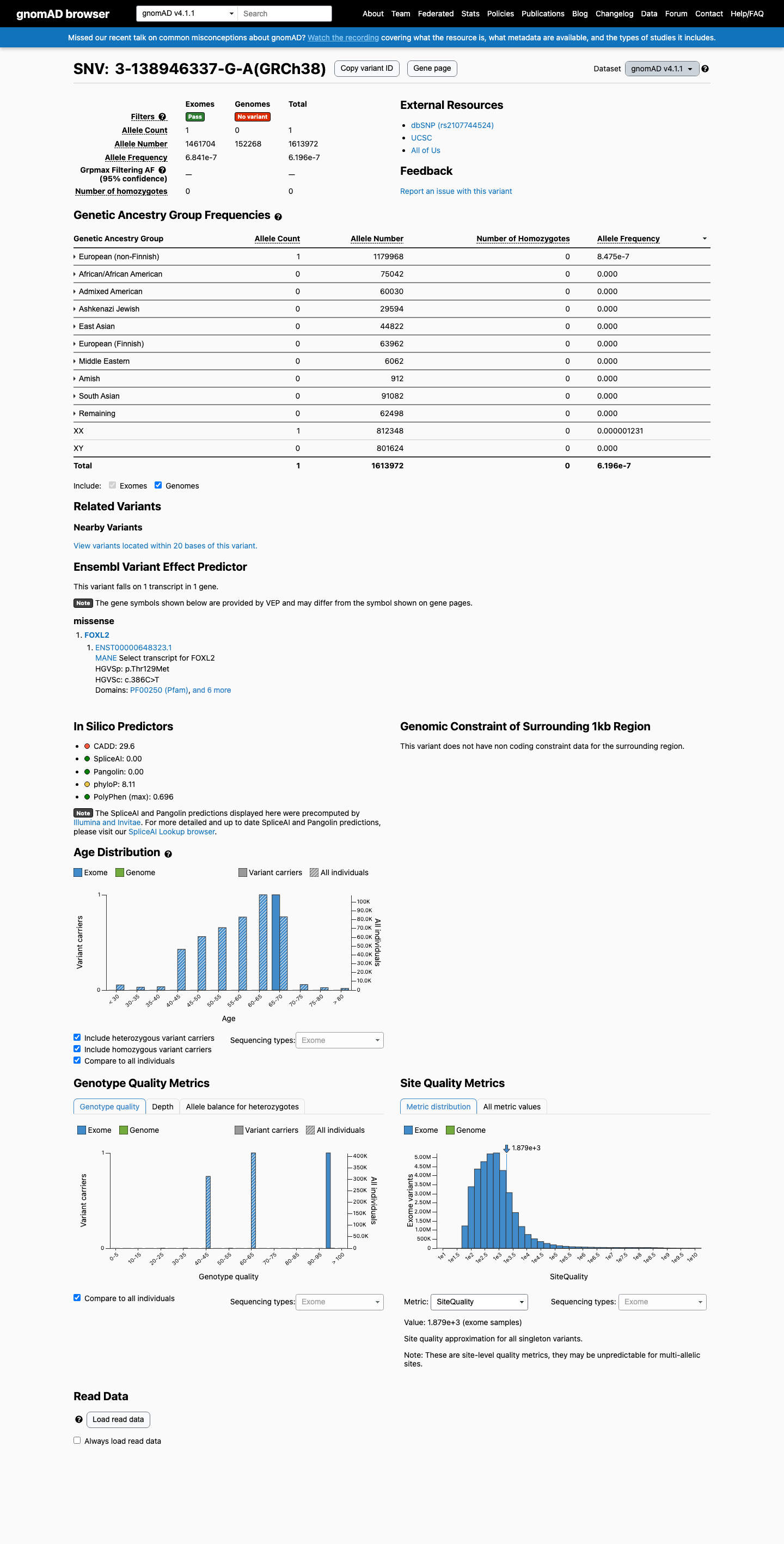
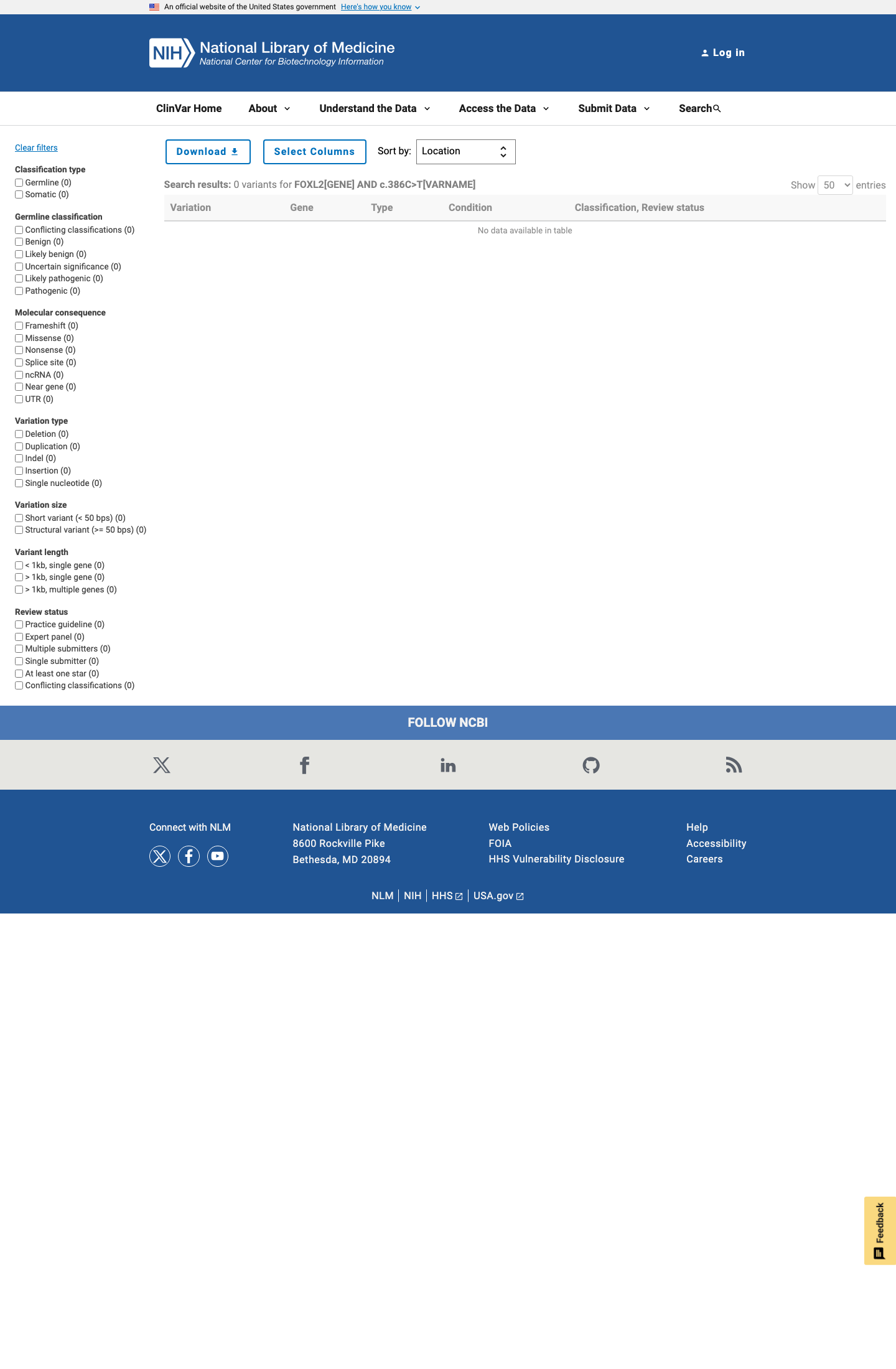
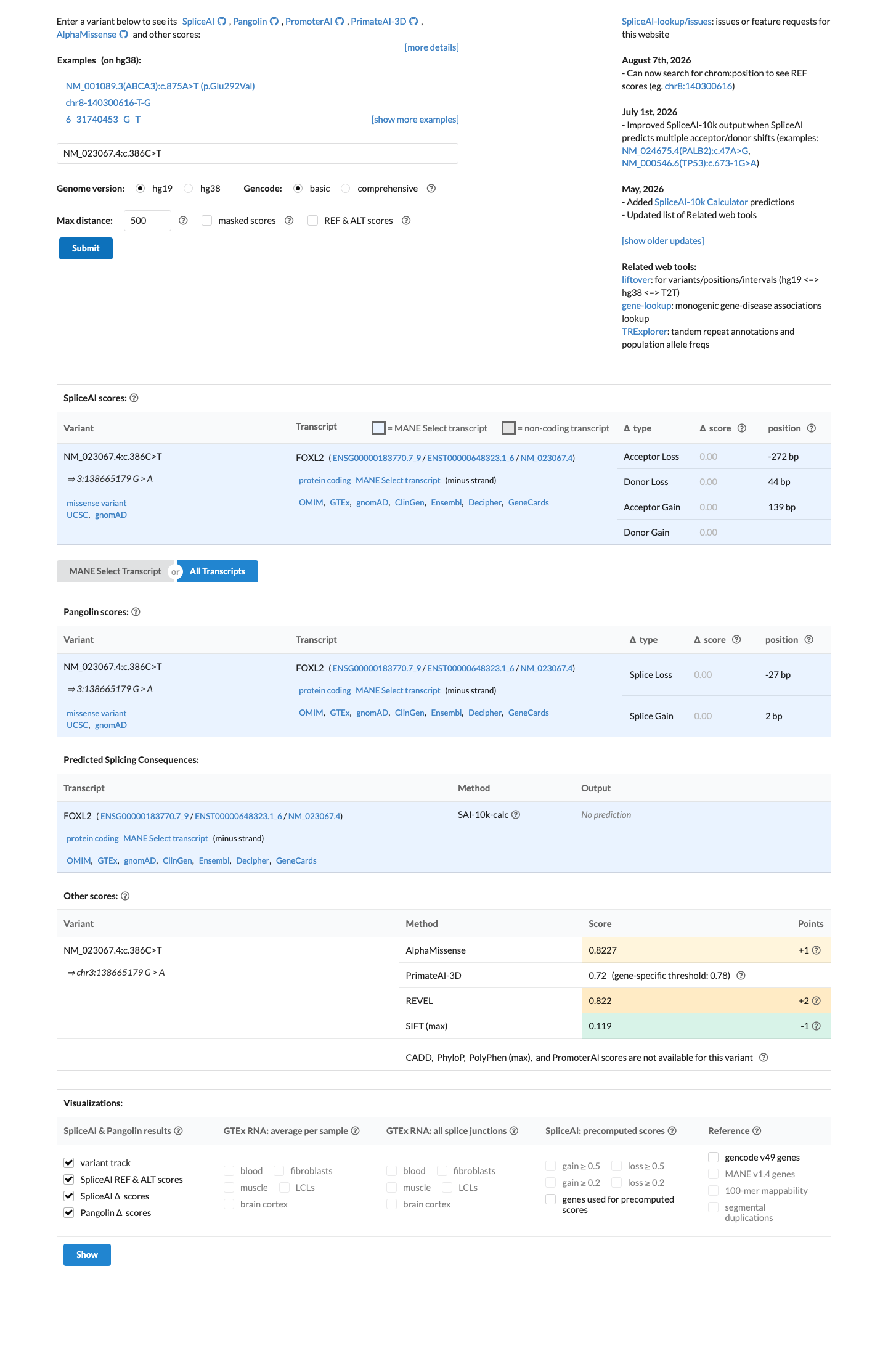
PM2 (Supporting): variant is absent from gnomAD v2.1 and ClinVar, with gnomAD v4.1 frequency 6.2e-07 (1/1,613,972 alleles), about 1,000-fold below the <0.1% threshold. PP3 (Supporting): REVEL 0.822 falls within the ClinGen-calibrated supporting band (0.773-0.931). Two supporting criteria meet no ACMG/AMP 2015 pathogenic or benign combination, so the variant is classified as Variant of Uncertain Significance (VUS).
PM2 + PP3→VUS
LYFE Sciences is an AI system, and it can make mistakes. Criteria
may be applied incorrectly, sources may be misread, and a confident-looking
classification can still be wrong. Double-check every criterion and
its underlying evidence before relying on any call.
Gene diagram
· NM_023067.4 · variants mapped to exon structure
FOXL2NM_023067.4
Fetching transcript structure from UCSC…
Exons
—
Transcript span
—
Strand
—
Variants mapped
—
Source
UCSC ncbiRefSeqCurated
All variants in FOXL2—click a row to locate it on the plot · use the link column to open its page
Protein
Location
Classification
Link
Applied criteria · 2 applied · 21 assessed
MetEvidence satisfies this criterion.
Not metEvaluated against available evidence; threshold not reached.
Not assessedApplies in principle, but no evidence was found to evaluate it.
N/ADoesn't apply to this variant type.
Applied · 2
Strength Supporting Moderate Strong Very strong
✓
PM2supportingPathogenic
Met (supporting): gnomAD v4.1 frequency 6.2e-07 (1/1,613,972 alleles) is ~1,000-fold below the <0.1% threshold.
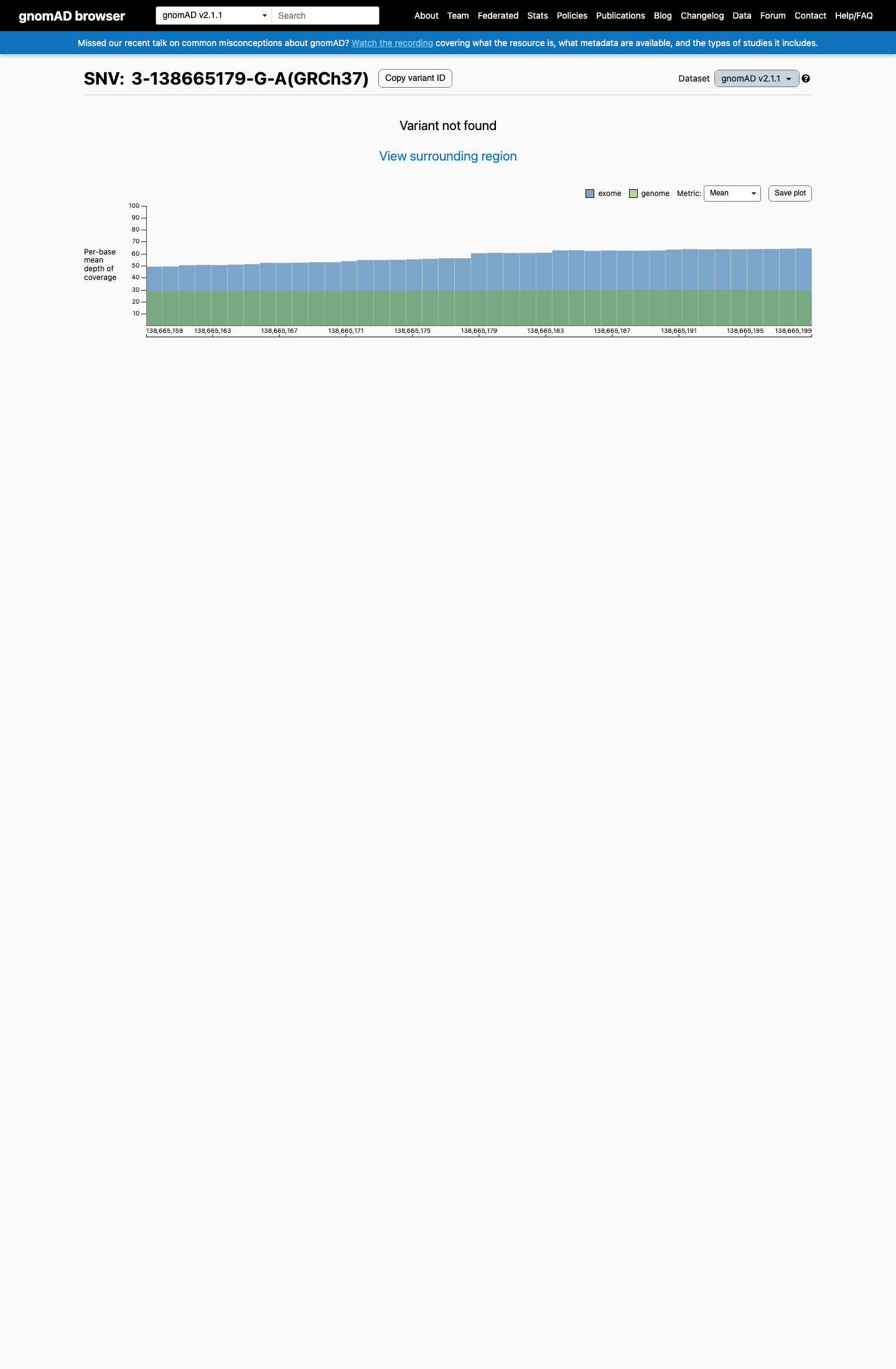
gnomAD v4.1: total AF 6.1959e-07 (1/1,613,972 alleles), exome AF 6.8413e-07 (1/1,461,704), 0 homozygotes; highest subpopulation NFE AF 8.4748e-07 (gnomad_v4)gnomAD v2.1: absent (gnomad_v2)gnomAD-Canada v1.0: absent (gnomad_canada)
Met (supporting): REVEL 0.822 falls within the ClinGen-calibrated PP3 supporting band (0.773-0.931).
REVEL score 0.822 for NM_023067.4:c.386C>T (p.Thr129Met); ClinGen SVI-calibrated PP3 supporting threshold REVEL >= 0.773 from Pejaver et al., Am J Hum Genet 2022;109(12):2163-2177 (PMID 36413997); 0.822 is within the supporting band (0.773-0.931) and below the PP3 strong threshold of 0.932.SpliceAI max delta score 0.00 (DS_AG 0.0, DS_AL 0.0, DS_DG 0.0, DS_DL 0.0; variant consequence sequence_variant) for NM_023067.4:c.386C>T; scores below ~0.2 indicate minimal probability of splice alteration (Jaganathan et al., Nat Genet 2019;51(8):1289-1301, PMID 30661751); splice sub-path negative and does not support PP3.BayesDel score 0.221987 retrieved from local lookup but excluded: no verified published threshold is available to this pipeline, so the score is treated as insufficiently calibrated for PP3 (and BP4).
Assessed · not applied
· 9 not met · 12 not assessed
Pathogenic
PS1Not met: no prior report establishes p.Thr129Met as pathogenic; the variant is absent from ClinVar and the literature.
PS2Not assessed: no proband genotype or confirmed-parentage data exist to establish a de novo occurrence.
PS3Not assessed: no variant-specific functional assay evidence exists for p.Thr129Met in any source.
PS4Not assessed: no case-control or cohort data on this variant exist, so enrichment cannot be evaluated.
PM1Not assessed: no statistically significant hotspot and no documented domain annotation for residue 129 are available.
PM5Not assessed: no pathogenic missense at residue 129 other than p.Thr129Met has been reported.
PM6Not assessed: no de novo evidence of any kind exists for this variant.
PP1Not assessed: no pedigree or segregation data exist for this variant.
PP2Not assessed: no gene-level missense constraint metrics (e.g., gnomAD Z-score) are available.
PP4Not assessed: no phenotype data exist for any carrier of c.386C>T.
PP5Not met: the variant has no ClinVar record, so no expert-panel Pathogenic classification exists to trigger PP5.
Benign
BA1Not met: highest allele frequency (0.00008%, NFE) is orders of magnitude below the >1% BA1 threshold.
BS1Not met: highest allele frequency (0.00008%) is far below the >0.3% BS1 threshold.
BS2Not met: only one heterozygous reference allele (0 homozygotes) exists, with no phenotype confirmation of an unaffected adult.
BS3Not assessed: no functional studies demonstrating no damaging effect are available.
BS4Not assessed: no family testing data exist to demonstrate non-segregation.
BP1Not met: missense variants are an established FOXL2 disease mechanism, so the truncation-only premise fails.
BP2Not met: no pathogenic variant was observed in trans or cis with c.386C>T.
BP4Not met: REVEL 0.822 predicts a damaging effect, contradicting the multiple no-impact lines BP4 requires.
BP5Not assessed: no proband data identifying an alternative molecular basis are available.
BP6Not met: the variant has no ClinVar record, so no expert-panel Benign classification exists to trigger BP6.
N/A · 5PVS1 · PM3 · PM4 · BP3 · BP7
Research & evidence
Population frequency
gnomAD v4.1
gnomAD v2.1
v4.1
This variant is present in gnomAD v4.1 (AF= 6.19589e-07; MAF= 0.00006%, 1/1613972 alleles, homozygotes = 0) and has highest observed frequency in the European (non-Finnish) population (AF= 8.47481e-07; MAF= 0.00008%, 1/1179968 alleles, homozygotes = 0).
v2.1
Absent from gnomAD v2.1.
🇨🇦 CA
Absent from gnomAD-Canada v1.0.
Allele frequency by ancestry
three datasets · side by side
gnomAD v4.1
6.2e-05%
· 1 / 1,613,972
0 hom
European (non-Finnish)
1 / 1,179,968
8.5e-05%
+ 9 not observed (Remaining individuals, Admixed American, European (Finnish), Amish, East Asian, Middle Eastern, South Asian, Ashkenazi Jewish, African/African American)
OncoKB did not identify variant-specific reviewed functional evidence for this variant; gene-level curated context is available for reviewer follow-up. FOXL2, a transcription factor, is recurrently mutated in adult granulosa cell tumors.