Back
NM_024642.5:c.123T>G
p.Arg41= · GALNT12
ACMG/AMP
0%
complete
Final classification
VUS
PM2BP7
GALNT12
c.123T>G
p.Arg41=
Gene context NCBI Gene ↗

GALNT12 encodes a member of the UDP-GalNAc:polypeptide N-acetylgalactosaminyltransferase family, enzymes that initiate O-linked glycosylation by transferring N-acetylgalactosamine (GalNAc) to serine or threonine residues on proteins. These glycosylation modifications are important for the proper function of many cellular proteins. Mutations in this gene are associated with increased susceptibility to colorectal cancer, indicating a role in colorectal cancer predisposition.

This variant

GALNT12 initiates O-linked glycosylation, and mutations in the gene increase susceptibility to colorectal cancer. This synonymous variant (p.Arg41=), classified as a Variant of Uncertain Significance, does not alter the protein sequence, so its effect on colorectal cancer risk remains unresolved.

Transcript
NM_024642.5
HGVS · transcript:coding
NM_024642.5:c.123T>G
GRCh38
chr9:98807821 T>G
GRCh37
chr9:101570103 T>G
No ClinGen VCEP specification exists for GALNT12, so generic ACMG/AMP 2015 rules applied; PM2 (supporting) plus BP7 (supporting) meets no combination threshold, yielding Variant of Uncertain Significance.
Classification rationale
PM2 BP7 VUS
GALNT12 c.123T>G

PM2 (Supporting): extremely rare in gnomAD (v4.1 total AF 0.0001%), far below the 0.1% threshold. BP7 (Supporting): synonymous variant with no predicted splice impact (SpliceAI max delta 0.00 vs the 0.2 threshold); conservation prong flagged for human review. Variant of Uncertain Significance: one supporting pathogenic (PM2) and one supporting benign (BP7) criterion meet no Pathogenic, Likely Pathogenic, Benign, or Likely Benign combination rule.

PM2 + BP7 → VUS
LYFE Sciences is an AI system, and it can make mistakes. Criteria may be applied incorrectly, sources may be misread, and a confident-looking classification can still be wrong. Double-check every criterion and its underlying evidence before relying on any call.
Gene diagram · NM_024642.5 · variants mapped to exon structure
GALNT12 NM_024642.5
Fetching transcript structure from UCSC…
Applied criteria · 2 applied · 17 assessed
MetEvidence satisfies this criterion.
Not metEvaluated against available evidence; threshold not reached.
Not assessedApplies in principle, but no evidence was found to evaluate it.
N/ADoesn't apply to this variant type.
Applied · 2
Strength Supporting Moderate Strong Very strong
PM2 supporting Pathogenic
Met (supporting): gnomAD v4.1 total allele frequency is 0.0001% (1/1,042,398 alleles), far below the 0.1% threshold.
gnomad_v4: total AF 9.59326e-07 (0.0001%), 1/1,042,398 alleles, 0 homozygotes; AMR AF 5.72e-05 (0.0057%)gnomad_v2: total AF 4.03942e-05 (0.004%), 1/24,756 alleles, 0 homozygotesLab non-VCEP PM2 threshold: AF <0.1% in gnomAD (generic ACMG fallback framework, PMID 25741868)
BP7 supporting review Benign
Met (supporting): synonymous variant with no splice impact (SpliceAI max delta 0.00, below the 0.2 threshold). Flagged for human review: the nucleotide-conservation prong could not be verified.
pvs1_variant_assessment: variant class 'synonymous' (NP_078918.3:p.(Arg41=)); canonical_splice_consensus false -> variant is a synonymous change outside the canonical splice consensus, satisfying the variant-type prong of BP7.SpliceAI (Jaganathan et al. 2019, PMID 30661751): max delta score = 0.00; DS_AG=0.0 (no acceptor gain), DS_AL=0.0 (no acceptor loss), DS_DG=0.0 (no donor gain), DS_DL=0.0 (no donor loss); below the >=0.2 splice-impact threshold of the SpliceAI publication (PMID 30661751) -> no predicted impact on splice consensus and no predicted creation of new splice sites.Generic ACMG/AMP 2015 BP7 definition (Richards et al. 2015, PMID 25741868) applied because no ClinGen CSPEC/VCEP exists for GALNT12.
Assessed · not applied · 8 not met · 9 not assessed
Pathogenic
PS2 Not assessed: no proband genotype or parental testing data were available to evaluate a confirmed de novo occurrence.
PS3 Not assessed: no functional assay evidence for this variant was available to evaluate a damaging effect.
PS4 Not assessed: no case-control or cohort data for this variant were available to evaluate enrichment in affected individuals.
PM3 Not met: no pathogenic variant in trans is documented, and no recessive inheritance framework applies to this variant.
PM6 Not assessed: no proband-parent trio data or de novo observation of this variant were available.
PP1 Not assessed: no affected family members were tested, so no segregation data were available.
PP3 Not met: SpliceAI max delta 0.00 shows no predicted splice impact, far below the 0.2 threshold.
PP4 Not assessed: no phenotype or family-history data were available for carriers of this variant.
PP5 Not met: no ClinVar expert-panel classification of pathogenic exists for this variant; only ordinary laboratory submissions.
Benign
BA1 Not met: highest population allele frequency is 0.000096% (gnomAD v4.1), far below the 1% benign threshold.
BS1 Not met: highest robust population frequency is 0.0057% (AMR), below the 0.3% threshold.
BS3 Not assessed: no functional studies demonstrating absence of a damaging effect were available.
BS4 Not assessed: no affected family members were tested, so lack of segregation could not be evaluated.
BP2 Not met: no second pathogenic variant or phase data show this variant in cis or trans with a pathogenic allele.
BP4 Not met: the only computational prediction (SpliceAI max delta 0.00) is counted under BP7, leaving no independent line of evidence.
BP5 Not assessed: no proband case data were available to evaluate an alternative molecular basis for disease.
BP6 Not met: no ClinVar expert-panel benign classification exists; the 'Likely benign' label comes from ordinary laboratory submissions.
N/A · 9 PVS1 · PS1 · PM1 · PM4 · PM5 · PP2 · BS2 · BP1 · BP3
Research & evidence
Population frequency
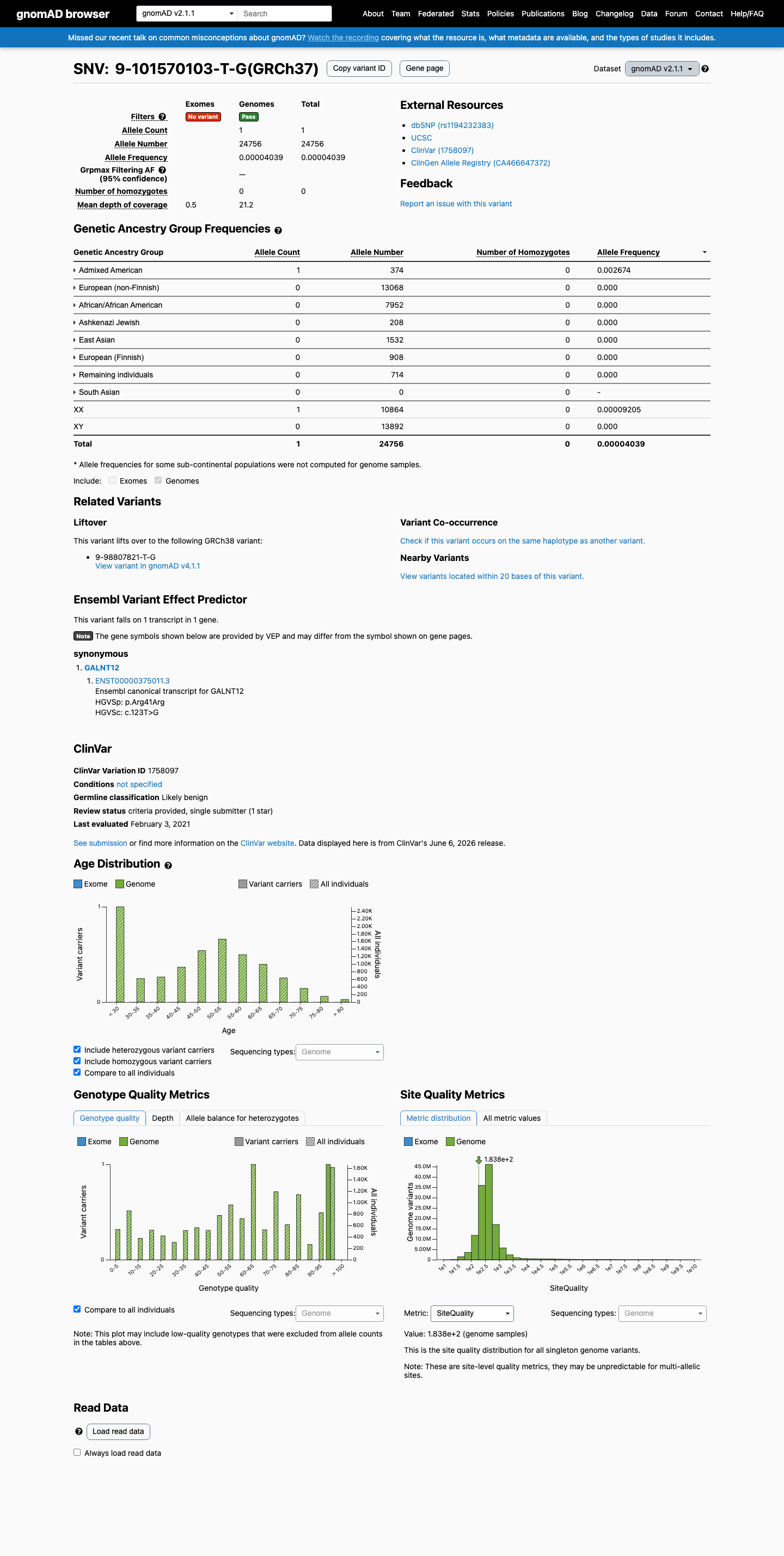
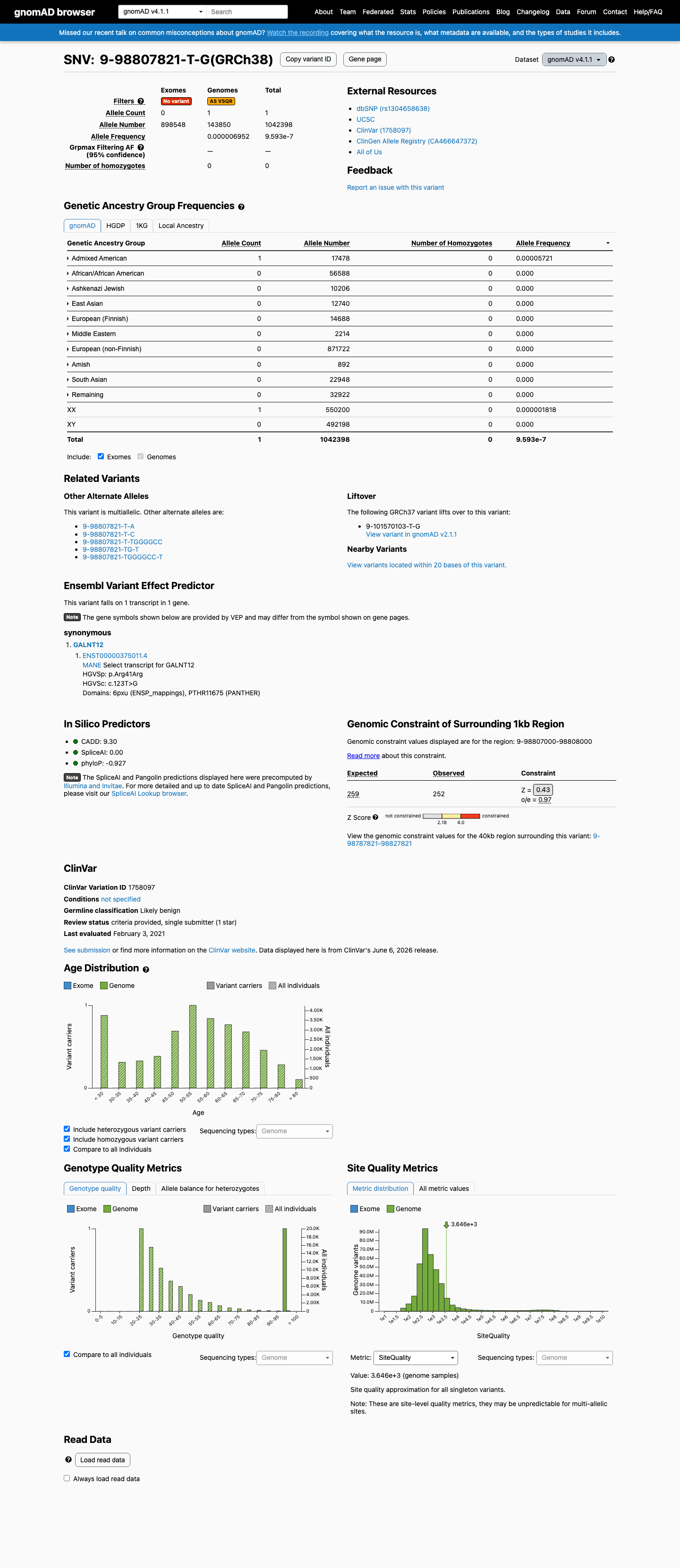
gnomAD v4.1 screenshot
gnomAD v4.1
gnomAD v2.1 screenshot
gnomAD v2.1
v4.1
This variant is present in gnomAD v4.1 (AF= 9.59326e-07; MAF= 0.00010%, 1/1042398 alleles, homozygotes = 0) and has highest observed frequency in the Admixed American population (AF= 5.72148e-05; MAF= 0.00572%, 1/17478 alleles, homozygotes = 0).
v2.1
This variant is present in gnomAD v2.1 (AF= 4.03942e-05; MAF= 0.00404%, 1/24756 alleles, homozygotes = 0) and has highest observed frequency in the Admixed American population (AF= 0.0026738; MAF= 0.26738%, 1/374 alleles, homozygotes = 0).
🇨🇦 CA
Not available in gnomAD-Canada v1.0.
Allele frequency by ancestry
three datasets · side by side
gnomAD v4.1
9.6e-05% · 1 / 1,042,398
0 hom
Admixed American
1 / 17,478
0.0057%
+ 9 not observed (Remaining individuals, European (Finnish), Amish, East Asian, Middle Eastern, South Asian, Ashkenazi Jewish, African/African American, European (non-Finnish))
gnomAD v2.1
0.004% · 1 / 24,756
0 hom
Admixed American
1 / 374
0.27%
+ 7 not observed (African/African American, Ashkenazi Jewish, East Asian, European (Finnish), European (non-Finnish), Remaining individuals, South Asian)
gnomAD Canada 🇨🇦
Absent · 0 / ?
0 hom
Not observed in any ancestry group.
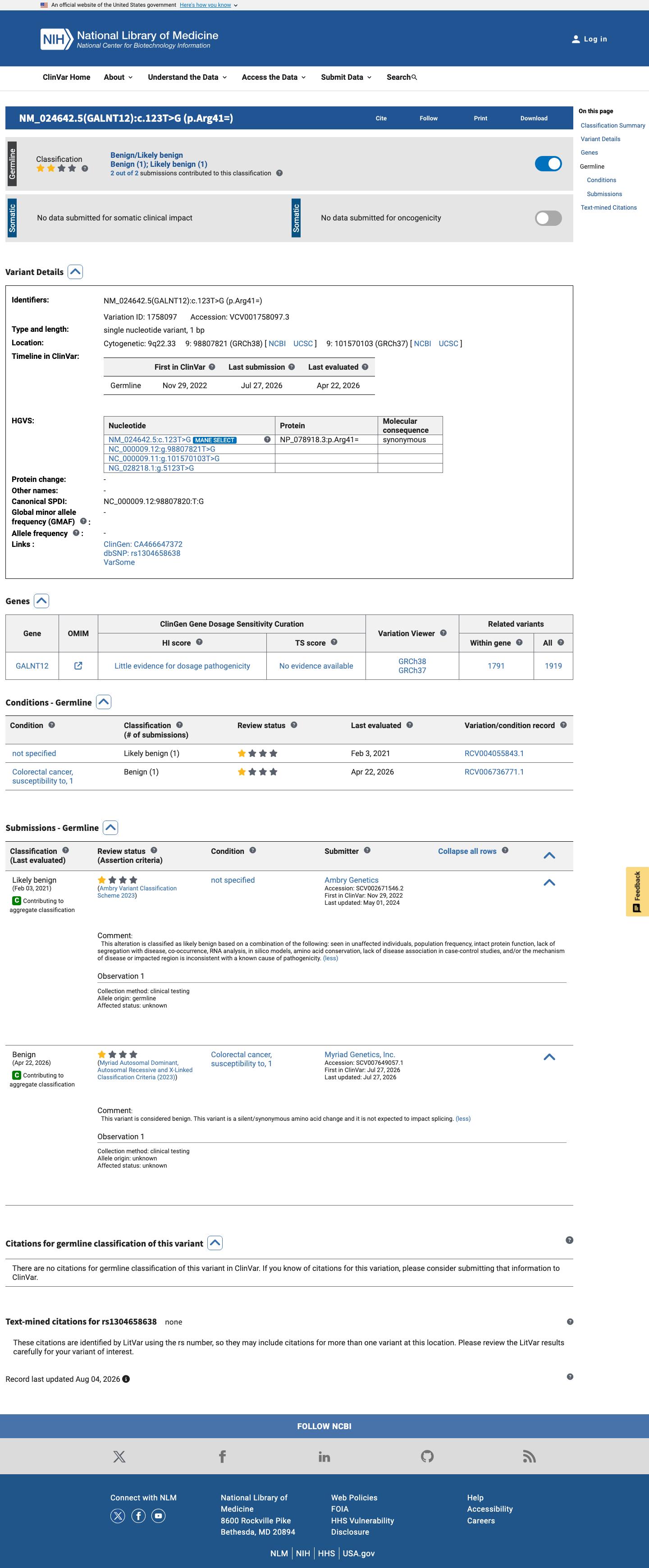
ClinVar screenshot
ClinVar
This variant has been reported in ClinVar as Likely benign (1 clinical laboratory) and as Benign (1 clinical laboratory). (ClinVarID = 1758097)
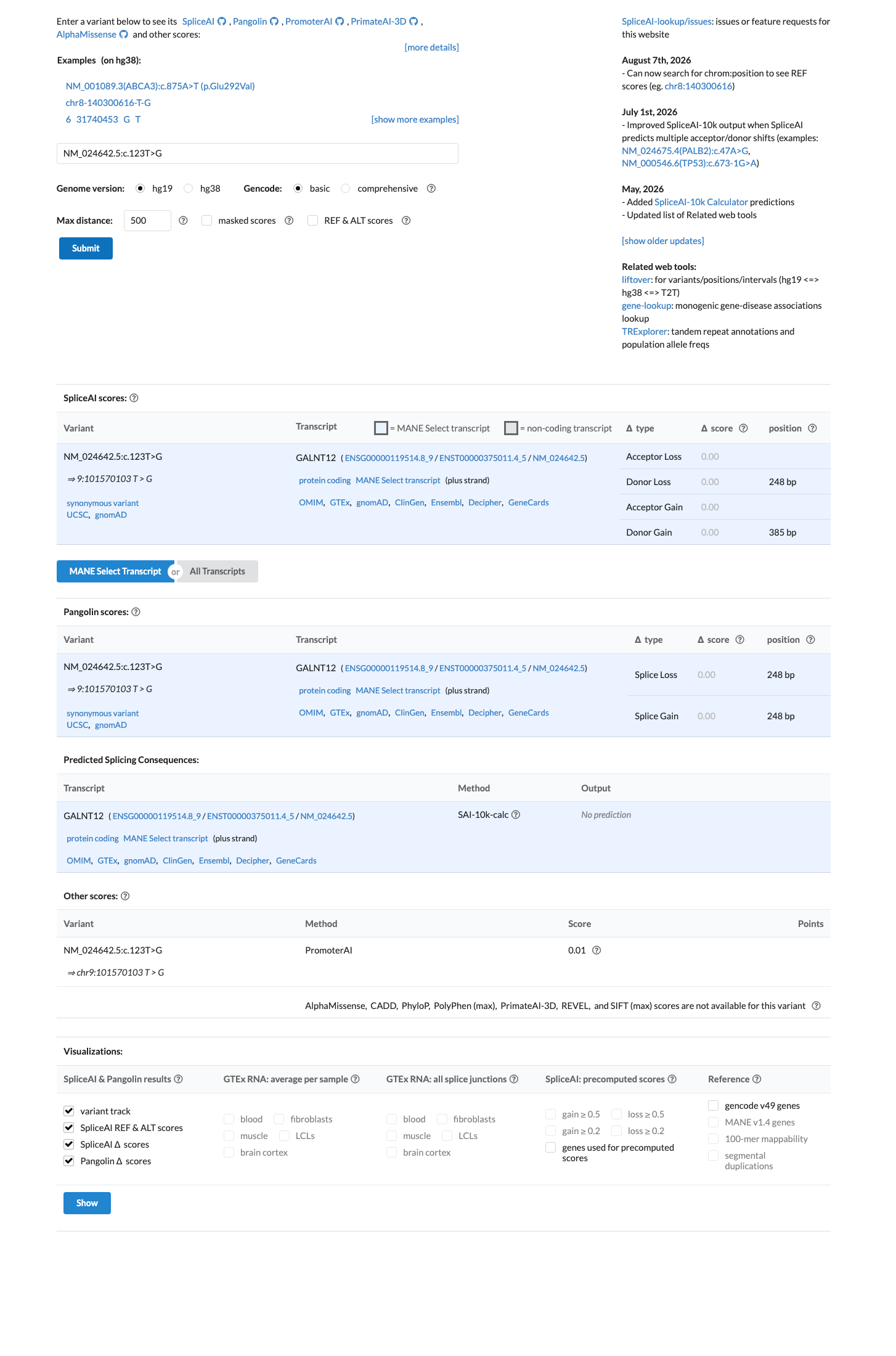
SpliceAI screenshot
In silico
SpliceAI predicts no significant splice impact for this variant (max delta score = 0.00).
Functional No data
No calibrated functional assay or RNA evidence was identified for this variant.
OncoKB ↗
COSMIC screenshot
COSMIC
Cancer hotspots screenshot
Cancer hotspots
Somatic evidence Not in COSMIC / hotspots
COSMIC
This variant does not lie in a statistically significant hotspot. This variant has not previously been reported in somatic cancers (COSMIC).
Hotspots
This variant does not lie in a statistically significant hotspot.
Sources & reference links
8Sources
ClinVar
gnomAD v2.1
gnomAD v4.1
gnomAD-Canada
SpliceAI
OncoKB
COSMIC
Cancer hotspots