BP4 supporting: SpliceAI max delta 0.017 for synonymous c.567T>C is below the <=0.1 no-splice-impact cutoff, the sole met criterion. PM2 not met: gnomAD v2.1 AF 0.00074 and v4.1 AF 0.00046 exceed the 0.0001 rarity threshold. BA1/BS1 not met: highest ancestry-specific frequency 0.151% is ~33-fold below 5% and ~7-fold below 1%. PP3 not met: SpliceAI max delta 0.017 is far below the >=0.2 supporting cutoff for a splice-altering effect. PP5/BP6 not met: expert_panel_submissions = 0 for ClinVar VCV000416212, so no expert-panel assertion exists in either direction. BS2 not met: the single gnomAD v4.1 homozygote cannot support a full-penetrance early-onset disorder, GALNT12-related risk being adult-onset and incompletely penetrant. Final combination: 1 supporting benign criterion (BP4) is below the Likely Benign threshold of 2 BP or 1 BS + 1 BP, and no pathogenic rule is met, giving VUS.
Final classification
VUS
BP4
GALNT12
c.567T>C
p.Asn189=
synonymous · exon 3
Gene context
NCBI Gene ↗
GALNT12 encodes a member of the UDP-GalNAc:polypeptide N-acetylgalactosaminyltransferase family, enzymes that initiate O-linked glycosylation by transferring N-acetylgalactosamine (GalNAc) to serine or threonine residues on proteins. These glycosylation modifications are important for the proper function of many cellular proteins. Mutations in this gene are associated with increased susceptibility to colorectal cancer, indicating a role in colorectal cancer predisposition.
This variant
GALNT12 c.567T>C (p.Asn189=) is a synonymous change in a gene encoding an O-linked glycosylation enzyme whose variants are associated with increased susceptibility to colorectal cancer, an adult-onset, incompletely penetrant dominant predisposition.
VUS: BP4 (supporting, SpliceAI max delta 0.017 indicating no splice impact) is the sole met criterion, below the two-supporting-benign threshold for Likely Benign.
Classification rationale
BP4
VUS
GALNT12 c.567T>C
synonymous · exon 3
BP4
→
VUS
LYFE Sciences is an AI system, and it can make mistakes. Criteria
may be applied incorrectly, sources may be misread, and a confident-looking
classification can still be wrong. Double-check every criterion and
its underlying evidence before relying on any call.
Gene diagram
· NM_024642.5 · variants mapped to exon structure
GALNT12
NM_024642.5
Fetching transcript structure from UCSC…
Applied criteria · 1 applied · 19 assessed
MetEvidence satisfies this criterion.
Not metEvaluated against available evidence; threshold not reached.
Not assessedApplies in principle, but no evidence was found to evaluate it.
N/ADoesn't apply to this variant type.
Applied · 1
Strength
Supporting
Moderate
Strong
Very strong
BP4
supporting
Benign
Met at supporting strength: SpliceAI max delta 0.017 is at or below the <=0.1 no-splice-impact BP4 cutoff, counted once and not reused for BP7.
Consequence type fixed first: NM_024642.5:c.567T>C / NP_078918.3:p.(Asn189=) is synonymous, so BP4 is assessed on the SpliceAI splice path only; the REVEL missense path does not apply (REVEL not found for this variant) and BayesDel has no generic ACMG-strength calibration.SpliceAI Lookup for NM_024642.5:c.567T>C / 9-101589059-T-C: max delta score 0.017 (DS_AG 0.000, DS_AL 0.007, DS_DG 0.017, DS_DL 0.007), DP_AG -25, DP_AL -23, DP_DG +21, DP_DL -175; Pangolin SG 0.01, SL -0.005.Threshold applied verbatim from the supplied generic ACMG/ClinGen-SVI calibration: SpliceAI max delta <= 0.1 -> BP4 (supporting) (Jaganathan et al. 2019, Cell, PMID:30661751); 0.017 satisfies it.
Assessed · not applied
· 8 not met · 11 not assessed
Pathogenic
PS2
Not assessed: no proband or parental genotype data are present in the case, so confirmed de novo status — PS2's required basis — cannot be established.
PS3
Not assessed: no functional assay of GALNT12 c.567T>C exists in any retrieved source, and the only functional-themed paper (PMID:25741868) never mentions the variant.
PS4
Not assessed: no case-control or affected-proband enrichment data exist for c.567T>C, and the only two papers retrieved are general ACMG/AMP framework documents.
PM2
Not met: allele frequencies 0.00074 (gnomAD v2.1) and 0.000455 (v4.1) exceed the 0.0001 supporting-PM2 rarity threshold.
PM3
Not assessed: no phase data exists - no pathogenic variant reported in trans with c.567T>C, and GALNT12 inheritance is undocumented.
PM6
Not assessed: no proband observation of c.567T>C exists, so even assumed de novo status — PM6's requirement — cannot be applied.
PP1
Not assessed: no pedigree or affected relatives were reported, leaving zero informative meioses for PP1 co-segregation assessment.
PP3
Not met: SpliceAI max delta 0.017 is far below the >=0.2 PP3 supporting cutoff for this synonymous variant, which is scored on the splice path only.
PP4
Not assessed: no proband phenotype or HPO terms are recorded, and the exact variant's ClinVar condition labels are only generic cancer-susceptibility entries.
PP5
Not met: all six ClinVar submissions for c.567T>C are from single clinical laboratories (expert_panel_submissions = 0), so no expert-panel pathogenic assertion exists.
Benign
BA1
Not met: highest subpopulation frequency 0.151% (gnomAD v3.1 non-cancer Ashkenazi Jewish) is roughly 33-fold below the 5% BA1 threshold.
BS1
Not met: highest observed frequency 0.151% (gnomAD v3.1 non-cancer Ashkenazi Jewish, 5/3,302) is about 7-fold below the 1% BS1 threshold.
BS2
Not met: a single gnomAD v4.1 homozygote (European non-Finnish) cannot satisfy BS2, which requires early-onset, fully penetrant disease.
BS3
Not assessed: no functional assay reports a benign effect for GALNT12 c.567T>C, and the ClinVar benign submissions cite no variant-level assay evidence.
BS4
Not assessed: no family members were genotyped, so no non-segregation observation exists to support BS4.
BP2
Not assessed: no cis/trans phase data exists for c.567T>C, so no pathogenic partner allele could be confirmed or excluded.
BP5
Not assessed: no proband-level data exist, and no alternate molecular cause of disease is documented for any carrier of c.567T>C.
BP6
Not met: expert_panel_submissions = 0 for c.567T>C, so the Benign/Likely benign label rests on six ordinary clinical laboratories, not an expert panel.
BP7
Not met: this synonymous variant's only supporting result, SpliceAI max delta 0.017, is already counted under BP4, and no conservation data is available.
N/A · 8
PVS1 · PS1 · PM1 · PM4 · PM5 · PP2 · BP1 · BP3
Research & evidence
Population frequency
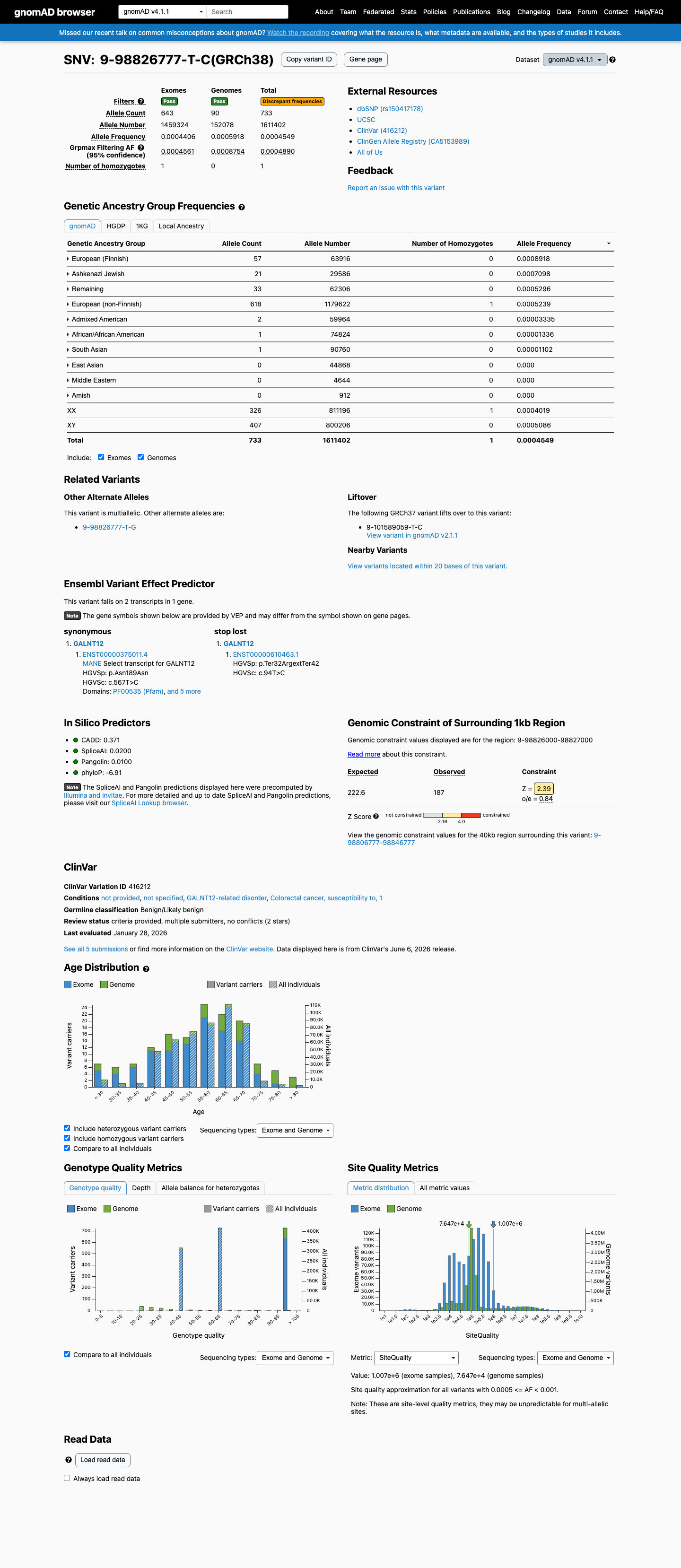
gnomAD v4.1
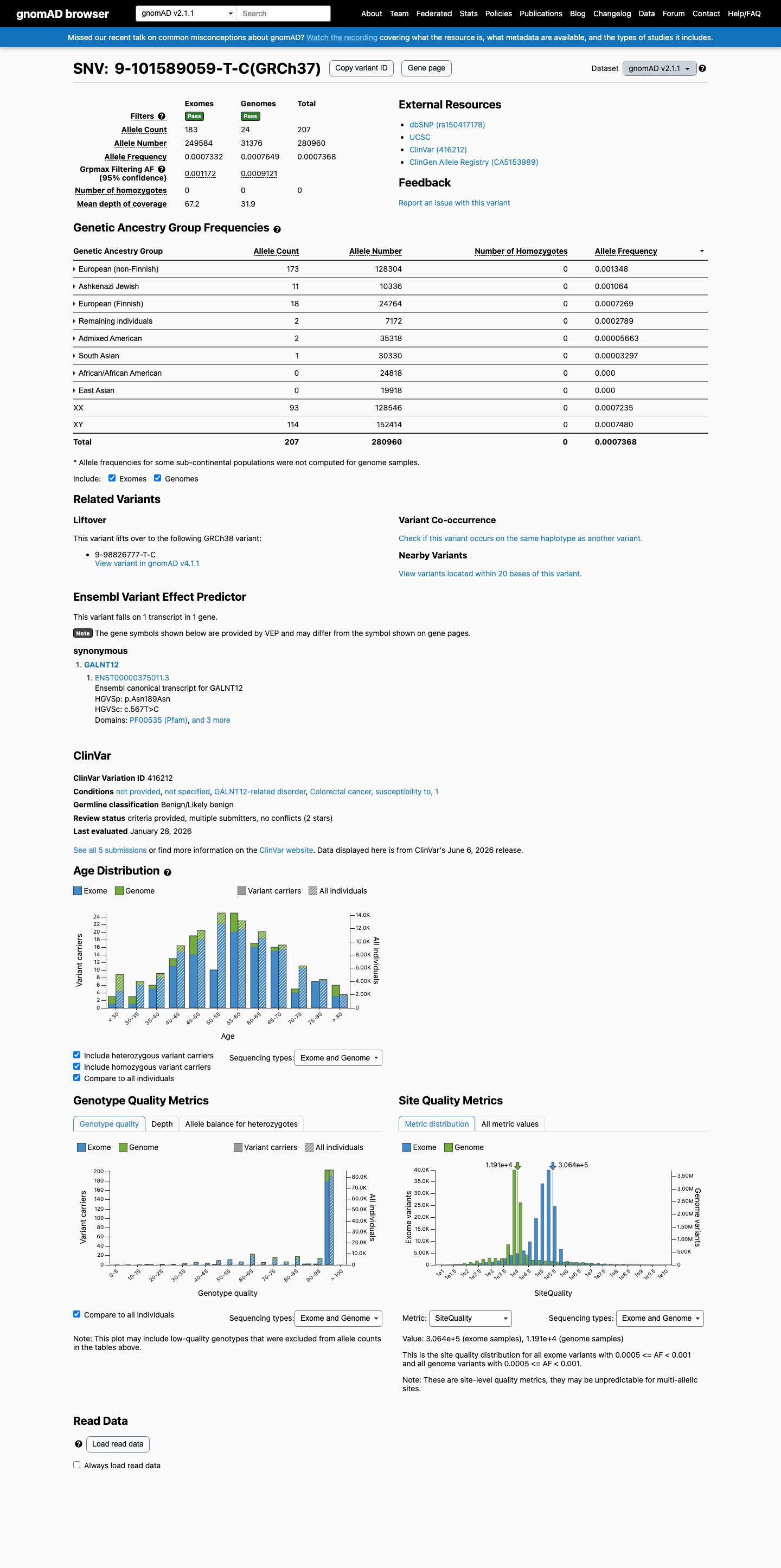
gnomAD v2.1
v4.1
This variant is present in gnomAD v4.1 (AF= 0.000454883; MAF= 0.04549%, 733/1611402 alleles, homozygotes = 1) and has highest observed frequency in the European (Finnish) population (AF= 0.000891795; MAF= 0.08918%, 57/63916 alleles, homozygotes = 0); grpmax FAF= 0.00048901.
v2.1
This variant is present in gnomAD v2.1 (AF= 0.00073676; MAF= 0.07368%, 207/280960 alleles, homozygotes = 0) and has highest observed frequency in the European (non-Finnish) population (AF= 0.00134836; MAF= 0.13484%, 173/128304 alleles, homozygotes = 0); grpmax FAF= 0.00117196.
🇨🇦 CA
This variant is present in gnomAD-Canada v1.0 (AF= 0.0005992590978426672, 11/18356 alleles, homozygotes = 0).
Allele frequency by ancestry
three datasets · side by side
gnomAD v4.1
0.045%
· 733 / 1,611,402
1 hom · FAF 0.049%
1 hom · FAF 0.049%
European (Finnish) 57 / 63,916 |
0.089% |
Ashkenazi Jewish 21 / 29,586 |
0.071% |
Remaining individuals 33 / 62,306 |
0.053% |
European (non-Finnish) 618 / 1,179,622 |
0.052% 1 hom |
Admixed American 2 / 59,964 |
0.0033% |
African/African American 1 / 74,824 |
0.0013% |
South Asian 1 / 90,760 |
0.0011% |
+ 3 not observed (Amish, East Asian, Middle Eastern)
gnomAD v2.1
0.074%
· 207 / 280,960
0 hom · FAF 0.12%
0 hom · FAF 0.12%
European (non-Finnish) 173 / 128,304 |
0.13% |
Ashkenazi Jewish 11 / 10,336 |
0.11% |
European (Finnish) 18 / 24,764 |
0.073% |
Remaining individuals 2 / 7,172 |
0.028% |
Admixed American 2 / 35,318 |
0.0057% |
South Asian 1 / 30,330 |
0.0033% |
+ 2 not observed (African/African American, East Asian)
gnomAD Canada 🇨🇦
0.06%
· 11 / 18,356
0 hom
0 hom
indel · split
Latino/Admixed American 1 / 836 |
0.12% |
Remaining individuals 1 / 1,136 |
0.088% |
European (non-Finnish) 9 / 11,696 |
0.077% |
+ 6 not observed (African/African American, Ashkenazi Jewish, East Asian, European (Finnish), Middle Eastern, South Asian)
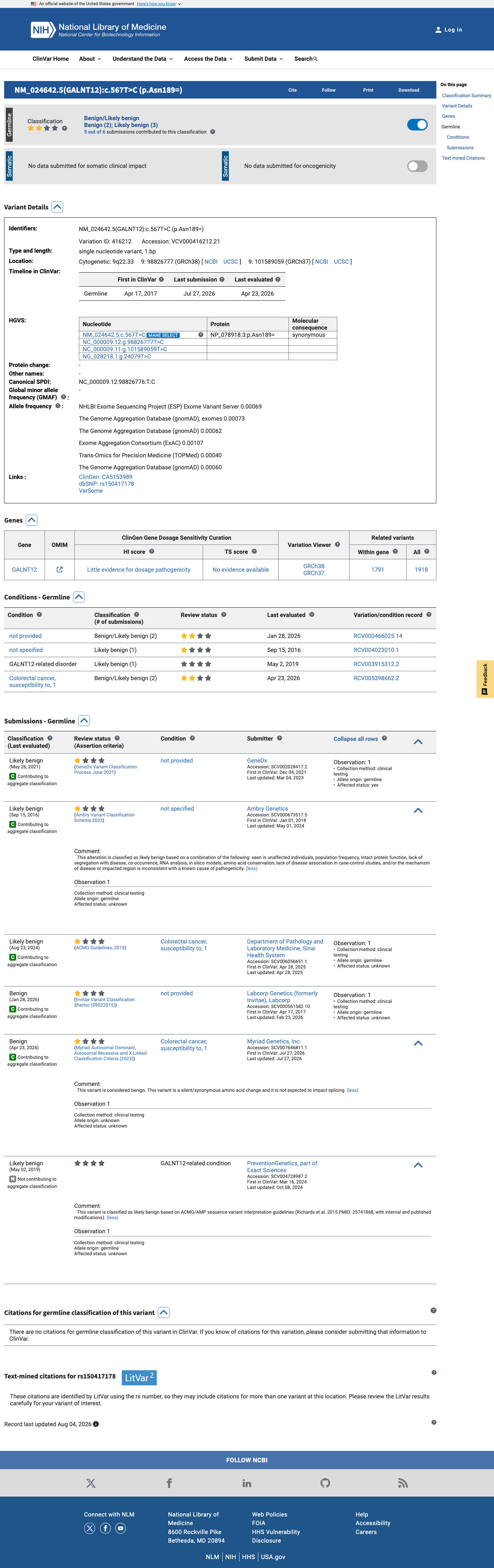
ClinVar
This variant has been reported in ClinVar as Likely benign (4 clinical laboratories) and as Benign (2 clinical laboratories). (ClinVarID = 416212)
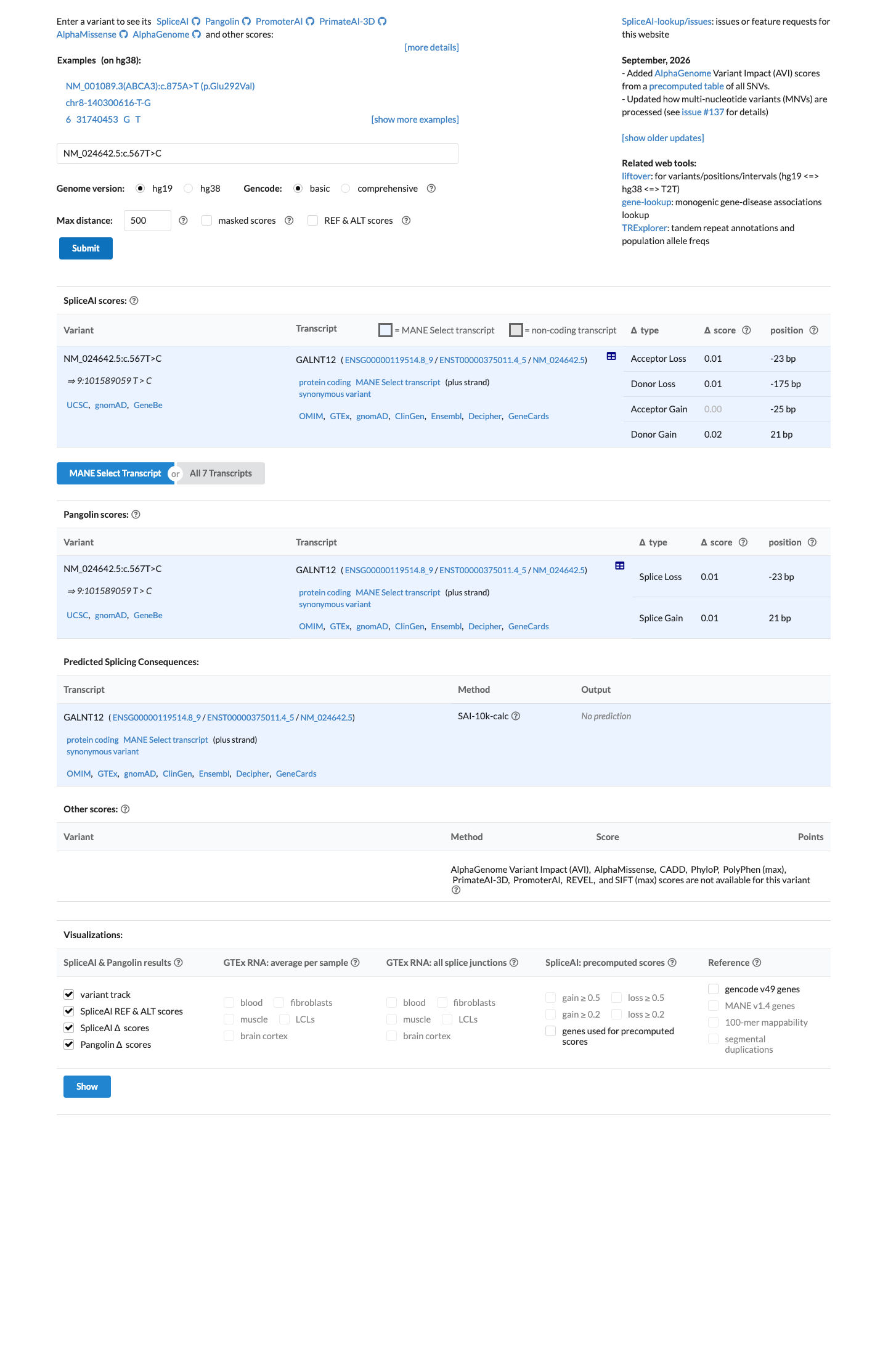
In silico
SpliceAI predicts no significant splice impact for this variant (max delta score = 0.02).
Functional
No data
No calibrated functional assay or RNA evidence was identified for this variant.
COSMIC

Cancer hotspots
Somatic evidence
Not in COSMIC / hotspots
COSMIC
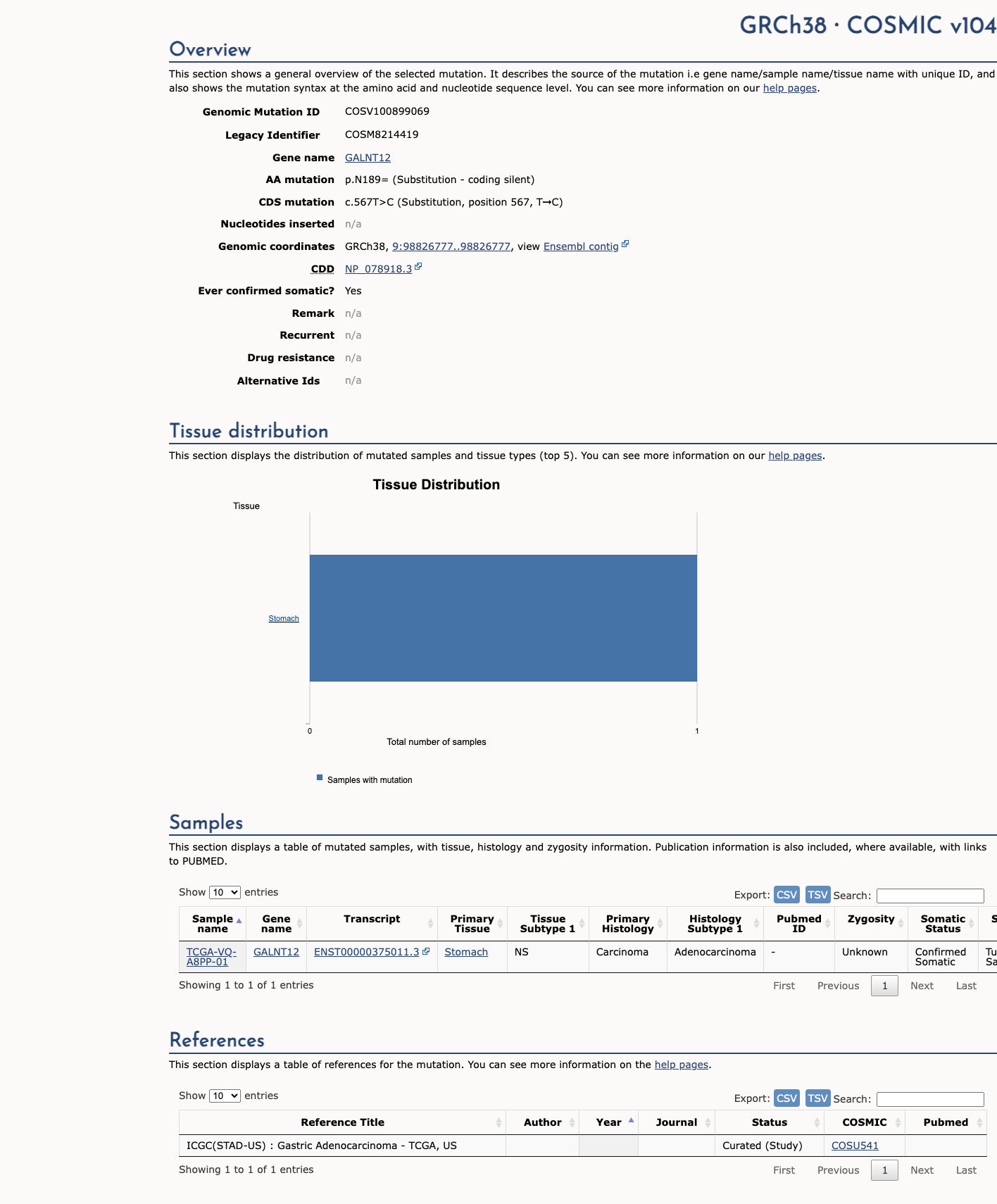
This variant does not lie in a statistically significant hotspot. This variant has previously been reported in somatic cancers (COSMIC; COSV100899069, n = 1 times).
Hotspots
This variant does not lie in a statistically significant hotspot.
Literature · how each cited paper was used
1papers cited
Each card is an audit: what was searched, what was found, whether it names the variant, which criteria it fed, and why. 1 further PMID triaged but not cited — see Sources & references.
Rule & framework references · cited for criterion definitions, not variant evidence
25741868 ↗
Standards and guidelines for the interpretation of sequence variants: a joint consensus recommendation of the American College of Medical Genetics and Genomics and the Association for Molecular Pathology.
Sources & reference links
Triaged references · 1 PMID not cited in assessment
28492532 ↗
Sherloc: a comprehensive refinement of the ACMG-AMP variant classification criteria.
CLINVAR