PALB2 encodes a tumor suppressor protein that partners with BRCA2 (and also interacts with BRCA1) to repair double-stranded DNA breaks through the homologous recombination pathway. It acts as a scaffold that stabilizes BRCA2 in the cell nucleus and helps recruit DNA-repair machinery to sites of damage. Inherited mutations in PALB2 increase susceptibility to breast cancer, with smaller associated risks for ovarian, pancreatic, and prostate cancer and melanoma, and inheriting two mutated copies causes Fanconi anemia complementation group N. Rare somatic alterations in PALB2 are also found across various tumor types.
This variant
This PALB2 variant occurs in a tumor-suppressor gene whose protein partners with BRCA1 and BRCA2 in homologous-recombination DNA double-strand-break repair.
Transcript
NM_024675.4
HGVS · transcript:coding
NM_024675.4:c.2135C>T
GRCh38
chr16:23630019 G>A
GRCh37
chr16:23641340 G>A
Benign: BA1 stand-alone benign independently satisfies PALB2 VCEP Rule17; BS1 (strong) and BP1 (supporting) are also met.
Classification rationale
BA1BS1BP1Benign
PALB2 c.2135C>Tmissense · exon 5
Benign: BA1 is met because the gnomAD grpmax filtering frequency is 0.412487%, above the >0.1% threshold. Benign: BS1 is met at strong strength because the gnomAD grpmax filtering frequency is 0.412487%, above the >0.01% threshold. Benign: BP1 is met at supporting strength because c.2135C>T is a missense substitution.
BA1 + BS1 + BP1→Benign
LYFE Sciences is an AI system, and it can make mistakes. Criteria
may be applied incorrectly, sources may be misread, and a confident-looking
classification can still be wrong. Double-check every criterion and
its underlying evidence before relying on any call.
Gene diagram
· NM_024675.4 · variants mapped to exon structure
PALB2NM_024675.4
Fetching transcript structure from UCSC…
Exons
—
Transcript span
—
Strand
—
Variants mapped
—
Source
UCSC ncbiRefSeqCurated
All variants in PALB2—click a row to locate it on the plot · use the link column to open its page
Protein
Location
Classification
Link
Applied criteria · 3 applied · 7 assessed
MetEvidence satisfies this criterion.
Not metEvaluated against available evidence; threshold not reached.
Not assessedApplies in principle, but no evidence was found to evaluate it.
N/ADoesn't apply to this variant type.
Applied · 3
Strength Supporting Moderate Strong Very strong
✓
BA1stand-aloneBenign
Met: gnomAD v4.1 grpmax FAF is 0.412487%, exceeding the PALB2 VCEP BA1 threshold of >0.1%.
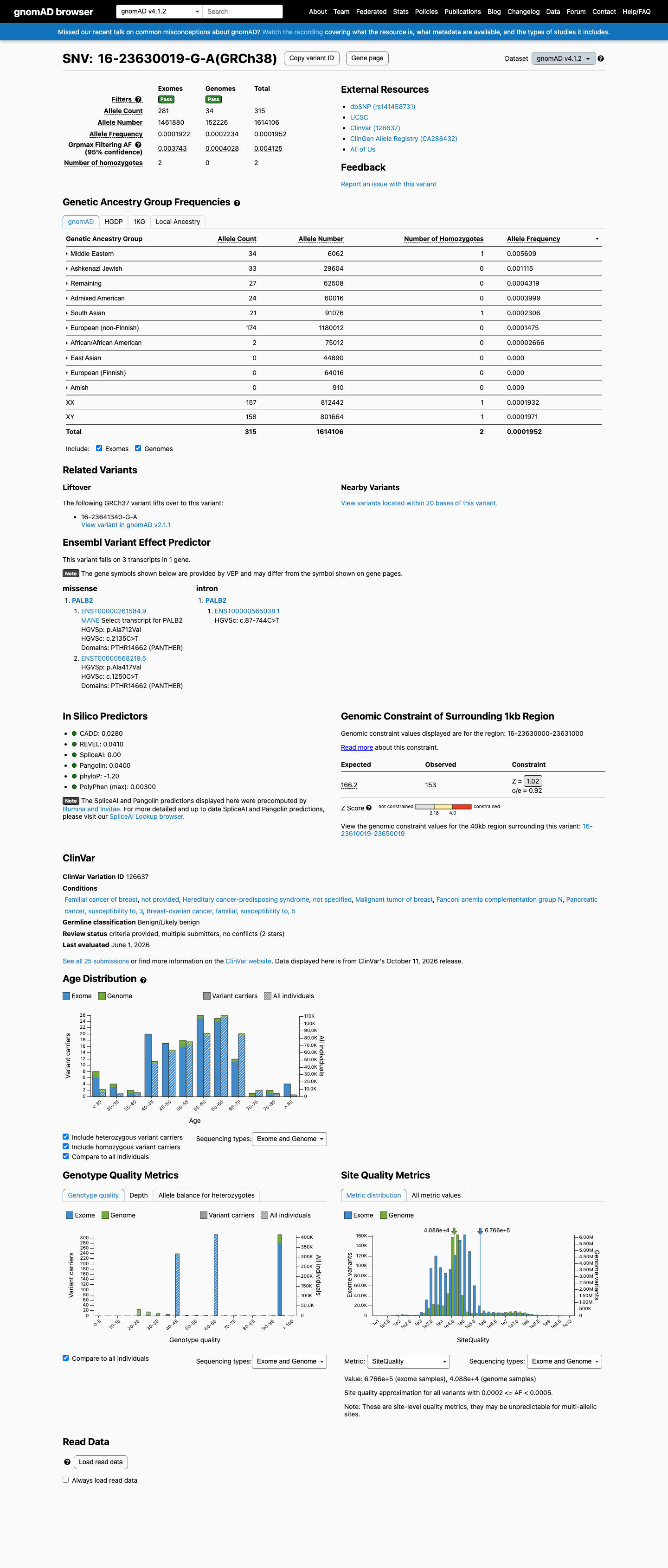
gnomAD v4.1 all-comers record for NM_024675.4:c.2135C>T / p.Ala712Val: grpmax FAF=0.00412487 (0.412487%), with the highest observed population frequency in Middle Eastern individuals at AF=0.00560871 (34/6062 alleles).
Met: gnomAD v4.1 grpmax FAF is 0.412487%, exceeding the PALB2 VCEP BS1 threshold of >0.01%.
gnomAD v4.1 all-comers record for NM_024675.4:c.2135C>T / p.Ala712Val: grpmax FAF=0.00412487 (0.412487%), with the highest observed population frequency in Middle Eastern individuals at AF=0.00560871 (34/6062 alleles).
Met, Supporting: BP1 applies to all missense variants, and NM_024675.4:c.2135C>T encodes missense p.Ala712Val.
PALB2 CSPEC BP1 rule: Apply to all missense variants.The case evidence identifies NM_024675.4:c.2135C>T (p.Ala712Val/p.A712V) as a missense substitution.
Assessed · not applied
· 2 not met · 5 not assessed
Pathogenic
PS4Not assessed: the variant was reported in one cohort, but no VCEP-required case-control p-value, effect estimate, or confidence interval is available.
PM2Not met: the highest gnomAD v4.1 subpopulation AF is 0.560871%, above the VCEP PM2 threshold of 0.000333%.
PM3Not assessed: the exact variant lacks documented Fanconi Anemia phenotype, pathogenic variant in trans, homozygosity, or phase information required by the VCEP PM3 table.
PP1Not assessed: the exact-variant report provides one proband but no affected relatives, parental testing, segregation count, LOD, or LR threshold value.
PP3Not met: SpliceAI maximum delta score 0.028 is below the VCEP PP3 threshold of ≥0.2 for predicted splice impact.
Benign
BS2Not assessed: gnomAD reports homozygotes, but no Fanconi Anemia BS2 table points can be assigned without proband phenotype and age data.
BS4Not assessed: no non-segregating relatives, informative meioses, LOD, or LR are reported for comparison with the VCEP BS4 thresholds.
This variant is present in gnomAD v4.1 (AF= 0.000195154; MAF= 0.01952%, 315/1614106 alleles, homozygotes = 2) and has highest observed frequency in the Middle Eastern population (AF= 0.00560871; MAF= 0.56087%, 34/6062 alleles, homozygotes = 1); grpmax FAF= 0.00412487.
v2.1
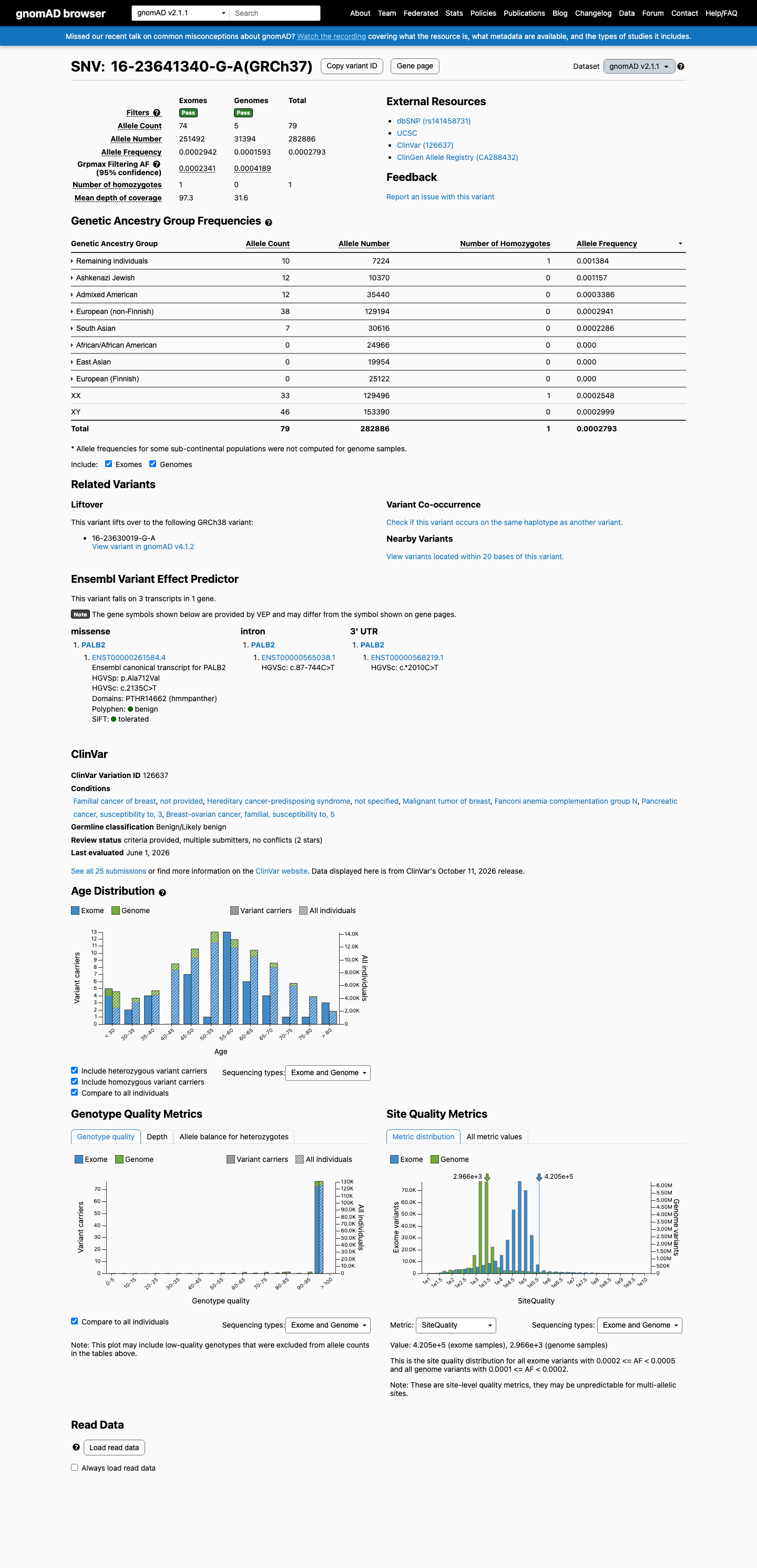
This variant is present in gnomAD v2.1 (AF= 0.000279264; MAF= 0.02793%, 79/282886 alleles, homozygotes = 1) and has highest observed frequency in the Remaining individuals population (AF= 0.00138427; MAF= 0.13843%, 10/7224 alleles, homozygotes = 1); grpmax FAF= 0.00041893.
🇨🇦 CA
This variant is present in gnomAD-Canada v1.0 (AF= 0.00027156202476645667, 5/18412 alleles, homozygotes = 0).
Allele frequency by ancestry
three datasets · side by side
gnomAD v4.1
0.02%
· 315 / 1,614,106
2 hom · FAF 0.41%
Middle Eastern
34 / 6,062
0.56%
1 hom
Ashkenazi Jewish
33 / 29,604
0.11%
Remaining individuals
27 / 62,508
0.043%
Admixed American
24 / 60,016
0.04%
South Asian
21 / 91,076
0.023%
1 hom
European (non-Finnish)
174 / 1,180,012
0.015%
African/African American
2 / 75,012
0.0027%
+ 3 not observed (European (Finnish), Amish, East Asian)
gnomAD v2.1
0.028%
· 79 / 282,886
1 hom · FAF 0.042%
Remaining individuals
10 / 7,224
0.14%
1 hom
Ashkenazi Jewish
12 / 10,370
0.12%
Admixed American
12 / 35,440
0.034%
European (non-Finnish)
38 / 129,194
0.029%
South Asian
7 / 30,616
0.023%
+ 3 not observed (African/African American, East Asian, European (Finnish))
gnomAD Canada 🇨🇦
0.027%
· 5 / 18,412
0 hom
Remaining individuals
1 / 1,138
0.088%
South Asian
1 / 1,362
0.073%
European (non-Finnish)
3 / 11,734
0.026%
+ 6 not observed (African/African American, Latino/Admixed American, Ashkenazi Jewish, East Asian, European (Finnish), Middle Eastern)
This variant has been reported in ClinVar as Likely benign (16 clinical laboratories) and as Benign (5 clinical laboratories) and as benign (1 clinical laboratory). (ClinVarID = 126637)
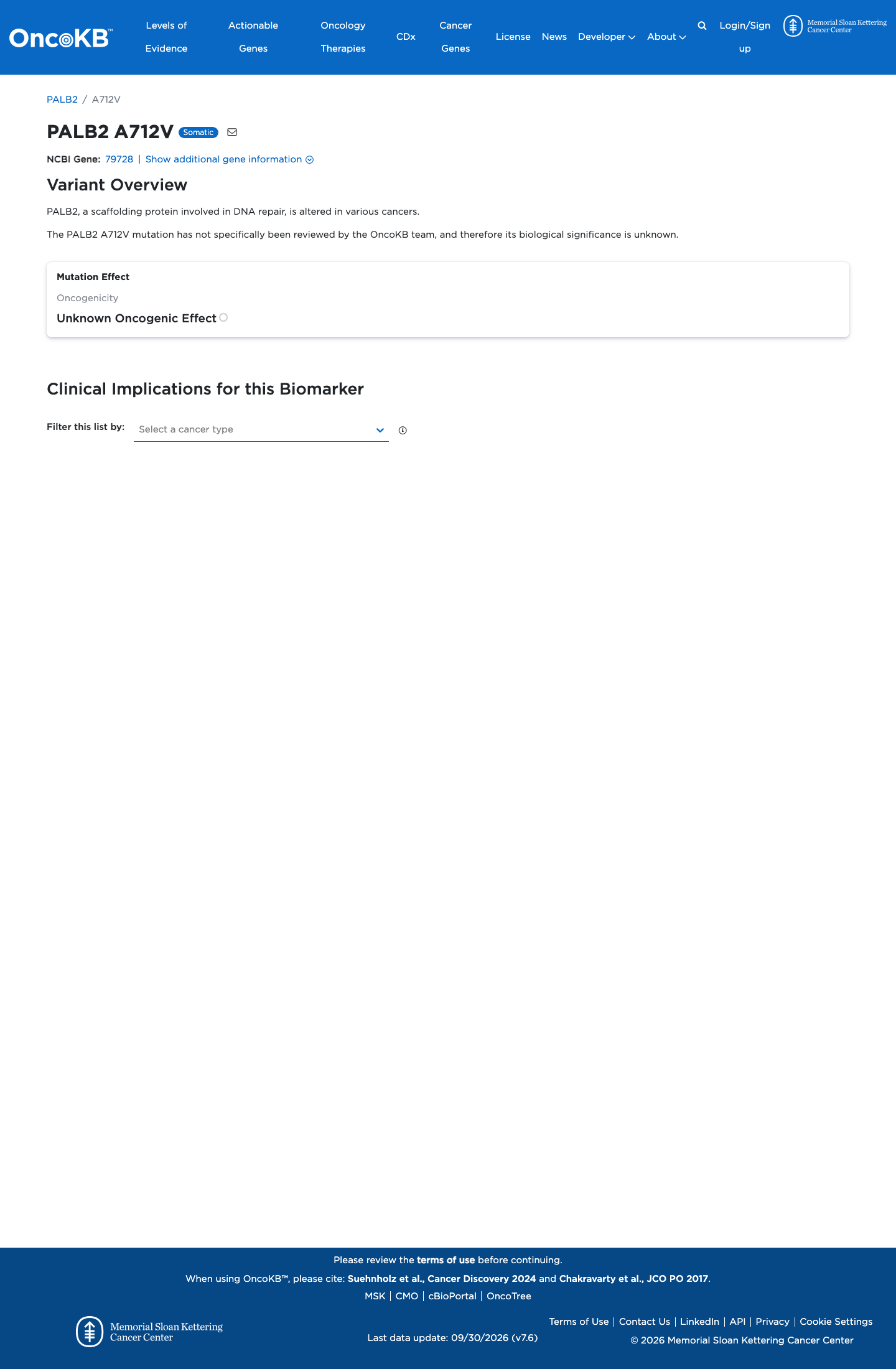
OncoKB did not identify variant-specific reviewed functional evidence for this variant; gene-level curated context is available for reviewer follow-up. PALB2, a scaffolding protein involved in DNA repair, is altered in various cancers.
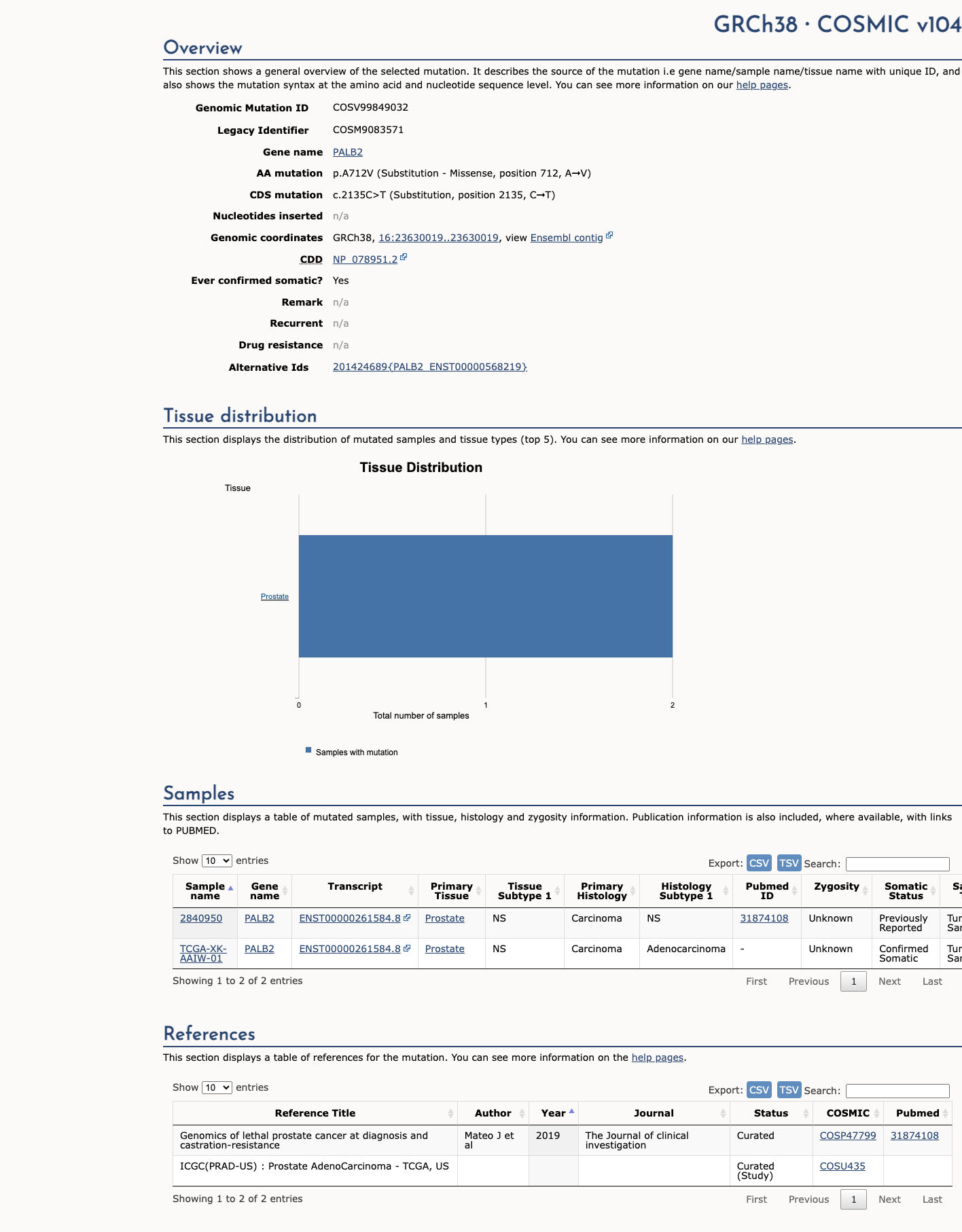
This variant does not lie in a statistically significant hotspot. This variant has previously been reported in somatic cancers (COSMIC; COSV99849032, n = 2 times).
Hotspots
This variant does not lie in a statistically significant hotspot.