Back
NM_024675.4:c.2488del
p.Glu830SerfsTer21 · PALB2
0%
complete
Final classification
Likely Pathogenic
PVS1PM5
PALB2
c.2488del
p.Glu830SerfsTer21
frameshift · exon 5

PALB2 encodes a tumor suppressor protein that partners with BRCA2 (and also interacts with BRCA1) to repair double-stranded DNA breaks through the homologous recombination pathway. It acts as a scaffold that stabilizes BRCA2 in the cell nucleus and helps recruit DNA-repair machinery to sites of damage. Inherited mutations in PALB2 increase susceptibility to breast cancer, with smaller associated risks for ovarian, pancreatic, and prostate cancer and melanoma, and inheriting two mutated copies causes Fanconi anemia complementation group N. Rare somatic alterations in PALB2 are also found across various tumor types.

This variant

This truncating PALB2 variant affects a tumor-suppressor gene whose protein partners with BRCA1 and BRCA2 in homologous-recombination DNA repair.

Transcript
NM_024675.4
HGVS · transcript:coding
NM_024675.4:c.2488del
GRCh38
chr16:23629665 TC>T
GRCh37
chr16:23640986 TC>T
Likely Pathogenic: PVS1 (very strong) plus PM5 (supporting) satisfy Rule19 of the PALB2 VCEP Version 1.3 framework.
Classification rationale
PVS1PM5 Likely Pathogenic
PALB2 c.2488del frameshift · exon 5

Likely Pathogenic: PVS1 very strong reflects the exon 5 frameshift truncating PALB2 before the critical WD40 domain. Likely Pathogenic: PM5 supporting reflects the VCEP rule for this PVS1 very strong truncating variant terminating upstream of p.His1184.

PVS1 + PM5 → Likely Pathogenic
LYFE Sciences is an AI system, and it can make mistakes. Criteria may be applied incorrectly, sources may be misread, and a confident-looking classification can still be wrong. Double-check every criterion and its underlying evidence before relying on any call.
Gene diagram · NM_024675.4 · variants mapped to exon structure
PALB2 NM_024675.4
Fetching transcript structure from UCSC…
Applied criteria · 2 applied · 8 assessed
MetEvidence satisfies this criterion.
Not metEvaluated against available evidence; threshold not reached.
Not assessedApplies in principle, but no evidence was found to evaluate it.
N/ADoesn't apply to this variant type.
Applied · 2
Strength Supporting Moderate Strong Very strong
PVS1 very strong Pathogenic
Met at very strong: frameshift p.Glu830SerfsTer21 truncates PALB2 in exon 5, upstream of the critical WD40 domain and far from the 1186-residue C-terminus.
Case variant assessment: NM_024675.4:c.2488del; NP_078951.2:p.(Glu830SerfsTer21) / p.(E830Sfs*21); frameshift in exon 5; canonical splice consensus false.PALB2_PVS1_v1.3.pdf, page 1: the VCEP PVS1 definition includes null frameshift variants in a gene where loss of function is a known disease mechanism.PALB2_PVS1_v1.3.pdf, page 3: the VCEP considers NM_024675.3 the clinically relevant reference transcript, with 13 coding exons and a 1186-amino-acid protein; the case uses the corresponding NM_024675.4 annotation.
PM5 supporting Pathogenic
Met at Supporting: the frameshift creates a stop at residue 850, upstream of His1184, and the VCEP rule requires PVS1 VeryStrong for this DNA-variant path.
Variant assessment identifies NM_024675.4:c.2488del as a frameshift with protein consequence NP_078951.2:p.(E830Sfs*21), exon 5.p.(E830Sfs*21) terminates after residue 850, which is upstream of the VCEP cutoff p.His1184.The VCEP PM5 DNA-variant rule requires an NMD-prone truncating variant receiving PVS1 at VeryStrong with a premature termination codon upstream of p.His1184.
Assessed · not applied · 3 not met · 5 not assessed
Pathogenic
PS4 Not assessed: the available study reports PALB2 truncating variants collectively (OR 4.69, p=6.9×10⁻⁶), not this specific c.2488del variant.
PM2 Not met: gnomAD v4.1 South Asian AF is 0.0098799%, exceeding the PALB2 VCEP PM2 threshold of 0.000333%.
PM3 Not assessed: the governing PM3 table has no entry for c.2488del and no case-specific phase or affected-proband point assignment is available.
PP1 Not assessed: no variant-specific LOD, Bayes factor, or documented affected-relative segregation is available for the VCEP's minimum LOD 0.3 or LR 2:1 threshold.
Benign
BA1 Not met: gnomAD v4.1 grpmax FAF is 0.005136%, below the PALB2 VCEP BA1 threshold of >0.1%.
BS1 Not met: gnomAD v4.1 grpmax FAF is 0.005136%, below the PALB2 VCEP BS1 threshold of >0.01%.
BS2 Not assessed: gnomAD cannot support BS2 under the VCEP rule, and no qualifying healthy-adult clinical or research observation was available.
BS4 Not assessed: no variant-specific non-segregation LOD or Bayes factor is available to meet the VCEP's Supporting threshold of LOD ≤-.32 or LR ≤.48.
N/A · 18 PS1 · PS2 · PS3 · PM1 · PM4 · PM6 · PP2 · PP3 · PP4 · PP5 · BS3 · BP1 · BP2 · BP3 · BP4 · BP5 · BP6 · BP7
Research & evidence
Population frequency · supports pathogenic
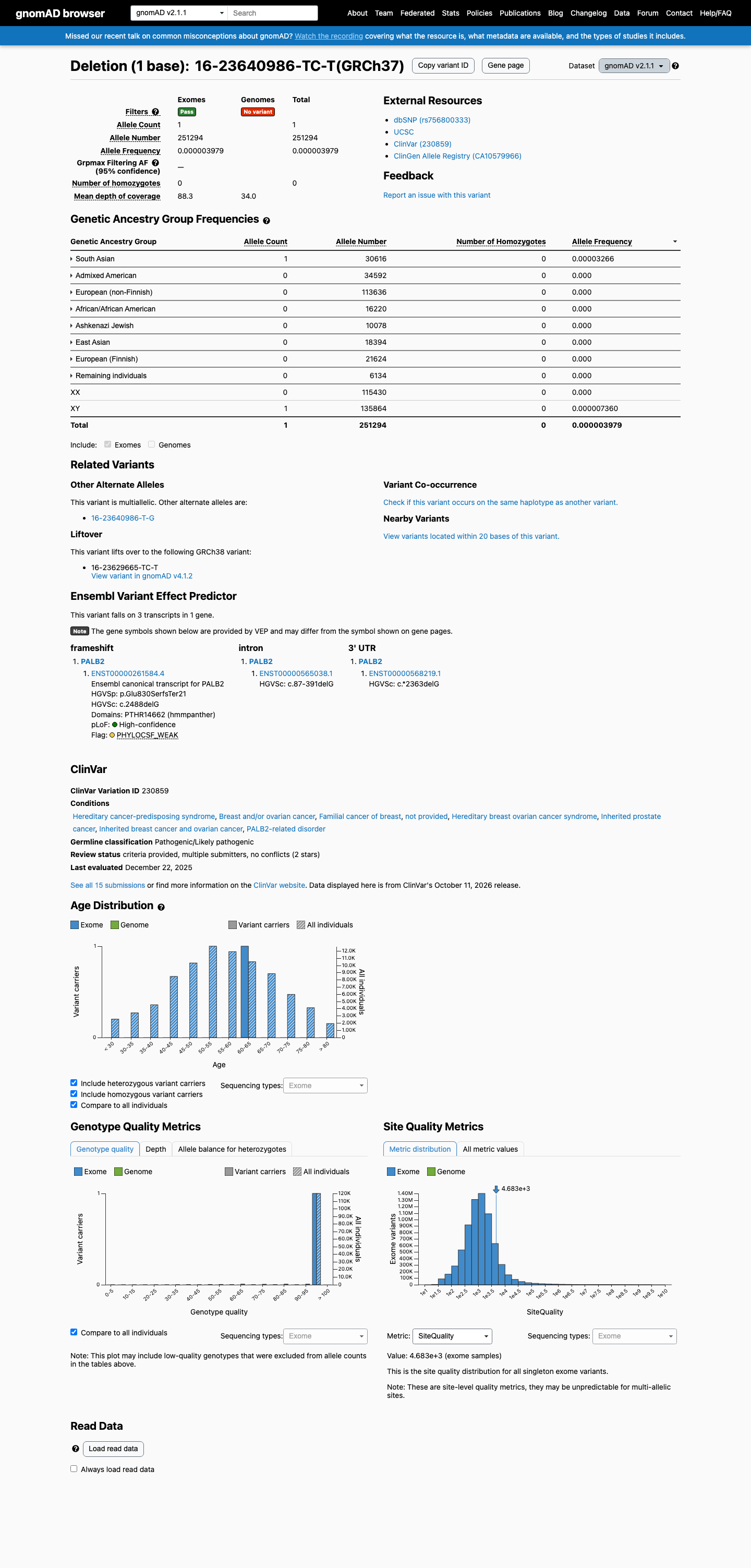
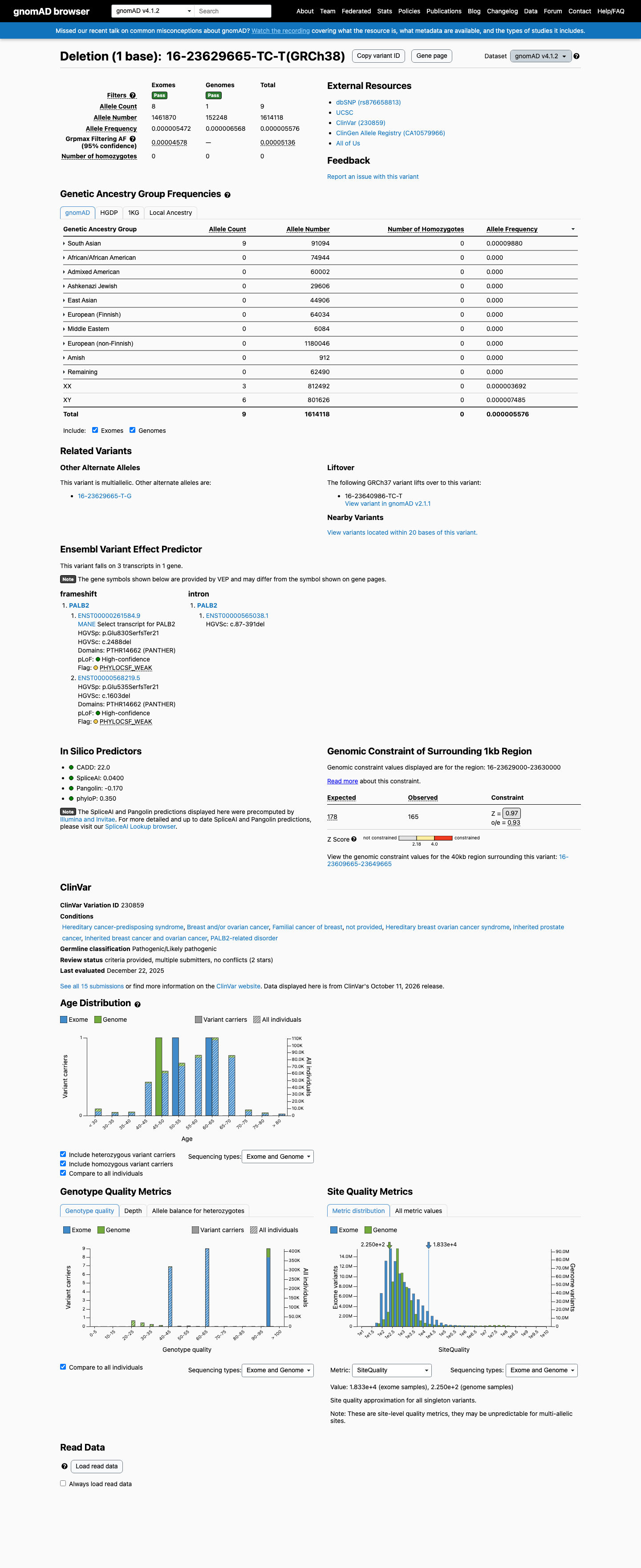
gnomAD v4.1 screenshot
gnomAD v4.1
gnomAD v2.1 screenshot
gnomAD v2.1
v4.1
This variant is present in gnomAD v4.1 (AF= 5.5758e-06; MAF= 0.00056%, 9/1614118 alleles, homozygotes = 0) and has highest observed frequency in the South Asian population (AF= 9.8799e-05; MAF= 0.00988%, 9/91094 alleles, homozygotes = 0); grpmax FAF= 5.136e-05.
v2.1
This variant is present in gnomAD v2.1 (AF= 3.9794e-06; MAF= 0.00040%, 1/251294 alleles, homozygotes = 0) and has highest observed frequency in the South Asian population (AF= 3.26627e-05; MAF= 0.00327%, 1/30616 alleles, homozygotes = 0).
🇨🇦 CA
Absent from gnomAD-Canada v1.0.
Allele frequency by ancestry
three datasets · side by side
gnomAD v4.1
0.00056% · 9 / 1,614,118
0 hom · FAF 0.0051%
South Asian
9 / 91,094
0.0099%
+ 9 not observed (Remaining individuals, Admixed American, European (Finnish), Amish, East Asian, Middle Eastern, Ashkenazi Jewish, African/African American, European (non-Finnish))
gnomAD v2.1
0.0004% · 1 / 251,294
0 hom
South Asian
1 / 30,616
0.0033%
+ 7 not observed (African/African American, Admixed American, Ashkenazi Jewish, East Asian, European (Finnish), European (non-Finnish), Remaining individuals)
gnomAD Canada 🇨🇦
Absent · 0 / ?
0 hom
Not observed in any ancestry group.
ClinVar screenshot
ClinVar
This variant has been reported in ClinVar as Pathogenic (12 clinical laboratories) and as pathogenic (1 clinical laboratory) and as Likely pathogenic (1 clinical laboratory). (ClinVarID = 230859)
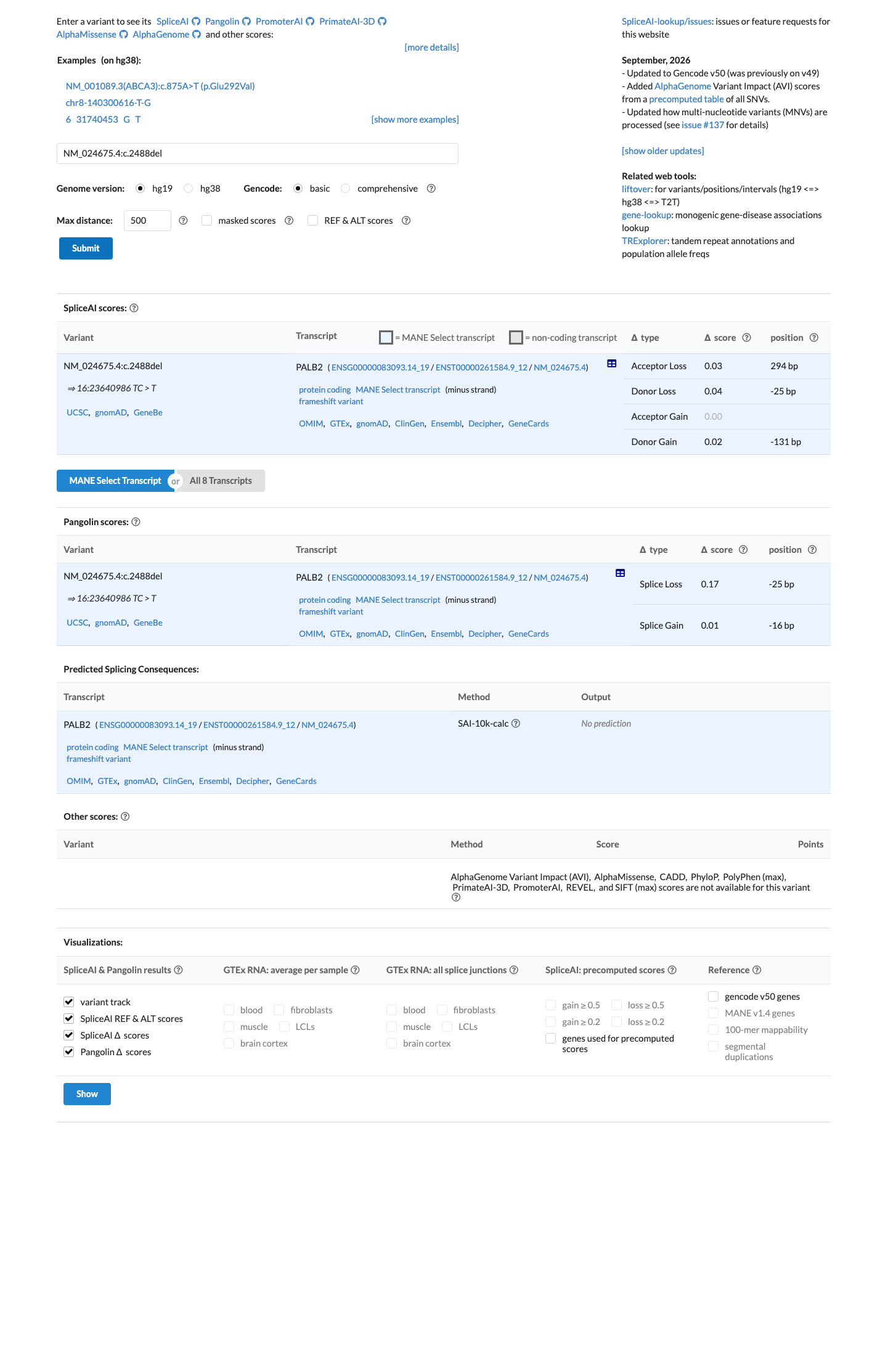
SpliceAI screenshot
In silico
SpliceAI predicts no significant splice impact for this variant (max delta score = 0.04).
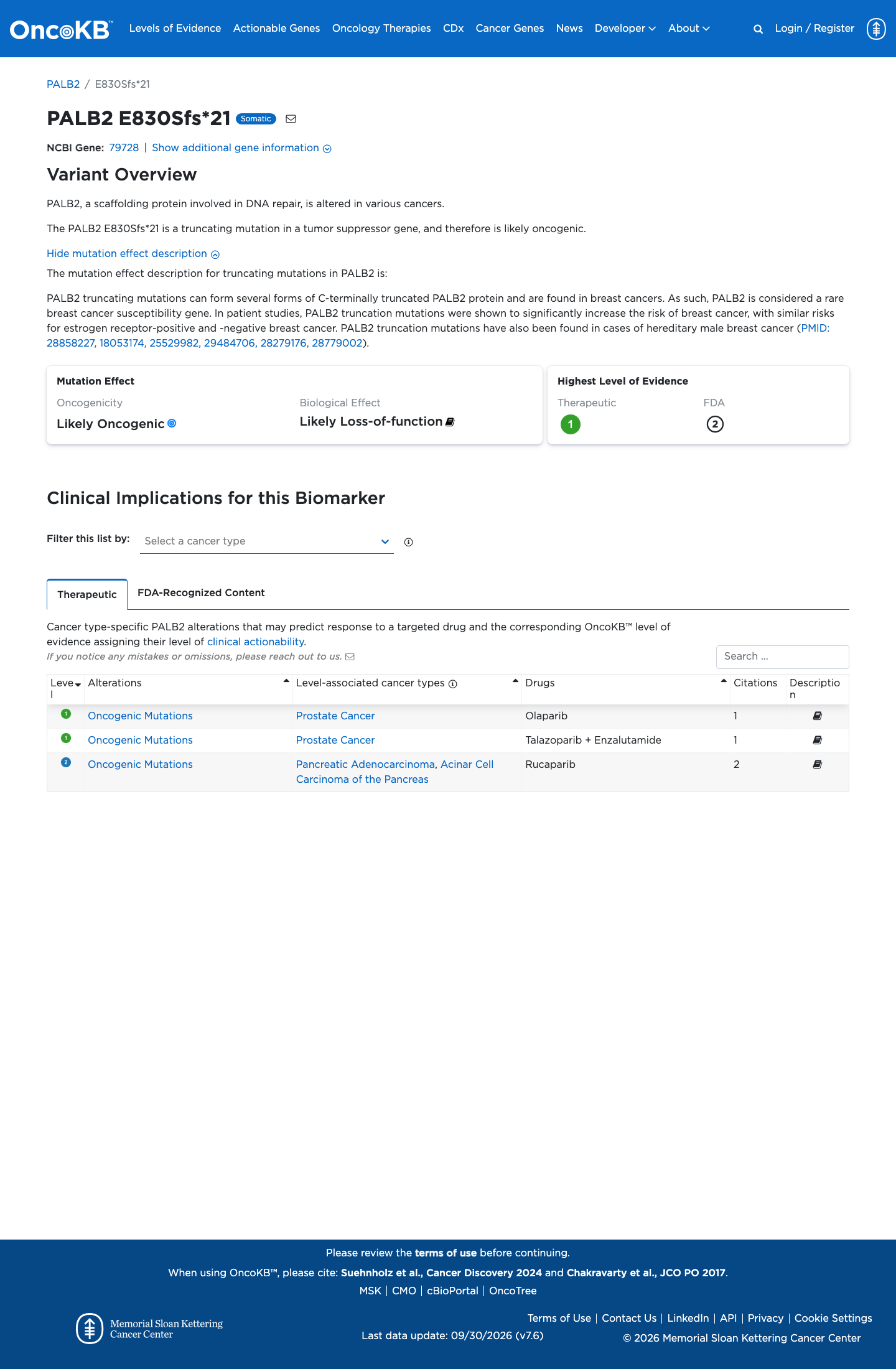
Functional / OncoKB screenshot
Functional Likely Oncogenic
OncoKB identified variant-specific curated literature and context relevant to functional review; biological-effect context: Likely Loss-of-function; curated oncogenicity label: Likely Oncogenic.
OncoKB ↗
COSMIC screenshot
COSMIC
Cancer hotspots screenshot
Cancer hotspots
Somatic evidence Not in COSMIC / hotspots
COSMIC
This variant does not lie in a statistically significant hotspot. This variant has not previously been reported in somatic cancers (COSMIC).
Hotspots
This variant does not lie in a statistically significant hotspot.
Sources & reference links
9Sources
CSpec VCEP
ClinVar
gnomAD v2.1
gnomAD v4.1
gnomAD-Canada
SpliceAI
OncoKB
COSMIC
Cancer hotspots
Triaged references · 8 PMIDs not cited in assessment
18053174 ↗ Identification of a novel truncating PALB2 mutation and analysis of its contribution to early-onset breast cancer in French-Canadian women. ONCOKB
25529982 ↗ A novel PALB2 truncating mutation in an Italian family with male breast cancer. ONCOKB
28279176 ↗ PALB2 mutations in BRCA1/2-mutation negative breast and ovarian cancer patients from Poland. ONCOKB
28779002 ↗ Rare, protein-truncating variants in ATM, CHEK2 and PALB2, but not XRCC2, are associated with increased breast cancer risks. ONCOKB
28858227 ↗ The Role of PALB2 in the DNA Damage Response and Cancer Predisposition. ONCOKB
17200671 ↗ Biallelic mutations in PALB2 cause Fanconi anemia subtype FA-N and predispose to childhood cancer. CLINVAR
23918944 ↗ Tamoxifen and risk of contralateral breast cancer for BRCA1 and BRCA2 mutation carriers. CLINVAR
25099575 ↗ Breast-cancer risk in families with mutations in PALB2. CLINVAR