PALB2 encodes a tumor suppressor protein that partners with BRCA2 (and also interacts with BRCA1) to repair double-stranded DNA breaks through the homologous recombination pathway. It acts as a scaffold that stabilizes BRCA2 in the cell nucleus and helps recruit DNA-repair machinery to sites of damage. Inherited mutations in PALB2 increase susceptibility to breast cancer, with smaller associated risks for ovarian, pancreatic, and prostate cancer and melanoma, and inheriting two mutated copies causes Fanconi anemia complementation group N. Rare somatic alterations in PALB2 are also found across various tumor types.
This variant
PALB2 is a tumor suppressor that partners with BRCA2 to repair double-stranded DNA breaks, and inherited mutations increase breast cancer susceptibility. This variant is a rare missense change (p.(Gly982Val)) with no clinical or functional evidence for or against pathogenicity, so it is classified as a variant of uncertain significance (VUS). As such, it does not by itself alter breast cancer risk assessment and should not guide clinical decisions without further evidence.
Transcript
NM_024675.4
HGVS · transcript:coding
NM_024675.4:c.2945G>T
GRCh38
chr16:23623020 C>A
GRCh37
chr16:23634341 C>A
PM2 (Supporting) and BP1 (Supporting) were the only criteria applied; no pathogenic, likely-pathogenic, or benign rule was satisfied, and Rule 31 maps the conflicting pair to VUS (Uncertain Significance - Conflicting Evidence).
Classification rationale
PM2BP1VUS
PALB2 c.2945G>Tmissense · exon 9
PM2 (Supporting): absent from gnomAD v4.1 exomes (AF 0), below the <=1/300,000 VCEP frequency threshold. BP1 (Supporting): the PALB2 VCEP applies BP1 to all missense variants given the low rate of pathogenic missense changes in PALB2. Overall: VUS (Uncertain Significance - Conflicting Evidence), per Rule 31 combining PM2 (Pathogenic.Supporting) with BP1 (Benign.Supporting).
PM2 + BP1→VUS
Gene diagram
· NM_024675.4 · variants mapped to exon structure
PALB2NM_024675.4
Fetching transcript structure from UCSC…
Exons
—
Transcript span
—
Strand
—
Variants mapped
—
Source
UCSC ncbiRefSeqCurated
All variants in PALB2—click a row to locate it on the plot · use the link column to open its page
Protein
Location
Classification
Link
Applied criteria · 2 applied · 8 assessed
MetEvidence satisfies this criterion.
Not metEvaluated against available evidence; threshold not reached.
Not assessedApplies in principle, but no evidence was found to evaluate it.
N/ADoesn't apply to this variant type.
Applied · 2
Strength Supporting Moderate Strong Very strong
✓
PM2supportingPathogenic
Met (Supporting): absent from gnomAD v4.1 exomes (AF 0), satisfying the VCEP frequency threshold of <=1/300,000.
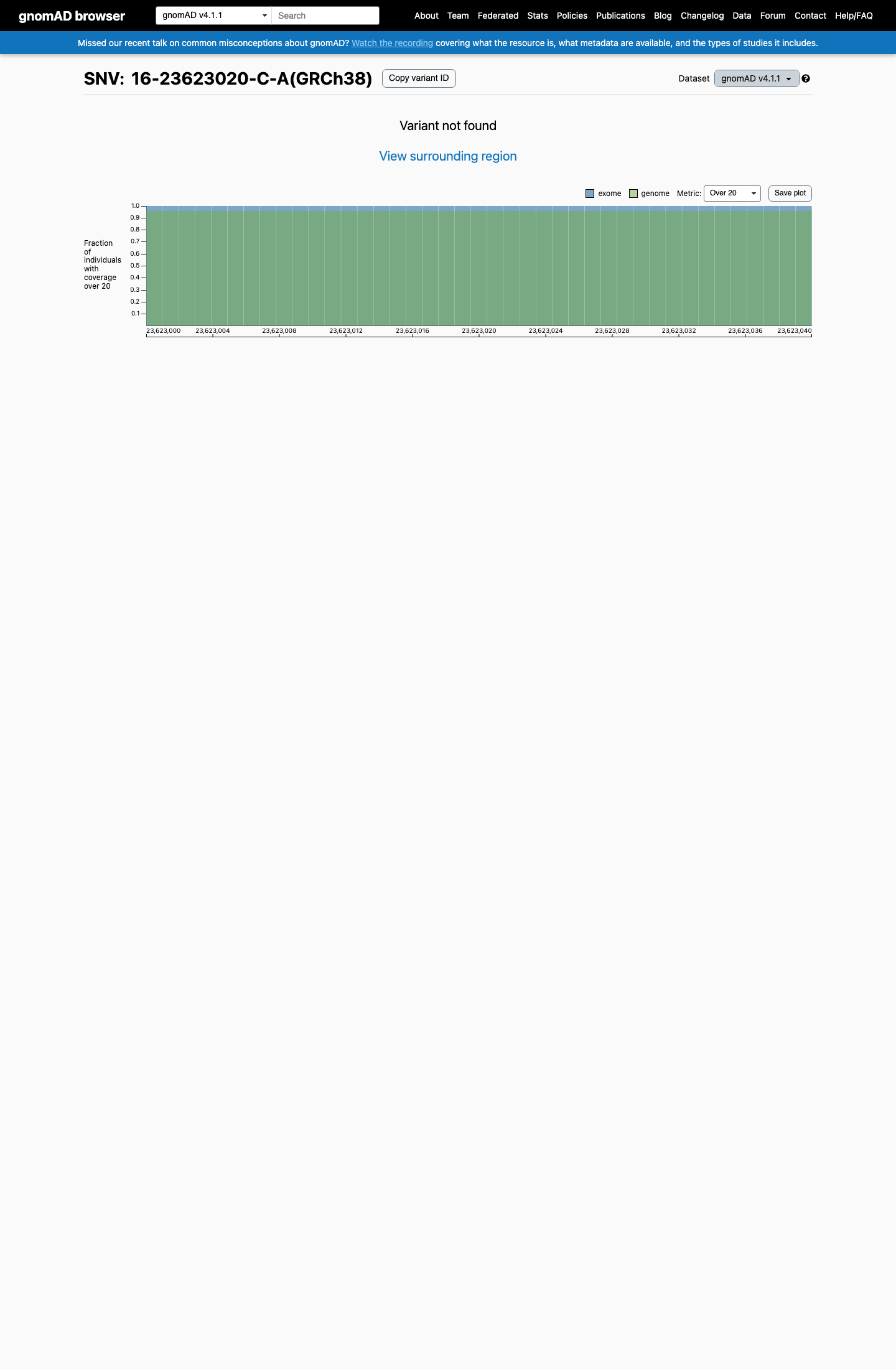
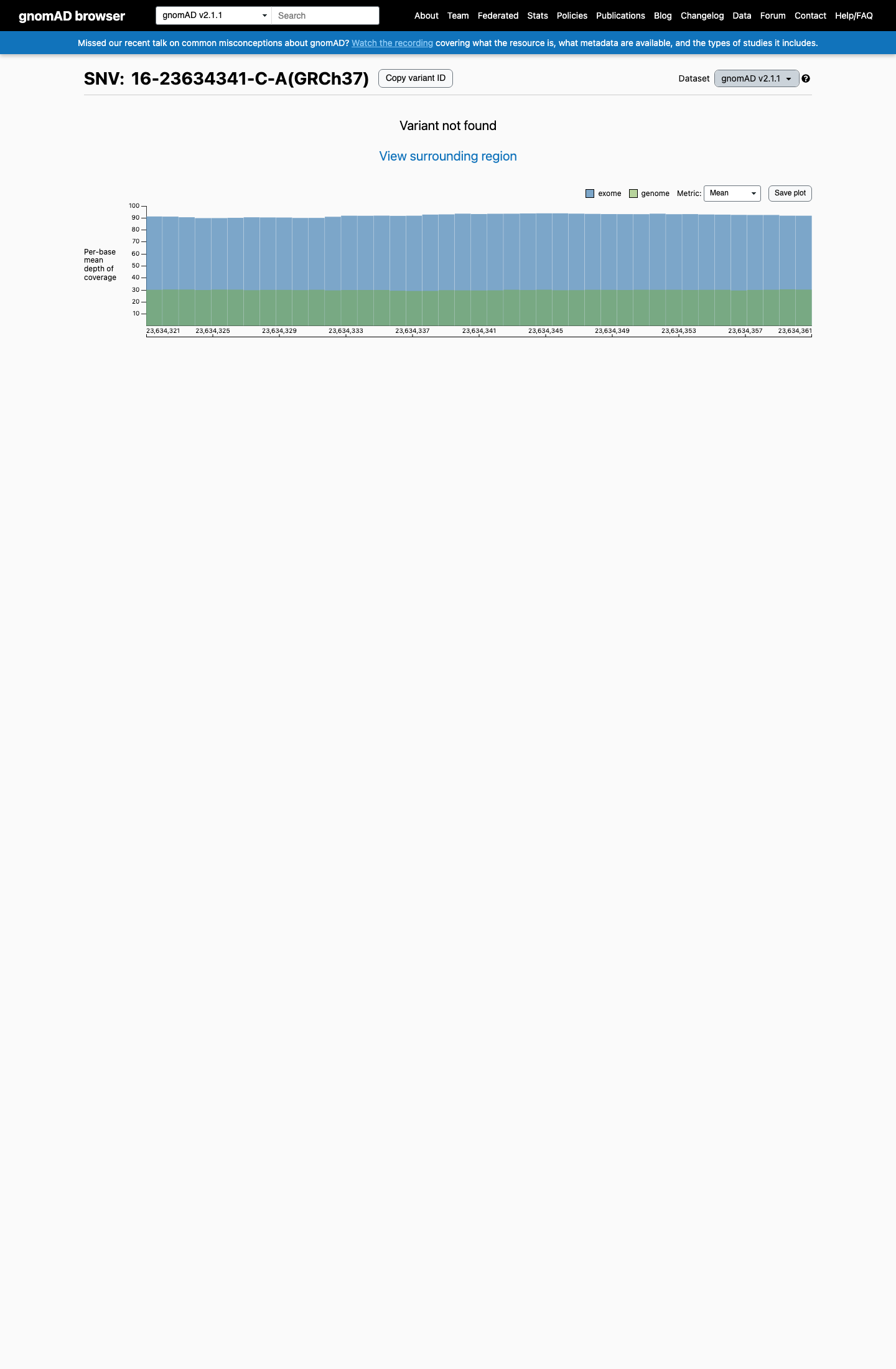
ClinGen HBOP PALB2 v1.2 CSPEC (cspec, version 1.2) rule: PM2 = Frequency <=1/300,000 (0.000333%) in gnomAD v4 dataset, strength Supporting.gnomAD v4.1 exome query for chr16-23623020-C-A (GRCh38) returned search_status 'absent' (found: false); an observed frequency of 0 is <= the 0.000333% (1/300,000) PM2 threshold.Corroborating absence from gnomAD v2.1 exomes (16-23634341-C-A, GRCh37) and gnomAD-Canada v1.0 genomes strengthens the rarity assertion for PM2.
Met (Supporting): the PALB2 VCEP applies BP1 to all missense variants, including p.(Gly982Val), given the low rate of pathogenic missense changes.
ClinGen HBOC VCEP PALB2 v1.2 (cspec) BP1 instructions: 'Based on published and unpublished functional studies, PALB2 has a low rate of missense variants that are non-functional in relevant assays. True missense pathogenic variants are not yet confirmed or refuted but are thought to be exceedingly rare. Given the very low likelihood that missense variants are pathogenic, this rule applies to all missense variants in PALB2.'Variant consequence (prefetch normalization): NM_024675.4:c.2945G>T is a substitution predicted to produce p.(Gly982Val) (NP_078951.2), i.e., a missense change in exon 9; VCEP BP1 Supporting rule: 'Apply to all missense variants.'
OncoKB did not identify variant-specific reviewed functional evidence for this variant; gene-level curated context is available for reviewer follow-up. PALB2, a scaffolding protein involved in DNA repair, is altered in various cancers.