Back
NM_032043.3:c.1655T>C
p.Ile552Thr · BRIP1
ACMG/AMP
0%
complete
Final classification
VUS
PM2BP1
BRIP1
c.1655T>C
p.Ile552Thr
missense · exon 12

BRIP1 encodes a helicase enzyme that partners with the BRCA1 protein to repair double-strand breaks in DNA, a process essential for maintaining genome stability. Germline mutations in this gene predispose carriers to ovarian cancer, and inheriting two faulty copies causes Fanconi anemia complementation group J, a rare disorder of impaired DNA repair. BRIP1 acts as a tumor suppressor, so loss of its function raises cancer risk, particularly in the ovary.

This variant

BRIP1 encodes a BRCA1-partner helicase involved in double-strand-break repair, and germline loss-of-function in this tumor-suppressor gene increases ovarian cancer susceptibility; biallelic disruption causes Fanconi anemia complementation group J.

Transcript
NM_032043.3
HGVS · transcript:coding
NM_032043.3:c.1655T>C
GRCh38
chr17:61780979 A>G
GRCh37
chr17:59858340 A>G
VUS: PM2 (supporting) plus BP1 (supporting) do not satisfy any generic ACMG/AMP pathogenic, likely pathogenic, benign, or likely benign combination.
Classification rationale
PM2 BP1 VUS
BRIP1 c.1655T>C missense · exon 12

PM2 supporting: gnomAD v4.1 allele frequency is 5.5764e-05 with zero homozygotes. BP1 supporting: BRIP1 disease-causing variants are predominantly truncating, while this variant is missense.

PM2 + BP1 → VUS
LYFE Sciences is an AI system, and it can make mistakes. Criteria may be applied incorrectly, sources may be misread, and a confident-looking classification can still be wrong. Double-check every criterion and its underlying evidence before relying on any call.
Gene diagram · NM_032043.3 · variants mapped to exon structure
BRIP1 NM_032043.3
Fetching transcript structure from UCSC…
Applied criteria · 2 applied · 22 assessed
MetEvidence satisfies this criterion.
Not metEvaluated against available evidence; threshold not reached.
Not assessedApplies in principle, but no evidence was found to evaluate it.
N/ADoesn't apply to this variant type.
Applied · 2
Strength Supporting Moderate Strong Very strong
PM2 supporting Pathogenic
Met at supporting strength: gnomAD v4.1 total allele frequency 5.5764e-05 is below the PM2 threshold of 0.0001, with zero homozygotes.
gnomAD v4.1 reports 90/1,613,944 alleles, total AF 5.5764e-05, and zero homozygotes.gnomAD v2.1 reports 5/282,702 alleles, total AF 1.768646843672843e-05, and zero homozygotes.The supplied generic ClinGen SVI PM2 calibration is AF <=0.0001 at supporting strength; the threshold source supplied with the calibration is ACMG/AMP 2015 (PMID:25741868).
BP1 supporting Benign
Met at supporting strength: BRIP1 disease-causing mutations are predominantly truncating, while rare missense variants comprise only a small proportion.
The reviewed paper states that BRIP1 disease-causing mutations predominantly cause premature protein truncation or nonsense-mediated RNA decay, with only a small proportion of rare missense variants disrupting critical functions.The target variant is a missense substitution, NM_032043.3:c.1655T>C (NP_114432.2:p.Ile552Thr).
Assessed · not applied · 7 not met · 15 not assessed
Pathogenic
PS1 Not assessed: no independently established pathogenic variant with the same amino-acid change as p.Ile552Thr was identified.
PS2 Not assessed: no documented parental testing or confirmed de novo status is available for NM_032043.3:c.1655T>C.
PS3 Not assessed: no variant-specific validated functional assay or assay-control result is available for BRIP1 p.Ile552Thr.
PS4 Not assessed: no exact-variant case-control counts, odds ratio, confidence interval, or p-value are available to establish significant enrichment.
PM1 Not assessed: no BRIP1-approved domain table or validated critical-domain evidence establishes that residue 552 meets PM1.
PM3 Not assessed: no documented affected proband with a pathogenic BRIP1 allele in trans or phase-resolved biallelic genotype is available.
PM5 Not assessed: no different pathogenic missense variant at BRIP1 residue 552 was identified for comparison.
PM6 Not assessed: neither suspected de novo occurrence nor the required proband and family-history context is documented.
PP1 Not assessed: no affected relatives, informative meioses, or segregation count is reported for NM_032043.3:c.1655T>C.
PP2 Not met: BRIP1 disease-causing variants are described as predominantly truncating, with only a small proportion of rare missense variants.
PP3 Not met: missense REVEL score 0.607 is below the 0.644 supporting PP3 threshold.
PP4 Not assessed: reported cancer contexts are broad and lack a disease-specific phenotype sufficiently characteristic to support PP4.
PP5 Not met: exact-variant ClinVar has zero expert-panel submissions and reports only Uncertain significance laboratory assertions.
Benign
BA1 Not met: gnomAD v4.1 total allele frequency 5.5764e-05 is far below the generic BA1 threshold of 0.05.
BS1 Not met: gnomAD v4.1 total allele frequency 5.5764e-05 is below the supplied generic BS1 threshold of 0.01.
BS2 Not assessed: gnomAD reports zero homozygotes but does not establish healthy-adult status, age, penetrance, or qualifying phenotype information.
BS3 Not assessed: no variant-specific validated functional assay or assay-control result is available to demonstrate normal BRIP1 p.Ile552Thr function.
BS4 Not assessed: no adequately phenotyped, tested unaffected relatives are documented to evaluate non-segregation.
BP2 Not assessed: no phase-resolved observation places this variant in trans with a pathogenic allele or in cis with a pathogenic variant.
BP4 Not met: missense REVEL score 0.607 is above the 0.29 supporting BP4 threshold.
BP5 Not assessed: no documented alternative molecular diagnosis explains the relevant phenotype in a patient carrying this exact variant.
BP6 Not met: exact-variant ClinVar has zero expert-panel submissions and reports only Uncertain significance laboratory assertions.
N/A · 4 PVS1 · PM4 · BP3 · BP7
Research & evidence
Population frequency
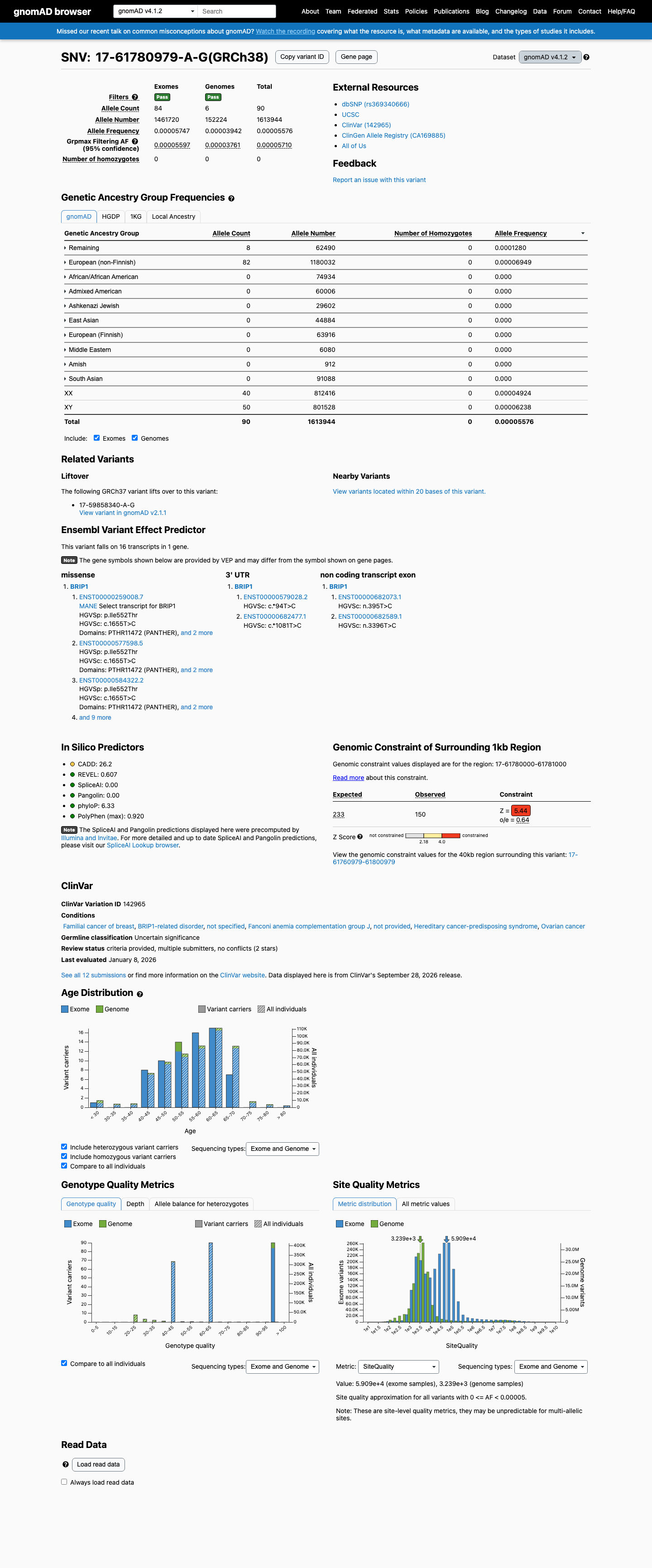
gnomAD v4.1 screenshot
gnomAD v4.1
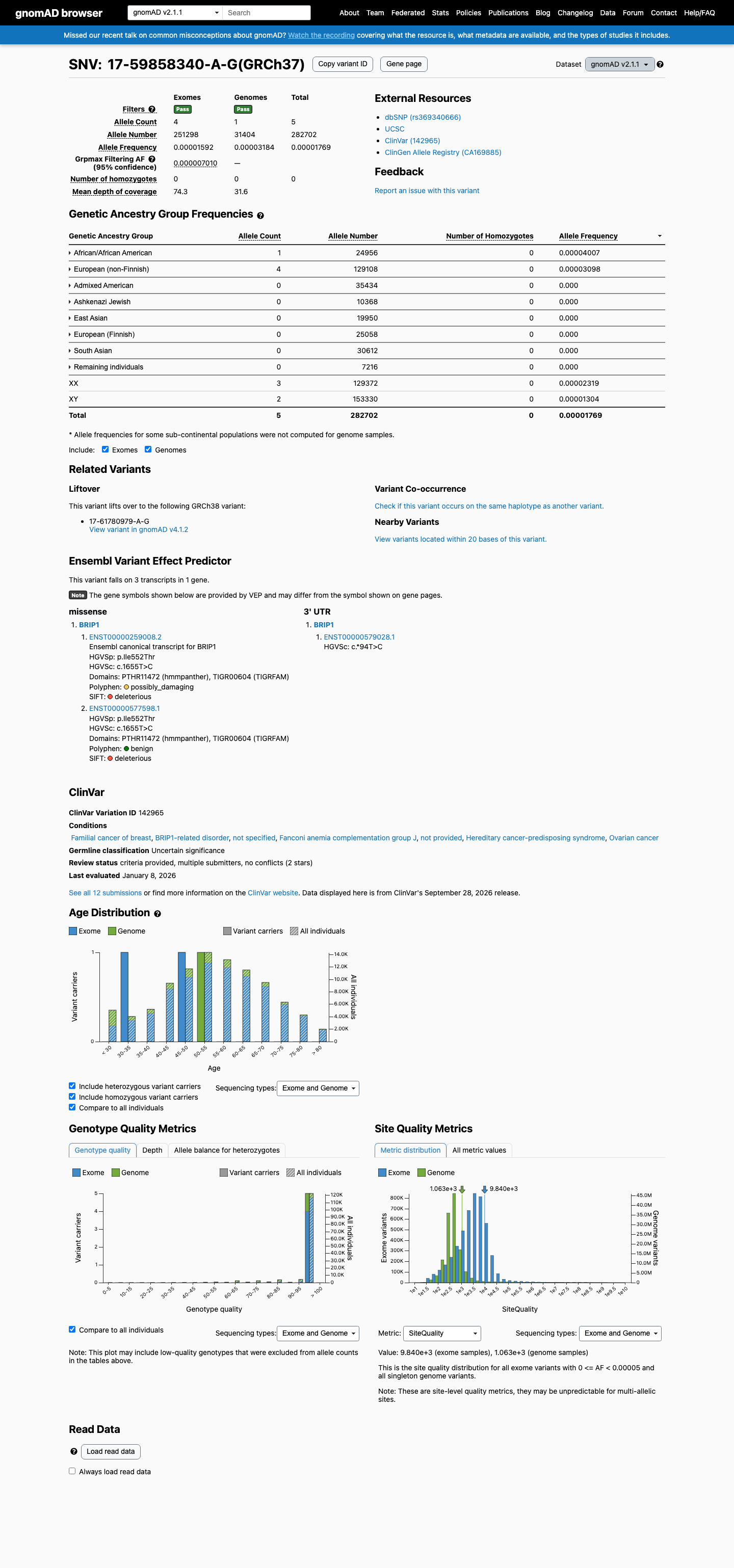
gnomAD v2.1 screenshot
gnomAD v2.1
v4.1
This variant is present in gnomAD v4.1 (AF= 5.5764e-05; MAF= 0.00558%, 90/1613944 alleles, homozygotes = 0) and has highest observed frequency in the Remaining individuals population (AF= 0.00012802; MAF= 0.01280%, 8/62490 alleles, homozygotes = 0); grpmax FAF= 5.71e-05.
v2.1
This variant is present in gnomAD v2.1 (AF= 1.76865e-05; MAF= 0.00177%, 5/282702 alleles, homozygotes = 0) and has highest observed frequency in the African/African American population (AF= 4.00705e-05; MAF= 0.00401%, 1/24956 alleles, homozygotes = 0); grpmax FAF= 7.01e-06.
🇨🇦 CA
Not available in gnomAD-Canada v1.0.
Allele frequency by ancestry
three datasets · side by side
gnomAD v4.1
0.0056% · 90 / 1,613,944
0 hom · FAF 0.0057%
Remaining individuals
8 / 62,490
0.013%
European (non-Finnish)
82 / 1,180,032
0.0069%
+ 8 not observed (Admixed American, European (Finnish), Amish, East Asian, Middle Eastern, South Asian, Ashkenazi Jewish, African/African American)
gnomAD v2.1
0.0018% · 5 / 282,702
0 hom · FAF 0.0007%
African/African American
1 / 24,956
0.004%
European (non-Finnish)
4 / 129,108
0.0031%
+ 6 not observed (Admixed American, Ashkenazi Jewish, East Asian, European (Finnish), Remaining individuals, South Asian)
gnomAD Canada 🇨🇦
Absent · 0 / ?
0 hom
Not observed in any ancestry group.
ClinVar screenshot
ClinVar
This variant has been reported in ClinVar as Uncertain significance (12 clinical laboratories). (ClinVarID = 142965)
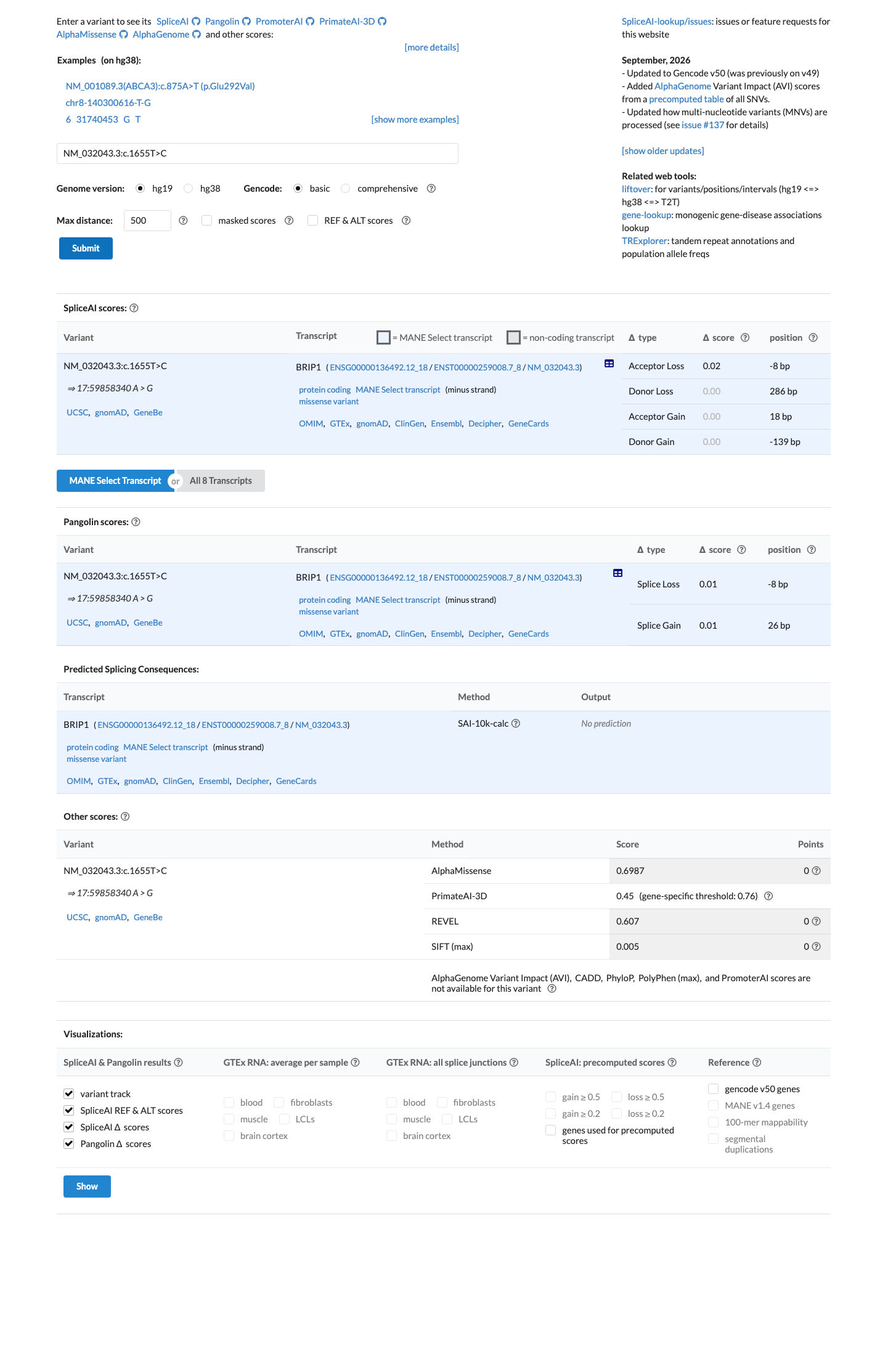
SpliceAI screenshot
In silico
SpliceAI predicts no significant splice impact for this variant (max delta score = 0.02). REVEL score = 0.607. BayesDel score = 0.0109582.
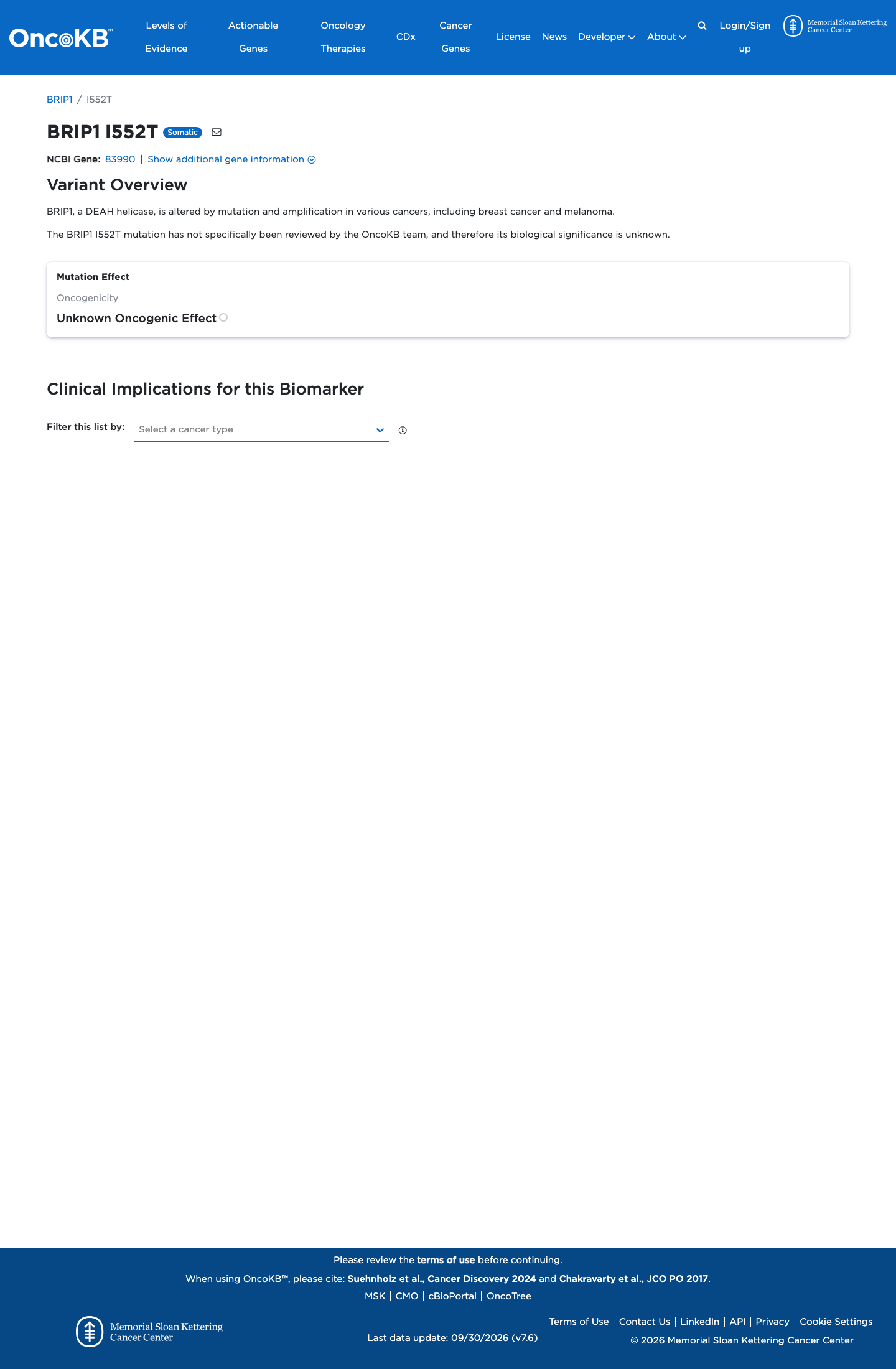
Functional / OncoKB screenshot
Functional Unknown Oncogenic Effect
OncoKB did not identify variant-specific reviewed functional evidence for this variant; gene-level curated context is available for reviewer follow-up. BRIP1, a DEAH helicase, is altered by mutation and amplification in various cancers, including breast cancer and melanoma.
OncoKB ↗
COSMIC screenshot
COSMIC
Cancer hotspots screenshot
Cancer hotspots
Somatic evidence Not in COSMIC / hotspots
COSMIC
This variant does not lie in a statistically significant hotspot. This variant has not previously been reported in somatic cancers (COSMIC).
Hotspots
This variant does not lie in a statistically significant hotspot.
Literature · how each cited paper was used
2papers cited
Each card is an audit: what was searched, what was found, whether it names the variant, which criteria it fed, and why. 7 further PMIDs triaged but not cited — see Sources & references.
Standards and guidelines for the interpretation of sequence variants: a joint consensus recommendation of the American College of Medical Genetics and Genomics and the Association for Molecular Pathology.
Found
the threshold source supplied with the calibration is ACMG/AMP 2015 (PMID:25741868).
Applied to
→PM2 supporting
Rule & framework references · cited for criterion definitions, not variant evidence
18163131 ↗ The emerging landscape of breast cancer susceptibility.
Sources & reference links
8Sources
ClinVar
gnomAD v2.1
gnomAD v4.1
gnomAD-Canada
SpliceAI
OncoKB
COSMIC
Cancer hotspots
Triaged references · 7 PMIDs not cited in assessment
26467025 ↗ A Standardized DNA Variant Scoring System for Pathogenicity Assessments in Mendelian Disorders. CLINVAR
26689913 ↗ Patterns and functional implications of rare germline variants across 12 cancer types. CLINVAR
28135145 ↗ Cancer Susceptibility Gene Mutations in Individuals With Colorectal Cancer. CLINVAR
34326862 ↗ Analysis of Sequence and Copy Number Variants in Canadian Patient Cohort With Familial Cancer Syndromes Using a Unique Next Generation Sequencing Based Approach. CLINVAR
15604628 ↗ Genetic cancer risk assessment and counseling: recommendations of the national society of genetic counselors. CLINVAR
25980754 ↗ Identification of a Variety of Mutations in Cancer Predisposition Genes in Patients With Suspected Lynch Syndrome. CLINVAR
28492532 ↗ Sherloc: a comprehensive refinement of the ACMG-AMP variant classification criteria. CLINVAR