0%
complete
Final classification
Likely Benign
BS1BP4
BRIP1
c.3459T>C
p.Asp1153=
synonymous · exon 20

BRIP1 encodes a helicase enzyme that partners with the BRCA1 protein to repair double-strand breaks in DNA, a process essential for maintaining genome stability. Germline mutations in this gene predispose carriers to ovarian cancer, and inheriting two faulty copies causes Fanconi anemia complementation group J, a rare disorder of impaired DNA repair. BRIP1 acts as a tumor suppressor, so loss of its function raises cancer risk, particularly in the ovary.

This variant

BRIP1's tumor-suppressor role in BRCA1-partnered DNA repair means loss-of-function variants raise ovarian-cancer risk. This synonymous variant (p.Asp1153=) shows no predicted splice effect and is carried at 1.62% in the gnomAD Middle Eastern population, indicating BRIP1 function is not impaired. The Likely Benign classification therefore carries no evidence of increased cancer risk.

Transcript
NM_032043.3
HGVS · transcript:coding
NM_032043.3:c.3459T>C
GRCh38
chr17:61683587 A>G
GRCh37
chr17:59760948 A>G
No BRIP1 VCEP or gene-specific framework was available, so generic ACMG/AMP 2015 rules were applied; BS1 (Strong) plus BP4 (Supporting) yields Likely Benign.
Classification rationale
BS1BP4 Likely Benign
BRIP1 c.3459T>C synonymous · exon 20

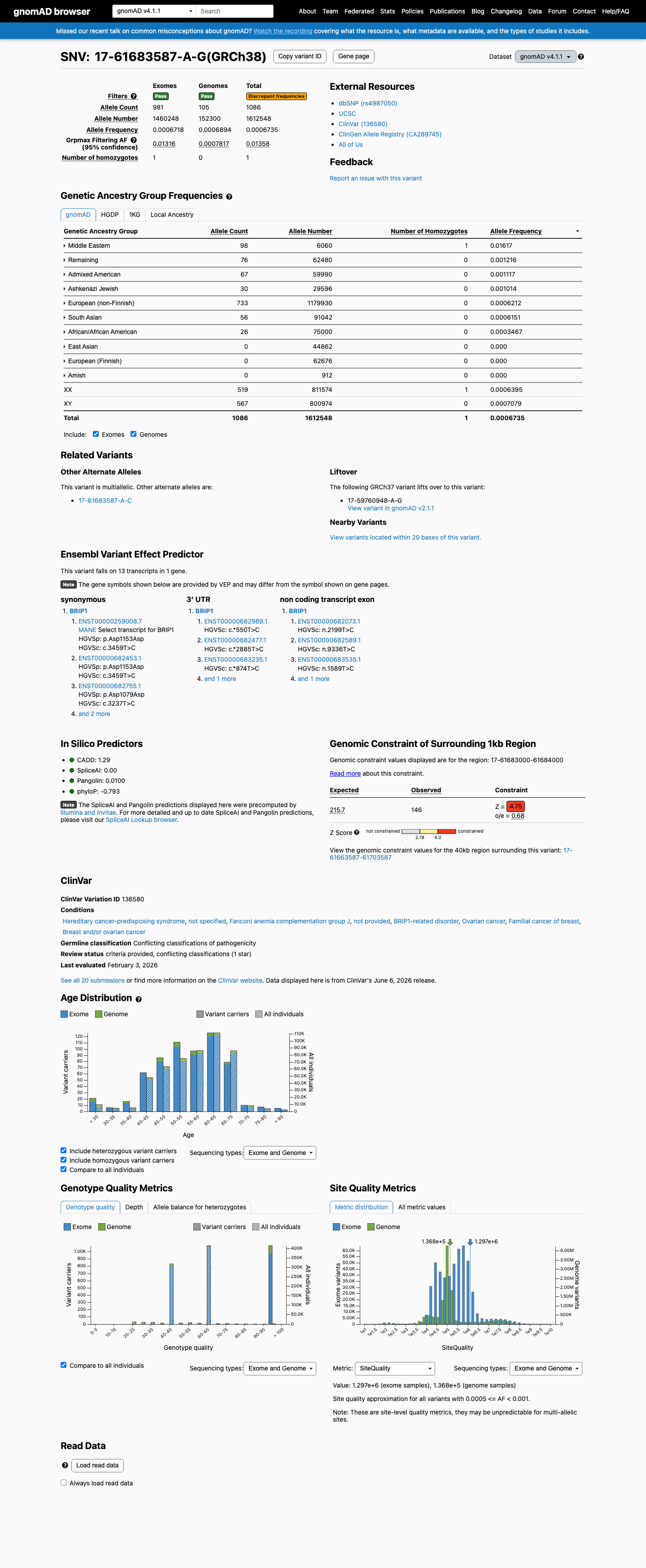
BS1 (Strong): 1.62% allele frequency in gnomAD v4.1 Middle Eastern exceeds the >0.3% threshold for benign population frequency. BP4 (Supporting): SpliceAI maximum delta 0.004 is below the 0.1 threshold, indicating no predicted splice impact. Final: Likely Benign by generic ACMG/AMP 2015 combination rules (BS1 Strong + BP4 Supporting).

BS1 + BP4 Likely Benign
Gene diagram · NM_032043.3 · variants mapped to exon structure
BRIP1 NM_032043.3
Fetching transcript structure from UCSC…
Applied criteria · 2 applied · 18 assessed
MetEvidence satisfies this criterion.
Not metEvaluated against available evidence; threshold not reached.
Not assessedApplies in principle, but no evidence was found to evaluate it.
N/ADoesn't apply to this variant type.
Applied · 2
Strength Supporting Moderate Strong Very strong
BS1 strong Benign
Met (Strong): 1.62% frequency in gnomAD v4.1 Middle Eastern exceeds the >0.3% benign-population threshold.
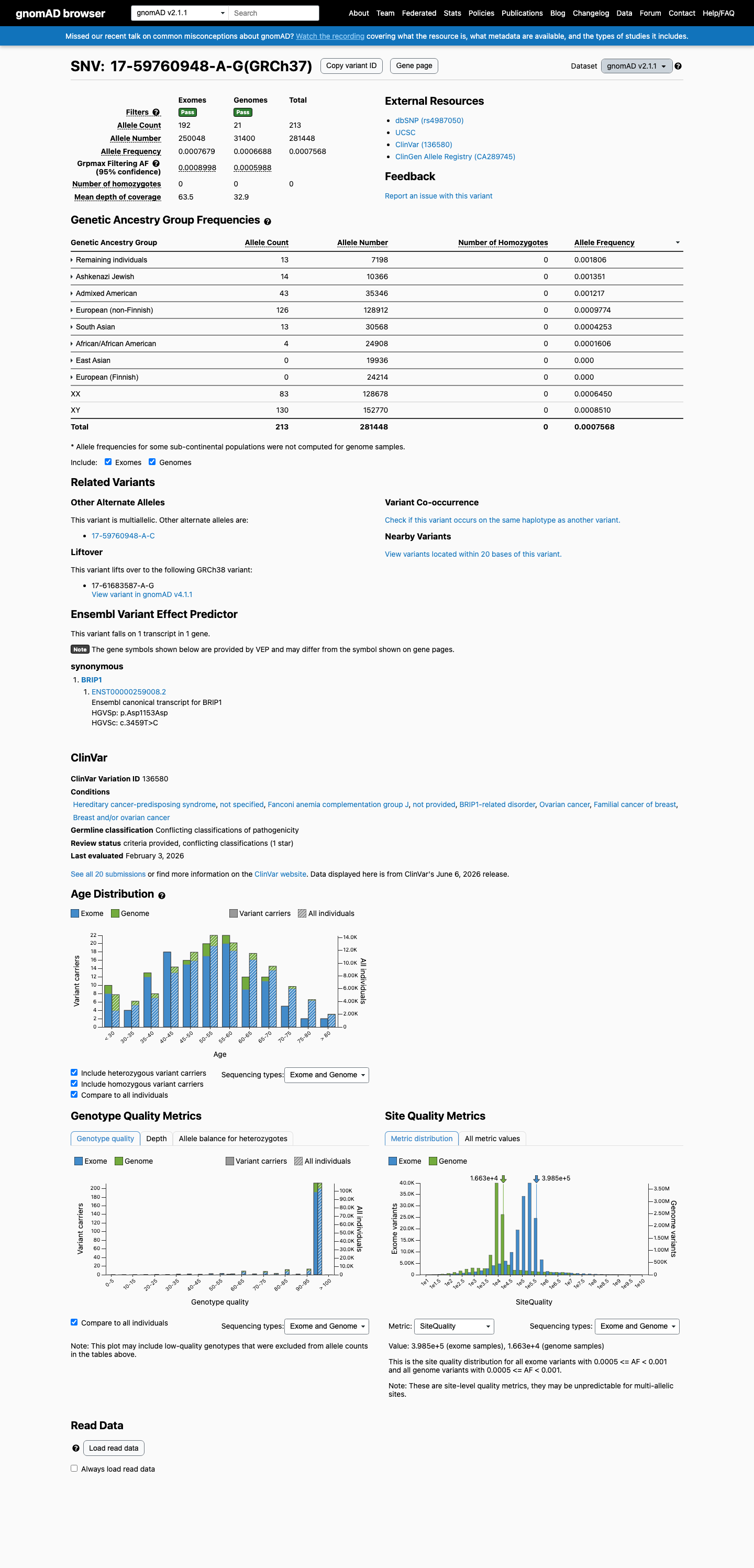
gnomAD v4.1 Middle Eastern group: 98/6060 alleles, AF 0.0161716 (1.61716%), one homozygote; joint grpmax FAF 0.0135815 (1.35815%).gnomAD v4.1 overall AF is 0.000673468 (0.06735%); gnomAD v2.1 overall AF is 0.000756801 (0.07568%); gnomAD-Canada AF is 0.00146612 (0.14661%). These pooled values are lower because of ancestry mixing and do not negate the much higher Middle Eastern subgroup frequency.Local non-VCEP operating convention for BS1 is AF >0.3%; the Middle Eastern gnomAD v4.1 frequency exceeds this threshold by more than fivefold.
BP4 supporting Benign
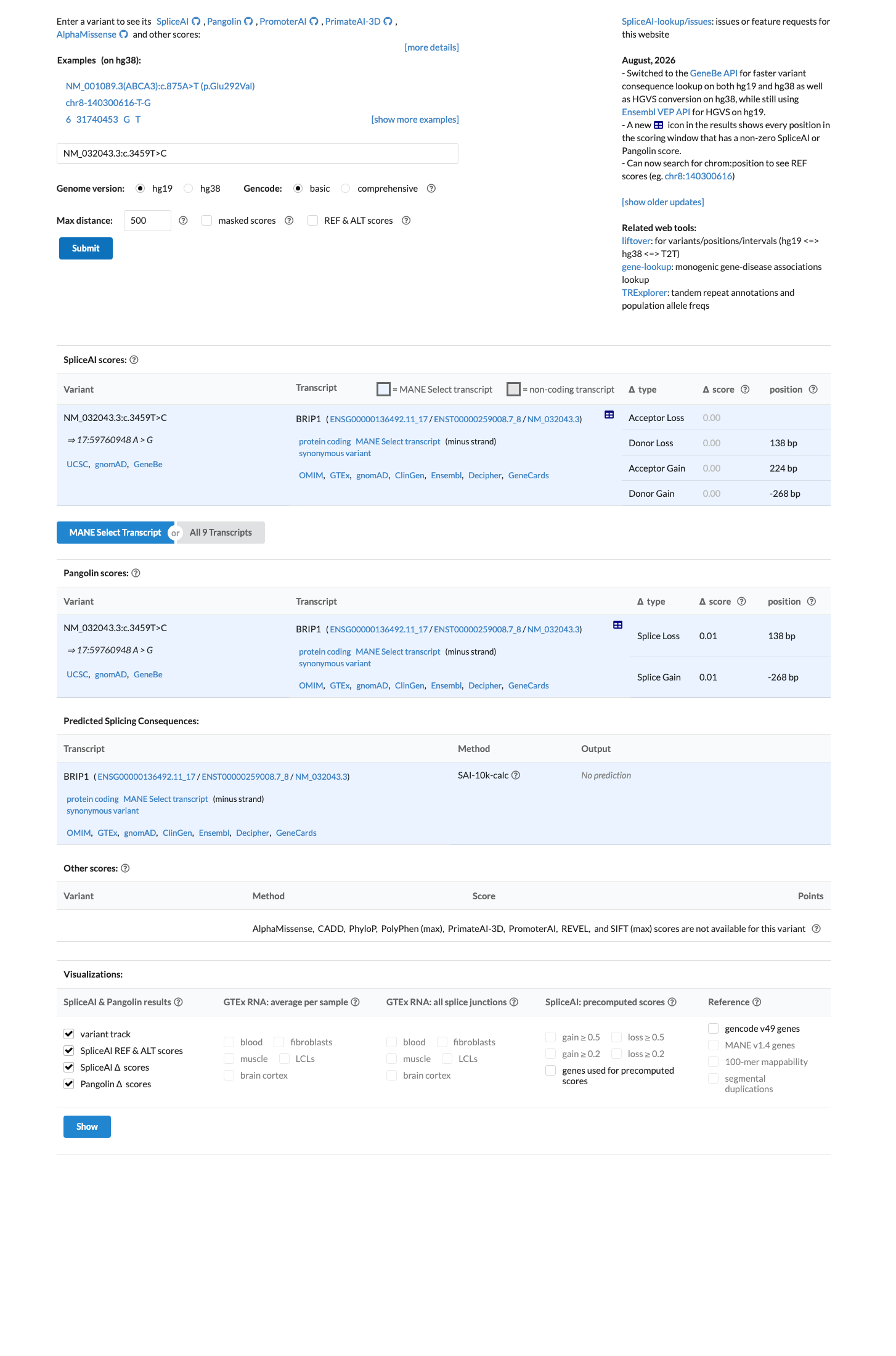
Met (Supporting): SpliceAI maximum delta 0.004 is below the 0.1 no-splice-impact threshold.
SpliceAI reports DS_AG 0.001, DS_AL 0.000, DS_DG 0.004, and DS_DL 0.004; maximum delta score is 0.004 for NM_032043.3:c.3459T>C.The retrieved generic ACMG/AMP fallback designates SpliceAI as the single computational mechanism for synonymous variants and assigns BP4 supporting when maximum delta score is less than 0.1; the observed maximum delta score is 0.004.No BRIP1 VCEP specification, gene-specific PP3/BP4 lookup, or pre-assigned computational code was retrieved.
Assessed · not applied · 5 not met · 13 not assessed
Pathogenic
PS2 Not assessed: no confirmed de novo occurrence with informative parental testing was documented.
PS3 Not assessed: no validated functional assay evidence reporting this variant was identified.
PS4 Not assessed: no case-control data, affected counts, or enrichment statistics for this variant were available.
PM2 Not met: the highest relevant population frequency is 1.62% (gnomAD v4.1 Middle Eastern), exceeding the <0.1% PM2 threshold.
PM3 Not assessed: no second pathogenic allele, phasing result, or in-trans evidence was documented.
PM6 Not assessed: no evidence of presumed de novo occurrence without confirmed parentage was documented.
PP1 Not assessed: no affected relatives, informative meioses, or segregation data were documented.
PP3 Not met: SpliceAI maximum delta 0.004 does not meet the splice-impact threshold.
PP4 Not assessed: no phenotype, age-of-onset, or family-history information for the tested individual was supplied.
PP5 Not met: ClinVar record 136580 has zero expert-panel submissions, so no expert-panel pathogenic assertion exists.
Benign
BA1 Not met: highest gnomAD v4.1 ancestry frequency is 1.62% (Middle Eastern), below the >5% stand-alone threshold.
BS2 Not assessed: gnomAD reports one homozygote, but aggregate data do not establish a clinically unaffected adult of relevant age.
BS3 Not assessed: no validated functional assay demonstrating a benign effect for this variant was identified.
BS4 Not assessed: no unaffected tested relatives were documented to evaluate non-segregation.
BP2 Not assessed: no data document the variant in cis with a pathogenic allele.
BP5 Not assessed: no phenotype information or alternate molecular diagnosis was available.
BP6 Not met: ClinVar record 136580 has zero expert-panel submissions, so no expert-panel benign assertion exists.
BP7 Not assessed: the no-splice-impact prediction was already counted under BP4, and no conservation evidence was available.
N/A · 8 PVS1 · PS1 · PM1 · PM4 · PM5 · PP2 · BP1 · BP3
Research & evidence
Population frequency · supports benign
gnomAD v4.1 screenshot
gnomAD v4.1
gnomAD v2.1 screenshot
gnomAD v2.1
v4.1
This variant is present in gnomAD v4.1 (AF= 0.000673468; MAF= 0.06735%, 1086/1612548 alleles, homozygotes = 1) and has highest observed frequency in the Middle Eastern population (AF= 0.0161716; MAF= 1.61716%, 98/6060 alleles, homozygotes = 1); grpmax FAF= 0.0135815.
v2.1
This variant is present in gnomAD v2.1 (AF= 0.000756801; MAF= 0.07568%, 213/281448 alleles, homozygotes = 0) and has highest observed frequency in the Remaining individuals population (AF= 0.00180606; MAF= 0.18061%, 13/7198 alleles, homozygotes = 0); grpmax FAF= 0.00089984.
🇨🇦 CA
This variant is present in gnomAD-Canada v1.0 (AF= 0.0014661164205039096, 27/18416 alleles, homozygotes = 0).
Allele frequency by ancestry
three datasets · side by side
gnomAD v4.1
0.067% · 1086 / 1,612,548
1 hom · FAF 1.4%
Middle Eastern
98 / 6,060
1.6%
1 hom
Remaining individuals
76 / 62,480
0.12%
Admixed American
67 / 59,990
0.11%
Ashkenazi Jewish
30 / 29,596
0.1%
European (non-Finnish)
733 / 1,179,930
0.062%
South Asian
56 / 91,042
0.062%
African/African American
26 / 75,000
0.035%
+ 3 not observed (European (Finnish), Amish, East Asian)
gnomAD v2.1
0.076% · 213 / 281,448
0 hom · FAF 0.09%
Remaining individuals
13 / 7,198
0.18%
Ashkenazi Jewish
14 / 10,366
0.14%
Admixed American
43 / 35,346
0.12%
European (non-Finnish)
126 / 128,912
0.098%
South Asian
13 / 30,568
0.043%
African/African American
4 / 24,908
0.016%
+ 2 not observed (East Asian, European (Finnish))
gnomAD Canada 🇨🇦
0.15% · 27 / 18,416
0 hom · FAF 0.13%
Middle Eastern
1 / 144
0.69%
Remaining individuals
5 / 1,138
0.44%
African/African American
4 / 1,020
0.39%
Ashkenazi Jewish
2 / 832
0.24%
South Asian
3 / 1,362
0.22%
Latino/Admixed American
1 / 838
0.12%
European (non-Finnish)
11 / 11,736
0.094%
+ 2 not observed (East Asian, European (Finnish))
ClinVar screenshot
ClinVar
This variant has been reported in ClinVar as Likely benign (12 clinical laboratories) and as Benign (6 clinical laboratories) and as Uncertain significance (1 clinical laboratory). (ClinVarID = 136580)
SpliceAI screenshot
In silico
SpliceAI predicts no significant splice impact for this variant (max delta score = 0.00).
Functional / OncoKB screenshot
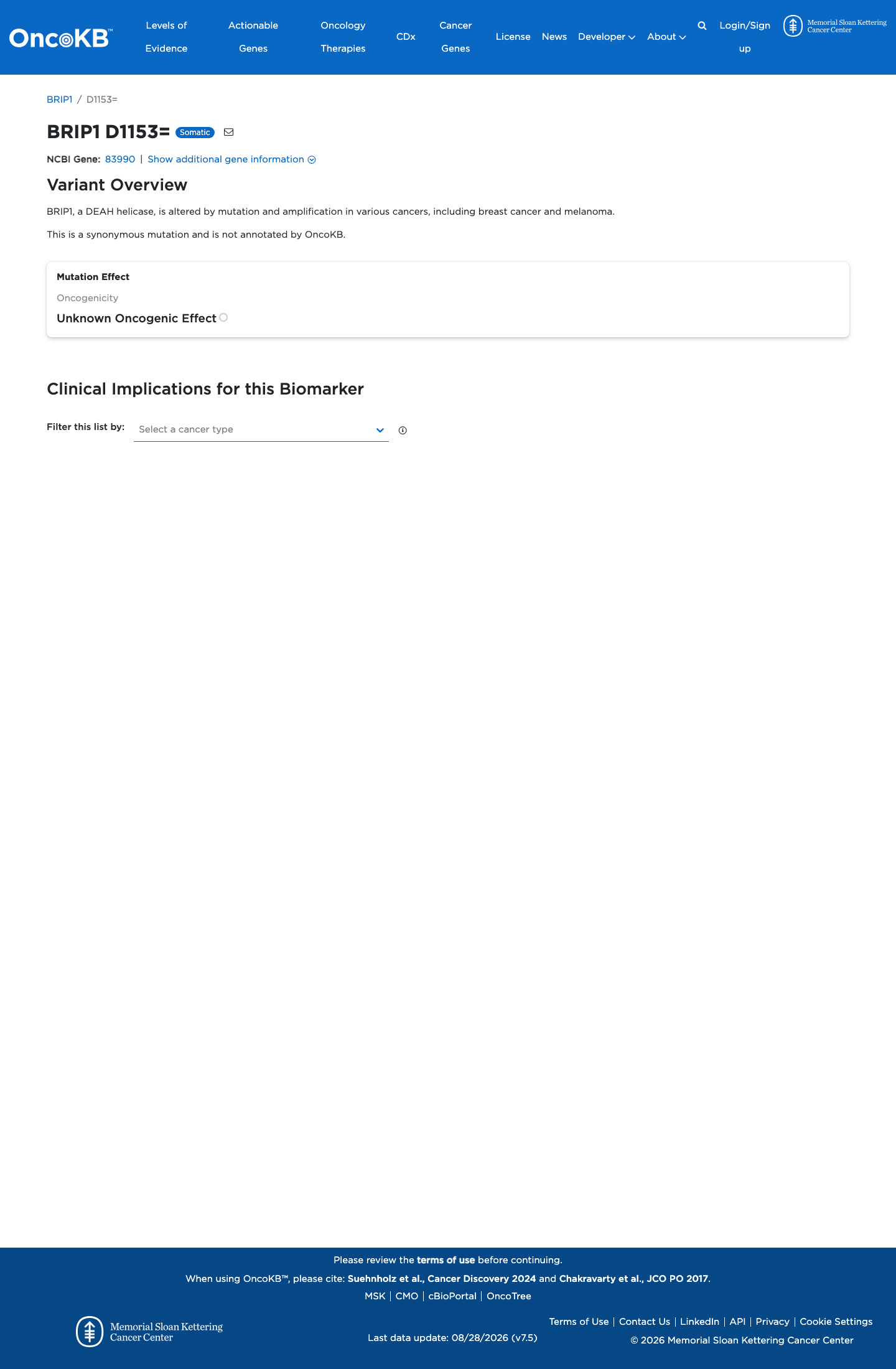
Functional Unknown Oncogenic Effect
OncoKB identified curated literature and non-variant-specific oncogenicity context for review; listed oncogenicity label: Unknown Oncogenic Effect.
OncoKB ↗
COSMIC screenshot
COSMIC
Cancer hotspots screenshot
Cancer hotspots
Somatic evidence Not in COSMIC / hotspots
COSMIC
This variant does not lie in a statistically significant hotspot. This variant has not previously been reported in somatic cancers (COSMIC).
Hotspots
This variant does not lie in a statistically significant hotspot.
Sources & reference links
8Sources
ClinVar
gnomAD v2.1
gnomAD v4.1
gnomAD-Canada
SpliceAI
OncoKB
COSMIC
Cancer hotspots
Triaged references · 8 PMIDs not cited in assessment
25741868 ↗ Standards and guidelines for the interpretation of sequence variants: a joint consensus recommendation of the American College of Medical Genetics and Genomics and the Association for Molecular Pathology. CLINVAR
26467025 ↗ A Standardized DNA Variant Scoring System for Pathogenicity Assessments in Mendelian Disorders. CLINVAR
24366376 ↗ Risk assessment, genetic counseling, and genetic testing for BRCA-related cancer in women: U.S. Preventive Services Task Force recommendation statement. CLINVAR
26389210 ↗ Genetics of Breast and Gynecologic Cancers (PDQ®): Health Professional Version. CLINVAR
34012068 ↗ ACMG SF v3.0 list for reporting of secondary findings in clinical exome and genome sequencing: a policy statement of the American College of Medical Genetics and Genomics (ACMG). CLINVAR
42258614 ↗ ATM-Related Cancer Predisposition. CLINVAR
22964825 ↗ Screening for ovarian cancer: U.S. Preventive Services Task Force reaffirmation recommendation statement. CLINVAR
28492532 ↗ Sherloc: a comprehensive refinement of the ACMG-AMP variant classification criteria. CLINVAR