BRIP1 encodes a helicase enzyme that partners with the BRCA1 protein to repair double-strand breaks in DNA, a process essential for maintaining genome stability. Germline mutations in this gene predispose carriers to ovarian cancer, and inheriting two faulty copies causes Fanconi anemia complementation group J, a rare disorder of impaired DNA repair. BRIP1 acts as a tumor suppressor, so loss of its function raises cancer risk, particularly in the ovary.
This variant
BRIP1 is a tumor-suppressor helicase that partners with BRCA1 to repair double-strand DNA breaks, and loss of its function predisposes carriers to ovarian cancer. This rare missense variant is classified as a VUS: in-silico evidence leans pathogenic, but without functional, segregation, or case-control data its impact on cancer risk cannot yet be established.
Transcript
NM_032043.3
HGVS · transcript:coding
NM_032043.3:c.2593C>T
GRCh38
chr17:61686148 G>A
GRCh37
chr17:59763509 G>A
BasisNo BRIP1-specific framework exists, so generic ACMG/AMP 2015 rules applied; only PM2 (supporting) and PP3 (moderate) were met, satisfying no combining rule, yielding a classification of VUS.▾
No BRIP1-specific framework exists, so generic ACMG/AMP 2015 rules applied; only PM2 (supporting) and PP3 (moderate) were met, satisfying no combining rule, yielding a classification of VUS.
Classification rationale
PM2PP3VUS
BRIP1 c.2593C>Tmissense · exon 19
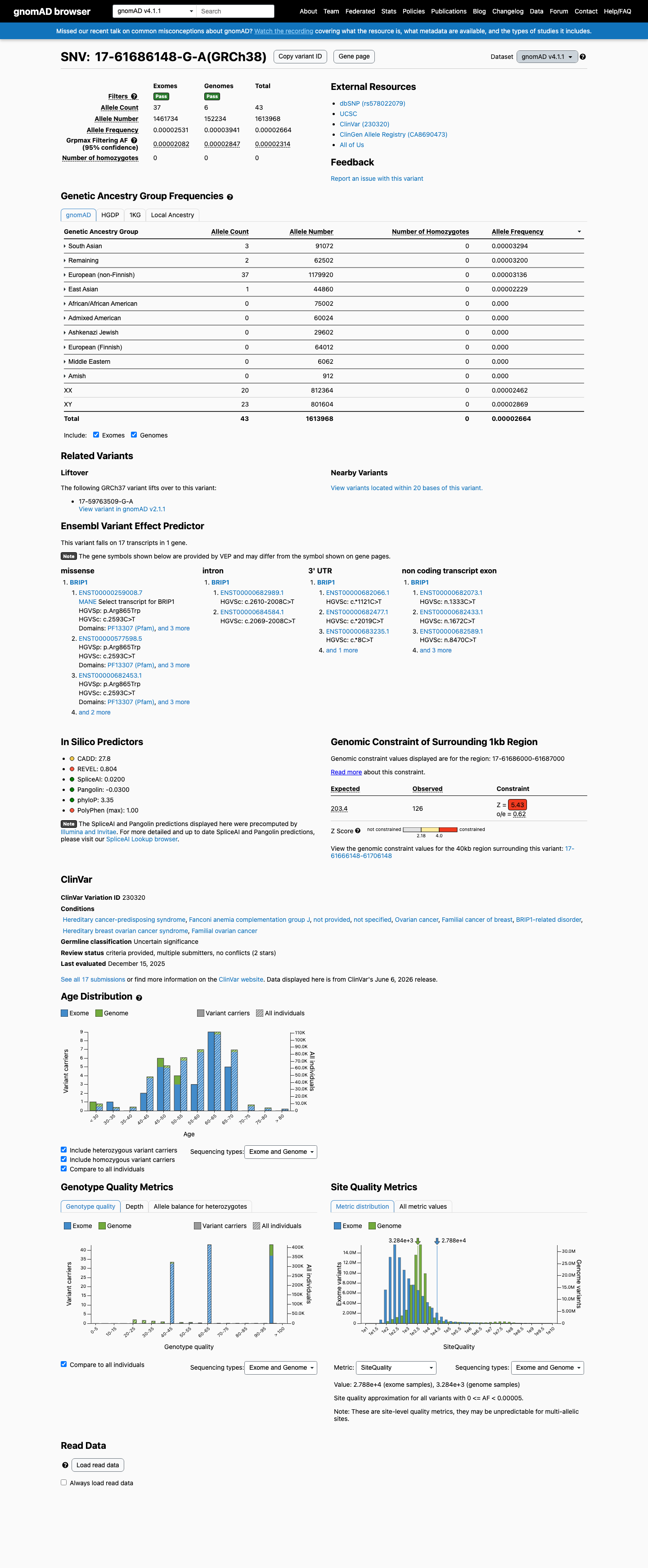
PM2 (Supporting): variant is present but extremely rare in gnomAD (v4.1 total allele frequency 2.66e-05), below the 0.1% rarity threshold. PP3 (Moderate): REVEL score 0.804 falls within the ClinGen-calibrated Pathogenic Moderate band (>=0.773). PM2 (supporting) plus PP3 (moderate) satisfies no generic ACMG/AMP 2015 combining rule, so the variant is classified as VUS.
PM2 + PP3→VUS
Gene diagram
· NM_032043.3 · variants mapped to exon structure
BRIP1NM_032043.3
Fetching transcript structure from UCSC…
Exons
—
Transcript span
—
Strand
—
Variants mapped
—
Source
UCSC ncbiRefSeqCurated
All variants in BRIP1—click a row to locate it on the plot · use the link column to open its page
Variant ↕
Protein
Location
Classification
Link
Applied criteria · 2 applied · 22 assessed
MetEvidence satisfies this criterion.
Not metEvaluated against available evidence; threshold not reached.
Not assessedApplies in principle, but no evidence was found to evaluate it.
N/ADoesn't apply to this variant type.
Applied · 2
Strength Supporting Moderate Strong Very strong
✓
PM2supportingPathogenic
Met (supporting): gnomAD v4.1 total allele frequency is 2.66e-05 (43/1,613,968), below the 0.1% PM2 threshold.
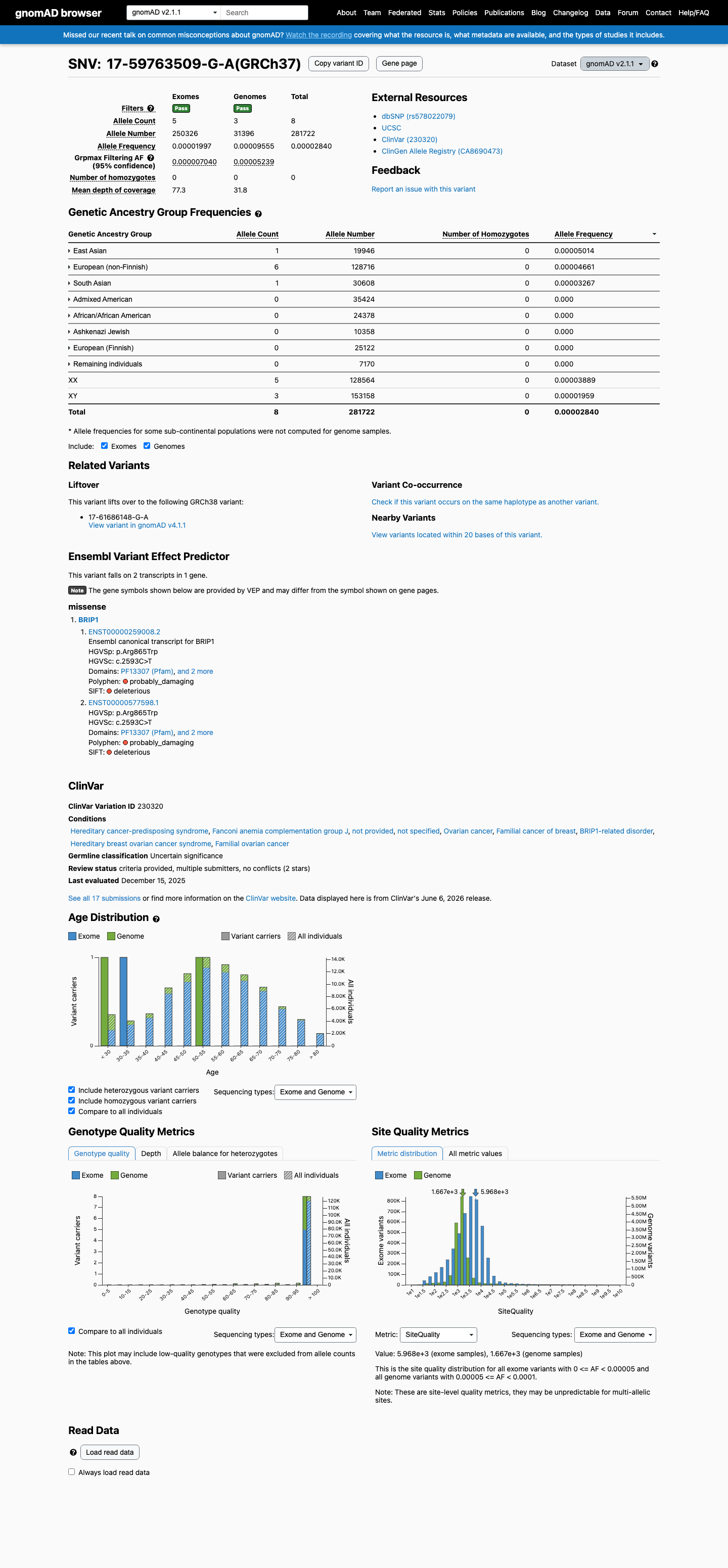
gnoMAD v4.1: 43/1,613,968 alleles (AF 2.66424e-05), South Asian 3/91,072 (AF 3.2941e-05), zero homozygotes, and grpmax FAF 2.314e-05.gnoMAD v2.1: 8/281,722 alleles (AF 2.83968e-05), zero homozygotes, and grpmax FAF 5.239e-05.gnomAD-Canada v1.0 reports the variant absent.
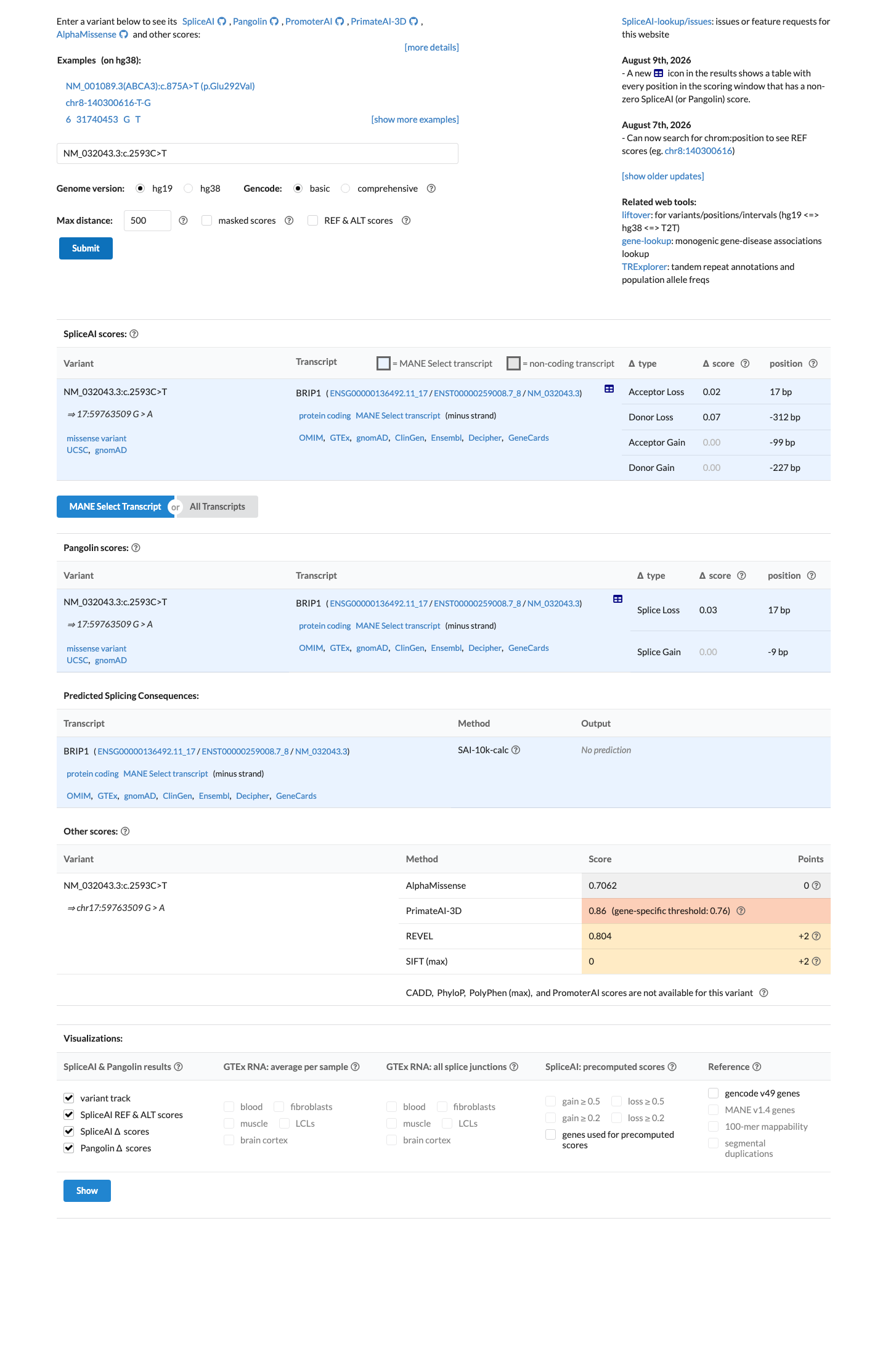
Met (moderate): REVEL score 0.804 falls in the ClinGen-calibrated Pathogenic Moderate band (>=0.773).
REVEL score = 0.804 for NM_032043.3:c.2593C>T (source_registry key 'revel'), meeting the ClinGen SVI calibrated Pathogenic-Moderate threshold (REVEL >= 0.773) from Pejaver et al. 2022, PMID 36413997.SpliceAI predicts no significant splice impact (max delta score = 0.066; DS_AG=0.001, DS_AL=0.021, DS_DG=0.002, DS_DL=0.066), indicating the splice-loss pathway is not activated and does not itself drive PP3.No CSPEC/VCEP-specific PP3/BP4 lookup spreadsheet exists for BRIP1 in this case (vcep_materials.json: files_found=[], summaries={}), so generic ACMG calibrated thresholds were applied.
Assessed · not applied
· 7 not met · 15 not assessed
Pathogenic
PS1Not assessed: no alternate nucleotide change producing the identical p.Arg865Trp change with an established pathogenic classification was available.
PS2Not assessed: no proband phenotype, parental genotypes, or parentage confirmation were available for this variant.
PS3Not assessed: no validated functional assay data on this variant were found in any cited publication.
PS4Not assessed: no case-control dataset reported carrier counts for this variant in affected individuals versus controls.
PM1Not met: Cancerhotspots.org returned no statistically significant hotspot at residue 865.
PM3Not assessed: no affected individual carrying this variant together with a second pathogenic BRIP1 allele was reported.
PM5Not assessed: no alternate missense change at codon 865 with an established pathogenic classification was identified.
PM6Not assessed: no report of this variant arising de novo in a proband with confirmed parental samples was available.
PP1Not assessed: no evaluable family segregation data were available.
PP2Not assessed: missense is a recognized BRIP1 disease mechanism, but no missense constraint metric was available.
PP4Not assessed: no proband phenotype data demonstrating specificity for a BRIP1-related disorder were available.
PP5Not met: the ClinVar record lacks expert-panel submissions and is classified as uncertain significance by laboratory submitters.
Benign
BA1Not met: highest gnomAD v4.1 population allele frequency is 3.29e-05, far below the 5% BA1 threshold.
BS1Not met: gnomAD allele frequencies (maximum 3.29e-05) are below the 0.3% BS1 threshold.
BS2Not assessed: no phenotype- and age-ascertained observations of this variant in healthy adults were available.
BS3Not assessed: no functional assay evidence of normal protein activity for this variant was found.
BS4Not assessed: the reported lack of co-segregation in one family was insufficiently documented to establish non-segregation.
BP1Not met: BRIP1 missense variants are an established disease mechanism, so missense cannot be presumed benign.
BP2Not assessed: no observation placed this variant in cis or trans with a pathogenic allele.
BP4Not met: REVEL 0.804 falls in the pathogenic direction, so no benign in-silico evidence applies.
BP5Not assessed: no data established that the phenotype is explained by an alternative molecular diagnosis.
BP6Not met: the ClinVar record has no expert-panel Benign/Likely benign assertion.
N/A · 4PVS1 · PM4 · BP3 · BP7
Research & evidence
Population frequency
gnomAD v4.1
gnomAD v2.1
v4.1
This variant is present in gnomAD v4.1 (AF= 2.66424e-05; MAF= 0.00266%, 43/1613968 alleles, homozygotes = 0) and has highest observed frequency in the South Asian population (AF= 3.2941e-05; MAF= 0.00329%, 3/91072 alleles, homozygotes = 0); grpmax FAF= 2.314e-05.
v2.1
This variant is present in gnomAD v2.1 (AF= 2.83968e-05; MAF= 0.00284%, 8/281722 alleles, homozygotes = 0) and has highest observed frequency in the East Asian population (AF= 5.01354e-05; MAF= 0.00501%, 1/19946 alleles, homozygotes = 0); grpmax FAF= 5.239e-05.
🇨🇦 CA
Absent from gnomAD-Canada v1.0.
Allele frequency by ancestry
three datasets · side by side
gnomAD v4.1
0.0027%
· 43 / 1,613,968
0 hom · FAF 0.0023%
South Asian
3 / 91,072
0.0033%
Remaining individuals
2 / 62,502
0.0032%
European (non-Finnish)
37 / 1,179,920
0.0031%
East Asian
1 / 44,860
0.0022%
+ 6 not observed (Admixed American, European (Finnish), Amish, Middle Eastern, Ashkenazi Jewish, African/African American)
gnomAD v2.1
0.0028%
· 8 / 281,722
0 hom · FAF 0.0052%
East Asian
1 / 19,946
0.005%
European (non-Finnish)
6 / 128,716
0.0047%
South Asian
1 / 30,608
0.0033%
+ 5 not observed (African/African American, Admixed American, Ashkenazi Jewish, European (Finnish), Remaining individuals)
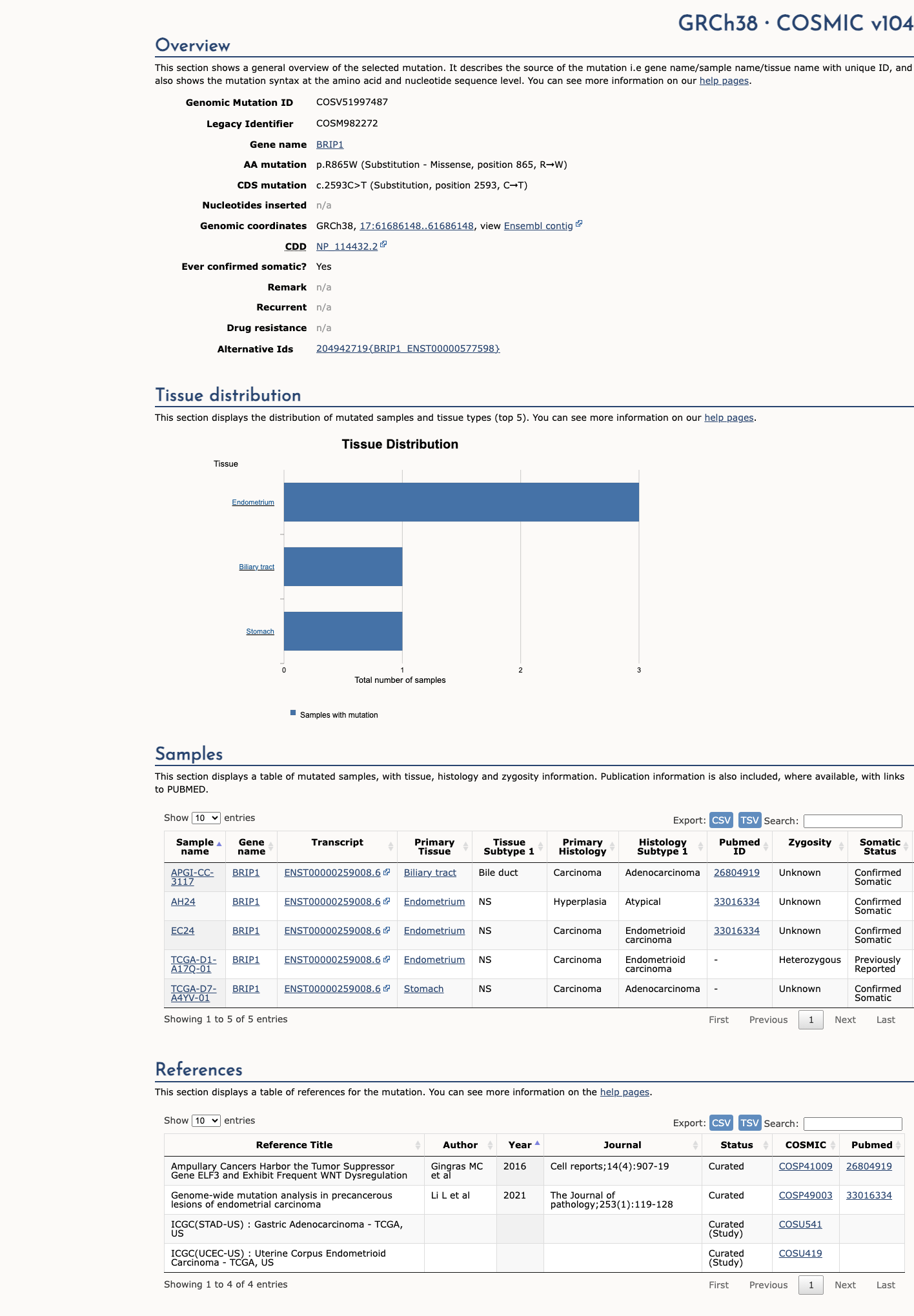
This variant does not lie in a statistically significant hotspot. This variant has previously been reported in somatic cancers (COSMIC; COSV51997487, n = 5 times).
Hotspots
This variant does not lie in a statistically significant hotspot.
Triaged references · 7 PMIDs not cited in assessment
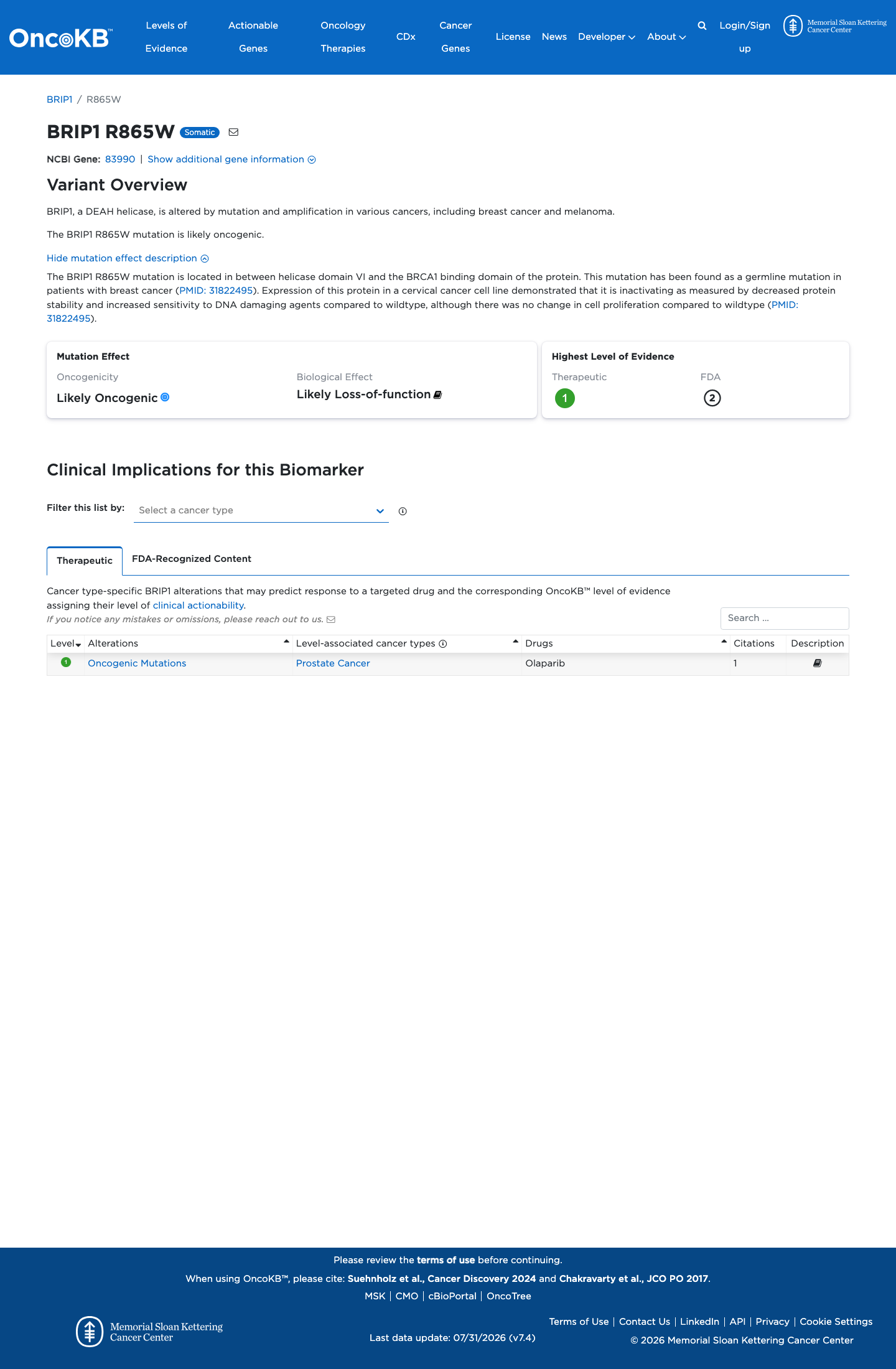
31822495 ↗Rare BRIP1 Missense Alleles Confer Risk for Ovarian and Breast Cancer.ONCOKB
25741868 ↗Standards and guidelines for the interpretation of sequence variants: a joint consensus recommendation of the American College of Medical Genetics and Genomics and the Association for Molecular Pathology.CLINVAR
26467025 ↗A Standardized DNA Variant Scoring System for Pathogenicity Assessments in Mendelian Disorders.CLINVAR
29368626 ↗BRIP1 loss-of-function mutations confer high risk for familial ovarian cancer, but not familial breast cancer.CLINVAR
17392385 ↗American Cancer Society guidelines for breast screening with MRI as an adjunct to mammography.CLINVAR
24366376 ↗Risk assessment, genetic counseling, and genetic testing for BRCA-related cancer in women: U.S. Preventive Services Task Force recommendation statement.CLINVAR
26324357 ↗American Society of Clinical Oncology Policy Statement Update: Genetic and Genomic Testing for Cancer Susceptibility.CLINVAR