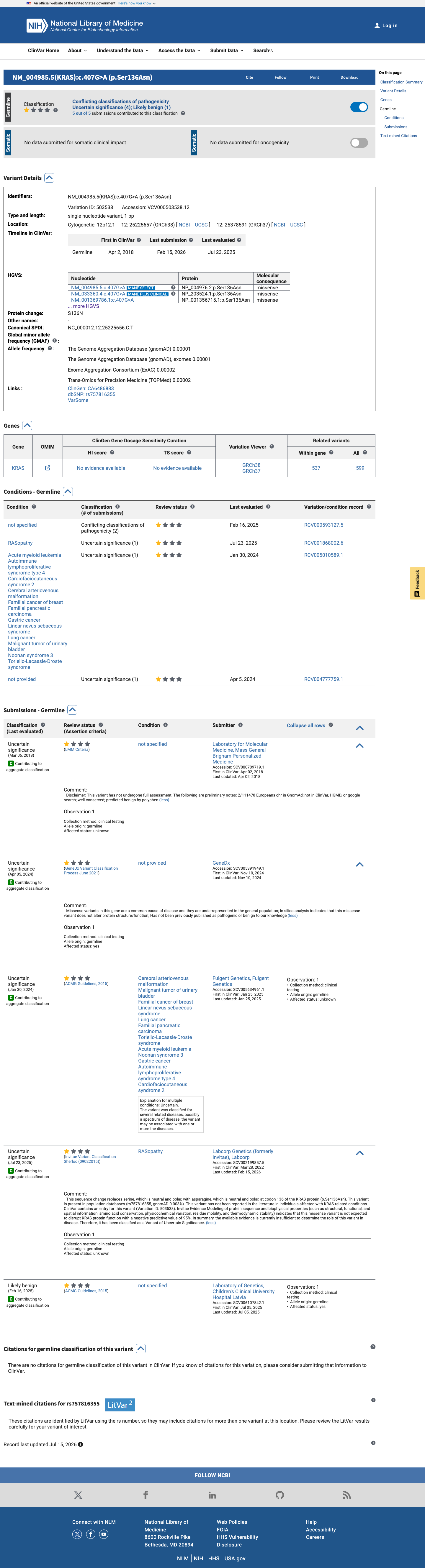
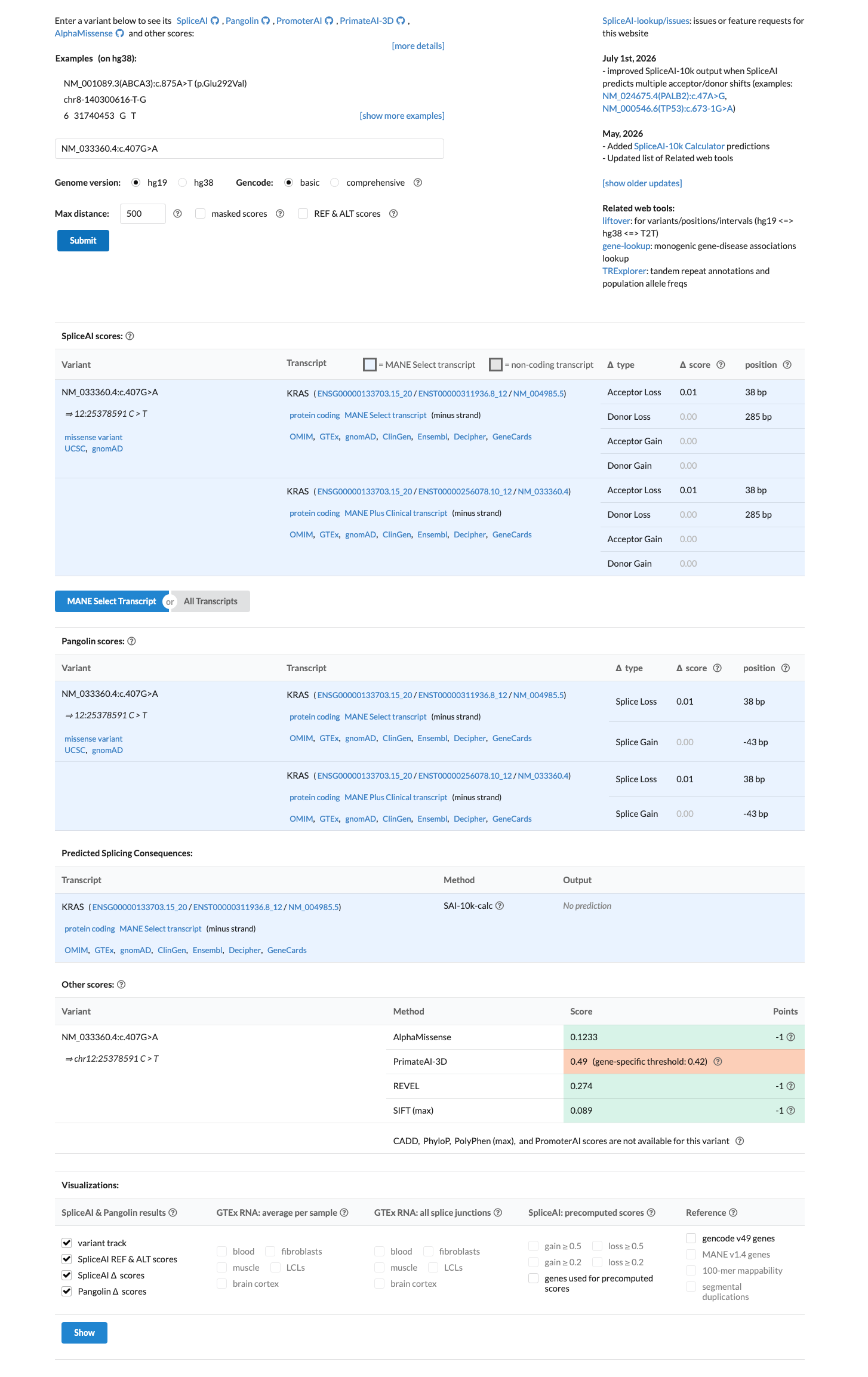
NM_033360.4:c.407G>A (p.Ser136Asn) is a missense variant in KRAS, a RASopathy gene. The variant is present in population databases (gnomAD v2.1: 3/251,172 alleles, AF=0.00119%; gnomAD v4.1: 11/1,613,106 alleles, AF=0.00068%), precluding application of PM2 (VCEP requires complete absence).1 The variant is located at codon 136, outside the VCEP-approved PM1 functional domains (P-loop residues 10-17, Switch I residues 25-40).2 No pathogenic variants have been established at this residue in KRAS, HRAS, or NRAS, precluding PM5 application.3 No de novo occurrences, segregation data, case-control studies, or functional characterization are available for this variant. PP2 is met at supporting strength per VCEP specification, as KRAS is a RASopathy gene where missense variants are a common disease mechanism with a low rate of benign missense variation.4 BP4 is met at supporting strength: multiple lines of computational evidence suggest no impact on the gene product (SpliceAI max delta 0.01, BayesDel -0.256, REVEL 0.274).5 ClinVar classifies this variant as Uncertain Significance (4 clinical laboratories) and Likely Benign (1 clinical laboratory).6
Final classification
Unclassified
PP2BP4
KRAS
c.407G>A
p.Ser136Asn
· exon NC_000012.11
This variant
NM_033360.4:c.407G>A (p.Ser136Asn) is a missense variant in KRAS, a RASopathy gene.
Classification rationale
PP2
BP4
Unclassified
KRAS c.407G>A
· exon NC_000012.11
PP2 + BP4
→
Unclassified
LYFE Sciences is an AI system, and it can make mistakes. Criteria
may be applied incorrectly, sources may be misread, and a confident-looking
classification can still be wrong. Double-check every criterion and
its underlying evidence before relying on any call.
Gene diagram
· NM_033360.4 · variants mapped to exon structure
KRAS
NM_033360.4
Fetching transcript structure from UCSC…
Applied criteria · 2 applied · 17 assessed
MetEvidence satisfies this criterion.
Not metEvaluated against available evidence; threshold not reached.
Not assessedApplies in principle, but no evidence was found to evaluate it.
N/ADoesn't apply to this variant type.
Applied · 2
Strength
Supporting
Moderate
Strong
Very strong
PP2
supporting
Pathogenic
Per RASopathy VCEP specification, PP2 is applicable to all RASopathy genes. KRAS has a low rate of benign missense variation and missense variants are a common mechanism of disease in RASopathies.
RASopathy VCEP: PP2 is applicable to all RASopathy genes described and curated
BP4
supporting
Benign
Multiple lines of computational evidence suggest no impact on the gene product. SpliceAI predicts no splice effect (max delta 0.01), BayesDel score is -0.256 (benign prediction), and REVEL score is 0.274 (below pathogenic threshold). Per VCEP caveat, BP4 can be used only once in any evaluation of a variant.
SpliceAI: max delta 0.01 (no splice impact)BayesDel: -0.256 (benign)REVEL: 0.274 (low
Assessed · not applied
· 17 not met · 0 not assessed
Pathogenic
PS1
No previously established pathogenic variant with the same amino acid change (p.Ser136Asn) has been identified in KRAS, HRAS, or NRAS per RASopathy VCEP criteria.
PS2
No de novo occurrence with confirmed paternity has been reported for NM_033360.4:c.407G>A in a patient with RASopathy and no family history.
PS3
The VCEP-approved functional studies for KRAS (RAS Activation, MEK Activation, ERK Activation assays) reference PMIDs 20949621 and 23059812 for assay validation.
PS4
No independent proband occurrences meeting RASopathy VCEP thresholds (>=1 for supporting, >=3 for moderate, >=5 for strong) have been identified.
PM1
Position p.Ser136 lies outside the VCEP-approved functional domains for PM1.
PM2
RASopathy VCEP requires complete absence from all population databases for PM2 application.
PM5
No pathogenic missense variant has been established at residue p.Ser136 in KRAS (or at the analogous residue in HRAS/NRAS) per RASopathy VCEP criteria.
PM6
No assumed de novo occurrence (without confirmation of paternity and maternity) has been reported for NM_033360.4:c.407G>A in RASopathy.
PP1
No co-segregation data available.
PP3
Multiple lines of computational evidence do not support a deleterious effect.
Benign
BA1
RASopathy VCEP BA1 threshold is allele frequency >=0.05%.
BS1
RASopathy VCEP BS1 threshold is allele frequency >=0.025%.
BS2
RASopathy VCEP specifies that general population data should not be used for BS2 due to variable expressivity and severity of RASopathies.
BS3
No VCEP-approved functional studies demonstrate a lack of damaging effect for p.Ser136Asn.
BS4
No segregation data demonstrating lack of segregation with RASopathy phenotype are available.
BP2
No observation of this variant in trans with a pathogenic variant for a fully penetrant dominant disorder, or in cis with a pathogenic variant in any inheritance pattern.
BP5
No evidence that this variant has been found in a case with an alternate molecular basis for RASopathy.
N/A · 6
PVS1 · PP4 · PP5 · BP1 · BP6 · BP7
Research & evidence
Population frequency
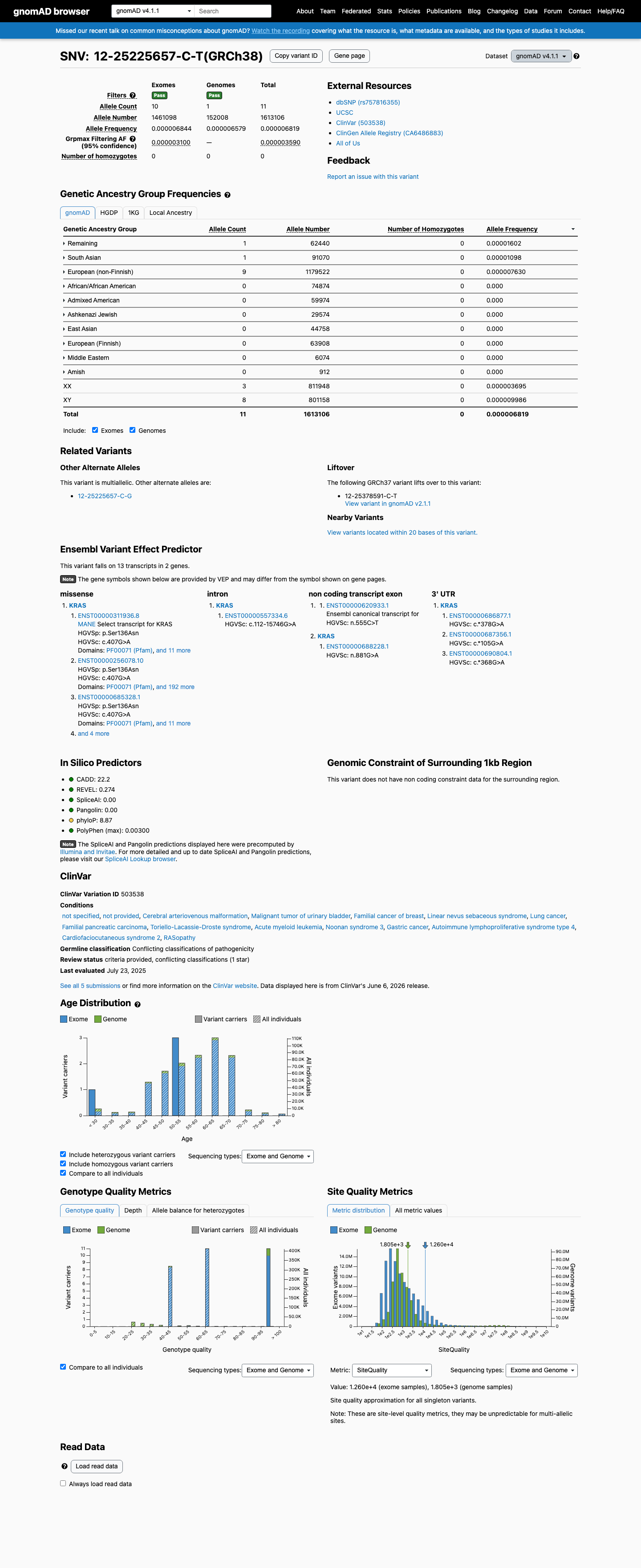
gnomAD v4.1
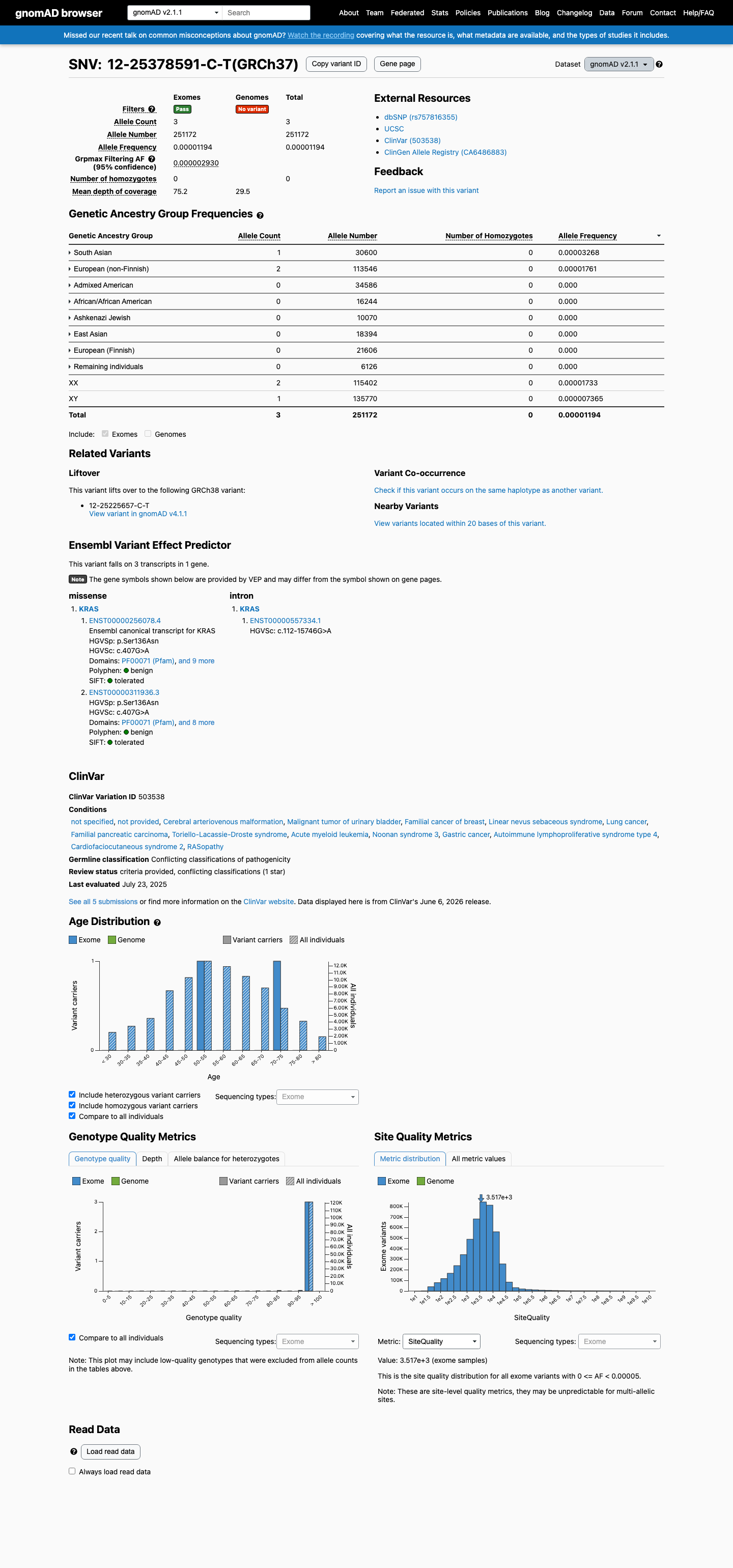
gnomAD v2.1
v4.1
This variant is present in gnomAD v4.1 (AF= 6.81914e-06; MAF= 0.00068%, 11/1613106 alleles, homozygotes = 0) and has highest observed frequency in the Remaining individuals population (AF= 1.60154e-05; MAF= 0.00160%, 1/62440 alleles, homozygotes = 0); grpmax FAF= 3.59e-06.
v2.1
This variant is present in gnomAD v2.1 (AF= 1.1944e-05; MAF= 0.00119%, 3/251172 alleles, homozygotes = 0) and has highest observed frequency in the South Asian population (AF= 3.26797e-05; MAF= 0.00327%, 1/30600 alleles, homozygotes = 0); grpmax FAF= 2.93e-06.
🇨🇦 CA
Absent from gnomAD-Canada v1.0.
Allele frequency by ancestry
three datasets · side by side
gnomAD v4.1
0.00068%
· 11 / 1,613,106
0 hom · FAF 0.00036%
0 hom · FAF 0.00036%
Remaining individuals 1 / 62,440 |
0.0016% |
South Asian 1 / 91,070 |
0.0011% |
European (non-Finnish) 9 / 1,179,522 |
0.00076% |
+ 7 not observed (Admixed American, European (Finnish), Amish, East Asian, Middle Eastern, Ashkenazi Jewish, African/African American)
gnomAD v2.1
0.0012%
· 3 / 251,172
0 hom · FAF 0.00029%
0 hom · FAF 0.00029%
South Asian 1 / 30,600 |
0.0033% |
European (non-Finnish) 2 / 113,546 |
0.0018% |
+ 6 not observed (African/African American, Admixed American, Ashkenazi Jewish, East Asian, European (Finnish), Remaining individuals)
gnomAD Canada 🇨🇦
Absent
· 0 / ?
0 hom
0 hom
Not observed in any ancestry group.
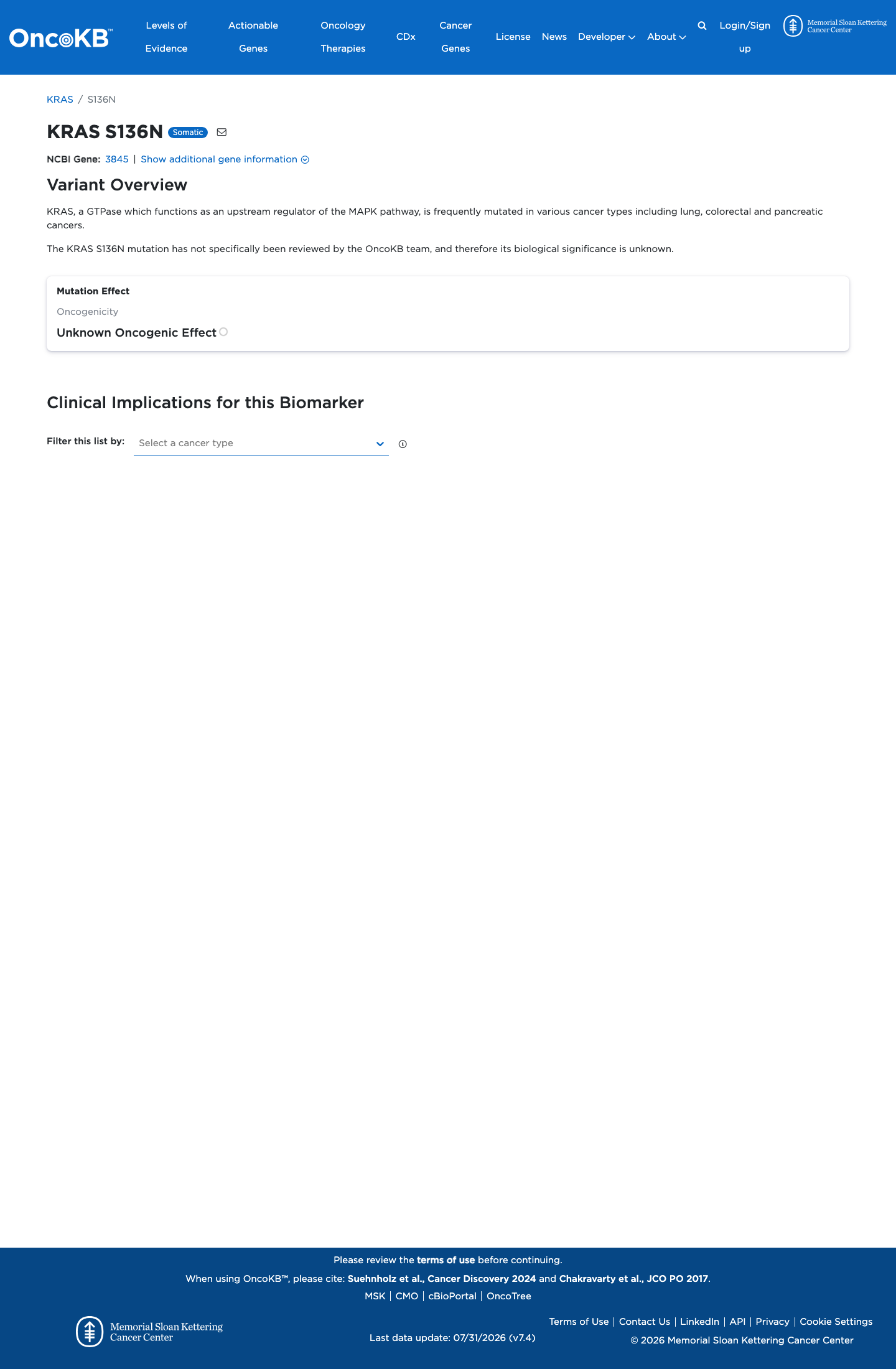
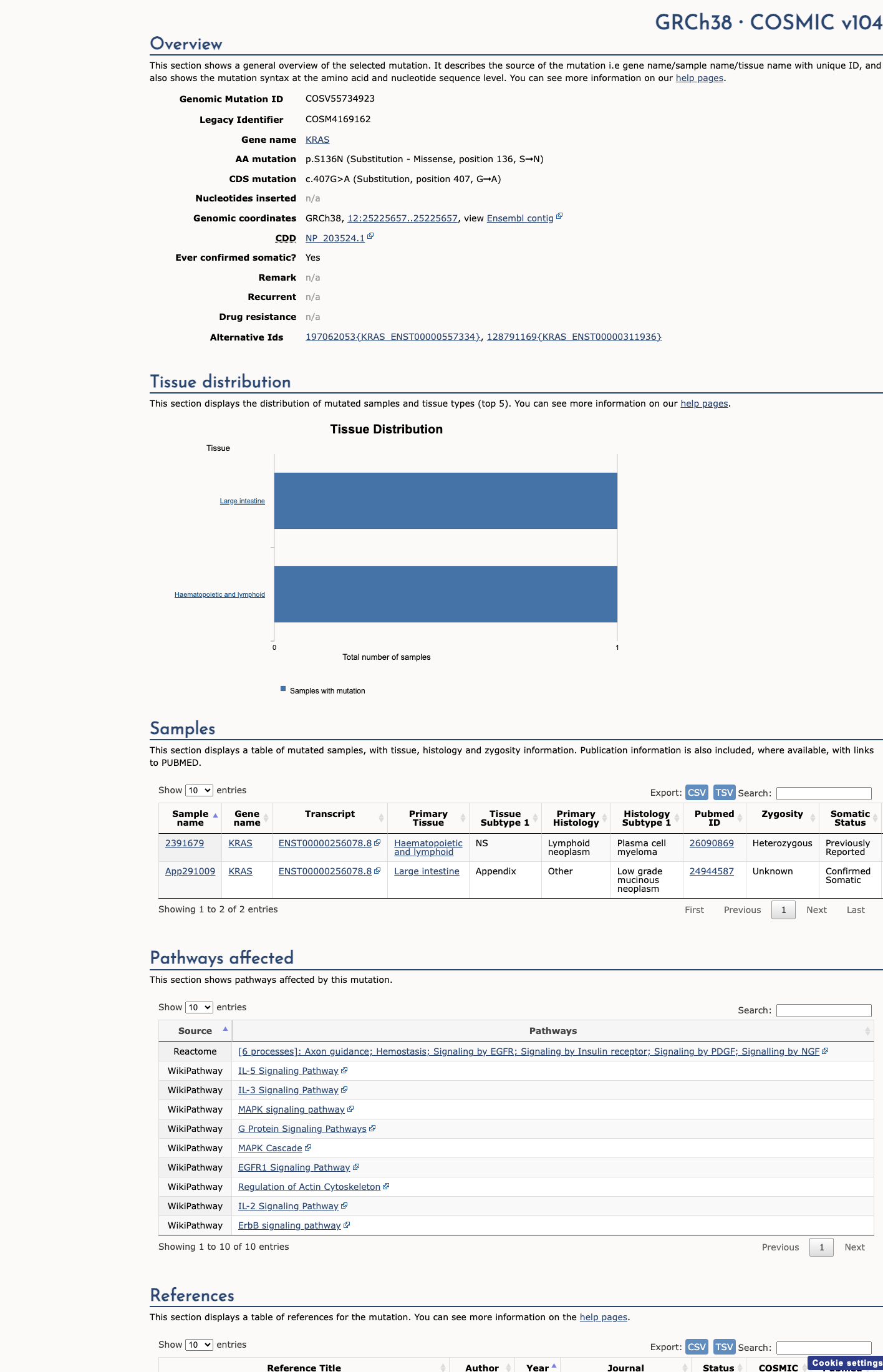
COSMIC

Cancer hotspots
Somatic evidence
Not in COSMIC / hotspots
COSMIC
In progress — evidence not uploaded yet.
Hotspots
This variant does not lie in a statistically significant hotspot.
Sources & reference links
9Sources
Triaged references · 7 PMIDs not cited in assessment
22138009 ↗
NCCN Task Force report: Evaluating the clinical utility of tumor markers in oncology.
CLINVAR
24033266 ↗
A systematic approach to assessing the clinical significance of genetic variants.
CLINVAR
25741868 ↗
Standards and guidelines for the interpretation of sequence variants: a joint consensus recommendation of the American College of Medical Genetics and Genomics and the Association for Molecular Pathology.
CLINVAR
15604628 ↗
Genetic cancer risk assessment and counseling: recommendations of the national society of genetic counselors.
CLINVAR
17508274 ↗
Risk assessment and genetic counseling for hereditary breast and ovarian cancer: recommendations of the National Society of Genetic Counselors.
CLINVAR
24366376 ↗
Risk assessment, genetic counseling, and genetic testing for BRCA-related cancer in women: U.S. Preventive Services Task Force recommendation statement.
CLINVAR