NM_033632.3:c.1394G>A (p.Arg465His) in FBXW7 is a missense variant in the WD40 substrate-recognition domain of this E3 ubiquitin ligase tumor suppressor. Two independent publications demonstrate that the R465H substitution severely impairs FBXW7 ubiquitin ligase activity: deficient in Notch1 ICD polyubiquitylation (PMID:17575125) and deficient in GRα polyubiquitylation (PMID:23228967), meeting PS3 at strong strength.1 Arg465 is located on the surface of the WD40 β-propeller, the substrate-binding pocket critical for FBXW7 function, in a statistically significant mutational hotspot, meeting PM1 at moderate strength.2 The variant is absent from gnomAD v2.1 (0/231,580 alleles) and v4.1 (0/1,593,060 alleles), meeting PM2 at supporting strength.3 REVEL in silico prediction score of 0.557 supports a deleterious effect, meeting PP3 at supporting strength.4 Applying generic ACMG/AMP 2015 combination rules: 1 strong (PS3) + 1 moderate (PM1) + 2 supporting (PM2, PP3) classifies this variant as Likely Pathogenic.5
Final classification
Likely Pathogenic
PS3PM1PM2PP3
FBXW7
c.1394G>A
p.Arg465His
This variant
NM_033632.3:c.1394G>A (p.Arg465His) in FBXW7 is a missense variant in the WD40 substrate-recognition domain of this E3 ubiquitin ligase tumor suppressor.
gene-specific framework lacked a usable explicit final combination framework, so generic ACMG/AMP 2015 final-combination rules were applied as fallback; applied criteria: PS3 strong, PM1 moderate, PM2 supporting, PP3 supporting; combination = 1 strong + 1 moderate + 2 supporting, which maps to Likely Pathogenic.
Classification rationale
PS3PM1PM2PP3
Likely Pathogenic
FBXW7 c.1394G>A
PS3 + PM1 + PM2 + PP3
→
Likely Pathogenic
4
revel
5
generic_acmg_combination_rules
LYFE Sciences is an AI system, and it can make mistakes. Criteria
may be applied incorrectly, sources may be misread, and a confident-looking
classification can still be wrong. Double-check every criterion and
its underlying evidence before relying on any call.
Gene diagram
· NM_033632.3 · variants mapped to exon structure
FBXW7
NM_033632.3
Fetching transcript structure from UCSC…
Applied criteria · 4 applied · 19 assessed
MetEvidence satisfies this criterion.
Not metEvaluated against available evidence; threshold not reached.
Not assessedApplies in principle, but no evidence was found to evaluate it.
N/ADoesn't apply to this variant type.
Applied · 4
Strength
Supporting
Moderate
Strong
Very strong
PS3
strong
Pathogenic
Two independent publications directly tested the R465H variant in functional assays and demonstrated unequivocal loss of E3 ubiquitin ligase function. PMID:17575125 showed R465H is severely deficient in Notch1 ICD polyubiquitylation and fails to suppress Notch1 signaling in a luciferase reporter assay. PMID:23228967 independently demonstrated R465H is severely deficient in polyubiquitylating GRα. Two independent studies testing the exact variant with unequivocal functional defect meets the strong strength threshold.
R465H mutant severely deficient in Notch1 ICD ubiquitylation vs wild-type hCdc4 (PMID:17575125Fig 1D)R465H mutant fails to suppress Notch1 transcriptional activity in luciferase reporter assay (PMID:17575125
PM1
moderate
Pathogenic
Arg465 is located on the surface of the WD40 β-propeller domain, the substrate-recognition pocket of FBXW7 critical for E3 ubiquitin ligase function. PMID:17575125 explicitly identifies Arg465 as a residue on the β-propeller surface essential for substrate recognition. The residue is in a statistically significant hotspot per cancerhotspots.org. The WD40 domain is a well-characterized functional domain without benign variation at structurally critical arginine positions.
Arg465 located on the surface of the WD40 β-propellerthe substrate-binding pocket (PMID:17575125)Residue in statistically significant hotspot (cancerhotspots.org)
PM2
supporting
Pathogenic
NM_033632.3:c.1394G>A is absent from gnomAD v2.1 (0/231,580 alleles) and gnomAD v4.1 (0/1,593,060 alleles), yielding an allele frequency of 0% in all populations. This is well below the PM2 threshold of <0.1% for a rare variant absent from population databases.
gnomAD v2.1: 0/231580 allelesAF=0.000%
PP3
supporting
Pathogenic
REVEL score of 0.557 exceeds the 0.5 threshold predictive of a damaging effect. BayesDel score of 0.112528 is below the typical 0.27 threshold and HCI prior is unavailable. SpliceAI predicts no splice impact (max delta=0.00). Despite mixed in silico results, the REVEL score provides one line of computational support for a deleterious effect.
REVEL: 0.557 (deleteriousabove 0.5 threshold)BayesDel: 0.112528 (below 0.27 deleterious threshold)
Assessed · not applied
· 12 not met · 7 not assessed
Pathogenic
PS1
No evidence of a different pathogenic amino acid change at codon 465 with established pathogenicity.
PS2
No de novo data (with confirmed paternity and maternity) is available for NM_033632.3:c.1394G>A in a germline context.
PS4
No case-control or cohort data for this variant in a germline disease context.
PM6
No de novo data (without confirmed parentage) is available for this variant.
PP1
No segregation data are available for this variant.
PP2
PP2 requires a gene with a low rate of benign missense variation where missense variants are a common disease mechanism.
PP4
No specific phenotype or clinical data for the proband are available to assess whether the patient's phenotype is specific for FBXW7-related disease.
PP5
ClinVar variation 4530533 is classified as 'Tier I - Strong' with review status 'criteria provided, single submitter' (1 star).
Benign
BA1
Variant is absent from gnomAD v2.1 (0/231,580 alleles) and v4.1 (0/1,593,060 alleles).
BS1
Variant is absent from gnomAD (AF=0%), well below the BS1 threshold of >0.3% allele frequency.
BS2
No data showing this variant observed in healthy adults with full penetrance expected at an early age.
BS3
Functional studies in PMID:17575125 and PMID:23228967 demonstrate that R465H impairs FBXW7 E3 ubiquitin ligase function, showing loss of function rather than normal function.
BS4
No segregation data available to evaluate lack of cosegregation with disease.
BP1
BP1 applies when a missense variant occurs in a gene where primarily truncating variants cause disease.
BP2
No data available showing this variant observed in trans with a pathogenic variant.
BP4
REVEL score of 0.557 predicts a deleterious effect, not a benign one.
BP5
BP5 is not applicable — the variant has been observed in somatic cancers (COSMIC: 311 entries, PMID:17575125: 3/26 T-ALL patients) and is classified as Likely Oncogenic by OncoKB.
BP6
ClinVar classification is pathogenic ('Tier I - Strong') by a single submitter (1 star).
BP7
BP7 applies to synonymous variants predicted to have no impact on splicing.
N/A · 5
PVS1 · PM3 · PM4 · PM5 · BP3
Research & evidence
Population frequency · supports pathogenic
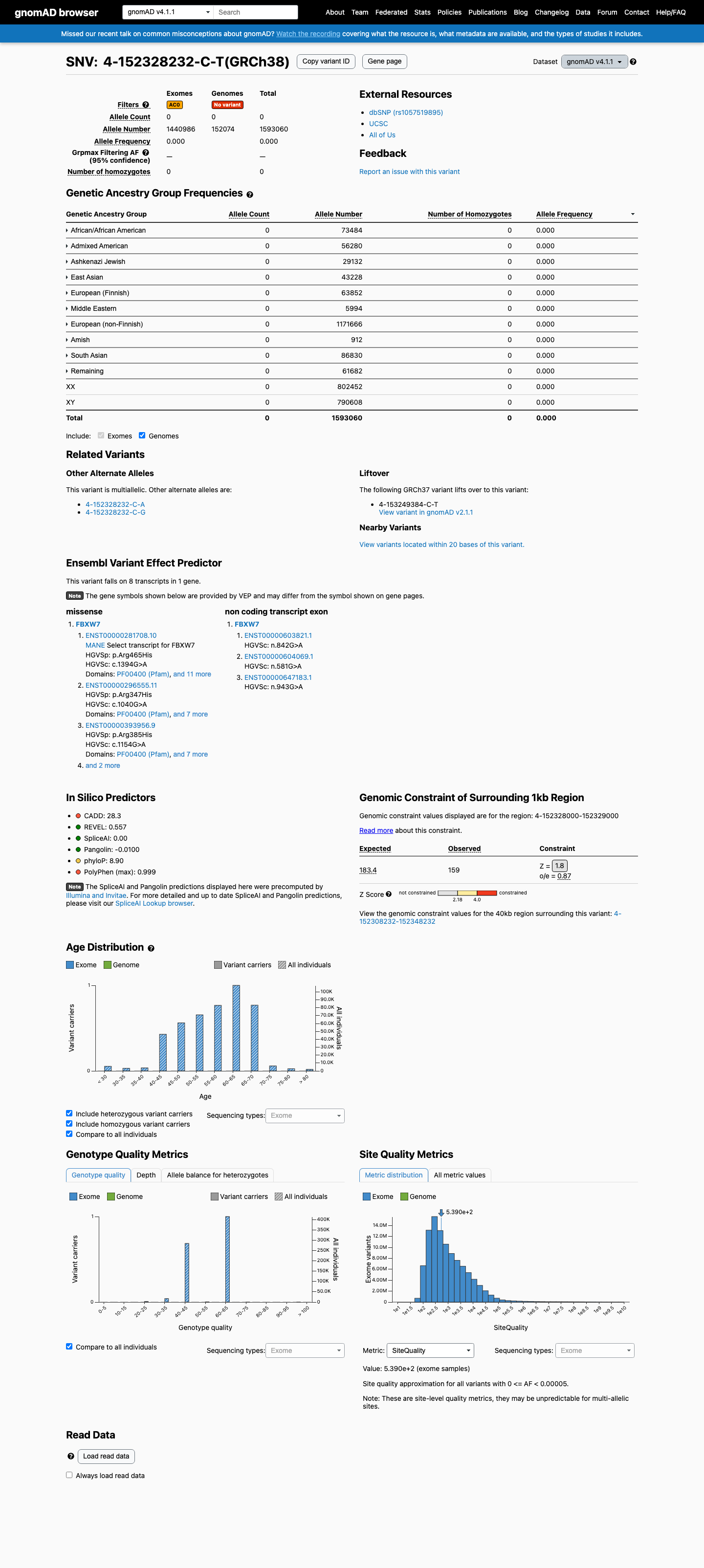
gnomAD v4.1
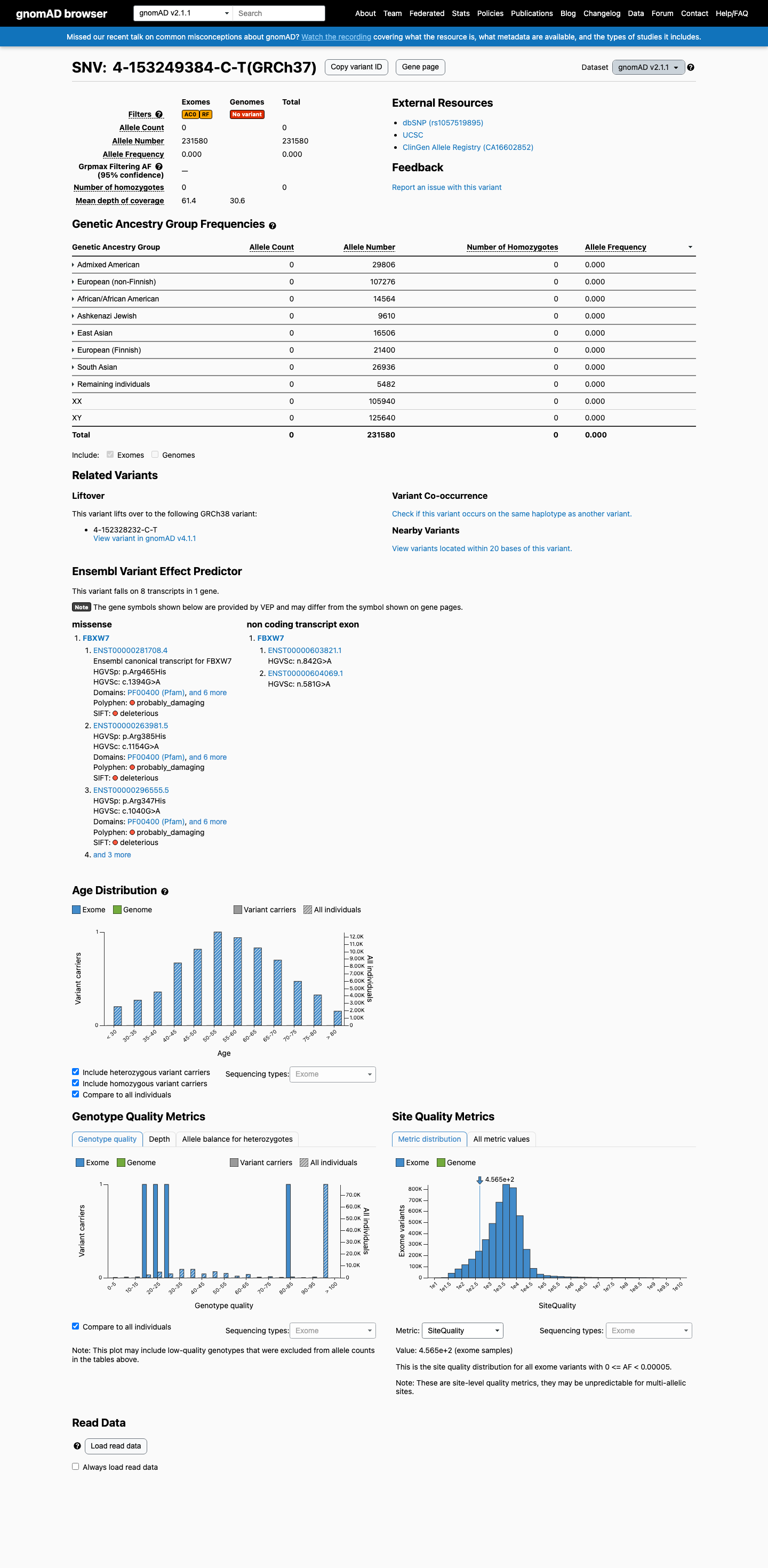
gnomAD v2.1
v4.1
This variant is present in gnomAD v4.1 (AF= 0; MAF= 0.00000%, 0/1593060 alleles, homozygotes = 0) and has highest observed frequency in the African/African American population (AF= 0; MAF= 0.00000%, 0/73484 alleles, homozygotes = 0).
v2.1
This variant is present in gnomAD v2.1 (AF= 0; MAF= 0.00000%, 0/231580 alleles, homozygotes = 0) and has highest observed frequency in the African/African American population (AF= 0; MAF= 0.00000%, 0/14564 alleles, homozygotes = 0).
🇨🇦 CA
Absent from gnomAD-Canada v1.0.
Allele frequency by ancestry
three datasets · side by side
gnomAD v4.1
Absent
· 0 / 1,593,060
0 hom
0 hom
Not observed in any ancestry group.
+ 10 not observed (Remaining individuals, Admixed American, European (Finnish), Amish, East Asian, Middle Eastern, South Asian, Ashkenazi Jewish, African/African American, European (non-Finnish))
gnomAD v2.1
Absent
· 0 / 231,580
0 hom
0 hom
Not observed in any ancestry group.
+ 8 not observed (African/African American, Admixed American, Ashkenazi Jewish, East Asian, European (Finnish), European (non-Finnish), Remaining individuals, South Asian)
gnomAD Canada 🇨🇦
Absent
· 0 / ?
0 hom
0 hom
Not observed in any ancestry group.
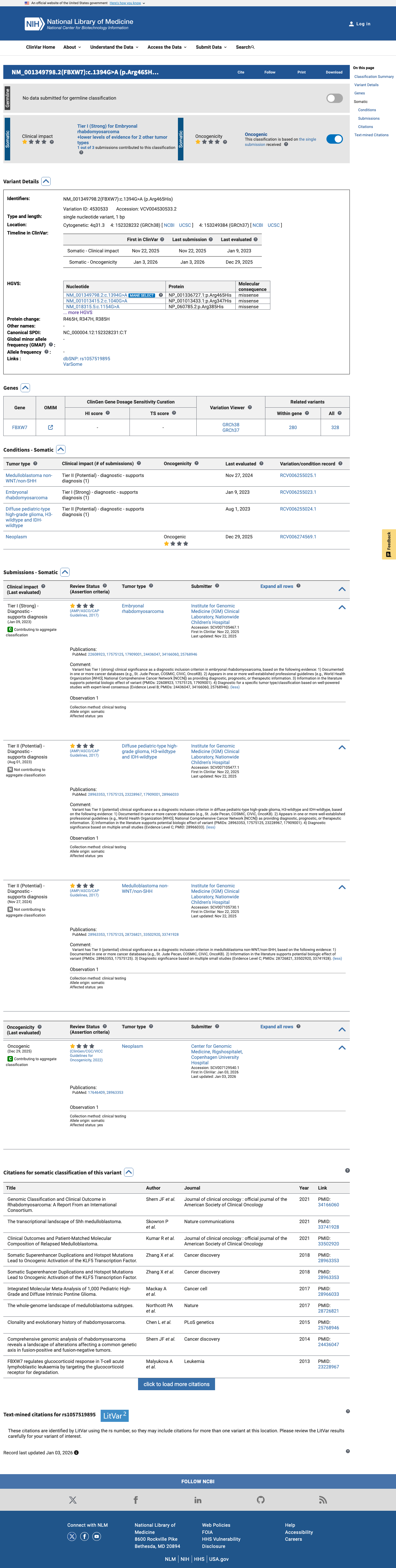
ClinVar
This variant has been reported in ClinVar but submission details could not be extracted. (ClinVarID = 4530533)
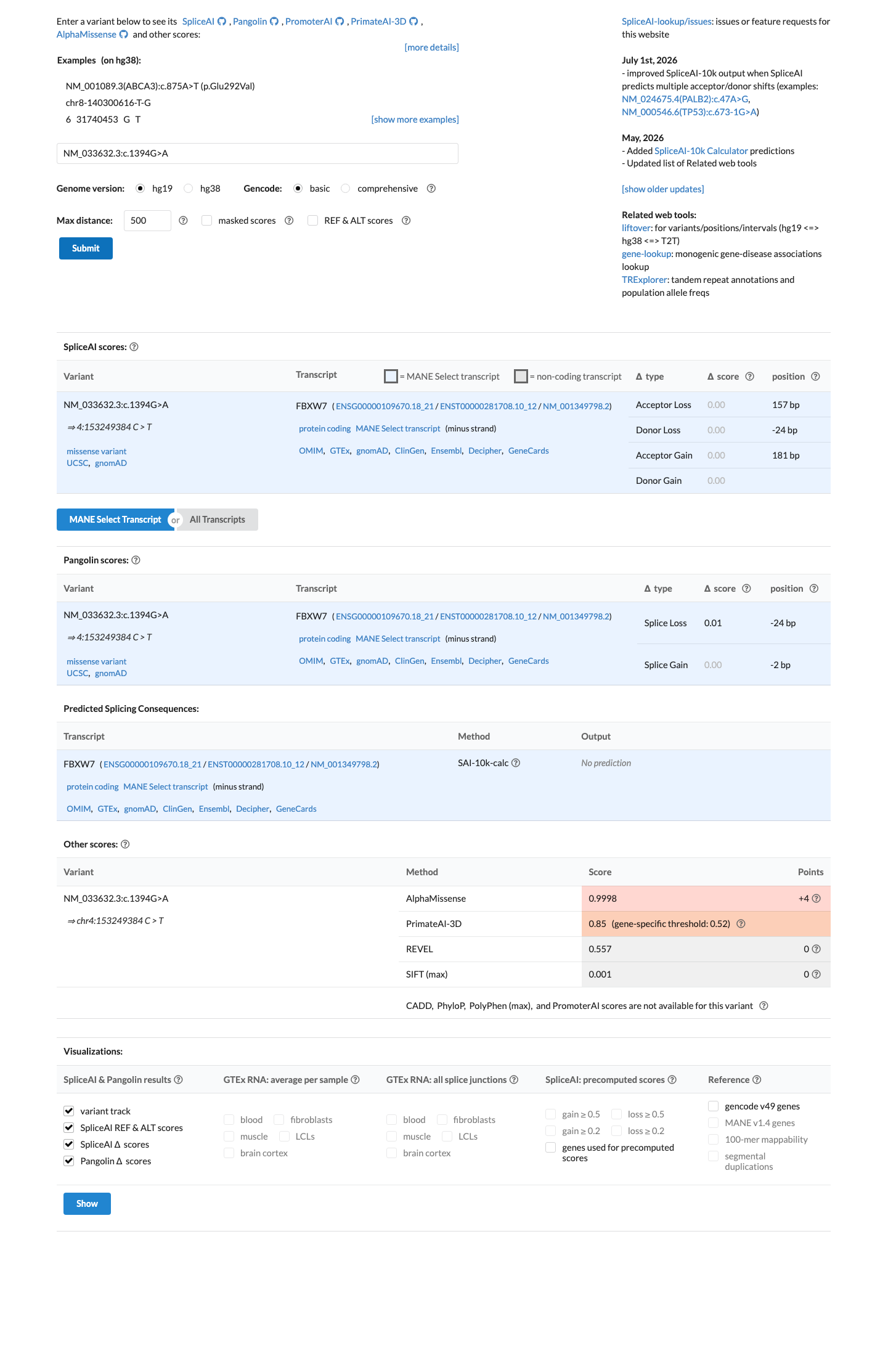
In silico
SpliceAI predicts no significant splice impact for this variant (max delta score = 0.00). REVEL score = 0.557. BayesDel score = 0.112528.
Functional
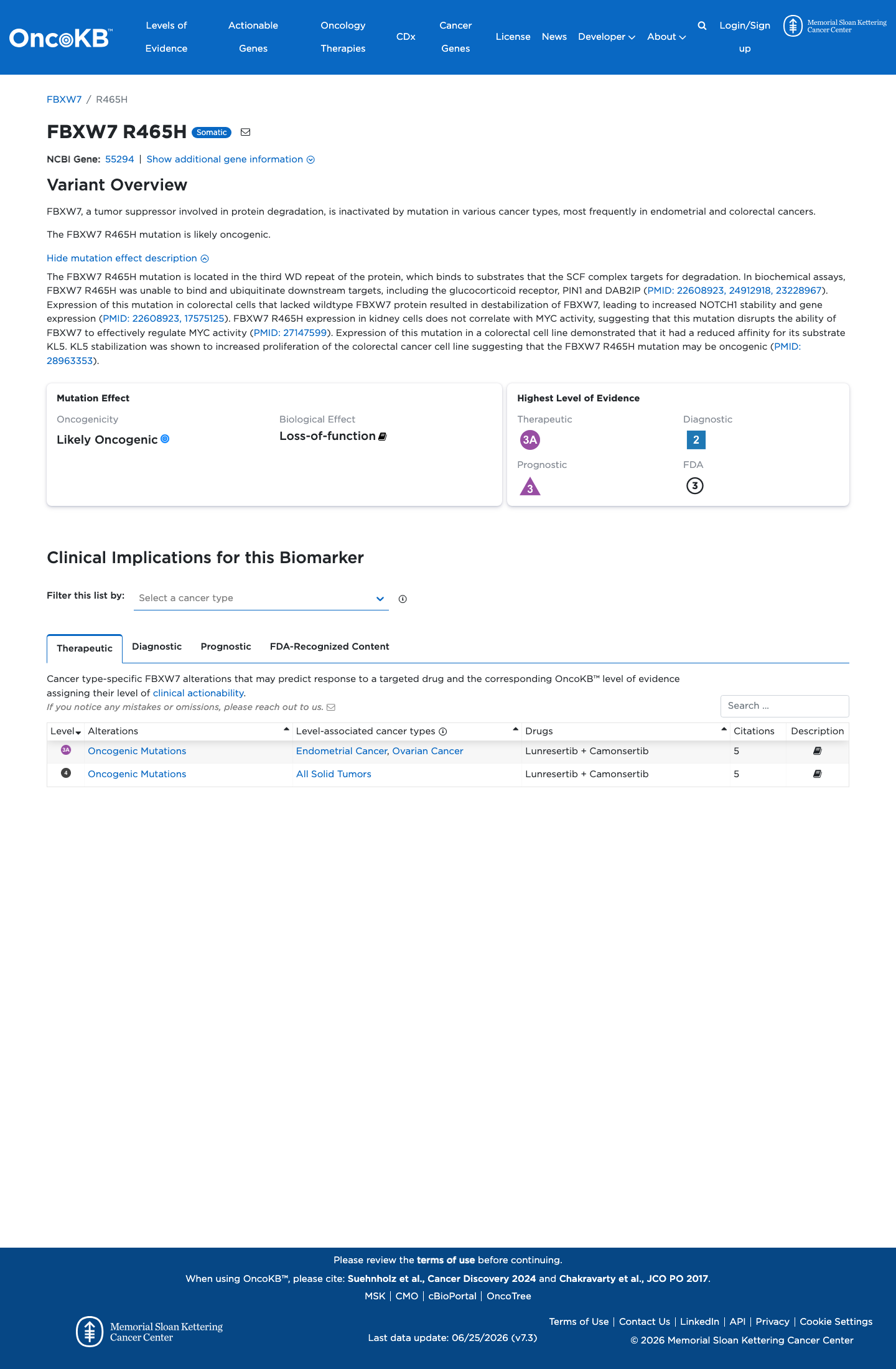
Likely Oncogenic
OncoKB identified variant-specific curated literature and context relevant to functional review; biological-effect context: Loss-of-function; curated oncogenicity label: Likely Oncogenic.
COSMIC

Cancer hotspots
Somatic evidence
Hotspot
COSMIC
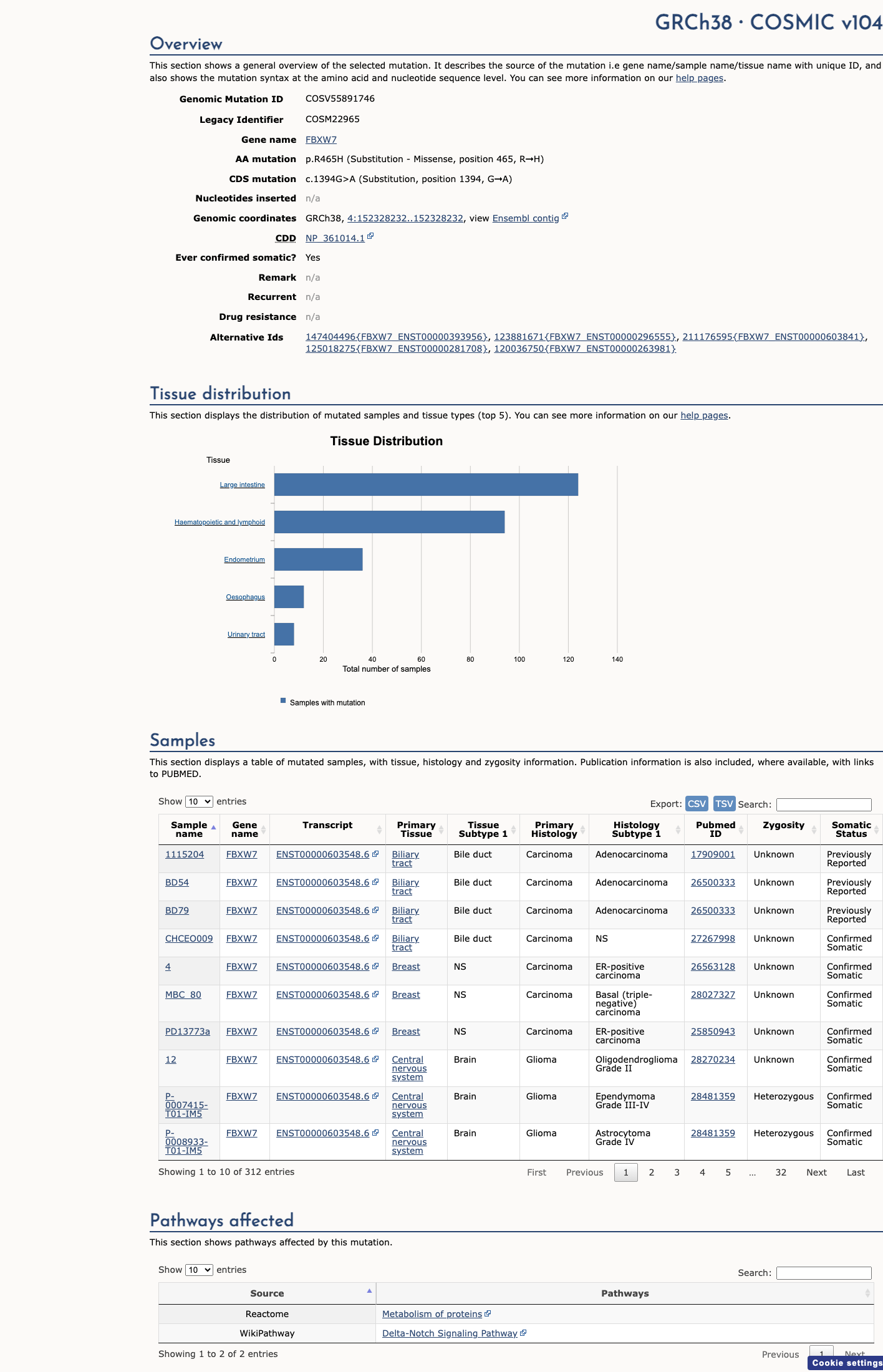
This variant lies in a statistically significant hotspot. This variant has previously been reported in somatic cancers (COSMIC; COSV55891746, n = 311 times).
Hotspots
This variant lies in a statistically significant hotspot.
Literature · how each cited paper was used
2papers cited
Each card is an audit: what was searched, what was found, whether it names the variant, which criteria it fed, and why. 6 further PMIDs triaged but not cited — see Sources & references.
The tumor suppressor gene hCDC4 is frequently mutated in human T-cell acute lymphoblastic leukemia with functional consequences for Notch signaling.
Searched
c.1394G>AR465HArg465p.Arg465His
Found
R465H identified in 3 of 26 pediatric T-ALL patients as a somatic mutation. In vitro functional assays demonstrated the R465H mutant is severely deficient in Notch1 ICD polyubiquitylation compared to wild-type hCdc4 and fails to suppress Notch1 transcriptional activity in a luciferase reporter assay. Codons Arg465, Arg479, and Arg505 are identified as critical arginine residues in the WD40 substrate-binding region.
Variant
✓ Names this variant — characterised directly
Applied to
→PS3
met
→PM1
met
Why
Variant-specific functional data confirmed; primary evidence for PS3 and PM1.
each of the mutant alleles was severely deficient in multiubiquitylating Notch1 ICD as compared with wild-type hCdc4
Location Abstract; Table 1 (patients 13-15); Results: nucleotide change description (G to A at codon 465); Figure 1A (SSCP); Figure 1D (ubiquitylation assay); Figure 2A-B (luciferase reporter) · Context In vivo ubiquitylation assay in HCT116 hCDC4-negative colorectal carcinoma cells; Notch1-sensitive luciferase reporter assay in HCT116 and U2OS cells · full text
FBXW7 regulates glucocorticoid response in T-cell acute lymphoblastic leukaemia by targeting the glucocorticoid receptor for degradation.
Searched
c.1394G>AR465HArg465R465
Found
The R465H FBXW7 mutant was directly tested alongside R479Q and R505C in in vivo ubiquitylation assays. All three arginine mutants were severely deficient in polyubiquitylating the glucocorticoid receptor alpha (GRα) compared to wild-type FBXW7, confirming loss of E3 ligase function. The paper defines GRα as a novel FBXW7 substrate and demonstrates that FBXW7 inactivation enhances glucocorticoid sensitivity in T-ALL.
Variant
✓ Names this variant — characterised directly
Applied to
→PS3
met
Why
Independent confirmation of variant-specific functional defect; supports PS3 at strong strength.
All FBXW7 mutants were severely deficient in polyubiquitylating GRα as compared with WT-FBXW7
Location Materials and Methods: plasmid construction (Flag-FBXW7-R465H); Figure 3c (in vivo ubiquitylation of GRα); Results paragraph on FBXW7 mutants · Context In vivo ubiquitylation assay in HCT116 FBXW7-knockout colorectal carcinoma cells, co-transfected with GRα and HA-ubiquitin · full text
Sources & reference links
Triaged references · 6 PMIDs not cited in assessment
22608923 ↗
Negative regulation of the stability and tumor suppressor function of Fbw7 by the Pin1 prolyl isomerase.
ONCOKB
27147599 ↗
Systematic Functional Interrogation of Rare Cancer Variants Identifies Oncogenic Alleles.
ONCOKB
17646409 ↗
FBW7 mutations in leukemic cells mediate NOTCH pathway activation and resistance to gamma-secretase inhibitors.
CLINVAR
24436047 ↗
Comprehensive genomic analysis of rhabdomyosarcoma reveals a landscape of alterations affecting a common genetic axis in fusion-positive and fusion-negative tumors.
CLINVAR
23619274 ↗
American College of Medical Genetics and Genomics technical standards and guidelines: microarray analysis for chromosome abnormalities in neoplastic disorders.
CLINVAR