Analysis in progress
Initialising…
0%
complete
This report is still being assembled — sections appear as each stage finishes. It isn't final yet.
FBXW7
Final classification
VUS
PM2BP4
FBXW7
c.608C>T
p.Ser203Leu
missense · exon 4

FBXW7 encodes a component of the SCF ubiquitin ligase complex that tags specific proteins for degradation, including the growth-regulating proteins c-MYC, NOTCH1, cyclin E, JUN, and mTOR. By keeping these proteins in check, FBXW7 helps control cell division, differentiation, and growth. It acts as a tumor suppressor: when it is inactivated by mutation or copy number loss, oncoproteins accumulate and can drive malignant transformation, with altered FBXW7 function implicated in human cancers including ovarian and breast cancer.

This variant

FBXW7 is a tumor suppressor that keeps growth-promoting proteins such as c-MYC, NOTCH1, and cyclin E in check, and its loss is linked to cancers including ovarian and breast cancer. This c.608C>T (p.Ser203Leu) variant is classified as a variant of uncertain significance: it is extremely rare and computationally predicted to be benign, but it does not meet the threshold for a benign classification. Its impact on FBXW7 tumor-suppressor function therefore remains unknown, and additional evidence would be needed to clarify its clinical significance.

Transcript
NM_033632.3
HGVS · transcript:coding
NM_033632.3:c.608C>T
GRCh38
chr4:152347048 G>A
GRCh37
chr4:153268200 G>A
Basis Uncertain Significance: only PM2 (Moderate) and BP4 (Moderate) were met, and this combination reaches no Benign, Likely Benign, Likely Pathogenic, or Pathogenic threshold under the generic ACMG/AMP 2015 rules.
Uncertain Significance: only PM2 (Moderate) and BP4 (Moderate) were met, and this combination reaches no Benign, Likely Benign, Likely Pathogenic, or Pathogenic threshold under the generic ACMG/AMP 2015 rules.
Classification rationale
PM2 BP4 VUS
FBXW7 c.608C>T missense · exon 4

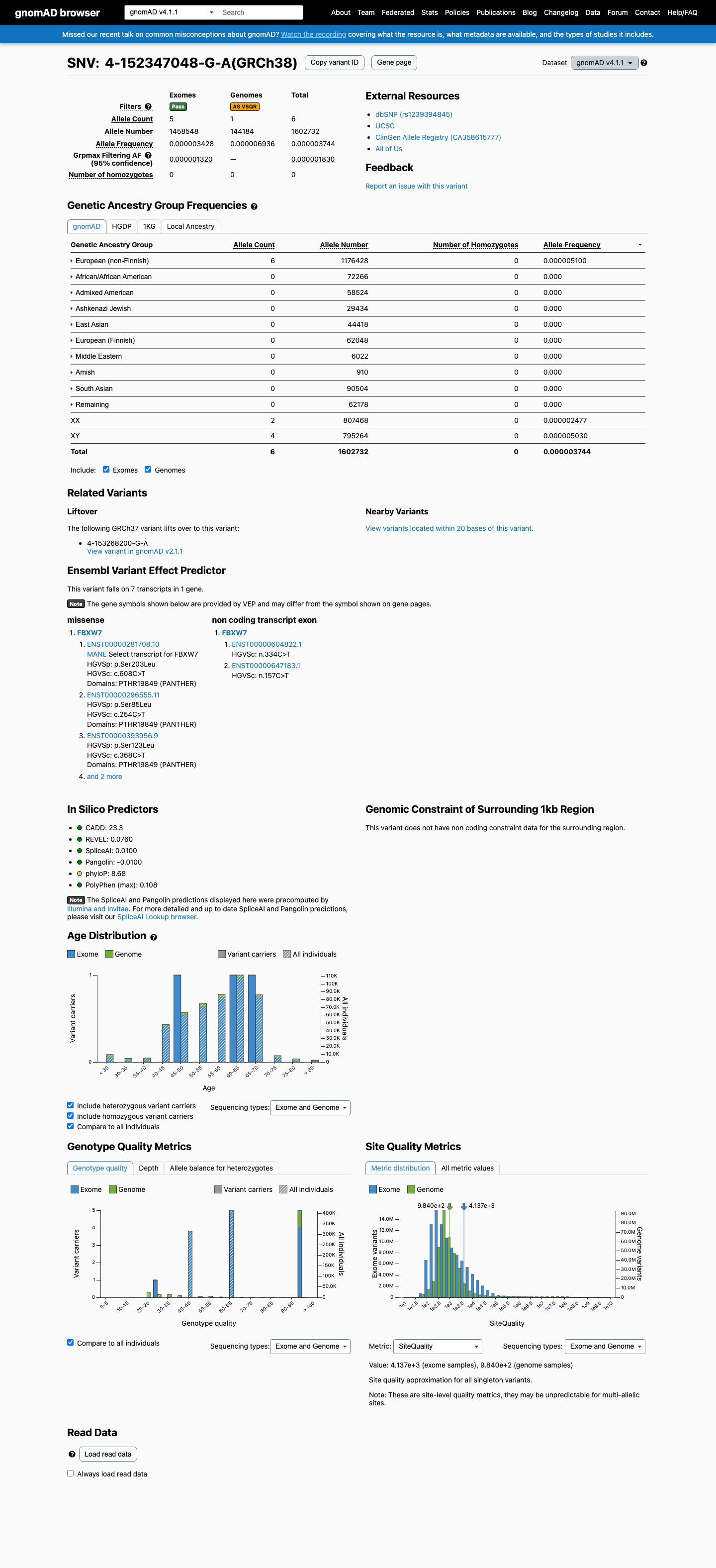
PM2 (Moderate): extremely rare in population data — gnomAD v4.1 AF 3.74e-06 (6/1,602,732 alleles), with no homozygotes observed. BP4 (Moderate): REVEL 0.076 is below the 0.183 benign-moderate threshold and SpliceAI max delta 0.012 predicts no splicing disruption, indicating a benign computational profile. Final classification: Uncertain Significance — PM2 (Moderate) plus BP4 (Moderate) reaches no Benign or Pathogenic threshold under the generic ACMG/AMP 2015 combination rules.

PM2 + BP4 VUS
Gene diagram · NM_033632.3 · variants mapped to exon structure
FBXW7 NM_033632.3
Fetching transcript structure from UCSC…
Applied criteria · 2 applied · 22 assessed
MetEvidence satisfies this criterion.
Not metEvaluated against available evidence; threshold not reached.
Not assessedApplies in principle, but no evidence was found to evaluate it.
N/ADoesn't apply to this variant type.
Applied · 2
Strength Supporting Moderate Strong Very strong
PM2 moderate Pathogenic
Met (Moderate): extremely rare in population data — gnomAD v4.1 AF 3.74e-06 (6/1,602,732 alleles), with no homozygotes observed.
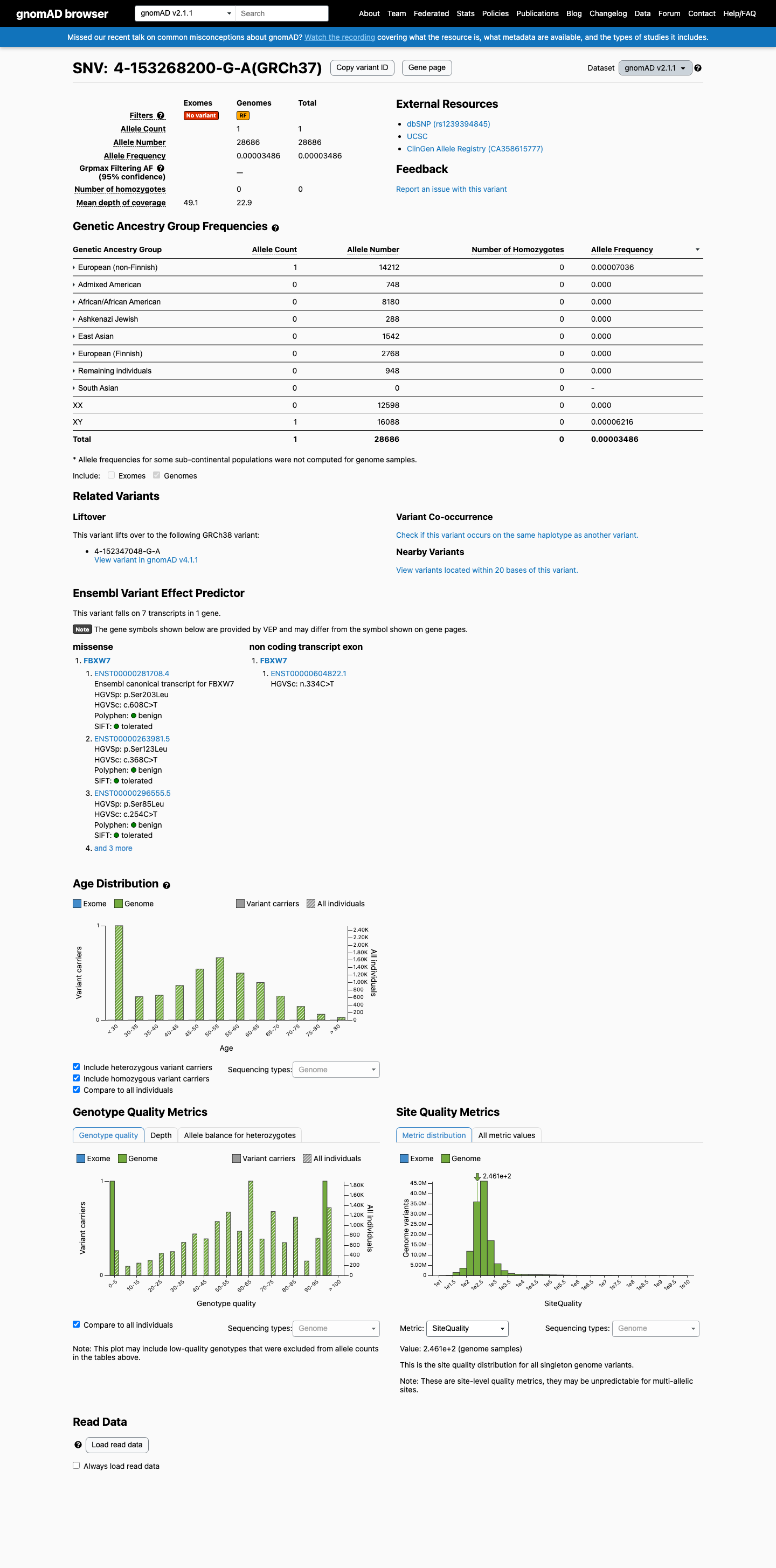
No FBXW7 VCEP/ClinGen gene-specific specification was retrieved; the case framework therefore designates generic ACMG/AMP 2015 fallback.gnomAD v4.1: total AC/AN 6/1,602,732 (AF 3.74361e-06), NFE AC/AN 6/1,176,428 (AF 5.10018e-06), grpmax FAF 1.83e-06, and zero homozygotes.gnomAD v2.1: total AC/AN 1/28,686 (AF 3.48602e-05), NFE AC/AN 1/14,212 (AF 7.03631e-05), and zero homozygotes.
BP4 moderate Benign
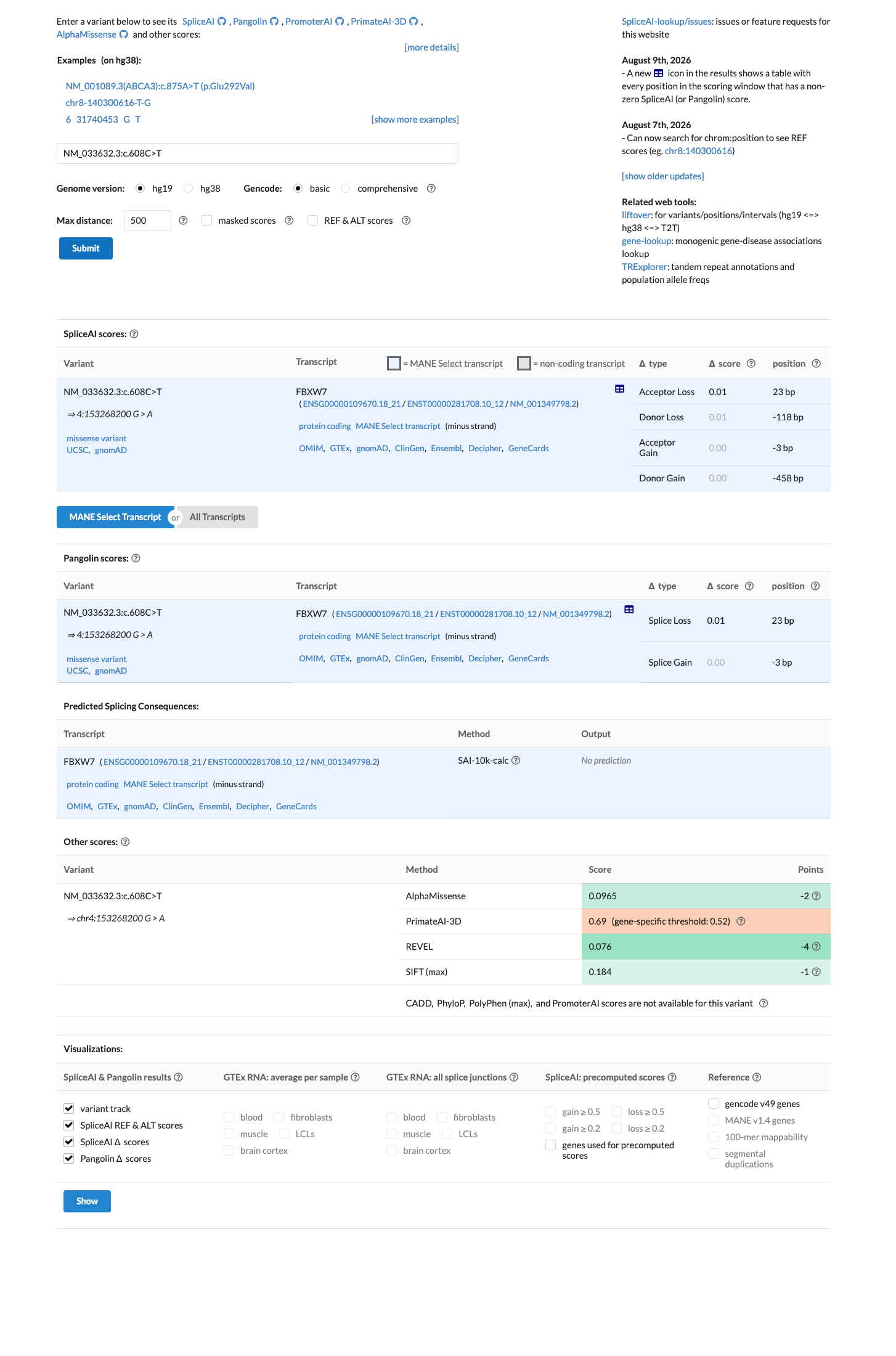
Met (Moderate): REVEL 0.076 is below the 0.183 benign-moderate threshold, and SpliceAI max delta 0.012 predicts no splicing disruption.
REVEL score = 0.076 for NM_033632.3:c.608C>T (NP_361014.1:p.(Ser203Leu)); ClinGen SVI-recommended REVEL calibration (Pejaver et al., PMID 36413997) sets benign-moderate threshold at REVEL <=0.183 - met, supporting BP4 at Moderate strength.SpliceAI predicts no significant splice impact for this variant (max delta score = 0.012), consistent with a benign computational profile using the standard 0.2 threshold associated with the SpliceAI algorithm (Jaganathan et al., PMID 30661751); not separately scored to avoid double-counting against the REVEL-based BP4 call.
Assessed · not applied · 6 not met · 16 not assessed
Pathogenic
PS1 Not assessed: no established pathogenic variant producing the same p.Ser203Leu amino acid change was available.
PS2 Not assessed: no proband phenotype or parental testing result was available to establish a de novo occurrence.
PS3 Not assessed: no functional or experimental assay data for this variant was available.
PS4 Not assessed: no case series or case-control enrichment data was available.
PM1 Not met: residue 203 lies outside the F-box and WD40 substrate-recognition domains, with only 2 somatic COSMIC occurrences and no significant hotspot.
PM3 Not assessed: no affected proband with a pathogenic FBXW7 variant in trans was available.
PM5 Not assessed: no established pathogenic variant at residue 203 (e.g., p.Ser203Pro) was identified.
PM6 Not assessed: no parental testing result was available to establish a presumed de novo occurrence.
PP1 Not assessed: no family segregation or informative relatives data was available.
PP2 Not assessed: no quantitative missense constraint metric (e.g., gnomAD missense Z-score) was available.
PP3 Not met: REVEL 0.076 is below the 0.644 pathogenic-supporting threshold, and SpliceAI max delta 0.012 is far below 0.2.
PP4 Not assessed: no proband phenotype or phenotype-to-FBXW7 specificity data was available.
PP5 Not met: the variant is absent from ClinVar, so no expert-panel pathogenic assertion exists.
Benign
BA1 Not met: the highest reliable allele frequency is 7.04e-05 (gnomAD v2.1 NFE), far below the stand-alone benign threshold.
BS1 Not assessed: no FBXW7 disease-specific maximum credible allele frequency threshold was available.
BS2 Not assessed: no unaffected adult individuals with phenotype and age data incompatible with the condition were documented.
BS3 Not assessed: no functional assay data demonstrating normal protein function was available.
BS4 Not assessed: no non-segregation observation was available.
BP1 Not met: missense variants are an established mechanism of FBXW7 germline disease, so a missense change is not inherently unlikely to be pathogenic.
BP2 Not assessed: no observation places the variant in cis or trans with a pathogenic FBXW7 variant.
BP5 Not assessed: no independent molecular diagnosis or phenotype data was available.
BP6 Not met: the variant is absent from ClinVar, so no expert-panel benign assertion exists.
N/A · 4 PVS1 · PM4 · BP3 · BP7
Research & evidence
Population frequency
gnomAD v4.1 screenshot
gnomAD v4.1
gnomAD v2.1 screenshot
gnomAD v2.1
v4.1
This variant is present in gnomAD v4.1 (AF= 3.74361e-06; MAF= 0.00037%, 6/1602732 alleles, homozygotes = 0) and has highest observed frequency in the European (non-Finnish) population (AF= 5.10018e-06; MAF= 0.00051%, 6/1176428 alleles, homozygotes = 0); grpmax FAF= 1.83e-06.
v2.1
This variant is present in gnomAD v2.1 (AF= 3.48602e-05; MAF= 0.00349%, 1/28686 alleles, homozygotes = 0) and has highest observed frequency in the European (non-Finnish) population (AF= 7.03631e-05; MAF= 0.00704%, 1/14212 alleles, homozygotes = 0).
🇨🇦 CA
Absent from gnomAD-Canada v1.0.
Allele frequency by ancestry
three datasets · side by side
gnomAD v4.1
0.00037% · 6 / 1,602,732
0 hom · FAF 0.00018%
European (non-Finnish)
6 / 1,176,428
0.00051%
+ 9 not observed (Remaining individuals, Admixed American, European (Finnish), Amish, East Asian, Middle Eastern, South Asian, Ashkenazi Jewish, African/African American)
gnomAD v2.1
0.0035% · 1 / 28,686
0 hom
European (non-Finnish)
1 / 14,212
0.007%
+ 7 not observed (African/African American, Admixed American, Ashkenazi Jewish, East Asian, European (Finnish), Remaining individuals, South Asian)
gnomAD Canada 🇨🇦
Absent · 0 / ?
0 hom
Not observed in any ancestry group.
ClinVar screenshot
ClinVar
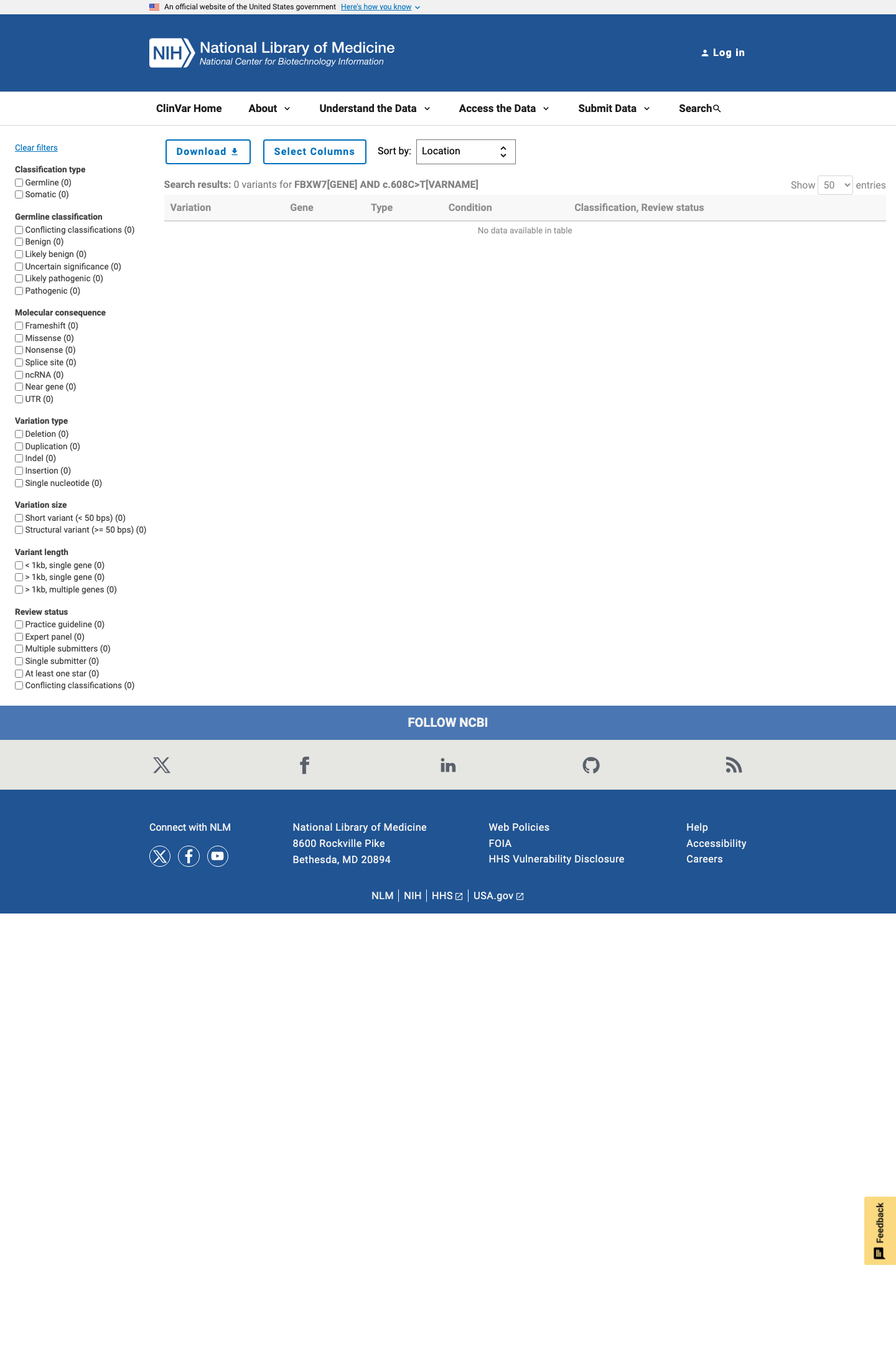
This variant is absent from ClinVar.
SpliceAI screenshot
In silico
SpliceAI predicts no significant splice impact for this variant (max delta score = 0.01). REVEL score = 0.076. BayesDel score = -0.296435.
Functional / OncoKB screenshot
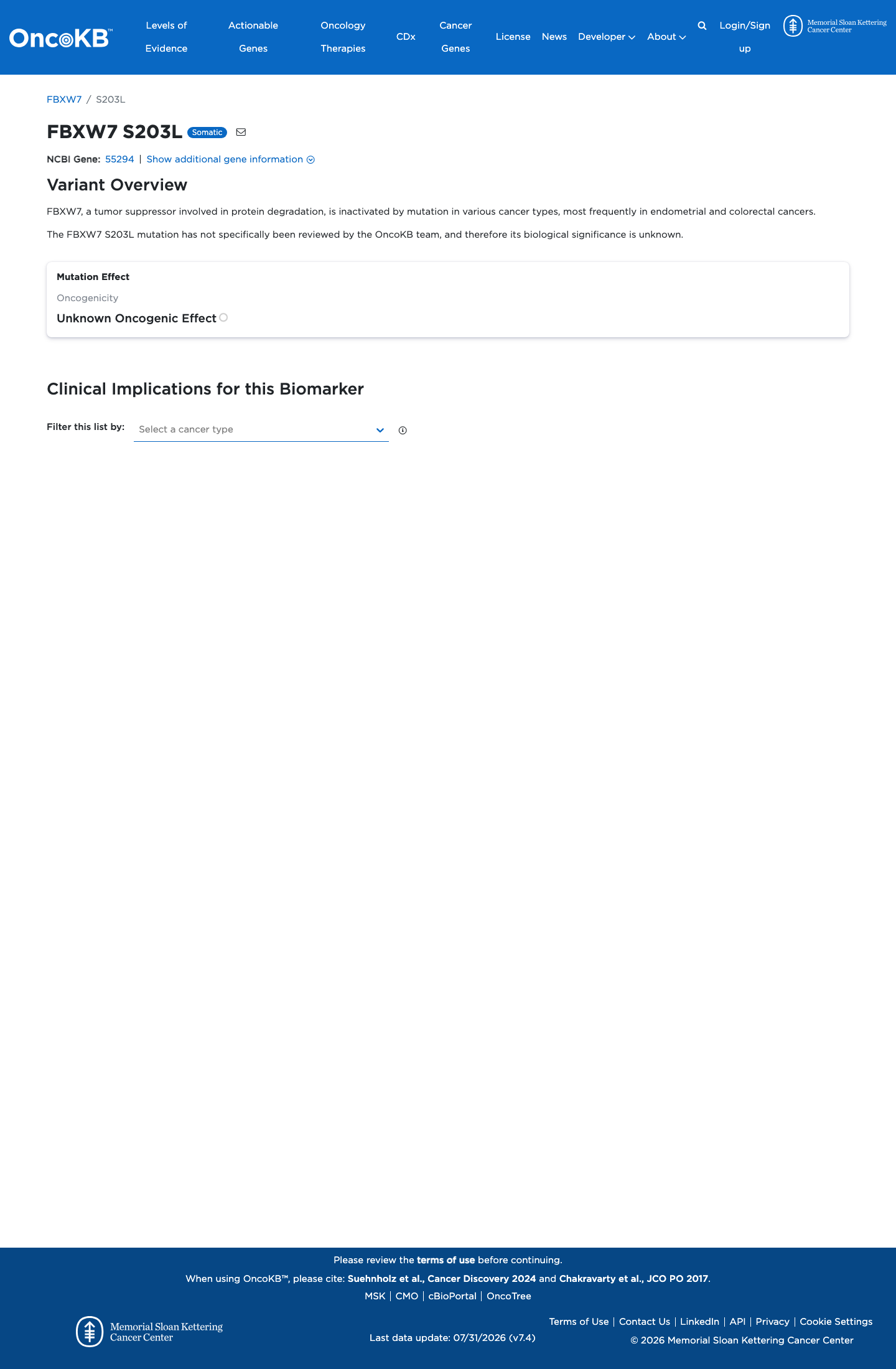
Functional Unknown Oncogenic Effect
OncoKB did not identify variant-specific reviewed functional evidence for this variant; gene-level curated context is available for reviewer follow-up. FBXW7, a tumor suppressor involved in protein degradation, is inactivated by mutation in various cancer types, most frequently in endometrial and colo
OncoKB ↗
COSMIC screenshot
COSMIC
Cancer hotspots screenshot
Cancer hotspots
Somatic evidence Not in COSMIC / hotspots
COSMIC
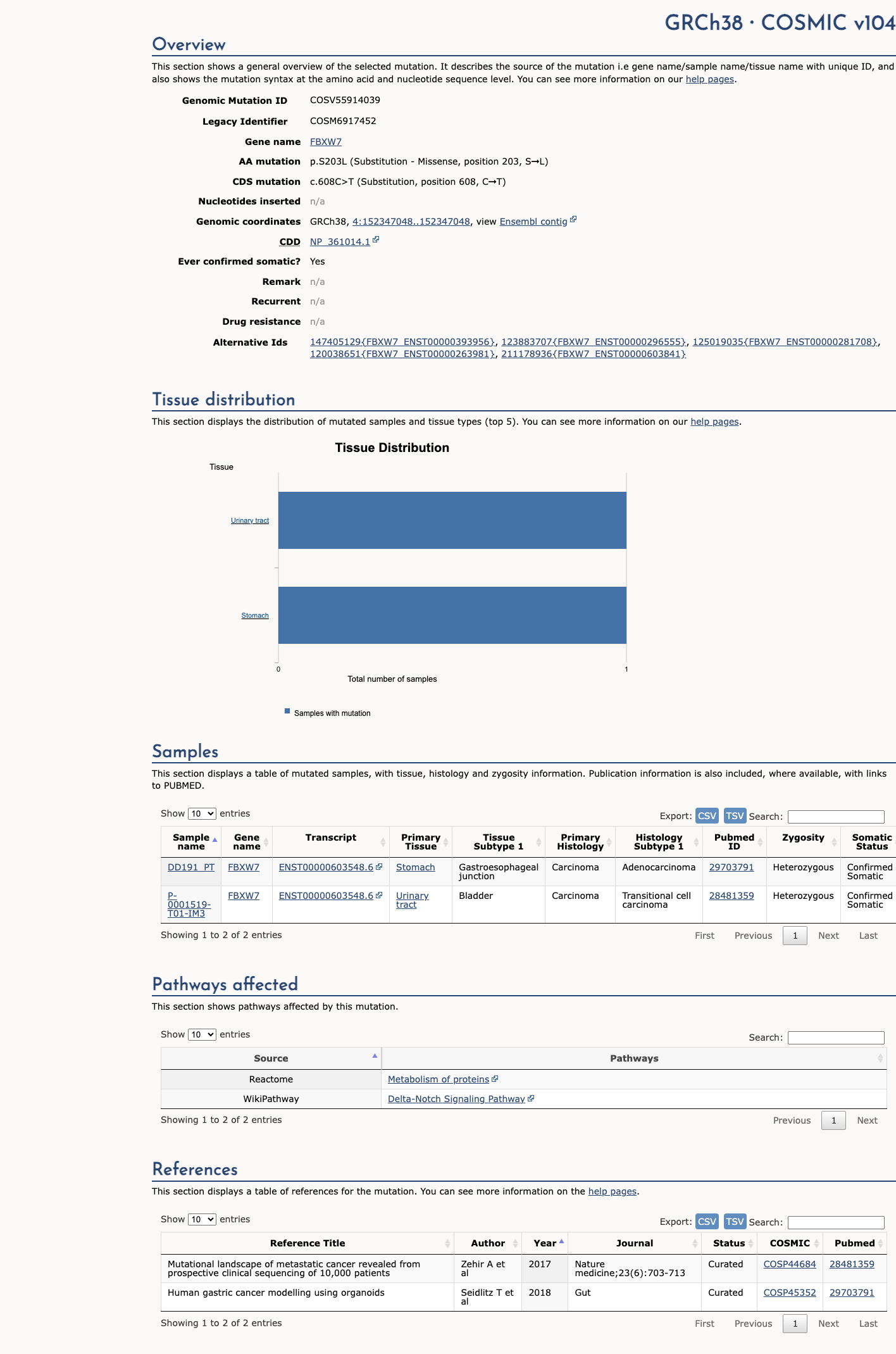
This variant does not lie in a statistically significant hotspot. This variant has previously been reported in somatic cancers (COSMIC; COSV55914039, n = 2 times).
Hotspots
This variant does not lie in a statistically significant hotspot.
Sources & reference links
8Sources
ClinVar
gnomAD v2.1
gnomAD v4.1
gnomAD-Canada
SpliceAI
OncoKB
COSMIC
Cancer hotspots