Analysis in progress
Initialising…
0%
complete
This report is still being assembled — sections appear as each stage finishes. It isn't final yet.
CCND1
Final classification
Likely Benign
BP3BP4
CCND1
c.839_841del
p.Glu280del
in_frame_indel_unknown · exon 5

CCND1 encodes cyclin D1, a cell-cycle regulator that partners with CDK4 and CDK6 to drive the transition from G1 to S phase, promoting cell growth, proliferation, and division. It helps control these processes by phosphorylating and inactivating the RB tumor suppressor, which in turn releases the E2F transcription program needed for cell-cycle entry. CCND1 is a well-established oncogene: its amplification or overexpression is common in many human cancers, including breast, lung, melanoma, and oral squamous cell carcinoma, where it allows cancer cells to proliferate independently of normal growth signals. Disruption of this gene's normal regulation is therefore frequently linked to cancer development and progression.

This variant

CCND1 drives cancer through amplification and overexpression of cyclin D1, so a Likely Benign result here means this single-codon in-frame deletion is not expected to disrupt the gene's cell-cycle regulatory function. Consistent with that, the variant has no predicted splice impact and falls in a repeat tract with no known function, giving no indication of the gain-of-function changes associated with CCND1-driven cancers.

Transcript
NM_053056.3
HGVS · transcript:coding
NM_053056.3:c.839_841del
GRCh38
chr11:69651219 AGAG>A
GRCh37
chr11:69465987 AGAG>A
Basis No ClinGen VCEP framework exists for CCND1, so generic ACMG/AMP 2015 rules were applied; only two supporting benign criteria (BP3, BP4) were met, yielding Likely Benign.
No ClinGen VCEP framework exists for CCND1, so generic ACMG/AMP 2015 rules were applied; only two supporting benign criteria (BP3, BP4) were met, yielding Likely Benign.
Classification rationale
BP3BP4 Likely Benign
CCND1 c.839_841del in_frame_indel_unknown · exon 5

BP3 (Supporting): in-frame deletion of one codon (p.Glu280del) within a low-complexity poly-glutamate repeat region without known function. BP4 (Supporting): SpliceAI max delta 0.001, below the 0.1 threshold indicating no splice impact. Final classification: Likely Benign, per the generic ACMG/AMP 2015 rule satisfied by two supporting benign (BP) criteria.

BP3 + BP4 Likely Benign
Gene diagram · NM_053056.3 · variants mapped to exon structure
CCND1 NM_053056.3
Fetching transcript structure from UCSC…
Applied criteria · 2 applied · 19 assessed
MetEvidence satisfies this criterion.
Not metEvaluated against available evidence; threshold not reached.
Not assessedApplies in principle, but no evidence was found to evaluate it.
N/ADoesn't apply to this variant type.
Applied · 2
Strength Supporting Moderate Strong Very strong
BP3 supporting review Benign
Met (supporting): in-frame deletion of one codon within a low-complexity poly-glutamate repeat with no known function. Flagged for human review: the repeat lies in a PEST-like region with general roles in protein stability.
Framework: no ClinGen CSPEC/VCEP exists for CCND1 (cspec not found; gene_vcep_dir null; vcep_materials framework_mode = generic_acmg_fallback); generic ACMG/AMP 2015 rules (Richards et al. 2015, PMID:25741868) govern PM4/BP3, as referenced by generic_acmg_combination_rules.In-frame status: prefetch normalization (Mutalyzer) predicts NP_444284.1:p.(Glu280del) from NM_053056.3:c.839_841del; a 3-nt deletion of one codon, so the reading frame is preserved, no premature stop, protein length 295 -> 294 aa.Repeat-region status - ClinVar variant title (source clinvar; only the sequence notation was used, not the record's classification): 'NM_053056.3(CCND1):c.827AGG[4] (p.Glu280del)' uses HGVS trinucleotide-repeat copy-number notation, i.e., NCBI represents this allele as a repeat contraction.
BP4 supporting Benign
Met (supporting): SpliceAI max delta 0.001 vs the 0.1 threshold for BP4.
SpliceAI Lookup predicts no significant splice impact for NM_053056.3:c.839_841del, max delta score = 0.001, below the 0.1 BP4 threshold in this lab's generic non-VCEP PP3/BP4 calibration.No CCND1 CSPEC/VCEP PP3/BP4 lookup material was found (cspec.found=false; vcep_materials note='no cspec url available'), so the generic ACMG fallback rule governs this criterion.
Assessed · not applied · 6 not met · 13 not assessed
Pathogenic
PS2 Not assessed: no de novo observation or parental testing results were available to establish confirmed de novo occurrence.
PS3 Not assessed: no validated functional assay data for this variant were available.
PS4 Not assessed: no case-control enrichment or affected-case count data for this exact variant were available.
PM2 Not met: present in population databases — gnomAD v4.1 reports 295 alleles and one homozygote.
PM3 Not assessed: no evidence of a second disease-causing allele in trans was available.
PM4 Not met: the in-frame deletion falls in a low-complexity poly-glutamate repeat, failing the non-repeat-region prerequisite (BP3 governs instead).
PM6 Not assessed: no de novo observation without parental confirmation was documented.
PP1 Not assessed: no segregation data from affected or unaffected relatives were available.
PP3 Not met: SpliceAI max delta 0.001 vs the 0.2 threshold required for PP3.
PP4 Not assessed: no patient phenotype description was available.
PP5 Not met: ClinVar's Likely benign entry is from one laboratory with zero review stars, not an expert-panel classification.
Benign
BA1 Not met: gnomAD maximum population allele frequency 0.0015 vs the 5% BA1 threshold.
BS1 Not assessed: no disease prevalence or gene-specific maximum credible allele frequency was available to set a threshold.
BS2 Not assessed: no age, phenotype, or health-status information for the gnomAD homozygote was available.
BS3 Not assessed: no validated functional assay data showing normal function were available.
BS4 Not assessed: no unaffected relatives with genotype and phenotype data were documented.
BP2 Not assessed: no phase or segregation data showing the variant in trans or cis with a pathogenic variant.
BP5 Not assessed: no alternative molecular diagnosis was established for the patient.
BP6 Not met: ClinVar's Likely benign entry is from one laboratory with zero review stars, not an expert-panel benign classification.
N/A · 7 PVS1 · PS1 · PM1 · PM5 · PP2 · BP1 · BP7
Research & evidence
Population frequency · supports benign
gnomAD v4.1 screenshot
gnomAD v4.1
gnomAD v2.1 screenshot
gnomAD v2.1
v4.1
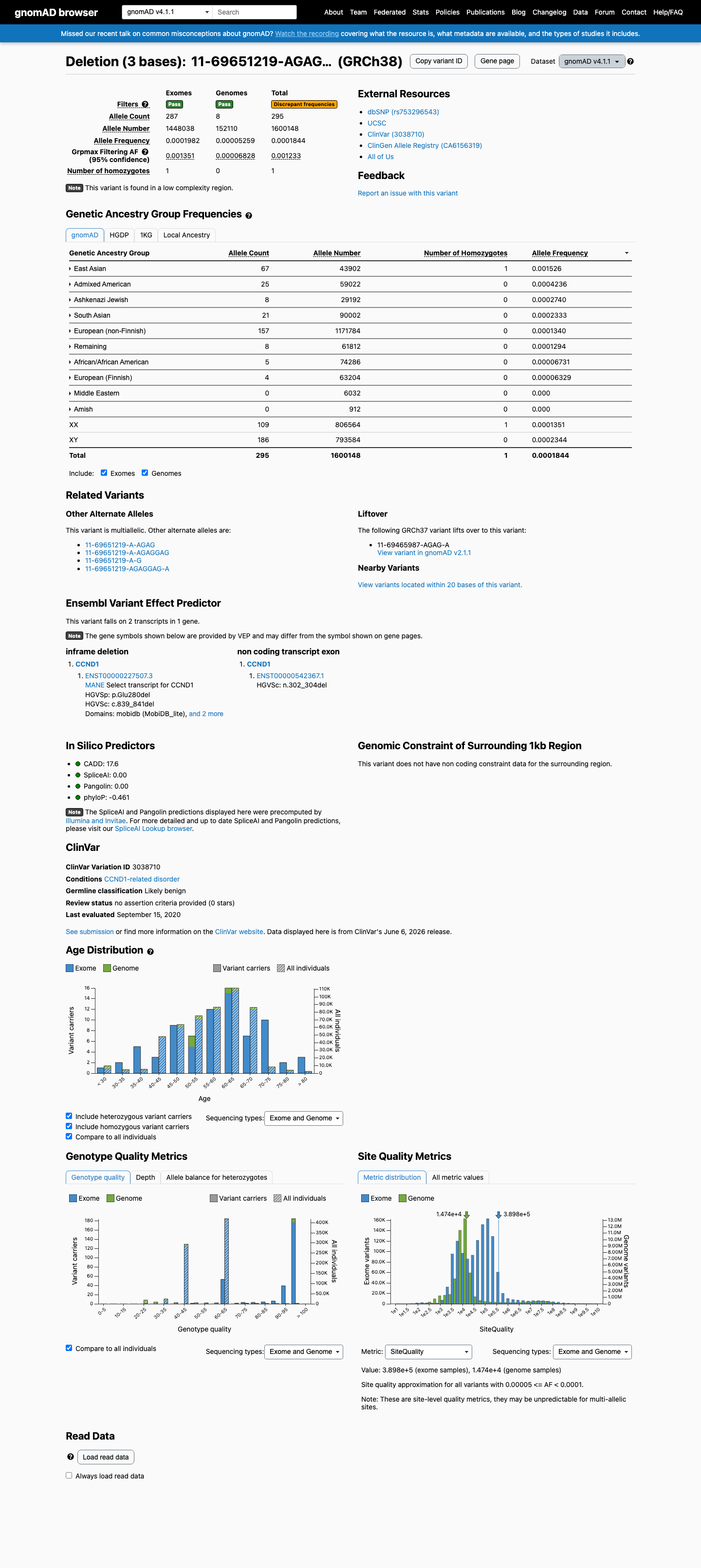
This variant is present in gnomAD v4.1 (AF= 0.000184358; MAF= 0.01844%, 295/1600148 alleles, homozygotes = 1) and has highest observed frequency in the East Asian population (AF= 0.00152613; MAF= 0.15261%, 67/43902 alleles, homozygotes = 1); grpmax FAF= 0.00123282.
v2.1
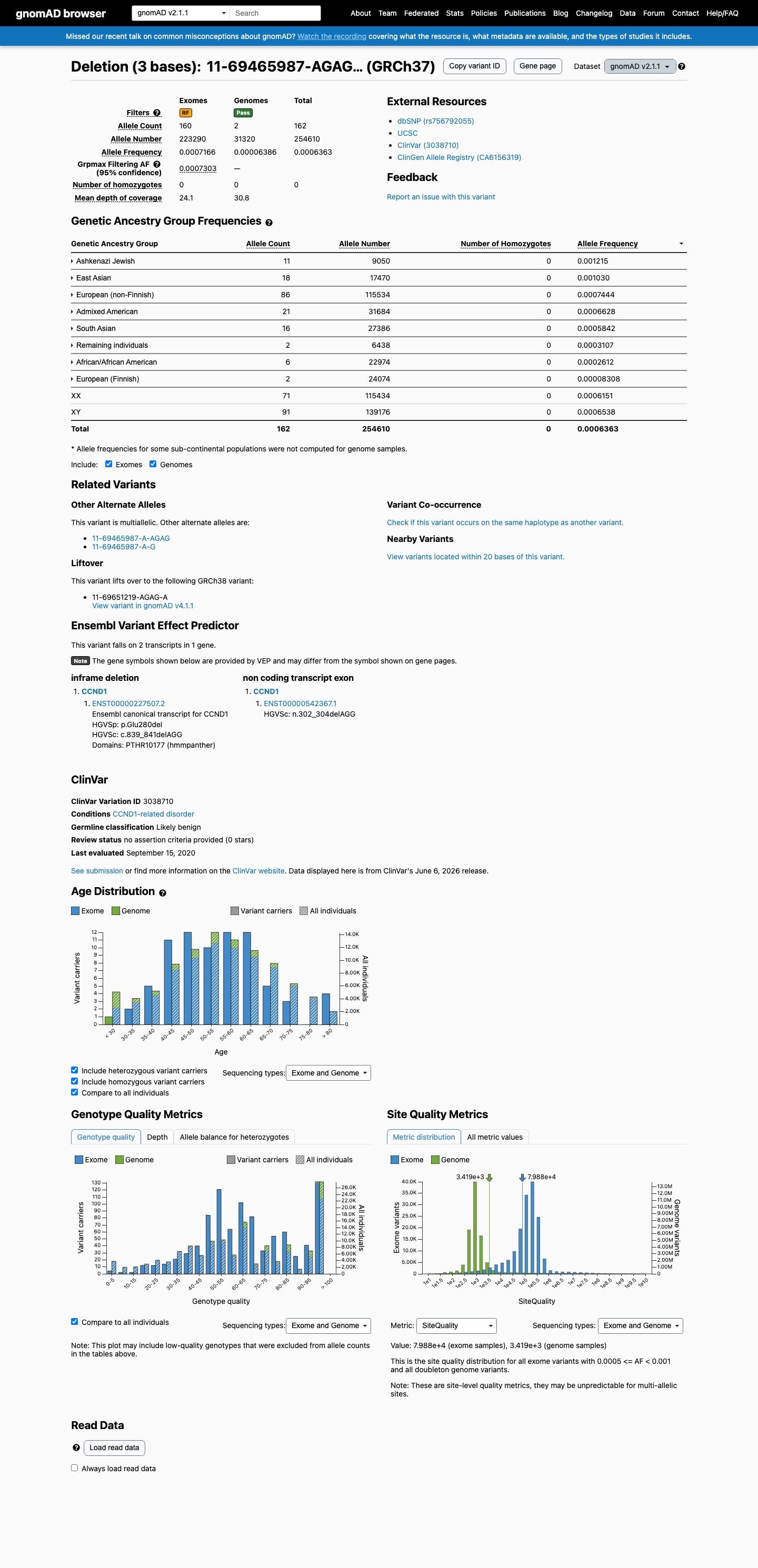
This variant is present in gnomAD v2.1 (AF= 0.000636267; MAF= 0.06363%, 162/254610 alleles, homozygotes = 0) and has highest observed frequency in the Ashkenazi Jewish population (AF= 0.00121547; MAF= 0.12155%, 11/9050 alleles, homozygotes = 0); grpmax FAF= 0.00073033.
🇨🇦 CA
Absent from gnomAD-Canada v1.0.
Allele frequency by ancestry
three datasets · side by side
gnomAD v4.1
0.018% · 295 / 1,600,148
1 hom · FAF 0.12%
East Asian
67 / 43,902
0.15%
1 hom
Admixed American
25 / 59,022
0.042%
Ashkenazi Jewish
8 / 29,192
0.027%
South Asian
21 / 90,002
0.023%
European (non-Finnish)
157 / 1,171,784
0.013%
Remaining individuals
8 / 61,812
0.013%
African/African American
5 / 74,286
0.0067%
European (Finnish)
4 / 63,204
0.0063%
+ 2 not observed (Amish, Middle Eastern)
gnomAD v2.1
0.064% · 162 / 254,610
0 hom · FAF 0.073%
Ashkenazi Jewish
11 / 9,050
0.12%
East Asian
18 / 17,470
0.1%
European (non-Finnish)
86 / 115,534
0.074%
Admixed American
21 / 31,684
0.066%
South Asian
16 / 27,386
0.058%
Remaining individuals
2 / 6,438
0.031%
African/African American
6 / 22,974
0.026%
European (Finnish)
2 / 24,074
0.0083%
gnomAD Canada 🇨🇦
Absent · 0 / ?
0 hom
Not observed in any ancestry group.
ClinVar screenshot
ClinVar
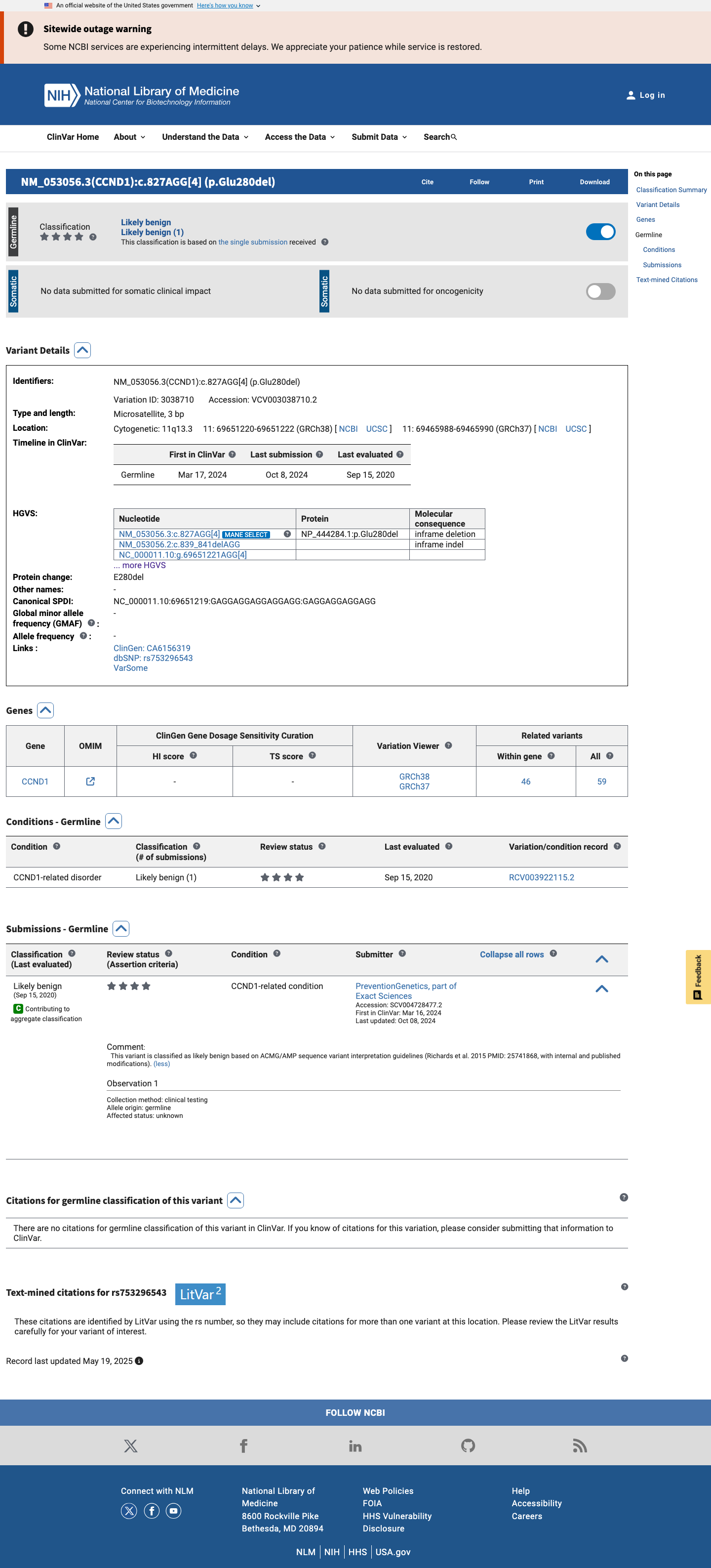
This variant has been reported in ClinVar as Likely benign (1 clinical laboratory). (ClinVarID = 3038710)
SpliceAI screenshot
In silico
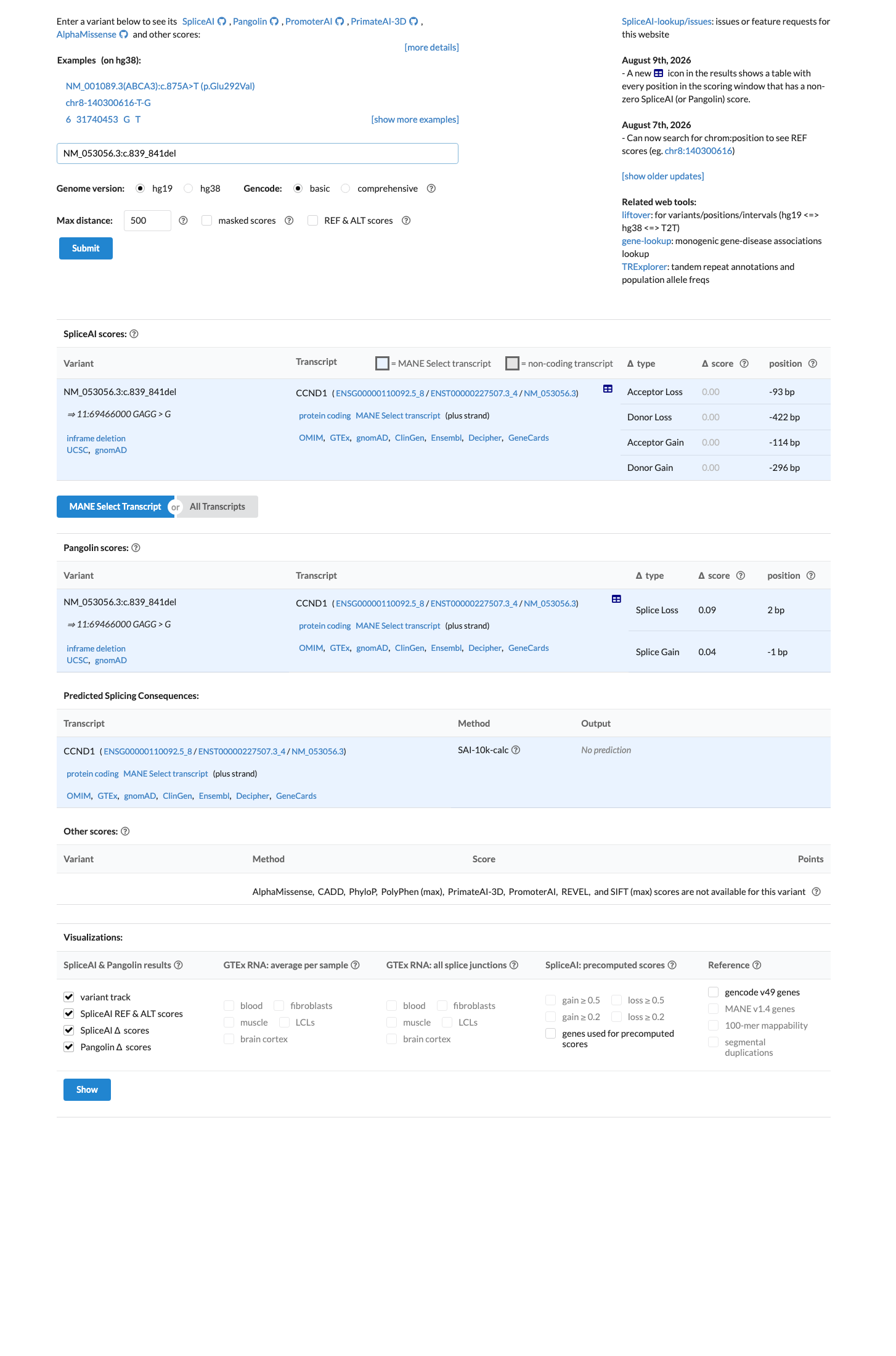
SpliceAI predicts no significant splice impact for this variant (max delta score = 0.00).
Functional / OncoKB screenshot
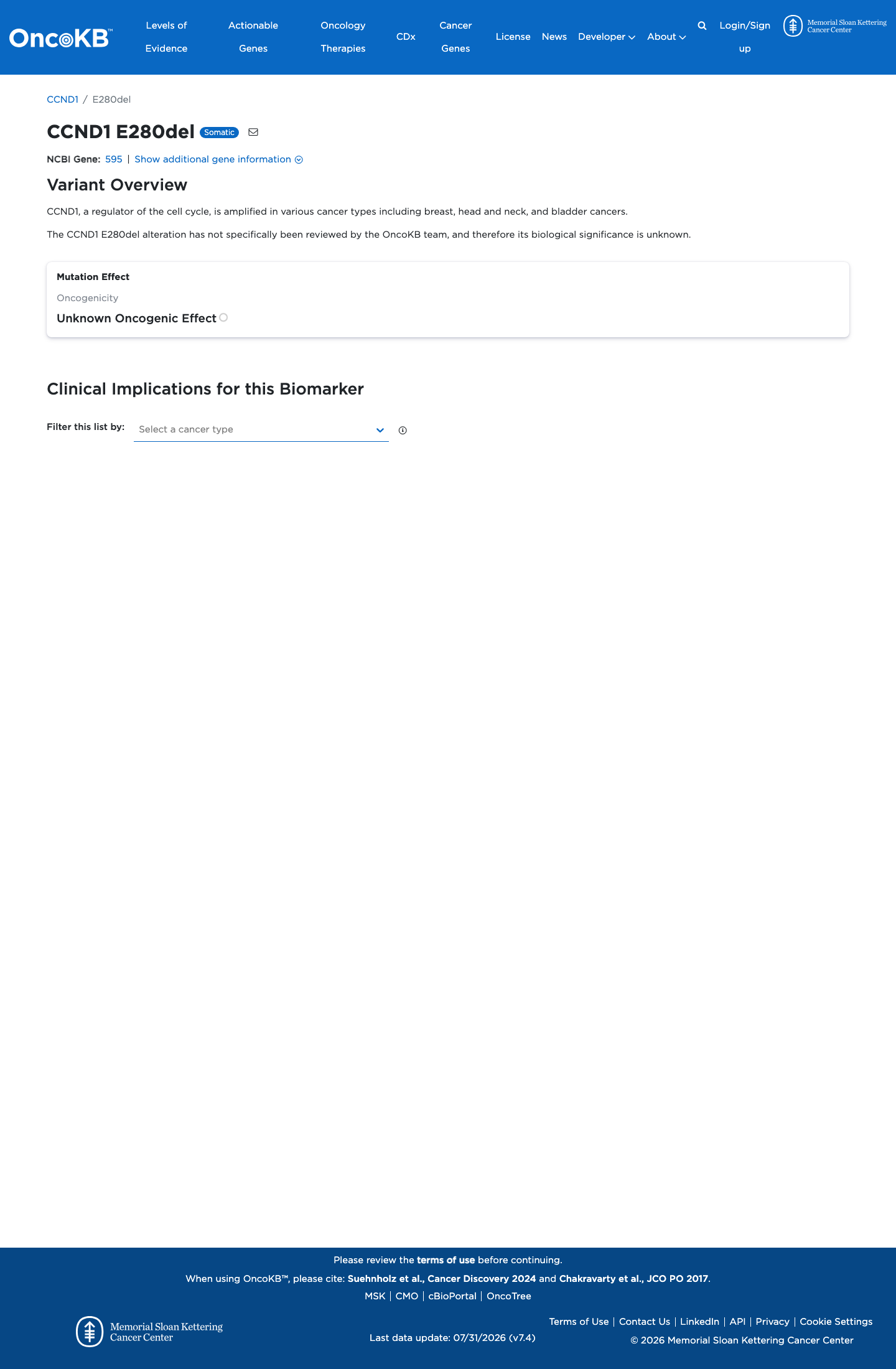
Functional Unknown Oncogenic Effect
OncoKB did not identify variant-specific reviewed functional evidence for this variant; gene-level curated context is available for reviewer follow-up. CCND1, a regulator of the cell cycle, is amplified in various cancer types including breast, head and neck, and bladder cancers.
OncoKB ↗
COSMIC screenshot
COSMIC
Cancer hotspots screenshot
Cancer hotspots
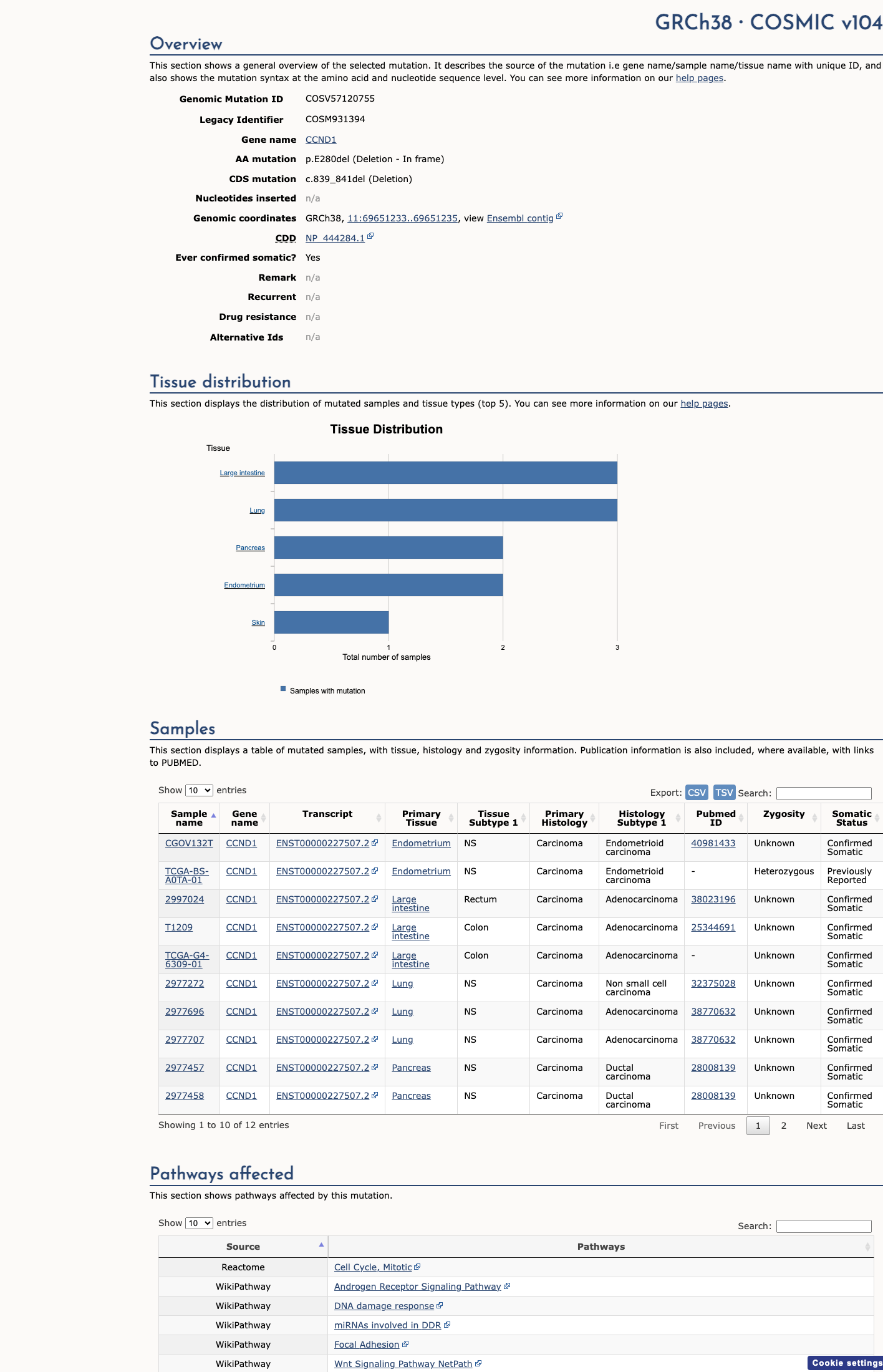
Somatic evidence Not in COSMIC / hotspots
COSMIC
This variant does not lie in a statistically significant hotspot. This variant has previously been reported in somatic cancers (COSMIC; COSV57120755, n = 12 times).
Hotspots
This variant does not lie in a statistically significant hotspot.
Sources & reference links
8Sources
ClinVar
gnomAD v2.1
gnomAD v4.1
gnomAD-Canada
SpliceAI
OncoKB
COSMIC
Cancer hotspots