Analysis in progress
Initialising…
0%
complete
This report is still being assembled — sections appear as each stage finishes. It isn't final yet.
RAD51C
Final classification
VUS
RAD51C c.187A>T · p.Ile63Phe
RAD51C

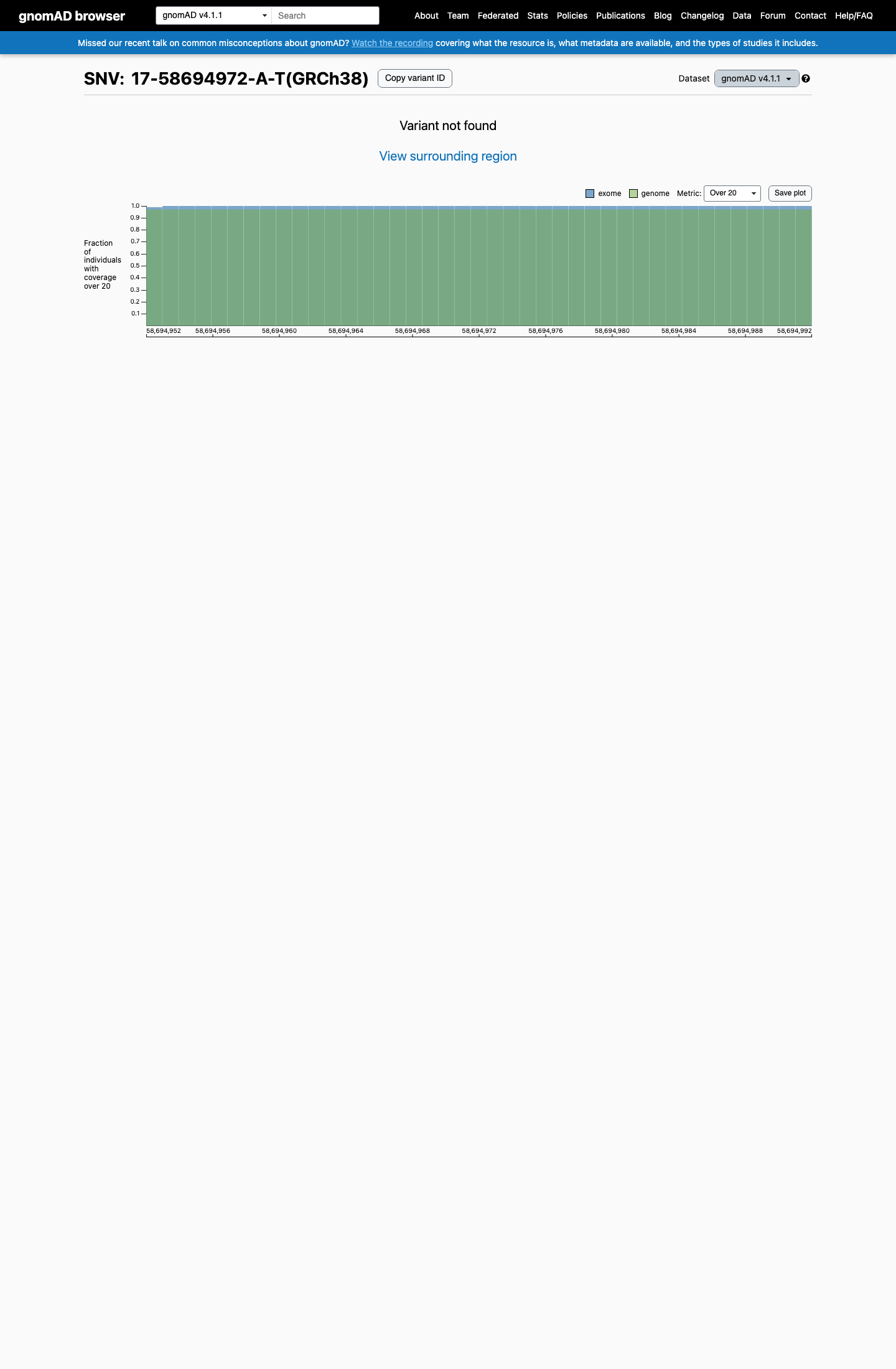
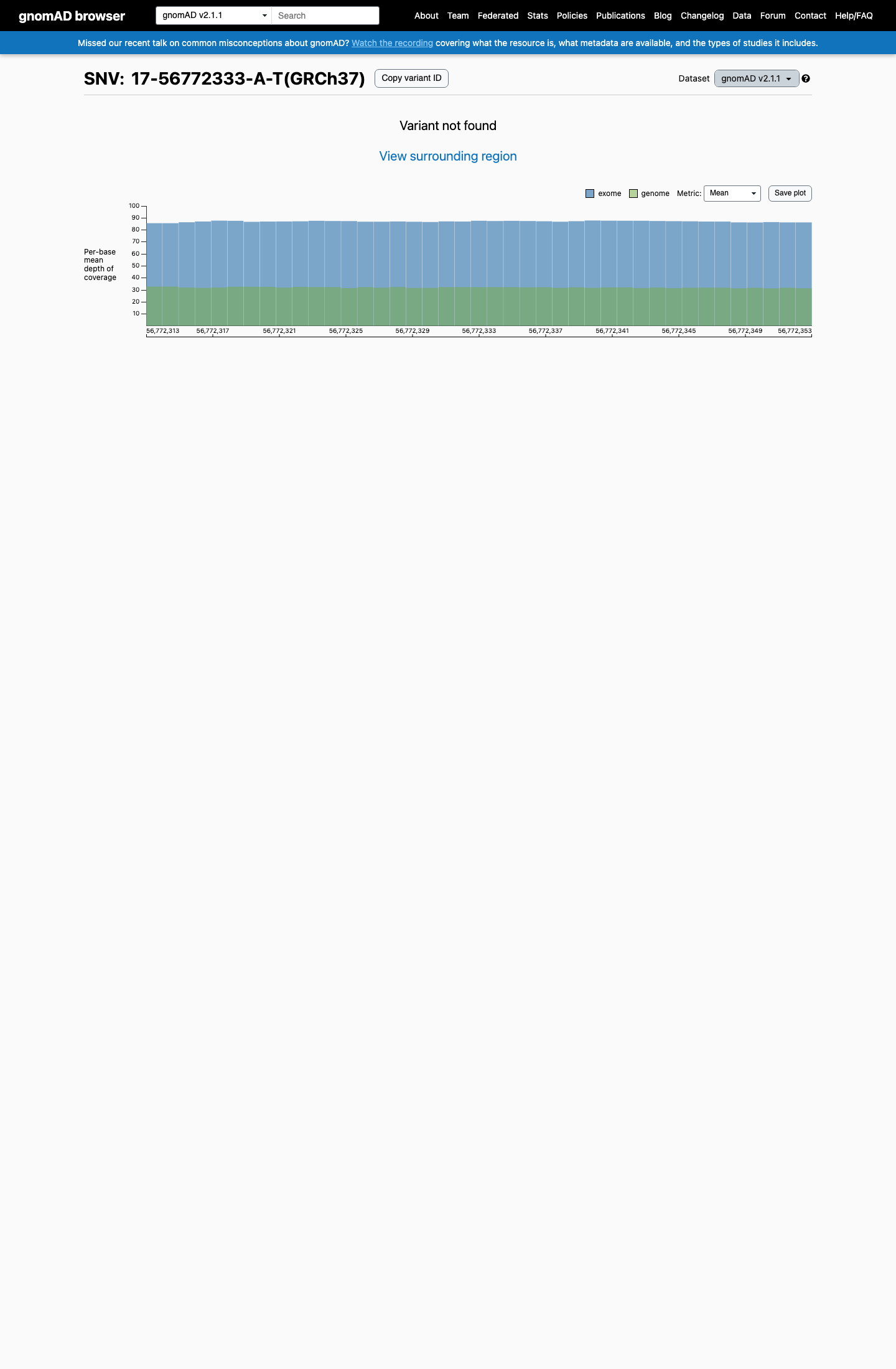
PM2 (Supporting): absent from gnomAD v2.1 and v4.1 (~856k exomes combined), allele frequency 0.

Gene
RAD51C
Transcript
NM_058216.3
HGVS · transcript:coding
NM_058216.3:c.187A>T
Consequence
N/A
GRCh38
chr17:58694972 A>T
GRCh37
chr17:56772333 A>T
Basis VUS: the applied criteria PM2 (supporting) and BP4 (supporting) conflict - one pathogenic-direction, one benign-direction - satisfying no ACMG/AMP combination rule.
VUS: the applied criteria PM2 (supporting) and BP4 (supporting) conflict - one pathogenic-direction, one benign-direction - satisfying no ACMG/AMP combination rule.
Classification rationale
PM2 BP4 VUS
RAD51C c.187A>T

PM2 (Supporting): absent from gnomAD v2.1 and v4.1 (~856k exomes combined), allele frequency 0. BP4 (Supporting): REVEL 0.084 falls in the SVI-calibrated benign-leaning interval (0.016-0.183). VUS: PM2 (pathogenic direction) and BP4 (benign direction) conflict at supporting strength, satisfying no ACMG/AMP combination rule.

PM2 + BP4 VUS
Gene diagram · NM_058216.3 · variants mapped to exon structure
RAD51C NM_058216.3
Fetching transcript structure from UCSC…
Applied criteria · 2 applied · 22 assessed
Applied · 2
Strength Supporting Moderate Strong Very strong
PM2 supporting Pathogenic
Met (supporting): absent from gnomAD v2.1 (~125.7k exomes) and v4.1 (~730.9k exomes), allele frequency 0.
gnomAD v2.1 (exome, ~125.7k individuals): variant 17-56772333-A-T absent (search_status 'absent', found=false, AF=0) (registry key: gnomad_v2).gnomAD v4.1 (exome, ~730.9k individuals): variant chr17-58694972-A-T absent (search_status 'absent', found=false, AF=0) (registry key: gnomad_v4).Generic ACMG/AMP 2015 PM2: absent in large population cohorts (or extremely low frequency if recessive) (Richards et al. 2015, PMID 25741868); local non-VCEP operating threshold PM2 <0.1% (registry key: generic_acmg_combination_rules). Absence (AF=0) satisfies PM2.
BP4 supporting Benign
Met (supporting): REVEL 0.084 falls in the SVI-calibrated BP4 interval (0.016-0.183), strongly benign-leaning.
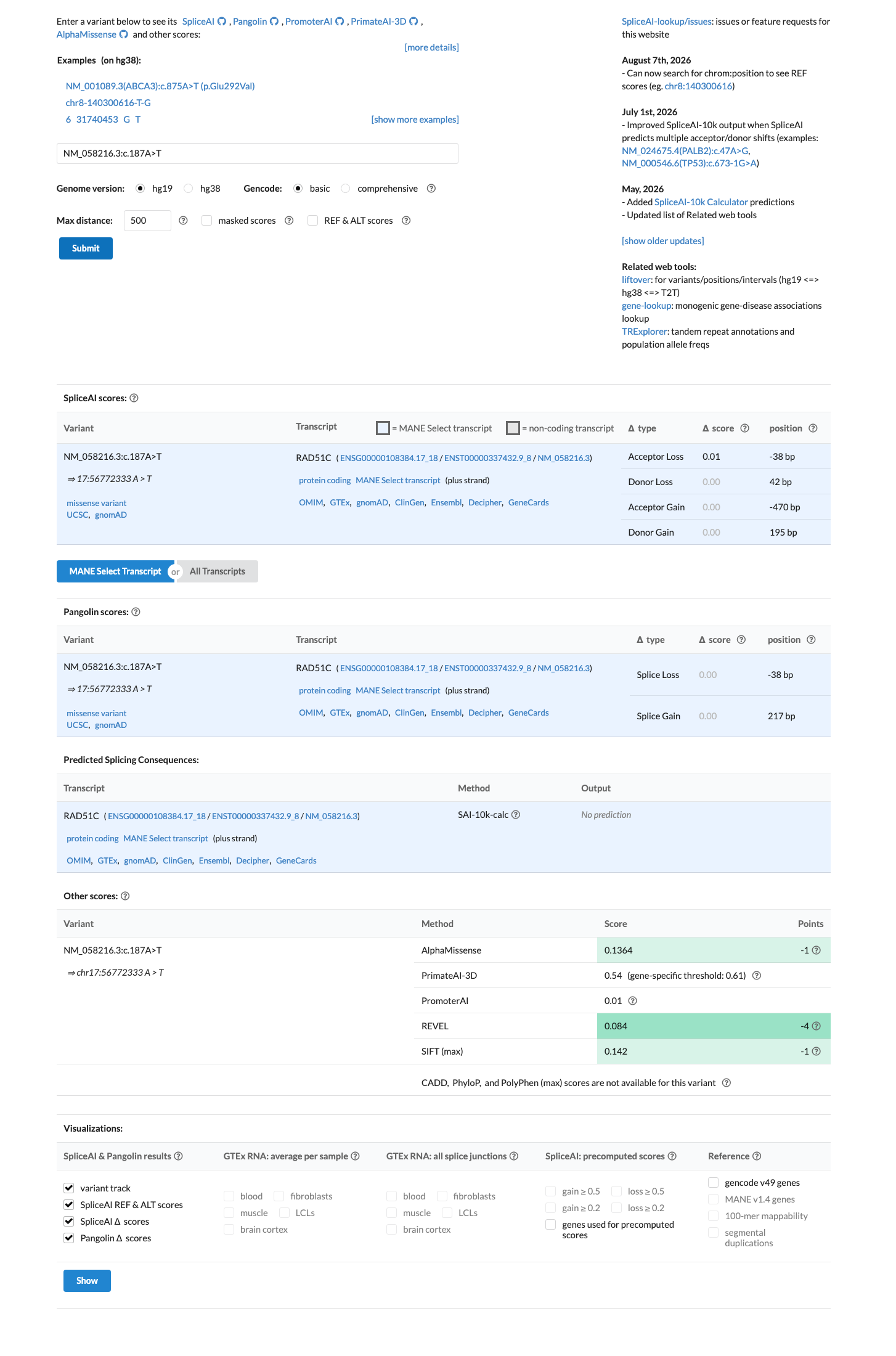
REVEL score 0.084 falls within the ClinGen SVI-calibrated REVEL BP4 moderate interval (0.016 < score <= 0.183; Pejaver et al. 2022, Am J Hum Genet, PMID 36413997, Table 2); BP4 applied at supporting strength per the governing generic ACMG/AMP fallback framework (Richards et al. 2015, PMID 25741868), which caps PP3/BP4 at supporting.BayesDel noAF score -0.3387 falls within the SVI-calibrated BayesDel BP4 supporting interval (-0.36 < score <= -0.18; Pejaver et al. 2022, PMID 36413997, Table 2); concordant with BP4 but not counted as a separate line (single-tool framework for missense).SpliceAI max delta 0.01, below the 0.2 splice-altering threshold (Jaganathan et al. 2019, Cell, PMID 30661751); concordant with no splice impact, but the splice path does not independently govern for a missense variant; not counted as a separate line.
Assessed · not applied
Pathogenic
PS1 Not met: no established pathogenic variant producing the same amino acid change p.(Ile63Phe) is documented.
PS2 Not assessed: no proband or parental genotype data were available to evaluate a de novo occurrence.
PS3 Not assessed: no functional assay evidence for p.(Ile63Phe) was identified in any consulted source.
PS4 Not assessed: no case-control or case-series data exist for this exact variant.
PM1 Not met: residue 63 is not a documented cancer hotspot, and no functional-domain annotation was available.
PM3 Not assessed: no biallelic or in-trans observation of c.187A>T with a pathogenic RAD51C variant is documented.
PM5 Not met: no pathogenic missense variant at a different amino acid at residue 63 is documented.
PM6 Not assessed: no de novo occurrence is reported and no proband or parental genotype data exist.
PP1 Not assessed: no segregation data exist for c.187A>T - no affected family members were genotyped.
PP2 Not met: missense is not a common mechanism of RAD51C disease, which is predominantly loss-of-function.
PP3 Not met: REVEL 0.084 is far below the >=0.644 threshold for a damaging prediction.
PP4 Not assessed: no proband phenotype or family-history information is available for any carrier.
PP5 Not met: no ClinVar expert-panel pathogenic classification exists; only a single-laboratory Benign assertion.
Benign
BA1 Not met: allele frequency is 0 (absent from gnomAD), far below the >1% BA1 threshold.
BS1 Not met: allele frequency is 0, far below the >0.3% BS1 threshold.
BS2 Not met: no healthy-adult or control observation exists; zero carriers among ~856k gnomAD exomes.
BS3 Not assessed: no well-established functional study of p.(Ile63Phe) is available.
BS4 Not assessed: no affected family members were genotyped, so non-segregation cannot be evaluated.
BP1 Not met: missense variants are an established disease mechanism in RAD51C, so BP1's truncating-only precondition fails.
BP2 Not assessed: no cis/trans phase observation relative to a pathogenic RAD51C variant exists.
BP5 Not assessed: no case data exist to evaluate an alternative molecular cause of disease.
BP6 Not met: the Benign label is from a single laboratory, not a ClinVar expert panel, so BP6's precondition fails.
N/A · 4 PVS1 · PM4 · BP3 · BP7
Research & evidence
Population frequency
gnomAD v4.1 screenshot
gnomAD v4.1
gnomAD v2.1 screenshot
gnomAD v2.1
v4.1
Absent from gnomAD v4.1.
v2.1
Absent from gnomAD v2.1.
🇨🇦 CA
Not available in gnomAD-Canada v1.0.
Allele frequency by ancestry
three datasets · side by side
gnomAD v4.1
Absent · 0 / ?
0 hom
Not observed in any ancestry group.
gnomAD v2.1
Absent · 0 / ?
0 hom
Not observed in any ancestry group.
gnomAD Canada 🇨🇦
Absent · 0 / ?
0 hom
Not observed in any ancestry group.
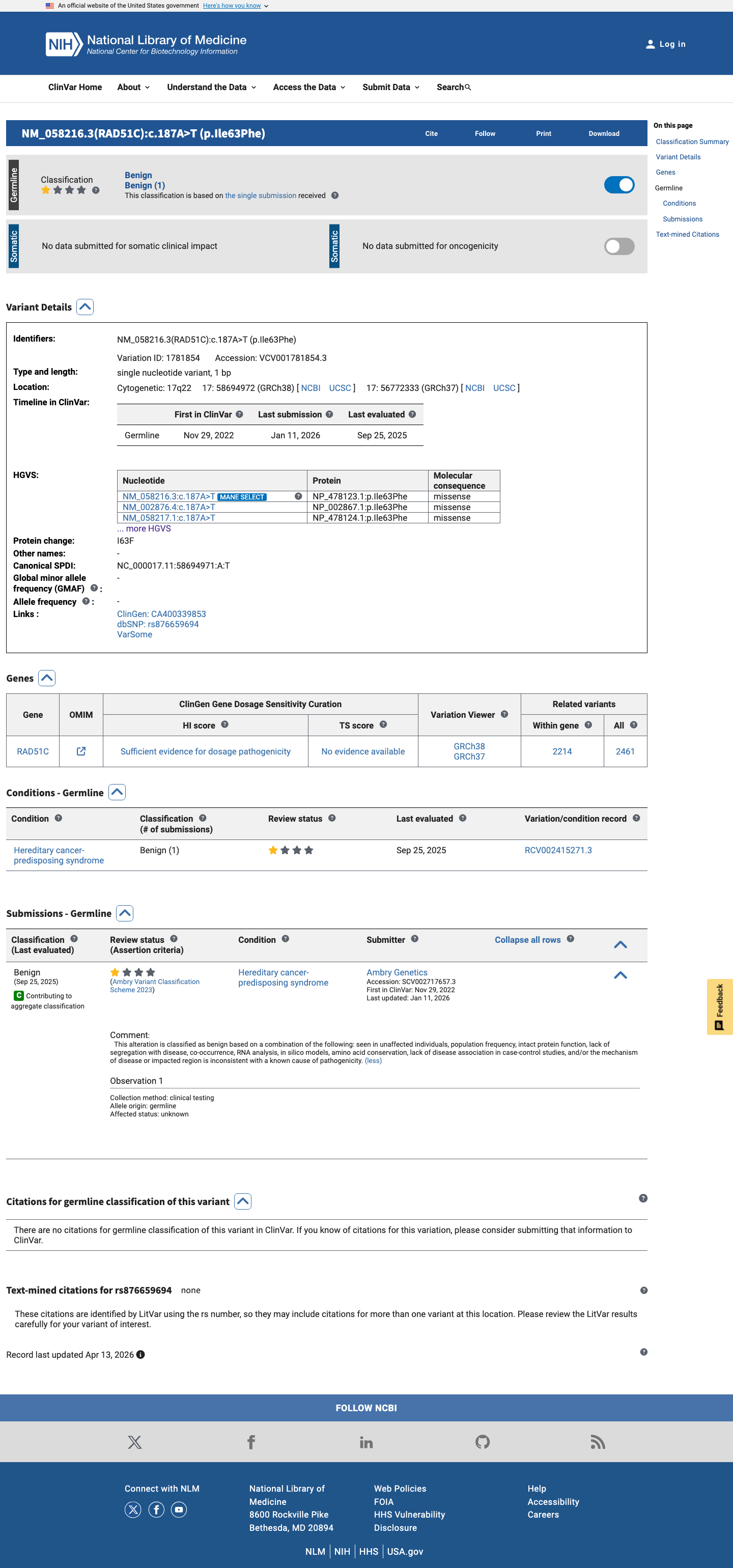
ClinVar screenshot
ClinVar
This variant has been reported in ClinVar as Benign (1 clinical laboratory). (ClinVarID = 1781854)
SpliceAI screenshot
In silico
SpliceAI predicts no significant splice impact for this variant (max delta score = 0.01). REVEL score = 0.084. BayesDel score = -0.338738.
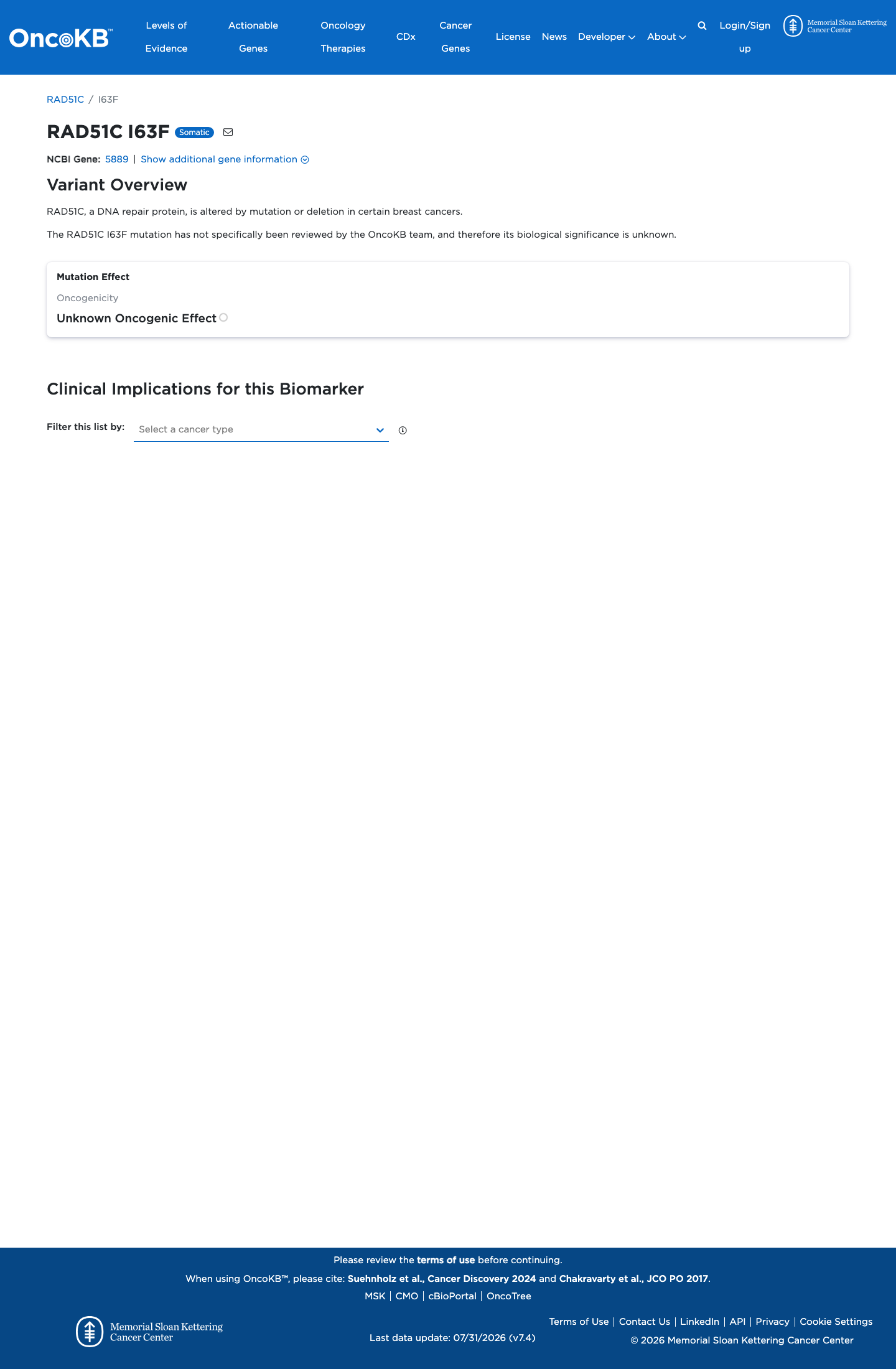
Functional / OncoKB screenshot
Functional Unknown Oncogenic Effect
OncoKB did not identify variant-specific reviewed functional evidence for this variant; gene-level curated context is available for reviewer follow-up. RAD51C, a DNA repair protein, is altered by mutation or deletion in certain breast cancers.
OncoKB ↗
COSMIC screenshot
COSMIC
Cancer hotspots screenshot
Cancer hotspots
Somatic evidence Not in COSMIC / hotspots
COSMIC
This variant does not lie in a statistically significant hotspot. This variant has not previously been reported in somatic cancers (COSMIC).
Hotspots
This variant does not lie in a statistically significant hotspot.
Literature · how each cited paper was used
1papers cited
Each card is an audit: what was searched, what was found, whether it names the variant, which criteria it fed, and why.
Rule & framework references · cited for criterion definitions, not variant evidence
25394175 ↗ A practice guideline from the American College of Medical Genetics and Genomics and the National Society of Genetic Counselors: referral indications for cancer predisposition assessment.
Sources & reference links
9Sources
CSpec VCEP
ClinVar
gnomAD v2.1
gnomAD v4.1
gnomAD-Canada
SpliceAI
OncoKB
COSMIC
Cancer hotspots