Analysis in progress
Initialising…
0%
complete
This report is still being assembled — sections appear as each stage finishes. It isn't final yet.
RAD51C
Final classification
VUS
PM2BP4
RAD51C
c.905-19T>C
p.?
unknown · exon 6i

RAD51C encodes a member of the RAD51 recombinase family that is central to repairing double-stranded DNA breaks via homologous recombination, helping assemble RAD51 filaments and resolve Holliday junctions. Mutations in this gene cause Fanconi anemia complementation group O, and germline mutations increase susceptibility to ovarian cancer and possibly breast cancer. RAD51C acts as a tumor suppressor: it is infrequently mutated in human cancers, but its expression is reduced in a subset of breast tumors, and it resides in a region of chromosome 17 that is frequently amplified in breast cancer.

This variant

RAD51C loss of function causes Fanconi anemia group O and increases susceptibility to ovarian and possibly breast cancer, but this deep intronic variant is not predicted to disrupt splicing and its effect on RAD51C function is unknown. The VUS classification means current evidence neither supports nor excludes a pathogenic contribution to RAD51C-associated cancer risk; functional studies or segregation data would be needed to clarify its clinical significance.

Transcript
NM_058216.3
HGVS · transcript:coding
NM_058216.3:c.905-19T>C
GRCh38
chr17:58724021 T>C
GRCh37
chr17:56801382 T>C
Basis VUS: only PM2 (supporting) and BP4 (supporting) are met, and one supporting pathogenic criterion opposed by one supporting benign criterion satisfies no ACMG/AMP 2015 combination rule.
VUS: only PM2 (supporting) and BP4 (supporting) are met, and one supporting pathogenic criterion opposed by one supporting benign criterion satisfies no ACMG/AMP 2015 combination rule.
Classification rationale
PM2 BP4 VUS
RAD51C c.905-19T>C unknown · exon 6i

PM2 (Supporting): gnomAD allele frequency 0.0088% (v2.1) and 0.0057% (v4.1), both below the 0.1% rarity threshold. BP4 (Supporting): SpliceAI max delta 0.016, below the 0.1 threshold, indicating no predicted splicing impact. Variant of Uncertain Significance: PM2 (supporting pathogenic) and BP4 (supporting benign) oppose each other, satisfying no Benign, Likely Benign, Likely Pathogenic, or Pathogenic combination rule under ACMG/AMP 2015.

PM2 + BP4 VUS
Gene diagram · NM_058216.3 · variants mapped to exon structure
RAD51C NM_058216.3
Fetching transcript structure from UCSC…
Applied criteria · 2 applied · 17 assessed
MetEvidence satisfies this criterion.
Not metEvaluated against available evidence; threshold not reached.
Not assessedApplies in principle, but no evidence was found to evaluate it.
N/ADoesn't apply to this variant type.
Applied · 2
Strength Supporting Moderate Strong Very strong
PM2 supporting Pathogenic
Met (supporting): gnomAD allele frequency 0.0088% (v2.1) and 0.0057% (v4.1), both below the 0.1% PM2 rarity threshold.
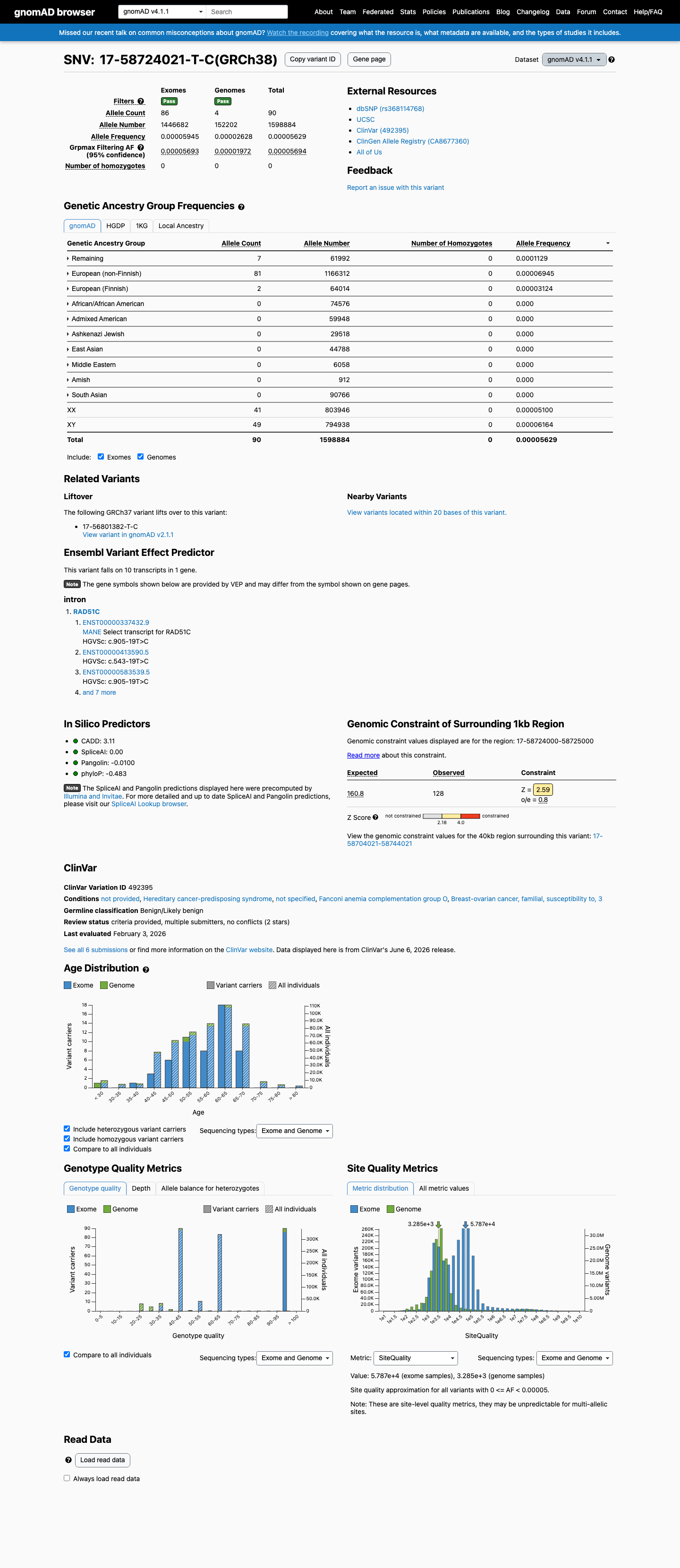
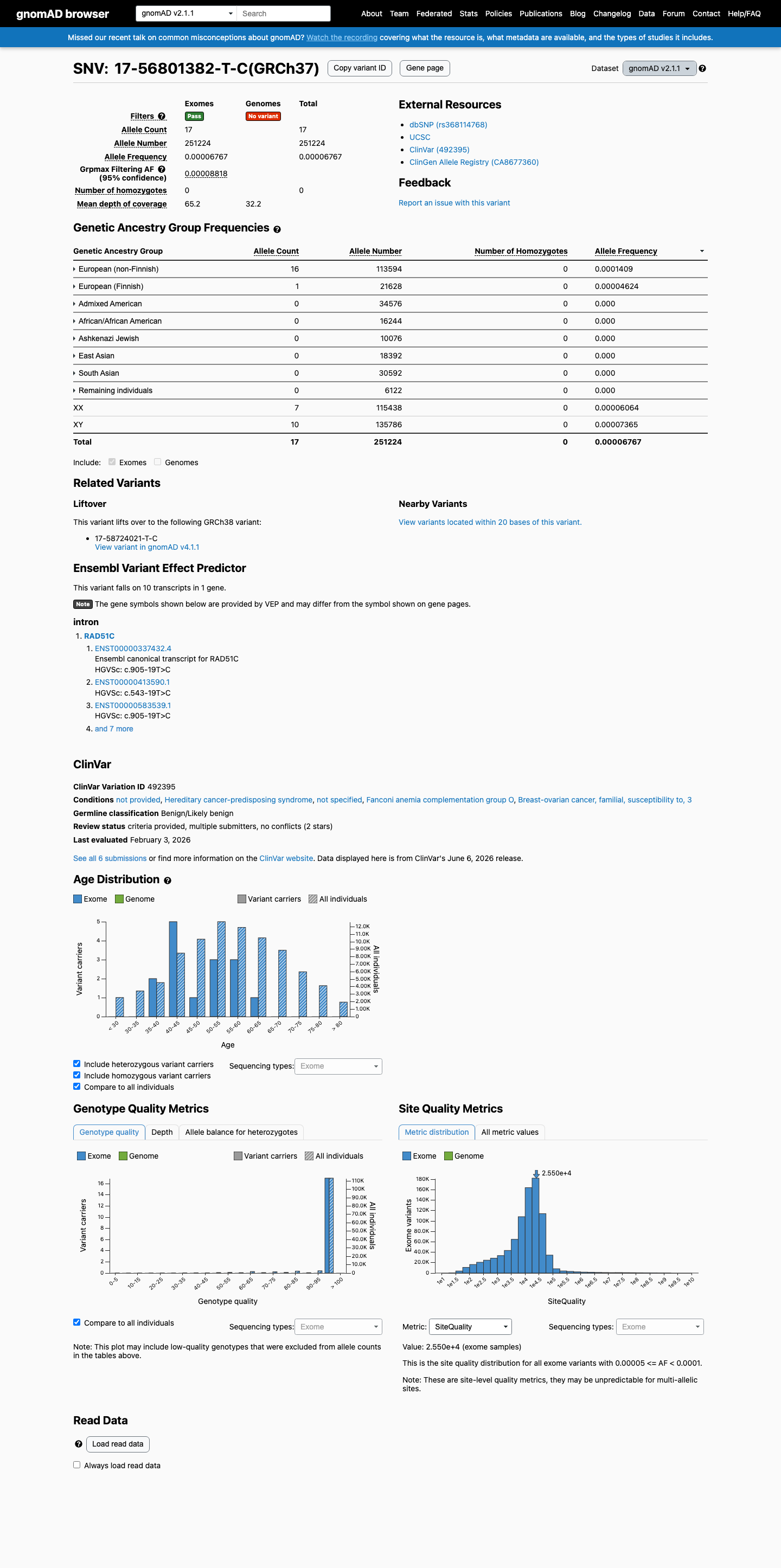
gnomAD v2.1: 17/251,224 alleles (AF 0.006767%), grpmax FAF 0.008818%, with no homozygotes; the highest broad-population AF is 0.014085% in non-Finnish Europeans (16/113,594 alleles).gnomAD v4.1: 90/1,598,884 alleles (AF 0.005629%), grpmax FAF 0.005694%, with no homozygotes; the highest broad-population AF is 0.011292% in Remaining individuals (7/61,992 alleles).The variant is absent from gnomAD-Canada v1.0.
BP4 supporting Benign
Met (supporting): SpliceAI max delta 0.016, below the <0.1 BP4 threshold, indicating no predicted splice impact.
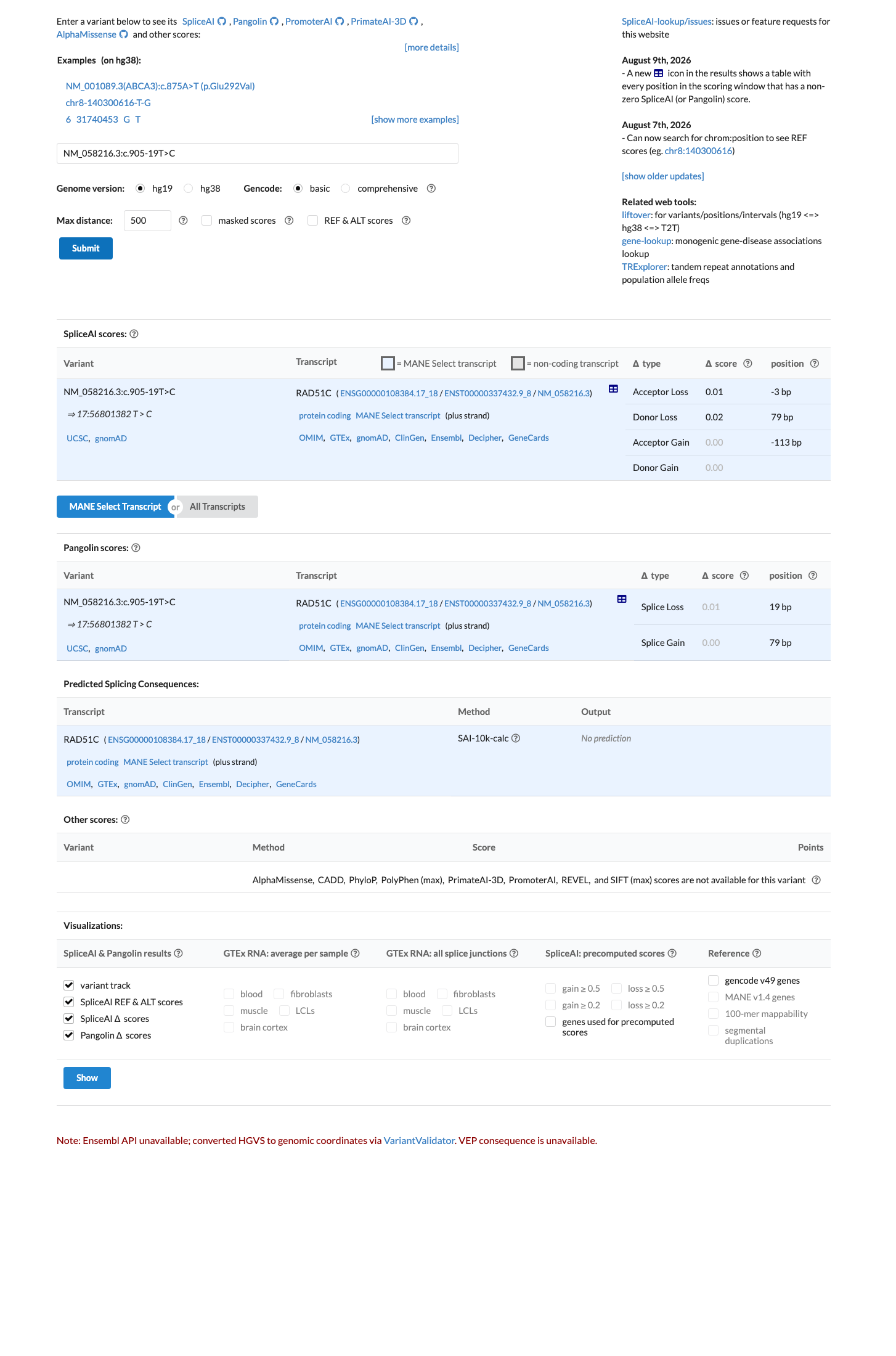
SpliceAI max delta score = 0.016 (DS_AG=0.0, DS_AL=0.013, DS_DG=0.0, DS_DL=0.016), well below the 0.1 BP4 supporting threshold for intronic variants (source: spliceai).Generic ACMG/AMP in-silico calibration (output/generic_acmg_classification_rules.md, source basis PMID:25741868, SVI-recommended SpliceAI thresholds as also reflected in VCEP CSPEC specifications such as ATM's per Walker et al. 2023): SpliceAI max delta <0.1 -> BP4 supporting for intronic/synonymous/non-canonical splice-position variants.BayesDel score for this variant was retrieved (score present in prefetch data) but is not used for PP3/BP4 per this pipeline's policy: no verified published calibration threshold/PMID is available for BayesDel, so it is treated as not_available regardless of the raw score.
Assessed · not applied · 6 not met · 11 not assessed
Pathogenic
PS2 Not assessed: no de novo observation or parental-testing data were available for this variant.
PS3 Not assessed: no validated functional assay data (splicing minigene, RT-PCR, or HDR assay) were available.
PS4 Not assessed: no case-control or statistical enrichment evidence for this variant was available.
PM3 Not assessed: no biallelic observation or second pathogenic/likely pathogenic RAD51C variant was reported.
PM6 Not assessed: no reported de novo occurrence or parental testing was available.
PP1 Not assessed: no segregation data from informative relatives were reported.
PP3 Not met: SpliceAI max delta 0.016, well below the >0.2 PP3 splice-path threshold.
PP4 Not assessed: no phenotype or personal/family cancer history was provided for the tested individual.
PP5 Not met: no ClinVar expert-panel pathogenic or likely pathogenic classification exists for this exact variant.
Benign
BA1 Not met: highest gnomAD allele frequency 0.0088%, far below the >1% BA1 stand-alone benign threshold.
BS1 Not met: highest observed gnomAD allele frequency 0.038% (NFE_SWE subset), below the >0.3% BS1 threshold.
BS2 Not met: gnomAD reports zero homozygotes and no disease-free carrier phenotype is established.
BS3 Not assessed: no validated functional assay with normal-range results was available.
BS4 Not assessed: no affected non-carrier or unaffected carrier observations were reported.
BP2 Not assessed: no co-occurrence data with a pathogenic RAD51C variant, or cis/trans phase, were reported.
BP5 Not assessed: no evidence of an alternative molecular diagnosis was available.
BP6 Not met: no ClinVar expert-panel benign or likely benign classification exists for this exact variant.
N/A · 9 PVS1 · PS1 · PM1 · PM4 · PM5 · PP2 · BP1 · BP3 · BP7
Research & evidence
Population frequency
gnomAD v4.1 screenshot
gnomAD v4.1
gnomAD v2.1 screenshot
gnomAD v2.1
v4.1
This variant is present in gnomAD v4.1 (AF= 5.62893e-05; MAF= 0.00563%, 90/1598884 alleles, homozygotes = 0) and has highest observed frequency in the Remaining individuals population (AF= 0.000112918; MAF= 0.01129%, 7/61992 alleles, homozygotes = 0); grpmax FAF= 5.694e-05.
v2.1
This variant is present in gnomAD v2.1 (AF= 6.76687e-05; MAF= 0.00677%, 17/251224 alleles, homozygotes = 0) and has highest observed frequency in the European (non-Finnish) population (AF= 0.000140853; MAF= 0.01409%, 16/113594 alleles, homozygotes = 0); grpmax FAF= 8.818e-05.
🇨🇦 CA
Absent from gnomAD-Canada v1.0.
Allele frequency by ancestry
three datasets · side by side
gnomAD v4.1
0.0056% · 90 / 1,598,884
0 hom · FAF 0.0057%
Remaining individuals
7 / 61,992
0.011%
European (non-Finnish)
81 / 1,166,312
0.0069%
European (Finnish)
2 / 64,014
0.0031%
+ 7 not observed (Admixed American, Amish, East Asian, Middle Eastern, South Asian, Ashkenazi Jewish, African/African American)
gnomAD v2.1
0.0068% · 17 / 251,224
0 hom · FAF 0.0088%
European (non-Finnish)
16 / 113,594
0.014%
European (Finnish)
1 / 21,628
0.0046%
+ 6 not observed (African/African American, Admixed American, Ashkenazi Jewish, East Asian, Remaining individuals, South Asian)
gnomAD Canada 🇨🇦
Absent · 0 / ?
0 hom
Not observed in any ancestry group.
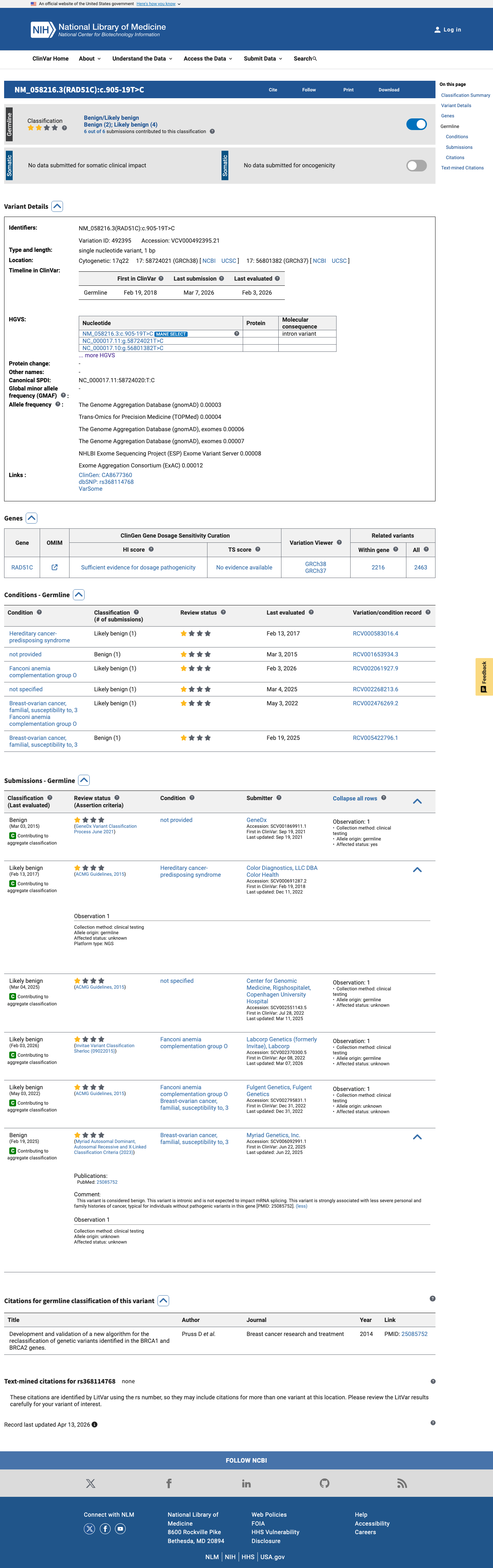
ClinVar screenshot
ClinVar
This variant has been reported in ClinVar as Likely benign (4 clinical laboratories) and as Benign (2 clinical laboratories). (ClinVarID = 492395)
SpliceAI screenshot
In silico
SpliceAI predicts no significant splice impact for this variant (max delta score = 0.02).
Functional No data
No calibrated functional assay or RNA evidence was identified for this variant.
OncoKB ↗
COSMIC screenshot
COSMIC
Somatic evidence
COSMIC
This variant has not previously been reported in somatic cancers (COSMIC).
Hotspots
This variant does not lie in a statistically significant cancer hotspot.
COSMIC ↗
Sources & reference links
8Sources
CSpec VCEP
ClinVar
gnomAD v2.1
gnomAD v4.1
gnomAD-Canada
SpliceAI
OncoKB
COSMIC
Triaged references · 5 PMIDs not cited in assessment
25741868 ↗ Standards and guidelines for the interpretation of sequence variants: a joint consensus recommendation of the American College of Medical Genetics and Genomics and the Association for Molecular Pathology. CLINVAR
20301575 ↗ Fanconi Anemia. CLINVAR
25085752 ↗ Development and validation of a new algorithm for the reclassification of genetic variants identified in the BRCA1 and BRCA2 genes. CLINVAR
25394175 ↗ A practice guideline from the American College of Medical Genetics and Genomics and the National Society of Genetic Counselors: referral indications for cancer predisposition assessment. CLINVAR
28492532 ↗ Sherloc: a comprehensive refinement of the ACMG-AMP variant classification criteria. CLINVAR