Back
NM_133509.4:c.585_587dup
p.Glu198dup · RAD51B
ACMG/AMP
0%
complete
Final classification
VUS
PM2BP3
RAD51B
c.585_587dup
p.Glu198dup
inframe insertion

RAD51B is a member of the RAD51 protein family that plays an essential role in repairing double-strand DNA breaks through homologous recombination, working together with RAD51C and other DNA repair partners. It also participates in cell cycle regulation, and its activity increases in response to DNA damage. RAD51B has been associated with an increased risk of familial breast cancer, and chromosomal rearrangements involving this gene have been observed in uterine leiomyomata. Loss of RAD51B function impairs DNA repair and can promote cancer through genome instability, and it acts as a tumor suppressor.

This variant

RAD51B repairs double-strand DNA breaks through homologous recombination, and loss of its function promotes cancer through genome instability. This variant adds a single glutamic acid to a low-complexity repeat tract, but no functional, clinical, or family data are available to show whether it affects RAD51B's DNA-repair activity; the Uncertain significance classification reflects that insufficient evidence, not evidence that the variant is benign or pathogenic.

Transcript
NM_133509.4
HGVS · transcript:coding
NM_133509.4:c.585_587dup
GRCh38
chr14:67887032 T>TGGA
GRCh37
chr14:68353749 T>TGGA
Variant of Uncertain Significance: a single supporting pathogenic criterion (PM2, max AF 0.00190% vs <0.1%) conflicts with a single supporting benign criterion (BP3), meeting no combination threshold under ACMG/AMP 2015. Flagged for human review: the (GAA)3 repeat-region determination is a threshold judgment, but overturning it would not alter the VUS call.
Classification rationale
PM2 BP3 VUS
RAD51B c.585_587dup inframe insertion

PM2 (Supporting): extremely low population frequency - maximum allele frequency 0.00190% (gnomAD v2.1), below the <0.1% threshold, with zero homozygotes. BP3 (Supporting): in-frame duplication lengthens a poly-glutamate repeat tract without known function (p.Glu198dup, 384 to 385 amino acids), with no predicted splice impact (SpliceAI delta 0.01). Final classification: Variant of Uncertain Significance - the one supporting pathogenic and one supporting benign criterion are conflicting and meet no combination threshold under generic ACMG/AMP 2015.

PM2 + BP3 VUS
LYFE Sciences is an AI system, and it can make mistakes. Criteria may be applied incorrectly, sources may be misread, and a confident-looking classification can still be wrong. Double-check every criterion and its underlying evidence before relying on any call.
Gene diagram · NM_133509.4 · variants mapped to exon structure
RAD51B NM_133509.4
Fetching transcript structure from UCSC…
Applied criteria · 2 applied · 17 assessed
MetEvidence satisfies this criterion.
Not metEvaluated against available evidence; threshold not reached.
Not assessedApplies in principle, but no evidence was found to evaluate it.
N/ADoesn't apply to this variant type.
Applied · 2
Strength Supporting Moderate Strong Very strong
PM2 supporting Pathogenic
Met (supporting): the variant is extremely rare, with a maximum population allele frequency of 0.00190%, far below the <0.1% threshold.
gnomAD v2.1 exome: total AF 9.09695e-06 (0.00091%, 2/219854 alleles), max NFE AF 1.89836e-05 (0.00190%), grpmax FAF 3.15e-06, 0 homozygotesgnomAD v4.1 exome: total AF 1.99861e-06 (0.00020%, 3/1501040 alleles), max NFE AF 2.72229e-06 (0.00027%), grpmax FAF 7.3e-07, 0 homozygotesgnomAD-Canada v1.0: absent (0 carriers)
BP3 supporting review Benign
Met (supporting): the in-frame p.Glu198dup lengthens a poly-glutamate repeat tract with no known function, with no predicted splice impact (SpliceAI delta 0.01).
generic_acmg_combination_rules: governing generic ACMG/AMP 2015 criteria definitions (PMID:25741868); no RAD51B VCEP/CSPEC available so generic BP3 definition appliesReference CDS sequence analysis of the case transcript NM_133509.4 (codons 195-201: TTG GAA GAA GAA ATT ATC TCA): tandem trinucleotide repeat (GAA)3 encoding poly-Glu tract E3 at residues 196-198; c.585_587dupGGA (unit GGA, spanning the TTG|GAA boundary) expands the tract to E4, i.e., single-amino-acid repeat-length change in a low-complexity repeat regionspliceai: max delta score 0.01 - no splice impact; the variant is a pure in-frame coding change (premise of BP3)
Assessed · not applied · 6 not met · 11 not assessed
Pathogenic
PS2 Not assessed: no parental testing or de novo occurrence of this variant is documented in any clinical record.
PS3 Not assessed: no functional assay data exist for p.(Glu198dup); the only available signal was an in silico prediction, which does not qualify.
PS4 Not assessed: no case-control study of this variant exists; population allele frequencies alone cannot establish enrichment in affected individuals.
PM3 Not assessed: no genotype or phase data exist to show the variant is in trans with a pathogenic allele.
PM4 Not met: although protein length changes (384 to 385 amino acids), the duplication lengthens a (GAA)3 repeat tract, and PM4 excludes repeat regions.
PM6 Not assessed: no de novo occurrence of this variant is reported in any proband or family record.
PP1 Not assessed: no segregation data exist - no affected relatives or informative meioses are reported for this variant.
PP3 Not met: SpliceAI predicts no splice impact (max delta 0.01 vs the 0.2 threshold), and no other calibrated computational evidence applies.
PP4 Not assessed: no proband phenotype or family history is available, and cancer predisposition is not a highly specific single-etiology phenotype.
Benign
BA1 Not met: the highest population allele frequency is 0.00190%, three orders of magnitude below the >1% BA1 threshold.
BS1 Not met: the highest population allele frequency is 0.00190%, far below the >0.3% BS1 threshold.
BS2 Not met: zero homozygotes in gnomAD (0 of ~1.5 million alleles), and the incompletely penetrant late-onset trait makes carrier status insufficient.
BS3 Not assessed: no functional assay data exist for this variant; in silico splice predictions do not qualify as well-established functional studies.
BS4 Not assessed: no family genotyping exists to show that affected relatives do not carry the variant.
BP2 Not assessed: no genotype or phase data exist to place the variant in cis or trans with a pathogenic allele.
BP4 Not met: SpliceAI (delta 0.01) is the only computational line and addresses splicing only, while BP4 requires multiple lines of evidence.
BP5 Not assessed: no proband genetic testing results are available to document an alternate molecular cause of disease.
N/A · 9 PVS1 · PS1 · PM1 · PM5 · PP2 · PP5 · BP1 · BP6 · BP7
Research & evidence
Population frequency
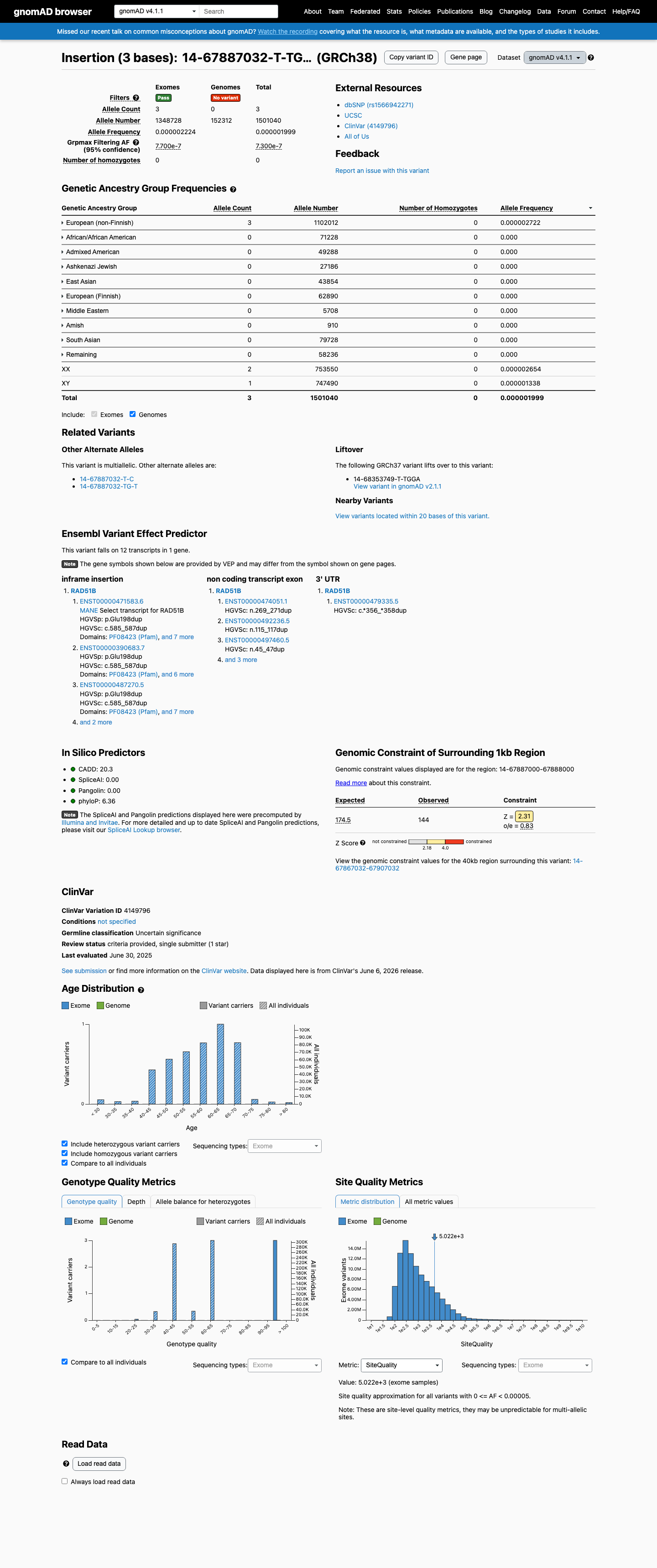
gnomAD v4.1 screenshot
gnomAD v4.1
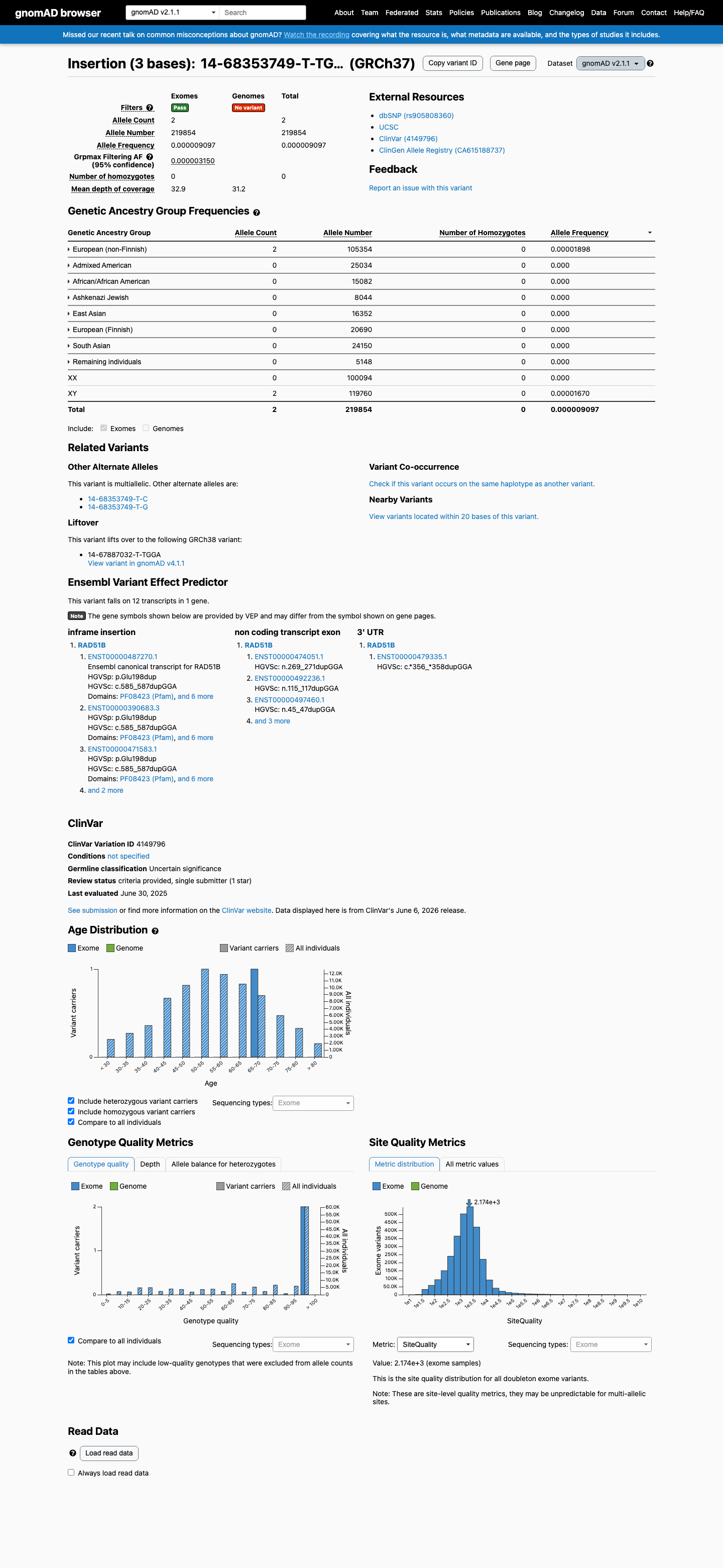
gnomAD v2.1 screenshot
gnomAD v2.1
v4.1
This variant is present in gnomAD v4.1 (AF= 1.99861e-06; MAF= 0.00020%, 3/1501040 alleles, homozygotes = 0) and has highest observed frequency in the European (non-Finnish) population (AF= 2.72229e-06; MAF= 0.00027%, 3/1102012 alleles, homozygotes = 0); grpmax FAF= 7.3e-07.
v2.1
This variant is present in gnomAD v2.1 (AF= 9.09695e-06; MAF= 0.00091%, 2/219854 alleles, homozygotes = 0) and has highest observed frequency in the European (non-Finnish) population (AF= 1.89836e-05; MAF= 0.00190%, 2/105354 alleles, homozygotes = 0); grpmax FAF= 3.15e-06.
🇨🇦 CA
Absent from gnomAD-Canada v1.0.
Allele frequency by ancestry
three datasets · side by side
gnomAD v4.1
0.0002% · 3 / 1,501,040
0 hom · FAF 7.3e-05%
European (non-Finnish)
3 / 1,102,012
0.00027%
+ 9 not observed (Remaining individuals, Admixed American, European (Finnish), Amish, East Asian, Middle Eastern, South Asian, Ashkenazi Jewish, African/African American)
gnomAD v2.1
0.00091% · 2 / 219,854
0 hom · FAF 0.00032%
European (non-Finnish)
2 / 105,354
0.0019%
+ 7 not observed (African/African American, Admixed American, Ashkenazi Jewish, East Asian, European (Finnish), Remaining individuals, South Asian)
gnomAD Canada 🇨🇦
Absent · 0 / ?
0 hom
Not observed in any ancestry group.
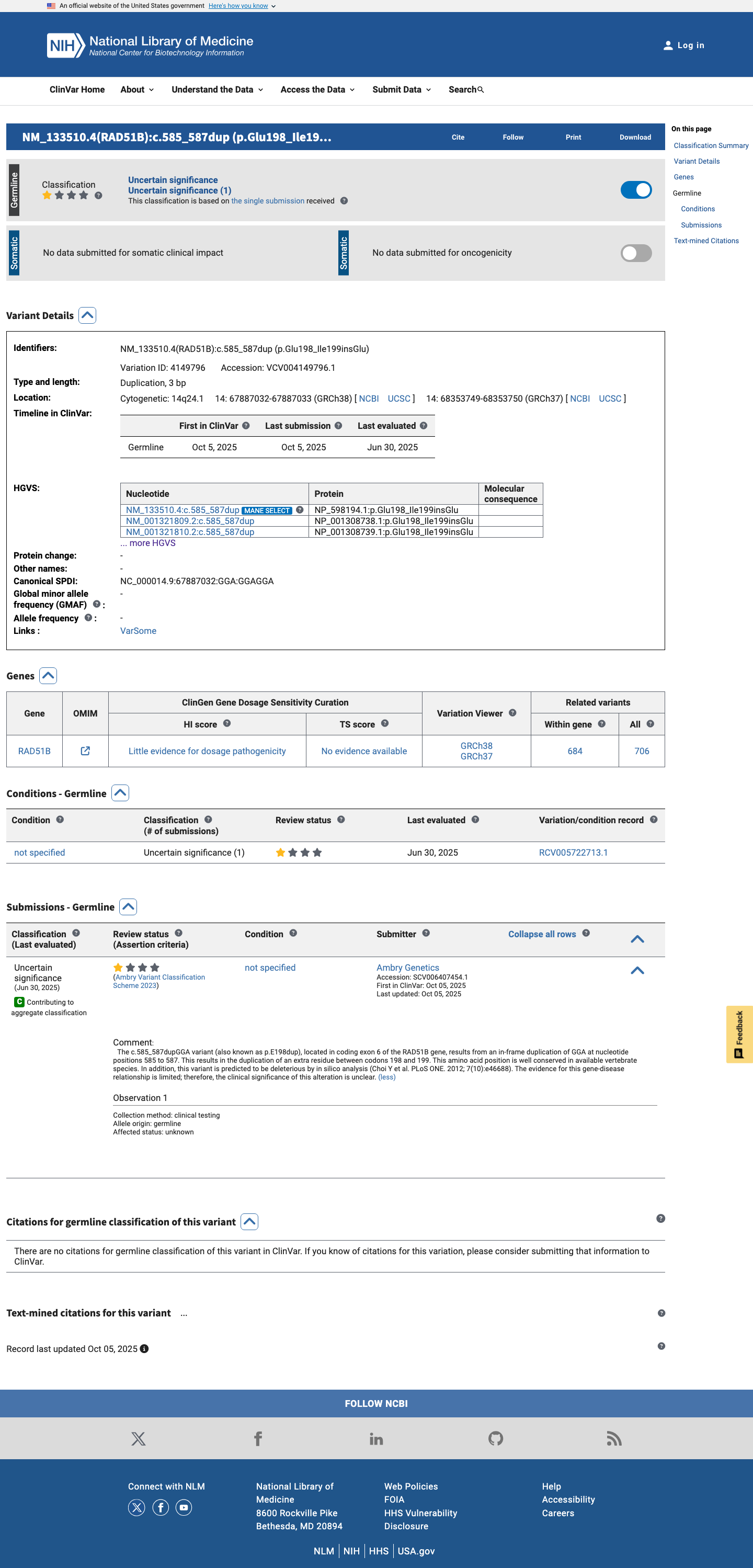
ClinVar screenshot
ClinVar
This variant has been reported in ClinVar as Uncertain significance (1 clinical laboratory). (ClinVarID = 4149796)
SpliceAI screenshot
In silico
SpliceAI predicts no significant splice impact for this variant (max delta score = 0.01).
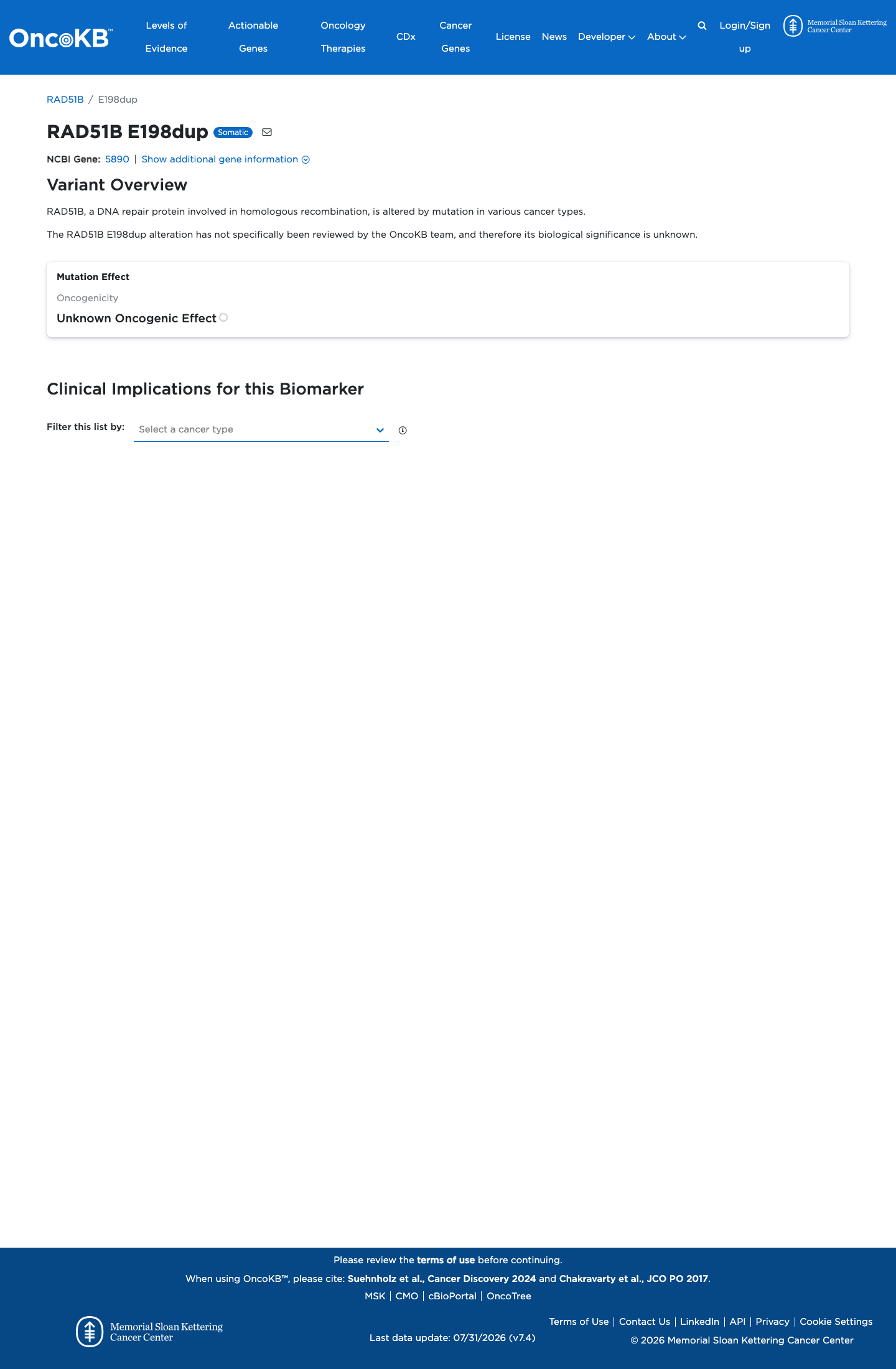
Functional / OncoKB screenshot
Functional Unknown Oncogenic Effect
OncoKB did not identify variant-specific reviewed functional evidence for this variant; gene-level curated context is available for reviewer follow-up. RAD51B, a DNA repair protein involved in homologous recombination, is altered by mutation in various cancer types.
OncoKB ↗
COSMIC screenshot
COSMIC
Cancer hotspots screenshot
Cancer hotspots
Somatic evidence Not in COSMIC / hotspots
COSMIC
This variant does not lie in a statistically significant hotspot. This variant has not previously been reported in somatic cancers (COSMIC).
Hotspots
This variant does not lie in a statistically significant hotspot.
Sources & reference links
8Sources
ClinVar
gnomAD v2.1
gnomAD v4.1
gnomAD-Canada
SpliceAI
OncoKB
COSMIC
Cancer hotspots