Analysis in progress
Initialising…
0%
complete
This report is still being assembled — sections appear as each stage finishes. It isn't final yet.
RAD51B
Final classification
VUS
RAD51B c.585_587dup · p.Glu198dup
RAD51B

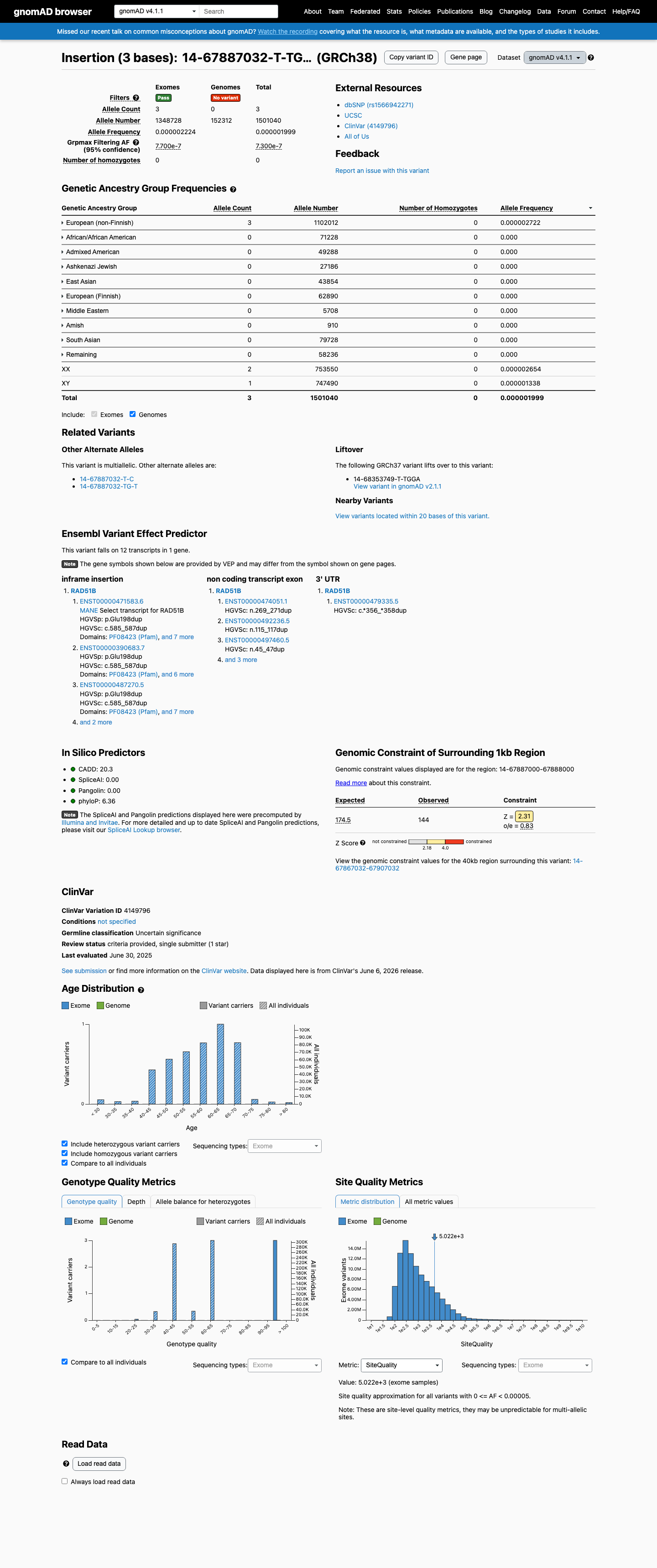
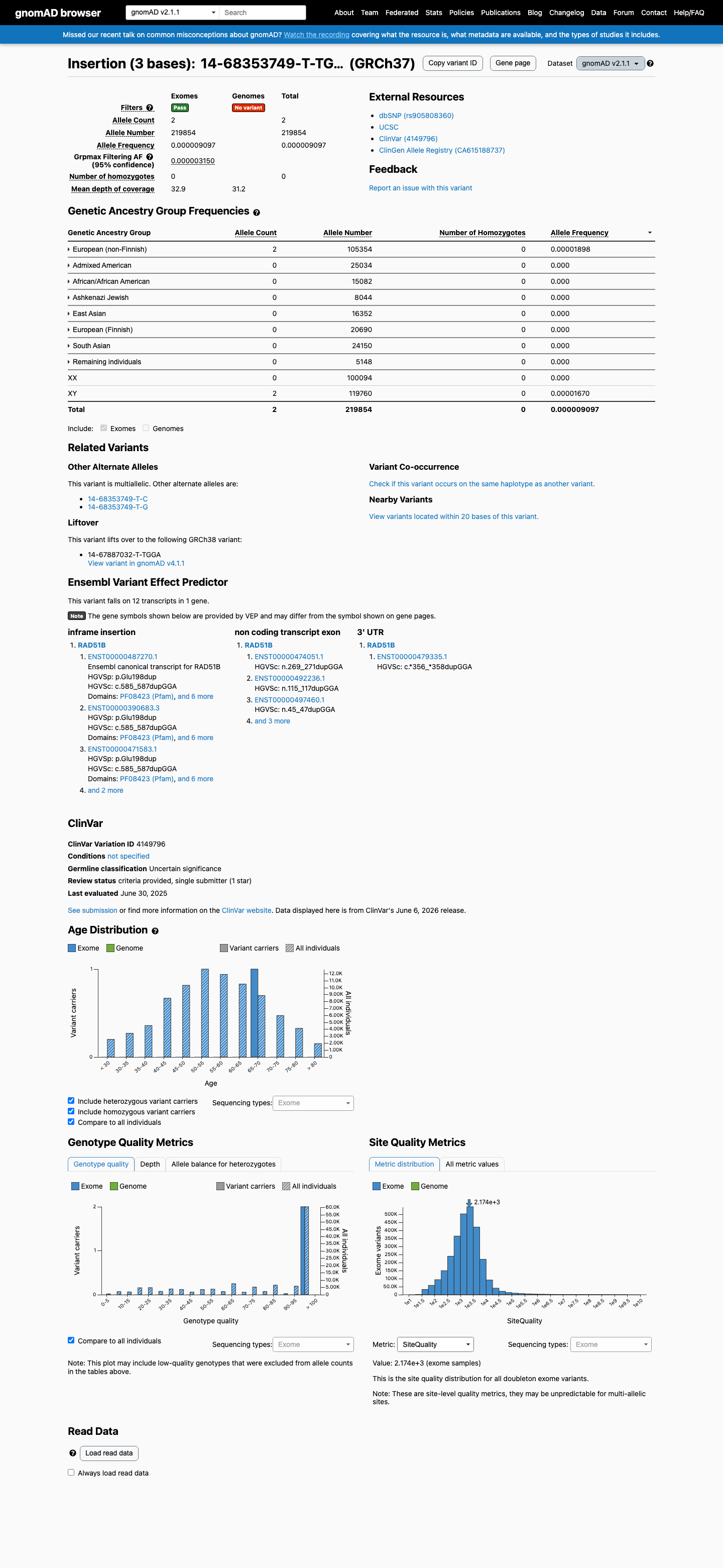
PM2 (Supporting): extremely low population frequency - maximum allele frequency 0.00190% (gnomAD v2.1), below the <0.1% threshold, with zero homozygotes.

Gene
RAD51B
Transcript
NM_133509.4
HGVS · transcript:coding
NM_133509.4:c.585_587dup
Consequence
N/A
GRCh38
chr14:67887032 T>TGGA
GRCh37
chr14:68353749 T>TGGA
Basis Variant of Uncertain Significance: a single supporting pathogenic criterion (PM2, max AF 0.00190% vs <0.1%) conflicts with a single supporting benign criterion (BP3), meeting no combination threshold under ACMG/AMP 2015. Flagged for human review: the (GAA)3 repeat-region determination is a threshold judgment, but overturning it would not alter the VUS call.
Variant of Uncertain Significance: a single supporting pathogenic criterion (PM2, max AF 0.00190% vs <0.1%) conflicts with a single supporting benign criterion (BP3), meeting no combination threshold under ACMG/AMP 2015. Flagged for human review: the (GAA)3 repeat-region determination is a threshold judgment, but overturning it would not alter the VUS call.
Classification rationale
PM2 BP3 VUS
RAD51B c.585_587dup

PM2 (Supporting): extremely low population frequency - maximum allele frequency 0.00190% (gnomAD v2.1), below the <0.1% threshold, with zero homozygotes. BP3 (Supporting): in-frame duplication lengthens a poly-glutamate repeat tract without known function (p.Glu198dup, 384 to 385 amino acids), with no predicted splice impact (SpliceAI delta 0.01). Final classification: Variant of Uncertain Significance - the one supporting pathogenic and one supporting benign criterion are conflicting and meet no combination threshold under generic ACMG/AMP 2015.

PM2 + BP3 VUS
Gene diagram · NM_133509.4 · variants mapped to exon structure
RAD51B NM_133509.4
Fetching transcript structure from UCSC…
Applied criteria · 2 applied · 17 assessed
Applied · 2
Strength Supporting Moderate Strong Very strong
PM2 supporting Pathogenic
Met (supporting): the variant is extremely rare, with a maximum population allele frequency of 0.00190%, far below the <0.1% threshold.
gnomAD v2.1 exome: total AF 9.09695e-06 (0.00091%, 2/219854 alleles), max NFE AF 1.89836e-05 (0.00190%), grpmax FAF 3.15e-06, 0 homozygotesgnomAD v4.1 exome: total AF 1.99861e-06 (0.00020%, 3/1501040 alleles), max NFE AF 2.72229e-06 (0.00027%), grpmax FAF 7.3e-07, 0 homozygotesgnomAD-Canada v1.0: absent (0 carriers)
BP3 supporting review Benign
Met (supporting): the in-frame p.Glu198dup lengthens a poly-glutamate repeat tract with no known function, with no predicted splice impact (SpliceAI delta 0.01).
generic_acmg_combination_rules: governing generic ACMG/AMP 2015 criteria definitions (PMID:25741868); no RAD51B VCEP/CSPEC available so generic BP3 definition appliesReference CDS sequence analysis of the case transcript NM_133509.4 (codons 195-201: TTG GAA GAA GAA ATT ATC TCA): tandem trinucleotide repeat (GAA)3 encoding poly-Glu tract E3 at residues 196-198; c.585_587dupGGA (unit GGA, spanning the TTG|GAA boundary) expands the tract to E4, i.e., single-amino-acid repeat-length change in a low-complexity repeat regionspliceai: max delta score 0.01 - no splice impact; the variant is a pure in-frame coding change (premise of BP3)
Assessed · not applied
Pathogenic
PS2 Not assessed: no parental testing or de novo occurrence of this variant is documented in any clinical record.
PS3 Not assessed: no functional assay data exist for p.(Glu198dup); the only available signal was an in silico prediction, which does not qualify.
PS4 Not assessed: no case-control study of this variant exists; population allele frequencies alone cannot establish enrichment in affected individuals.
PM3 Not assessed: no genotype or phase data exist to show the variant is in trans with a pathogenic allele.
PM4 Not met: although protein length changes (384 to 385 amino acids), the duplication lengthens a (GAA)3 repeat tract, and PM4 excludes repeat regions.
PM6 Not assessed: no de novo occurrence of this variant is reported in any proband or family record.
PP1 Not assessed: no segregation data exist - no affected relatives or informative meioses are reported for this variant.
PP3 Not met: SpliceAI predicts no splice impact (max delta 0.01 vs the 0.2 threshold), and no other calibrated computational evidence applies.
PP4 Not assessed: no proband phenotype or family history is available, and cancer predisposition is not a highly specific single-etiology phenotype.
Benign
BA1 Not met: the highest population allele frequency is 0.00190%, three orders of magnitude below the >1% BA1 threshold.
BS1 Not met: the highest population allele frequency is 0.00190%, far below the >0.3% BS1 threshold.
BS2 Not met: zero homozygotes in gnomAD (0 of ~1.5 million alleles), and the incompletely penetrant late-onset trait makes carrier status insufficient.
BS3 Not assessed: no functional assay data exist for this variant; in silico splice predictions do not qualify as well-established functional studies.
BS4 Not assessed: no family genotyping exists to show that affected relatives do not carry the variant.
BP2 Not assessed: no genotype or phase data exist to place the variant in cis or trans with a pathogenic allele.
BP4 Not met: SpliceAI (delta 0.01) is the only computational line and addresses splicing only, while BP4 requires multiple lines of evidence.
BP5 Not assessed: no proband genetic testing results are available to document an alternate molecular cause of disease.
N/A · 9 PVS1 · PS1 · PM1 · PM5 · PP2 · PP5 · BP1 · BP6 · BP7
Research & evidence
Population frequency
gnomAD v4.1 screenshot
gnomAD v4.1
gnomAD v2.1 screenshot
gnomAD v2.1
v4.1
This variant is present in gnomAD v4.1 (AF= 1.99861e-06; MAF= 0.00020%, 3/1501040 alleles, homozygotes = 0) and has highest observed frequency in the European (non-Finnish) population (AF= 2.72229e-06; MAF= 0.00027%, 3/1102012 alleles, homozygotes = 0); grpmax FAF= 7.3e-07.
v2.1
This variant is present in gnomAD v2.1 (AF= 9.09695e-06; MAF= 0.00091%, 2/219854 alleles, homozygotes = 0) and has highest observed frequency in the European (non-Finnish) population (AF= 1.89836e-05; MAF= 0.00190%, 2/105354 alleles, homozygotes = 0); grpmax FAF= 3.15e-06.
🇨🇦 CA
Absent from gnomAD-Canada v1.0.
Allele frequency by ancestry
three datasets · side by side
gnomAD v4.1
0.0002% · 3 / 1,501,040
0 hom · FAF 7.3e-05%
European (non-Finnish)
3 / 1,102,012
0.00027%
+ 9 not observed (Remaining individuals, Admixed American, European (Finnish), Amish, East Asian, Middle Eastern, South Asian, Ashkenazi Jewish, African/African American)
gnomAD v2.1
0.00091% · 2 / 219,854
0 hom · FAF 0.00032%
European (non-Finnish)
2 / 105,354
0.0019%
+ 7 not observed (African/African American, Admixed American, Ashkenazi Jewish, East Asian, European (Finnish), Remaining individuals, South Asian)
gnomAD Canada 🇨🇦
Absent · 0 / ?
0 hom
Not observed in any ancestry group.
ClinVar screenshot
ClinVar
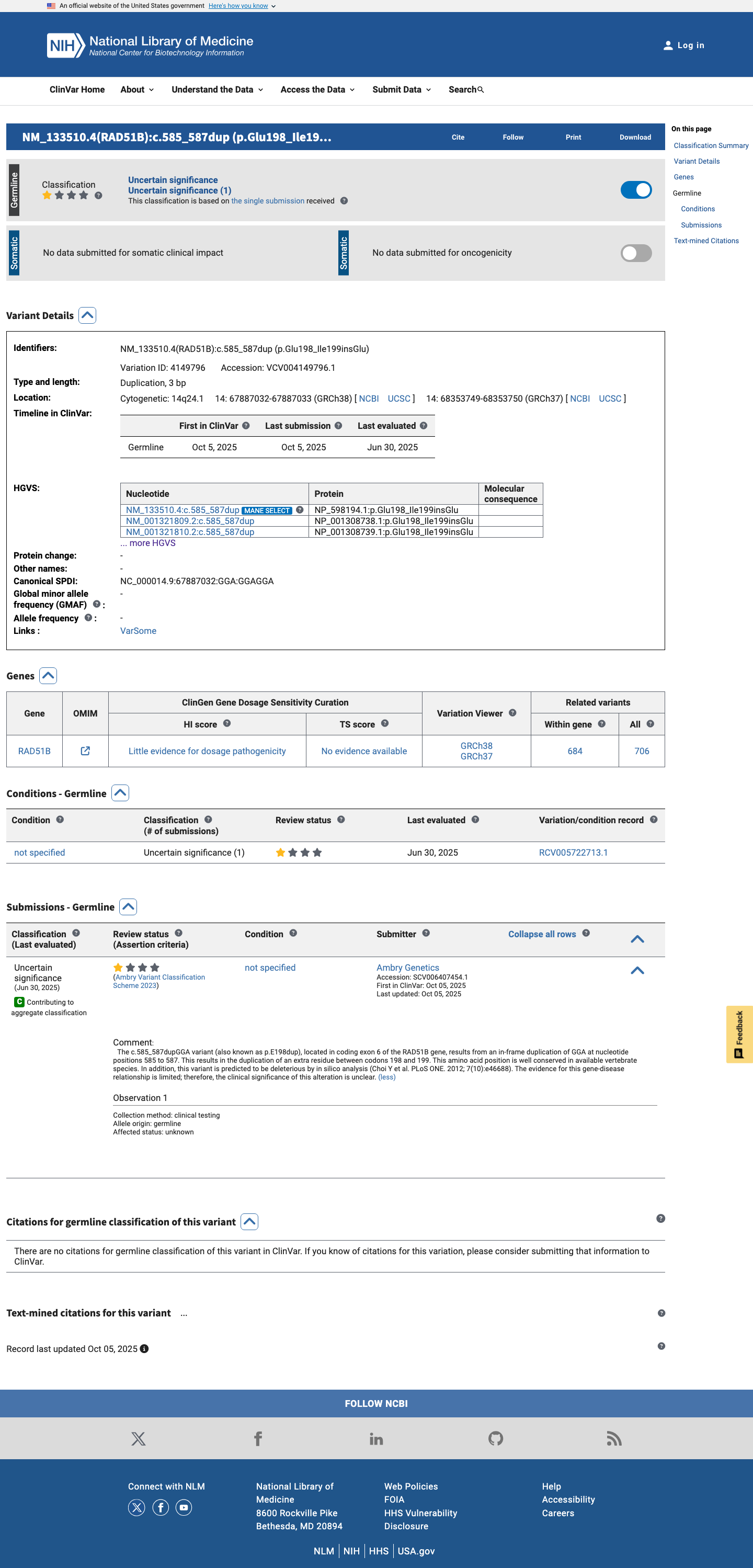
This variant has been reported in ClinVar as Uncertain significance (1 clinical laboratory). (ClinVarID = 4149796)
SpliceAI screenshot
In silico
SpliceAI predicts no significant splice impact for this variant (max delta score = 0.01).
Functional / OncoKB screenshot
Functional Unknown Oncogenic Effect
OncoKB did not identify variant-specific reviewed functional evidence for this variant; gene-level curated context is available for reviewer follow-up. RAD51B, a DNA repair protein involved in homologous recombination, is altered by mutation in various cancer types.
OncoKB ↗
COSMIC screenshot
COSMIC
Cancer hotspots screenshot
Cancer hotspots
Somatic evidence Not in COSMIC / hotspots
COSMIC
This variant does not lie in a statistically significant hotspot. This variant has not previously been reported in somatic cancers (COSMIC).
Hotspots
This variant does not lie in a statistically significant hotspot.
Sources & reference links
8Sources
ClinVar
gnomAD v2.1
gnomAD v4.1
gnomAD-Canada
SpliceAI
OncoKB
COSMIC
Cancer hotspots