Analysis in progress
Initialising…
0%
complete
This report is still being assembled — sections appear as each stage finishes. It isn't final yet.
RAD51B
Final classification
VUS
PM2BP4
RAD51B
c.82C>G
p.Gln28Glu
missense · exon 2

RAD51B is a member of the RAD51 protein family that plays an essential role in repairing double-strand DNA breaks through homologous recombination, working together with RAD51C and other DNA repair partners. It also participates in cell cycle regulation, and its activity increases in response to DNA damage. RAD51B has been associated with an increased risk of familial breast cancer, and chromosomal rearrangements involving this gene have been observed in uterine leiomyomata. Loss of RAD51B function impairs DNA repair and can promote cancer through genome instability, and it acts as a tumor suppressor.

This variant

RAD51B is a tumor suppressor whose loss impairs homologous-recombination DNA repair and is linked to familial breast cancer risk. This rare missense variant (p.Gln28Glu) shows no predicted splice or missense impact but lacks functional and clinical evidence, so its effect on RAD51B's DNA-repair function, and any contribution to cancer risk, remains unknown.

Transcript
NM_133509.4
HGVS · transcript:coding
NM_133509.4:c.82C>G
GRCh38
chr14:67823625 C>G
GRCh37
chr14:68290342 C>G
Basis VUS: only PM2 and BP4 are met (one supporting each), a combination satisfying no Pathogenic or Benign rule under generic ACMG/AMP 2015, since no RAD51B VCEP framework exists.
VUS: only PM2 and BP4 are met (one supporting each), a combination satisfying no Pathogenic or Benign rule under generic ACMG/AMP 2015, since no RAD51B VCEP framework exists.
Classification rationale
PM2 BP4 VUS
RAD51B c.82C>G missense · exon 2

PM2 (Supporting): absent from gnomAD-Canada; maximum subgroup frequency 0.01653% and overall 0.000435%, both below the <0.1% threshold. BP4 (Supporting): SpliceAI max delta 0.056 (below 0.2) and REVEL 0.071 predict no splice or missense impact. VUS: one supporting pathogenic (PM2) and one supporting benign (BP4) criterion satisfies no Pathogenic or Benign combination under the generic ACMG/AMP 2015 rules.

PM2 + BP4 VUS
Gene diagram · NM_133509.4 · variants mapped to exon structure
RAD51B NM_133509.4
Fetching transcript structure from UCSC…
Applied criteria · 2 applied · 22 assessed
MetEvidence satisfies this criterion.
Not metEvaluated against available evidence; threshold not reached.
Not assessedApplies in principle, but no evidence was found to evaluate it.
N/ADoesn't apply to this variant type.
Applied · 2
Strength Supporting Moderate Strong Very strong
PM2 supporting Pathogenic
Met (supporting): absent from gnomAD-Canada, with maximum subgroup frequency 0.01653% and overall 0.000435%, both below the <0.1% PM2 threshold.
gnomAD v4.1: 7/1,609,138 alleles, total AF 4.35016e-06 (0.000435%), no homozygotes; highest subgroup AF 0.000165344 (0.01653%) in the Middle Eastern subgroup.gnomAD v2.1: 2/248,786 alleles, total AF 8.03904e-06 (0.000804%), no homozygotes; highest reported subgroup AF 1.76929e-05 (0.00177%) in the European non-Finnish subgroup.gnomAD-Canada v1.0 reports the variant as absent.
BP4 supporting Benign
Met (supporting): SpliceAI max delta 0.056 (below 0.2) and REVEL 0.071 (below pathogenic-supporting thresholds) predict no splice or missense impact.
SpliceAI Lookup (NM_133509.4:c.82C>G, hg37): max delta score = 0.056, indicating no significant predicted splice impact.REVEL local predictor lookup at 14:67823625 C>G: score = 0.071, below benign-supporting thresholds per the ClinGen SVI-recommended REVEL calibration (PMID 36413997).
Assessed · not applied · 5 not met · 17 not assessed
Pathogenic
PS1 Not assessed: insufficient evidence was available to compare this variant against a known pathogenic change at the same amino acid position.
PS2 Not assessed: no parental genotypes, parentage confirmation, or de novo observation was available to establish de novo origin.
PS3 Not assessed: no validated functional assay data addressing this specific variant was available.
PS4 Not assessed: no case-control enrichment or affected-case series data was available for this variant.
PM1 Not assessed: insufficient evidence was available to evaluate location in a mutational hotspot or critical functional domain.
PM3 Not assessed: no second-allele, phase, or inheritance data was available to evaluate a trans configuration.
PM5 Not assessed: insufficient evidence was available to identify an established pathogenic missense at the same amino acid position.
PM6 Not assessed: no unconfirmed de novo observation with negative family history was available.
PP1 Not assessed: no pedigree, affected relatives, or cosegregation data was available.
PP2 Not assessed: insufficient evidence was available to evaluate this gene's pattern of pathogenic missense variation.
PP3 Not met: SpliceAI max delta 0.056 is below the 0.2 splice-altering threshold and REVEL 0.071 predicts no missense impact.
PP4 Not assessed: no sufficiently specific phenotype or genotype-phenotype correlation was available.
PP5 Not met: the exact variant is absent from ClinVar, with no expert-panel Pathogenic or Likely Pathogenic classification.
Benign
BA1 Not met: gnomAD v4.1 total allele frequency is 0.000435%, far below the >1% BA1 threshold.
BS1 Not met: highest observed subgroup frequency is 0.01653%, below the >0.3% BS1 threshold.
BS2 Not assessed: no evidence of unaffected healthy adult carriers or healthy homozygotes was available.
BS3 Not assessed: no functional assay data showing a benign or wild-type-like effect for this variant was available.
BS4 Not assessed: no tested unaffected relatives or non-segregation evidence was available.
BP1 Not assessed: insufficient evidence was available to evaluate whether this missense variant meets BP1.
BP2 Not assessed: no second pathogenic variant, phase, or inheritance data was available to evaluate cis/trans configuration.
BP5 Not assessed: no alternative molecular etiology explaining the patient's phenotype was documented.
BP6 Not met: the exact variant is absent from ClinVar, with no expert-panel Benign or Likely Benign classification.
N/A · 4 PVS1 · PM4 · BP3 · BP7
Research & evidence
Population frequency
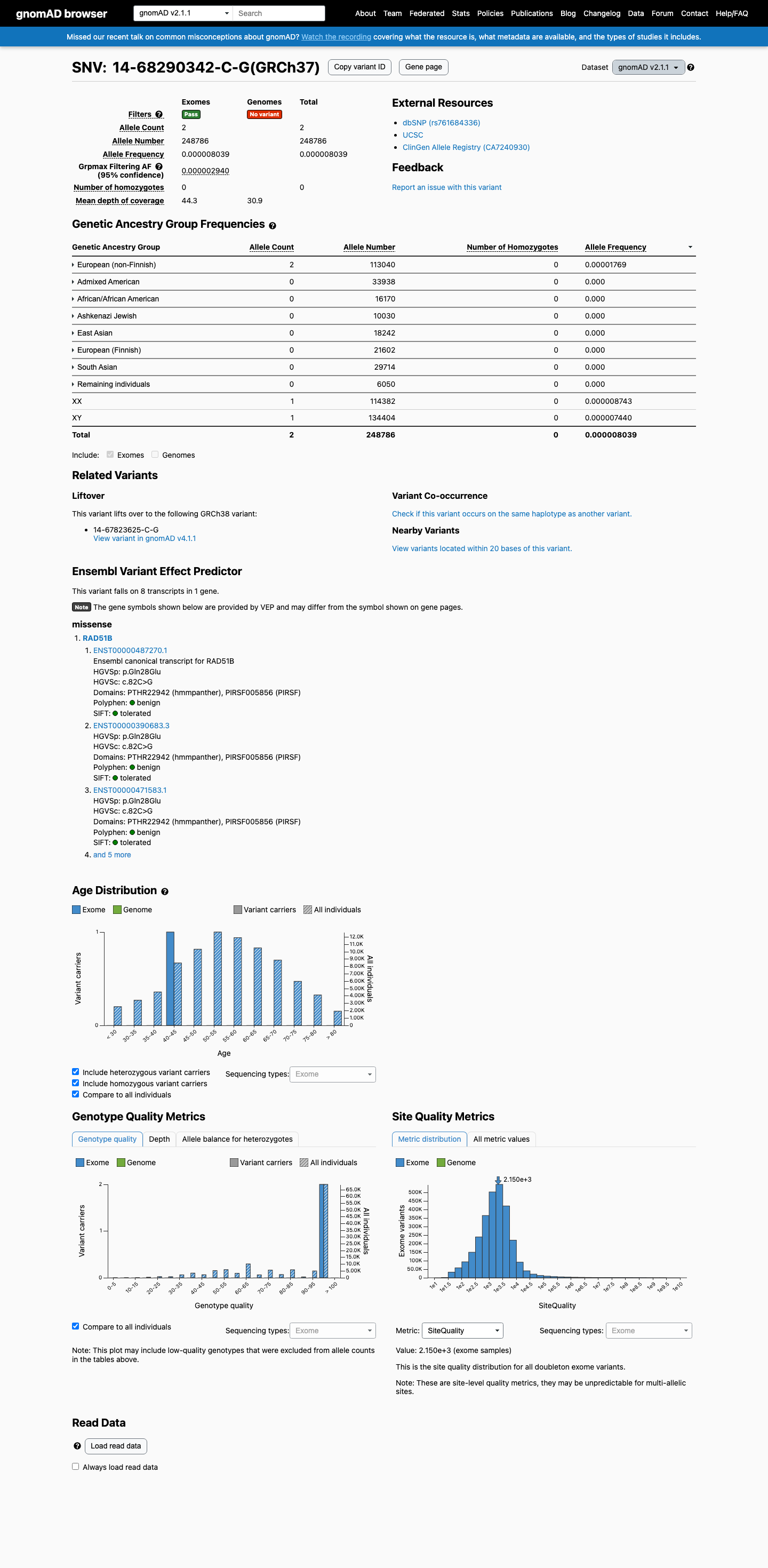
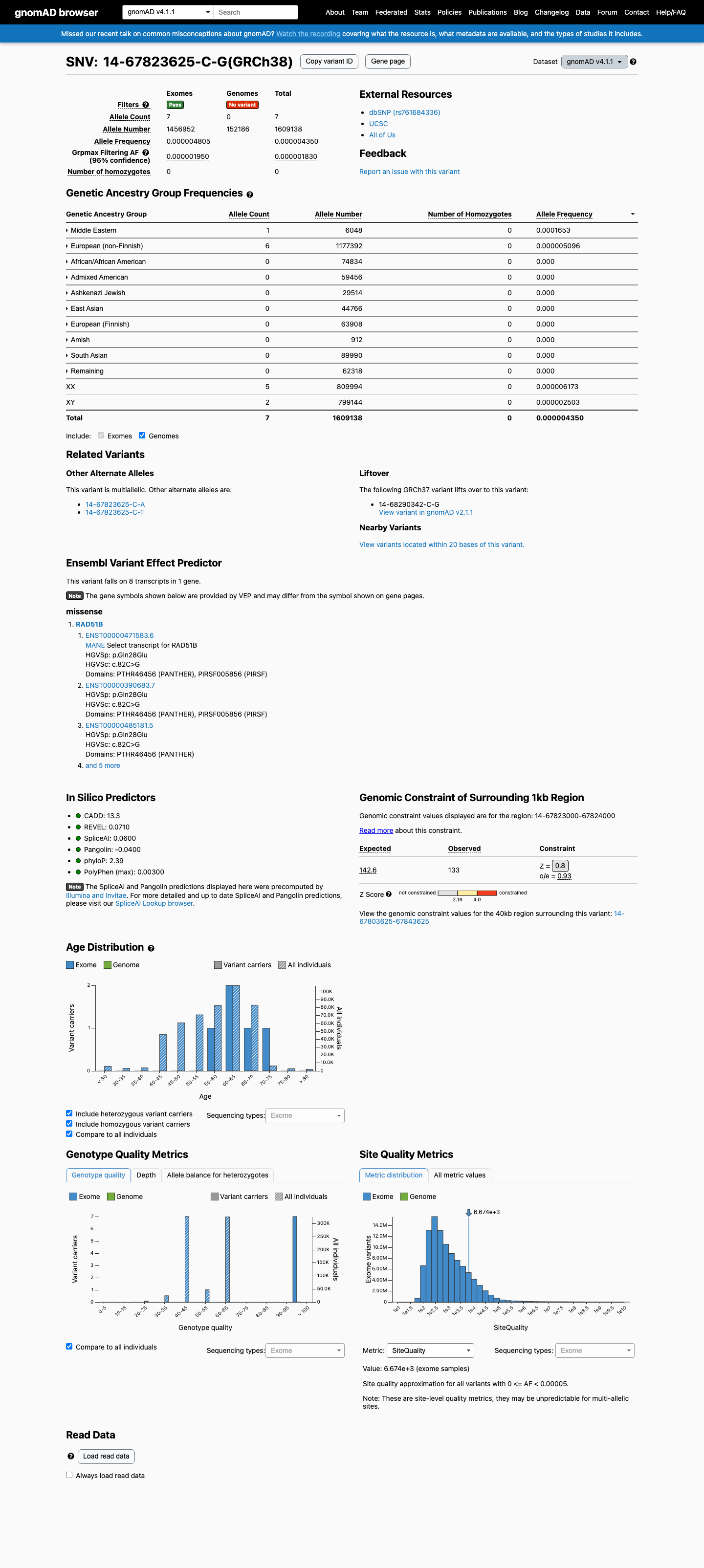
gnomAD v4.1 screenshot
gnomAD v4.1
gnomAD v2.1 screenshot
gnomAD v2.1
v4.1
This variant is present in gnomAD v4.1 (AF= 4.35016e-06; MAF= 0.00044%, 7/1609138 alleles, homozygotes = 0) and has highest observed frequency in the Middle Eastern population (AF= 0.000165344; MAF= 0.01653%, 1/6048 alleles, homozygotes = 0); grpmax FAF= 1.83e-06.
v2.1
This variant is present in gnomAD v2.1 (AF= 8.03904e-06; MAF= 0.00080%, 2/248786 alleles, homozygotes = 0) and has highest observed frequency in the European (non-Finnish) population (AF= 1.76929e-05; MAF= 0.00177%, 2/113040 alleles, homozygotes = 0); grpmax FAF= 2.94e-06.
🇨🇦 CA
Absent from gnomAD-Canada v1.0.
Allele frequency by ancestry
three datasets · side by side
gnomAD v4.1
0.00044% · 7 / 1,609,138
0 hom · FAF 0.00018%
Middle Eastern
1 / 6,048
0.017%
European (non-Finnish)
6 / 1,177,392
0.00051%
+ 8 not observed (Remaining individuals, Admixed American, European (Finnish), Amish, East Asian, South Asian, Ashkenazi Jewish, African/African American)
gnomAD v2.1
0.0008% · 2 / 248,786
0 hom · FAF 0.00029%
European (non-Finnish)
2 / 113,040
0.0018%
+ 7 not observed (African/African American, Admixed American, Ashkenazi Jewish, East Asian, European (Finnish), Remaining individuals, South Asian)
gnomAD Canada 🇨🇦
Absent · 0 / ?
0 hom
Not observed in any ancestry group.
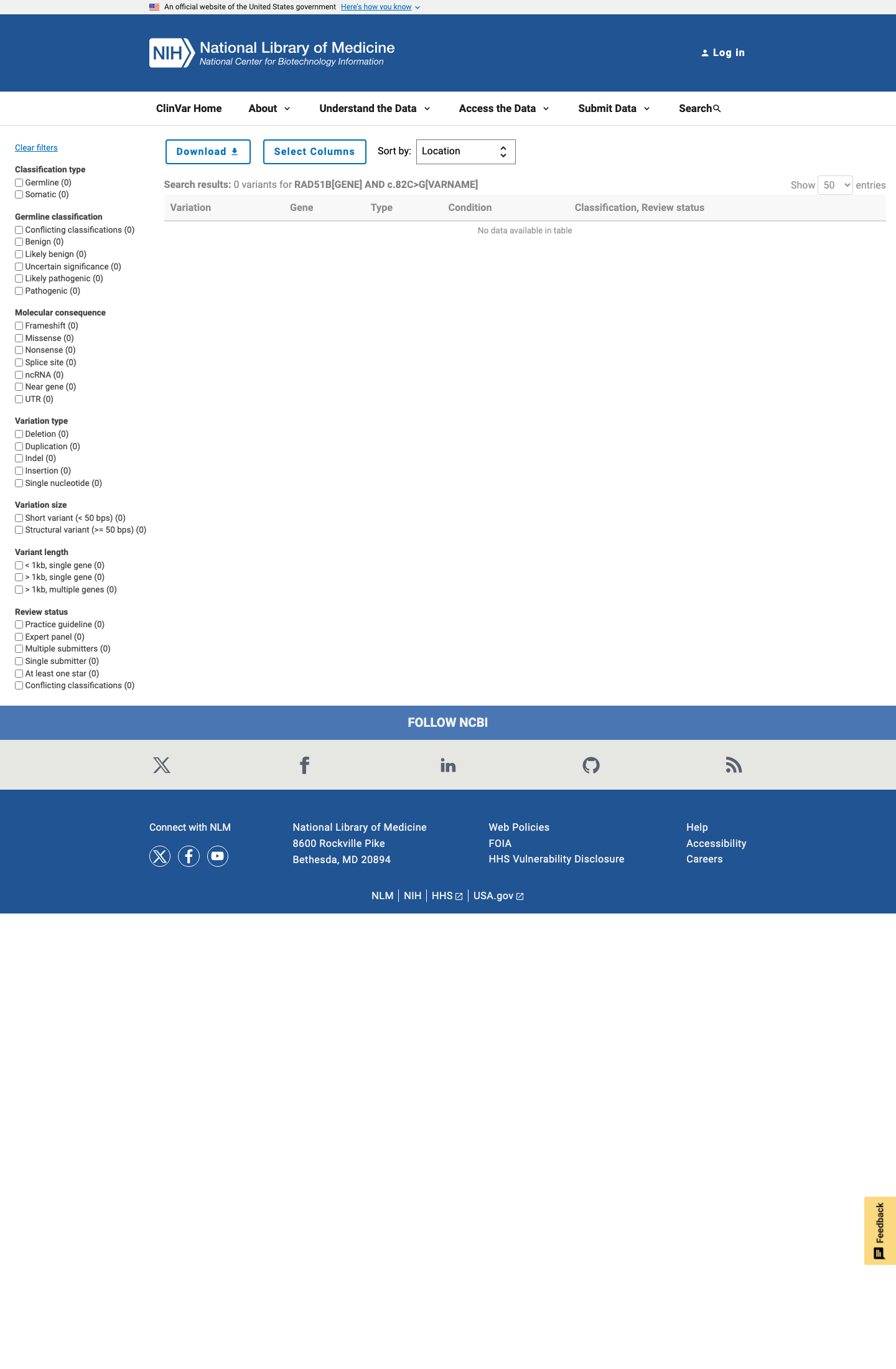
ClinVar screenshot
ClinVar
This variant is absent from ClinVar.
SpliceAI screenshot
In silico
SpliceAI predicts no significant splice impact for this variant (max delta score = 0.06). REVEL score = 0.071. BayesDel score = -0.414292.
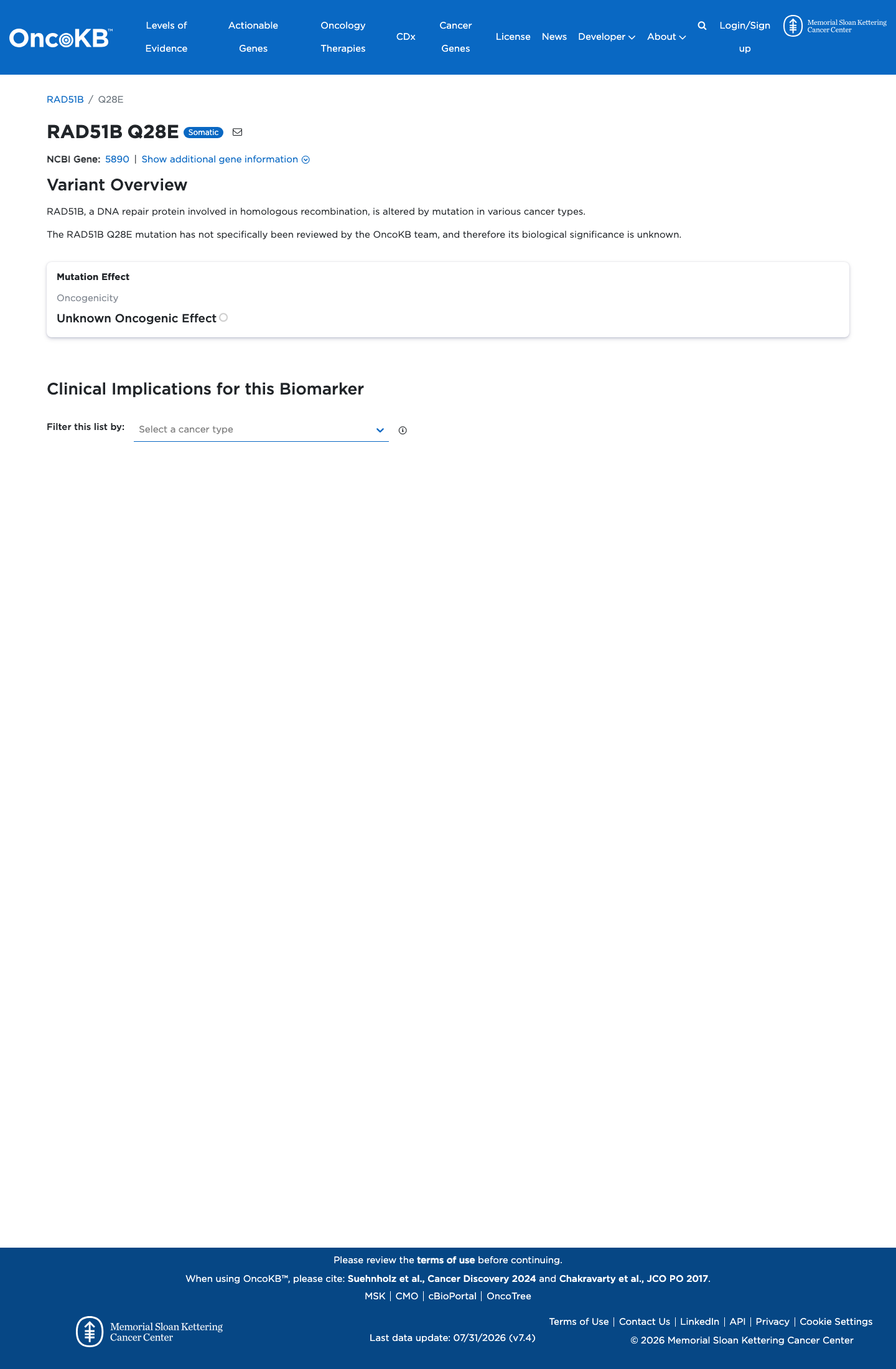
Functional / OncoKB screenshot
Functional Unknown Oncogenic Effect
OncoKB did not identify variant-specific reviewed functional evidence for this variant; gene-level curated context is available for reviewer follow-up. RAD51B, a DNA repair protein involved in homologous recombination, is altered by mutation in various cancer types.
OncoKB ↗
COSMIC screenshot
COSMIC
Cancer hotspots screenshot
Cancer hotspots
Somatic evidence Not in COSMIC / hotspots
COSMIC
This variant does not lie in a statistically significant hotspot. This variant has not previously been reported in somatic cancers (COSMIC).
Hotspots
This variant does not lie in a statistically significant hotspot.
Sources & reference links
8Sources
ClinVar
gnomAD v2.1
gnomAD v4.1
gnomAD-Canada
SpliceAI
OncoKB
COSMIC
Cancer hotspots