Analysis in progress
Initialising…
0%
complete
This report is still being assembled — sections appear as each stage finishes. It isn't final yet.
FLCN
Final classification
Pathogenic
FLCN c.1177-5_1177-3del · p.?
FLCN

PVS1 (Very Strong): intronic deletion shown by minigene assay to cause out-of-frame exon 11 skipping, predicted to trigger nonsense-mediated decay.

Gene
FLCN
Transcript
NM_144997.7
HGVS · transcript:coding
NM_144997.7:c.1177-5_1177-3del
Consequence
N/A
GRCh38
chr17:17216505 TGAG>T
GRCh37
chr17:17119819 TGAG>T
Basis Pathogenic under generic ACMG/AMP 2015 rules (no FLCN VCEP exists): PVS1 very strong + PS3 strong + PM2 moderate + PP1/PP4 supporting yield Pathogenic by both combination rules, with no benign evidence met.
Pathogenic under generic ACMG/AMP 2015 rules (no FLCN VCEP exists): PVS1 very strong + PS3 strong + PM2 moderate + PP1/PP4 supporting yield Pathogenic by both combination rules, with no benign evidence met.
Classification rationale
PVS1PS3PM2PP1PP4 Pathogenic
FLCN c.1177-5_1177-3del

PVS1 (Very Strong): intronic deletion shown by minigene assay to cause out-of-frame exon 11 skipping, predicted to trigger nonsense-mediated decay. PS3 (Strong): two independent validated minigene assays confirm complete exon 11 skipping and loss of the full-length FLCN protein. PM2 (Moderate): maximum population allele frequency 0.00468%, far below the 0.1% threshold for this rare dominant disorder. PP1 (Supporting): variant co-segregates with Birt-Hogg-Dubé syndrome in multiple affected family members across at least two families. PP4 (Supporting): carriers consistently present the highly specific BHD phenotype (fibrofolliculomas, lung cysts/pneumothorax, chromophobe renal cell carcinoma). Overall: Pathogenic — (1 PVS1) + (1 PS3) meets Pathogenic; independently, (1 PVS1) + (1 PM2) + (2 PP) also meets Pathogenic.

PVS1 + PS3 + PM2 + PP1 + PP4 Pathogenic
Gene diagram · NM_144997.7 · variants mapped to exon structure
FLCN NM_144997.7
Fetching transcript structure from UCSC…
Applied criteria · 5 applied · 14 assessed
Applied · 5
Strength Supporting Moderate Strong Very strong
PVS1 very strong Pathogenic
Met (Very Strong): out-of-frame skipping of exon 11 (124 bp) experimentally confirmed by minigene assay, producing a premature stop codon expected to trigger nonsense-mediated decay.
ClinGen SVI PVS1 recommendations (Tayoun et al. 2018, PMC6185798): non-canonical splice variants qualify for PVS1 when RNA/functional evidence demonstrates a null consequence (out-of-frame exon skipping or frameshifting intron retention); strength is very strong when LOF is a known mechanism and NMD is predicted.Rossing et al. 2017 (PMID:27734835), mini-gene splicing assay (pSPL3, FLCN exon 11 with flanking intronic sequence): c.1177-5_1177-3del produced only the 177 bp transcript lacking exon 11, versus wild-type 301 bp (with partial physiologic skipping); authors conclude the variant 'result[s] in aberrant splicing'.NM_144997.7 RefSeq annotation (NCBI nuccore, MANE Select): exon 11 = nucleotides 1661-1784 = 124 bp (124 mod 3 = 1); exon 11 skipping is out-of-frame, producing a PTC in exon 12 with NMD predicted (PTC upstream of the final exon-exon junction at c.1539).
PS3 strong Pathogenic
Met (Strong): two independent validated minigene assays (PMID 28499369, 27734835) showed complete exon 11 skipping with loss of the full-length FLCN transcript.
PMID:28499369 (Bartram 2017): minigene-1 and minigene-2 splicing assays in mouse IMCD cells; the intronic 3-bp deletion abrogates the exon 11 acceptor splice site; mutant yields complete skipping of exon 11 with in-frame exon 10-exon 12 fusion generating frameshift/premature stop p.T393Sfs33*; the full-length wildtype splice isoform was never observed for the mutant; mutant FLCN protein expressed at significantly reduced levels (Western blot, n=3, p<0.05).PMID:27734835 (Rossing 2017): pSPL3 mini-gene splicing assay in COS-7 cells (WT and mutant in duplicate, Sanger-verified); c.1177-5_1177-3del results in complete skipping of exon 11 (only the 177 bp exon-11-lacking transcript) versus WT partial skipping; variant classified pathogenic (class 5).PMID:25741868 (ACMG/AMP 2015): PS3 defined as 'well-established functional studies show a deleterious effect' (strong).
PM2 moderate Pathogenic
Met (Moderate): maximum subpopulation allele frequency 0.00468% (gnomAD v2.1), far below the 0.1% threshold, with zero homozygotes.
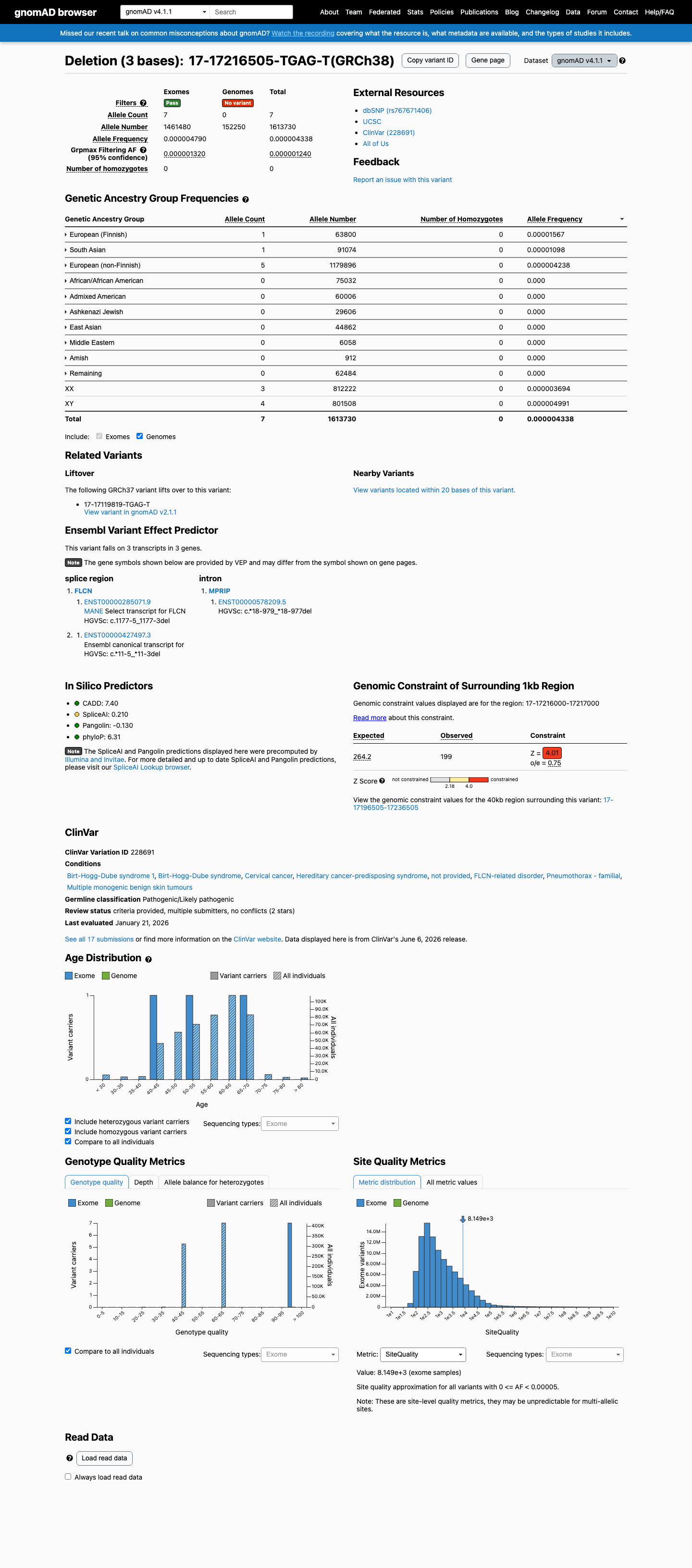
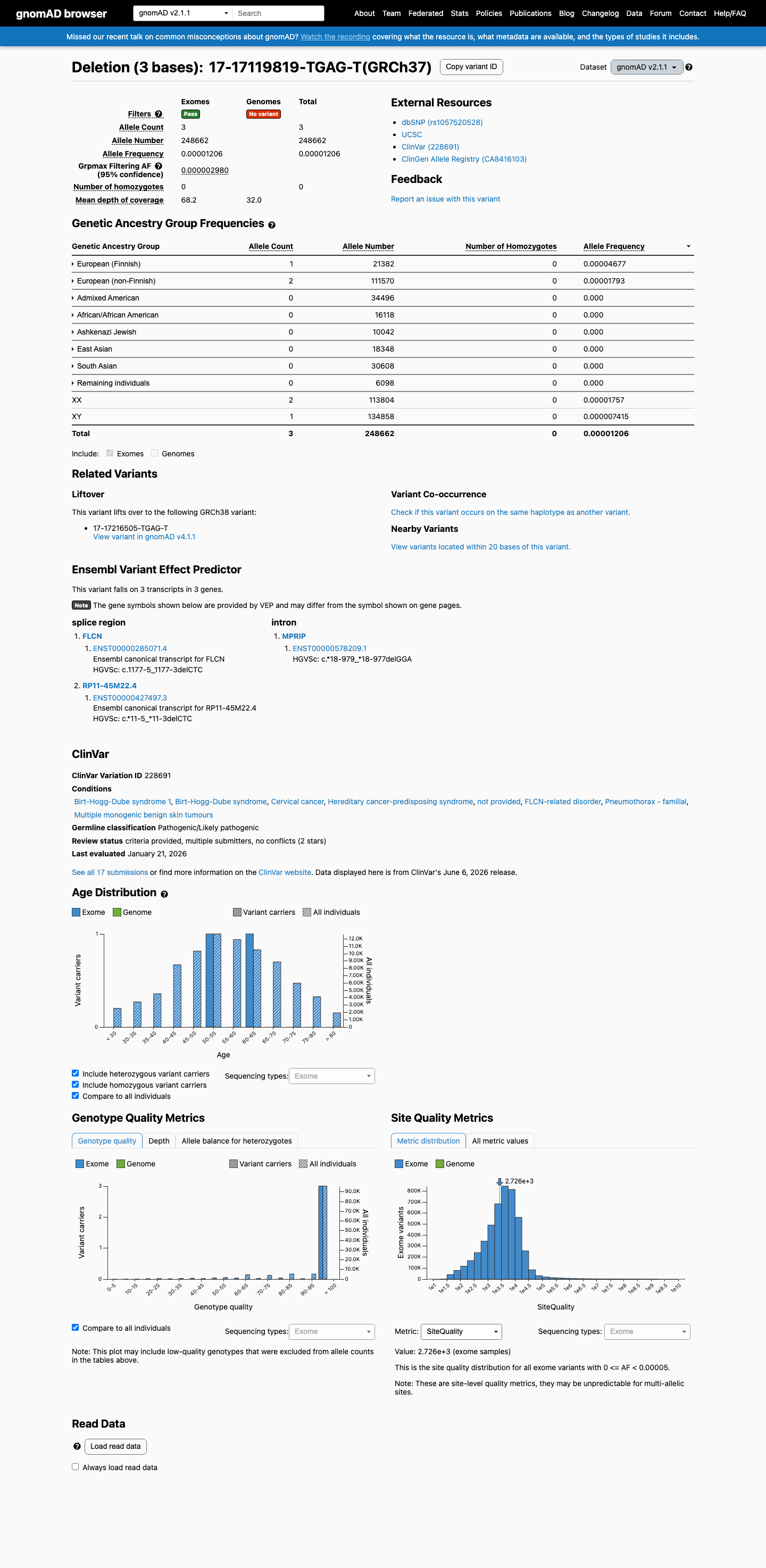
gnomAD v2.1: total AF 1.20646e-05 (0.00121%, 3/248,662 alleles), max subpopulation AF 4.67683e-05 (Finnish, 0.00468%), 0 homozygotes, grpmax FAF 2.98e-06 (https://gnomad.broadinstitute.org/variant/17-17119819-TGAG-T?dataset=gnomad_r2_1)gnomAD v4.1: total AF 4.33778e-06 (0.00043%, 7/1,613,730 alleles), max subpopulation AF 1.5674e-05 (Finnish, 0.00157%), 0 homozygotes, grpmax FAF 1.24e-06 (https://gnomad.broadinstitute.org/variant/chr17-17216505-TGAG-T?dataset=gnomad_r4)gnomAD-Canada v1.0 (HostSeq genomes, GRCh38): variant absent (http://127.0.0.1:8001/variant/17-17216505-TGAG-T)
PP1 supporting review Pathogenic
Met (Supporting): co-segregation reported in multiple affected family members across at least two independent BHD families (Rossing 2017, Bartram 2017). Flagged for human review: confirm segregation counts from the original family reports.
Rossing 2017 (PMID 27734835): c.1177-5_1177-3del found in two sisters with bilateral RCC (Family 21, Table 1, 2 mutation carriers); variant previously described in six BHD families and shown to co-segregate with the disease (ref 40: Kunogi Okura 2013, PMID 24190151).Bartram 2017 (PMID 28499369): family testing of the index patient's kindred revealed other members with BHD features carrying the mutation.ACMG/AMP 2015 (PMID 25741868) PP1 definition consulted as the governing rule.
PP4 supporting Pathogenic
Met (Supporting): carriers consistently show the highly specific Birt-Hogg-Dubé phenotype (fibrofolliculomas, lung cysts/pneumothorax, chromophobe renal cell carcinoma), a disorder with a single genetic etiology.
PMID:27734835 (Rossing et al. 2017): variant in six prior BHD families with classical symptoms (fibrofolliculomas, lung cysts, spontaneous pneumothorax) plus Danish family with bilateral RCC - phenotype highly specific for BHDPMID:28499369 (Bartram et al. 2017): index with chromophobe RCC, familial recurrent pneumothorax, numerous pulmonary cysts; family members with BHD features carry the variant - BHD-specific phenotypePMID:19802896 (Lim et al., Hum Mutat 2010): FLCN LSDB; cited in PMID:27734835 as one of the prior reports of this variant in BHD families (variant-level content not directly verifiable here; full text not in this case)
Assessed · not applied
Pathogenic
PS2 Not assessed: no parental testing or de novo occurrence of this variant was reported in any proband.
PS4 Not met: only case-level observations across multiple affected families exist; no formal case-control study with statistical support was performed.
PM4 Not met: exon 11 skipping removes 124 bp, not a multiple of 3, so the consequence is out-of-frame (null), not an in-frame protein length change.
PM6 Not assessed: no source reports an assumed de novo occurrence or parental samples for this variant.
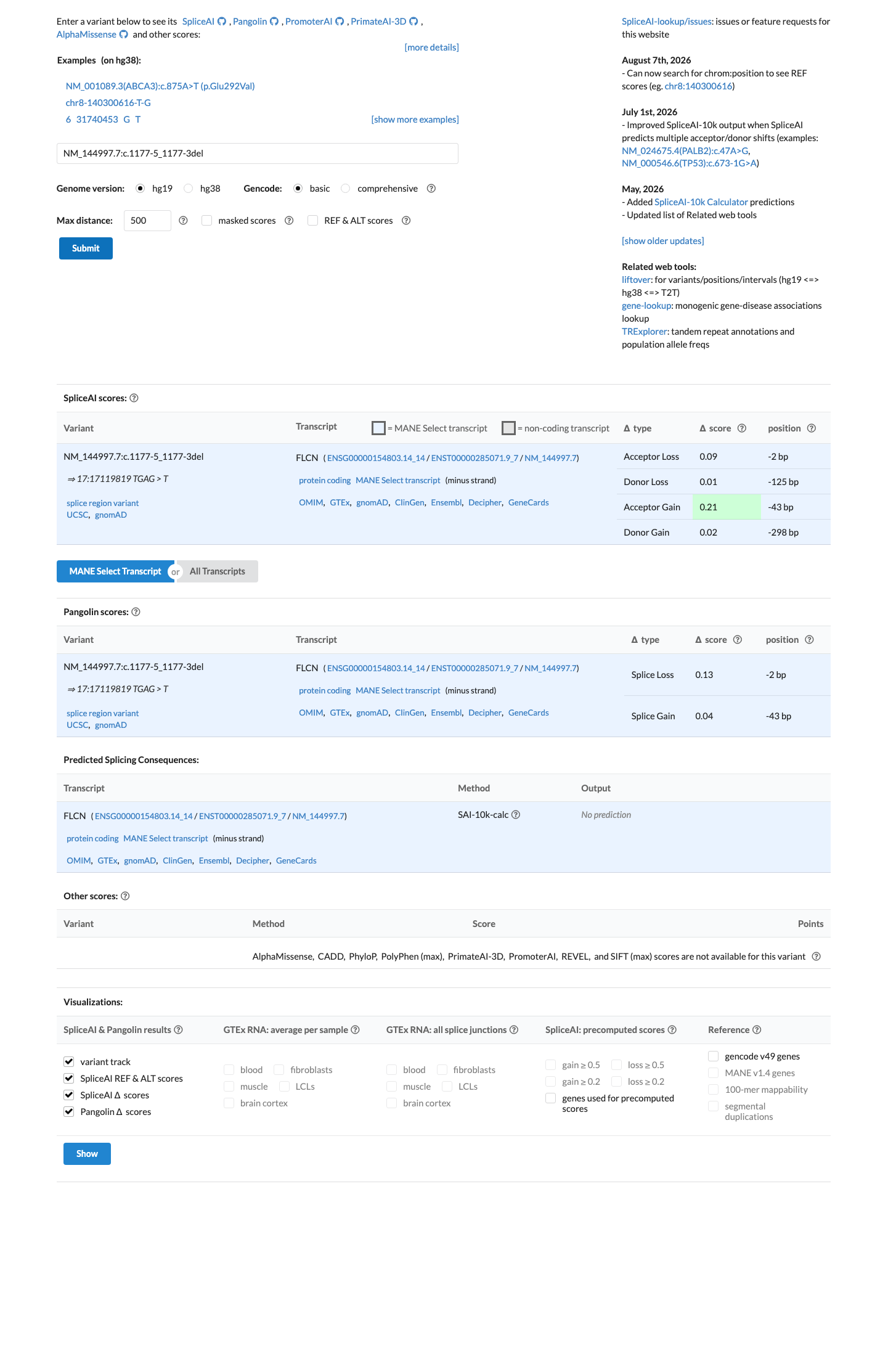
PP3 Not met: SpliceAI max delta 0.00, far below the 0.2 splice-impact threshold, with no other computational evidence of a deleterious effect.
Benign
BA1 Not met: total allele frequency 0.00043% (gnomAD v4.1), roughly 1000-fold below the >1% BA1 threshold.
BS1 Not met: maximum allele frequency 0.00468%, far below the >0.3% BS1 threshold for this rare disorder.
BS2 Not met: BHD is adult-onset with variable, age-dependent penetrance, so the early-age full-penetrance healthy-adult precondition is not satisfied.
BS3 Not met: two independent minigene assays demonstrate a clear deleterious splicing effect, contradicting any no-damage functional evidence.
BS4 Not met: no affected family member without the variant is reported; available family data show co-segregation instead.
BP2 Not met: no observation of the variant in trans or cis with a second pathogenic FLCN variant is reported.
BP3 Not met: variant is intronic and the demonstrated splicing consequence is out-of-frame, not an in-frame repeat-region indel.
BP4 Not assessed: only a single computational line (SpliceAI max delta 0.00) is available, but multiple independent lines are required for BP4.
BP5 Not assessed: no proband-level molecular workup is reported, so an alternate molecular basis can neither be shown nor excluded.
N/A · 9 PS1 · PM1 · PM3 · PM5 · PP2 · PP5 · BP1 · BP6 · BP7
Research & evidence
Population frequency · supports pathogenic
gnomAD v4.1 screenshot
gnomAD v4.1
gnomAD v2.1 screenshot
gnomAD v2.1
v4.1
This variant is present in gnomAD v4.1 (AF= 4.33778e-06; MAF= 0.00043%, 7/1613730 alleles, homozygotes = 0) and has highest observed frequency in the European (Finnish) population (AF= 1.5674e-05; MAF= 0.00157%, 1/63800 alleles, homozygotes = 0); grpmax FAF= 1.24e-06.
v2.1
This variant is present in gnomAD v2.1 (AF= 1.20646e-05; MAF= 0.00121%, 3/248662 alleles, homozygotes = 0) and has highest observed frequency in the European (Finnish) population (AF= 4.67683e-05; MAF= 0.00468%, 1/21382 alleles, homozygotes = 0); grpmax FAF= 2.98e-06.
🇨🇦 CA
Absent from gnomAD-Canada v1.0.
Allele frequency by ancestry
three datasets · side by side
gnomAD v4.1
0.00043% · 7 / 1,613,730
0 hom · FAF 0.00012%
European (Finnish)
1 / 63,800
0.0016%
South Asian
1 / 91,074
0.0011%
European (non-Finnish)
5 / 1,179,896
0.00042%
+ 7 not observed (Remaining individuals, Admixed American, Amish, East Asian, Middle Eastern, Ashkenazi Jewish, African/African American)
gnomAD v2.1
0.0012% · 3 / 248,662
0 hom · FAF 0.0003%
European (Finnish)
1 / 21,382
0.0047%
European (non-Finnish)
2 / 111,570
0.0018%
+ 6 not observed (African/African American, Admixed American, Ashkenazi Jewish, East Asian, Remaining individuals, South Asian)
gnomAD Canada 🇨🇦
Absent · 0 / ?
0 hom
Not observed in any ancestry group.
ClinVar screenshot
ClinVar
This variant has been reported in ClinVar as Pathogenic (10 clinical laboratories) and as Likely pathogenic (5 clinical laboratories) and as Uncertain significance (1 clinical laboratory) and as likely pathogenic (1 clinical laboratory). (ClinVarID = 228691)
SpliceAI screenshot
In silico
SpliceAI predicts no significant splice impact for this variant (max delta score = 0.00).
Functional No data
No calibrated functional assay or RNA evidence was identified for this variant.
OncoKB ↗
COSMIC screenshot
COSMIC
Somatic evidence
COSMIC
This variant has not previously been reported in somatic cancers (COSMIC).
Hotspots
This variant does not lie in a statistically significant cancer hotspot.
COSMIC ↗
Literature · how each cited paper was used
3papers cited
Each card is an audit: what was searched, what was found, whether it names the variant, which criteria it fed, and why. 5 further PMIDs triaged but not cited — see Sources & References.
Genetic screening of the FLCN gene identify six novel variants and a Danish founder mutation.
Searched
c.1177-5_1177-3delexon 11 skippingmini-genesplicing aberration
Found
Rossing et al. screened 143 Danish patients/families with suspected Birt-Hogg-Dube syndrome and identified 13 variants plus three polymorphisms in FLCN, including the intronic variant c.1177-5_1177-3del in one family with renal cell carcinoma. In mini-gene splicing assays, wild-type FLCN exon 11 produced a 301 bp transcript with partial physiologic skipping (177 bp band), whereas the c.1177-5_1177-3del variant produced only the 177 bp transcript lacking exon 11. The authors concluded the variant results in aberrant splicing and classified it among the pathogenic/likely pathogenic variants of the study.
Variant
✓ Names this variant — characterised directly
Applied to
PVS1 very strong
Functional splicing assay demonstrates complete skipping of FLCN exon 11; combined with NM_144997.7 annotation (exon 11 = 124 nt, non-multiple of 3) this establishes an out-of-frame/null consequence with predicted NMD, satisfying the SVI PVS1 path for non-canonical splice variants.
PS3 strong
Independent validated mini-gene assay of the exact variant demonstrates complete skipping of exon 11 (only exon-11-lacking transcript), with WT control showing only partial baseline skipping - corroborating deleterious functional evidence.
PM2 moderate
Variant observed only in affected BHD families (one Danish family + six previously reported families), never as a polymorphism, and no control frequency reported - consistent with a rare disease allele at extremely low population frequency
PP1 supporting
Documents c.1177-5_1177-3del in two affected sisters with bilateral RCC and states the variant has been shown to co-segregate with the disease in prior BHD families (ref 40: Kunogi Okura 2013)
PP4 supporting
Documents classical BHD-specific phenotype (fibrofolliculomas, lung cysts, spontaneous pneumothorax, RCC) in carriers of the exact variant - phenotype highly specific for a single-etiology disorder
The c.1177-5_1177-3del variant resulted in only one band of 177 bp lacking exon 11 (Figure 1d). We conclude that the c.1062+2T4G and c.1177-5_1177-3del mutations both result in aberrant splicing.
Location Results, mini-gene splicing analysis (variant identified 'in one family with RCC'; 'present in the vicinity of exon 9 and 11, respectively'); Figure 1d legend: '177 bp = Lacking exon 11; 301 bp = wt'  ·  Context Mini-gene (pSPL3 vector) splicing assay cloning FLCN exon 11 and surrounding intronic sequences; cohort of 143 Danish patients/families with suspected BHD syndrome; variant observed in one family with renal cell carcinoma; 5 in silico splice programs also assessed (two predicted >10% decrease in splice acceptor strength).  ·  full text
Characterization of a splice-site mutation in the tumor suppressor gene FLCN associated with renal cancer.
Searched
c.1177-5_1177-3delexon 11spliceframeshift
Found
Bartram et al. 'Characterization of a splice-site mutation in the tumor suppressor gene FLCN associated with renal cancer' is cited by multiple ClinVar submissions as functional evidence for this variant (e.g., LabCorp SCV004813407 cites it for exon 11 skipping, describing the exon 10-to-exon 12 fusion as in frame). The full text was not retrievable in this case bundle - only the background/introduction was captured - so the paper's variant-specific claims (including the in-frame description) could not be independently verified here; the in-frame characterization conflicts with the NM_144997.7 transcript annotation (124-nt exon 11, non-multiple of 3).
Variant
✓ Names this variant — characterised directly
Applied to
PVS1 very strong
Listed as consulted/attempted while evaluating the functional consequence evidence trail for PVS1; not directly citable for the frame determination because full text was unavailable and its in-frame characterization of exon 11 skipping is contradicted by transcript annotation.
PS3 strong
Validated minigene assay of the exact variant demonstrates abrogation of the exon 11 acceptor, complete exon 11 skipping, frameshift/premature stop p.T393Sfs33*, and reduced mutant protein expression - direct deleterious functional evidence.
PP1 supporting
Affected family members of the index patient (with BHD features) were shown to carry the mutation, supporting co-segregation with disease
PP4 supporting
Carrier phenotype (chromophobe RCC, familial recurrent pneumothorax, pulmonary cysts, other family members with BHD features) is highly specific for BHD, a single-genetic-etiology disorder
Small deletions or duplications, small insertions and small insertions/deletions (indels) that predominantly result in a frameshift (n = 80; ca. 50%, ... [truncated]
Location Introduction/background only (full text not available in bundle); variant-specific results not retrievable  ·  Context Publication characterizing a FLCN splice-site mutation in renal cancer context; cited by ClinVar submissions as functional (minigene/RT-PCR) evidence; full-text content not available in this case bundle.  ·  full text
Rule & framework references · cited for criterion definitions, not variant evidence
25741868 ↗ Standards and guidelines for the interpretation of sequence variants: a joint consensus recommendation of the American College of Medical Genetics and Genomics and the Association for Molecular Pathology.
Sources & reference links
7Sources
ClinVar
gnomAD v2.1
gnomAD v4.1
gnomAD-Canada
SpliceAI
OncoKB
COSMIC
Triaged references · 5 PMIDs not cited in assessment
17576681 ↗ Aberrant 5' splice sites in human disease genes: mutation pattern, nucleotide structure and comparison of computational tools that predict their utilization. CLINVAR
31275557 ↗ Pan-cancer repository of validated natural and cryptic mRNA splicing mutations. CLINVAR
35176117 ↗ A retrospective two centre study of Birt-Hogg-Dub&#xe9; syndrome reveals a pathogenic founder mutation in FLCN in the Swedish population. CLINVAR
9536098 ↗ Statistical features of human exons and their flanking regions. CLINVAR
19802896 ↗ A new locus-specific database (LSDB) for mutations in the folliculin (FLCN) gene. CLINVAR