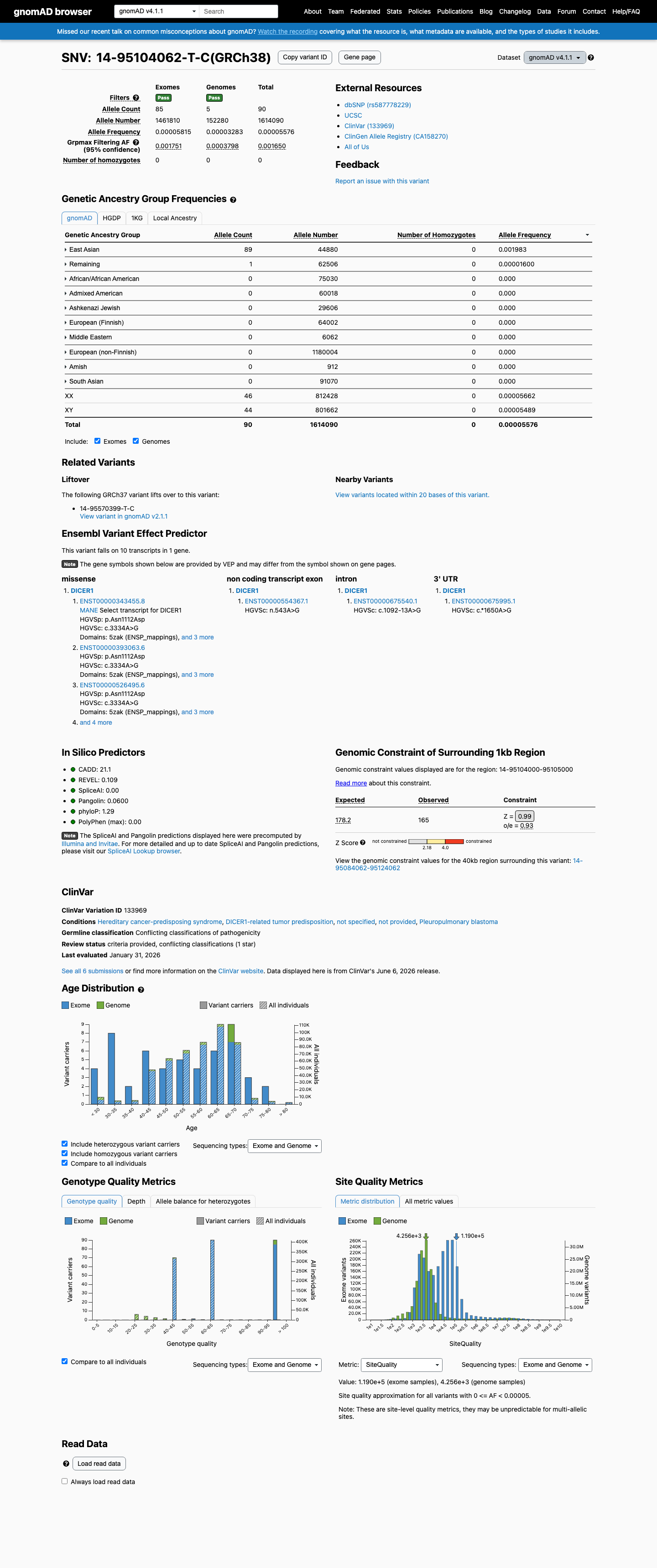
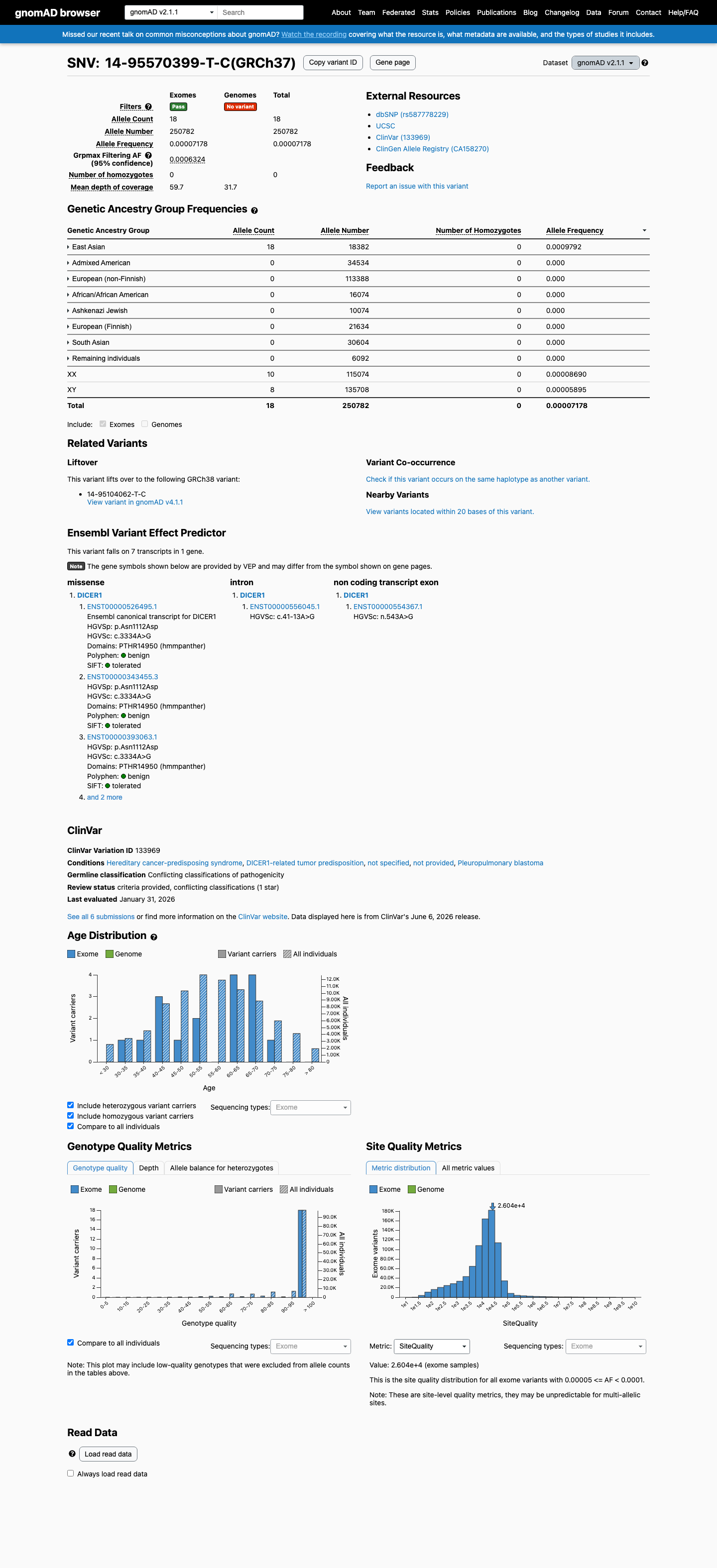
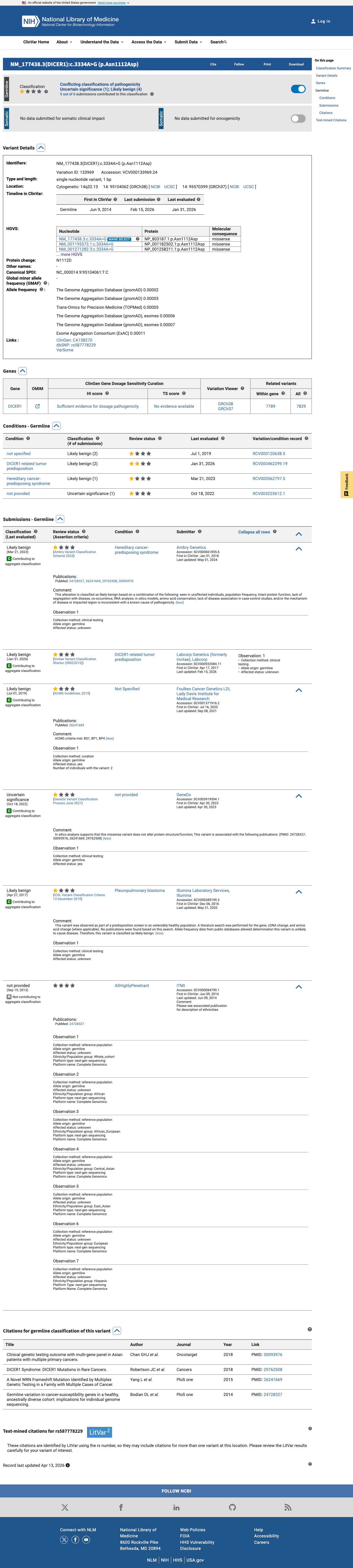
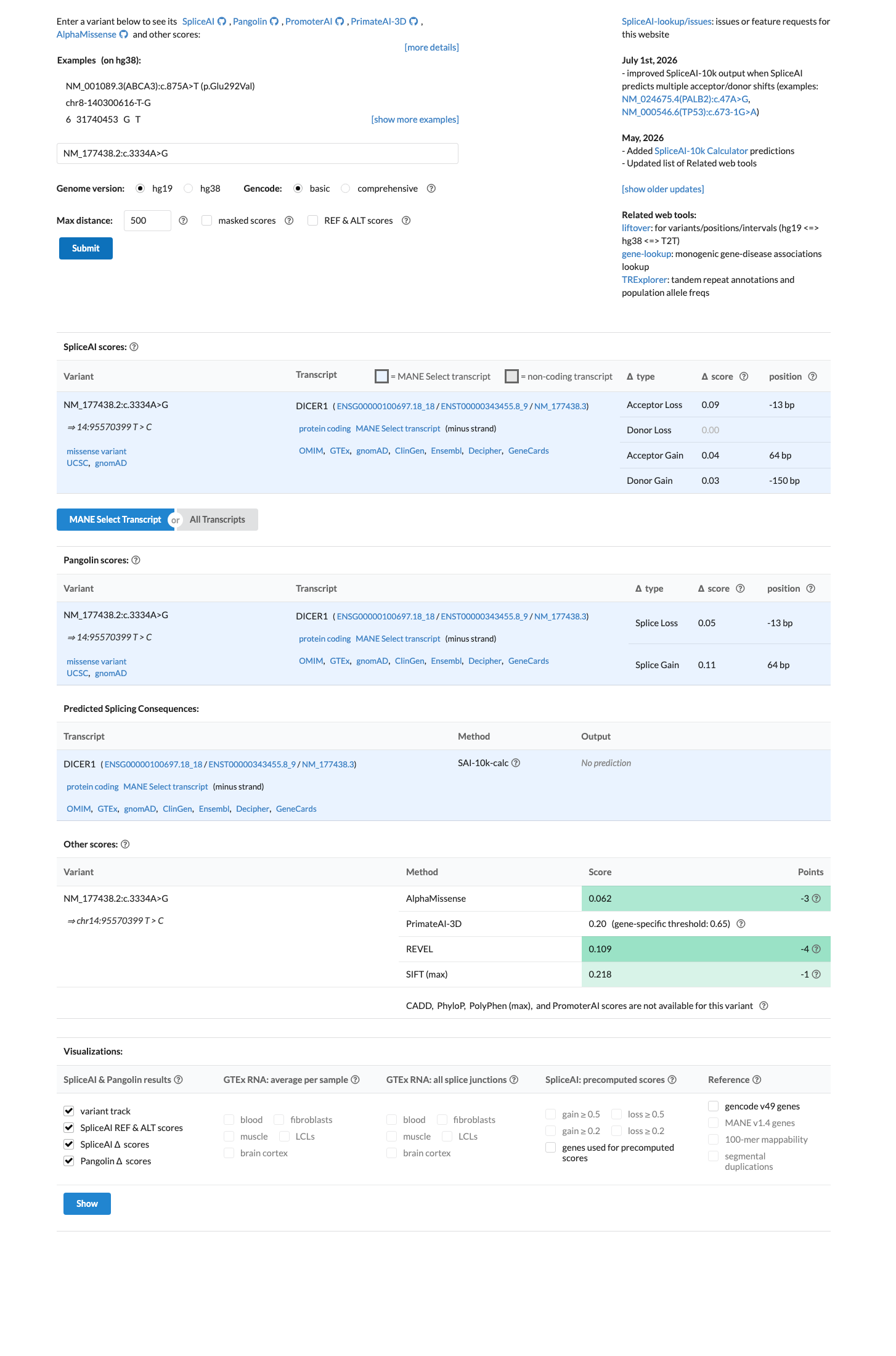
NM_177438.2:c.3334A>G (p.Asn1112Asp) is a missense variant in exon 21 of DICER1, located outside the RNase IIIb catalytic domain (p.Y1682-p.S1846) and not at a metal ion-binding residue.1 This variant is present in gnomAD at a frequency exceeding the DICER1 VCEP threshold for rarity. In the East Asian population, the allele frequency is 0.098% (gnomAD v2.1, 18/18,382 alleles) and 0.198% (gnomAD v4.1, 89/44,880 alleles), meeting BS1 at strong strength (VCEP threshold: >0.03%).2 Computational predictions uniformly support a benign interpretation: REVEL score 0.109 (below BP4 threshold of <0.500), SpliceAI max delta 0.09 (no splicing impact), and BayesDel score -0.562 (benign). BP4 is met at supporting strength.3 In ClinVar, this variant has been classified as Likely benign by three clinical laboratories (Ambry Genetics, Labcorp/Invitae, Illumina) and as Uncertain significance by one (GeneDx). No expert panel has reviewed this variant. The ITMI submission derived from a reference population cohort (Bodian et al. 2014), consistent with a benign population variant.4 No functional studies, segregation data, de novo observations, or tumor testing data are available for this variant. No pathogenic comparator variants exist at codon 1112 for PM5 application. The variant falls outside characterized functional domains, so PM1 does not apply. Applying the DICER1 VCEP v1.4 Tavtigian point-based classification framework: BS1_Strong (-4 points) + BP4_Supporting (-1 point) = -5 points. This falls within the Likely Benign range (>= -6 and <= -2).5 Final classification: Likely Benign.
Final classification
Likely Benign
BS1BP4
DICER1
c.3334A>G
p.Asn1112Asp
missense
This variant
NM_177438.2:c.3334A>G (p.Asn1112Asp) is a missense variant in exon 21 of DICER1, located outside the RNase IIIb catalytic domain (p.Y1682-p.S1846) and not at a metal ion-binding residue.
DICER1 VCEP v1.4 Tavtigian point-based framework applied to adjudicated criteria: BS1_Strong (-4 points) + BP4_Supporting (-1 point) = -5 points. Per the VCEP point rules, -5 falls within the Likely Benign range (>= -6 and <= -2). The special override for -1 (>=2 benign codes with only PM2_Supporting pathogenic) does not apply since the score is -5.
Classification rationale
BS1BP4
Likely Benign
DICER1 c.3334A>G
missense
BS1 + BP4
→
Likely Benign
LYFE Sciences is an AI system, and it can make mistakes. Criteria
may be applied incorrectly, sources may be misread, and a confident-looking
classification can still be wrong. Double-check every criterion and
its underlying evidence before relying on any call.
Gene diagram
· NM_177438.2 · variants mapped to exon structure
DICER1
NM_177438.2
Fetching transcript structure from UCSC…
Applied criteria · 2 applied · 15 assessed
MetEvidence satisfies this criterion.
Not metEvaluated against available evidence; threshold not reached.
Not assessedApplies in principle, but no evidence was found to evaluate it.
N/ADoesn't apply to this variant type.
Applied · 2
Strength
Supporting
Moderate
Strong
Very strong
BS1
strong
Benign
The East Asian population allele frequency of 0.098% (gnomAD v2.1, 18/18,382 alleles) and 0.198% (gnomAD v4.1, 89/44,880 alleles) exceeds the DICER1 VCEP BS1 threshold of >0.03%. The subpopulation has >2,000 alleles tested and >5 alleles present, satisfying all BS1 requirements at strong strength.
EAS AF 0.098% (v2.118/18382)0.198% (v4.1
BP4
supporting
Benign
REVEL score of 0.109 is well below the DICER1 VCEP BP4 threshold of <0.500, and SpliceAI predicts no splicing impact (max delta score 0.09). The agreement of multiple in silico predictors supports a benign interpretation.
REVEL 0.109 (<0.500 BP4 threshold)SpliceAI max delta 0.09 (no splicing effect)BayesDel -0.562 (benign).
Assessed · not applied
· 15 not met · 0 not assessed
Pathogenic
PS1
No different nucleotide change at c.3334 resulting in the same amino acid change (p.Asn1112Asp) has been classified as pathogenic by the ClinGen DICER1 VCEP.
PS2
No de novo observations have been reported for NM_177438.2:c.3334A>G (p.Asn1112Asp).
PS3
No functional studies (RNA splicing assay or in vitro cleavage assay) have been reported for p.Asn1112Asp.
PS4
No probands with DICER1-related tumor predisposition phenotypes have been reported to carry this variant.
PM1
p.Asn1112 is not located within the RNase IIIb domain (p.Y1682-p.S1846) and is not one of the seven metal ion-binding hotspot residues (p.S1344, p.E1705, p.D1709, p.D1713, p.G1809, p.D1810, p.E1813) per the DICER1 VCEP PM1 specification.
PM2
This variant is present in gnomAD v2.1 at an overall allele frequency of 0.00718% (18/250,782 alleles) and gnomAD v4.1 at 0.00558% (90/1,614,090 alleles), both exceeding the DICER1 VCEP PM2_Supporting threshold of <0.0005%.
PM5
No pathogenic missense variant at codon 1112 has been classified by the ClinGen DICER1 VCEP for comparison.
PP1
No co-segregation data are available for this variant.
PP3
REVEL score of 0.109 is well below the DICER1 VCEP PP3 threshold of >=0.750.
PP4
No somatic tumor testing data are available for a proband carrying this germline variant.
Benign
BA1
The highest subpopulation allele frequency is in East Asians at 0.098% (gnomAD v2.1, 18/18,382 alleles) and 0.198% (gnomAD v4.1, 89/44,880 alleles), both below the DICER1 VCEP BA1 threshold of >0.3%.
BS2
No data are available on healthy adult carriers meeting the DICER1 VCEP BS2 criteria.
BS3
No functional studies demonstrating no damaging effect on DICER1 splicing or pre-miRNA cleavage have been performed for p.Asn1112Asp.
BS4
No family segregation data are available for this variant.
BP2
No observations of this variant in trans with a P/LP DICER1 variant have been reported.
N/A · 11
PVS1 · PM3 · PM4 · PM6 · PP2 · PP5 · BP1 · BP3 · BP5 · BP6 · BP7
Research & evidence
Population frequency · supports benign
gnomAD v4.1
gnomAD v2.1
v4.1
This variant is present in gnomAD v4.1 (AF= 5.5759e-05; MAF= 0.00558%, 90/1614090 alleles, homozygotes = 0) and has highest observed frequency in the East Asian population (AF= 0.00198307; MAF= 0.19831%, 89/44880 alleles, homozygotes = 0); grpmax FAF= 0.00165003.
v2.1
This variant is present in gnomAD v2.1 (AF= 7.17755e-05; MAF= 0.00718%, 18/250782 alleles, homozygotes = 0) and has highest observed frequency in the East Asian population (AF= 0.000979219; MAF= 0.09792%, 18/18382 alleles, homozygotes = 0); grpmax FAF= 0.0006324.
🇨🇦 CA
Absent from gnomAD-Canada v1.0.
Allele frequency by ancestry
three datasets · side by side
gnomAD v4.1
0.0056%
· 90 / 1,614,090
0 hom · FAF 0.17%
0 hom · FAF 0.17%
East Asian 89 / 44,880 |
0.2% |
Remaining individuals 1 / 62,506 |
0.0016% |
+ 8 not observed (Admixed American, European (Finnish), Amish, Middle Eastern, South Asian, Ashkenazi Jewish, African/African American, European (non-Finnish))
gnomAD v2.1
0.0072%
· 18 / 250,782
0 hom · FAF 0.063%
0 hom · FAF 0.063%
East Asian 18 / 18,382 |
0.098% |
+ 7 not observed (African/African American, Admixed American, Ashkenazi Jewish, European (Finnish), European (non-Finnish), Remaining individuals, South Asian)
gnomAD Canada 🇨🇦
Absent
· 0 / ?
0 hom
0 hom
Not observed in any ancestry group.
ClinVar
This variant has been reported in ClinVar as Likely benign (3 clinical laboratories) and as Uncertain significance (1 clinical laboratory). (ClinVarID = 133969)
In silico
SpliceAI predicts no significant splice impact for this variant (max delta score = 0.09). REVEL score = 0.109. BayesDel score = -0.562068.
Functional
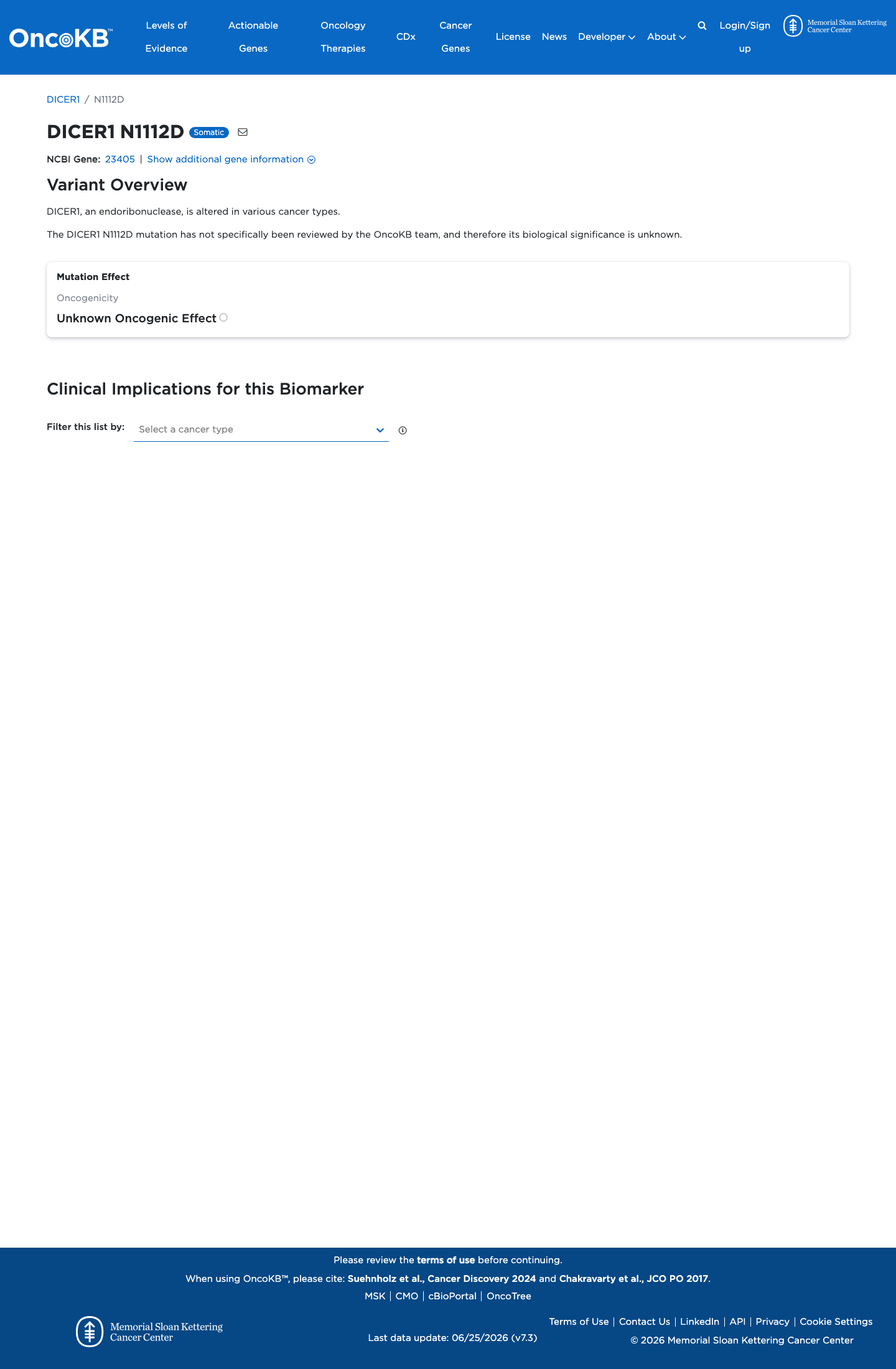
Unknown Oncogenic Effect
OncoKB did not identify variant-specific reviewed functional evidence for this variant; gene-level curated context is available for reviewer follow-up. DICER1, an endoribonuclease, is altered in various cancer types.
COSMIC

Cancer hotspots
Somatic evidence
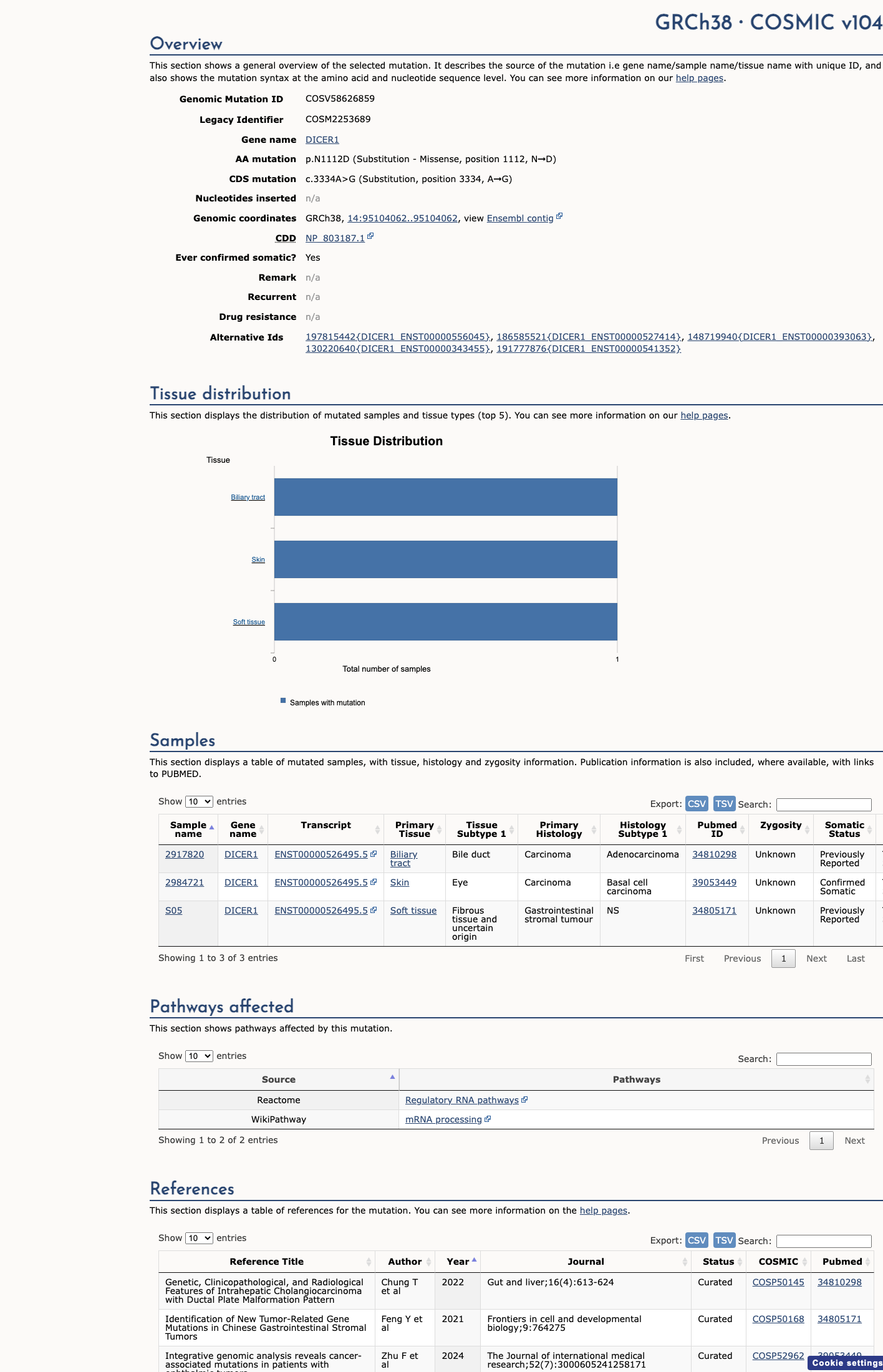
Not in COSMIC / hotspots
COSMIC
This variant does not lie in a statistically significant hotspot. This variant has previously been reported in somatic cancers (COSMIC; COSV58626859, n = 3 times).
Hotspots
This variant does not lie in a statistically significant hotspot.
Sources & reference links
9Sources
Triaged references · 8 PMIDs not cited in assessment
25741868 ↗
Standards and guidelines for the interpretation of sequence variants: a joint consensus recommendation of the American College of Medical Genetics and Genomics and the Association for Molecular Pathology.
CLINVAR
26241669 ↗
A Novel WRN Frameshift Mutation Identified by Multiplex Genetic Testing in a Family with Multiple Cases of Cancer.
CLINVAR
24728327 ↗
Germline variation in cancer-susceptibility genes in a healthy, ancestrally diverse cohort: implications for individual genome sequencing.
CLINVAR
25394175 ↗
A practice guideline from the American College of Medical Genetics and Genomics and the National Society of Genetic Counselors: referral indications for cancer predisposition assessment.
CLINVAR
30093976 ↗
Clinical genetic testing outcome with multi-gene panel in Asian patients with multiple primary cancers.
CLINVAR
28492532 ↗
Sherloc: a comprehensive refinement of the ACMG-AMP variant classification criteria.
CLINVAR