0%
complete
Final classification
Likely Benign
BS1BS2
DICER1
c.4206+11_4206+13del
p.?
unknown · exon 22i

DICER1 encodes an enzyme that processes RNA into small silencing RNAs and microRNAs, which regulate gene expression after transcription. Germline mutations in DICER1 cause DICER1-related disorders, a familial tumor susceptibility syndrome that increases the risk of pleuropulmonary blastoma, cystic nephroma, rhabdomyosarcoma, multinodular goiter, and ovarian Sertoli-Leydig cell tumors. DICER1 acts as a tumor suppressor, and loss or reduced activity of the protein is linked to cancer development and poorer outcomes in several cancer types, including lung, breast, and ovarian cancers.

This variant

Germline DICER1 mutations predispose to a familial tumor susceptibility syndrome, so this variant's Likely Benign classification means it is not considered to carry that disease risk. Its allele frequency (0.26% in East Asians) is far higher than expected for a pathogenic variant, and its deep intronic location shows no predicted splice impact.

Transcript
NM_177438.3
HGVS · transcript:coding
NM_177438.3:c.4206+11_4206+13del
GRCh38
chr14:95099766 ACAC>A
GRCh37
chr14:95566103 ACAC>A
Likely Benign: BS1 Strong (-4 points) plus BS2 Supporting (-1 point) totals -5 points, within the DICER1 VCEP Likely Benign range of -6 to -2.
Classification rationale
BS1BS2 Likely Benign
DICER1 c.4206+11_4206+13del unknown · exon 22i

BS1 (Strong): gnomAD v4.1 East Asian allele frequency 0.00261 (76/29,110 alleles) exceeds the >0.0003 threshold. BS2 (Supporting): gnomAD v4.1 reports 2 homozygotes overall, meeting the VCEP rule for homozygous observations without clinical information. Final classification: Likely Benign, from -5 points (BS1 Strong -4, BS2 Supporting -1) within the -6 to -2 range of the DICER1 VCEP point-based framework.

BS1 + BS2 Likely Benign
Gene diagram · NM_177438.3 · variants mapped to exon structure
DICER1 NM_177438.3
Fetching transcript structure from UCSC…
Applied criteria · 2 applied · 16 assessed
MetEvidence satisfies this criterion.
Not metEvaluated against available evidence; threshold not reached.
Not assessedApplies in principle, but no evidence was found to evaluate it.
N/ADoesn't apply to this variant type.
Applied · 2
Strength Supporting Moderate Strong Very strong
BS1 strong Benign
Met (Strong): gnomAD v4.1 East Asian frequency 0.00261 (76/29,110 alleles) exceeds the >0.0003 BS1 threshold with adequate sample size.
The DICER1 VCEP v1.4 BS1 rule requires frequency >0.0003 (0.03%) in a gnomAD subpopulation, with >2,000 alleles tested and at least 5 alleles present.gnomAD v4.1 reports East Asian frequency 0.0026107867 from 76/29,110 alleles, clearly exceeding the BS1 threshold with adequate allele count and tested-allele count.The gnomAD v4.1 result is the most recent and comprehensive population dataset provided, as directed by the VCEP specification.
BS2 supporting Benign
Met (Supporting): gnomAD v4.1 reports 2 homozygotes overall, meeting the VCEP rule for homozygous observations lacking clinical information.
The DICER1 VCEP v1.4 BS2 Supporting rule permits 2 or more observations of homozygosity in individuals lacking clinical information.gnomAD v4.1 reports 2 homozygotes for the variant overall; the AMR and NFE subpopulations each report one homozygote.gnomAD v2.1 reports 6 homozygotes overall, providing additional population-database observations, but does not provide individual clinical status or parental confirmation.
Assessed · not applied · 4 not met · 12 not assessed
Pathogenic
PVS1 Not met: this deep intronic deletion has no predicted splice impact (SpliceAI max delta 0.012), so no loss-of-function consequence is established.
PS1 Not assessed: no ClinGen DICER1 VCEP pathogenic comparator at this nucleotide was available.
PS2 Not assessed: no parental testing, de novo assertion, or de novo point data were available.
PS3 Not assessed: no validated functional study, RNA assay, or cleavage-assay data were available for this variant.
PS4 Not assessed: no affected probands, phenotype points, or case-control data for this exact variant were available.
PM2 Not met: gnomAD v4.1 total AF 0.000439 (620/1,412,262 alleles) far exceeds the <0.000005 Supporting threshold.
PM4 Not met: this intronic 3-bp deletion has no assigned protein consequence, so no in-frame indel or RNase IIIb residue can be evaluated.
PP1 Not assessed: no affected or genotype-positive relatives, pedigree, or meiosis count were available.
PP3 Not assessed: SpliceAI max delta 0.012 does not support a splice effect, and no MaxEntScan result was available.
PP4 Not assessed: no tumor testing, germline-retention result, or somatic second-hit data were available.
Benign
BA1 Not met: the highest qualifying gnomAD v4.1 subpopulation frequency is 0.00261 in East Asians (76/29,110), below the >0.003 BA1 threshold.
BS3 Not assessed: no benign functional study, RNA evidence, or cleavage assay was available.
BS4 Not assessed: no phenotype-positive, genotype-negative relatives or segregation results were available.
BP2 Not assessed: no trans/cis observations with a pathogenic DICER1 variant, phase data, or parental testing were available.
BP4 Not assessed: although SpliceAI predicts no splice impact (max delta 0.012), the required MaxEntScan concordance result is unavailable.
BP7 Not assessed: BP7 requires BP4, which cannot be assessed without the required MaxEntScan result.
N/A · 10 PM1 · PM3 · PM5 · PM6 · PP2 · PP5 · BP1 · BP3 · BP5 · BP6
Research & evidence
Population frequency · supports benign
gnomAD v4.1 screenshot
gnomAD v4.1
gnomAD v2.1 screenshot
gnomAD v2.1
v4.1
This variant is present in gnomAD v4.1 (AF= 0.000439012; MAF= 0.04390%, 620/1412262 alleles, homozygotes = 2) and has highest observed frequency in the East Asian population (AF= 0.00261079; MAF= 0.26108%, 76/29110 alleles, homozygotes = 0); grpmax FAF= 0.00213789.
v2.1
This variant is present in gnomAD v2.1 (AF= 0.000167591; MAF= 0.01676%, 40/238676 alleles, homozygotes = 6) and has highest observed frequency in the East Asian population (AF= 0.000565163; MAF= 0.05652%, 10/17694 alleles, homozygotes = 2); grpmax FAF= 0.00028983.
🇨🇦 CA
Not available in gnomAD-Canada v1.0.
Allele frequency by ancestry
three datasets · side by side
gnomAD v4.1
0.044% · 620 / 1,412,262
2 hom · FAF 0.21%
East Asian
76 / 29,110
0.26%
Admixed American
34 / 48,548
0.07%
1 hom
European (non-Finnish)
456 / 1,060,752
0.043%
1 hom
Middle Eastern
2 / 5,136
0.039%
Remaining individuals
19 / 54,416
0.035%
South Asian
20 / 74,708
0.027%
African/African American
11 / 61,570
0.018%
European (Finnish)
2 / 51,180
0.0039%
+ 2 not observed (Amish, Ashkenazi Jewish)
gnomAD v2.1
0.017% · 40 / 238,676
6 hom · FAF 0.029%
East Asian
10 / 17,694
0.057%
2 hom
European (non-Finnish)
19 / 110,416
0.017%
2 hom
South Asian
4 / 26,516
0.015%
1 hom
African/African American
3 / 20,578
0.015%
Admixed American
3 / 30,064
0.01%
1 hom
European (Finnish)
1 / 18,036
0.0055%
+ 2 not observed (Ashkenazi Jewish, Remaining individuals)
gnomAD Canada 🇨🇦
Absent · 0 / ?
0 hom
Not observed in any ancestry group.
ClinVar screenshot
ClinVar
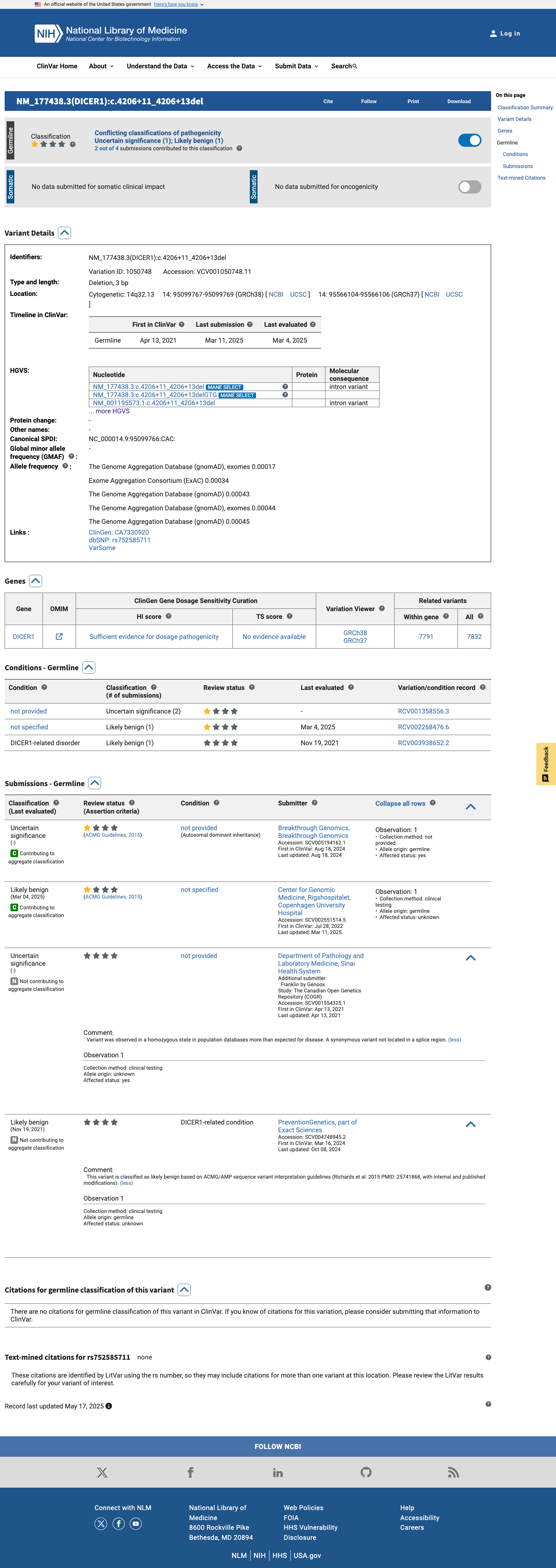
This variant has been reported in ClinVar as Likely benign (2 clinical laboratories) and as Uncertain significance (1 clinical laboratory). (ClinVarID = 1050748)
SpliceAI screenshot
In silico
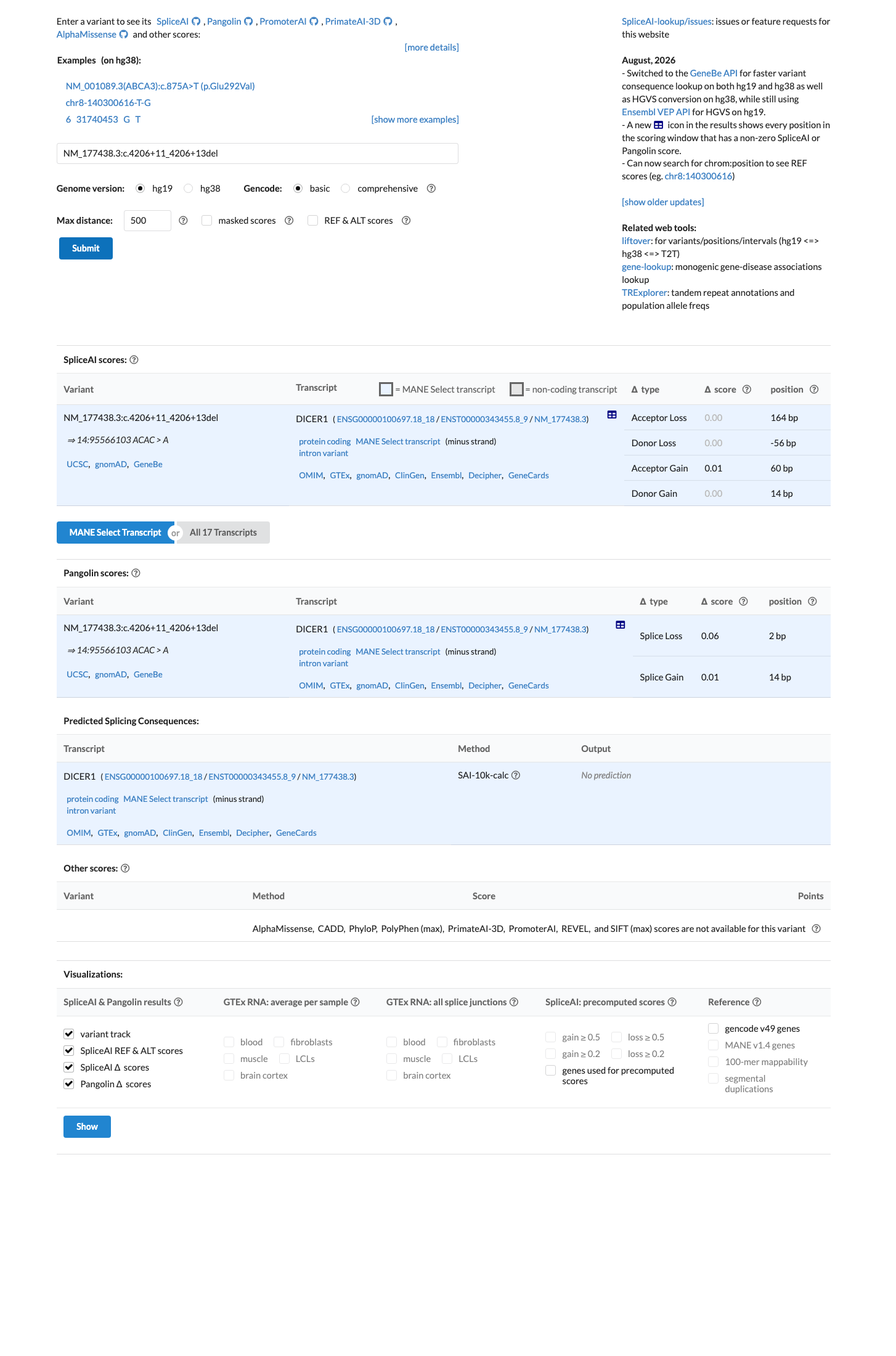
SpliceAI predicts no significant splice impact for this variant (max delta score = 0.01).
Functional No data
No calibrated functional assay or RNA evidence was identified for this variant.
OncoKB ↗
COSMIC screenshot
COSMIC
Somatic evidence
COSMIC
This variant has not previously been reported in somatic cancers (COSMIC).
Hotspots
This variant does not lie in a statistically significant cancer hotspot.
COSMIC ↗
Sources & reference links
8Sources
CSpec VCEP
ClinVar
gnomAD v2.1
gnomAD v4.1
gnomAD-Canada
SpliceAI
OncoKB
COSMIC
Triaged references · 1 PMID not cited in assessment
25741868 ↗ Standards and guidelines for the interpretation of sequence variants: a joint consensus recommendation of the American College of Medical Genetics and Genomics and the Association for Molecular Pathology. CLINVAR