Analysis in progress
Initialising…
0%
complete
This report is still being assembled — sections appear as each stage finishes. It isn't final yet.
DICER1
Final classification
Benign
DICER1 c.3033G>A · p.Ala1011=
DICER1

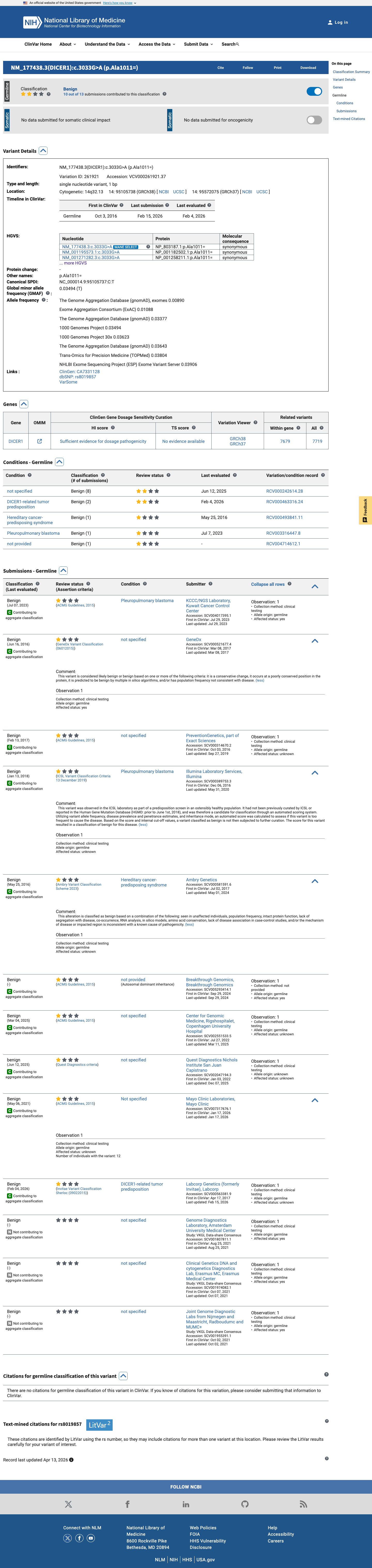
The DICER1 NM_177438.3:c.3033G>A (NP_803187.1:p.(Ala1011=)) variant has been reported in ClinVar with multiple benign submissions.

Gene
DICER1
Transcript
NM_177438.3
HGVS · transcript:coding
NM_177438.3:c.3033G>A
Consequence
N/A
GRCh38
chr14:95105738 C>T
GRCh37
chr14:95572075 C>T
Basis ClinGen DICER1 and miRNA-Processing Gene Expert Panel Specifications to the ACMG/AMP Variant Interpretation Guidelines for DICER1 Version 1.4.0 v1.4.0 point-based framework: BA1 stand-alone benign (-8) + BS1 strong (-4) + BS2 supporting (-1) = -13 points, which maps to Benign.
ClinGen DICER1 and miRNA-Processing Gene Expert Panel Specifications to the ACMG/AMP Variant Interpretation Guidelines for DICER1 Version 1.4.0 v1.4.0 point-based framework: BA1 stand-alone benign (-8) + BS1 strong (-4) + BS2 supporting (-1) = -13 points, which maps to Benign.
Classification rationale
BA1BS1BS2 Benign
DICER1 c.3033G>A

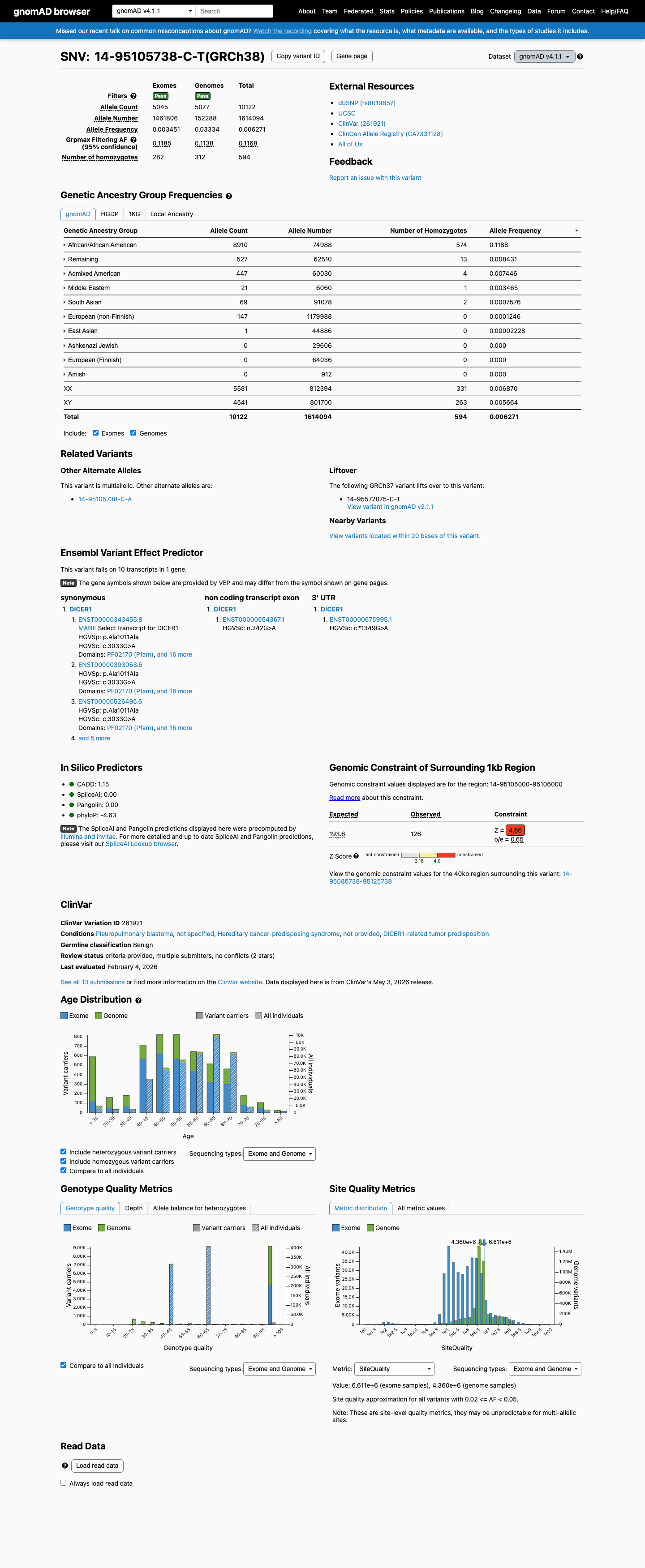
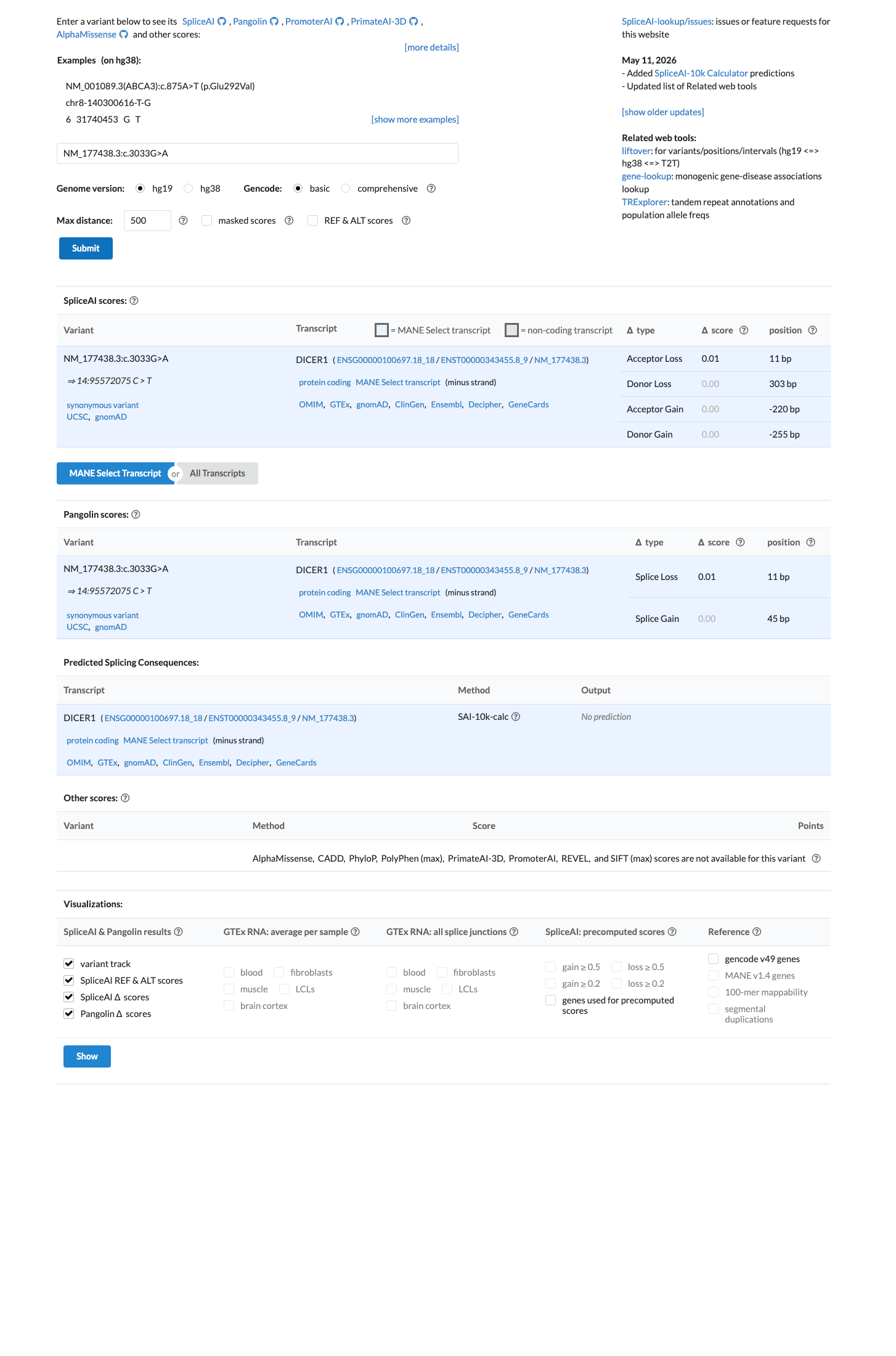
The DICER1 NM_177438.3:c.3033G>A (NP_803187.1:p.(Ala1011=)) variant has been reported in ClinVar with multiple benign submissions.1 This variant is common in population databases, including gnomAD v4.1 at 0.62710% overall and 11.88190% in the African/African American subpopulation (8910/74988 alleles, 594 homozygotes overall), which exceeds the DICER1 BA1 threshold of 0.3% and BS1 threshold of 0.03%.2 SpliceAI predicts no significant splice impact, with a maximum delta score of 0.01, arguing against an abnormal splicing effect for this synonymous change, although BP4/BP7 were not fully applied because concordant MaxEntScan evidence was not identified.3

BA1 + BS1 + BS2 Benign
Gene diagram · NM_177438.3 · variants mapped to exon structure
DICER1 NM_177438.3
Fetching transcript structure from UCSC…
Applied criteria · 3 applied · 13 assessed
Applied · 3
Strength Supporting Moderate Strong Very strong
BA1 stand-alone Benign
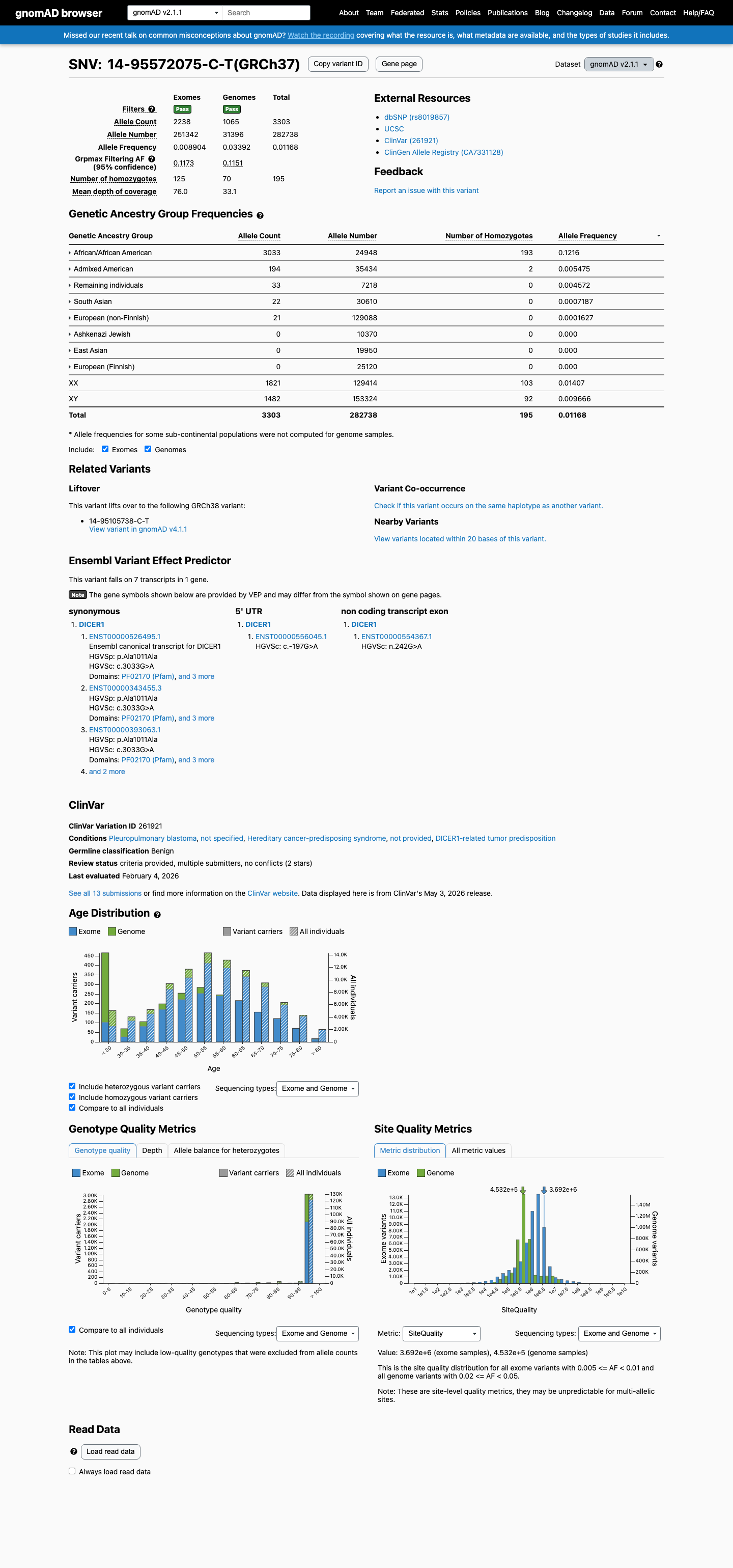
This variant exceeds the DICER1 BA1 threshold of >0.003 in a gnomAD subpopulation with >2,000 alleles tested and at least 5 variant alleles. In gnomAD v4.1, the African/African American subpopulation frequency is 0.118819 (8910/74988 alleles); gnomAD v2.1 similarly shows 0.121573 (3033/24948 alleles).
gnomAD v4.1 AFR AF 0.118819 with AN 74988 and AC 8910gnomAD v2.1 AFR AF 0.121573 with AN 24948 and AC 3033
BS1 strong Benign
This variant exceeds the DICER1 BS1 threshold of >0.0003 in a gnomAD subpopulation with >2,000 alleles tested and at least 5 variant alleles. In gnomAD v4.1, the African/African American subpopulation frequency is 0.118819 (8910/74988 alleles), well above the threshold.
gnomAD v4.1 AFR AF 0.118819gnomAD v2.1 AFR AF 0.121573
BS2 supporting Benign
This variant is observed in many homozygous individuals in population databases lacking individual clinical information, meeting the DICER1 BS2 Supporting rule for 2 or more homozygous observations without clinical data. gnomAD v4.1 reports 594 homozygotes overall, and gnomAD v2.1 reports 195 homozygotes overall.
gnomAD v4.1 homozygotes 594gnomAD v2.1 homozygotes 195
Assessed · not applied
Pathogenic
PS1 Available evidence does not establish a DICER1 pathogenic comparator producing the same amino-acid outcome with equivalent splicing context, so PS1 was not assessed.
PS2 No confirmed de novo observation with parental testing was identified, so PS2 was not assessed.
PS3 No RNA study or other DICER1 functional assay demonstrating an abnormal effect for this variant was identified, so PS3 was not assessed.
PS4 No case-level phenotype-point evidence supporting enrichment in affected individuals was identified, so PS4 was not assessed.
PM2 Population frequency is far above the DICER1 PM2 threshold of <0.000005.
PP1 No segregation data were identified, so PP1 was not assessed.
PP3 Available computational evidence does not support a damaging or splice-altering effect.
PP4 No tumor study showing retention of this germline variant with a qualifying DICER1 RNase IIIb hotspot second hit and no additional somatic DICER1 variants was identified, so PP4 was not assessed.
Benign
BS3 No RNA assay showing normal splicing for this synonymous variant was identified, so BS3 was not assessed.
BS4 No non-segregation data in affected relatives were identified, so BS4 was not assessed.
BP2 No evidence of this variant occurring in trans with a pathogenic or likely pathogenic DICER1 variant, or repeated cis/unknown-phase observations with different pathogenic variants, was identified.
BP4 SpliceAI predicts no significant splice impact with a maximum delta score of 0.01, which argues against abnormal splicing, but the DICER1 BP4 rule for synonymous variants requires concordance of MaxEntScan and SpliceAI.
BP7 This is a synonymous variant, but the DICER1 BP7 rule has a caveat that BP4 must also be met.
N/A · 12 PVS1 · PM1 · PM3 · PM4 · PM5 · PM6 · PP2 · PP5 · BP1 · BP3 · BP5 · BP6
Research & evidence
Population frequency · supports benign
gnomAD v4.1 screenshot
gnomAD v4.1
gnomAD v2.1 screenshot
gnomAD v2.1
v4.1
This variant is present in gnomAD v4.1 (AF= 0.00627101; MAF= 0.62710%, 10122/1614094 alleles, homozygotes = 594) and has highest observed frequency in the African/African American population (AF= 0.118819; MAF= 11.88190%, 8910/74988 alleles, homozygotes = 574); grpmax FAF= 0.116756.
v2.1
This variant is present in gnomAD v2.1 (AF= 0.0116822; MAF= 1.16822%, 3303/282738 alleles, homozygotes = 195) and has highest observed frequency in the African/African American population (AF= 0.121573; MAF= 12.15729%, 3033/24948 alleles, homozygotes = 193); grpmax FAF= 0.117343.
🇨🇦 CA
This variant is present in gnomAD-Canada v1.0 (AF= 0.0085289; MAF= 0.85289%, 157/18408 alleles, homozygotes = 11) and has highest observed frequency in the afr population (AF= 0.140472; grpmax FAF95= 0.121724).
Allele frequency by ancestry
three datasets · side by side
gnomAD v4.1
0.63% · 10122 / 1,614,094
594 hom · FAF 12%
African/African American
8910 / 74,988
12%
574 hom
Remaining individuals
527 / 62,510
0.84%
13 hom
Admixed American
447 / 60,030
0.74%
4 hom
Middle Eastern
21 / 6,060
0.35%
1 hom
South Asian
69 / 91,078
0.076%
2 hom
European (non-Finnish)
147 / 1,179,988
0.012%
East Asian
1 / 44,886
0.0022%
+ 3 not observed (European (Finnish), Amish, Ashkenazi Jewish)
gnomAD v2.1
1.2% · 3303 / 282,738
195 hom · FAF 12%
African/African American
3033 / 24,948
12%
193 hom
Admixed American
194 / 35,434
0.55%
2 hom
Remaining individuals
33 / 7,218
0.46%
South Asian
22 / 30,610
0.072%
European (non-Finnish)
21 / 129,088
0.016%
+ 3 not observed (Ashkenazi Jewish, East Asian, European (Finnish))
gnomAD Canada 🇨🇦
0.85% · 157 / 18,408
11 hom · FAF 12%
African/African American
143 / 1,018
14%
11 hom
Remaining individuals
8 / 1,138
0.7%
Latino/Admixed American
5 / 836
0.6%
European (non-Finnish)
1 / 11,732
0.0085%
+ 5 not observed (Ashkenazi Jewish, East Asian, European (Finnish), Middle Eastern, South Asian)
ClinVar screenshot
ClinVar
This variant has been reported in ClinVar as Benign (11 clinical laboratories) and as benign (1 clinical laboratory). (ClinVarID = 261921)
SpliceAI screenshot
In silico
SpliceAI predicts no significant splice impact for this variant (max delta score = 0.01).
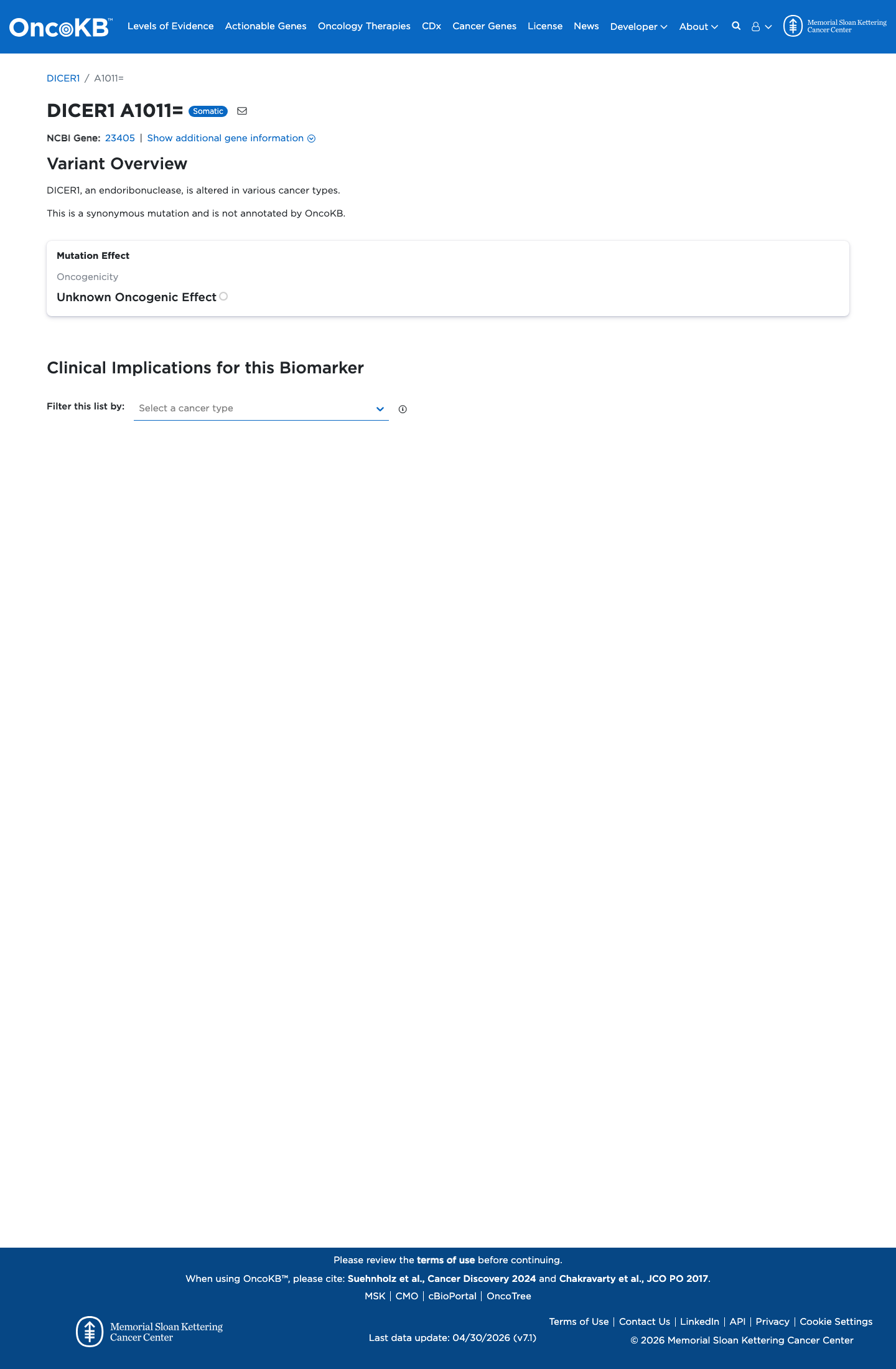
Functional / OncoKB screenshot
Functional Unknown Oncogenic Effect
OncoKB identified curated literature and non-variant-specific oncogenicity context for review; listed oncogenicity label: Unknown Oncogenic Effect.
OncoKB ↗
COSMIC screenshot
COSMIC
Cancer hotspots screenshot
Cancer hotspots
Somatic evidence Not in COSMIC / hotspots
COSMIC
This variant does not lie in a statistically significant hotspot. This variant has not previously been reported in somatic cancers (COSMIC).
Hotspots
This variant does not lie in a statistically significant hotspot.
Sources & reference links
9Sources
CSpec VCEP
ClinVar
gnomAD v2.1
gnomAD v4.1
gnomAD-Canada
SpliceAI
OncoKB
COSMIC
Cancer hotspots
Triaged references · 6 PMIDs not cited in assessment
25741868 ↗ Standards and guidelines for the interpretation of sequence variants: a joint consensus recommendation of the American College of Medical Genetics and Genomics and the Association for Molecular Pathology. CLINVAR
26467025 ↗ A Standardized DNA Variant Scoring System for Pathogenicity Assessments in Mendelian Disorders. CLINVAR
24493721 ↗ American Society of Clinical Oncology Expert Statement: collection and use of a cancer family history for oncology providers. CLINVAR
24761742 ↗ DICER1-Related Tumor Predisposition. CLINVAR
25394175 ↗ A practice guideline from the American College of Medical Genetics and Genomics and the National Society of Genetic Counselors: referral indications for cancer predisposition assessment. CLINVAR
28492532 ↗ Sherloc: a comprehensive refinement of the ACMG-AMP variant classification criteria. CLINVAR