Back
NM_177438.3:c.734+6C>T
p.? · DICER1
0%
complete
Final classification
VUS
DICER1
c.734+6C>T
p.?
unknown · exon 6i

DICER1 encodes an enzyme that processes RNA into small silencing RNAs and microRNAs, which regulate gene expression after transcription. Germline mutations in DICER1 cause DICER1-related disorders, a familial tumor susceptibility syndrome that increases the risk of pleuropulmonary blastoma, cystic nephroma, rhabdomyosarcoma, multinodular goiter, and ovarian Sertoli-Leydig cell tumors. DICER1 acts as a tumor suppressor, and loss or reduced activity of the protein is linked to cancer development and poorer outcomes in several cancer types, including lung, breast, and ovarian cancers.

This variant

This intronic DICER1 variant lies in a gene whose reduced RNA-processing activity causes the autosomal-dominant DICER1-related tumor predisposition syndrome.

Transcript
NM_177438.3
HGVS · transcript:coding
NM_177438.3:c.734+6C>T
GRCh38
chr14:95129466 G>A
GRCh37
chr14:95595803 G>A
VUS: no pathogenic or benign criteria are applied, yielding 0 points under the DICER1 VCEP Version 1.4 Rule 3.
Classification rationale
VUS
DICER1 c.734+6C>T unknown · exon 6i

Only PVS1, PM4, and BP3 were adjudicated. The DICER1 VCEP specification governs: PVS1 is not met for this noncanonical +6 intronic variant, while PM4 and BP3 are not applicable to its consequence type. The governing DICER1 VCEP framework applies PS2, PP1, and BS4 but excludes PM6; the available evidence does not document parental testing, de novo status, informative segregation, or non-segregation. No paper in the extracted literature set provides variant-specific de novo, segregation, or non-segregation evidence for NM_177438.3:c.734+6C>T. The variant is an intronic c.734+6 substitution; PP3 and BP4 use the splice-impact path, while BP7 is out of scope because the variant is not synonymous. The available SpliceAI max delta is 0.07, but the governing DICER1 PP3/BP4 rules require MaxEntScan and SpliceAI concordance, and MaxEntScan evidence is unavailable.

LYFE Sciences is an AI system, and it can make mistakes. Criteria may be applied incorrectly, sources may be misread, and a confident-looking classification can still be wrong. Double-check every criterion and its underlying evidence before relying on any call.
Gene diagram · NM_177438.3 · variants mapped to exon structure
DICER1 NM_177438.3
Fetching transcript structure from UCSC…
Applied criteria · 0 applied · 16 assessed
MetEvidence satisfies this criterion.
Not metEvaluated against available evidence; threshold not reached.
Not assessedApplies in principle, but no evidence was found to evaluate it.
N/ADoesn't apply to this variant type.
Applied · 0

No criteria were applied for this variant.
Assessed · not applied · 4 not met · 12 not assessed
Pathogenic
PVS1 Not met: c.734+6C>T is outside the DICER1 VCEP +/-1/+/-2 splice rule and has SpliceAI maximum delta 0.07.
PS1 Not assessed: c.734+6C>T has SpliceAI max delta 0.07, but no qualifying same-nucleotide VCEP-pathogenic comparator with comparable splicing impact is available.
PS2 Not assessed: no documented de novo observation or confirmed parental testing is available to assign PS2 de novo points.
PS3 Not assessed: no variant-specific RNA or pre-miRNA cleavage assay is available; SpliceAI max delta 0.07 is predictive evidence, not functional validation.
PS4 Not assessed: the DICER1 VCEP requires ≥4 phenotype points for strong PS4, but no adjudicated phenotype-point total is available.
PM2 Not met: gnomAD v4.1 total frequency was 4.65e-05, exceeding the DICER1 VCEP PM2 cutoff of <5e-06.
PP1 Not assessed: no affected relatives or countable segregating meioses are documented for this variant.
PP3 Not assessed: SpliceAI max delta 0.07 is below the 0.2 PP3 threshold, but the DICER1 rule also requires unavailable MaxEntScan concordance.
PP4 Not assessed: PP4 requires a documented DICER1 RNase IIIb hotspot second hit with germline-variant retention, but no qualifying tumor result is available.
Benign
BA1 Not met: the highest gnomAD v4.1 subpopulation frequency was 5.68e-05, below the DICER1 VCEP BA1 threshold of >0.003.
BS1 Not met: the highest gnomAD v4.1 subpopulation frequency was 5.68e-05, below the DICER1 VCEP BS1 threshold of >0.0003.
BS2 Not assessed: gnomAD v4.1 reports 0 homozygotes, but no qualifying healthy homozygote or tumor-free female cohort is available for the VCEP BS2 rule.
BS3 Not assessed: no repeated RNA assay or controlled cleavage assay demonstrates normal function; SpliceAI max delta 0.07 alone cannot establish BS3.
BS4 Not assessed: no phenotype-positive, genotype-negative relatives are documented to demonstrate non-segregation.
BP2 Not assessed: no qualifying trans observation or three cis/phase-unknown observations with two or more P/LP DICER1 variants are documented.
BP4 Not assessed: SpliceAI max delta 0.07 meets the <=0.1 BP4 threshold, but the DICER1 rule also requires unavailable MaxEntScan concordance.
N/A · 12 PM1 · PM3 · PM4 · PM5 · PM6 · PP2 · PP5 · BP1 · BP3 · BP5 · BP6 · BP7
Research & evidence
Population frequency
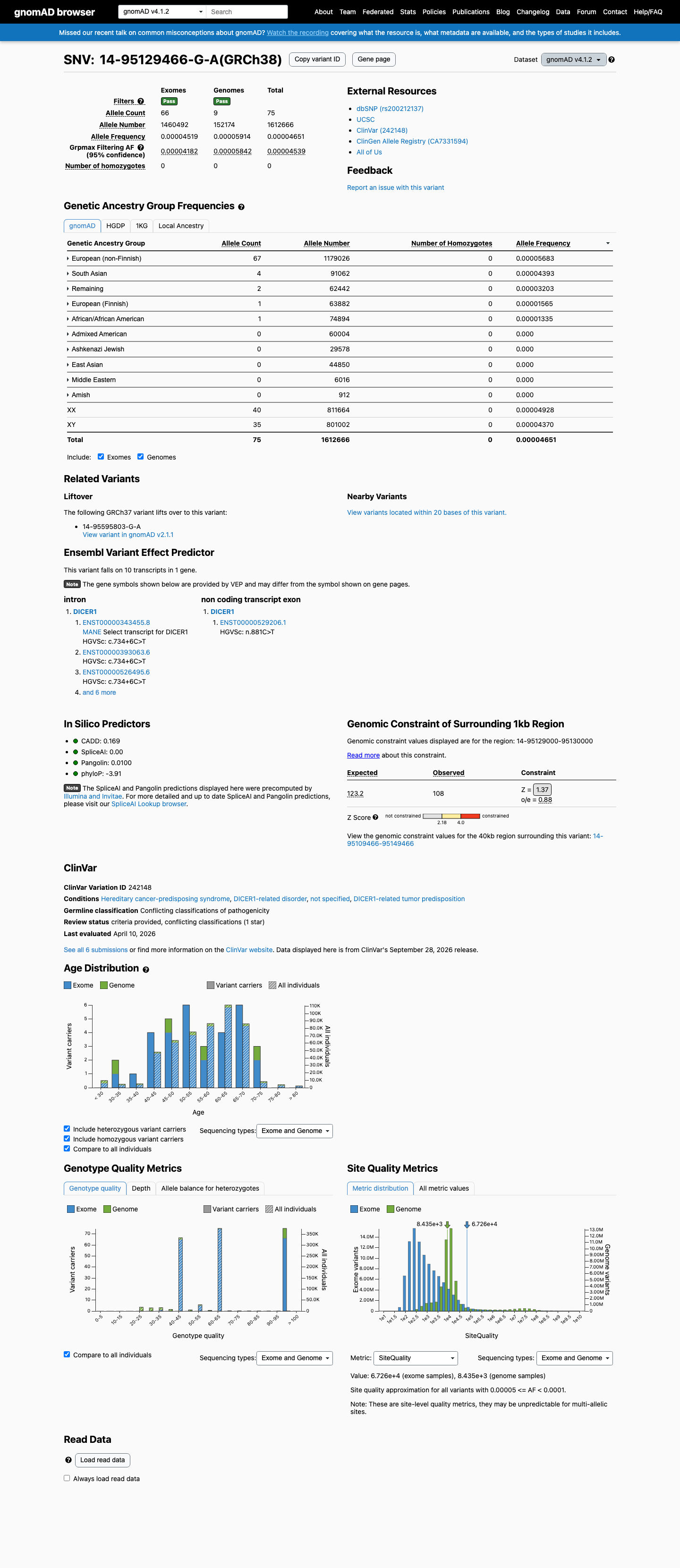
gnomAD v4.1 screenshot
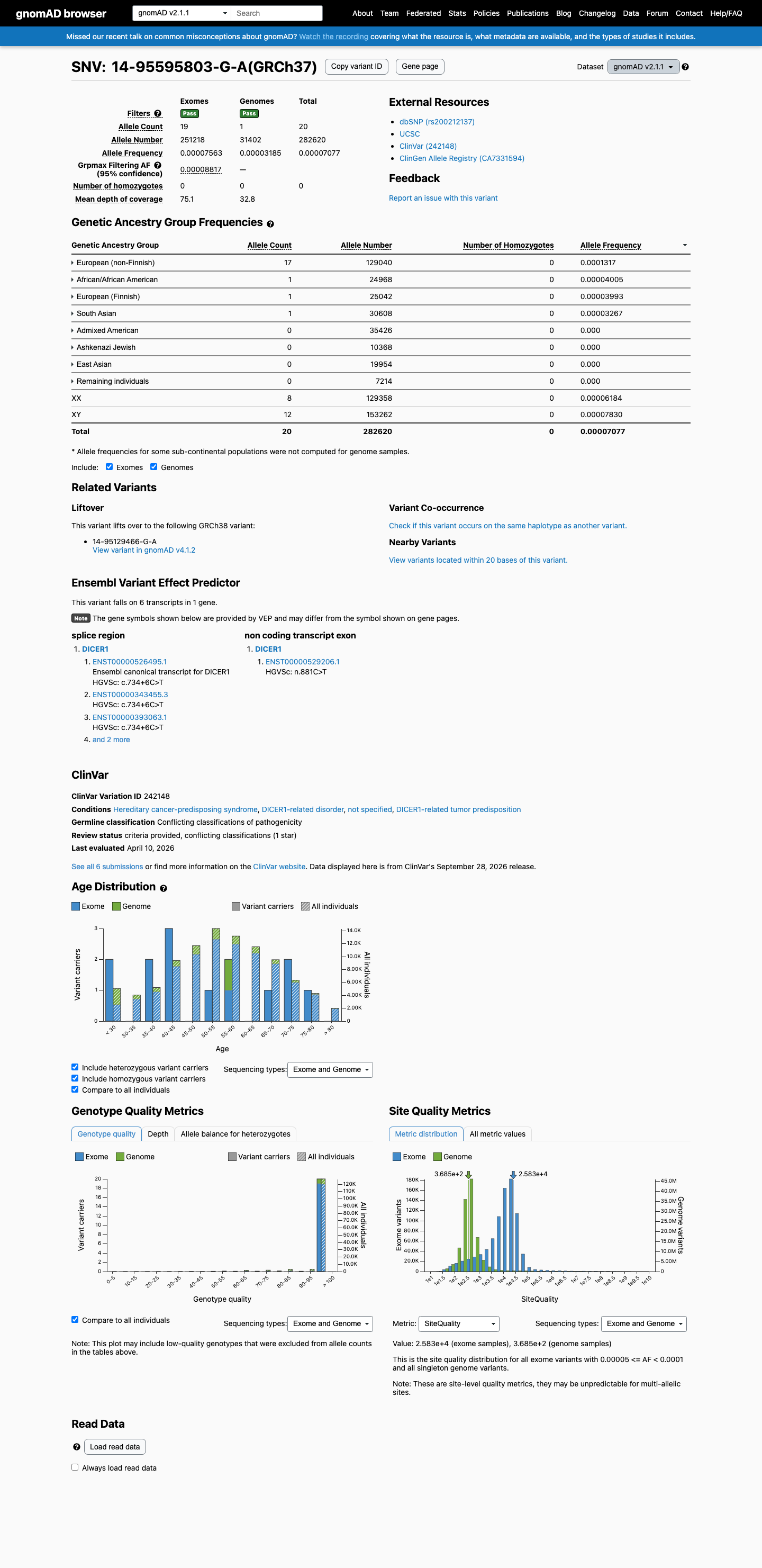
gnomAD v4.1
gnomAD v2.1 screenshot
gnomAD v2.1
v4.1
This variant is present in gnomAD v4.1 (AF= 4.65068e-05; MAF= 0.00465%, 75/1612666 alleles, homozygotes = 0) and has highest observed frequency in the European (non-Finnish) population (AF= 5.68266e-05; MAF= 0.00568%, 67/1179026 alleles, homozygotes = 0); grpmax FAF= 4.539e-05.
v2.1
This variant is present in gnomAD v2.1 (AF= 7.07664e-05; MAF= 0.00708%, 20/282620 alleles, homozygotes = 0) and has highest observed frequency in the European (non-Finnish) population (AF= 0.000131742; MAF= 0.01317%, 17/129040 alleles, homozygotes = 0); grpmax FAF= 8.817e-05.
🇨🇦 CA
Not available in gnomAD-Canada v1.0.
Allele frequency by ancestry
three datasets · side by side
gnomAD v4.1
0.0047% · 75 / 1,612,666
0 hom · FAF 0.0045%
European (non-Finnish)
67 / 1,179,026
0.0057%
South Asian
4 / 91,062
0.0044%
Remaining individuals
2 / 62,442
0.0032%
European (Finnish)
1 / 63,882
0.0016%
African/African American
1 / 74,894
0.0013%
+ 5 not observed (Admixed American, Amish, East Asian, Middle Eastern, Ashkenazi Jewish)
gnomAD v2.1
0.0071% · 20 / 282,620
0 hom · FAF 0.0088%
European (non-Finnish)
17 / 129,040
0.013%
African/African American
1 / 24,968
0.004%
European (Finnish)
1 / 25,042
0.004%
South Asian
1 / 30,608
0.0033%
+ 4 not observed (Admixed American, Ashkenazi Jewish, East Asian, Remaining individuals)
gnomAD Canada 🇨🇦
Absent · 0 / ?
0 hom
Not observed in any ancestry group.
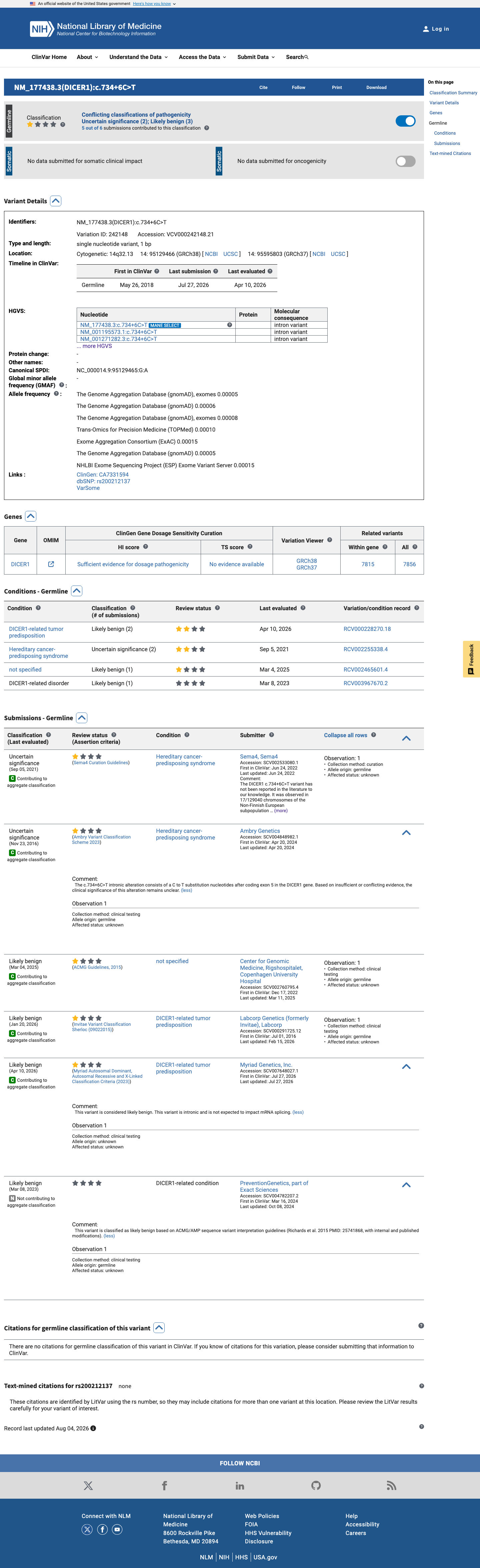
ClinVar screenshot
ClinVar
This variant has been reported in ClinVar as Likely benign (4 clinical laboratories) and as Uncertain significance (1 clinical laboratory). (ClinVarID = 242148)
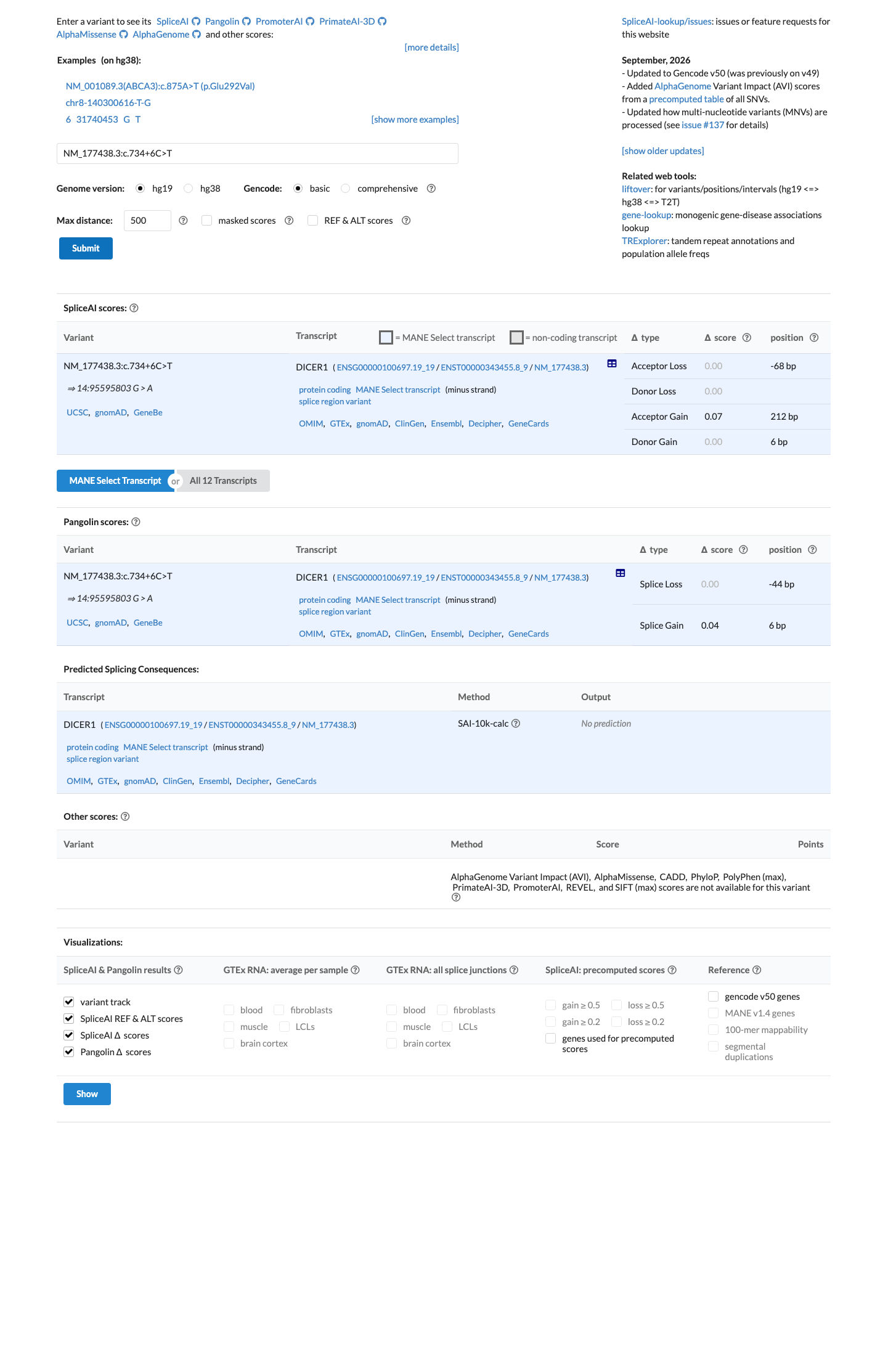
SpliceAI screenshot
In silico
SpliceAI predicts no significant splice impact for this variant (max delta score = 0.07).
Functional No data
No calibrated functional assay or RNA evidence was identified for this variant.
OncoKB ↗
COSMIC screenshot
COSMIC
Somatic evidence
COSMIC
This variant has not previously been reported in somatic cancers (COSMIC).
Hotspots
This variant does not lie in a statistically significant cancer hotspot.
COSMIC ↗
Sources & reference links
8Sources
CSpec VCEP
ClinVar
gnomAD v2.1
gnomAD v4.1
gnomAD-Canada
SpliceAI
OncoKB
COSMIC
Triaged references · 4 PMIDs not cited in assessment
25741868 ↗ Standards and guidelines for the interpretation of sequence variants: a joint consensus recommendation of the American College of Medical Genetics and Genomics and the Association for Molecular Pathology. CLINVAR
24761742 ↗ DICER1-Related Tumor Predisposition. CLINVAR
25394175 ↗ A practice guideline from the American College of Medical Genetics and Genomics and the National Society of Genetic Counselors: referral indications for cancer predisposition assessment. CLINVAR
28492532 ↗ Sherloc: a comprehensive refinement of the ACMG-AMP variant classification criteria. CLINVAR