This variant was interpreted by pipeline
7.1.0.
The current version is
8.0.0.
Re-running queues a fresh interpretation; the result replaces this page when complete.
Re-runs are not free. Blank = draws on today's public interpretation allowance.
With a code = uses 1 of that code's uses.
TERT encodes the catalytic subunit of telomerase, the enzyme that maintains chromosome ends (telomeres) by adding TTAGGG repeat sequences and preserves genomic integrity. Telomerase is normally switched off in adult somatic cells, so telomeres shorten with each cell division, contributing to cellular senescence; reactivation of telomerase can therefore help cells divide indefinitely. Telomerase activity is upregulated in the vast majority of tumors and is thought to drive cancer cell immortality, and TERT alterations — including promoter mutations and gene amplification — are found in cancers such as melanoma, liver, bladder, and brain tumors.
This variant
TERT encodes the catalytic subunit of telomerase, and telomerase reactivation drives cancer cell immortality, making TERT alterations relevant to cancer and related disorders. This synonymous change (p.Ala604=) is predicted not to disrupt splicing and appears at about 0.3% in population databases, a frequency inconsistent with a highly penetrant disease allele. As a variant of uncertain significance, it currently provides no basis for attributing TERT-related disease to this variant.
Transcript
NM_198253.2
HGVS · transcript:coding
NM_198253.2:c.1812A>G
GRCh38
chr5:1280296 T>C
GRCh37
chr5:1280411 T>C
No gene-specific framework exists for TERT, so generic ACMG/AMP 2015 rules applied; only BP7 (supporting) was met, with all other criteria not applicable, not assessed, or not met.
Classification rationale
BP7VUS
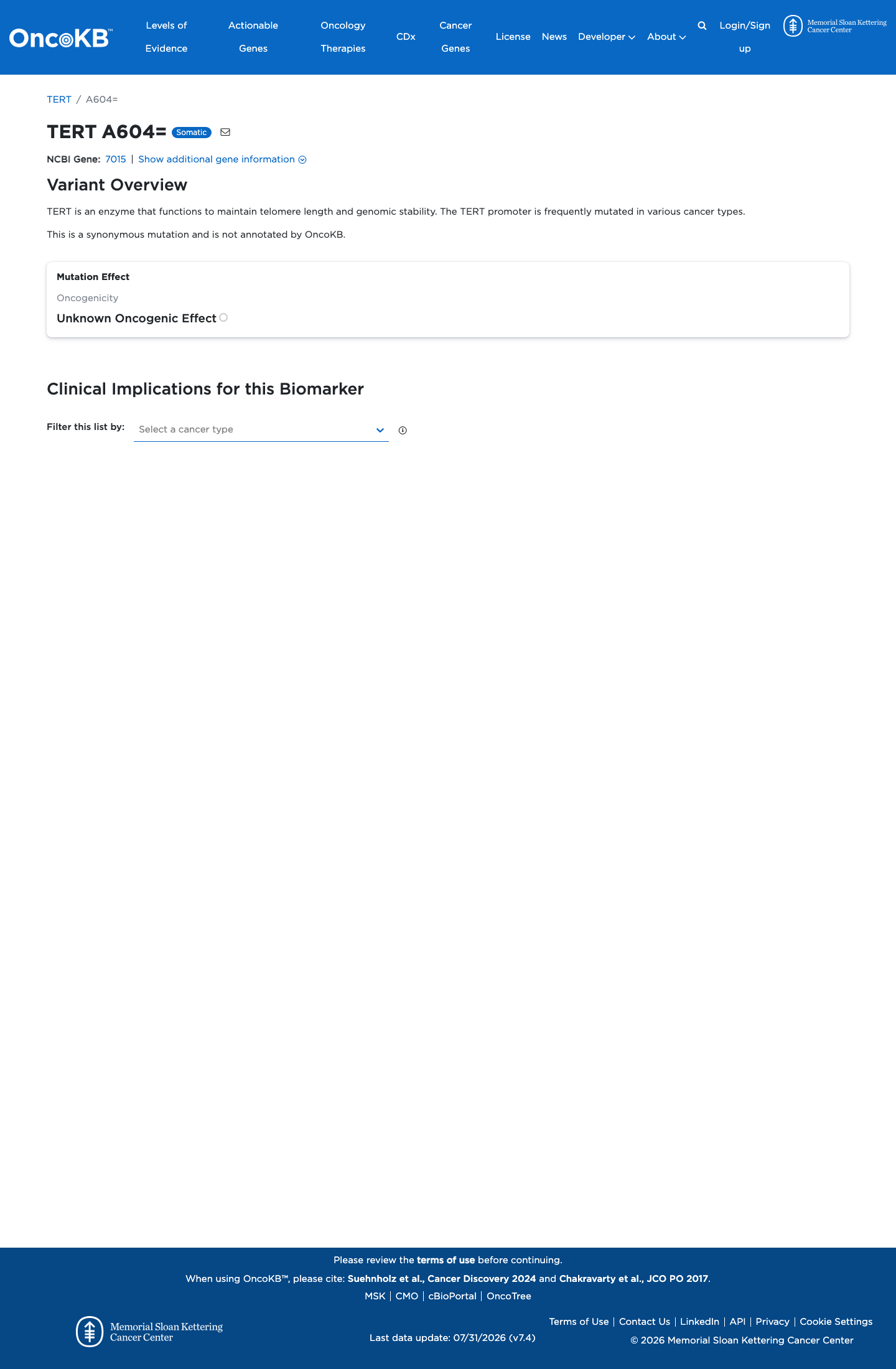
TERT c.1812A>Gsynonymous · exon 4
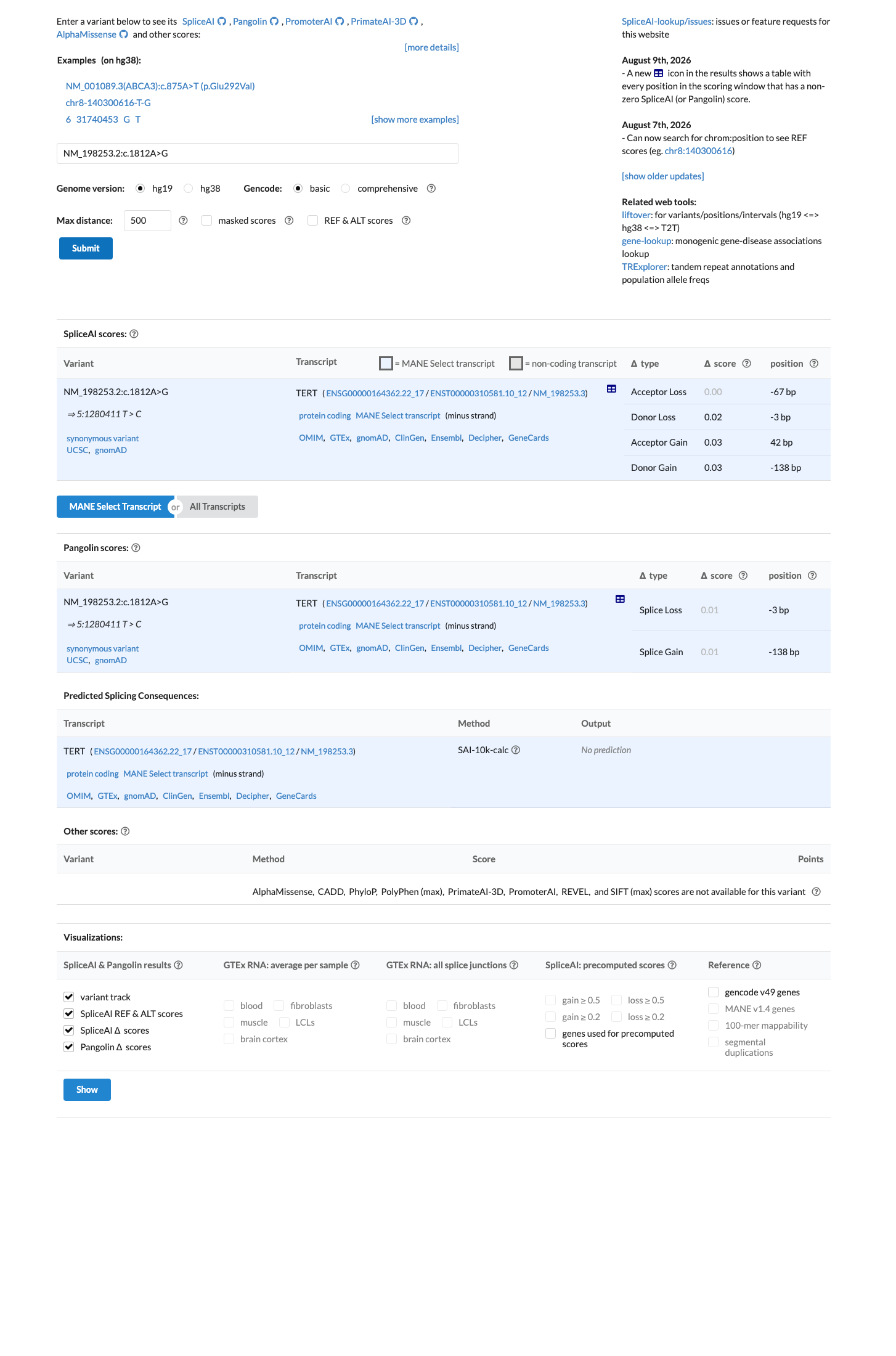
BP7 (Supporting): synonymous variant with SpliceAI max delta 0.034, below the 0.1 threshold, indicating no predicted splice disruption. Overall classification: VUS - with only BP7 (supporting) applied under the generic ACMG/AMP 2015 fallback, the variant is of uncertain significance.
BP7→VUS
LYFE Sciences is an AI system, and it can make mistakes. Criteria
may be applied incorrectly, sources may be misread, and a confident-looking
classification can still be wrong. Double-check every criterion and
its underlying evidence before relying on any call.
Gene diagram
· NM_198253.2 · variants mapped to exon structure
TERTNM_198253.2
Fetching transcript structure from UCSC…
Exons
—
Transcript span
—
Strand
—
Variants mapped
—
Source
UCSC ncbiRefSeqCurated
All variants in TERT—click a row to locate it on the plot · use the link column to open its page
Protein
Location
Classification
Link
Applied criteria · 1 applied · 18 assessed
MetEvidence satisfies this criterion.
Not metEvaluated against available evidence; threshold not reached.
Not assessedApplies in principle, but no evidence was found to evaluate it.
N/ADoesn't apply to this variant type.
Applied · 1
Strength Supporting Moderate Strong Very strong
✓
BP7supportingBenign
Met (Supporting): SpliceAI max delta 0.034, below the 0.1 threshold, indicating no predicted splice disruption.
SpliceAI max delta score = 0.034 (DS_AG=0.026, DS_AL=0.001, DS_DG=0.034, DS_DL=0.022) indicates no predicted splice impact, below the 0.1 threshold in the generic fallback splice-path calibration for synonymous variants.No TERT-specific ClinGen VCEP CSPEC was retrieved (vcep_materials.json summaries={}, final_classification_framework.json found=false), so the generic_acmg_classification_rules.md SpliceAI-based threshold governs BP7 application for this synonymous variant.
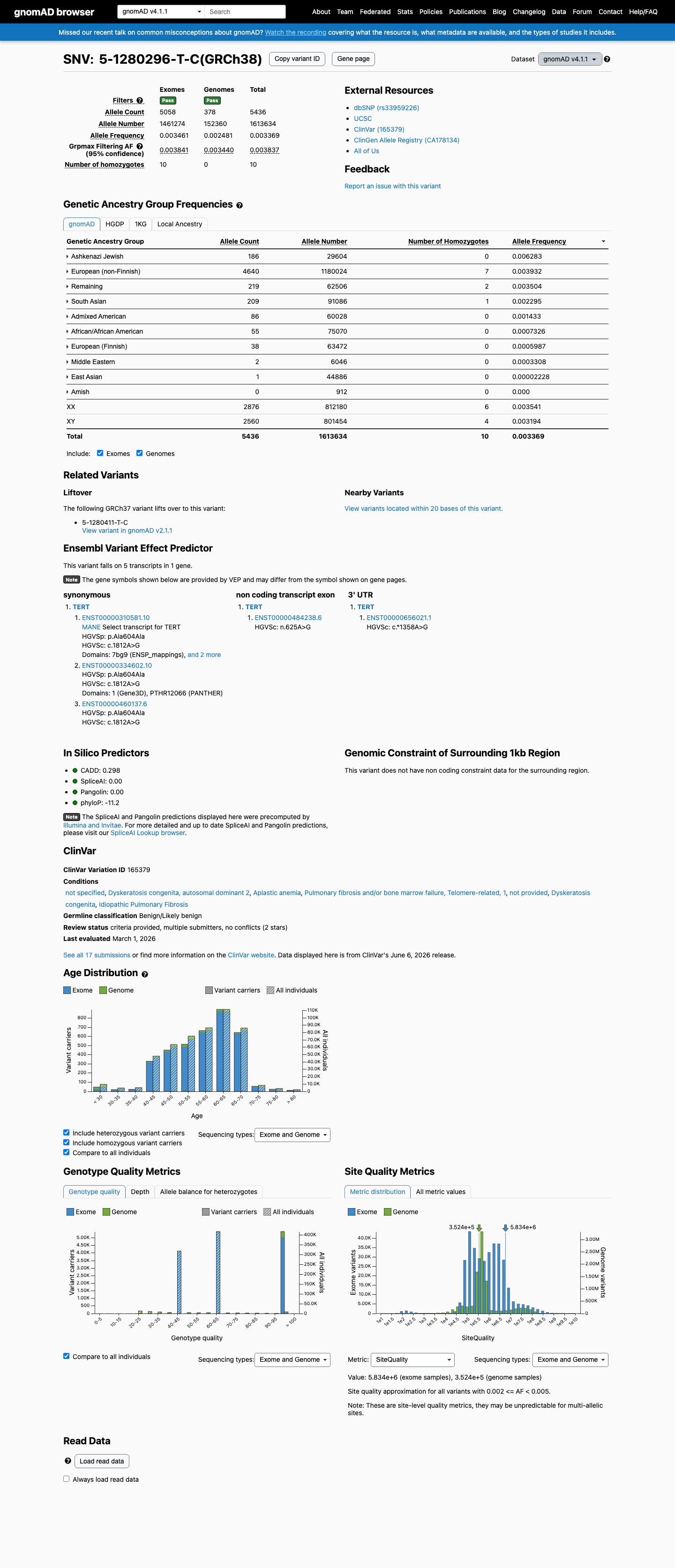
This variant is present in gnomAD v4.1 (AF= 0.00336879; MAF= 0.33688%, 5436/1613634 alleles, homozygotes = 10) and has highest observed frequency in the Ashkenazi Jewish population (AF= 0.00628293; MAF= 0.62829%, 186/29604 alleles, homozygotes = 0); grpmax FAF= 0.00383685.
v2.1
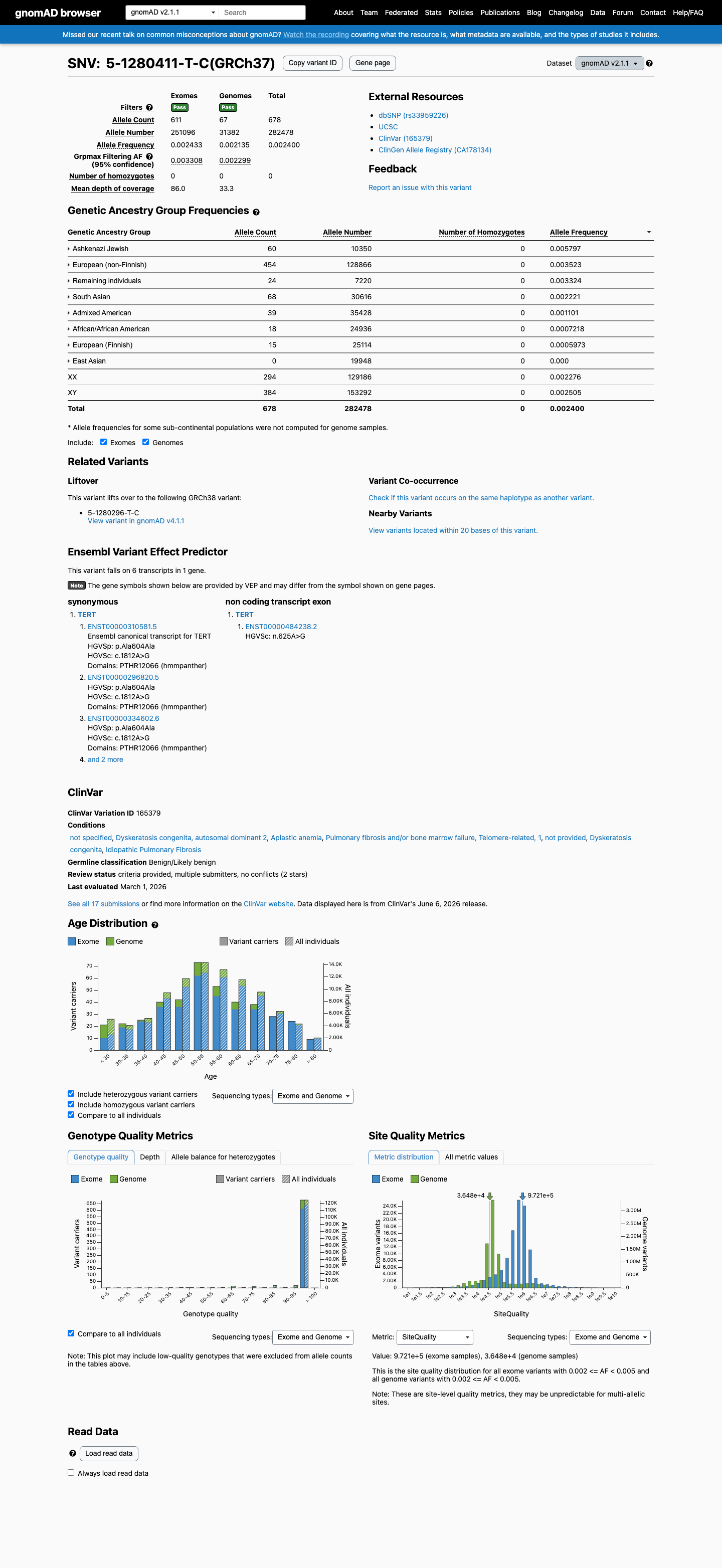
This variant is present in gnomAD v2.1 (AF= 0.00240019; MAF= 0.24002%, 678/282478 alleles, homozygotes = 0) and has highest observed frequency in the Ashkenazi Jewish population (AF= 0.0057971; MAF= 0.57971%, 60/10350 alleles, homozygotes = 0); grpmax FAF= 0.00330808.
🇨🇦 CA
This variant is present in gnomAD-Canada v1.0 (AF= 0.0026601520086862104, 49/18420 alleles, homozygotes = 1).
Allele frequency by ancestry
three datasets · side by side
gnomAD v4.1
0.34%
· 5436 / 1,613,634
10 hom · FAF 0.38%
Ashkenazi Jewish
186 / 29,604
0.63%
European (non-Finnish)
4640 / 1,180,024
0.39%
7 hom
Remaining individuals
219 / 62,506
0.35%
2 hom
South Asian
209 / 91,086
0.23%
1 hom
Admixed American
86 / 60,028
0.14%
African/African American
55 / 75,070
0.073%
European (Finnish)
38 / 63,472
0.06%
Middle Eastern
2 / 6,046
0.033%
East Asian
1 / 44,886
0.0022%
+ 1 not observed (Amish)
gnomAD v2.1
0.24%
· 678 / 282,478
0 hom · FAF 0.33%
Ashkenazi Jewish
60 / 10,350
0.58%
European (non-Finnish)
454 / 128,866
0.35%
Remaining individuals
24 / 7,220
0.33%
South Asian
68 / 30,616
0.22%
Admixed American
39 / 35,428
0.11%
African/African American
18 / 24,936
0.072%
European (Finnish)
15 / 25,114
0.06%
+ 1 not observed (East Asian)
gnomAD Canada 🇨🇦
0.27%
· 49 / 18,420
1 hom · FAF 0.19%
Ashkenazi Jewish
5 / 832
0.6%
South Asian
6 / 1,362
0.44%
European (non-Finnish)
35 / 11,740
0.3%
1 hom
Remaining individuals
2 / 1,138
0.18%
Latino/Admixed American
1 / 838
0.12%
+ 4 not observed (African/African American, East Asian, European (Finnish), Middle Eastern)
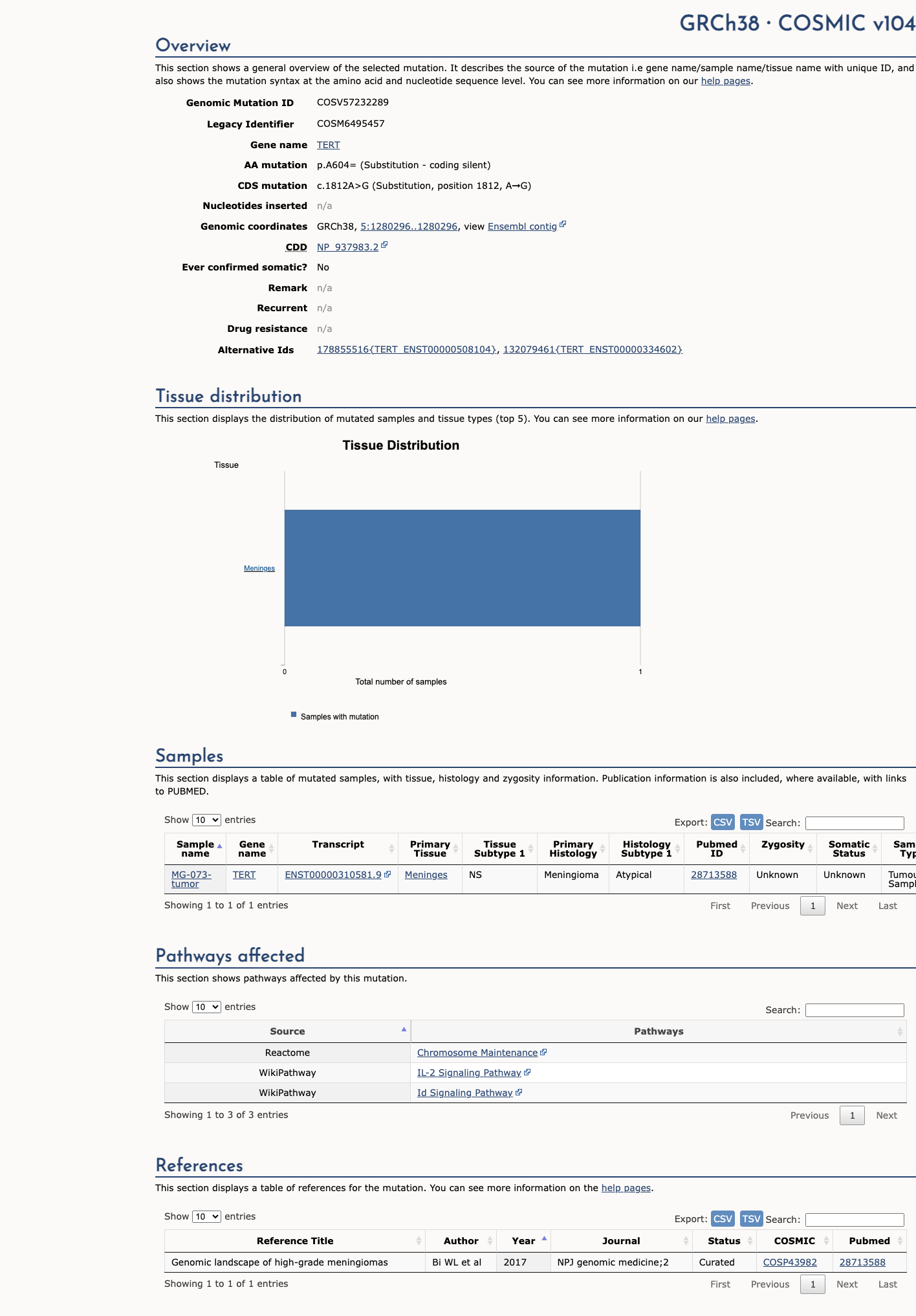
This variant does not lie in a statistically significant hotspot. This variant has previously been reported in somatic cancers (COSMIC; COSV57232289, n = 1 times).
Hotspots
This variant does not lie in a statistically significant hotspot.
Triaged references · 7 PMIDs not cited in assessment
24033266 ↗A systematic approach to assessing the clinical significance of genetic variants.CLINVAR
25741868 ↗Standards and guidelines for the interpretation of sequence variants: a joint consensus recommendation of the American College of Medical Genetics and Genomics and the Association for Molecular Pathology.CLINVAR