Analysis in progress
Initialising…
0%
complete
This report is still being assembled — sections appear as each stage finishes. It isn't final yet.
FGFR4
Final classification
VUS
PM2
FGFR4
c.770C>T
p.Ala257Val
missense · exon 7

FGFR4 encodes a receptor tyrosine kinase that binds fibroblast growth factors and helps regulate cell proliferation, differentiation, and migration, as well as lipid metabolism, bile acid biosynthesis, vitamin D metabolism, glucose uptake, and phosphate homeostasis. Germline alterations in FGFR4 cause forms of craniosynostosis, a group of conditions marked by abnormal skull and bone development. FGFR4 acts as an oncogene in cancer: activating mutations and amplifications occur in rhabdomyosarcoma, its overexpression is linked to prostate, colon, and liver cancer progression, and FGFR-targeted inhibitors are used in treatment.

This variant

FGFR4 germline alterations cause craniosynostosis, while activating somatic mutations act as oncogenic drivers in cancers such as rhabdomyosarcoma. This missense variant, p.(Ala257Val), is classified as a variant of uncertain significance: it is absent from population databases, but no functional, clinical, or same-residue evidence currently establishes whether it alters FGFR4 function in either context.

Transcript
NM_213647.2
HGVS · transcript:coding
NM_213647.2:c.770C>T
GRCh38
chr5:177092363 C>T
GRCh37
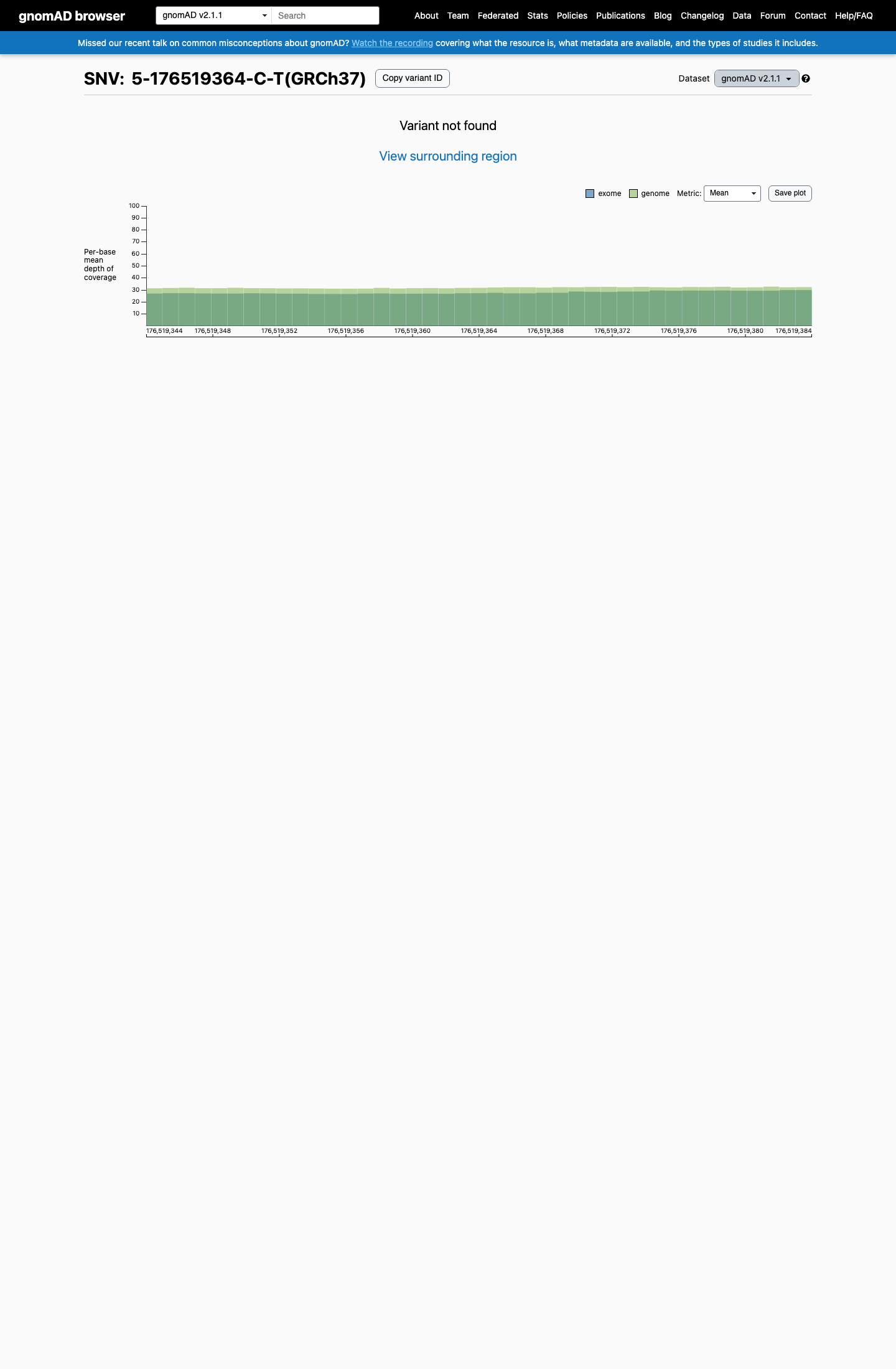
chr5:176519364 C>T
Basis VUS: only PM2 is met (supporting; absent from gnomAD with 0/1,601,818 alleles), and no Pathogenic, Likely Pathogenic, Benign, or Likely Benign ACMG/AMP 2015 combination rule is satisfied.
VUS: only PM2 is met (supporting; absent from gnomAD with 0/1,601,818 alleles), and no Pathogenic, Likely Pathogenic, Benign, or Likely Benign ACMG/AMP 2015 combination rule is satisfied.
Classification rationale
PM2 VUS
FGFR4 c.770C>T missense · exon 7

PM2 (Supporting): absent from gnomAD v2.1 and gnomAD-Canada v1.0, with 0/1,601,818 alleles and zero homozygotes in gnomAD v4.1. Overall: VUS - a single supporting-strength criterion (PM2) does not satisfy any ACMG/AMP 2015 Pathogenic, Likely Pathogenic, Benign, or Likely Benign combination rule.

PM2 VUS
Gene diagram · NM_213647.2 · variants mapped to exon structure
FGFR4 NM_213647.2
Fetching transcript structure from UCSC…
Applied criteria · 1 applied · 23 assessed
MetEvidence satisfies this criterion.
Not metEvaluated against available evidence; threshold not reached.
Not assessedApplies in principle, but no evidence was found to evaluate it.
N/ADoesn't apply to this variant type.
Applied · 1
Strength Supporting Moderate Strong Very strong
PM2 supporting Pathogenic
Met (supporting): absent from gnomAD v2.1 and gnomAD-Canada v1.0, with 0/1,601,818 alleles and zero homozygotes in gnomAD v4.1.
No FGFR4 ClinGen VCEP specification or local gene-specific framework was available; generic ACMG/AMP population-frequency interpretation was used.gnomAD v4.1 reports AC=0, AN=1,601,818, AF=0, and zero homozygotes; the highest listed population, African/African American, has AC=0/AN=74,776.The variant is reported absent from gnomAD v2.1 and gnomAD-Canada v1.0.
Assessed · not applied · 7 not met · 16 not assessed
Pathogenic
PS1 Not assessed: the variant is absent from ClinVar, and no comparator data on a pathogenic change producing the identical amino acid was available.
PS2 Not assessed: no proband phenotype, parental genotypes, parentage confirmation, or de novo testing result is available.
PS3 Not assessed: no validated functional or biochemical assay data (kinase activity, phosphorylation, proliferation) for p.Ala257Val was available.
PS4 Not assessed: no affected-case series or case-control dataset reports this exact FGFR4 variant.
PM1 Not met: cancerhotspots.org returned no significant-hotspot row for FGFR4 A257, and no residue-level functional-domain annotation places codon 257 in a critical domain.
PM3 Not assessed: no affected-proband observation, second variant, phase result, or recessive FGFR4 disease evidence is present.
PM5 Not assessed: no previously established pathogenic variant with a different amino acid substitution at residue 257 was identified.
PM6 Not assessed: no report identifies the variant as de novo without confirmed parentage.
PP1 Not assessed: no affected relatives, genotypes, phenotypes, or informative meioses are reported.
PP2 Not assessed: no missense-constraint metric (e.g., gnomAD Z-score) or established missense disease mechanism for FGFR4 was available.
PP3 Not met: REVEL score 0.396 falls in the gray zone (0.250-0.750), below the >0.750 PP3 supporting threshold.
PP4 Not assessed: no proband phenotype or phenotype-specificity evidence is supplied.
PP5 Not met: no exact-variant ClinVar record or expert-panel Pathogenic/Likely pathogenic assertion is present.
Benign
BA1 Not met: 0/1,601,818 alleles in gnomAD v4.1 (AF 0) does not show a stand-alone benign population frequency.
BS1 Not met: no observed alleles in gnomAD v4.1, v2.1, or gnomAD-Canada v1.0, so frequency cannot exceed a disease-compatible threshold.
BS2 Not assessed: no observed gnomAD homozygotes or phenotype-verified healthy adult carriers are available.
BS3 Not assessed: no functional or biochemical assay data showing normal activity for p.Ala257Val was available.
BS4 Not assessed: no family data show lack of segregation between the variant and a relevant phenotype.
BP1 Not assessed: no formal gene-level curation of the missense-versus-truncating disease mechanism for FGFR4 was available.
BP2 Not assessed: no co-occurrence with a pathogenic variant, phase information, or established dominant FGFR4 disease context is available.
BP4 Not met: REVEL score 0.396 is above the <0.250 BP4 supporting threshold.
BP5 Not assessed: no proband-level molecular results or established alternative genetic cause are supplied.
BP6 Not met: no exact-variant ClinVar record or expert-panel Benign/Likely benign assertion is present.
N/A · 4 PVS1 · PM4 · BP3 · BP7
Research & evidence
Population frequency
gnomAD v4.1 screenshot
gnomAD v4.1
gnomAD v2.1 screenshot
gnomAD v2.1
v4.1
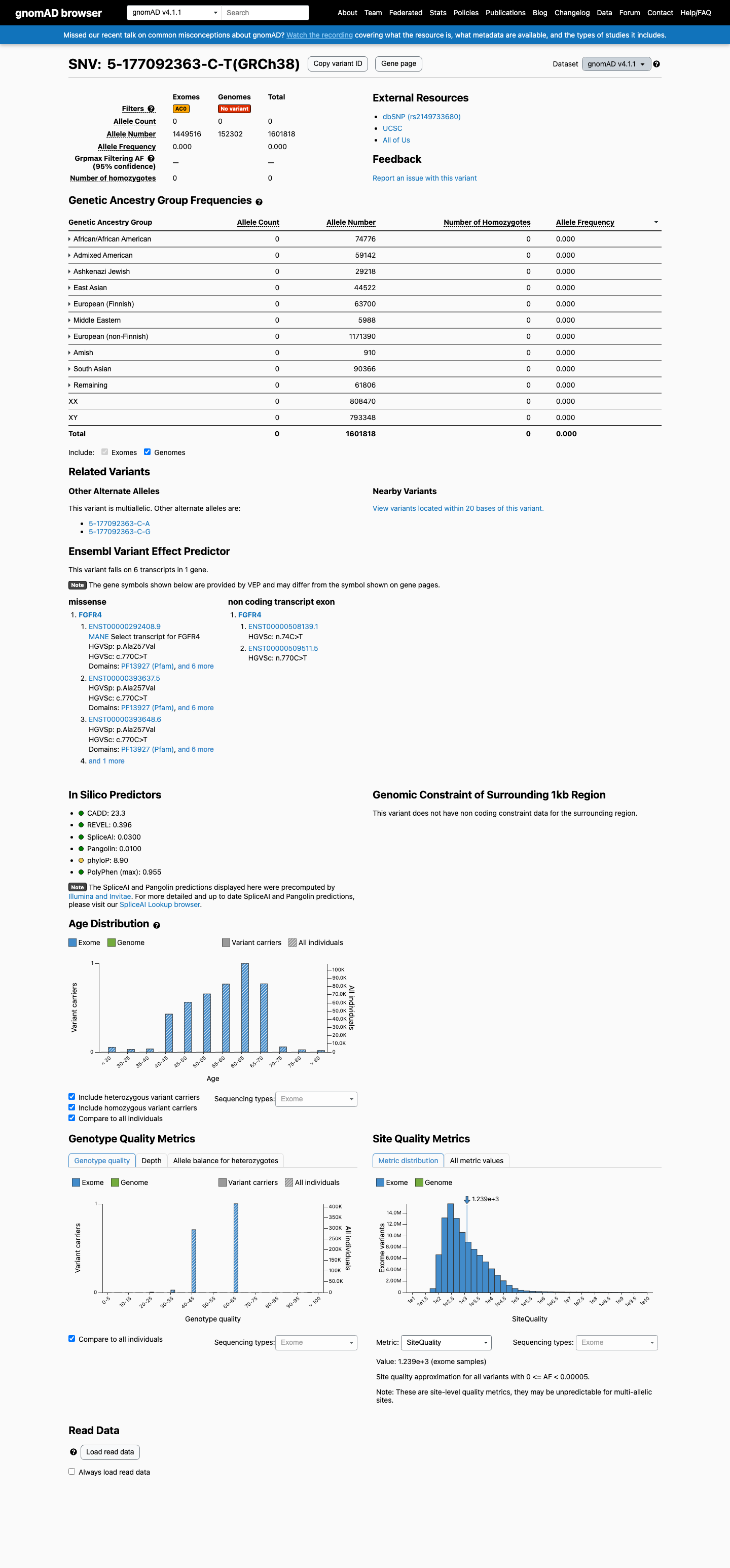
This variant is present in gnomAD v4.1 (AF= 0; MAF= 0.00000%, 0/1601818 alleles, homozygotes = 0) and has highest observed frequency in the African/African American population (AF= 0; MAF= 0.00000%, 0/74776 alleles, homozygotes = 0).
v2.1
Absent from gnomAD v2.1.
🇨🇦 CA
Absent from gnomAD-Canada v1.0.
Allele frequency by ancestry
three datasets · side by side
gnomAD v4.1
Absent · 0 / 1,601,818
0 hom
Not observed in any ancestry group.
+ 10 not observed (Remaining individuals, Admixed American, European (Finnish), Amish, East Asian, Middle Eastern, South Asian, Ashkenazi Jewish, African/African American, European (non-Finnish))
gnomAD v2.1
Absent · 0 / ?
0 hom
Not observed in any ancestry group.
gnomAD Canada 🇨🇦
Absent · 0 / ?
0 hom
Not observed in any ancestry group.
ClinVar screenshot
ClinVar
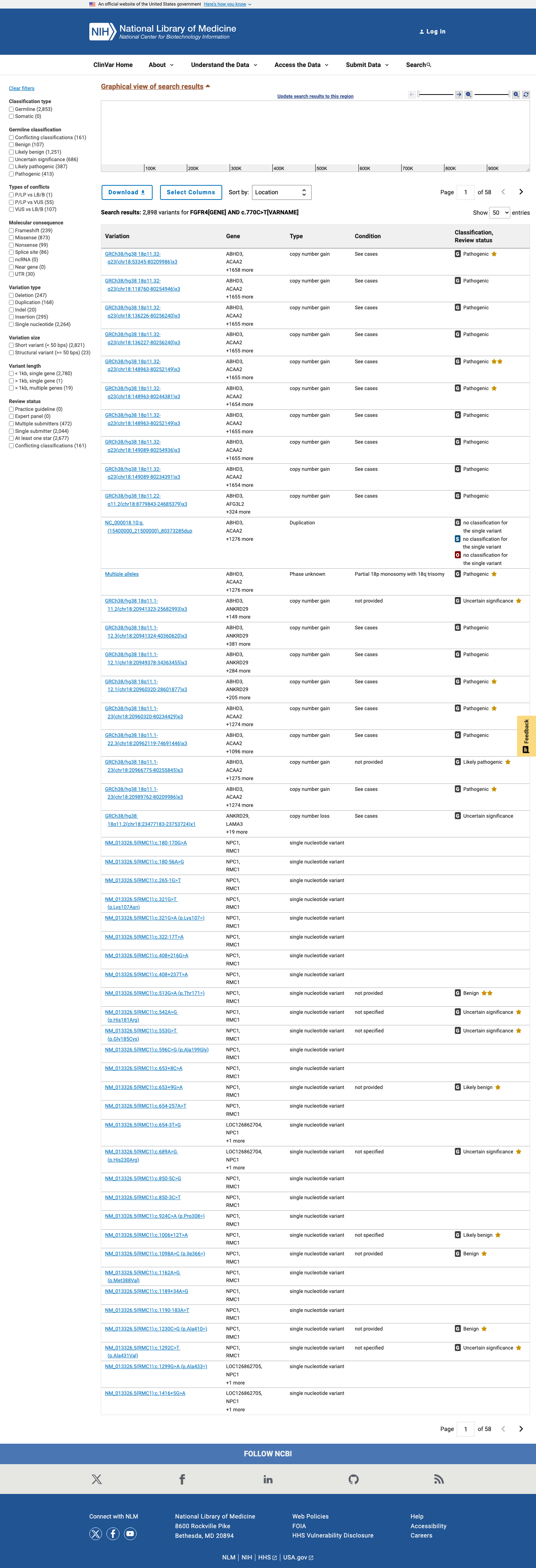
This variant is absent from ClinVar.
SpliceAI screenshot
In silico
SpliceAI predicts no significant splice impact for this variant (max delta score = 0.00). REVEL score = 0.396. BayesDel score = -0.167142.
Functional No data
No calibrated functional assay or RNA evidence was identified for this variant.
OncoKB ↗
COSMIC screenshot
COSMIC
Cancer hotspots screenshot
Cancer hotspots
Somatic evidence Not in COSMIC / hotspots
COSMIC
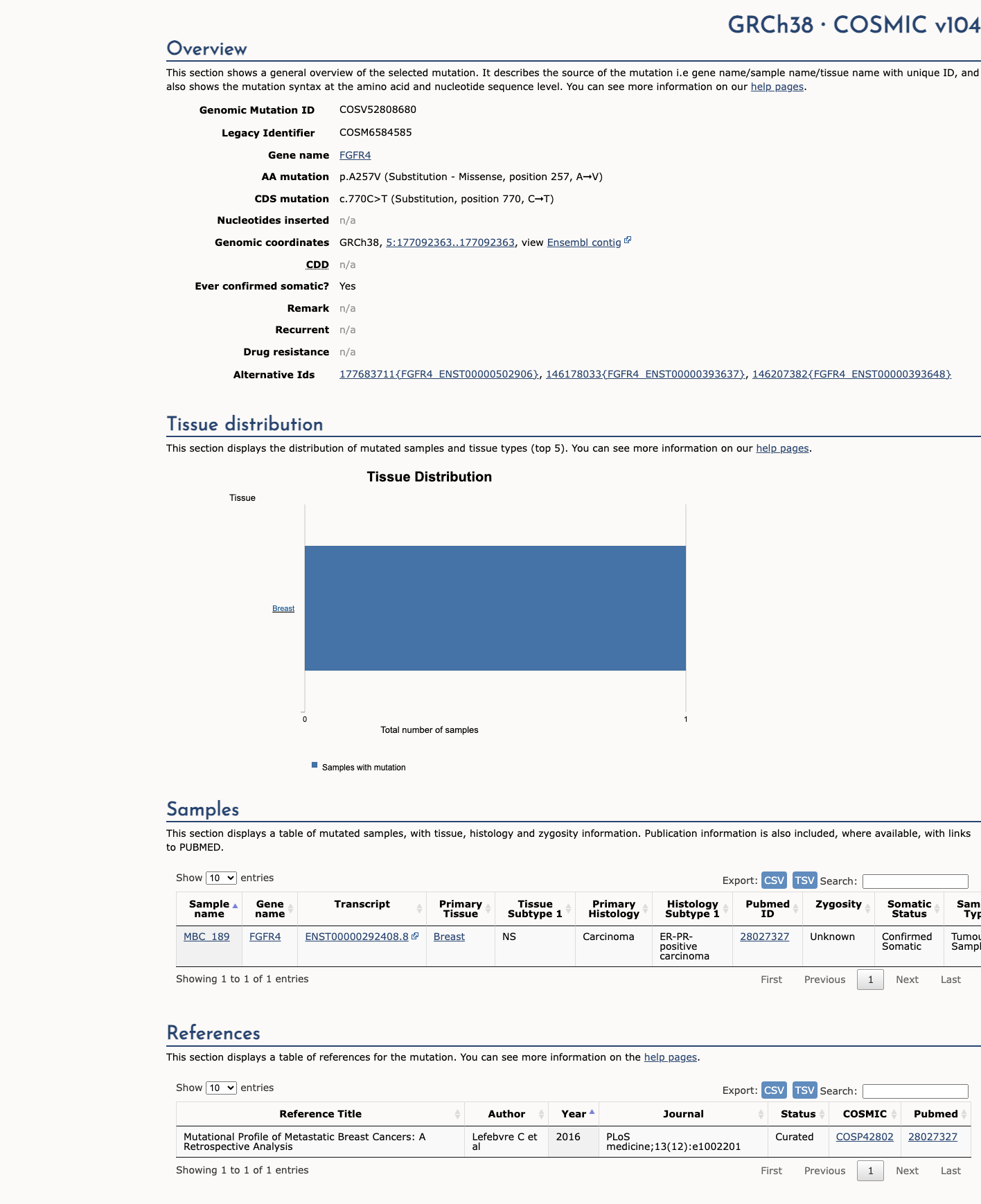
This variant does not lie in a statistically significant hotspot. This variant has previously been reported in somatic cancers (COSMIC; COSV52808680, n = 1 times).
Hotspots
This variant does not lie in a statistically significant hotspot.
Sources & reference links
8Sources
ClinVar
gnomAD v2.1
gnomAD v4.1
gnomAD-Canada
SpliceAI
OncoKB
COSMIC
Cancer hotspots