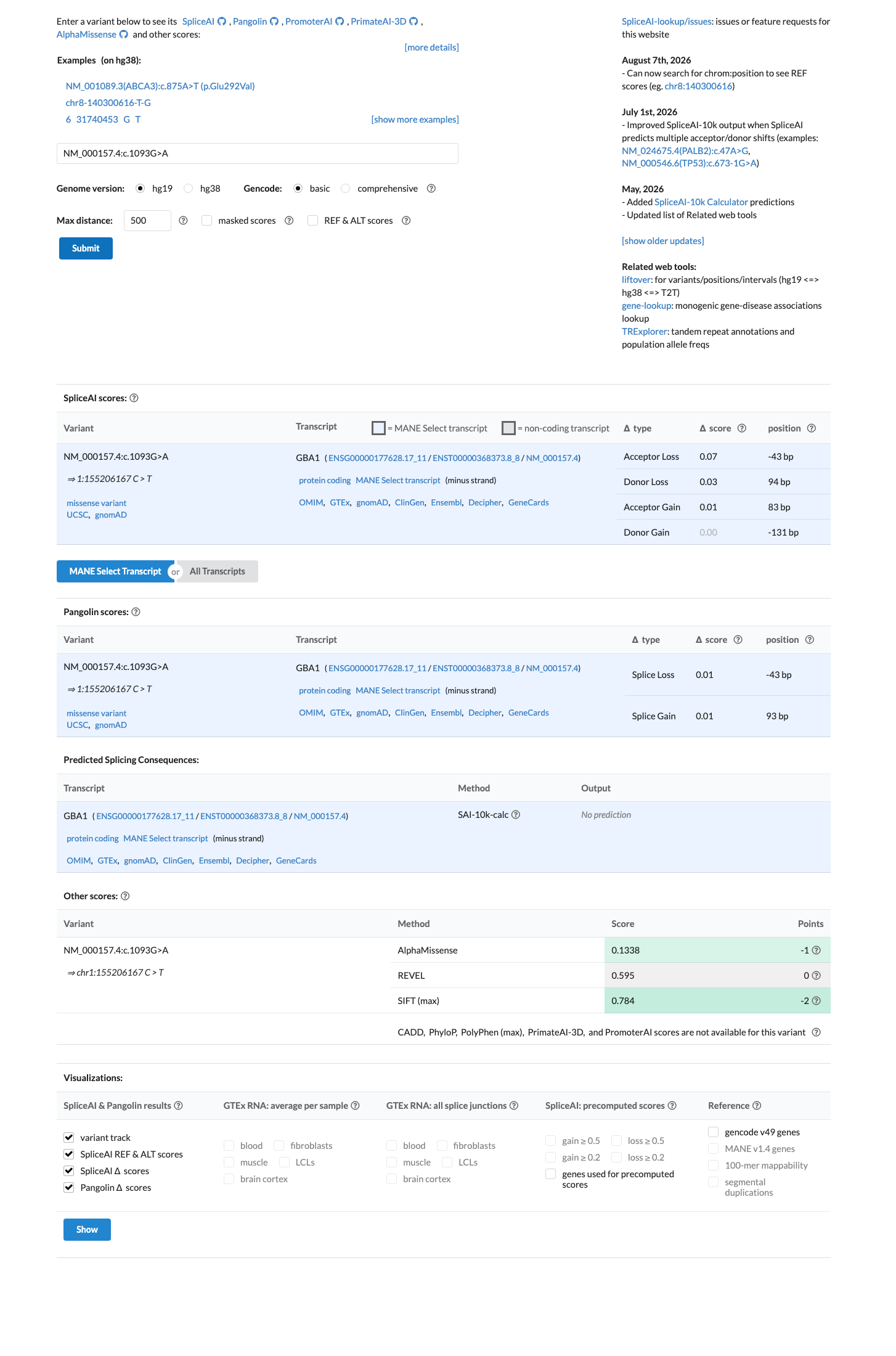
BS2 (Strong): 196 gnomAD v4.1 homozygotes without Gaucher disease show biallelic carriage of this allele is non-pathogenic. BS4 (Strong): in a Gaucher disease family, E326K did not segregate with disease - affected members lack it while unaffected carriers have it. BS1 (Supporting): gnomAD v4.1 allele frequency 1.23% far exceeds the expected frequency for a Gaucher disease allele. BP2 (Supporting): E326K occurs in cis with pathogenic L444P/N188S and is never found alone on a disease-causing allele. BP5 (Supporting): affected family members carrying E326K have a documented alternate molecular basis (trans G202R or L444P). Overall Benign: two strong benign criteria (BS2 + BS4) satisfy the Benign combination rule, with additional supporting BS1, BP2, and BP5.
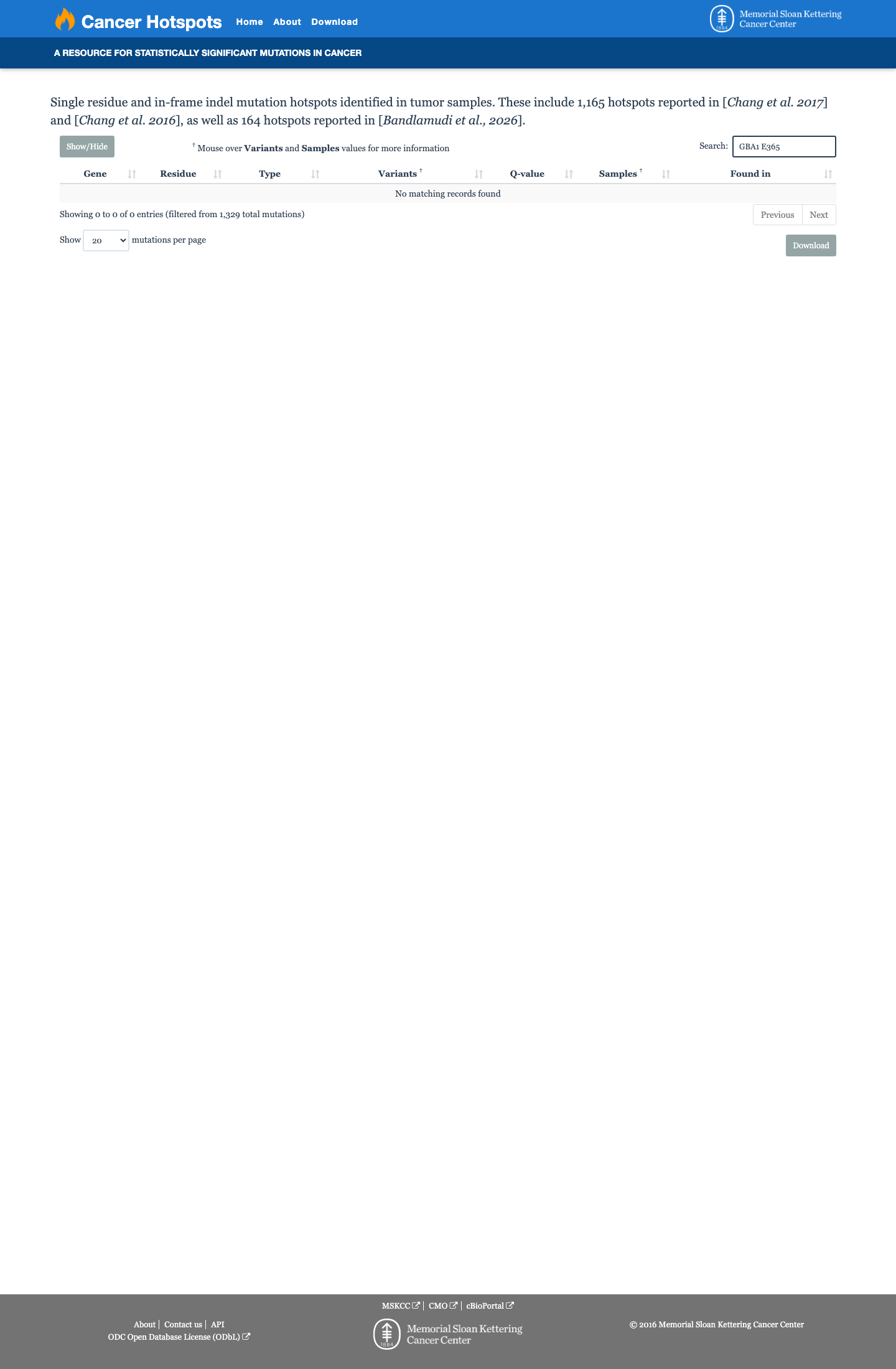
GBA1 encodes glucocerebrosidase, a lysosomal enzyme that breaks down glucosylceramide, an intermediate in glycolipid metabolism. Loss of this enzyme's activity causes Gaucher disease, a lysosomal storage disorder characterized by the accumulation of glucocerebrosides in cells. No direct role in cancer has been established for this gene.
GBA1 encodes glucocerebrosidase, whose deficiency causes Gaucher disease, a lysosomal storage disorder. p.Glu365Lys (E326K) retains roughly half of normal enzyme activity and is far too common to be a Gaucher disease-causing allele, supporting its Benign classification in that context; it is instead a low-penetrance risk factor for Parkinson's disease. The gene has no established role in cancer, so this variant carries no cancer-relevant implication.
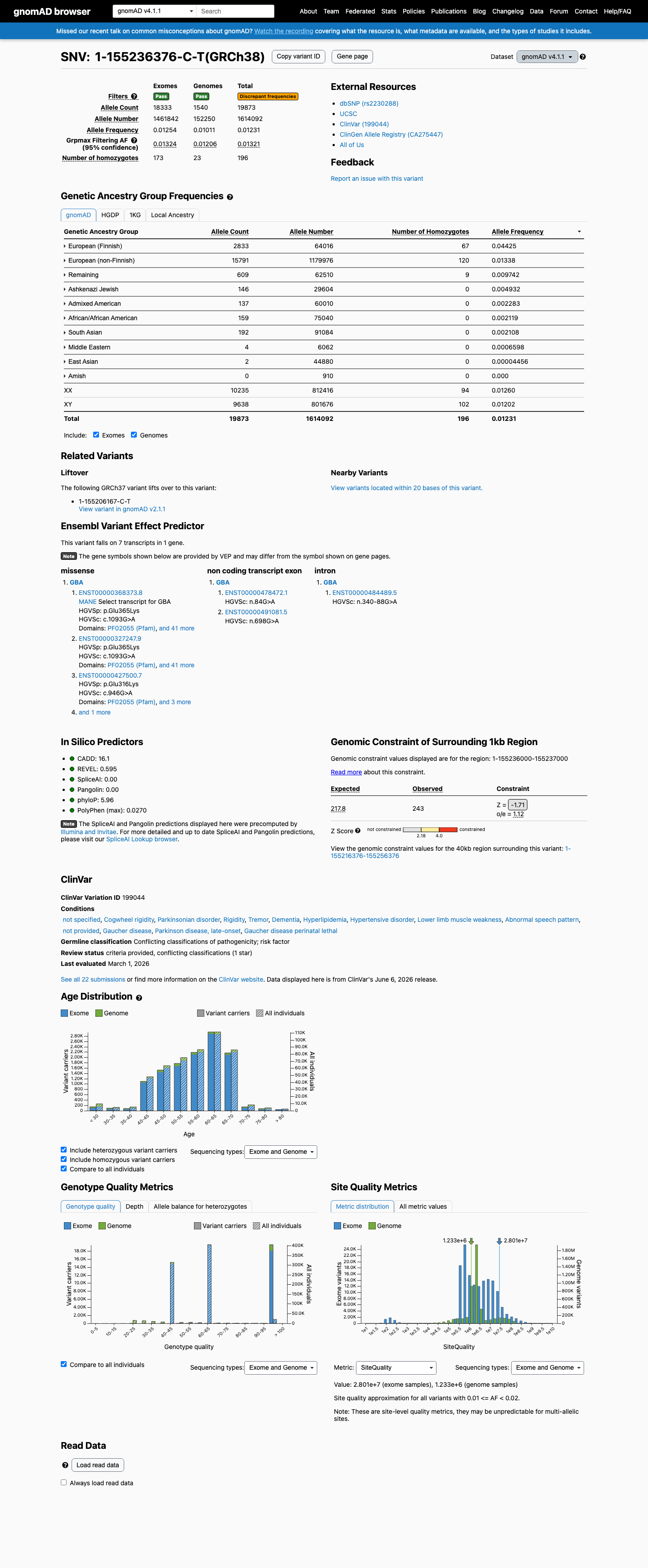
196 hom · FAF 1.3%
European (Finnish) 2833 / 64,016 |
4.4% 67 hom |
European (non-Finnish) 15791 / 1,179,976 |
1.3% 120 hom |
Remaining individuals 609 / 62,510 |
0.97% 9 hom |
Ashkenazi Jewish 146 / 29,604 |
0.49% |
Admixed American 137 / 60,010 |
0.23% |
African/African American 159 / 75,040 |
0.21% |
South Asian 192 / 91,084 |
0.21% |
Middle Eastern 4 / 6,062 |
0.066% |
East Asian 2 / 44,880 |
0.0045% |
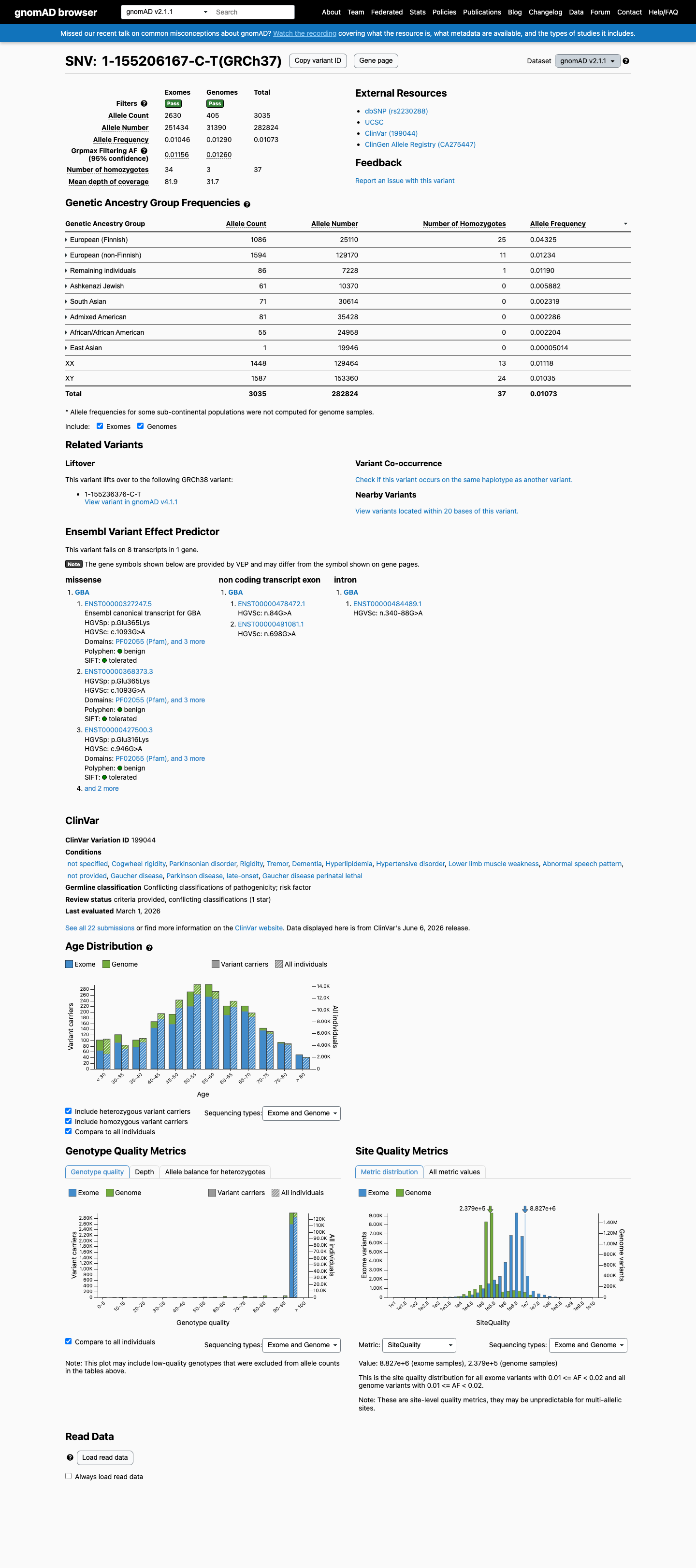
37 hom · FAF 1.3%
European (Finnish) 1086 / 25,110 |
4.3% 25 hom |
European (non-Finnish) 1594 / 129,170 |
1.2% 11 hom |
Remaining individuals 86 / 7,228 |
1.2% 1 hom |
Ashkenazi Jewish 61 / 10,370 |
0.59% |
South Asian 71 / 30,614 |
0.23% |
Admixed American 81 / 35,428 |
0.23% |
African/African American 55 / 24,958 |
0.22% |
East Asian 1 / 19,946 |
0.005% |
1 hom · FAF 0.95%
European (Finnish) 1 / 8 |
12% |
European (non-Finnish) 130 / 11,742 |
1.1% 1 hom |
Remaining individuals 7 / 1,138 |
0.62% |
Latino/Admixed American 3 / 838 |
0.36% |
Ashkenazi Jewish 2 / 832 |
0.24% |
African/African American 2 / 1,020 |
0.2% |
South Asian 2 / 1,362 |
0.15% |