BARD1 encodes a protein that partners with BRCA1 to form a complex essential for repairing damaged DNA, particularly double-stranded breaks, and for maintaining genome stability through cell-cycle checkpoints and chromatin regulation. Germline mutations in BARD1 predispose to breast and ovarian cancer, among other cancers, and the gene is generally regarded as a tumor suppressor, although some evidence suggests it can also promote cancer in certain cellular contexts.
This variant
BARD1 partners with BRCA1 to repair double-stranded DNA breaks, and germline mutations predispose to breast and ovarian cancer. This Likely Pathogenic frameshift removes part of the BRCT domain required for that repair function, so it is expected to impair BARD1's tumor-suppressor activity and confer cancer predisposition.
Transcript
NM_000465.4
HGVS · transcript:coding
NM_000465.4:c.1935_1954dup
GRCh38
chr2:214730457 T>TCATACTTTTCTTCCTGTTCA
GRCh37
chr2:215595181 T>TCATACTTTTCTTCCTGTTCA
BasisWith no BARD1-specific gene framework available, generic ACMG/AMP 2015 rules were used: one strong (PVS1) plus one moderate (PM2) pathogenic criterion yields Likely Pathogenic.▾
With no BARD1-specific gene framework available, generic ACMG/AMP 2015 rules were used: one strong (PVS1) plus one moderate (PM2) pathogenic criterion yields Likely Pathogenic.
Classification rationale
PVS1PM2Likely Pathogenic
BARD1 c.1935_1954dupframeshift · exon 10
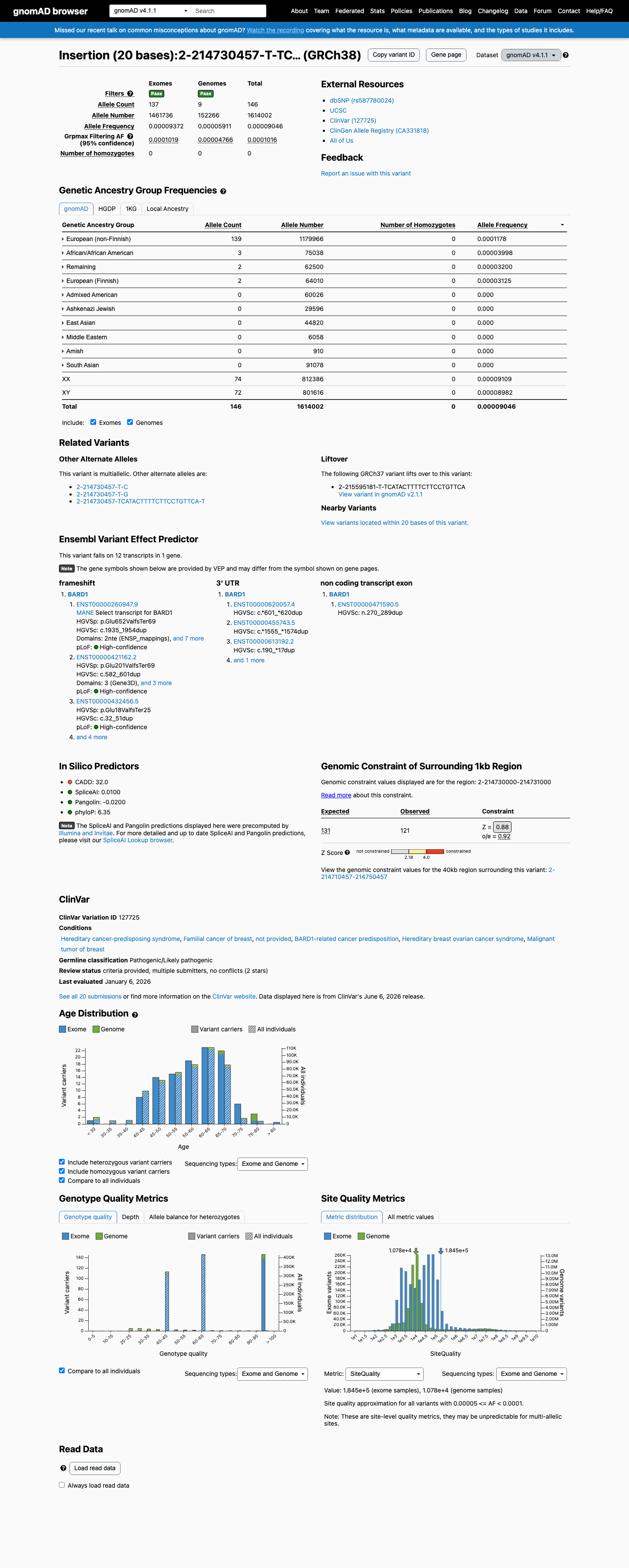
PVS1 (Strong): truncating frameshift p.(Glu652ValfsTer69) escapes NMD but deletes the second BRCT domain, a critical functional region. PM2 (Moderate): rare in gnomAD, with maximum subpopulation allele frequency 0.0001178, no homozygotes, and absence from gnomAD-Canada. Likely Pathogenic: combination of one strong (PVS1) plus one moderate (PM2) pathogenic criterion.
PVS1 + PM2→Likely Pathogenic
Gene diagram
· NM_000465.4 · variants mapped to exon structure
BARD1NM_000465.4
Fetching transcript structure from UCSC…
Exons
—
Transcript span
—
Strand
—
Variants mapped
—
Source
UCSC ncbiRefSeqCurated
All variants in BARD1—click a row to locate it on the plot · use the link column to open its page
Variant ↕
Protein
Location
Classification
Link
Applied criteria · 2 applied · 16 assessed
MetEvidence satisfies this criterion.
Not metEvaluated against available evidence; threshold not reached.
Not assessedApplies in principle, but no evidence was found to evaluate it.
N/ADoesn't apply to this variant type.
Applied · 2
Strength Supporting Moderate Strong Very strong
✓
PVS1strongPathogenic
Met (Strong): truncating frameshift p.(Glu652ValfsTer69) escapes NMD but removes the second BRCT domain, a critical functional region.
No BARD1 CSPEC/VCEP or local explicit PVS1 framework was available; generic ACMG/AMP assessment follows the ClinGen SVI PVS1 recommendations (PMC6185798).VariantValidator normalization identifies NM_000465.4 as MANE Select and RefSeq Select. c.1935_1954dup lies in exon 10; the predicted p.(Glu652ValfsTer69) product ends at residue 720, whereas the reference product extends to residue 778. The terminal coding exon begins at c.2002, placing the predicted premature stop in the terminal exon and supporting NMD escape.The gene-level PVS1 context identifies BARD1 loss of function as an established germline disease mechanism and marks the gene eligible for generic PVS1 assessment.
Met (Moderate): essentially absent from population databases, with maximum subpopulation allele frequency 0.0001178 and no homozygotes.
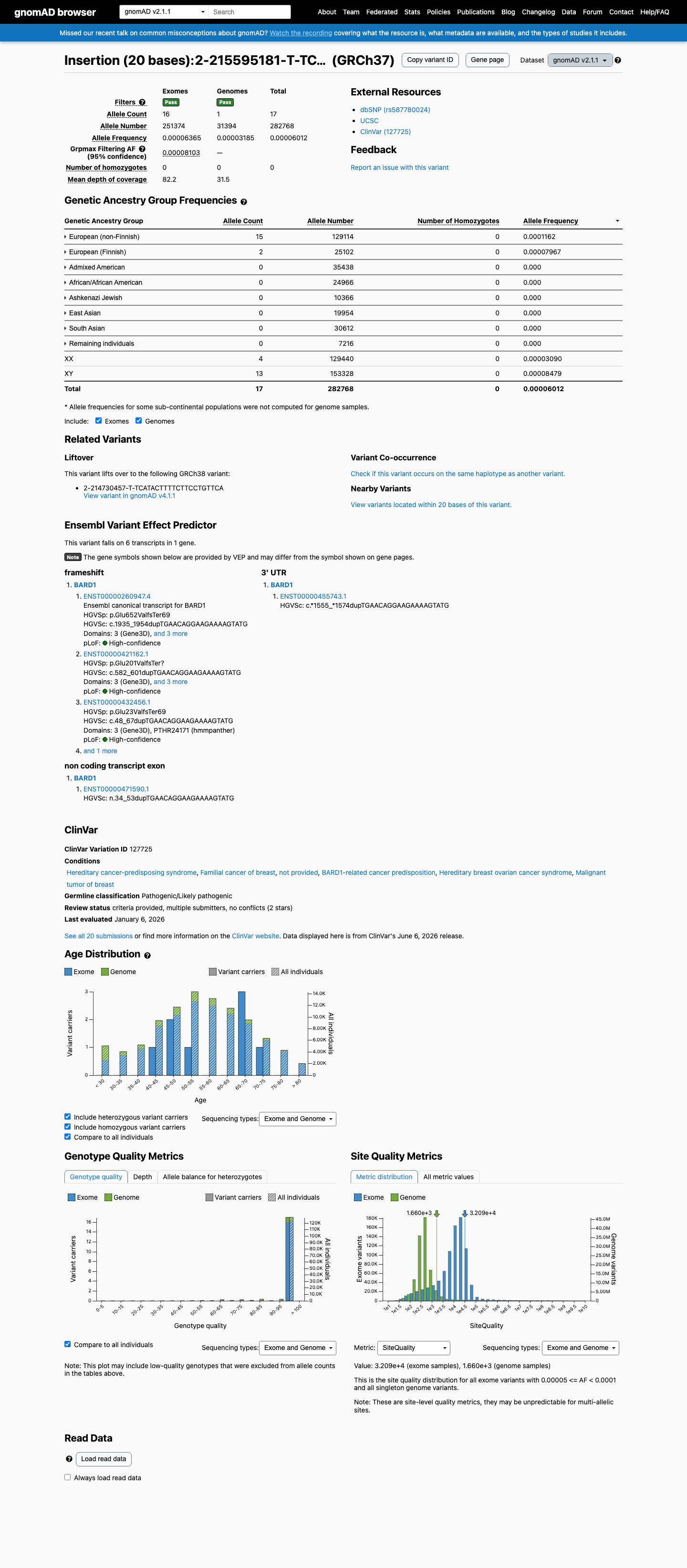
gnomAD v4.1: 146/1,614,002 alleles, AF 9.04584e-05; highest reported subpopulation AF 139/1,179,966 (0.0001178) in European non-Finnish individuals; homozygotes = 0.gnomAD v2.1: 17/282,768 alleles, AF 6.012e-05; highest reported subpopulation AF 15/129,114 (0.000116176) in European non-Finnish individuals; homozygotes = 0.gnomAD-Canada v1.0 reports the variant as absent.
This variant is present in gnomAD v4.1 (AF= 9.04584e-05; MAF= 0.00905%, 146/1614002 alleles, homozygotes = 0) and has highest observed frequency in the European (non-Finnish) population (AF= 0.0001178; MAF= 0.01178%, 139/1179966 alleles, homozygotes = 0); grpmax FAF= 0.0001016.
v2.1
This variant is present in gnomAD v2.1 (AF= 6.012e-05; MAF= 0.00601%, 17/282768 alleles, homozygotes = 0) and has highest observed frequency in the European (non-Finnish) population (AF= 0.000116176; MAF= 0.01162%, 15/129114 alleles, homozygotes = 0); grpmax FAF= 8.103e-05.
🇨🇦 CA
Absent from gnomAD-Canada v1.0.
Allele frequency by ancestry
three datasets · side by side
gnomAD v4.1
0.009%
· 146 / 1,614,002
0 hom · FAF 0.01%
European (non-Finnish)
139 / 1,179,966
0.012%
African/African American
3 / 75,038
0.004%
Remaining individuals
2 / 62,500
0.0032%
European (Finnish)
2 / 64,010
0.0031%
+ 6 not observed (Admixed American, Amish, East Asian, Middle Eastern, South Asian, Ashkenazi Jewish)
gnomAD v2.1
0.006%
· 17 / 282,768
0 hom · FAF 0.0081%
European (non-Finnish)
15 / 129,114
0.012%
European (Finnish)
2 / 25,102
0.008%
+ 6 not observed (African/African American, Admixed American, Ashkenazi Jewish, East Asian, Remaining individuals, South Asian)
This variant has been reported in ClinVar as Pathogenic (13 clinical laboratories) and as Likely pathogenic (4 clinical laboratories). (ClinVarID = 127725)
Each card is an audit: what was searched, what was found, whether it names the variant, which criteria it fed, and why. 6 further PMIDs triaged but not cited — see Sources & references.
New concepts on BARD1: Regulator of BRCA pathways and beyond.
PMID 26738429 ↗· Irminger-Finger I et al.
· 2016 Mar
CLINVAR· splicing rna
In a screening study of 196 non-BRCA1/2 breast or ovarian cancer families, the paper reports the exact BARD1 frameshift duplication c.1935_1954dup, resulting in p.E652Vfs*69. It states that this variant causes a premature stop and loss of BARD1's second BRCT domain.
Variant
✓ Names this variant — characterised directly
Applied to
→PVS1
strong
Directly identifies the queried frameshift as causing premature termination and loss of the second BRCT domain.
The screening of 196 non-BRCA1/2 breast or ovarian cancer families for BARD1 germline mutations identified eleven intron variants and fifteen exon variants, comprising nine missense mutations, four silent mutations, one in-frame deletion and one frame-shift duplication (c.1935_1954dup; p.E652Vfs*69) causing a premature stop and loss of the second BRCT domain of BARD1 (De Brakeleer et al., 2010).
Location Section 7.1.1.1, page 16 · Context Screening of 196 non-BRCA1/2 breast or ovarian cancer families for germline BARD1 mutations; exon and intron variant identification. · full text
Rule & framework references · cited for criterion definitions, not variant evidence
17848578 ↗Structural requirements for the BARD1 tumor suppressor in chromosomal stability and homology-directed DNA repair.
Sources & reference links
8Sources
ClinVar
gnomAD v2.1
gnomAD v4.1
gnomAD-Canada
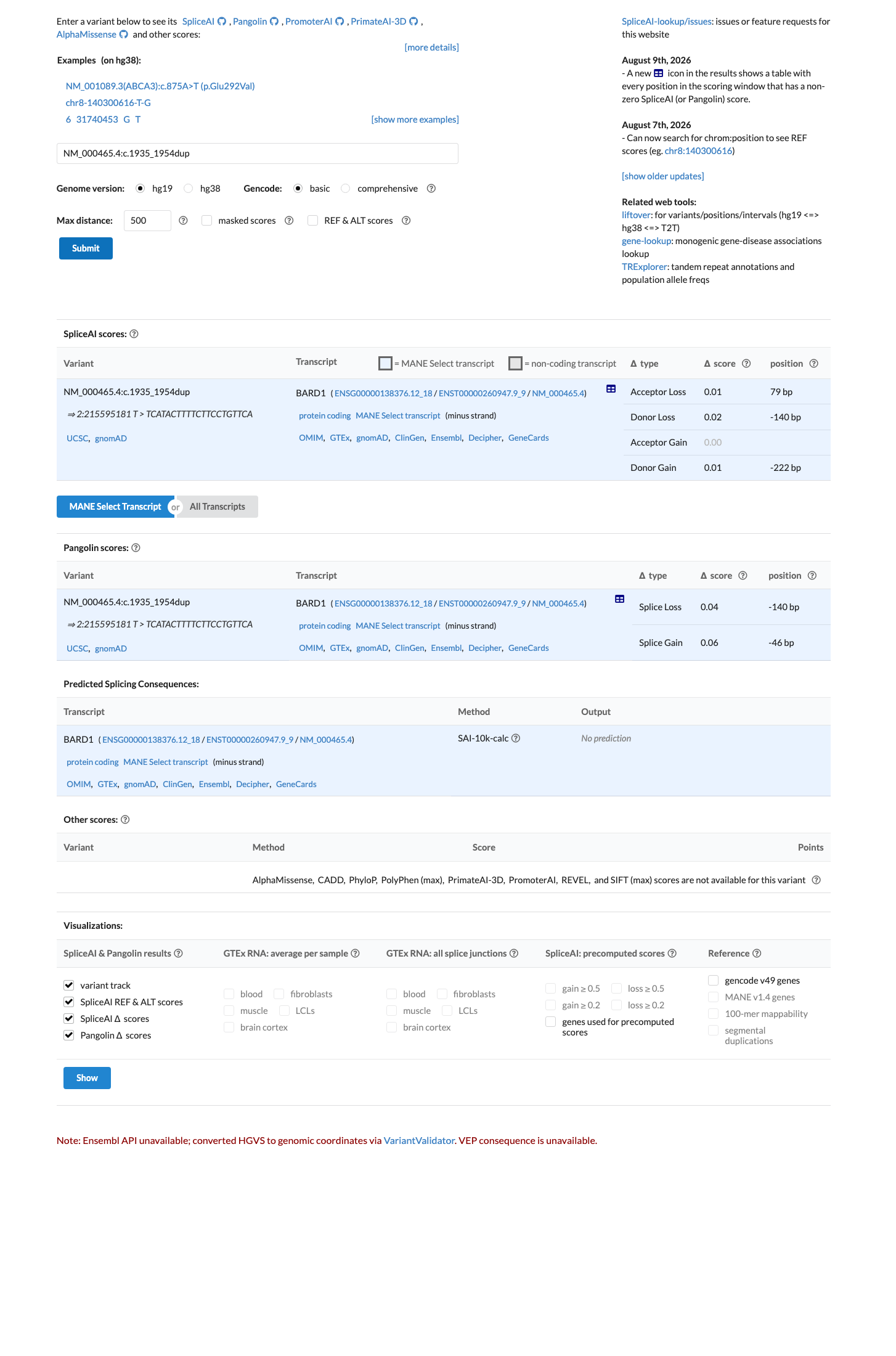
SpliceAI
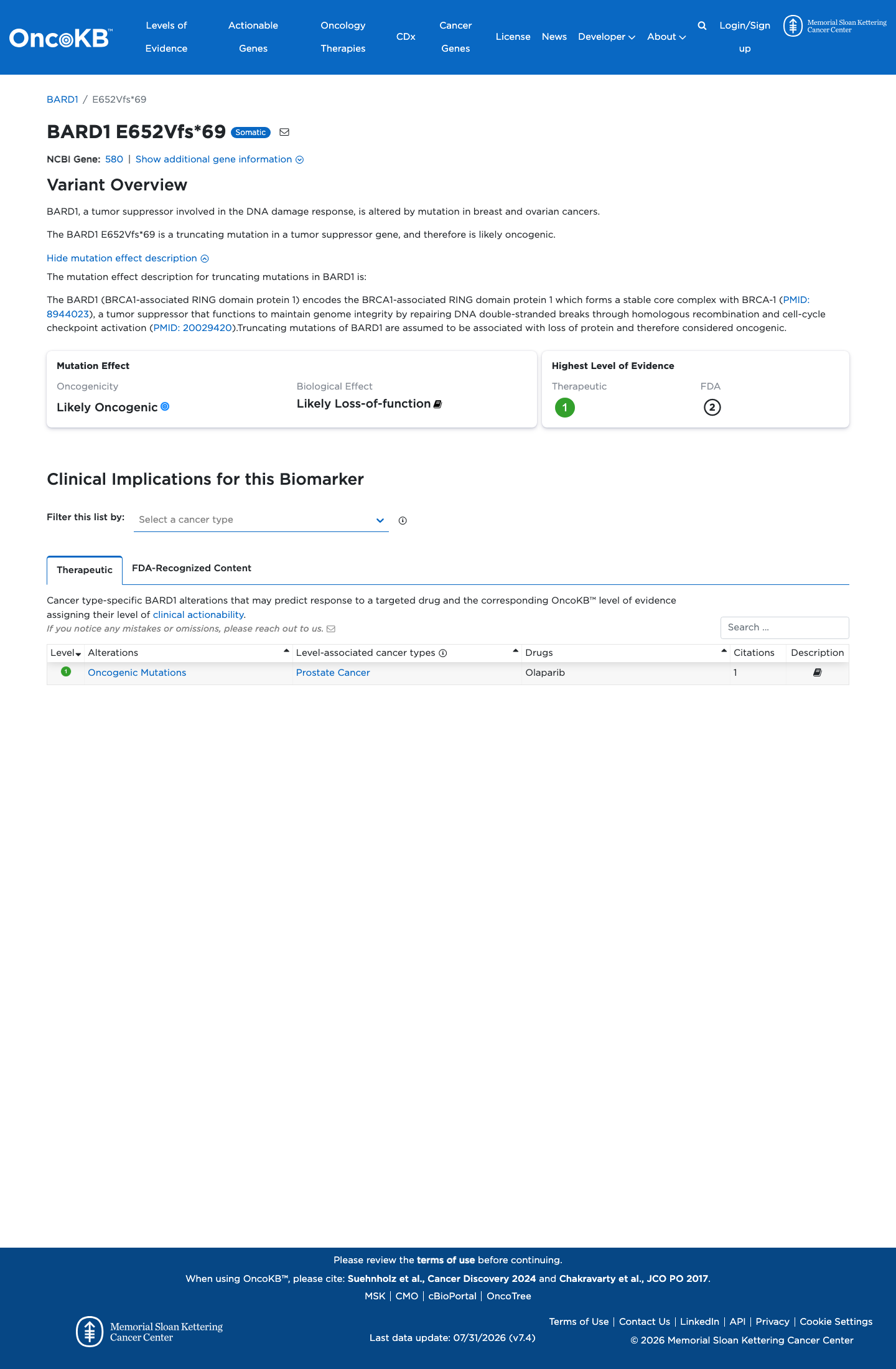
OncoKB
COSMIC
Cancer hotspots
Triaged references · 6 PMIDs not cited in assessment
20029420 ↗BRCA1 and its toolbox for the maintenance of genome integrity.ONCOKB
8944023 ↗Identification of a RING protein that can interact in vivo with the BRCA1 gene product.ONCOKB
17550235 ↗Crystal structure of the BARD1 BRCT domains.CLINVAR
21344236 ↗Cancer predisposing BARD1 mutations in breast-ovarian cancer families.CLINVAR
25741868 ↗Standards and guidelines for the interpretation of sequence variants: a joint consensus recommendation of the American College of Medical Genetics and Genomics and the Association for Molecular Pathology.CLINVAR
26467025 ↗A Standardized DNA Variant Scoring System for Pathogenicity Assessments in Mendelian Disorders.CLINVAR