POLE encodes the catalytic subunit of DNA polymerase epsilon, the enzyme that replicates the leading strand of DNA during cell division and participates in DNA repair. It contains a proofreading domain that corrects replication errors, keeping the accumulation of mutations in check. Germline mutations in POLE cause polyposis and predispose to colorectal cancer, and are also linked to a rare syndrome of facial dysmorphism, immunodeficiency, livedo, and short stature. Somatic mutations, particularly in the proofreading domain, occur in colorectal and endometrial cancers, where they drive an ultra-mutated tumor phenotype and are associated with better responses to immune checkpoint inhibitors.
This variant
Loss of normal POLE function is relevant to germline polyposis and colorectal-cancer predisposition because POLE provides DNA replication proofreading and repair.
Transcript
NM_006231.4
HGVS · transcript:coding
NM_006231.4:c.62+2T>G
GRCh38
chr12:132687252 A>C
GRCh37
chr12:133263838 A>C
Pathogenic: PVS1 (very strong), PP3 (moderate), and PM2 (supporting) satisfy the local POLE framework's PVS1 + moderate + supporting rule.
Classification rationale
PVS1PM2PP3Pathogenic
POLE c.62+2T>Gcanonical_splice · exon 1i
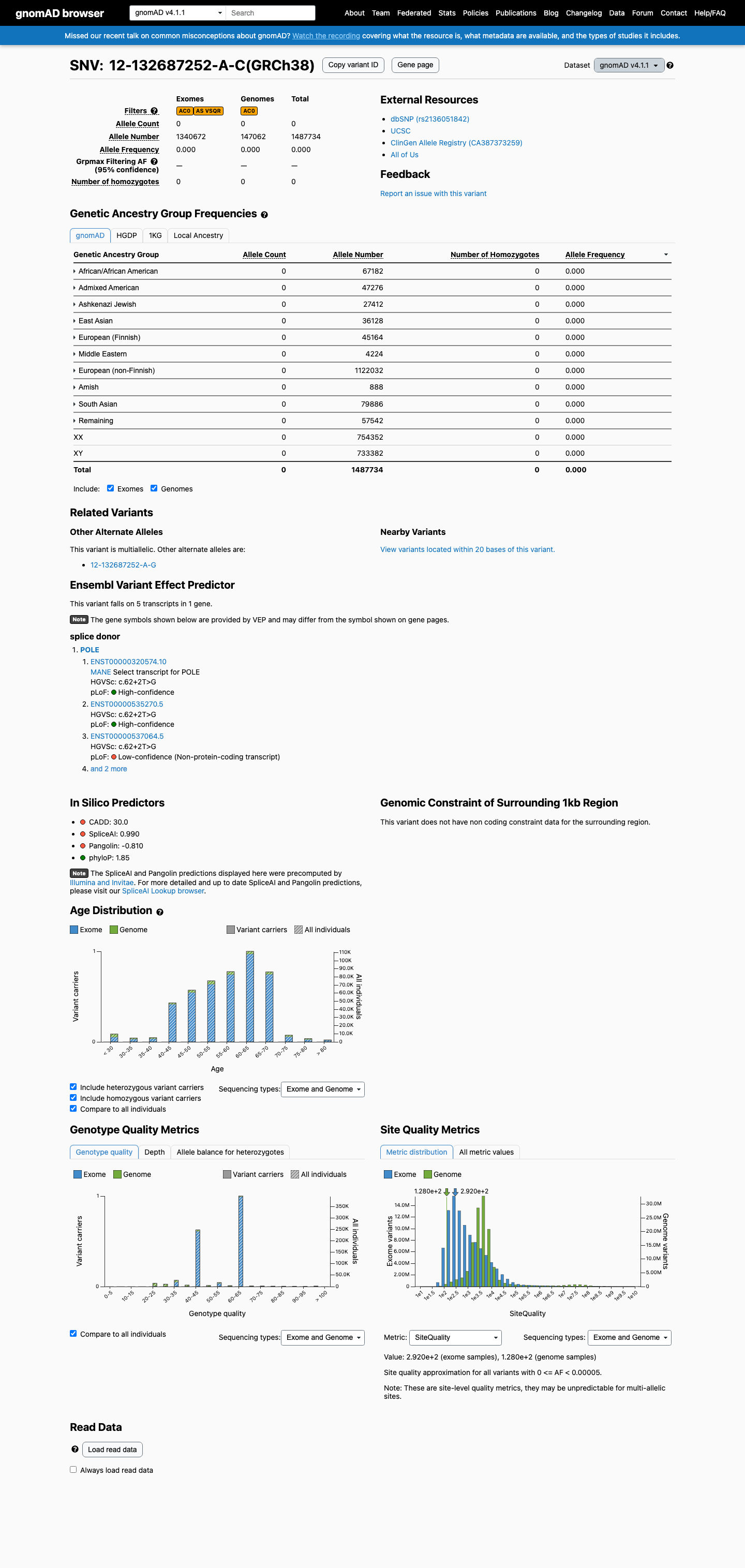
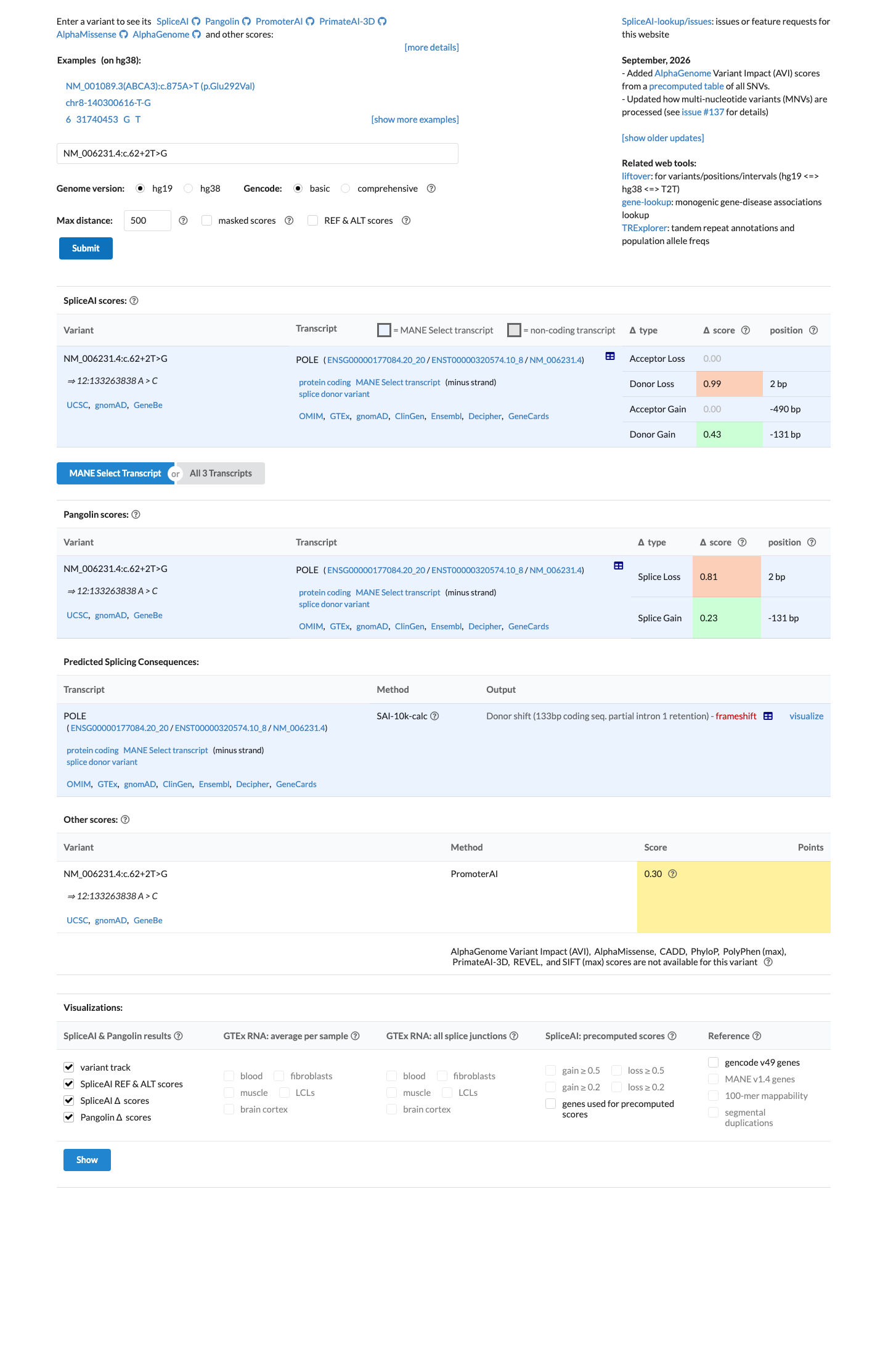
Pathogenic: PVS1 very strong supports loss of normal POLE splicing at the canonical +2 donor site. Pathogenic: PP3 moderate is met by SpliceAI maximum delta 0.989. Pathogenic: PM2 supporting is met because the variant is absent from gnomAD v4.1 (0/1,487,734 alleles).
PVS1 + PM2 + PP3→Pathogenic
LYFE Sciences is an AI system, and it can make mistakes. Criteria
may be applied incorrectly, sources may be misread, and a confident-looking
classification can still be wrong. Double-check every criterion and
its underlying evidence before relying on any call.
Gene diagram
· NM_006231.4 · variants mapped to exon structure
POLENM_006231.4
Fetching transcript structure from UCSC…
Exons
—
Transcript span
—
Strand
—
Variants mapped
—
Source
UCSC ncbiRefSeqCurated
All variants in POLE—click a row to locate it on the plot · use the link column to open its page
Protein
Location
Classification
Link
Applied criteria · 3 applied · 17 assessed
MetEvidence satisfies this criterion.
Not metEvaluated against available evidence; threshold not reached.
Not assessedApplies in principle, but no evidence was found to evaluate it.
N/ADoesn't apply to this variant type.
Applied · 3
Strength Supporting Moderate Strong Very strong
✓
PVS1very strongPathogenic
Met at very strong: canonical splice-donor c.62+2T>G in the relevant POLE transcript has SpliceAI maximum delta 0.989 and no demonstrated NMD-escape downgrade.
The generic ClinGen SVI PVS1 framework (PMC6185798) applies to canonical splice consensus variants and requires consideration of transcript relevance, NMD escape, exon importance, and distal-region exceptions.NM_006231.4 is the MANE Select POLE transcript, and the variant is annotated as a canonical splice variant at c.62+2 with predicted protein consequence p.? and no alternative protein consequence supplied.The gene-level assessment supports POLE loss of function as a germline disease mechanism and marks the generic PVS1 gate eligible.
Met at supporting: AF 0 in gnomAD v4.1 (0/1,487,734 alleles) is below the <=0.0001 PM2 threshold.
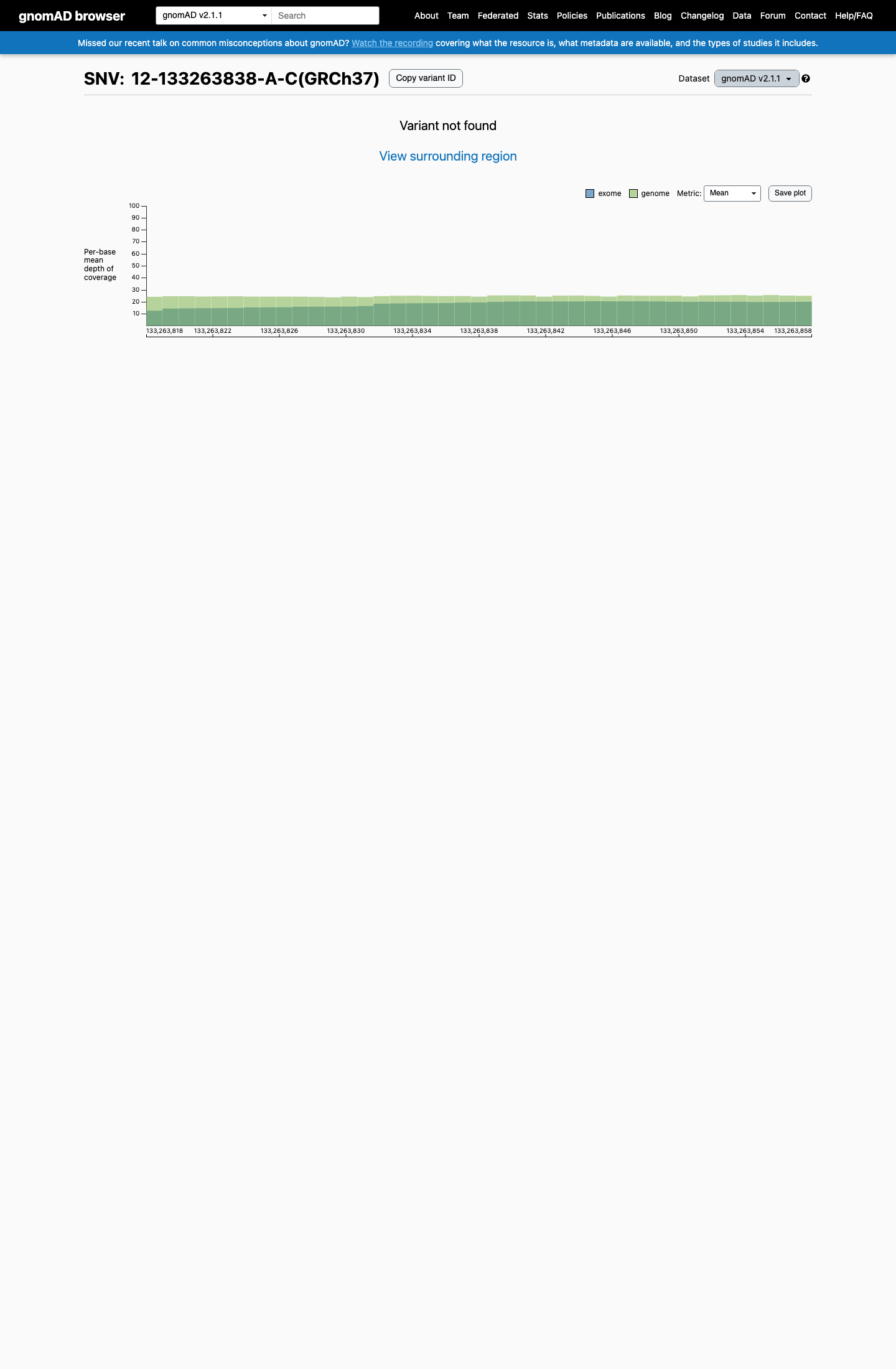
The retrieved POLE-specific framework does not define PM2; generic ACMG/ClinGen-SVI fallback therefore applies.The supplied PM2 Supporting threshold is allele frequency <=0.0001 (ClinGen SVI recommendation, PMID:25741868).gnomAD v2.1 exomes report the variant as absent.
Met at moderate strength: SpliceAI maximum delta 0.989 exceeds the >=0.5 threshold for predicted splice impact.
The case normalization identifies NM_006231.4:c.62+2T>G as a canonical splice variant with predicted protein consequence NP_006222.2:p.?.SpliceAI reports DS_AG 0.0, DS_AL 0.0, DS_DG 0.426, and DS_DL 0.989; the maximum delta is therefore 0.989.The generic SpliceAI moderate PP3 threshold is >=0.5, from Jaganathan et al. 2019, Cell (PMID:30661751); 0.989 meets this threshold.
Assessed · not applied
· 5 not met · 12 not assessed
Pathogenic
PS2Not assessed: no parental genotypes, parentage confirmation, or testing methodology are documented to establish a de novo occurrence.
PS3Not assessed: SpliceAI max delta 0.989 is computational and does not substitute for a validated variant-specific functional assay with appropriate controls.
PS4Not met: the POLE PS4 rule requires an exact recurrent pathogenic missense variant with combined COSMIC/TCGA count >=10, but c.62+2T>G is absent and is splice-region.
PM3Not assessed: no affected-proband observation or phased pathogenic variant in trans is documented for NM_006231.4:c.62+2T>G.
PM6Not assessed: no published or clinical case evidence documents this variant as presumed de novo without parental testing.
PP1Not assessed: no informative meioses or affected and unaffected relatives with genotype-phenotype segregation data are documented.
PP4Not assessed: no patient phenotype or disease-specific clinical presentation is available to evaluate against a PP4 specificity rule.
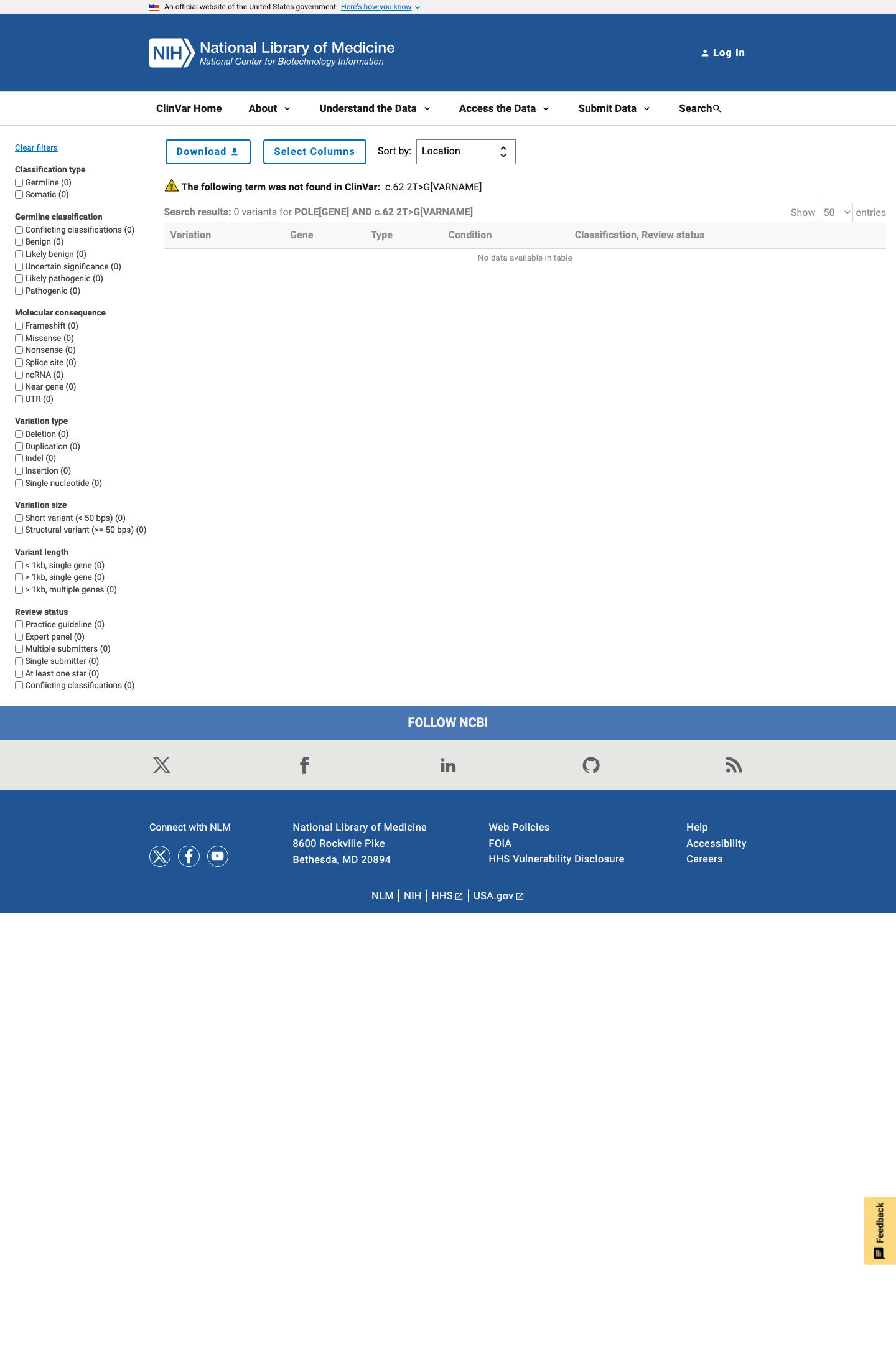
PP5Not assessed: ClinVar has no exact record or expert-panel Pathogenic/Likely pathogenic classification for c.62+2T>G.
Benign
BA1Not met: gnomAD v4.1 total AF 0 (0/1,487,734 alleles), far below the >=0.05 BA1 threshold.
BS1Not met: gnomAD v4.1 total AF 0 (0/1,487,734 alleles), below the >=0.01 BS1 threshold.
BS2Not met: gnomAD v4.1 reports zero homozygotes and zero alleles, providing no healthy-population observation for BS2.
BS3Not assessed: SpliceAI max delta 0.989 predicts splice impact and provides no validated evidence of preserved normal function for BS3.
BS4Not assessed: no unaffected variant carriers or other informative non-segregation observations are documented.
BP2Not assessed: no cis or trans observation with a pathogenic variant is documented for NM_006231.4:c.62+2T>G.
BP4Not met: SpliceAI maximum delta 0.989 exceeds the <=0.1 threshold for BP4 supporting evidence.
BP5Not assessed: no phenotype, alternative molecular diagnosis, or competing cause is available to evaluate BP5.
BP6Not assessed: ClinVar has no exact record or expert-panel Benign/Likely benign classification for c.62+2T>G.
This variant is present in gnomAD v4.1 (AF= 0; MAF= 0.00000%, 0/1487734 alleles, homozygotes = 0) and has highest observed frequency in the African/African American population (AF= 0; MAF= 0.00000%, 0/67182 alleles, homozygotes = 0).
v2.1
Absent from gnomAD v2.1.
🇨🇦 CA
Absent from gnomAD-Canada v1.0.
Allele frequency by ancestry
three datasets · side by side
gnomAD v4.1
Absent
· 0 / 1,487,734
0 hom
Not observed in any ancestry group.
+ 10 not observed (Remaining individuals, Admixed American, European (Finnish), Amish, East Asian, Middle Eastern, South Asian, Ashkenazi Jewish, African/African American, European (non-Finnish))