Analysis in progress
Initialising…
0%
complete
This report is still being assembled — sections appear as each stage finishes. It isn't final yet.
GBA1
Final classification
Benign
GBA1 c.1093G>A · p.Glu365Lys
GBA1

BS2 (Strong): 196 gnomAD v4.1 homozygotes without Gaucher disease show biallelic carriage of this allele is non-pathogenic.

Gene
GBA1
Transcript
NM_000157.4
HGVS · transcript:coding
NM_000157.4:c.1093G>A
Consequence
N/A
GRCh38
chr1:155236376 C>T
GRCh37
chr1:155206167 C>T
Basis Benign: two strong criteria (BS2, 196 homozygotes without disease; BS4, no segregation with disease) satisfy the Benign rule, with supporting BS1, BP2, and BP5 and no conflicting pathogenic evidence. Human review is flagged: this allele is a low-penetrance Parkinson's disease risk factor, so 'Benign' applies to Gaucher disease.
Benign: two strong criteria (BS2, 196 homozygotes without disease; BS4, no segregation with disease) satisfy the Benign rule, with supporting BS1, BP2, and BP5 and no conflicting pathogenic evidence. Human review is flagged: this allele is a low-penetrance Parkinson's disease risk factor, so 'Benign' applies to Gaucher disease.
Classification rationale
BS1BS2BS4BP2BP5 Benign
GBA1 c.1093G>A

BS2 (Strong): 196 gnomAD v4.1 homozygotes without Gaucher disease show biallelic carriage of this allele is non-pathogenic. BS4 (Strong): in a Gaucher disease family, E326K did not segregate with disease - affected members lack it while unaffected carriers have it. BS1 (Supporting): gnomAD v4.1 allele frequency 1.23% far exceeds the expected frequency for a Gaucher disease allele. BP2 (Supporting): E326K occurs in cis with pathogenic L444P/N188S and is never found alone on a disease-causing allele. BP5 (Supporting): affected family members carrying E326K have a documented alternate molecular basis (trans G202R or L444P). Overall Benign: two strong benign criteria (BS2 + BS4) satisfy the Benign combination rule, with additional supporting BS1, BP2, and BP5.

BS1 + BS2 + BS4 + BP2 + BP5 Benign
Gene diagram · NM_000157.4 · variants mapped to exon structure
GBA1 NM_000157.4
Fetching transcript structure from UCSC…
Applied criteria · 5 applied · 18 assessed
Applied · 5
Strength Supporting Moderate Strong Very strong
BS1 supporting review Benign
Met (supporting): gnomAD v4.1 allele frequency 1.23% is 2.5-4x above the >0.3% convention and far exceeds the expected frequency for a Gaucher disease allele.
gnomAD v4.1 overall AF 1.2312% > BS1>0.3% convention; Finnish AF 4.4255%; grpmax FAF 1.3208%gnomAD v2.1 overall AF 1.0731%; gnomAD-Canada AF 0.7980%PMID 12791040: E326K frequency 1.3% in Gaucher disease patients vs 0.9% in normal controls - allele frequency not greater in affected individuals
BS2 strong review Benign
Met (strong): 196 homozygotes in gnomAD v4.1 (and 37 in v2.1) are biallelic without Gaucher disease, indicating this allele does not cause the recessive disorder.
gnomAD v4.1: 196 homozygotes (67 Finnish, 120 NFE) of 19,873 allelesgnomAD v2.1: 37 homozygotes of 3,035 alleles; gnomAD-Canada: 1 homozygotePMID 12791040: E326K non-pathogenic in family segregation (healthy G202R/E326K father age 45; L444P/E326K sister with ~45% GCase activity)
BS4 strong review Benign
Met (strong): in a Gaucher disease family, affected members lack E326K while unaffected relatives carry it (G202R/E326K, L444P/E326K), demonstrating lack of segregation with disease.
PMID:12791040: 'The E326K mutation was not present in [II-4] or [I-2], but was present in [I-1] and [II-5]. This indicates that the bearing of the mutations encoding E326K, G202R or L444P segregate independently.' (Fig. 1 legend); 'The presence of G202R and the absence of E326K in case 4 (II-4) and II-3, and the L444P/E326K genotype in II-5, confirm the trans orientation of these two alleles in I-1.' and 'This supports E326K as a polymorphic allele that, at least in this family, is non-pathogenic.' (Discussion); abstract: 'isolated E326K is non-pathogenic in this family.'ClinVar LabCorp SCV000697574 (Likely benign) assertion signal: 'this variant did not co-segregate with disease in at-least one family with a clinical diagnosis of gaucher's disease'.
BP2 supporting Benign
Met (supporting): E326K is observed in cis with pathogenic L444P or N188S on complex Gaucher alleles, and never alone on a disease-causing allele.
PMID:15146461: E326K observed in cis with pathogenic L444P and N188S on complex alleles [c.1448T>C; c.1093G>A] ([p.L444P; p.E326K]) and [c.680A>G; c.1093G>A] ([p.N188S; p.E326K]) found in Gaucher disease patients; E326K 'never found alone in a Gaucher disease-causing allele'.PMID:12791040: E326K in trans with pathogenic G202R and L444P in phenotypically normal carriers of a type 3 Gaucher family (healthy father and sister), directly consulted for BP2 and consistent with a non-pathogenic role.
BP5 supporting Benign
Met (supporting): affected family members carry E326K alongside a documented alternate molecular basis - pathogenic G202R or L444P in trans.
PMID:12791040 (Zhao et al., Hum Mutat 2003): Gaucher disease family - E326K in trans with G202R and L444P; affected members' disease attributable to the alternate GBA allele; isolated E326K non-pathogenic; 'similar frequencies of this mutation in Gaucher's disease patients (1.3%) and normal controls (0.9%)'
Assessed · not applied
Pathogenic
PS1 Not met: p.Glu365Lys (E326K) is documented as a non-pathogenic polymorphic allele, so no established-pathogenic same-amino-acid comparator exists.
PS2 Not met: no de novo occurrence is documented; gnomAD v4.1 shows a 1.23% allele frequency with 196 homozygotes, and family data show paternal inheritance.
PS3 Not met: functional studies show 43-55% residual glucocerebrosidase activity, far above the near-complete loss (<15%) seen in pathogenic GBA1 alleles.
PS4 Not met: E326K showed no significant case-control enrichment (13/517 cases vs 3/252 controls, P=0.289).
PM1 Not met: Glu365 is a surface residue outside the active site, and the site carries abundant benign variation (gnomAD v4.1 AF 1.23%), failing the 'without benign variation' condition.
PM2 Not met: gnomAD v4.1 allele frequency 1.23% is orders of magnitude above the <0.1% extremely-low-frequency threshold.
PM3 Not met: carriers with this allele in trans with pathogenic G202R or L444P are phenotypically normal, refuting a recessive pathogenic role.
PM5 Not met: no different missense change at residue Glu365 has been established as pathogenic; the only characterized change there, p.Glu365Lys, is a common polymorphism.
PM6 Not met: no assumed de novo occurrence is documented, and a 1.23%-frequency polymorphism with 196 homozygotes is implausible as a de novo event.
PP1 Not met: segregation data affirmatively contradict co-segregation - the affected proband lacks E326K while unaffected relatives carry it.
PP2 Not met: GBA1 has a high rate of benign missense variation - p.Glu365Lys itself is a 1.23%-frequency polymorphism (196 gnomAD v4.1 homozygotes).
PP3 Not met: SpliceAI max delta 0.00 predicts no splice impact, and REVEL 0.595 falls below the 0.773 supporting threshold, so no calibrated computational support exists.
PP4 Not met: the phenotype is not highly specific to a single genetic etiology - this allele is a low-penetrance Parkinson's risk factor, not a Gaucher disease-causing variant.
PP5 Not met: ClinVar record VCV000199044 has zero expert-panel submissions, and only laboratory assertions exist, which cannot trigger PP5.
Benign
BA1 Not met: gnomAD v4.1 allele frequency 1.23% is below the >5% stand-alone benign threshold, and the allele is a documented low-penetrance Parkinson's risk factor.
BS3 Not met: the ~40-55% residual enzyme activity is a partial functional deficit, so the studies do not establish that E326K has no damaging effect.
BP4 Not met: only one calibrated computational line exists (SpliceAI max delta 0.00); REVEL 0.595 is uninformative and in silico predictions disagree, failing the multiple-lines requirement.
BP6 Not met: no ClinVar expert-panel benign classification exists for VCV000199044; only single-submitter laboratory assertions are present.
N/A · 5 PVS1 · PM4 · BP1 · BP3 · BP7
Research & evidence
Population frequency · supports benign
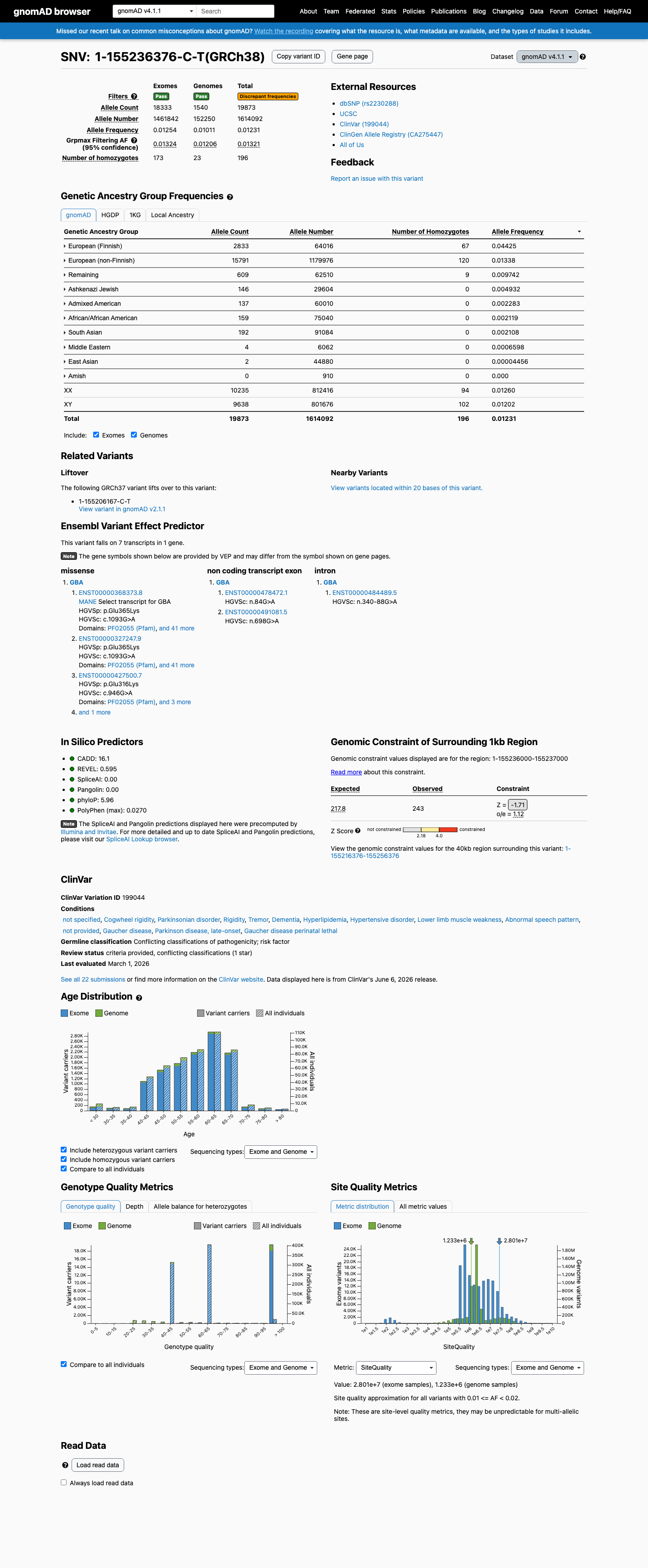
gnomAD v4.1 screenshot
gnomAD v4.1
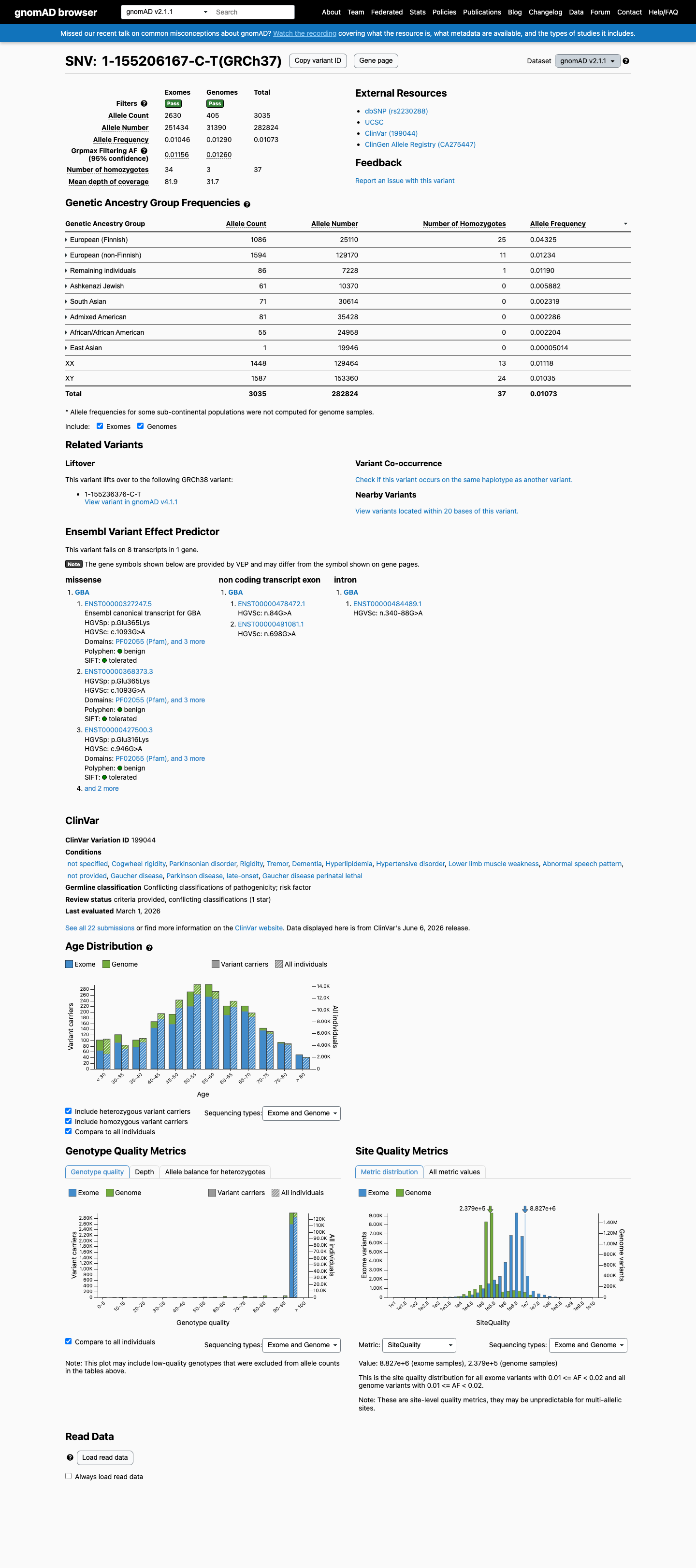
gnomAD v2.1 screenshot
gnomAD v2.1
v4.1
This variant is present in gnomAD v4.1 (AF= 0.0123122; MAF= 1.23122%, 19873/1614092 alleles, homozygotes = 196) and has highest observed frequency in the European (Finnish) population (AF= 0.0442546; MAF= 4.42546%, 2833/64016 alleles, homozygotes = 67); grpmax FAF= 0.0132075.
v2.1
This variant is present in gnomAD v2.1 (AF= 0.0107311; MAF= 1.07311%, 3035/282824 alleles, homozygotes = 37) and has highest observed frequency in the European (Finnish) population (AF= 0.0432497; MAF= 4.32497%, 1086/25110 alleles, homozygotes = 25); grpmax FAF= 0.0125998.
🇨🇦 CA
This variant is present in gnomAD-Canada v1.0 (AF= 0.0079795896211052, 147/18422 alleles, homozygotes = 1).
Allele frequency by ancestry
three datasets · side by side
gnomAD v4.1
1.2% · 19873 / 1,614,092
196 hom · FAF 1.3%
European (Finnish)
2833 / 64,016
4.4%
67 hom
European (non-Finnish)
15791 / 1,179,976
1.3%
120 hom
Remaining individuals
609 / 62,510
0.97%
9 hom
Ashkenazi Jewish
146 / 29,604
0.49%
Admixed American
137 / 60,010
0.23%
African/African American
159 / 75,040
0.21%
South Asian
192 / 91,084
0.21%
Middle Eastern
4 / 6,062
0.066%
East Asian
2 / 44,880
0.0045%
+ 1 not observed (Amish)
gnomAD v2.1
1.1% · 3035 / 282,824
37 hom · FAF 1.3%
European (Finnish)
1086 / 25,110
4.3%
25 hom
European (non-Finnish)
1594 / 129,170
1.2%
11 hom
Remaining individuals
86 / 7,228
1.2%
1 hom
Ashkenazi Jewish
61 / 10,370
0.59%
South Asian
71 / 30,614
0.23%
Admixed American
81 / 35,428
0.23%
African/African American
55 / 24,958
0.22%
East Asian
1 / 19,946
0.005%
gnomAD Canada 🇨🇦
0.8% · 147 / 18,422
1 hom · FAF 0.95%
European (Finnish)
1 / 8
12%
European (non-Finnish)
130 / 11,742
1.1%
1 hom
Remaining individuals
7 / 1,138
0.62%
Latino/Admixed American
3 / 838
0.36%
Ashkenazi Jewish
2 / 832
0.24%
African/African American
2 / 1,020
0.2%
South Asian
2 / 1,362
0.15%
+ 2 not observed (East Asian, Middle Eastern)
ClinVar screenshot
ClinVar
This variant has been reported in ClinVar as Benign (8 clinical laboratories) and as Likely benign (5 clinical laboratories) and as risk factor (4 clinical laboratories) and as Uncertain significance (2 clinical laboratories) and as Likely pathogenic (1 clinical laboratory). (ClinVarID = 199044)
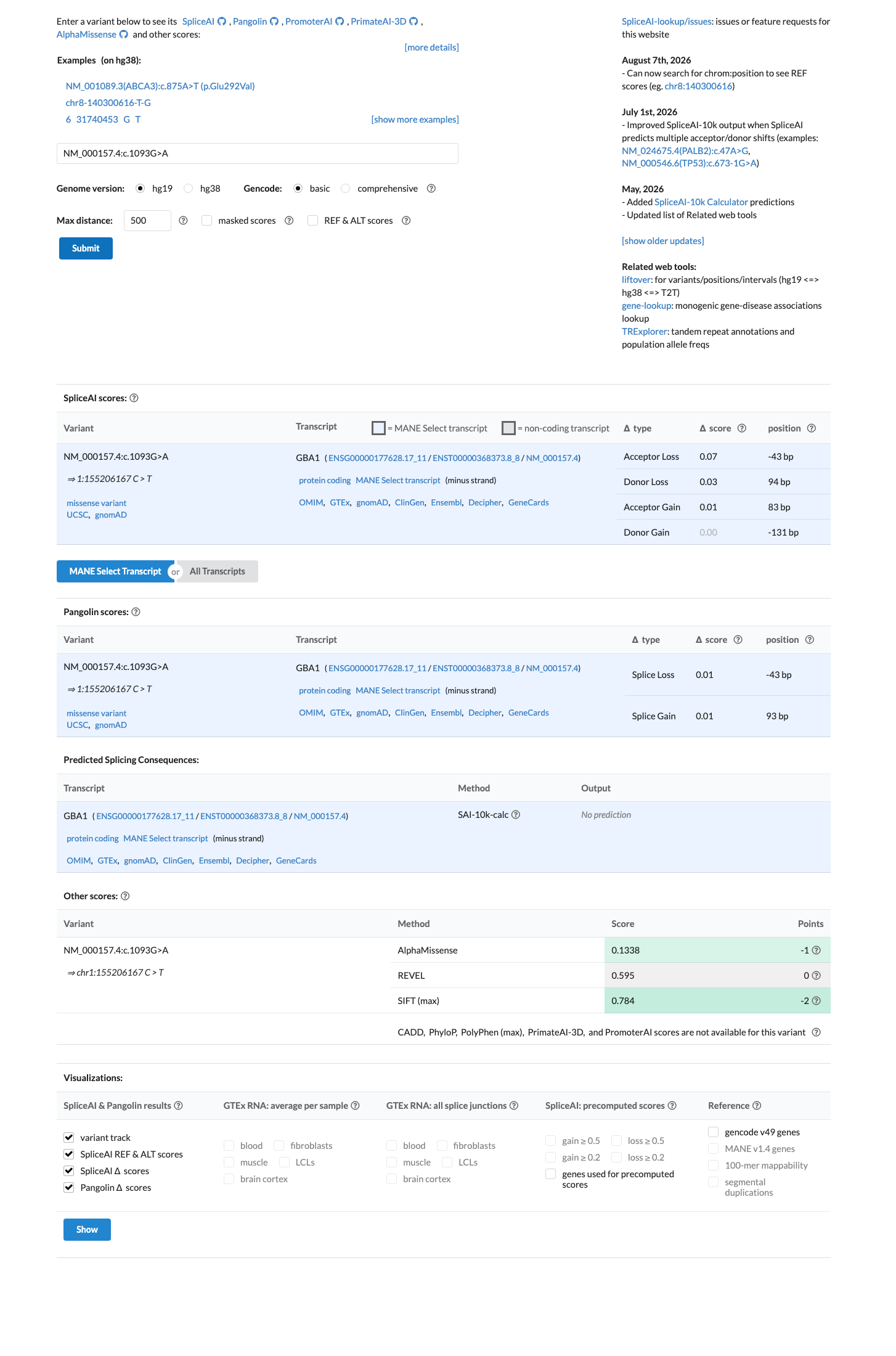
SpliceAI screenshot
In silico
SpliceAI predicts no significant splice impact for this variant (max delta score = 0.00). REVEL score = 0.595. BayesDel score = -0.0147355.
Functional No data
No calibrated functional assay or RNA evidence was identified for this variant.
OncoKB ↗
COSMIC screenshot
COSMIC
Cancer hotspots screenshot
Cancer hotspots
Somatic evidence Not in COSMIC / hotspots
COSMIC
This variant does not lie in a statistically significant hotspot. This variant has not previously been reported in somatic cancers (COSMIC).
Hotspots
This variant does not lie in a statistically significant hotspot.
Literature · how each cited paper was used
5papers cited
Each card is an audit: what was searched, what was found, whether it names the variant, which criteria it fed, and why. 5 further PMIDs triaged but not cited — see Sources & References.
Gaucher's disease: identification of novel mutant alleles and genotype-phenotype relationships.
Searched
c.1093G>Ap.Glu365LysE326KGlu365
Found
Full GBA gene sequencing (long-range PCR) in Gaucher disease patients and families. In a type 3 Gaucher family, the E326K allele (c.1093G>A) segregates in trans with the disease alleles G202R and L444P, and isolated E326K is non-pathogenic in this family. The paper provides in vivo evidence that the recurrent E326K change is not a pathogenic mutation, notes its similar allele frequency in Gaucher patients (1.3%) versus normal controls (0.9%), and concludes E326K is a polymorphic allele that can act as a modifier when in cis with other disease-causing mutations.
Variant
✓ Names this variant — characterised directly
Applied to
BS1 supporting
E326K frequency not increased in Gaucher disease patients (1.3%) vs controls (0.9%) - population frequency consistent with benignity for GD
BS2 strong
Healthy adults carrying E326K (homozygous-state-adjacent compound genotypes G202R/E326K, L444P/E326K) without Gaucher disease support BS2 in the AR context
BS4 strong
Affected proband (II-4) lacks the E326K allele while unaffected relatives (I-1, II-5) carry it; classic lack of segregation in affected members of a family.
BP2 supporting
Directly consulted for BP2: in-trans observation of E326K with pathogenic variants in unaffected carriers supports a non-pathogenic role, though Gaucher disease is recessive so the dominant-disorder clause of BP2 is not strictly satisfied.
BP5 supporting
E326K found in Gaucher disease cases whose molecular basis is the alternate GBA allele (G202R, L444P) in trans; isolated E326K non-pathogenic - variant found in cases with an alternate molecular basis
Family studies indicated that E326K is in trans to G202R and L444P, and that isolated E326K is non-pathogenic in this family. ... The similar frequencies of this mutation in Gaucher's disease patients (1.3%) and normal controls (0.9%) support this contention. ... This supports E326K as a polymorphic allele that, at least in this family, is non-pathogenic.
Location Abstract; Results/Discussion - E326K segregation in family of case 1 and allele-frequency comparison (lines 923-938 of extracted text); Table 5 GCase activity.  ·  Context Gaucher disease cohort: complete GBA sequencing by long-range PCR; family segregation analysis (case 1, type 3 Gaucher family); comparison of E326K allele frequencies between Gaucher patients and normal controls.  ·  full text
Functional analysis of 13 GBA mutant alleles identified in Gaucher disease patients: Pathogenic changes and "modifier" polymorphisms.
Searched
c.1093G>Ap.Glu365LysE326KGlu365
Found
Functional expression of 13 GBA mutant alleles identified in Spanish Gaucher disease patients using a baculovirus/Sf9 system. The single c.1093G>A (p.E326K) allele yields 42.7% residual enzyme activity - among the highest of the tested alleles - and was never found alone in a Gaucher disease-causing allele. When combined in cis with N188S or L444P, E326K further decreases activity relative to the other mutation alone. The authors conclude c.1093G>A (p.E326K) should be considered a 'modifier variant' rather than a neutral polymorphism, while confirming it is not disease-causing on its own.
Variant
✓ Names this variant — characterised directly
Applied to
BS1 supporting
BS2 strong
E326K never found alone on a GD-causing allele supports non-pathogenicity in the homozygous/AR Gaucher disease context
BP2 supporting
E326K observed in cis with pathogenic L444P and N188S on complex alleles [L444P;E326K] and [N188S;E326K] found in Gaucher patients, satisfying the BP2 cis clause in any inheritance pattern.
Expression studies revealed that the c.1093G>A (p.E326K) change, which was never found alone in a Gaucher disease-causing allele, when found in a double mutant such as [c.680A>G; c.1093G>A] ([p.N188S; p.E326K]) and [c.1448T>C; c.1093G>A] ([p.L444P; p.E326K]), decreases activity compared to the activity found for the other mutation alone. These results suggest that c.1093G>A (p.E326K) should be considered a 'modifier variant' rather than a neutral polymorphism, as previously considered.
Location Abstract; Results - residual activity values of single vs double mutants (lines 480-503 of extracted text); Figure 2 activity bar chart.  ·  Context Baculovirus/Sf9 expression of 13 GBA mutant alleles from Gaucher disease patients; measurement of residual acid beta-glucosidase activity relative to wild type; single- vs double-mutant comparisons (N188S;E326K and L444P;E326K).  ·  full text
Analyses of variant acid beta-glucosidases: effects of Gaucher disease mutations.
Searched
c.1093G>Ap.Glu365LysE326KGlu326residue 365
Found
Comprehensive structure/function analysis of 52 single amino acid substitutions in acid beta-glucosidase (GCase) expressed in a baculovirus/insect cell system. The E326K variant (legacy numbering for c.1093G>A, p.Glu365Lys in NP_000148.2) retains roughly 40-50% of wild-type CRIM specific activity, is a stable enzyme, and has been found in phenotypically normal individuals as the heteroallele to L444P- or G202R-encoding alleles. Structural mapping places Glu326 as a surface-accessible residue of domain 3, not in the active site; E326K showed the most modest reduction in enzymatic activity (42%) of the mutants and localizes to a surface region with few identified disease mutations.
Variant
✓ Names this variant — characterised directly
Applied to
BS1 supporting
Supports tolerance of the allele in the population (non-GD-causing), consistent with its high population frequency
BS2 strong
Phenotypically normal E326K heteroallele carriers and normal health over decades with G202R/E326K and L444P/E326K genotypes support BS2 for the AR Gaucher disease context
E326K was a stable enzyme with about 40-50% of wild-type CRIM SA, although the mutation resulted in the addition of a bulky group with a complete charge change (i.e. - to +). This variant has been found in phenotypically normal individuals as the heteroallele to L444P- or G202R-encoding alleles (36). ... The most modest reduction in enzymatic activity was associated with the surface mutation E326K (42% activity) in domain 3 and localized to a surface of the enzyme that has relatively few identified mutations in this group.
Location Results - CRIM specific-activity groups (paragraph after Fig. 1); Discussion - three-dimensional structure, surface-accessible residues of Table 2 (lines 1245-1265 of extracted text).  ·  Context 52 selected single amino acid substitutions in GCase expressed in baculovirus-infected insect cells, purified and characterized for kinetic/stability parameters and CRIM specific activity relative to wild type; findings correlated with the GCase crystal structure.  ·  full text
Glucocerebrosidase activity in Parkinson's disease with and without GBA mutations.
Searched
c.1093G>Ap.Glu365LysE326KE365K
Found
Quantitative glucocerebrosidase (GCase) enzymatic activity measured in dried blood spots of Parkinson's disease patients (n=517) and controls (n=252) with and without GBA/LRRK2 mutations. E326K carriers had significantly lower GCase activity than non-carriers (P=0.009), placing E326K among 'GBA variants associated with Parkinson's risk but not with Gaucher disease' (together with T369M). GBA homozygotes/compound heterozygotes had much lower activity (0.85 vs 7.88 mmol/l/h) than heterozygotes, and heterozygotes (7.88) were below non-carriers (11.93 mmol/l/h). The E326K effect is a modest partial reduction in vivo, not a severe loss; the authors interpret reduced GCase activity as a possible mechanism linking E326K to PD risk.
Variant
✓ Names this variant — characterised directly
Applied to
BS1 supporting
Provides penetrance/risk context: PD carrier frequency 2.5% vs 1.2% controls - frequency in affected individuals exceeds control frequency, tempering BS1's benign weight
BS2 strong
Notes contribution of E326K to Gaucher disease 'in the homozygote state is controversial' - context for BS2's application to the AR/GD phenotype
Glucocerebrosidase activity was reduced in heterozygotes compared to non-carriers when each mutation was compared independently (N370S, P = 0.001; L444P, P = 0.001; 84GG, P = 0.003; R496H, P = 0.018) and also reduced in GBA variants associated with Parkinson's risk but not with Gaucher disease (E326K, P = 0.009; T369M, P = 0.001).
Location Abstract; Discussion ('we show that two GBA variants, E326K and T369M, whose contribution to Gaucher disease in the homozygote state is controversial (Horowitz et al., 2011), are associated with lower enzymatic activity than non-carriers'); Table 3 and Supplementary Table 2 (E326K carrier activity)  ·  Context Dried blood spot (DBS) glucocerebrosidase enzymatic activity assay in a PD case-control cohort (517 PD patients, 252 controls); activity in mmol/l/h; genotype groups: GBA homozygotes/compound heterozygotes, heterozygotes by mutation, and non-carriers; linear models; note 82.7% of GBA heterozygotes were PD cases and only 17 unaffected heterozygotes (mostly E326K/T369M/VUS) were available; assay is research-grade, not CLIA-validated.  ·  full text
Rule & framework references · cited for criterion definitions, not variant evidence
25741868 ↗ Standards and guidelines for the interpretation of sequence variants: a joint consensus recommendation of the American College of Medical Genetics and Genomics and the Association for Molecular Pathology.
Sources & reference links
9Sources
CSpec VCEP
ClinVar
gnomAD v2.1
gnomAD v4.1
gnomAD-Canada
SpliceAI
OncoKB
COSMIC
Cancer hotspots
Triaged references · 5 PMIDs not cited in assessment
20482602 ↗ EFNS guidelines on diagnosis and treatment of primary dystonias. CLINVAR
24033266 ↗ A systematic approach to assessing the clinical significance of genetic variants. CLINVAR
18197057 ↗ Carrier screening in individuals of Ashkenazi Jewish descent. CLINVAR
28492532 ↗ Sherloc: a comprehensive refinement of the ACMG-AMP variant classification criteria. CLINVAR
32725777 ↗ Recommendations of the 5th Canadian Consensus Conference on the diagnosis and treatment of dementia. CLINVAR